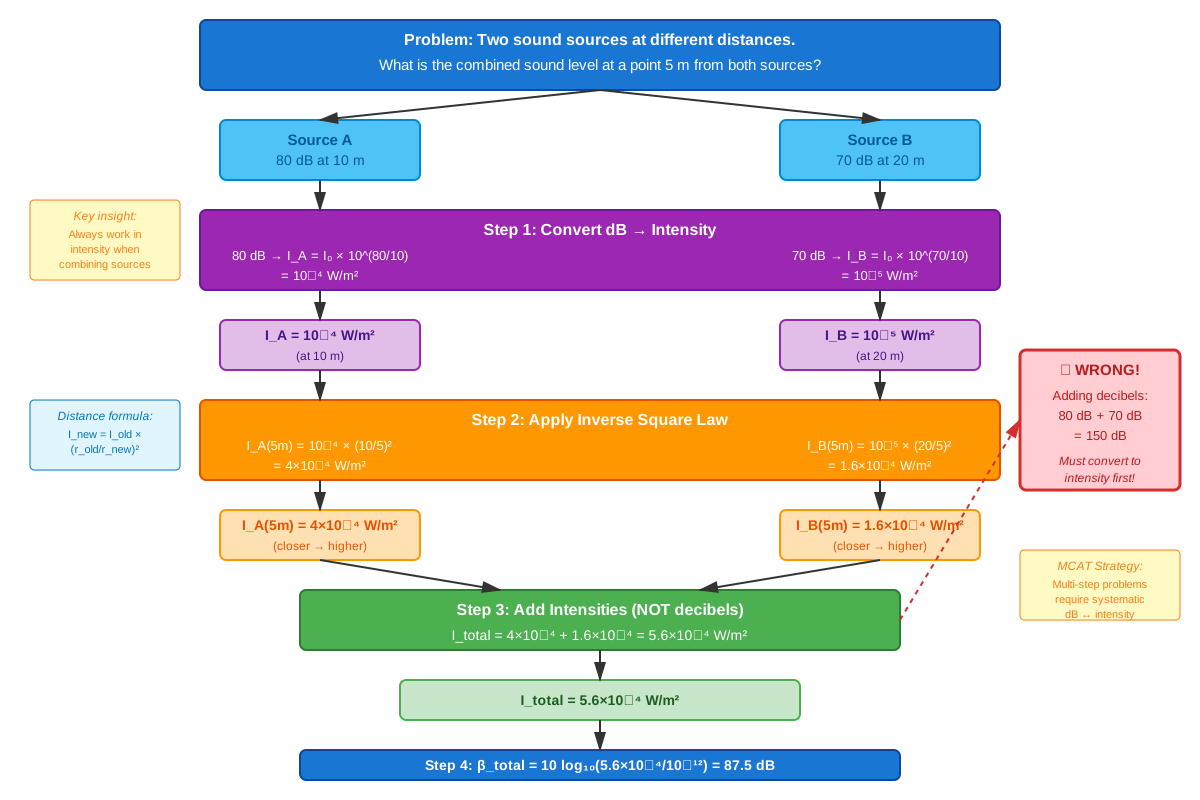
Overview
Decibels represent a logarithmic unit of measurement used to quantify sound intensity, a fundamental concept in the Physics section of the MCAT. Understanding decibels is essential because the human ear perceives sound intensity on a logarithmic rather than linear scale, making this unit both physiologically relevant and mathematically practical. The decibel scale compresses an enormous range of sound intensities—from the threshold of hearing to the threshold of pain—into a manageable numerical range, typically from 0 to 140 dB.
For the MCAT, decibels bridge multiple high-yield concepts within Waves and Sound, including intensity, power, energy transmission, and the inverse square law. Questions involving Decibels Physics often appear in passage-based formats where students must interpret experimental data, compare sound levels, or calculate intensity changes. The MCAT frequently tests whether students understand that a 10 dB increase represents a 10-fold increase in intensity, not a simple additive change—a distinction that separates high-scoring students from those who struggle with logarithmic reasoning.
Beyond pure physics applications, Decibels MCAT questions connect to biological and medical contexts, such as hearing damage, audiometry, ultrasound imaging, and the physiology of the auditory system. This interdisciplinary nature makes decibels a medium-yield but strategically important topic that can appear in both Physical Sciences passages and in integrated reasoning questions that span physics and biology. Mastering this topic requires comfort with logarithms, proportional reasoning, and the ability to quickly convert between intensity ratios and decibel differences.
Learning Objectives
- [ ] Define Decibels using accurate Physics terminology
- [ ] Explain why Decibels matters for the MCAT
- [ ] Apply Decibels to exam-style questions
- [ ] Identify common mistakes related to Decibels
- [ ] Connect Decibels to related Physics concepts
- [ ] Calculate sound intensity level changes using the decibel formula
- [ ] Convert between intensity ratios and decibel differences without a calculator
- [ ] Analyze real-world scenarios involving multiple sound sources and their combined intensity levels
Prerequisites
- Logarithmic functions: Understanding log₁₀ and the relationship between logarithms and exponents is essential for manipulating the decibel formula
- Wave properties: Knowledge of frequency, wavelength, amplitude, and wave speed provides context for how sound energy propagates
- Intensity and power: Familiarity with intensity as power per unit area (I = P/A) forms the foundation for understanding what decibels measure
- Inverse square law: Recognition that intensity decreases with the square of distance from a point source connects to practical decibel calculations
- Scientific notation: Comfort with powers of 10 enables quick mental calculations with the logarithmic decibel scale
Why This Topic Matters
Clinical and Real-World Significance: Decibels are the standard unit for measuring sound in clinical audiology, occupational health, and environmental noise assessment. Audiologists use decibel measurements to diagnose hearing loss, with specific thresholds indicating mild (25-40 dB), moderate (41-55 dB), or severe (71-90 dB) impairment. Prolonged exposure to sounds above 85 dB can cause permanent hearing damage, making decibel understanding crucial for workplace safety regulations. Medical imaging technologies like ultrasound operate at specific intensity levels measured in decibels, and understanding these measurements helps clinicians optimize image quality while minimizing tissue heating.
Exam Statistics: Decibels appear in approximately 2-4% of MCAT physics questions, typically within passages about sound waves, hearing physiology, or experimental acoustics. Questions most commonly test the relationship between intensity ratios and decibel differences, the ability to calculate sound level changes when distance or power changes, and interpretation of logarithmic scales. The MCAT rarely requires complex logarithmic calculations; instead, it tests conceptual understanding and the ability to use benchmark values (10 dB = 10× intensity, 20 dB = 100× intensity, 30 dB = 1000× intensity).
Common Exam Contexts: Decibel questions frequently appear in passages describing hearing experiments, noise pollution studies, or acoustic measurement devices. Discrete questions might present scenarios involving sound sources at different distances or ask students to compare the loudness of different environments. Integrated passages may combine decibel calculations with concepts like resonance, standing waves, or the Doppler effect, requiring students to navigate between multiple physics principles within a single question set.
Core Concepts
The Decibel Scale Definition
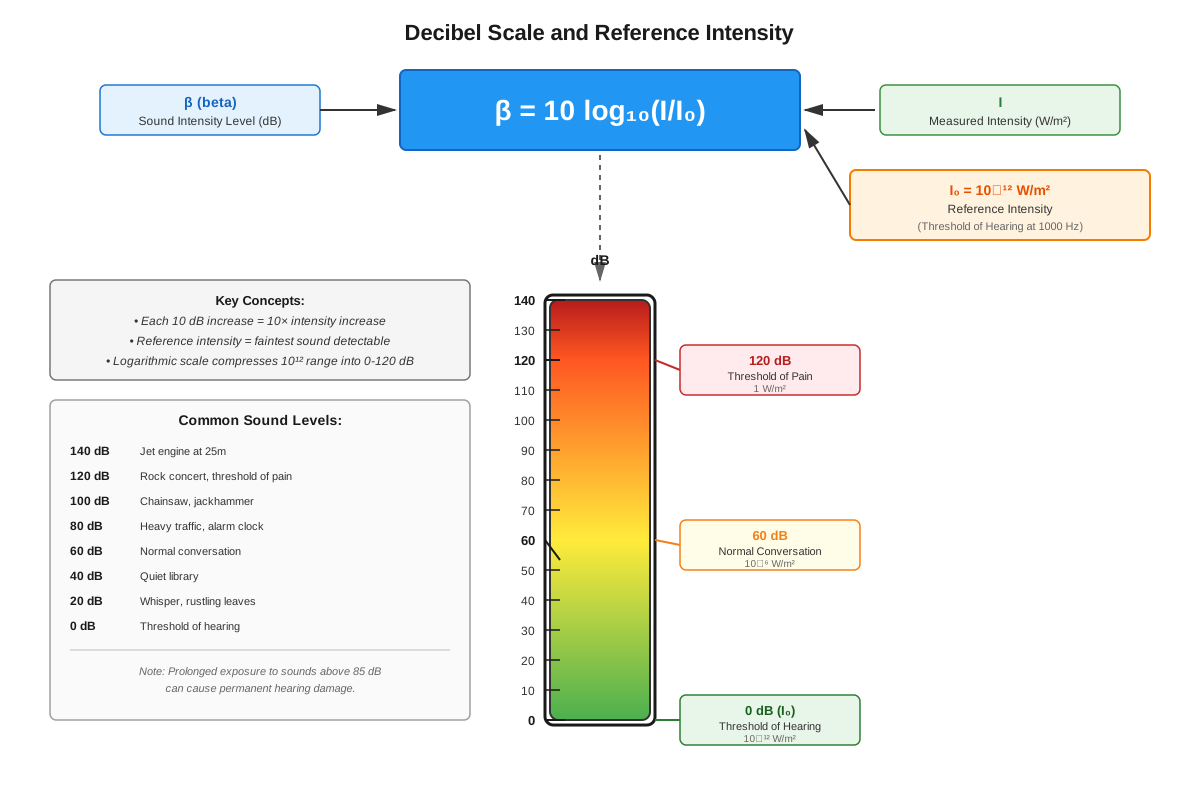
The decibel (dB) is a dimensionless unit that expresses the ratio between two quantities on a logarithmic scale. In acoustics, the sound intensity level (β) in decibels is defined by the formula:
β = 10 log₁₀(I/I₀)where:
- β = sound intensity level in decibels (dB)
- I = intensity of the sound being measured (W/m²)
- I₀ = reference intensity = 1.0 × 10⁻¹² W/m² (threshold of human hearing at 1000 Hz)
The reference intensity I₀ represents the quietest sound a typical human ear can detect, corresponding to 0 dB. This logarithmic definition means that each 10 dB increase represents a tenfold increase in actual physical intensity. The logarithmic scale compresses the vast range of human hearing—from 10⁻¹² W/m² to approximately 1 W/m² (threshold of pain)—into a 0 to 120 dB scale.
Intensity and the Logarithmic Nature
Intensity (I) represents the power transmitted per unit area perpendicular to the direction of wave propagation, measured in watts per square meter (W/m²). For sound waves, intensity relates to the square of the amplitude and is proportional to the energy carried by the wave. The logarithmic nature of decibels reflects how human perception of loudness works: doubling the perceived loudness requires approximately a 10 dB increase, which corresponds to a 10-fold increase in physical intensity.
This logarithmic relationship creates several important patterns:
| Decibel Change | Intensity Ratio | Perceived Loudness Change |
|---|---|---|
| +3 dB | 2× | Barely noticeable |
| +10 dB | 10× | Approximately 2× louder |
| +20 dB | 100× | Approximately 4× louder |
| +30 dB | 1,000× | Approximately 8× louder |
| -10 dB | 0.1× (1/10) | Approximately 1/2 as loud |
| -20 dB | 0.01× (1/100) | Approximately 1/4 as loud |
Calculating Decibel Changes
When comparing two sound intensities I₁ and I₂, the difference in sound level is:
Δβ = β₂ - β₁ = 10 log₁₀(I₂/I₀) - 10 log₁₀(I₁/I₀)Using logarithm properties (log A - log B = log(A/B)):
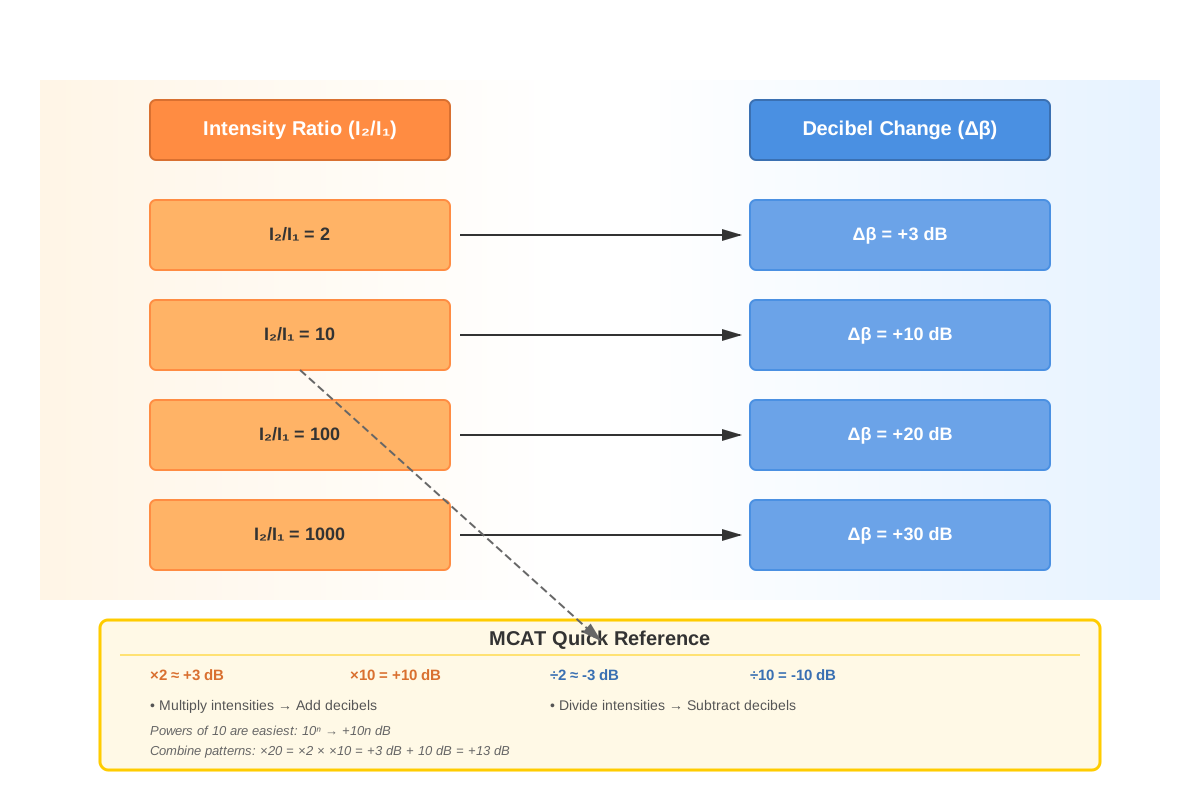
Δβ = 10 log₁₀(I₂/I₁)This simplified formula allows direct comparison of two intensities without needing to know the reference intensity. For MCAT purposes, memorizing key intensity ratios and their corresponding decibel changes enables rapid problem-solving:
- If intensity doubles (I₂ = 2I₁): Δβ = 10 log₁₀(2) ≈ 3 dB
- If intensity increases 10-fold (I₂ = 10I₁): Δβ = 10 log₁₀(10) = 10 dB
- If intensity increases 100-fold (I₂ = 100I₁): Δβ = 10 log₁₀(100) = 20 dB
- If intensity decreases to 1/10 (I₂ = 0.1I₁): Δβ = 10 log₁₀(0.1) = -10 dB
Distance and the Inverse Square Law
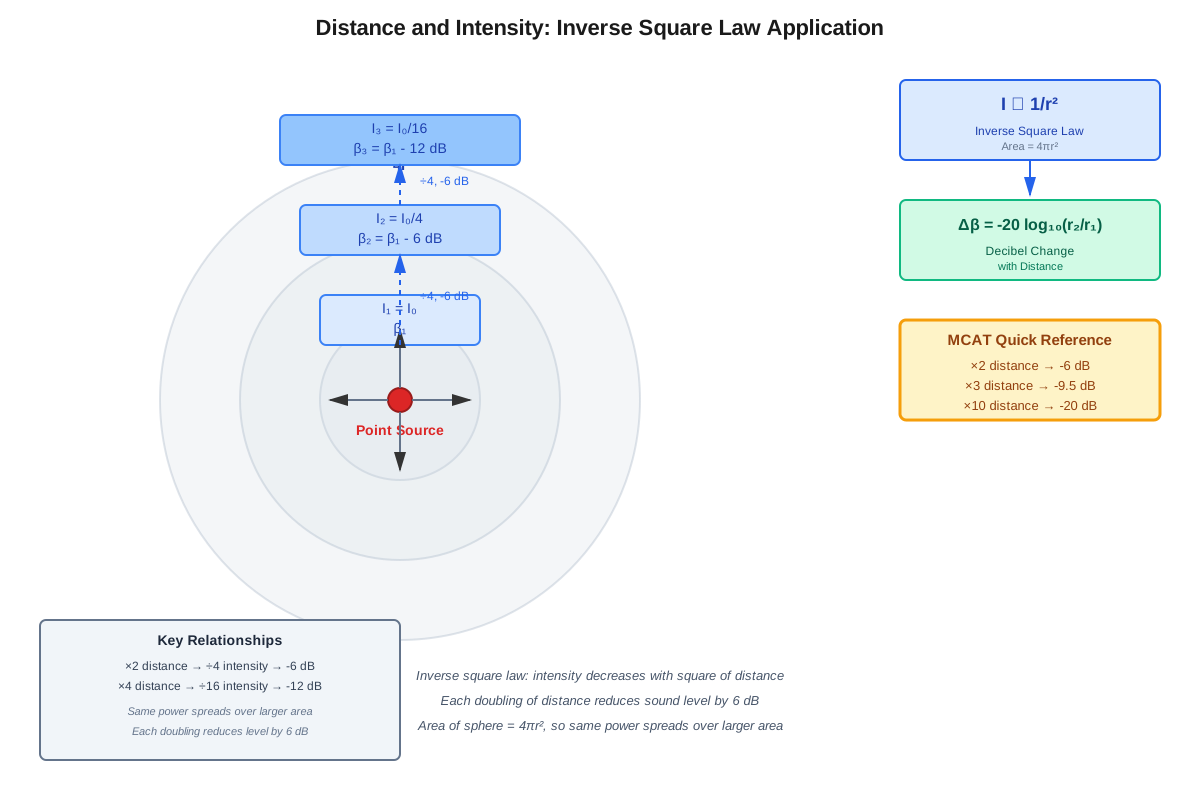
For a point source radiating sound uniformly in all directions, intensity follows the inverse square law:
I ∝ 1/r²where r is the distance from the source. This means that doubling the distance reduces intensity to one-quarter (1/4) of its original value. In decibel terms:
Δβ = 10 log₁₀(I₂/I₁) = 10 log₁₀[(r₁/r₂)²] = 20 log₁₀(r₁/r₂)Key distance-decibel relationships:
- Doubling distance (r₂ = 2r₁): Δβ = 20 log₁₀(1/2) ≈ -6 dB
- Tripling distance (r₂ = 3r₁): Δβ = 20 log₁₀(1/3) ≈ -9.5 dB (approximately -10 dB)
- Increasing distance 10-fold (r₂ = 10r₁): Δβ = 20 log₁₀(1/10) = -20 dB
MCAT Exam Tip: When distance doubles, sound level decreases by approximately 6 dB. When distance increases 10-fold, sound level decreases by 20 dB. These are high-yield relationships for quick elimination of wrong answers.
Combining Sound Sources
When multiple independent sound sources operate simultaneously, their intensities add linearly (not their decibel levels):
I_total = I₁ + I₂ + I₃ + ...For two identical sources producing the same intensity I:
- I_total = 2I
- Δβ = 10 log₁₀(2I/I) = 10 log₁₀(2) ≈ 3 dB
This means two identical sound sources together produce a sound level approximately 3 dB higher than one source alone. Ten identical sources would produce a 10 dB increase (since 10 log₁₀(10) = 10 dB).
Common Decibel Levels
Familiarity with typical sound levels helps with MCAT passage interpretation and answer estimation:
| Sound Source | Approximate Level (dB) |
|---|---|
| Threshold of hearing | 0 |
| Whisper | 20 |
| Normal conversation | 60 |
| Busy traffic | 80 |
| Lawnmower | 90 |
| Rock concert | 110 |
| Jet engine at 30m | 130 |
| Threshold of pain | 120-130 |
Concept Relationships
The decibel concept sits at the intersection of multiple physics principles. Intensity serves as the foundation, connecting wave energy to measurable quantities. Intensity relates to power through the relationship I = P/A, where power is the rate of energy transfer and area determines how that power spreads. The inverse square law governs how intensity changes with distance, which directly determines decibel level changes in three-dimensional space.
Logarithmic functions transform the multiplicative relationships of intensity into the additive relationships of decibels, making calculations more intuitive and matching human perception. This logarithmic transformation connects to exponential relationships in reverse—understanding that 10^(β/10) converts decibels back to intensity ratios.
Within Waves and Sound, decibels connect to frequency (pitch perception), amplitude (which determines intensity), and wave interference (which affects combined intensities from multiple sources). The concept extends to resonance and standing waves, where intensity patterns vary spatially, and to the Doppler effect, where frequency shifts can affect perceived intensity.
Relationship map:
Wave amplitude → Intensity (I ∝ A²) → Decibel level (β = 10 log(I/I₀)) → Perceived loudness
Distance from source → Inverse square law (I ∝ 1/r²) → Decibel decrease (Δβ = -20 log(r₂/r₁))
Multiple sources → Linear intensity addition (I_total = ΣI) → Logarithmic decibel addition
High-Yield Facts
⭐ The reference intensity I₀ = 1.0 × 10⁻¹² W/m² corresponds to 0 dB, the threshold of human hearing
⭐ A 10 dB increase represents a 10-fold increase in intensity; a 20 dB increase represents a 100-fold increase
⭐ Doubling the intensity increases the sound level by approximately 3 dB
⭐ Doubling the distance from a point source decreases the sound level by approximately 6 dB
⭐ Two identical sound sources together produce a sound level 3 dB higher than one source alone
- The decibel formula is β = 10 log₁₀(I/I₀), where the factor of 10 comes from the definition of the decibel as one-tenth of a bel
- The threshold of pain occurs around 120-130 dB, corresponding to an intensity of approximately 1 W/m²
- Prolonged exposure to sounds above 85 dB can cause permanent hearing damage
- The decibel scale is logarithmic, so decibel values cannot be added directly; intensities must be added first, then converted back to decibels
- A 10-fold increase in distance from a point source results in a 20 dB decrease in sound level
- Normal conversation occurs at approximately 60 dB, representing an intensity 10⁶ times greater than the threshold of hearing
- The logarithmic nature of decibels means that small decibel differences at high levels represent enormous differences in actual physical intensity
Quick check — test yourself on Decibels so far.
Try Flashcards →Common Misconceptions
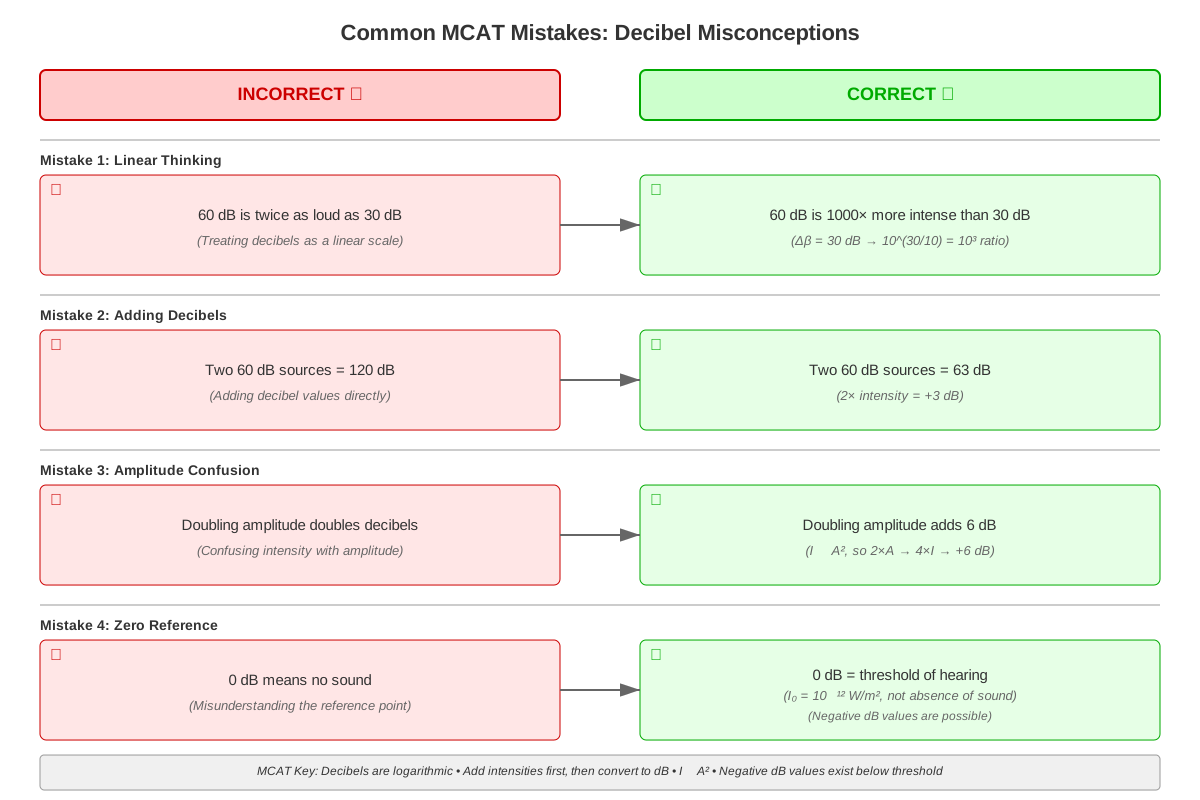
Misconception: Decibels are a direct measure of sound intensity.
Correction: Decibels are a logarithmic ratio comparing one intensity to a reference intensity. The same decibel value always represents the same ratio, not the same absolute intensity. A 60 dB sound has an intensity 10⁶ times the reference intensity, not 60 units of intensity.
Misconception: Adding two 60 dB sounds produces 120 dB.
Correction: Decibel values cannot be added directly because they represent logarithmic quantities. Two identical 60 dB sources produce approximately 63 dB (a 3 dB increase), not 120 dB. To combine sounds, add their intensities first, then convert back to decibels.
Misconception: A 10 dB increase means the sound is 10 times louder.
Correction: A 10 dB increase represents a 10-fold increase in physical intensity, but perceived loudness approximately doubles. The relationship between physical intensity and perceived loudness is not linear; humans perceive loudness on a roughly logarithmic scale that doesn't perfectly match the decibel scale.
Misconception: Doubling the distance from a sound source cuts the decibel level in half.
Correction: Doubling the distance decreases the sound level by approximately 6 dB, not by half. The inverse square law means intensity becomes one-quarter at twice the distance, and 10 log₁₀(1/4) ≈ -6 dB. Halving the decibel level would require reducing intensity to 1/√10 ≈ 0.316 of its original value.
Misconception: The decibel formula requires knowing the reference intensity I₀ for all calculations.
Correction: When comparing two sound levels, the reference intensity cancels out, and the formula simplifies to Δβ = 10 log₁₀(I₂/I₁). Only when calculating the absolute decibel level of a single sound do you need the reference intensity.
Misconception: A negative decibel value is impossible or meaningless.
Correction: Negative decibel values are valid and represent intensities below the reference level. While rare in everyday contexts (since I₀ is defined as the threshold of hearing), negative dB values can occur in specialized acoustic measurements or when expressing changes (e.g., "the sound level decreased by -10 dB" means it decreased by 10 dB).
Worked Examples
Example 1: Calculating Decibel Change from Intensity Change
Problem: A speaker produces a sound with intensity I₁ = 2.0 × 10⁻⁶ W/m². The power is increased so that the new intensity is I₂ = 5.0 × 10⁻⁵ W/m². What is the change in sound level in decibels?
Solution:
Step 1: Identify the relevant formula. Since we're comparing two intensities, use:
Δβ = 10 log₁₀(I₂/I₁)Step 2: Calculate the intensity ratio:
I₂/I₁ = (5.0 × 10⁻⁵)/(2.0 × 10⁻⁶) = 25Step 3: Apply the formula:
Δβ = 10 log₁₀(25)Step 4: Evaluate the logarithm. Recognize that 25 = 10² × 2.5, so:
log₁₀(25) = log₁₀(100/4) = log₁₀(100) - log₁₀(4) ≈ 2 - 0.6 = 1.4Or more simply, recognize that log₁₀(25) ≈ 1.4 (this is worth memorizing for the MCAT).
Step 5: Complete the calculation:
Δβ = 10 × 1.4 = 14 dBAnswer: The sound level increases by approximately 14 dB.
Connection to Learning Objectives: This problem demonstrates applying the decibel formula to exam-style questions and reinforces that a 25-fold intensity increase corresponds to a 14 dB increase, not a simple additive relationship.
Example 2: Distance and Decibel Level
Problem: A person stands 5.0 m from a loudspeaker and measures a sound level of 80 dB. If the person moves to a position 20 m from the speaker, what will be the new sound level? Assume the speaker acts as a point source.
Solution:
Step 1: Recognize that this involves the inverse square law for a point source. The relevant formula is:
Δβ = 20 log₁₀(r₁/r₂)where r₁ = initial distance = 5.0 m and r₂ = final distance = 20 m.
Step 2: Calculate the distance ratio:
r₁/r₂ = 5.0/20 = 1/4 = 0.25Step 3: Apply the formula:
Δβ = 20 log₁₀(0.25) = 20 log₁₀(1/4)Step 4: Evaluate the logarithm:
log₁₀(1/4) = log₁₀(1) - log₁₀(4) = 0 - log₁₀(4) ≈ -0.6Step 5: Complete the calculation:
Δβ = 20 × (-0.6) = -12 dBStep 6: Find the new sound level:
β₂ = β₁ + Δβ = 80 + (-12) = 68 dBAnswer: The new sound level is 68 dB.
Alternative approach: Recognize that the distance increased by a factor of 4. Since doubling distance decreases sound level by 6 dB, quadrupling distance (doubling twice) decreases it by 12 dB. This mental shortcut avoids logarithm calculations entirely.
Connection to Learning Objectives: This problem connects decibels to the inverse square law and demonstrates how to quickly solve distance-based problems using benchmark values, a critical MCAT strategy.
Exam Strategy
Approaching Decibel Questions: First, identify whether the question asks for an absolute decibel level (requiring the reference intensity) or a change in decibel level (which doesn't require I₀). Most MCAT questions involve changes, simplifying calculations. Second, determine whether the problem involves intensity ratios, distance changes, or multiple sources, as each has a specific approach.
Trigger Words and Phrases:
- "How much louder" or "change in sound level" → Calculate Δβ using intensity or distance ratios
- "Point source" or "spherical spreading" → Apply inverse square law with the 20 log formula
- "Two identical sources" → Remember the 3 dB rule for doubling intensity
- "Threshold of hearing" → Reference intensity I₀ = 10⁻¹² W/m² or 0 dB
- "Twice as far" or "double the distance" → Decrease of approximately 6 dB
Process of Elimination Tips:
- Eliminate answers that add decibel values directly when combining sources
- Eliminate answers suggesting linear relationships (e.g., doubling intensity doubles decibels)
- For distance problems, eliminate answers that don't follow the inverse square law pattern
- If an answer suggests a change greater than 30 dB from a modest intensity change (less than 1000×), it's likely wrong
- Watch for answers that confuse the 10 log formula (for intensity) with the 20 log formula (for distance)
Time Allocation: Decibel calculations should take 30-60 seconds for straightforward problems. If a calculation requires complex logarithms beyond log₁₀(2) ≈ 0.3, log₁₀(10) = 1, or log₁₀(100) = 2, look for a conceptual shortcut or estimation strategy. The MCAT rarely requires precise logarithm evaluation; instead, it tests whether you understand the relationships.
Quick Reference for MCAT: Memorize these relationships: 2× intensity = +3 dB; 10× intensity = +10 dB; 2× distance = -6 dB; 10× distance = -20 dB. These four facts solve most MCAT decibel problems.
Memory Techniques
"Ten-Ten Rule" Mnemonic: "TEN times intensity equals TEN more decibels" helps remember that a 10-fold intensity increase corresponds to a 10 dB increase. Extend this to "HUNDRED times intensity equals TWENTY more decibels" (100 = 10²).
"Double Distance, Drop Six" Mnemonic: For distance problems, remember "Double Distance, Drop Six" (dB). This captures the -6 dB change when distance doubles. For tripling distance, think "Triple Distance, Drop Ten" (approximately -10 dB).
"Three for Two" Mnemonic: "Three dB for Two times intensity" helps remember that doubling intensity increases sound level by 3 dB. Similarly, "Three dB for Two sources" reminds you that two identical sources produce a 3 dB increase.
Visualization Strategy: Picture the decibel scale as a ladder where each rung represents 10 dB. Climbing one rung means intensity multiplies by 10; climbing two rungs means intensity multiplies by 100. Descending one rung means intensity divides by 10. This visual helps prevent the mistake of treating decibels as linear.
Logarithm Anchor Points: Memorize these logarithm values as anchors:
- log₁₀(2) ≈ 0.3
- log₁₀(3) ≈ 0.5
- log₁₀(4) ≈ 0.6
- log₁₀(5) ≈ 0.7
- log₁₀(10) = 1
Use these to estimate other values: log₁₀(8) = log₁₀(2³) = 3 × 0.3 = 0.9.
Summary
Decibels provide a logarithmic scale for measuring sound intensity that compresses the enormous range of human hearing into a manageable numerical scale. The fundamental formula β = 10 log₁₀(I/I₀) defines sound intensity level relative to the threshold of hearing (I₀ = 10⁻¹² W/m²). The logarithmic nature means that each 10 dB increase represents a 10-fold increase in physical intensity, while doubling intensity produces only a 3 dB increase. For MCAT success, students must master the relationship between intensity ratios and decibel changes, understand how distance affects sound level through the inverse square law (doubling distance decreases level by 6 dB), and recognize that decibel values cannot be added directly when combining sources. The key to efficient problem-solving lies in memorizing benchmark relationships—particularly the 3 dB rule for doubling intensity, the 10 dB rule for 10-fold intensity changes, and the 6 dB rule for doubling distance—and applying these patterns rather than performing complex logarithmic calculations. Understanding decibels connects wave physics to real-world applications in audiology, occupational health, and medical imaging, making this topic both practically relevant and strategically important for the MCAT.
Key Takeaways
- The decibel scale is logarithmic: β = 10 log₁₀(I/I₀), where I₀ = 10⁻¹² W/m² represents the threshold of hearing at 0 dB
- A 10 dB increase corresponds to a 10-fold increase in intensity; a 3 dB increase corresponds to doubling intensity
- For point sources, doubling distance decreases sound level by approximately 6 dB due to the inverse square law
- Decibel values cannot be added directly; intensities must be added first, then converted back to decibels
- Two identical sound sources together produce a sound level 3 dB higher than one source alone
- Memorizing key benchmark relationships (3 dB for 2×, 10 dB for 10×, -6 dB for 2× distance) enables rapid MCAT problem-solving
- The logarithmic scale matches human perception better than linear intensity measurements, making decibels physiologically relevant
Related Topics
Intensity and Power: Understanding the relationship I = P/A and how power distributes over spherical surfaces provides the foundation for why intensity follows the inverse square law, which directly determines decibel level changes with distance.
Wave Properties and Energy: The connection between wave amplitude and intensity (I ∝ A²) explains why doubling amplitude increases intensity by a factor of four, corresponding to a 6 dB increase—a relationship that appears in MCAT questions about wave manipulation.
Doppler Effect: When sources or observers move, frequency shifts occur, but intensity also changes due to relative motion. Combining Doppler calculations with decibel changes creates complex MCAT passage scenarios.
Hearing Physiology: The anatomy of the ear, including the cochlea and auditory nerve, connects to decibel measurements in audiometry. Understanding frequency-dependent hearing sensitivity curves (equal loudness contours) extends decibel concepts into biology.
Standing Waves and Resonance: In enclosed spaces, standing waves create nodes and antinodes with varying intensity patterns. Calculating decibel differences between these locations combines wave interference with intensity measurements.
Practice CTA
Now that you've mastered the core concepts of decibels, it's time to solidify your understanding through active practice. Work through the practice questions to test your ability to apply the decibel formula, calculate intensity changes, and solve distance-based problems under timed conditions. Use the flashcards to reinforce the high-yield relationships and benchmark values that enable rapid problem-solving on test day. Remember, the difference between understanding decibels conceptually and scoring points on the MCAT lies in your ability to quickly recognize patterns and apply shortcuts—skills that only develop through deliberate practice. You've built a strong foundation; now transform that knowledge into test-day confidence through consistent application!
Sign up free to keep reading
Create a free AnvayaPrep account to finish this MCAT guide on Decibels — plus flashcards and practice questions.