Overview
Transverse waves represent one of the two fundamental categories of wave motion in Physics, distinguished by the perpendicular relationship between particle oscillation and wave propagation direction. In a transverse wave, particles of the medium move at right angles to the direction in which the wave travels, creating characteristic crests and troughs that define the wave's profile. This wave behavior appears throughout nature and technology—from electromagnetic radiation (including visible light) to waves on strings and water surface waves—making it an essential concept for understanding diverse physical phenomena tested on the MCAT.
Understanding transverse waves is critical for the Waves and Sound unit because it establishes foundational principles that apply across multiple MCAT topics, including optics, electromagnetic radiation, and mechanical wave behavior. The MCAT frequently tests students' ability to distinguish between transverse and longitudinal waves, analyze wave properties such as amplitude and wavelength, and apply wave principles to biological and medical contexts. For instance, understanding how light behaves as a transverse electromagnetic wave is essential for comprehending vision, medical imaging techniques, and spectroscopy applications in biochemistry.
The study of transverse waves connects directly to broader Physics concepts including energy transfer, periodic motion, and wave interference. These connections extend into other MCAT subjects: transverse wave principles underlie the electromagnetic spectrum (relevant to General Chemistry and Biochemistry), polarization phenomena (important for understanding molecular interactions), and the behavior of light in biological tissues (critical for understanding medical diagnostic tools). Mastering transverse waves provides the conceptual framework necessary for tackling complex, interdisciplinary MCAT passages that integrate physics principles with biological applications.
Learning Objectives
- [ ] Define transverse waves using accurate Physics terminology
- [ ] Explain why transverse waves matters for the MCAT
- [ ] Apply transverse waves to exam-style questions
- [ ] Identify common mistakes related to transverse waves
- [ ] Connect transverse waves to related Physics concepts
- [ ] Distinguish between transverse and longitudinal waves based on particle motion and wave propagation
- [ ] Calculate wave properties (wavelength, frequency, amplitude, wave speed) for transverse waves
- [ ] Analyze polarization phenomena as unique characteristics of transverse waves
- [ ] Predict the behavior of transverse waves at boundaries and interfaces
Prerequisites
- Basic wave terminology: Understanding terms like wavelength, frequency, amplitude, and period is essential for describing transverse wave properties quantitatively
- Vectors and coordinate systems: Necessary for visualizing perpendicular relationships between particle displacement and wave propagation direction
- Energy and work concepts: Required to understand how transverse waves transfer energy through a medium without net particle displacement
- Trigonometric functions: Sine and cosine functions describe the mathematical representation of transverse wave motion
- Newton's laws of motion: Provide the foundation for understanding the forces that restore particles to equilibrium in wave media
Why This Topic Matters
Clinical and Real-World Significance
Transverse waves are fundamental to numerous medical technologies and biological processes. Electromagnetic waves—all of which are transverse—include X-rays used in radiography, ultraviolet light that causes DNA damage, visible light essential for vision, and infrared radiation used in thermal imaging. Understanding transverse wave behavior helps explain how polarized light is used in microscopy to examine tissue samples, how fiber optic endoscopes transmit images through the body, and how laser surgery precisely delivers energy to target tissues. The polarization property unique to transverse waves enables technologies like polarized sunglasses and LCD displays, and it's crucial for understanding molecular spectroscopy techniques used in biochemical analysis.
MCAT Exam Statistics
Transverse waves appear in approximately 2-4 questions per MCAT administration, typically within the Chemical and Physical Foundations of Biological Systems section. Questions may appear as discrete items testing fundamental wave properties or embedded within passages describing optical instruments, electromagnetic radiation effects on biological molecules, or wave interference phenomena. The MCAT particularly favors questions that require students to integrate wave concepts with other physics principles or apply wave behavior to biological contexts.
Common Exam Presentations
The MCAT presents transverse waves through several recurring formats: passages describing experimental setups involving light or string waves, questions comparing transverse and longitudinal wave properties, problems requiring calculation of wave parameters from graphical representations, and scenarios involving polarization or electromagnetic spectrum applications. Passages often embed transverse wave concepts within discussions of spectroscopy, vision physiology, or medical imaging technologies, requiring students to extract relevant wave principles and apply them to novel situations.
Core Concepts
Definition and Fundamental Characteristics
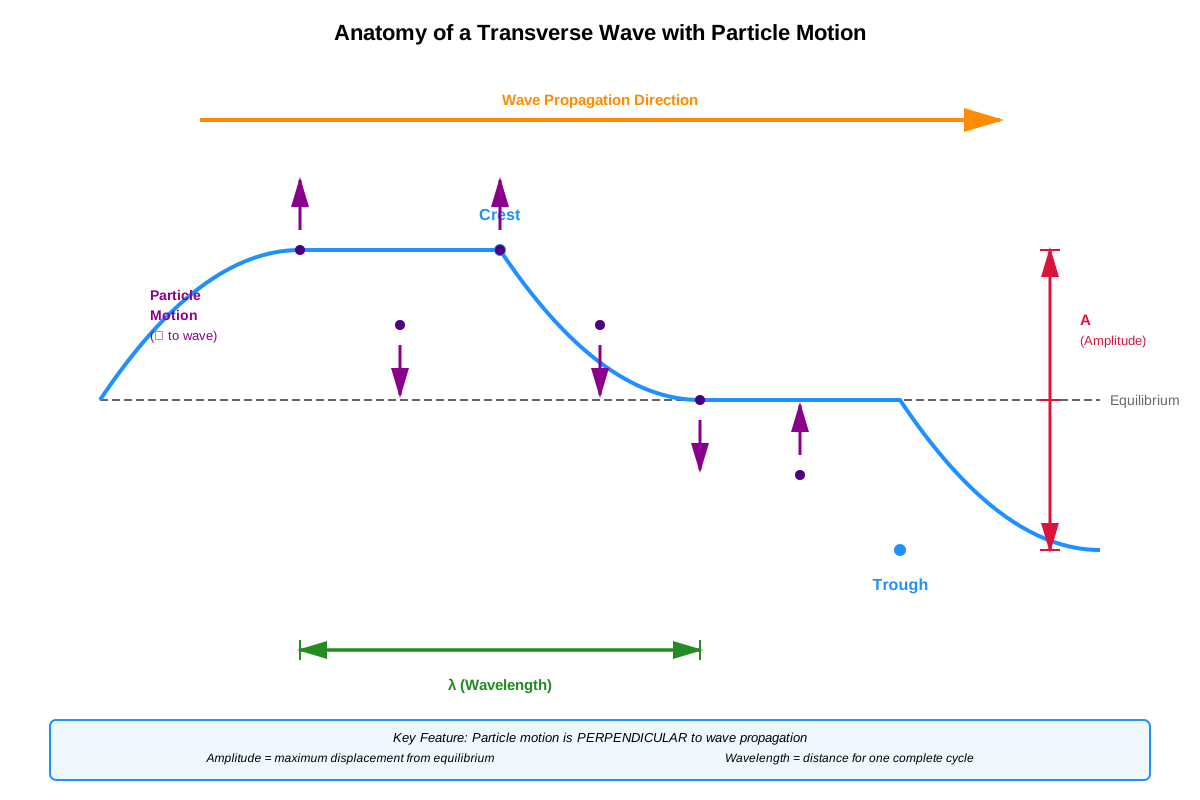
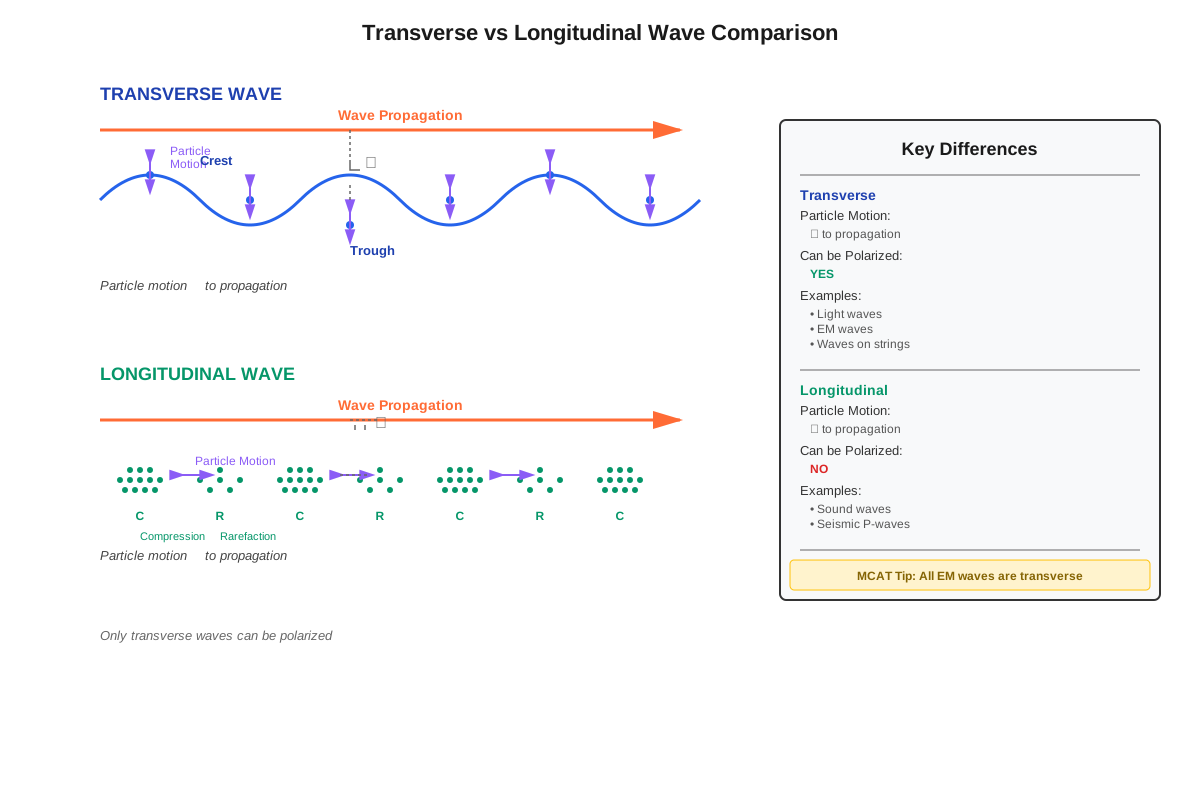
A transverse wave is a wave in which the displacement of the medium's particles occurs perpendicular (at 90 degrees) to the direction of wave propagation. When a transverse wave travels through a medium, individual particles oscillate up and down (or side to side) while the wave pattern moves forward. This creates the characteristic wave shape with alternating crests (maximum positive displacement) and troughs (maximum negative displacement). The key distinguishing feature is this perpendicular relationship: if a wave travels horizontally along the x-axis, particles move vertically along the y-axis.
Transverse waves require a medium that can support shear stress—the ability to resist forces applied parallel to a surface. This explains why transverse mechanical waves propagate through solids and along surfaces (like water waves) but cannot travel through the bulk of fluids (liquids and gases) under normal conditions. However, electromagnetic waves represent a special category of transverse waves that require no material medium, propagating through vacuum via oscillating electric and magnetic fields perpendicular to each other and to the direction of propagation.
Mathematical Description
The displacement of a particle in a transverse wave can be described mathematically using a sinusoidal function:
y(x,t) = A sin(kx - ωt + φ)Where:
- y = transverse displacement of the particle from equilibrium
- A = amplitude (maximum displacement from equilibrium)
- k = wave number = 2π/λ (where λ is wavelength)
- ω = angular frequency = 2πf (where f is frequency)
- x = position along the direction of propagation
- t = time
- φ = phase constant (initial phase)
The wave speed (v) relates to wavelength and frequency through the fundamental wave equation:
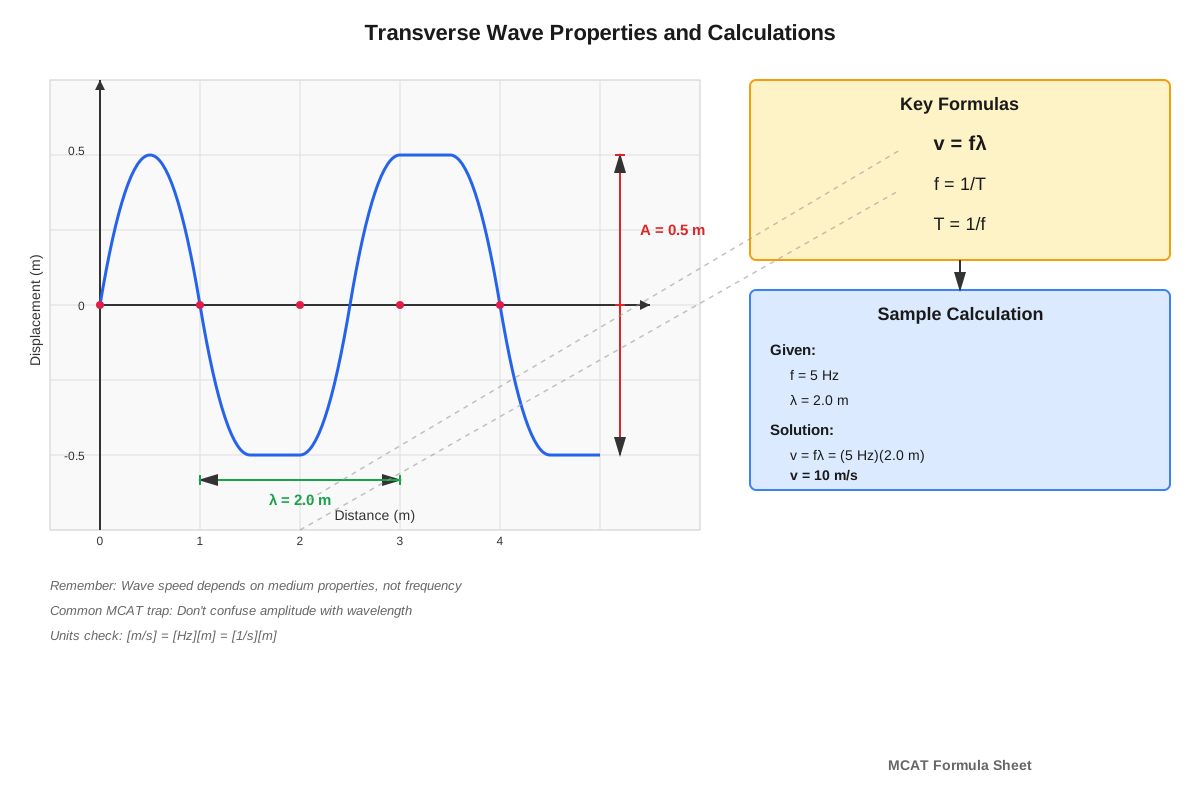
v = fλThis relationship is crucial for MCAT problem-solving, as questions often provide two of these variables and require calculation of the third.
Key Wave Parameters
| Parameter | Symbol | Definition | Units | MCAT Relevance |
|---|---|---|---|---|
| Amplitude | A | Maximum displacement from equilibrium | meters (m) | Related to wave energy and intensity |
| Wavelength | λ | Distance between consecutive crests or troughs | meters (m) | Determines wave properties in electromagnetic spectrum |
| Frequency | f | Number of complete oscillations per unit time | hertz (Hz) | Inversely related to period; determines photon energy |
| Period | T | Time for one complete oscillation | seconds (s) | T = 1/f; relevant for periodic phenomena |
| Wave speed | v | Speed of wave propagation through medium | m/s | Depends on medium properties; c for EM waves in vacuum |
| Wave number | k | Spatial frequency (oscillations per unit distance) | rad/m or m⁻¹ | Used in wave equations and quantum mechanics |
Polarization: A Unique Property
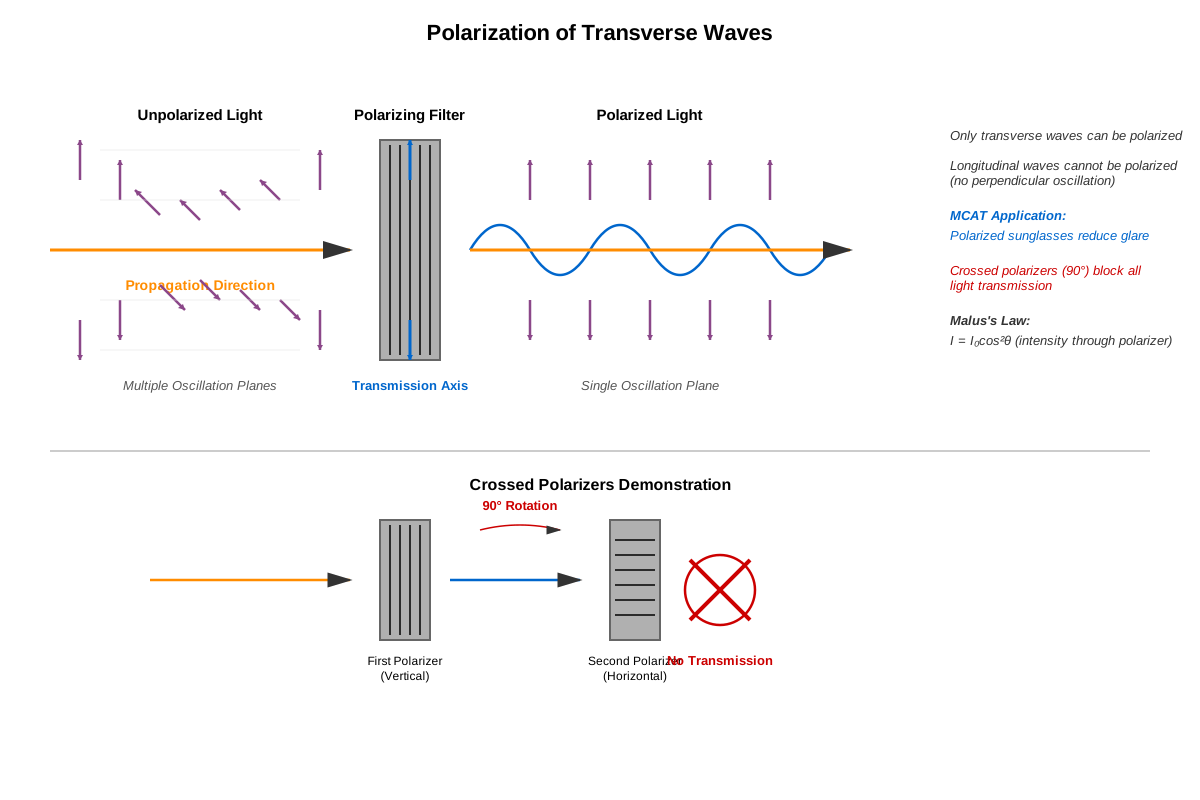
Polarization is a phenomenon exclusive to transverse waves and represents one of the most important distinguishing features tested on the MCAT. In an unpolarized transverse wave, particles oscillate in all possible directions perpendicular to the propagation direction. A polarized wave has particle oscillations confined to a single plane. For electromagnetic waves, polarization refers to the orientation of the electric field vector.
Light can be polarized through several mechanisms:
- Selective absorption: Polarizing filters absorb waves oscillating in all but one direction
- Reflection: Light reflected at specific angles (Brewster's angle) becomes partially or completely polarized
- Scattering: Scattered light often exhibits polarization
- Birefringence: Double refraction in certain crystals separates light into two polarized components
The MCAT may test polarization through questions about polarized sunglasses reducing glare, microscopy techniques using polarized light to examine tissue structure, or the inability of sound waves (longitudinal) to be polarized.
Energy and Intensity
Transverse waves transport energy through a medium without causing net displacement of the medium itself. The intensity (I) of a wave—the power per unit area—is proportional to the square of the amplitude:
I ∝ A²For waves spreading from a point source in three dimensions, intensity follows an inverse square law:
I = P/(4πr²)Where P is the power of the source and r is the distance from the source. This relationship is crucial for understanding how electromagnetic radiation intensity decreases with distance, relevant to radiation safety and astronomical observations.
Transverse Waves on Strings
A common MCAT context involves transverse waves traveling along stretched strings or cables. The wave speed on a string depends on the tension (T) in the string and its linear mass density (μ, mass per unit length):
v = √(T/μ)This equation reveals that:
- Increasing tension increases wave speed (tighter strings transmit waves faster)
- Increasing mass density decreases wave speed (heavier strings transmit waves slower)
String wave problems often appear in MCAT passages about musical instruments, where standing waves and harmonics combine with transverse wave principles.
Electromagnetic Waves as Transverse Waves
All electromagnetic waves are transverse, consisting of oscillating electric and magnetic fields perpendicular to each other and to the direction of propagation. In vacuum, all electromagnetic waves travel at the speed of light (c = 3.0 × 10⁸ m/s). The electromagnetic spectrum spans from low-frequency radio waves to high-frequency gamma rays, with energy per photon given by:
E = hf = hc/λWhere h is Planck's constant (6.626 × 10⁻³⁴ J·s). This relationship connects wave properties to quantum mechanical concepts, frequently tested in integrated MCAT passages.
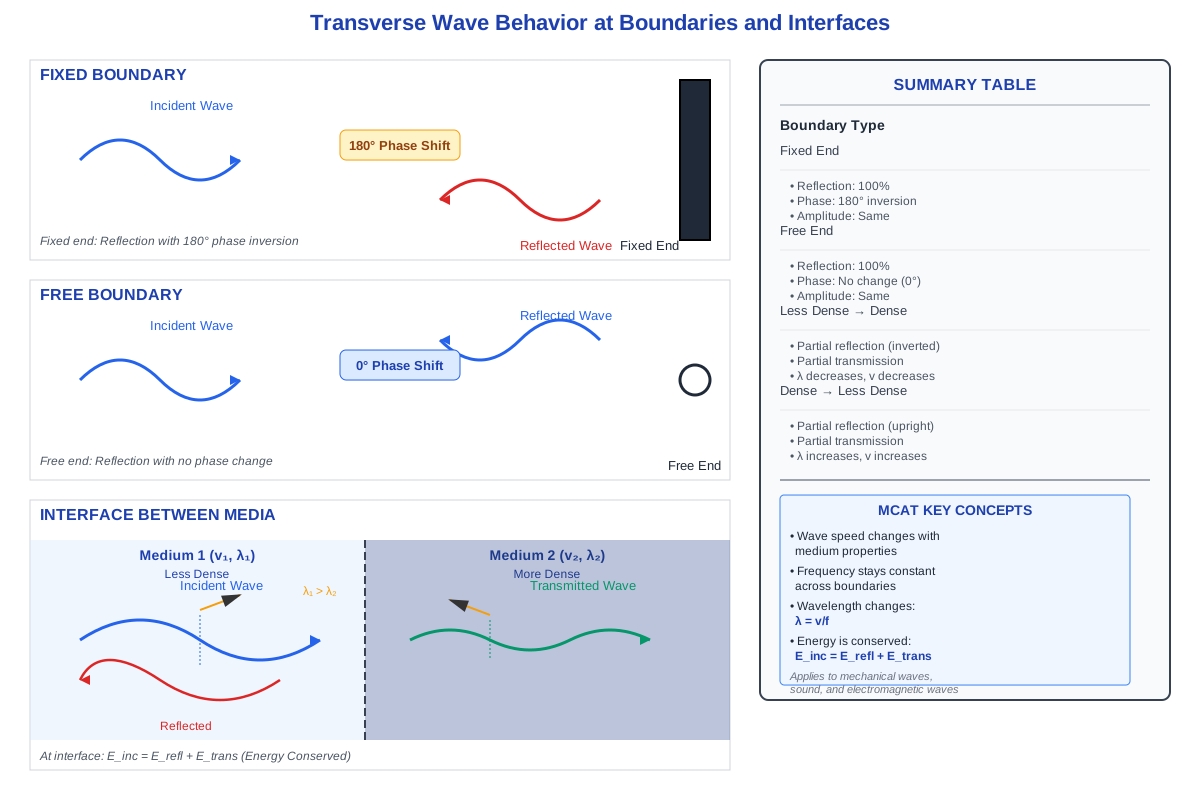
Reflection and Transmission at Boundaries
When a transverse wave encounters a boundary between two media, partial reflection and partial transmission occur. The behavior depends on the relative properties of the media:
- Fixed boundary: A wave pulse reflects inverted (180° phase change)
- Free boundary: A wave pulse reflects upright (no phase change)
- Interface between media: Reflection and transmission occur simultaneously, with proportions depending on the impedance mismatch
The principle of superposition governs what happens when the incident and reflected waves overlap, leading to interference patterns. This principle is fundamental to understanding standing waves, which form when transverse waves reflect back and forth between boundaries.
Concept Relationships
The core concepts of transverse waves interconnect through several key relationships. The mathematical description using sinusoidal functions → provides the foundation for → calculating all wave parameters (amplitude, wavelength, frequency, speed). These parameters → determine → the energy and intensity of the wave, which → affects → how the wave interacts with matter and biological tissues.
Polarization → emerges from → the transverse nature of wave oscillations and → distinguishes → transverse waves from longitudinal waves. This property → enables → specific applications in medical imaging and molecular analysis. The behavior of transverse waves at boundaries → depends on → medium properties (tension, density) which → determine → wave speed through the relationship v = √(T/μ) for mechanical waves.
Electromagnetic waves → represent → a special case of transverse waves that → require no medium and → travel at constant speed c in vacuum. The electromagnetic spectrum → organizes → these waves by frequency/wavelength, which → determines → photon energy through E = hf. This connection → links → classical wave physics to quantum mechanics, a relationship frequently exploited in MCAT passages.
The principle of superposition → governs → wave interference, which → produces → standing waves when transverse waves reflect at boundaries. Standing waves → create → nodes and antinodes, patterns that → appear in → musical instruments, resonance phenomena, and quantum mechanical systems. All these concepts → ultimately trace back to → the fundamental definition of transverse waves as oscillations perpendicular to propagation direction.
Quick check — test yourself on Transverse waves so far.
Try Flashcards →High-Yield Facts
⭐ Transverse waves have particle displacement perpendicular to the direction of wave propagation, creating crests and troughs
⭐ Only transverse waves can be polarized; longitudinal waves cannot exhibit polarization
⭐ All electromagnetic waves are transverse and travel at speed c = 3.0 × 10⁸ m/s in vacuum
⭐ Wave speed relates to frequency and wavelength through v = fλ, a fundamental equation for all wave types
⭐ Wave intensity is proportional to the square of amplitude: I ∝ A²
- Transverse mechanical waves require a medium capable of supporting shear stress (solids, surfaces)
- For waves on strings, speed increases with tension and decreases with linear mass density: v = √(T/μ)
- Electromagnetic wave energy per photon is E = hf = hc/λ, connecting wave and particle properties
- Reflection at a fixed boundary produces a 180° phase change (inverted reflection)
- The principle of superposition allows waves to pass through each other, producing interference patterns
- Polarization can occur through selective absorption, reflection, scattering, or birefringence
- Wave amplitude determines energy, but does not affect wave speed in a given medium
- Transverse waves on strings form standing wave patterns with nodes (zero displacement) and antinodes (maximum displacement)
Common Misconceptions
Misconception: Particles in a transverse wave move forward with the wave.
Correction: Individual particles oscillate perpendicular to wave propagation and return to their original positions; only the wave pattern and energy move forward through the medium.
Misconception: Amplitude and wavelength are the same thing.
Correction: Amplitude measures maximum displacement from equilibrium (vertical distance from equilibrium to crest), while wavelength measures the distance between consecutive crests (horizontal distance along propagation direction). They are independent properties.
Misconception: All waves require a medium to propagate.
Correction: While mechanical transverse waves (like waves on strings) require a medium, electromagnetic waves are transverse waves that propagate through vacuum without any material medium, traveling via oscillating electric and magnetic fields.
Misconception: Increasing wave frequency increases wave speed.
Correction: In a given medium, wave speed is determined by medium properties (tension and density for strings, or c for electromagnetic waves in vacuum). Changing frequency changes wavelength proportionally (v = fλ) but does not change speed in the same medium.
Misconception: Polarization means the wave oscillates in the direction of propagation.
Correction: Polarization means the transverse oscillations are confined to a single plane perpendicular to propagation. The oscillations remain perpendicular to propagation direction; polarization simply restricts which perpendicular direction is used.
Misconception: Doubling amplitude doubles wave intensity.
Correction: Since intensity is proportional to amplitude squared (I ∝ A²), doubling amplitude quadruples intensity. This relationship is crucial for understanding energy transport in waves.
Misconception: Sound waves can be polarized.
Correction: Sound waves are longitudinal waves with particle displacement parallel to propagation direction. Only transverse waves can be polarized because only they have oscillations in multiple perpendicular directions that can be selectively filtered.
Misconception: Wave speed on a string increases when you increase the string's mass.
Correction: Increasing mass (specifically linear mass density μ) decreases wave speed according to v = √(T/μ). Heavier strings transmit waves more slowly at constant tension.
Worked Examples
Example 1: Calculating Wave Parameters
Problem: A transverse wave travels along a stretched string with a frequency of 50 Hz and a wavelength of 0.40 m. The string has a linear mass density of 0.020 kg/m. Calculate: (a) the wave speed, (b) the tension in the string, and (c) the period of oscillation.
Solution:
(a) Using the fundamental wave equation v = fλ:
v = (50 Hz)(0.40 m) = 20 m/s(b) For waves on strings, v = √(T/μ), so solving for tension T:
v² = T/μ
T = μv² = (0.020 kg/m)(20 m/s)² = (0.020)(400) = 8.0 N
(c) Period is the inverse of frequency:
T = 1/f = 1/(50 Hz) = 0.020 s = 20 msKey Concepts Applied: This problem integrates the fundamental wave equation (v = fλ) with the string-specific equation (v = √(T/μ)), demonstrating how wave parameters interconnect. The MCAT frequently tests whether students can identify which equation applies to a given situation and manipulate algebraic relationships.
Example 2: Electromagnetic Wave Energy and Intensity
Problem: A laser emits green light with a wavelength of 520 nm. If the laser has a power output of 5.0 mW and the beam has a cross-sectional area of 2.0 mm², calculate: (a) the frequency of the light, (b) the energy per photon, and (c) the intensity of the beam.
Solution:
(a) For electromagnetic waves, c = fλ, so:
f = c/λ = (3.0 × 10⁸ m/s)/(520 × 10⁻⁹ m) = 5.77 × 10¹⁴ Hz(b) Energy per photon uses E = hf:
E = (6.626 × 10⁻³⁴ J·s)(5.77 × 10¹⁴ Hz) = 3.82 × 10⁻¹⁹ JConverting to electron volts (1 eV = 1.6 × 10⁻¹⁹ J):
E = (3.82 × 10⁻¹⁹ J)/(1.6 × 10⁻¹⁹ J/eV) = 2.39 eV(c) Intensity is power per unit area:
I = P/A = (5.0 × 10⁻³ W)/(2.0 × 10⁻⁶ m²) = 2.5 × 10³ W/m²Key Concepts Applied: This problem demonstrates the transverse electromagnetic wave nature of light, connecting classical wave properties (wavelength, frequency) to quantum mechanical properties (photon energy). The MCAT often presents scenarios requiring students to move between wave and particle descriptions of light, particularly in passages about spectroscopy or photochemistry.
Exam Strategy
Approaching MCAT Questions on Transverse Waves
When encountering transverse wave questions, first identify whether the question involves mechanical waves (strings, surfaces) or electromagnetic waves, as different equations apply. For mechanical waves, look for information about medium properties (tension, density); for electromagnetic waves, remember that speed is always c in vacuum. Create a quick inventory of given information and identify which fundamental equation (v = fλ, E = hf, v = √(T/μ), or I ∝ A²) connects the known and unknown quantities.
Trigger Words and Phrases
Watch for these key phrases that signal transverse wave concepts:
- "Perpendicular to propagation" or "oscillates at right angles": Definitional characteristic of transverse waves
- "Polarized light" or "polarizing filter": Indicates transverse wave property; eliminates longitudinal waves
- "Electromagnetic radiation" or "light wave": Always transverse; use c = 3.0 × 10⁸ m/s
- "Stretched string" or "tension in the rope": Use v = √(T/μ) for wave speed
- "Crest and trough" or "amplitude": Describes transverse wave profile
- "Intensity decreases with distance": Consider inverse square law for point sources
- "Phase change upon reflection": Fixed boundaries invert waves; free boundaries don't
Process of Elimination Tips
When comparing answer choices:
- Eliminate options that confuse transverse and longitudinal properties (e.g., claiming sound can be polarized)
- Rule out answers that violate v = fλ (if frequency doubles at constant speed, wavelength must halve)
- Reject choices that incorrectly relate amplitude to speed (amplitude doesn't affect wave speed in a given medium)
- Eliminate options showing linear relationships when squared relationships apply (intensity and amplitude)
- Discard answers that claim electromagnetic waves need a medium or travel at speeds other than c in vacuum
Time Allocation Advice
For discrete questions on transverse waves, allocate 60-90 seconds: 20 seconds to identify the wave type and relevant equation, 30-40 seconds for calculation, and 10-20 seconds to verify the answer makes physical sense. For passage-based questions, spend 30-40 seconds per question after initially reading the passage, but be prepared to reference the passage for specific values. If a calculation becomes complex, check whether the question asks for a qualitative relationship or order of magnitude rather than an exact value—the MCAT often rewards conceptual understanding over computational precision.
Memory Techniques
Mnemonic for Wave Equation Variables
"Very Fast Lamborghinis" → v = f × λ (velocity = frequency × wavelength)
Visualizing Transverse vs. Longitudinal
Picture a "T" for Transverse where the vertical line represents particle motion perpendicular to the horizontal line representing wave propagation. For longitudinal, imagine an "L" for Longitudinal" where both particle motion and wave propagation align along the same line.
Polarization Exclusivity
"Only T-waves can be P-olarized" (Only Transverse waves can be Polarized) - The T and P create a memorable pairing.
String Wave Speed Factors
"Tight strings are Fast, Fat strings are Slow" → Increasing Tension increases speed; increasing Mass (fat) decreases speed in v = √(T/μ)
Electromagnetic Spectrum Order
"Radio Waves Make Interesting Visible Light, Ultraviolet X-rays, Gamma" → Radio, Microwave, Infrared, Visible, Ultraviolet, X-ray, Gamma (increasing frequency/energy)
Phase Change on Reflection
"Fixed = Flipped" → Reflection from a fixed boundary produces an inverted (flipped) wave with 180° phase change
Intensity and Amplitude Relationship
"Amplitude Squared = Intensity" → Visualize A² to remember that doubling amplitude quadruples intensity
Summary
Transverse waves represent a fundamental wave type characterized by particle oscillations perpendicular to the direction of wave propagation, creating the distinctive crest-and-trough pattern essential to wave physics. These waves encompass both mechanical waves (requiring media that support shear stress, like strings and solid surfaces) and electromagnetic waves (requiring no medium, propagating through vacuum at speed c). The mathematical description y = A sin(kx - ωt) captures the sinusoidal nature of transverse waves, while the fundamental relationship v = fλ connects wave speed, frequency, and wavelength across all wave types. Polarization stands as the defining property that distinguishes transverse from longitudinal waves, enabling numerous applications in medical imaging, spectroscopy, and optical technologies. For the MCAT, mastery requires understanding how wave parameters interconnect, recognizing that intensity scales with amplitude squared, applying medium-specific equations like v = √(T/μ) for strings, and connecting electromagnetic wave properties to photon energy through E = hf. Success on exam questions demands rapid identification of wave type, selection of appropriate equations, and recognition of the unique transverse wave properties that appear throughout physics, chemistry, and biological contexts.
Key Takeaways
- Transverse waves have particle displacement perpendicular to propagation direction, enabling polarization—a property impossible for longitudinal waves
- The fundamental wave equation v = fλ applies universally, but wave speed depends on medium properties (√(T/μ) for strings, c for EM waves in vacuum)
- All electromagnetic radiation consists of transverse waves traveling at c = 3.0 × 10⁸ m/s in vacuum, with photon energy E = hf = hc/λ
- Wave intensity is proportional to amplitude squared (I ∝ A²), meaning doubling amplitude quadruples energy transport
- Transverse waves reflect with phase inversion at fixed boundaries but without phase change at free boundaries
- Polarization occurs through selective absorption, reflection, scattering, or birefringence, and serves as a diagnostic tool in medical and research applications
- Understanding transverse waves provides the foundation for optics, electromagnetic spectrum applications, and wave interference phenomena frequently tested on the MCAT
Related Topics
Longitudinal Waves: Understanding the complementary wave type where particle displacement parallels propagation direction (sound waves, pressure waves) helps solidify the distinction and recognize when each type applies in MCAT scenarios.
Wave Interference and Superposition: Building on transverse wave fundamentals, interference explains how waves combine to create constructive and destructive patterns, essential for understanding standing waves, diffraction, and beats.
Electromagnetic Spectrum: Detailed study of the frequency/wavelength ranges and properties of radio waves through gamma rays, with emphasis on biological effects and medical applications of different regions.
Optics and Light Behavior: Transverse wave principles extend to reflection, refraction, diffraction, and polarization of light, forming the basis for understanding lenses, mirrors, and optical instruments.
Standing Waves and Resonance: The formation of standing wave patterns from transverse waves reflecting between boundaries, crucial for understanding musical instruments, resonance phenomena, and quantum mechanical systems.
Doppler Effect: How relative motion between wave source and observer affects observed frequency, applicable to both sound (longitudinal) and light (transverse) waves, with medical applications in Doppler ultrasound.
Practice CTA
Now that you've mastered the core concepts of transverse waves, it's time to solidify your understanding through active practice. Attempt the practice questions and flashcards designed specifically for this topic—they'll challenge you to apply these principles in MCAT-style scenarios and help identify any remaining gaps in your knowledge. Remember, the MCAT rewards not just memorization but the ability to recognize how transverse wave concepts appear in novel contexts and integrate with other physics principles. Each practice question you work through builds the pattern recognition and problem-solving speed essential for test day success. You've built a strong foundation—now strengthen it through deliberate practice!
Sign up free to keep reading
Create a free AnvayaPrep account to finish this MCAT guide on Transverse waves — plus flashcards and practice questions.