Overview
Wave speed is a fundamental concept in Physics that describes how quickly a disturbance propagates through a medium. Understanding wave speed is essential for mastering the Waves and Sound section of the MCAT, as it forms the foundation for analyzing mechanical waves, electromagnetic radiation, and acoustic phenomena that appear frequently in both passage-based and discrete questions.
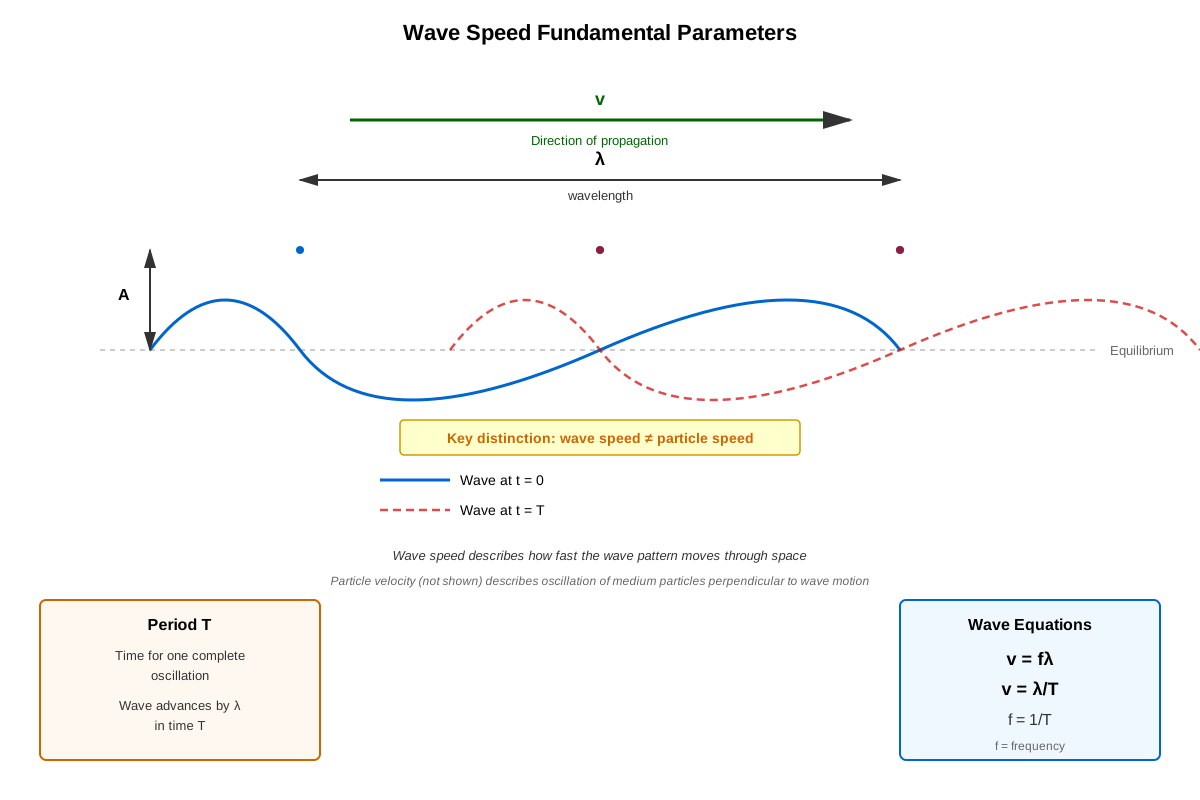
Wave speed represents the rate at which energy and information transfer through space via wave motion. Unlike particle velocity, which describes the oscillatory motion of individual medium particles, wave speed characterizes the forward progression of the wave pattern itself. This distinction is critical for MCAT success, as test-makers frequently design questions that exploit confusion between these two concepts. The mathematical relationship between wave speed, frequency, and wavelength (v = fλ) serves as one of the most high-yield equations in MCAT Physics, appearing in contexts ranging from ultrasound imaging to electromagnetic spectrum problems.
The significance of wave speed Physics extends beyond isolated calculations. This topic connects intimately with energy transmission, resonance phenomena, the Doppler effect, and interference patterns—all testable concepts on the MCAT. Medical applications abound: ultrasound diagnostics rely on wave speed differences between tissues, fiber optic endoscopy depends on light wave propagation, and even electrocardiography involves understanding electrical signal transmission. Mastering wave speed provides the conceptual framework necessary to approach complex MCAT passages involving medical imaging, acoustic diagnostics, and electromagnetic applications with confidence and efficiency.
Learning Objectives
- [ ] Define wave speed using accurate Physics terminology
- [ ] Explain why wave speed matters for the MCAT
- [ ] Apply wave speed to exam-style questions
- [ ] Identify common mistakes related to wave speed
- [ ] Connect wave speed to related Physics concepts
- [ ] Calculate wave speed using multiple approaches (v = fλ, v = √(T/μ), and medium-specific formulas)
- [ ] Distinguish between wave speed and particle velocity in oscillating media
- [ ] Predict how changes in medium properties affect wave propagation speed
- [ ] Analyze wave speed in the context of medical imaging and diagnostic technologies
Prerequisites
- Basic algebra and equation manipulation: Required to rearrange the fundamental wave equation and solve for unknown variables in multi-step problems
- Understanding of frequency and wavelength: These parameters directly determine wave speed through the relationship v = fλ
- Concept of periodic motion: Wave propagation involves repeating patterns that travel through space over time
- Energy transfer principles: Waves transport energy without net displacement of matter, a foundational concept for understanding propagation
- Properties of different media (solids, liquids, gases): Wave speed depends critically on the physical characteristics of the transmission medium
Why This Topic Matters
Wave speed MCAT questions appear with moderate frequency across multiple contexts within the Physics section. Approximately 3-5 questions per exam directly or indirectly test wave speed concepts, making this a reliable source of points for well-prepared students. The topic appears most commonly in passages about medical imaging (ultrasound, MRI), acoustic phenomena (hearing, echolocation), and electromagnetic applications (fiber optics, spectroscopy).
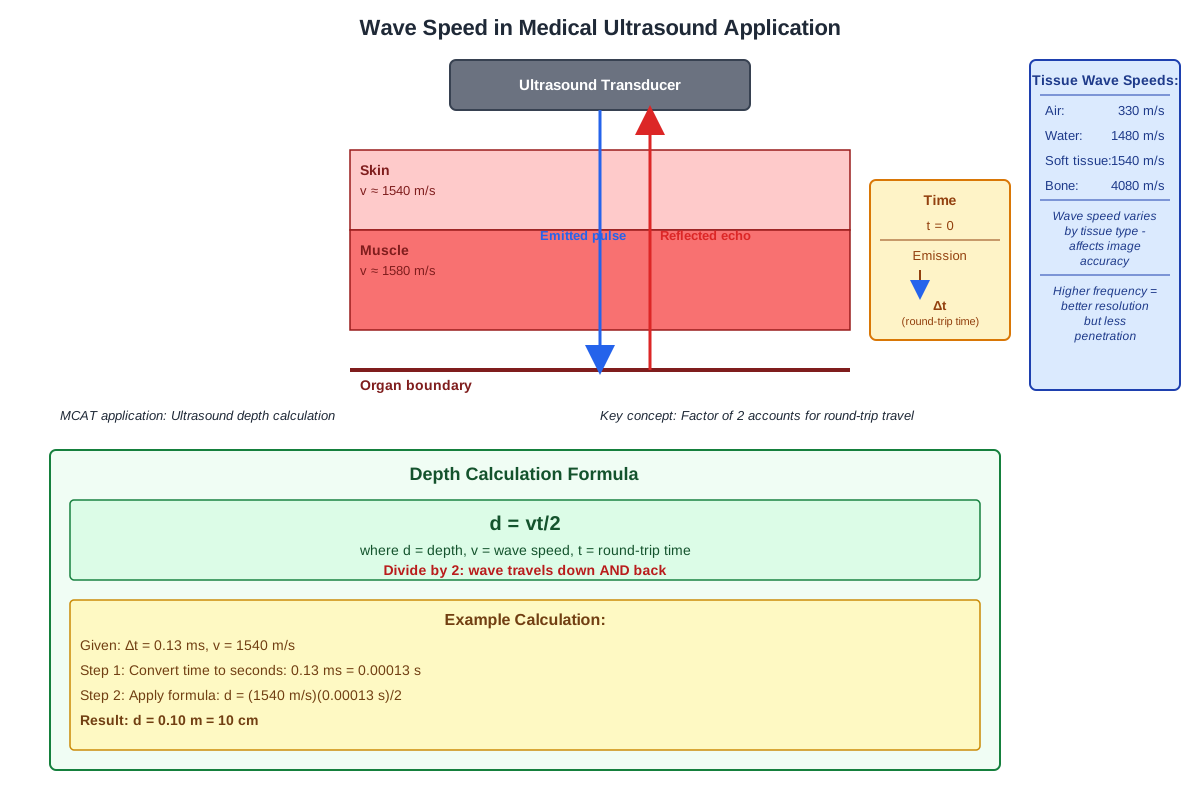
Clinically, wave speed underlies numerous diagnostic and therapeutic technologies. Ultrasound imaging exploits the different speeds of sound waves in various tissues to create anatomical images. The time delay between transmitted and reflected waves, combined with known wave speeds, allows calculation of tissue depth. Similarly, pulse oximetry relies on the speed of light through tissues at different wavelengths to measure blood oxygen saturation. Understanding wave speed enables medical professionals to interpret imaging artifacts, optimize diagnostic parameters, and troubleshoot equipment malfunctions.
On the MCAT, wave speed typically appears in three formats: (1) discrete questions requiring direct calculation using v = fλ, (2) passage-based questions involving experimental data about wave propagation through different media, and (3) conceptual questions testing understanding of how medium properties affect wave speed. The AAMC particularly favors questions that integrate wave speed with other concepts like the Doppler effect, standing waves, or interference patterns, requiring students to apply multiple principles simultaneously. Recognizing these patterns and practicing integrated problem-solving significantly improves performance on test day.
Core Concepts
Fundamental Definition of Wave Speed
Wave speed (symbolized as v or c for light) represents the distance a wave travels per unit time, measured in meters per second (m/s). This velocity describes the propagation of the wave pattern through space, not the motion of individual particles within the medium. For a wave traveling through a medium, wave speed quantifies how quickly energy and information transfer from one location to another.
The most fundamental equation relating wave speed to other wave properties is:
v = fλWhere:
- v = wave speed (m/s)
- f = frequency (Hz or s⁻¹)
- λ = wavelength (m)
This equation reveals that wave speed equals the product of how many wave cycles pass a point per second (frequency) and the spatial length of each cycle (wavelength). This relationship holds true for all types of waves—mechanical, electromagnetic, transverse, and longitudinal.
Wave Speed in Different Media
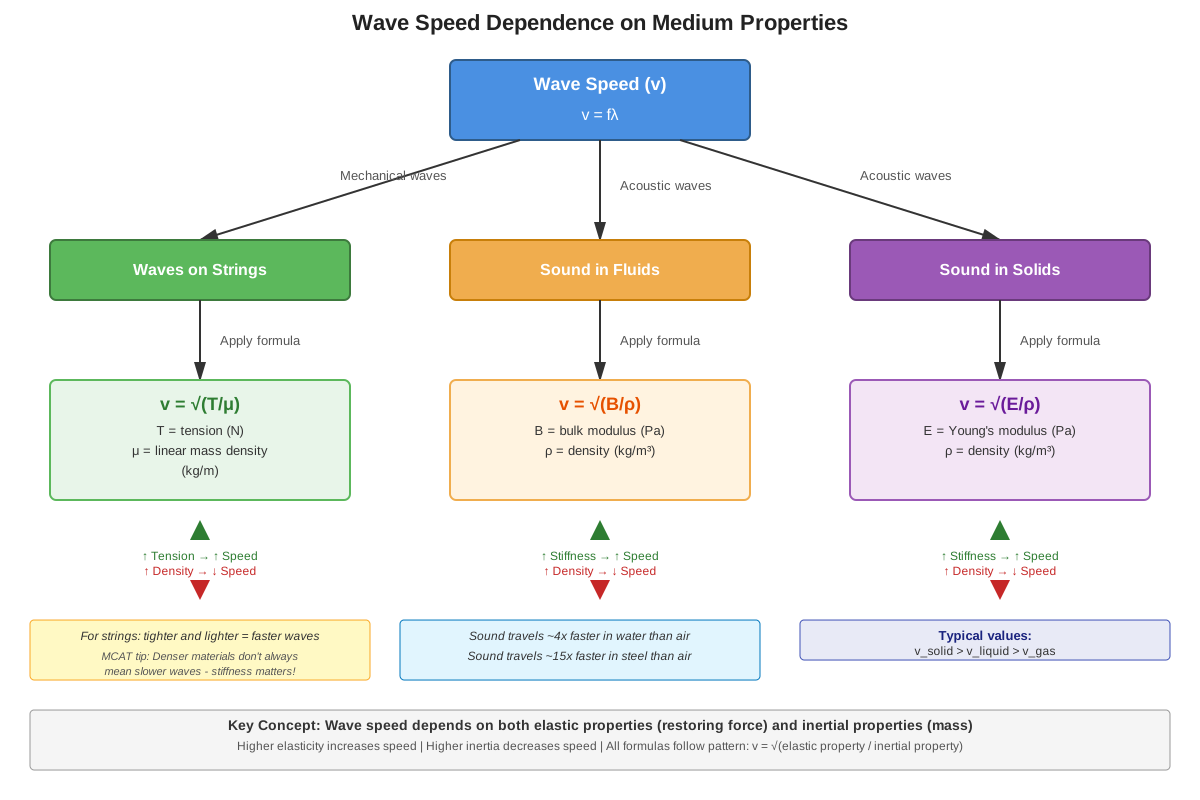
Wave speed depends fundamentally on the properties of the medium through which the wave travels. For mechanical waves (which require a medium), two primary factors determine propagation speed:
- Restoring force properties: How strongly the medium resists deformation
- Inertial properties: The mass density of the medium
For waves on a string under tension:
v = √(T/μ)Where:
- T = tension in the string (N)
- μ = linear mass density (kg/m)
This equation demonstrates that wave speed increases with greater tension (stronger restoring force) and decreases with greater mass density (more inertia to overcome).
For sound waves in gases:
v = √(γRT/M)Where:
- γ = adiabatic index (ratio of specific heats)
- R = universal gas constant
- T = absolute temperature (K)
- M = molar mass (kg/mol)
For sound waves in solids and liquids:
v = √(B/ρ)Where:
- B = bulk modulus (measure of medium's resistance to compression)
- ρ = density (kg/m³)
Speed of Sound: A High-Yield Special Case
The speed of sound varies significantly across different media, making it a favorite MCAT testing point. Key values to memorize:
| Medium | Approximate Speed (m/s) | Notes |
|---|---|---|
| Air (20°C) | 343 | Temperature dependent; increases ~0.6 m/s per °C |
| Water | 1,480 | About 4.3× faster than in air |
| Soft tissue | 1,540 | Standard value used in medical ultrasound |
| Bone | 3,500-4,000 | Highest speed in biological materials |
| Steel | 5,000-6,000 | Solids generally conduct sound faster than liquids |
The general principle: sound travels fastest in solids, slower in liquids, and slowest in gases. This occurs because solids have the strongest intermolecular forces (high restoring forces) despite having higher density. The restoring force effect dominates over the inertial effect.
Electromagnetic Wave Speed
Electromagnetic waves (light, radio waves, X-rays, etc.) do not require a medium and travel at the speed of light in vacuum:
c = 3.00 × 10⁸ m/sIn transparent media, electromagnetic waves travel slower than c. The index of refraction (n) quantifies this reduction:
n = c/vWhere v is the speed of light in the medium. Since n ≥ 1 for all materials, light always travels slower in matter than in vacuum. Common values:
- Air: n ≈ 1.0003 (essentially equal to vacuum)
- Water: n ≈ 1.33
- Glass: n ≈ 1.5
- Diamond: n ≈ 2.42
Wave Speed vs. Particle Speed
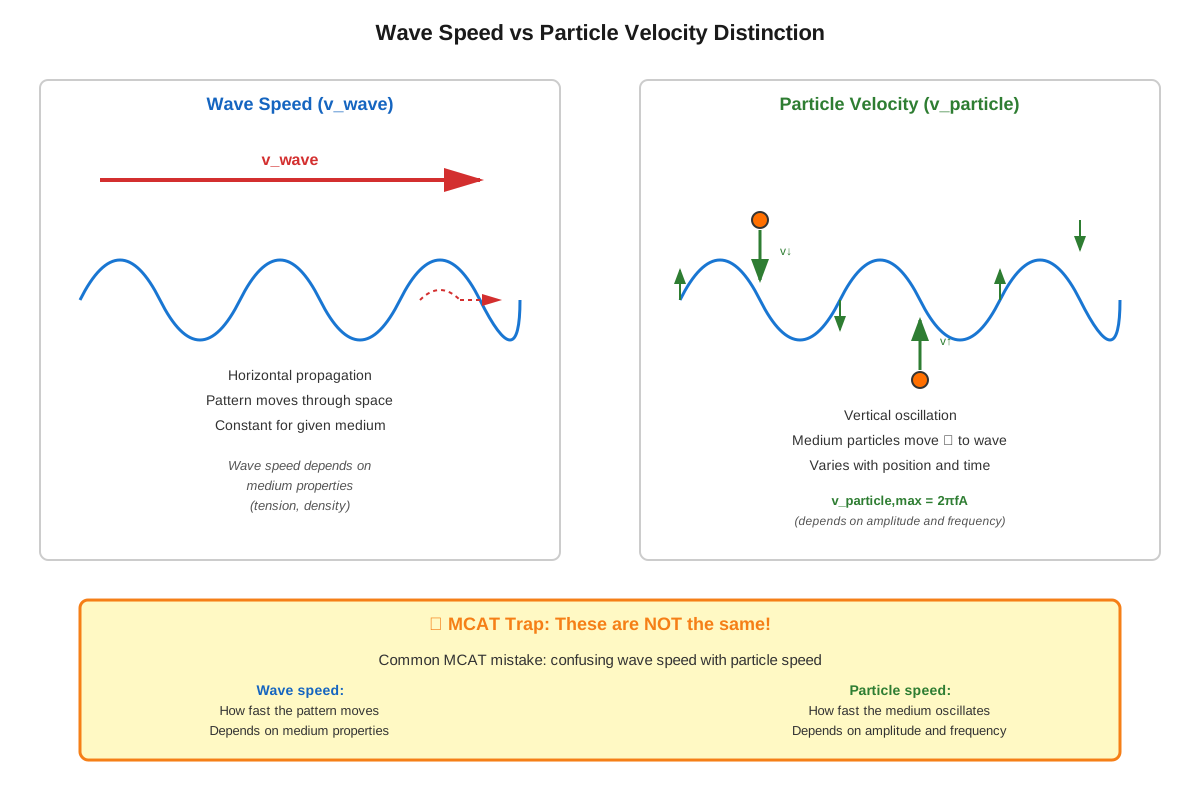
A critical distinction for MCAT success: wave speed differs fundamentally from particle velocity. When a wave passes through a medium:
- Wave speed (v): The velocity at which the wave pattern propagates forward through space
- Particle velocity: The oscillatory motion of individual medium particles perpendicular (transverse waves) or parallel (longitudinal waves) to wave propagation
For example, in a water wave, the wave pattern moves horizontally across the surface at the wave speed, while individual water molecules move in circular or elliptical paths, returning approximately to their starting positions. The maximum particle speed depends on wave amplitude and frequency but is independent of wave speed.
Factors That Do NOT Affect Wave Speed
Understanding what doesn't change wave speed is equally important:
- Amplitude: Larger amplitude waves travel at the same speed as smaller amplitude waves in the same medium
- Frequency: Changing frequency changes wavelength proportionally (v = fλ), but wave speed remains constant for a given medium
- Wave shape: Sinusoidal, square, or triangular waves all propagate at the same speed in a given medium
Wave speed is determined solely by medium properties, not by characteristics of the wave itself. This principle frequently appears in MCAT questions designed to test conceptual understanding.
Dispersion and Wave Speed
In most media, wave speed is independent of frequency—these are called non-dispersive media. However, some materials exhibit dispersion, where different frequencies travel at different speeds. This causes wave packets to spread out over time and is responsible for phenomena like:
- Chromatic aberration in lenses (different colors of light travel at slightly different speeds)
- Rainbow formation in prisms (different wavelengths refract by different amounts because they travel at different speeds in glass)
- Pulse broadening in fiber optic cables
While dispersion is a more advanced topic, recognizing that most MCAT problems assume non-dispersive media (constant wave speed regardless of frequency) helps avoid confusion.
Concept Relationships
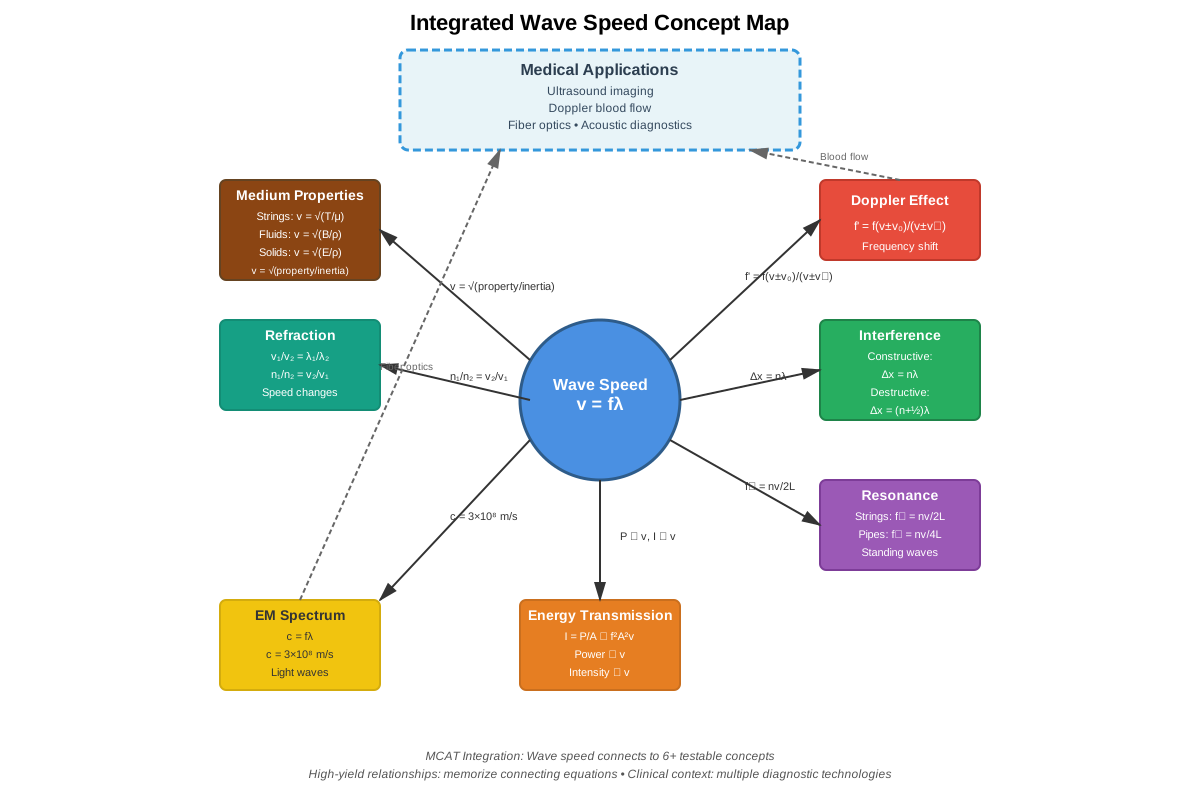
Wave speed serves as a central hub connecting multiple wave phenomena. The fundamental relationship v = fλ links wave speed directly to frequency and wavelength, establishing that these three parameters are interdependent—knowing any two allows calculation of the third.
Wave speed connects to energy transmission because waves transport energy at the wave speed, not at particle velocities. The power transmitted by a wave depends on both amplitude and frequency, but the rate at which this energy reaches distant locations depends on wave speed.
The relationship extends to interference and superposition: when two waves meet, their interaction patterns depend on their relative phases, which in turn depend on the distances traveled and the wave speed. Standing waves form when waves with identical speeds reflect and interfere, creating nodes and antinodes at predictable locations determined by wavelength (which depends on wave speed for a given frequency).
Doppler effect calculations require wave speed as a fundamental parameter. The observed frequency shift depends on the ratio of source/observer velocities to wave speed, making wave speed essential for analyzing moving sources or observers.
Resonance phenomena connect to wave speed through the relationship between resonant frequencies and physical dimensions. For example, the fundamental frequency of a vibrating string depends on length, tension, and mass density—all related through wave speed equations.
The progression flows: Medium properties → Wave speed → Wavelength (for given frequency) → Interference patterns → Standing waves and resonance. This chain of relationships explains why changing medium properties (like tightening a guitar string) changes the pitch (frequency) of the sound produced.
High-Yield Facts
⭐ Wave speed equals frequency times wavelength (v = fλ) for all wave types—this is the single most important equation for wave problems
⭐ Sound travels approximately 343 m/s in air at room temperature and 1,540 m/s in soft tissue—these specific values appear frequently in MCAT passages about ultrasound
⭐ Wave speed depends only on medium properties, not on amplitude or frequency of the wave—a fundamental principle tested conceptually
⭐ Light travels at c = 3.00 × 10⁸ m/s in vacuum and slows down in transparent media by a factor of the refractive index
⭐ Sound generally travels fastest in solids, slower in liquids, and slowest in gases due to the balance between restoring forces and inertia
- Wave speed on a string increases with greater tension and decreases with greater linear mass density (v = √(T/μ))
- Particle velocity in a medium differs from wave speed—particles oscillate while the wave pattern propagates
- Temperature increases the speed of sound in gases because molecules move faster and transmit vibrations more quickly
- The speed of sound in air increases by approximately 0.6 m/s for each 1°C temperature increase
- Electromagnetic waves do not require a medium and all travel at the same speed (c) in vacuum regardless of frequency
- In non-dispersive media, all frequencies travel at the same speed; in dispersive media, speed varies with frequency
- Doubling the frequency of a wave halves its wavelength if wave speed remains constant
- Wave speed determines the time delay between transmission and reception, which is critical for ultrasound imaging depth calculations
Quick check — test yourself on Wave speed so far.
Try Flashcards →Common Misconceptions
Misconception: Higher frequency waves travel faster than lower frequency waves.
Correction: In a given medium, wave speed is independent of frequency. When frequency increases, wavelength decreases proportionally (v = fλ) so that wave speed remains constant. Only in dispersive media do different frequencies travel at different speeds, and this is not the typical MCAT scenario.
Misconception: Larger amplitude waves travel faster than smaller amplitude waves.
Correction: Amplitude does not affect wave speed in the same medium. A loud sound and a quiet sound of the same frequency travel at exactly the same speed through air. Wave speed depends only on properties of the medium (temperature, density, elasticity), not on wave characteristics like amplitude.
Misconception: Wave speed and particle velocity are the same thing.
Correction: Wave speed describes how fast the wave pattern propagates through space, while particle velocity describes the oscillatory motion of individual medium particles. In a transverse wave on a string, the wave might travel horizontally at 10 m/s while particles move vertically with maximum speeds of 2 m/s. These are completely different motions.
Misconception: Sound travels at the same speed in all materials.
Correction: Sound speed varies dramatically across different media. It travels about 4.3 times faster in water than in air, and even faster in solids like steel. The speed depends on the medium's bulk modulus (resistance to compression) and density, which vary significantly between materials.
Misconception: The speed of light is always 3.00 × 10⁸ m/s regardless of the medium.
Correction: The value c = 3.00 × 10⁸ m/s applies only to light in vacuum. In transparent materials, light travels slower by a factor equal to the refractive index. In water (n ≈ 1.33), light travels at approximately 2.25 × 10⁸ m/s, and in glass (n ≈ 1.5), it travels at approximately 2.00 × 10⁸ m/s.
Misconception: If you increase the tension in a string, both wave speed and wavelength increase proportionally.
Correction: Increasing tension increases wave speed (v = √(T/μ)), but the effect on wavelength depends on whether frequency is held constant. If you pluck the string at the same frequency, wavelength increases proportionally to wave speed (v = fλ). However, for standing waves on a string with fixed length, increasing tension increases both wave speed and frequency, and the wavelength is determined by the boundary conditions.
Misconception: Electromagnetic waves need a medium to propagate, just like sound waves.
Correction: Electromagnetic waves are fundamentally different from mechanical waves—they consist of oscillating electric and magnetic fields that can propagate through vacuum without any medium. This is why light from the sun reaches Earth through the vacuum of space, while sound cannot travel through vacuum.
Worked Examples
Example 1: Ultrasound Imaging Depth Calculation
Problem: A medical ultrasound device emits sound waves at a frequency of 5.0 MHz. The ultrasound pulse travels through soft tissue, reflects off a structure, and returns to the detector after 52 μs. Given that the speed of sound in soft tissue is 1,540 m/s, calculate: (a) the wavelength of the ultrasound in tissue, and (b) the depth of the reflecting structure.
Solution:
Part (a): Finding wavelength
We use the fundamental wave equation v = fλ, solving for wavelength:
λ = v/fFirst, convert frequency to Hz:
- f = 5.0 MHz = 5.0 × 10⁶ Hz
Now substitute:
λ = 1,540 m/s ÷ (5.0 × 10⁶ Hz)
λ = 3.08 × 10⁻⁴ m = 0.308 mm
Part (b): Finding depth
The total time of 52 μs includes both the outward journey to the structure and the return journey. Therefore, the one-way travel time is:
t_one-way = 52 μs ÷ 2 = 26 μs = 26 × 10⁻⁶ sUsing distance = speed × time:
d = v × t = 1,540 m/s × 26 × 10⁻⁶ s
d = 0.040 m = 4.0 cm
Key Insights: This problem demonstrates the practical medical application of wave speed. The wavelength calculation shows why higher frequency ultrasound provides better resolution (shorter wavelength) but penetrates less deeply. The depth calculation illustrates the fundamental principle behind ultrasound imaging—measuring time delays and using known wave speeds to determine distances. Notice that we must divide the total time by 2 because the wave makes a round trip.
Example 2: Wave Speed on a Vibrating String
Problem: A guitar string has a length of 0.65 m and a mass of 3.2 g. When tuned properly, it vibrates at its fundamental frequency of 330 Hz (the note E). Calculate: (a) the wave speed on the string, (b) the tension in the string, and (c) what happens to the frequency if the guitarist increases the tension by 21%.
Solution:
Part (a): Finding wave speed
For the fundamental frequency on a string fixed at both ends, the wavelength is twice the string length:
λ = 2L = 2 × 0.65 m = 1.3 mUsing v = fλ:
v = 330 Hz × 1.3 m = 429 m/sPart (b): Finding tension
The wave speed on a string relates to tension by v = √(T/μ), where μ is linear mass density.
First, calculate μ:
μ = mass/length = 0.0032 kg ÷ 0.65 m = 4.92 × 10⁻³ kg/mSolving for tension:
v² = T/μ
T = μv² = (4.92 × 10⁻³ kg/m) × (429 m/s)²
T = 905 N
Part (c): Effect of increasing tension
If tension increases by 21%, the new tension is:
T_new = 1.21 × T_originalSince v = √(T/μ), wave speed is proportional to the square root of tension:
v_new = √(T_new/μ) = √(1.21 × T/μ) = 1.1 × √(T/μ) = 1.1 × v_originalWave speed increases by 10% (since √1.21 = 1.1).
For a string of fixed length, wavelength remains constant (determined by boundary conditions), so from v = fλ:
f_new = v_new/λ = 1.1 × v_original/λ = 1.1 × f_original
f_new = 1.1 × 330 Hz = 363 Hz
Key Insights: This problem integrates multiple concepts—standing waves, boundary conditions, and the relationship between tension and wave speed. The crucial insight is that wave speed depends on medium properties (tension and mass density), while the wavelength of standing waves depends on boundary conditions (string length). When tension changes, wave speed changes, and since wavelength is constrained by the string length, frequency must change proportionally. This explains why tightening a guitar string raises its pitch.
Exam Strategy
When approaching wave speed MCAT questions, begin by identifying what type of wave is involved (mechanical vs. electromagnetic, transverse vs. longitudinal) and what medium it travels through. This immediately tells you which equations and principles apply.
Trigger words and phrases to recognize:
- "Speed of sound in tissue" → Use v = 1,540 m/s for soft tissue
- "Index of refraction" → Light speed problem; use n = c/v
- "Tension in the string" → Use v = √(T/μ)
- "Time delay" or "echo" → Calculate distance using d = vt, remembering to divide by 2 for round-trip
- "Frequency increases" → Check whether wave speed is constant (usually yes); if so, wavelength must decrease proportionally
Process of elimination strategies:
- Eliminate answers that confuse wave speed with particle velocity
- Eliminate answers suggesting amplitude affects wave speed (it doesn't in typical MCAT scenarios)
- For sound problems, eliminate answers with speeds outside the reasonable range (100-6,000 m/s depending on medium)
- For light problems, eliminate answers with speeds greater than c
Time allocation: Most wave speed questions should take 60-90 seconds. If a problem requires more than two equation manipulations, you may be overcomplicating it. The MCAT favors conceptual understanding and straightforward calculations over complex multi-step mathematics.
Common question patterns:
- Direct calculation: Given two of {v, f, λ}, find the third using v = fλ
- Medium comparison: Predict relative wave speeds in different materials based on properties
- Application problems: Use wave speed to calculate distances (ultrasound, sonar) or times
- Conceptual questions: Identify what does or doesn't affect wave speed
Exam Tip: If a passage provides a table of wave speeds in different media, that information will definitely be needed for at least one question. Mark it clearly for quick reference.
Memory Techniques
Mnemonic for sound speed in different states: "Solids are Superior, Liquids are Less, Gases are Gradual" (SSL-G) to remember that sound travels fastest in solids, slower in liquids, and slowest in gases.
Visualization for v = fλ: Picture a train where frequency is how many cars pass per second, wavelength is the length of each car, and wave speed is how fast the train moves. More cars per second (higher f) or longer cars (larger λ) means the train moves faster.
Acronym for wave speed factors: "Tension Makes Speed" (TMS) for strings—increasing Tension increases wave speed, while increasing Mass (density) decreases Speed.
Memory aid for ultrasound speed: "1-5-4-0 soft tissue" sounds like "15-40 is middle age"—both are in the middle range of their respective scales. This helps recall that sound travels at 1,540 m/s in soft tissue.
Conceptual anchor for light speed: Remember that light takes about 8 minutes to travel from the Sun to Earth (150 million km). This gives an intuitive sense of c = 3 × 10⁸ m/s as incredibly fast but finite.
Relationship reminder: "Very Fast Lamborghinis" (VFL) to remember the order of variables in v = fλ.
Summary
Wave speed represents the rate at which wave patterns propagate through space, fundamentally distinct from the oscillatory motion of particles within the medium. The universal relationship v = fλ connects wave speed to frequency and wavelength for all wave types, serving as the foundation for most MCAT wave calculations. Wave speed depends exclusively on medium properties—not on wave characteristics like amplitude or frequency. For mechanical waves, speed increases with stronger restoring forces and decreases with greater inertia. Sound travels fastest in solids (~5,000 m/s in steel), slower in liquids (~1,540 m/s in tissue), and slowest in gases (~343 m/s in air). Electromagnetic waves travel at c = 3.00 × 10⁸ m/s in vacuum and slow down in transparent media by a factor equal to the refractive index. Medical applications, particularly ultrasound imaging, exploit wave speed differences between tissues and use time-delay measurements to calculate distances. Success on MCAT wave speed questions requires distinguishing wave speed from particle velocity, recognizing that medium properties determine propagation speed, and applying v = fλ correctly in various contexts.
Key Takeaways
- Wave speed (v = fλ) depends only on medium properties, not on wave amplitude or frequency
- Sound travels at approximately 343 m/s in air, 1,540 m/s in soft tissue, and fastest in solids
- Light travels at c = 3.00 × 10⁸ m/s in vacuum and slows by a factor of n (refractive index) in materials
- Wave speed differs fundamentally from particle velocity—the wave pattern propagates while particles oscillate
- Increasing tension in a string increases wave speed (v = √(T/μ)); increasing mass density decreases it
- Medical ultrasound uses wave speed and time delays to calculate tissue depths (d = vt/2 for round-trip)
- All electromagnetic waves travel at the same speed in vacuum regardless of frequency
Related Topics
Doppler Effect: Understanding wave speed is essential for calculating frequency shifts when sources or observers move relative to the medium. The magnitude of frequency change depends on the ratio of velocities to wave speed.
Standing Waves and Resonance: Wave speed determines the wavelengths that fit boundary conditions, establishing resonant frequencies for strings, pipes, and other systems. Mastering wave speed enables prediction of harmonic frequencies.
Interference and Superposition: Path length differences that determine constructive or destructive interference depend on wavelength, which relates to wave speed through v = fλ. Wave speed calculations are often preliminary steps in interference problems.
Refraction and Snell's Law: Light bending at interfaces occurs because wave speed changes between media. The refractive index directly relates to wave speed (n = c/v), making wave speed fundamental to understanding optical phenomena.
Electromagnetic Spectrum: Different regions of the spectrum (radio, visible, X-ray) all travel at the same speed in vacuum but have vastly different frequencies and wavelengths, connected through c = fλ.
Practice CTA
Now that you've mastered the core concepts of wave speed, it's time to solidify your understanding through active practice. Attempt the practice questions and flashcards associated with this topic to test your ability to apply these principles under exam-like conditions. Focus particularly on distinguishing between wave speed and particle velocity, calculating wavelengths from given speeds and frequencies, and predicting how medium changes affect propagation. Remember that wave speed appears in approximately 3-5 questions per MCAT, making this a reliable opportunity to earn points. Your investment in mastering this foundational topic will pay dividends not only in direct wave speed questions but also in the many related topics that build upon these principles. You've got this!
Sign up free to keep reading
Create a free AnvayaPrep account to finish this MCAT guide on Wave speed — plus flashcards and practice questions.