Overview
The unconditioned stimulus (US or UCS) represents one of the foundational pillars of classical conditioning theory and serves as a critical concept within the broader domain of Learning and Memory in Psychology. An unconditioned stimulus is any stimulus that naturally and automatically triggers an innate, unlearned response without requiring prior experience or conditioning. This concept, first systematically studied by Ivan Pavlov in his groundbreaking experiments with dogs, forms the basis for understanding how organisms learn associations between environmental cues and biologically significant events. For MCAT preparation, mastering the unconditioned stimulus is essential because it appears frequently in both discrete questions and passage-based items, often requiring students to distinguish between learned and unlearned responses or to analyze experimental paradigms involving classical conditioning.
Understanding the unconditioned stimulus extends far beyond memorizing a simple definition. The concept connects intimately with neural mechanisms of learning, evolutionary adaptations, and behavioral modification techniques used in clinical psychology and medicine. On the MCAT, questions involving unconditioned stimuli often appear within experimental scenarios where students must identify which elements of a conditioning paradigm are innate versus learned, or they may be embedded in passages discussing phobia acquisition, taste aversion, or therapeutic interventions like systematic desensitization. The ability to rapidly identify an unconditioned stimulus and distinguish it from conditioned stimuli, neutral stimuli, and various types of responses represents a high-yield skill that directly translates to points on test day.
The unconditioned stimulus MCAT questions typically integrate this concept with broader psychological principles including biological bases of behavior, emotion, motivation, and cognitive processes. Because classical conditioning represents a fundamental learning mechanism conserved across species, understanding unconditioned stimuli provides insight into both basic behavioral science and clinical applications ranging from addiction treatment to anxiety disorder management. This topic bridges multiple MCAT content categories, making it particularly valuable for students seeking to maximize their performance on the Psychological, Social, and Biological Foundations of Behavior section.
Learning Objectives
- [ ] Define unconditioned stimulus using accurate Psychology terminology
- [ ] Explain why unconditioned stimulus matters for the MCAT
- [ ] Apply unconditioned stimulus to exam-style questions
- [ ] Identify common mistakes related to unconditioned stimulus
- [ ] Connect unconditioned stimulus to related Psychology concepts
- [ ] Distinguish between unconditioned and conditioned stimuli in experimental scenarios
- [ ] Analyze the biological and evolutionary significance of unconditioned responses
- [ ] Evaluate the role of unconditioned stimuli in therapeutic interventions and behavior modification
Prerequisites
- Basic understanding of stimulus-response relationships: Essential for comprehending how unconditioned stimuli automatically elicit responses without learning
- Familiarity with reflexes and innate behaviors: Necessary because unconditioned responses represent unlearned, reflexive reactions
- General knowledge of experimental design: Required to analyze classical conditioning experiments where unconditioned stimuli are manipulated
- Awareness of biological bases of behavior: Important for understanding why certain stimuli naturally trigger specific responses through evolutionary adaptation
Why This Topic Matters
The unconditioned stimulus concept holds profound clinical and real-world significance across multiple domains of medicine and psychology. In clinical practice, understanding unconditioned stimuli enables healthcare providers to comprehend how patients develop conditioned responses to medical procedures (such as chemotherapy-induced nausea occurring before treatment begins), how phobias originate from traumatic experiences, and how therapeutic techniques like exposure therapy work by manipulating learned associations with naturally aversive stimuli. Taste aversion learning, which involves unconditioned stimuli like nausea-inducing toxins, has practical applications in cancer treatment, where patients may develop aversions to foods consumed before chemotherapy.
From an MCAT perspective, unconditioned stimulus questions appear with high frequency, typically in 3-5 questions per exam administration. These questions most commonly appear as part of experimental analysis passages where students must identify components of classical conditioning paradigms, but they also surface in discrete questions testing definitional knowledge and in passages discussing behavioral treatments for psychological disorders. The MCAT particularly favors questions that require students to distinguish between unconditioned and conditioned stimuli, identify which responses are learned versus innate, or predict outcomes when conditioning parameters are manipulated.
Common exam presentations include: (1) experimental vignettes describing Pavlovian conditioning procedures where students must label each component; (2) clinical scenarios involving phobia development or treatment where students must identify the original unconditioned stimulus; (3) research passages on taste aversion, fear conditioning, or other learning paradigms requiring analysis of stimulus-response relationships; and (4) questions integrating classical conditioning with neuroscience concepts like neural plasticity or neurotransmitter systems. The ability to rapidly identify unconditioned stimuli and understand their role in learning processes represents a high-yield skill that frequently differentiates top-scoring students from average performers.
Core Concepts
Definition and Fundamental Properties
An unconditioned stimulus (US or UCS) is defined as any stimulus that naturally and automatically elicits an innate, unlearned response without requiring prior conditioning or experience. The term "unconditioned" indicates that the stimulus-response relationship exists independent of learning—it is "not conditional" upon experience. This distinguishes unconditioned stimuli from conditioned stimuli, which only elicit responses after being paired with unconditioned stimuli through associative learning processes.
The fundamental properties of unconditioned stimuli include: (1) biological significance—they typically relate to survival needs like food, pain avoidance, or reproduction; (2) automatic elicitation—they trigger responses reflexively without conscious processing; (3) species-typical responses—they generally produce consistent responses across members of a species; (4) evolutionary basis—the stimulus-response relationship has been shaped by natural selection; and (5) resistance to extinction—unlike conditioned responses, unconditioned responses do not diminish when the stimulus is repeatedly presented alone.
The Unconditioned Stimulus in Classical Conditioning
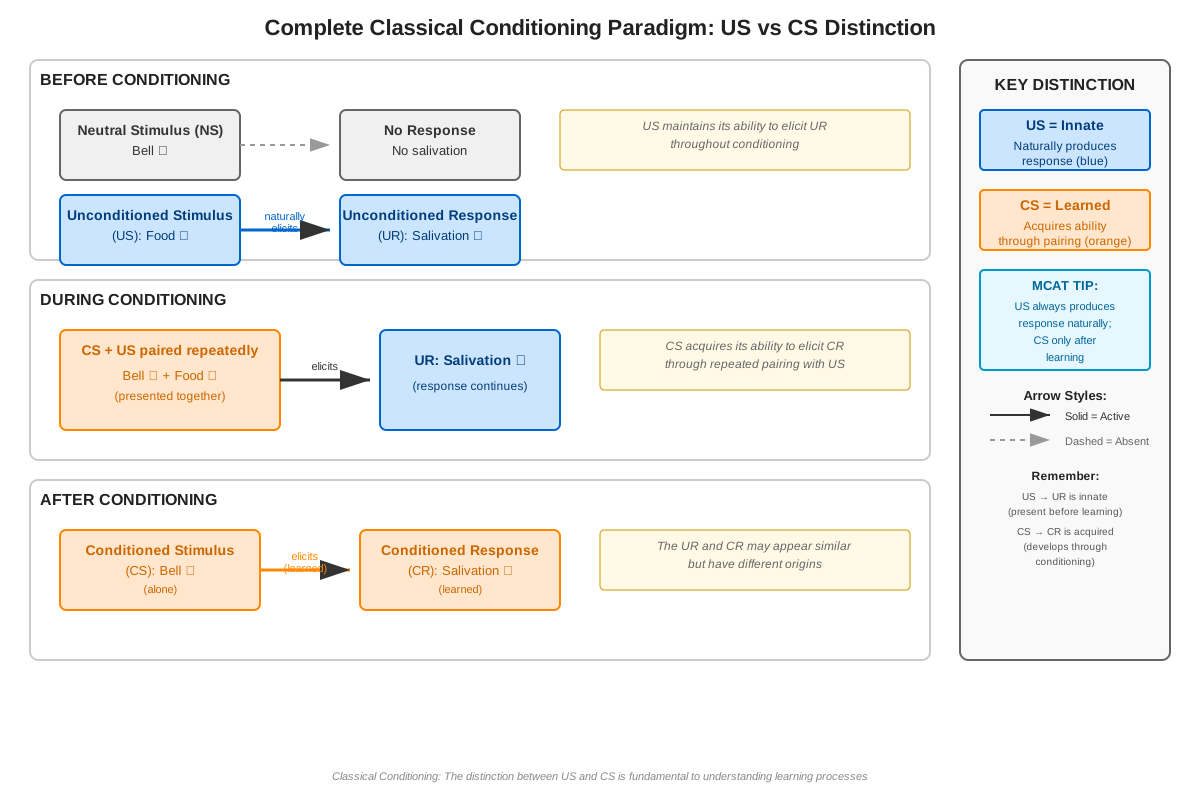
Within the classical conditioning paradigm, the unconditioned stimulus serves as the critical element that drives learning. Classical conditioning occurs when a neutral stimulus (one that does not initially elicit a response) is repeatedly paired with an unconditioned stimulus. Through this temporal association, the neutral stimulus becomes a conditioned stimulus (CS) that can elicit a learned response similar to the original unconditioned response.
The temporal relationship between the conditioned stimulus and unconditioned stimulus critically determines conditioning effectiveness. Forward conditioning, where the CS precedes the US, typically produces the strongest learning, particularly with a brief delay (0.5 seconds for many responses). Simultaneous conditioning (CS and US presented together) and backward conditioning (US before CS) generally produce weaker or no conditioning. This temporal sensitivity reflects the biological function of classical conditioning: learning predictive relationships that allow organisms to prepare for biologically significant events.
Common Examples of Unconditioned Stimuli
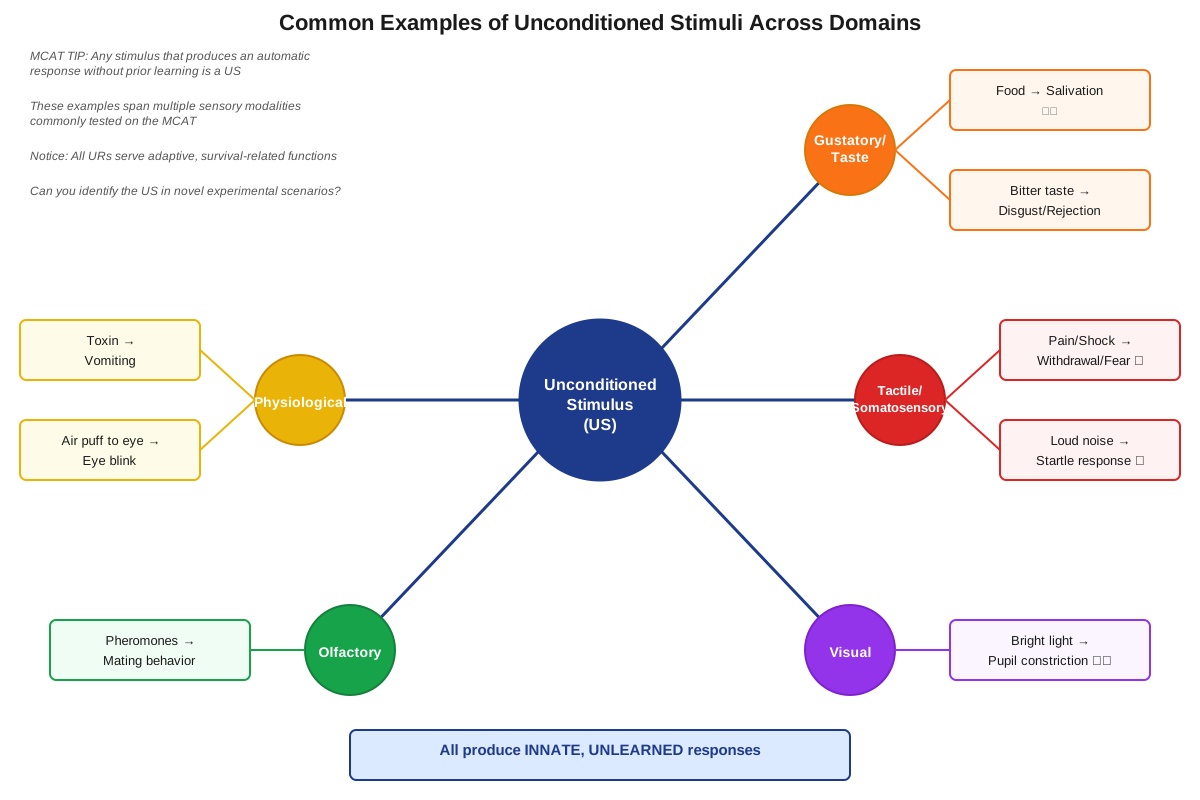
Understanding concrete examples helps solidify the abstract concept of unconditioned stimuli:
| Unconditioned Stimulus | Unconditioned Response | Biological Function |
|---|---|---|
| Food in mouth | Salivation | Digestion preparation |
| Painful shock | Fear/withdrawal | Injury avoidance |
| Puff of air to eye | Eye blink | Eye protection |
| Loud noise | Startle response | Threat detection |
| Nausea-inducing toxin | Nausea/vomiting | Poison elimination |
| Sexual stimulation | Arousal | Reproduction |
| Bright light | Pupil constriction | Retinal protection |
Each of these examples demonstrates the key characteristic of unconditioned stimuli: they produce responses automatically without requiring learning. A newborn infant will salivate when food touches the tongue, blink when air puffs toward the eye, and startle at loud noises—all without any prior experience or conditioning.
Biological and Neural Mechanisms
The effectiveness of unconditioned stimuli stems from hardwired neural circuits that have been shaped by evolutionary pressures. These circuits typically involve subcortical structures that enable rapid, automatic responses to biologically significant stimuli. For example, fear-related unconditioned stimuli (like painful shocks or predator cues) activate the amygdala, which coordinates fear responses including autonomic arousal, hormonal stress responses, and defensive behaviors.
The neural pathways mediating unconditioned responses often involve relatively direct connections between sensory systems and motor or autonomic output systems. This contrasts with conditioned responses, which require plasticity in additional neural circuits that learn to associate the conditioned stimulus with the unconditioned stimulus. The cerebellum plays a crucial role in classical conditioning of motor responses (like eyeblink conditioning), while the amygdala is essential for emotional conditioning. The hippocampus contributes to contextual aspects of conditioning, helping organisms learn when and where unconditioned stimuli are likely to occur.
Stimulus Generalization and Discrimination
Once conditioning has occurred, organisms may respond to stimuli that resemble the original conditioned stimulus—a phenomenon called stimulus generalization. However, the unconditioned stimulus itself maintains its ability to elicit responses regardless of similarity to other stimuli. The specificity of unconditioned stimulus-response relationships reflects evolutionary tuning: organisms have been selected to respond to particular biologically significant stimuli with appropriate defensive, appetitive, or reproductive responses.
Preparedness theory suggests that organisms are biologically predisposed to form associations between certain types of conditioned stimuli and unconditioned stimuli more readily than others. For example, humans and other animals rapidly learn to associate tastes (CS) with nausea (US), even when the nausea occurs hours after consumption—a phenomenon called taste aversion learning or the Garcia effect. This preparedness reflects evolutionary history: in natural environments, illness typically results from ingested toxins, making taste-nausea associations highly adaptive.
Intensity and Effectiveness
The intensity of an unconditioned stimulus significantly affects conditioning strength. More intense unconditioned stimuli (stronger shocks, more palatable food, more noxious odors) typically produce faster conditioning and stronger conditioned responses. This relationship makes biological sense: more intense unconditioned stimuli signal more important biological events, warranting stronger learning about predictive cues.
However, extremely intense unconditioned stimuli can sometimes produce different effects. Very strong aversive stimuli may cause learned helplessness if they are uncontrollable, or they may produce one-trial learning where a single pairing of CS and US creates a strong, lasting association. The latter phenomenon is particularly evident in taste aversion learning, where a single experience of illness following consumption of a novel food can create a lifelong aversion.
Concept Relationships
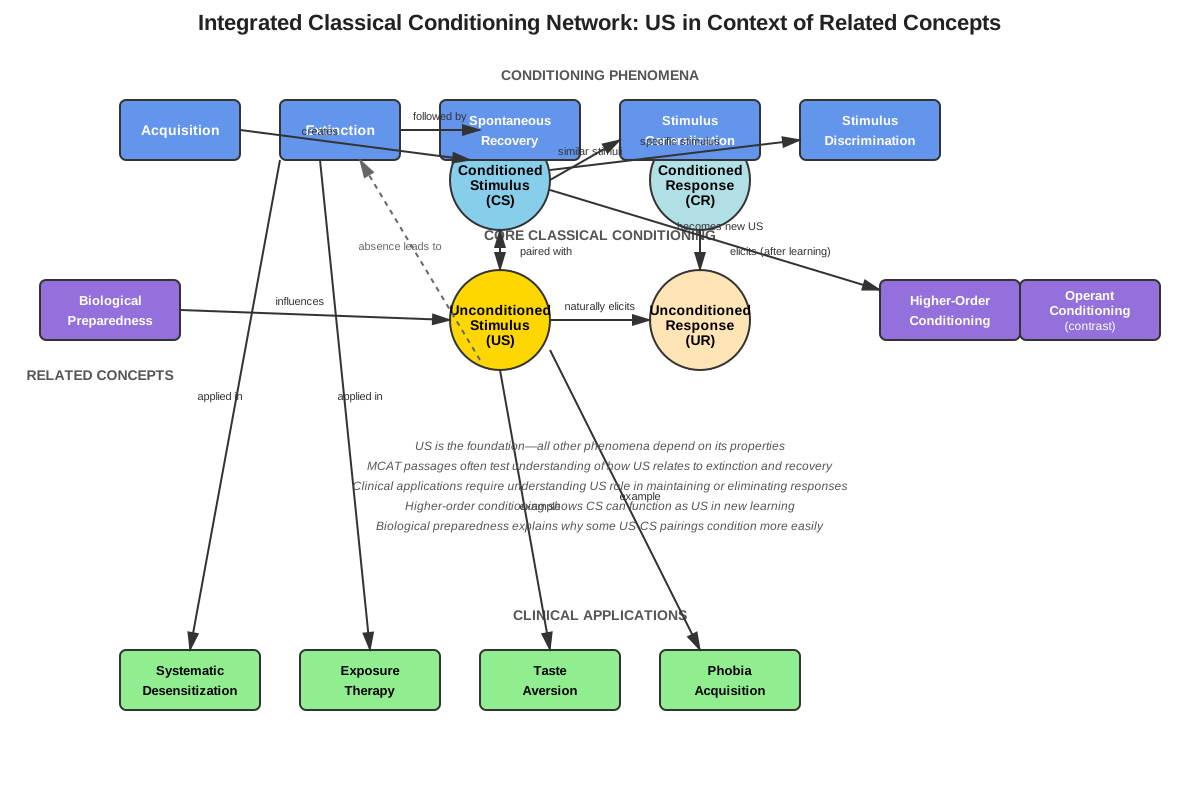
The unconditioned stimulus concept exists within a network of interconnected learning and memory principles. Most directly, the unconditioned stimulus pairs with the unconditioned response (UR)—the innate, automatic reaction it elicits. This US→UR relationship represents the foundation upon which classical conditioning builds. When a neutral stimulus is repeatedly paired with the unconditioned stimulus, it becomes a conditioned stimulus (CS) that elicits a conditioned response (CR) similar to the original unconditioned response. Thus: Neutral Stimulus + Unconditioned Stimulus → Conditioned Stimulus → Conditioned Response.
The unconditioned stimulus concept connects to broader learning theory through its role in acquisition (the initial learning phase), extinction (when the CS is presented without the US), spontaneous recovery (reappearance of extinguished responses), and reinstatement (recovery of conditioned responses when the US is presented alone). Understanding that extinction does not eliminate the original CS-US association but rather creates new inhibitory learning helps explain why conditioned responses can return even after apparent elimination.
Within the Learning and Memory unit, unconditioned stimuli relate to other learning mechanisms including operant conditioning, where consequences (reinforcers or punishers) function analogously to unconditioned stimuli by providing biologically significant outcomes that shape behavior. The concept also connects to observational learning, where witnessing others experience unconditioned stimuli can produce vicarious conditioning. Additionally, unconditioned stimuli link to memory consolidation processes, as emotionally arousing unconditioned stimuli (like those producing fear or pleasure) enhance memory formation through amygdala-mediated modulation of hippocampal consolidation.
The evolutionary perspective on unconditioned stimuli connects to motivation and emotion, as many unconditioned stimuli relate to primary drives (hunger, thirst, pain avoidance) and produce emotional states (fear, pleasure, disgust). This relationship extends to stress and health psychology, where understanding how neutral medical stimuli become conditioned through association with painful or nausea-inducing unconditioned stimuli helps explain anticipatory anxiety in medical settings and treatment-related side effects.
High-Yield Facts
⭐ An unconditioned stimulus automatically elicits an innate, unlearned response without requiring prior conditioning or experience
⭐ The unconditioned stimulus is the critical element that drives classical conditioning by being paired with a neutral stimulus
⭐ Common MCAT examples of unconditioned stimuli include food (eliciting salivation), shock (eliciting fear/withdrawal), and air puff (eliciting eye blink)
⭐ The temporal relationship between CS and US matters: forward conditioning (CS before US) is most effective
⭐ Unconditioned responses do not extinguish when the unconditioned stimulus is repeatedly presented alone, unlike conditioned responses
- Unconditioned stimuli typically have biological significance related to survival, reproduction, or homeostasis
- More intense unconditioned stimuli generally produce faster and stronger conditioning
- The amygdala plays a crucial role in processing fear-related unconditioned stimuli
- Taste aversion learning demonstrates preparedness: organisms readily associate tastes (CS) with nausea (US) even with long delays
- In experimental descriptions, the unconditioned stimulus is the element that naturally produces a response before any conditioning occurs
- Unconditioned stimuli activate hardwired neural circuits shaped by evolutionary pressures
- The same stimulus can function as an unconditioned stimulus in one context and a conditioned stimulus in another, depending on learning history
- Stimulus generalization applies to conditioned stimuli, but unconditioned stimuli maintain specific response relationships
- Understanding unconditioned stimuli is essential for analyzing phobia development, where traumatic events serve as unconditioned stimuli
- In therapeutic contexts like systematic desensitization, the original unconditioned stimulus (e.g., the traumatic event) is not re-presented; instead, the conditioned stimulus is presented without the US to promote extinction
Quick check — test yourself on Unconditioned stimulus so far.
Try Flashcards →Common Misconceptions
Misconception: Any stimulus that produces a response is an unconditioned stimulus → Correction: Only stimuli that produce innate, unlearned responses are unconditioned stimuli. Stimuli that produce responses only after learning are conditioned stimuli. For example, a bell that causes salivation after being paired with food is a conditioned stimulus, not an unconditioned stimulus.
Misconception: Unconditioned stimuli and unconditioned responses are the same thing → Correction: The unconditioned stimulus is the trigger (the input), while the unconditioned response is the reaction (the output). Food is the unconditioned stimulus; salivation is the unconditioned response. These are distinct components of the stimulus-response relationship.
Misconception: Once a neutral stimulus becomes a conditioned stimulus, the original unconditioned stimulus is no longer needed → Correction: While the conditioned stimulus can elicit responses independently after conditioning, the unconditioned stimulus remains necessary to maintain conditioning strength. Without occasional US presentations (reinforcement), the conditioned response will gradually extinguish.
Misconception: All unconditioned stimuli are aversive or negative → Correction: Unconditioned stimuli can be appetitive (food, sexual stimulation), aversive (shock, loud noise), or neutral in valence but biologically significant (air puff to eye). The defining feature is that they naturally elicit responses, not that they are unpleasant.
Misconception: The unconditioned response and conditioned response are always identical → Correction: While conditioned responses typically resemble unconditioned responses, they are often weaker, may have different timing, or may show qualitative differences. For example, conditioned salivation may be less copious than unconditioned salivation, and conditioned fear responses may differ in specific behavioral components from unconditioned fear responses.
Misconception: Humans can consciously control their responses to unconditioned stimuli through willpower → Correction: Unconditioned responses are largely automatic and reflexive, mediated by subcortical neural circuits. While some modulation is possible (e.g., suppressing a startle response with effort), the fundamental response tendency remains involuntary. This automaticity is precisely what makes classical conditioning so powerful and resistant to conscious control.
Misconception: An unconditioned stimulus must be presented every time during conditioning → Correction: While consistent US presentation produces strongest conditioning, partial reinforcement schedules (where the US follows the CS only sometimes) can actually produce more persistent conditioned responses that are more resistant to extinction, though acquisition may be slower.
Worked Examples
Example 1: Identifying Components in a Classical Conditioning Experiment
Scenario: Researchers study fear conditioning in rats. They place rats in a chamber and present a tone for 10 seconds. During the last 2 seconds of the tone, they deliver a mild electric shock to the rats' feet. After several pairings, rats begin showing fear responses (freezing behavior) when they hear the tone, even before the shock is delivered.
Question: Identify the unconditioned stimulus, unconditioned response, conditioned stimulus, and conditioned response in this experiment.
Solution Process:
Step 1: Identify what naturally produces a response without learning. The electric shock naturally causes fear and defensive behaviors (like freezing or escape attempts) without any prior experience—this is the unconditioned stimulus.
Step 2: Identify the natural response to the unconditioned stimulus. The fear response and freezing behavior that occur in response to the shock represent the unconditioned response—the innate reaction to pain.
Step 3: Identify what becomes associated with the unconditioned stimulus through learning. The tone initially doesn't cause fear (it's neutral), but through repeated pairing with the shock, it becomes a conditioned stimulus that predicts shock delivery.
Step 4: Identify the learned response. The freezing behavior that occurs in response to the tone alone (before shock delivery) represents the conditioned response—a learned reaction to a previously neutral stimulus.
Answer Summary:
- Unconditioned Stimulus: Electric shock
- Unconditioned Response: Fear/freezing in response to shock
- Conditioned Stimulus: Tone
- Conditioned Response: Fear/freezing in response to tone
Key Learning Point: The unconditioned stimulus is always the element that naturally produces a response before any conditioning occurs. Look for what has biological significance and would produce a reaction in a naive organism.
Example 2: Clinical Application in Chemotherapy-Induced Nausea
Scenario: A cancer patient receives chemotherapy treatments in a hospital room with distinctive lavender-scented air freshener. The chemotherapy drugs (unconditioned stimulus) naturally cause severe nausea (unconditioned response). After several treatments, the patient begins feeling nauseous when entering the hospital room, even before receiving chemotherapy. Eventually, the patient reports feeling nauseous when smelling lavender in other contexts, such as in a store.
Question: Explain the classical conditioning process occurring here, identify all components, and explain the final phenomenon where lavender in other contexts triggers nausea.
Solution Process:
Step 1: Identify the unconditioned stimulus. The chemotherapy drugs naturally cause nausea through their pharmacological effects—no learning required. This makes the chemotherapy drugs the unconditioned stimulus.
Step 2: Identify the unconditioned response. The nausea that occurs as a direct pharmacological effect of the chemotherapy represents the unconditioned response—an innate physiological reaction to toxic substances.
Step 3: Identify the conditioned stimulus. The lavender scent (and other hospital room cues) were initially neutral but became associated with the chemotherapy through repeated temporal pairing. These environmental cues became conditioned stimuli.
Step 4: Identify the conditioned response. The anticipatory nausea that occurs when entering the hospital room or smelling lavender (before receiving chemotherapy) represents the conditioned response—a learned reaction.
Step 5: Explain the generalization. The nausea triggered by lavender scent in other contexts (like stores) demonstrates stimulus generalization—the conditioned response extends to stimuli similar to the original conditioned stimulus.
Clinical Implications: Understanding this conditioning process has led to interventions such as: (1) varying the treatment environment to prevent strong associations, (2) using distinctive flavors/scents that can be avoided later, (3) administering anti-nausea medication before chemotherapy to reduce the strength of the unconditioned response, thereby weakening conditioning, and (4) using systematic desensitization techniques to extinguish conditioned nausea responses.
Key Learning Point: In clinical contexts, identifying the unconditioned stimulus (the element with direct biological effects) versus conditioned stimuli (environmental cues) is essential for developing interventions. Reducing the intensity of the unconditioned response can prevent or weaken the formation of conditioned responses.
Exam Strategy
When approaching unconditioned stimulus MCAT questions, employ a systematic identification strategy. First, read the question stem carefully to determine whether you're being asked to identify components of a conditioning paradigm, predict outcomes of conditioning procedures, or analyze a clinical scenario involving learned associations. Questions often present experimental or clinical vignettes requiring you to label each element of classical conditioning.
Trigger words and phrases that signal unconditioned stimulus questions include: "naturally produces," "innate response," "without prior learning," "reflexive reaction," "before conditioning," "biological significance," and "automatic elicitation." When you encounter descriptions of classical conditioning experiments, immediately ask: "What would produce a response in a completely naive organism?" This element is your unconditioned stimulus. Conversely, phrases like "after repeated pairings," "learned association," or "previously neutral" indicate conditioned stimuli.
Process-of-elimination strategy: When identifying the unconditioned stimulus among multiple options, eliminate any stimuli that: (1) would not produce a response without prior experience, (2) are described as "neutral" or "arbitrary," (3) only produce responses "after training" or "following conditioning," or (4) lack clear biological significance. The correct answer will be the stimulus with inherent biological meaning that would affect any member of the species without learning.
For questions asking about experimental manipulations, remember that varying the intensity of the unconditioned stimulus affects conditioning strength, while varying the temporal relationship between CS and US affects conditioning effectiveness (forward > simultaneous > backward). Questions may present scenarios where conditioning fails and ask you to identify why—look for backward conditioning, very long CS-US intervals, or situations where the CS doesn't reliably predict the US.
Time allocation: Most unconditioned stimulus questions can be answered in 60-90 seconds. Spend 20-30 seconds carefully reading the scenario to identify all components, 20-30 seconds applying classical conditioning principles, and 20-30 seconds selecting and confirming your answer. Don't overthink these questions—the unconditioned stimulus is typically the most obviously "biological" element in the scenario.
Common question formats: (1) "Which of the following represents the unconditioned stimulus?" (direct identification), (2) "What would happen if the unconditioned stimulus were presented alone repeatedly?" (testing understanding of extinction principles), (3) "The researcher wants to strengthen conditioning. Which manipulation would be most effective?" (testing understanding of US intensity effects), and (4) "Which element of this scenario would produce a response in an organism with no prior experience?" (testing definitional understanding).
Memory Techniques
US = "Unlearned Stimulus": Remember that "unconditioned" means "not conditional on learning." The US is the Unlearned Stimulus that works from birth or first exposure.
The FOOD Mnemonic for Unconditioned Stimulus Properties:
- Functional without learning
- Originates from biology/evolution
- Occurs automatically/reflexively
- Drives conditioning when paired with neutral stimuli
Pavlov's Plate Visualization: Picture Pavlov's original experiment as a plate with four quadrants:
- Top left: Bell (CS) - learned
- Top right: Tone of bell (neutral initially)
- Bottom left: Food (US) - unlearned, biological
- Bottom right: Salivation (UR/CR)
The "bottom" elements (food and salivation) are the foundation—they exist naturally. The "top" elements (bell) are added through learning. The US is always at the foundation.
The "Baby Test": When uncertain whether a stimulus is conditioned or unconditioned, ask: "Would a newborn baby (or naive animal) respond to this stimulus?" If yes, it's unconditioned. If no (requires experience), it's conditioned. A baby will cry at a painful stimulus (US) but won't cry at a white lab coat (CS) until after experiencing painful procedures in medical settings.
Acronym for Common US Examples - "FLASH":
- Food (salivation)
- Loud noise (startle)
- Air puff (eye blink)
- Shock (fear/withdrawal)
- Heat/cold (temperature regulation responses)
Temporal Relationship Mnemonic - "Forward Wins": Remember that Forward conditioning (CS before US) is most effective. Think "Forward = First place" in conditioning effectiveness.
Summary
The unconditioned stimulus represents a cornerstone concept in classical conditioning and learning theory, defined as any stimulus that naturally and automatically elicits an innate, unlearned response without requiring prior conditioning. This concept is essential for MCAT success because it appears frequently in both experimental analysis passages and clinical scenarios, requiring students to distinguish learned from unlearned stimulus-response relationships. Unconditioned stimuli possess biological significance shaped by evolutionary pressures, activate hardwired neural circuits involving structures like the amygdala and cerebellum, and serve as the foundation upon which classical conditioning builds. When a neutral stimulus is repeatedly paired with an unconditioned stimulus, it becomes a conditioned stimulus capable of eliciting learned responses. The intensity of the unconditioned stimulus and its temporal relationship with the conditioned stimulus critically determine conditioning effectiveness, with more intense unconditioned stimuli and forward conditioning (CS before US) producing strongest learning. Understanding unconditioned stimuli enables analysis of diverse phenomena from phobia development to chemotherapy-induced anticipatory nausea, making this concept both theoretically fundamental and clinically applicable for medical professionals.
Key Takeaways
- The unconditioned stimulus is any stimulus that naturally produces an innate, unlearned response without requiring prior experience or conditioning
- Unconditioned stimuli have biological significance related to survival, reproduction, or homeostasis and activate evolutionarily shaped neural circuits
- In classical conditioning paradigms, the unconditioned stimulus drives learning by being paired with neutral stimuli, which become conditioned stimuli
- Common MCAT examples include food (→salivation), shock (→fear), air puff (→eye blink), and nausea-inducing agents (→nausea)
- The temporal relationship between conditioned and unconditioned stimuli matters: forward conditioning (CS before US) is most effective
- Unlike conditioned responses, unconditioned responses do not extinguish when the unconditioned stimulus is presented repeatedly alone
- Clinical applications include understanding anticipatory nausea in chemotherapy, phobia development, and therapeutic interventions like systematic desensitization
Related Topics
Conditioned Stimulus and Conditioned Response: After mastering unconditioned stimuli, understanding how neutral stimuli become conditioned stimuli through association is the logical next step, completing the classical conditioning paradigm.
Acquisition, Extinction, and Spontaneous Recovery: These temporal dynamics of classical conditioning depend fundamentally on the presence or absence of the unconditioned stimulus during different phases of learning.
Operant Conditioning: While classical conditioning involves unconditioned stimuli that elicit responses, operant conditioning involves consequences (reinforcers and punishers) that modify voluntary behaviors, representing a complementary learning mechanism.
Biological Preparedness and Taste Aversion: This topic extends understanding of unconditioned stimuli by exploring why certain CS-US associations form more readily than others due to evolutionary constraints.
Neural Basis of Learning: Exploring the neurobiological mechanisms underlying how unconditioned stimuli activate specific brain circuits and how these circuits change during conditioning deepens understanding of learning processes.
Phobias and Anxiety Disorders: Clinical applications of classical conditioning theory, where understanding the original unconditioned stimulus (traumatic event) helps explain phobia development and informs treatment approaches.
Practice CTA
Now that you've mastered the foundational concept of unconditioned stimuli, you're ready to test your knowledge and solidify your understanding. Challenge yourself with practice questions that require you to identify unconditioned stimuli in complex experimental scenarios, distinguish them from conditioned stimuli, and apply classical conditioning principles to clinical situations. Work through flashcards focusing on the key properties of unconditioned stimuli and common MCAT examples. Remember, the difference between knowing this material and truly mastering it lies in active application—each practice question you complete strengthens the neural pathways that will serve you on test day. You've built a strong foundation; now reinforce it through deliberate practice. Your investment in understanding this high-yield concept will pay dividends across multiple MCAT questions and throughout your medical career!
Sign up free to keep reading
Create a free AnvayaPrep account to finish this MCAT guide on Unconditioned stimulus — plus flashcards and practice questions.