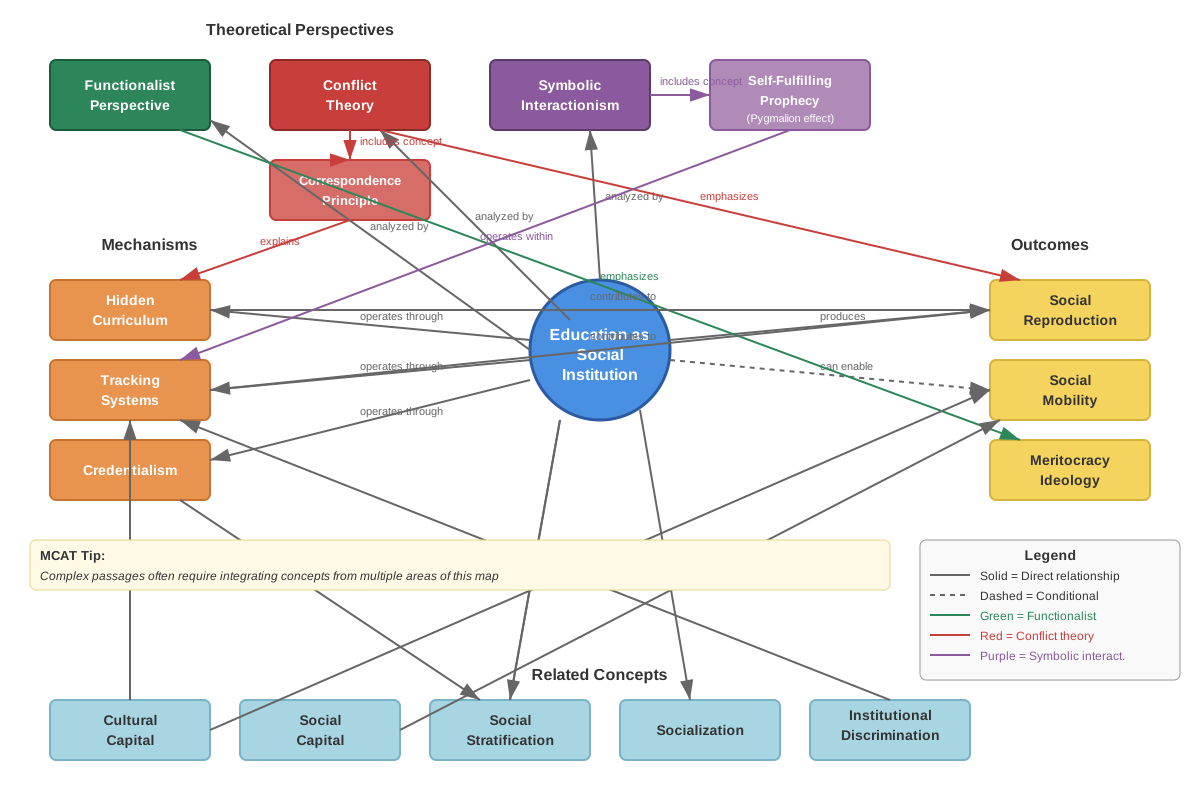
Overview
Education is a fundamental social institution that serves as the primary mechanism for transmitting knowledge, skills, values, and cultural norms from one generation to the next. Within Sociology, education represents far more than simple knowledge transfer—it functions as a critical agent of socialization, a determinant of social stratification, and a powerful force shaping both individual life trajectories and broader societal structures. The sociological study of education examines how educational systems reflect and perpetuate social inequalities, how they facilitate social mobility, and how they serve various manifest and latent functions within society.
For the MCAT, understanding Education Sociology is essential because questions frequently integrate educational concepts with themes of social inequality, cultural capital, social reproduction, and institutional power dynamics. The Psychological, Social, and Biological Foundations of Behavior section regularly presents passages examining educational disparities, tracking systems, credentialism, and the hidden curriculum. Test-takers must recognize how education intersects with race, class, gender, and other dimensions of social stratification while understanding the theoretical frameworks sociologists use to analyze educational institutions.
This topic sits at the intersection of multiple high-yield MCAT domains within Social Structure and Institutions. Education connects directly to concepts of social stratification, social mobility, cultural capital, socialization, and institutional discrimination. Understanding education requires integrating knowledge about how institutions shape individual behavior, how social inequalities are maintained across generations, and how formal and informal mechanisms of social control operate within structured settings. Mastery of education sociology provides the foundation for analyzing complex passages about healthcare access, professional socialization, and the social determinants of health outcomes.
Learning Objectives
- [ ] Define Education using accurate Sociology terminology
- [ ] Explain why Education matters for the MCAT
- [ ] Apply Education to exam-style questions
- [ ] Identify common mistakes related to Education
- [ ] Connect Education to related Sociology concepts
- [ ] Distinguish between manifest and latent functions of education
- [ ] Compare and contrast major sociological perspectives on education (functionalist, conflict theory, symbolic interactionist)
- [ ] Analyze how educational systems contribute to social reproduction and social mobility
- [ ] Evaluate the role of hidden curriculum, tracking, and credentialism in perpetuating social inequality
Prerequisites
- Social institutions: Understanding that institutions are organized patterns of beliefs and behaviors centered on basic social needs; relevant because education is analyzed as one of society's core institutions
- Social stratification: Knowledge of how societies organize hierarchically based on class, race, gender, and other dimensions; relevant because education both reflects and reinforces stratification patterns
- Socialization: Familiarity with how individuals learn cultural norms and values; relevant because education is a primary agent of secondary socialization
- Cultural capital: Understanding of non-financial social assets that promote social mobility; relevant because education transmits and validates cultural capital
- Social mobility: Knowledge of movement between social positions; relevant because education is theorized as both a pathway to mobility and a barrier maintaining inequality
Why This Topic Matters
Education sociology appears with high frequency on the MCAT, particularly in passages examining health disparities, professional development, and social determinants of health. Understanding educational systems is crucial for future physicians because educational attainment strongly correlates with health outcomes, health literacy, and healthcare access. The social processes learned through studying education—credentialism, tracking, social reproduction—directly parallel mechanisms in medical education and healthcare delivery systems.
Statistically, education-related content appears in approximately 15-20% of Sociology passages on the MCAT, often integrated with questions about social inequality, cultural transmission, or institutional discrimination. Questions typically present scenarios involving educational disparities, teacher expectations, standardized testing, or access to educational resources, then ask test-takers to identify underlying sociological mechanisms or predict outcomes based on theoretical frameworks.
Common MCAT question formats include: (1) passage-based questions presenting research on educational interventions and asking students to identify which sociological theory best explains the findings; (2) discrete questions requiring application of concepts like hidden curriculum or credentialism to novel scenarios; (3) questions asking students to distinguish between manifest and latent functions of specific educational practices; and (4) questions examining how educational tracking systems relate to social stratification and mobility. The MCAT particularly favors questions that require synthesizing education concepts with health-related outcomes, such as how educational attainment affects health behaviors or how medical school admissions processes reflect credentialism.
Core Concepts
Definition and Functions of Education
Education is the social institution through which society provides its members with important knowledge, including basic facts, job skills, and cultural norms and values. As a formal system, education encompasses structured learning environments (schools, universities) with standardized curricula, credentialing processes, and hierarchical organization. However, education also occurs informally through family, peers, media, and community interactions.
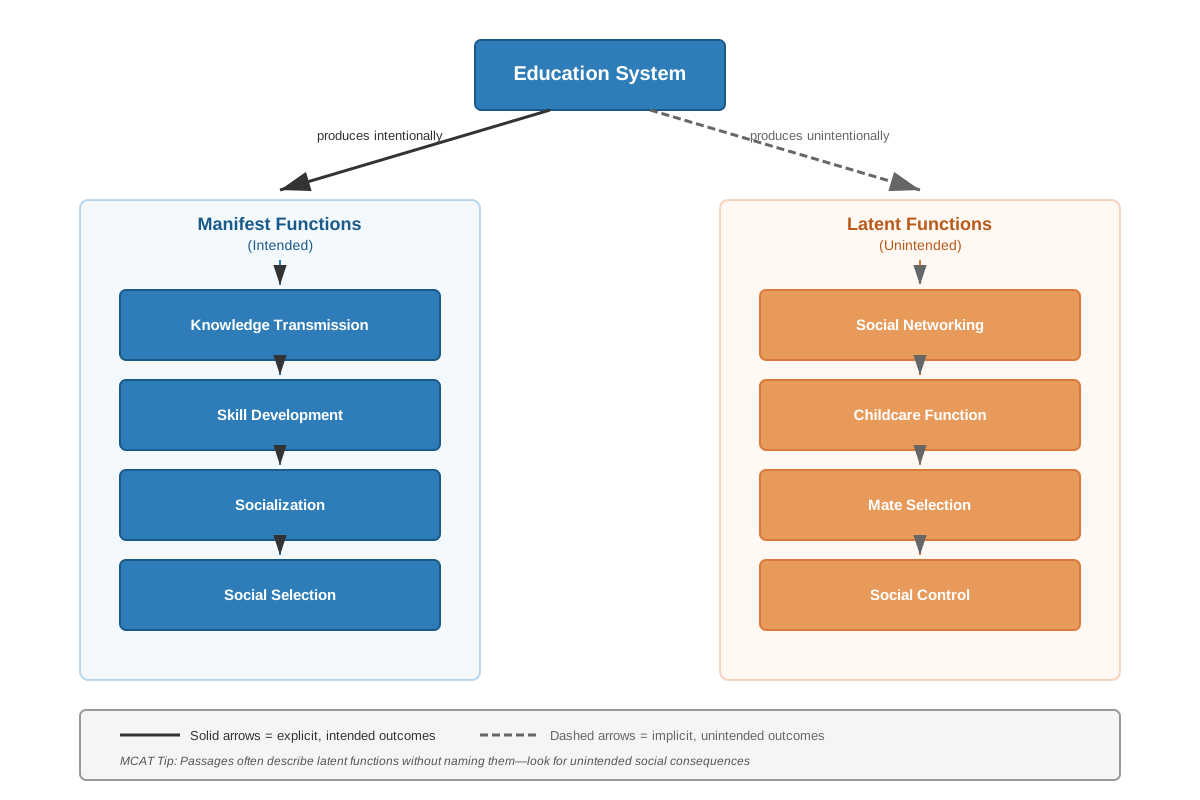
Sociologists analyze education through its manifest functions (intended, obvious purposes) and latent functions (unintended, less obvious consequences). Manifest functions include:
- Knowledge transmission: Teaching academic skills, literacy, numeracy, and specialized knowledge
- Socialization: Instilling cultural values, norms, and appropriate social behaviors
- Social placement: Sorting individuals into different social positions based on merit and achievement
- Social integration: Creating social cohesion by teaching shared values and common culture
Latent functions include:
- Childcare: Providing supervision while parents work
- Peer relationship formation: Creating social networks and friendship groups
- Establishment of social hierarchies: Creating status distinctions through grades, honors, and credentials
- Restricting labor market competition: Keeping young people out of the workforce
Theoretical Perspectives on Education
Functionalist Perspective
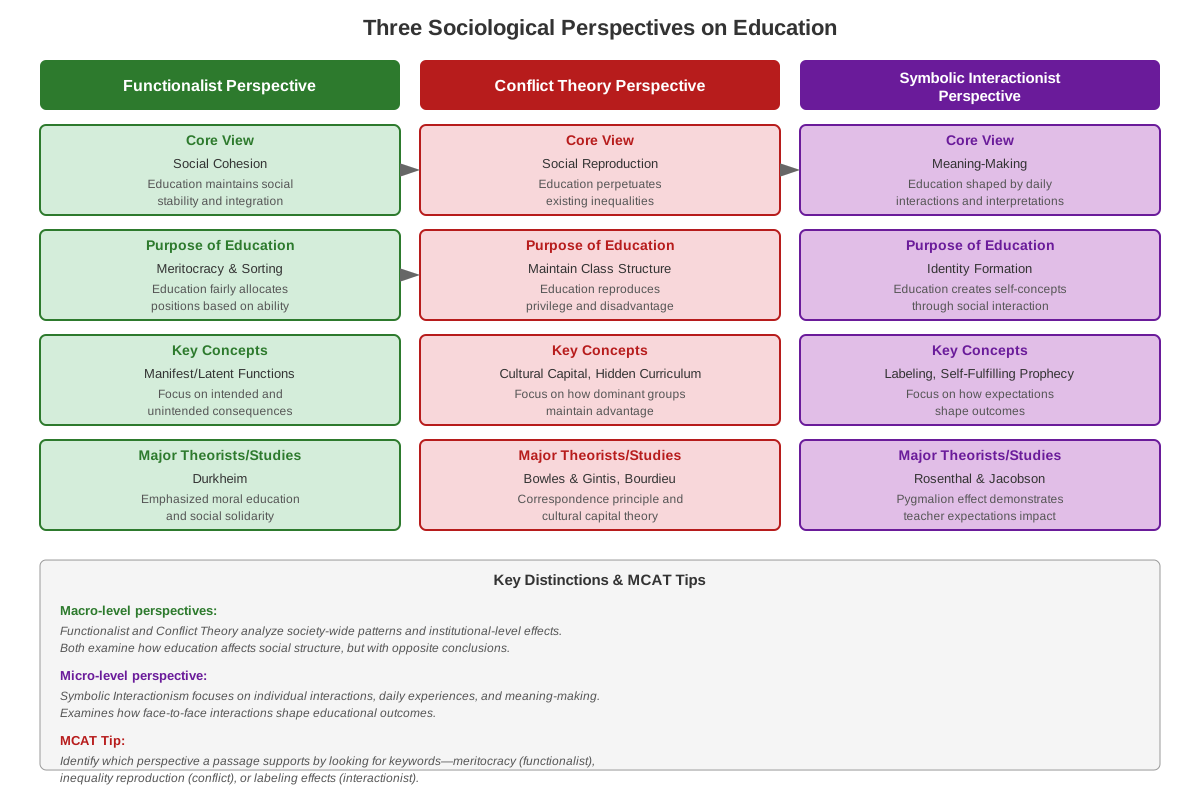
The functionalist perspective views education as serving essential functions that maintain social stability and order. Functionalists argue that education creates a meritocracy—a system where social position is determined by individual merit, talent, and effort rather than inherited status. Through standardized testing and objective evaluation, education theoretically identifies the most capable individuals and prepares them for positions requiring greater skill and responsibility.
Functionalists emphasize that education promotes social solidarity by teaching a common curriculum that transmits shared cultural values. Schools socialize students into accepting societal norms, respecting authority, following rules, and internalizing values like punctuality, discipline, and achievement orientation—all necessary for functioning in modern bureaucratic society.
Conflict Theory Perspective
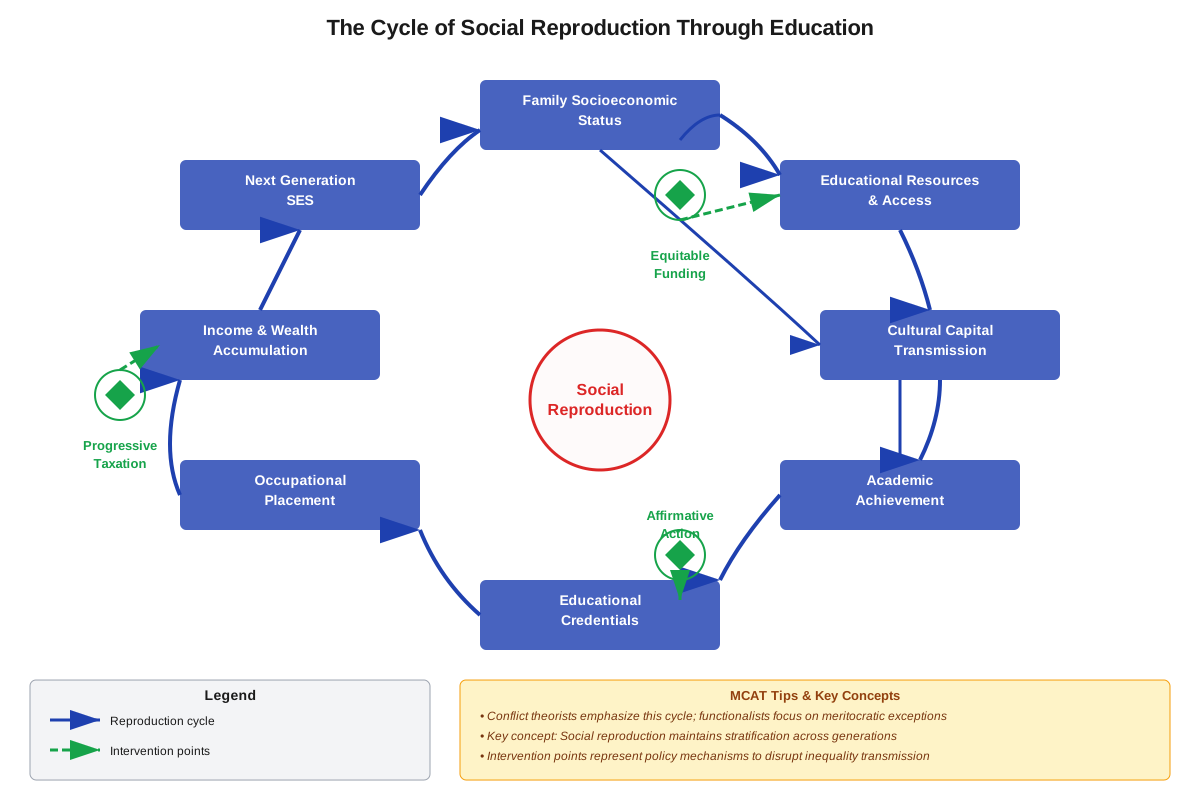
Conflict theory presents a contrasting view, arguing that education perpetuates and legitimizes social inequality rather than promoting meritocracy. From this perspective, educational systems serve the interests of dominant groups by reproducing existing class structures across generations—a process called social reproduction.
Cultural capital, a concept developed by sociologist Pierre Bourdieu, explains how education favors students from privileged backgrounds. Cultural capital includes knowledge, skills, education, and advantages that a person has, which give them a higher status in society. Students from higher socioeconomic backgrounds possess cultural capital (familiarity with high culture, sophisticated language patterns, knowledge of how institutions work) that schools reward and validate. Schools use middle- and upper-class cultural standards as the norm, disadvantaging students from working-class or marginalized backgrounds.
Credentialism represents another mechanism through which education maintains inequality. Credentialism is the emphasis on credentials (degrees, certificates, diplomas) for signaling competence and determining job eligibility, often beyond what job tasks actually require. As more people obtain degrees, credential inflation occurs—higher credentials become necessary for the same positions, advantaging those with resources to pursue extended education.
Symbolic Interactionist Perspective
The symbolic interactionist perspective focuses on micro-level interactions within educational settings, particularly how teacher expectations and labeling affect student outcomes. The self-fulfilling prophecy in education occurs when teacher expectations about student performance actually cause those expectations to become reality.
The classic Rosenthal and Jacobson study demonstrated this phenomenon: when teachers were told (falsely) that certain students were "intellectual bloomers," those randomly selected students showed greater academic gains than their peers. Teachers' beliefs influenced their interactions with students—providing more attention, encouragement, and challenging material—which shaped student self-concepts and actual performance.
Labeling theory in education examines how students internalize labels (gifted, learning disabled, troublemaker) applied by teachers and administrators, which then influences their academic identity and behavior. Once labeled, students may experience a master status—an identity that overrides all other aspects of their identity in social interactions.
Hidden Curriculum
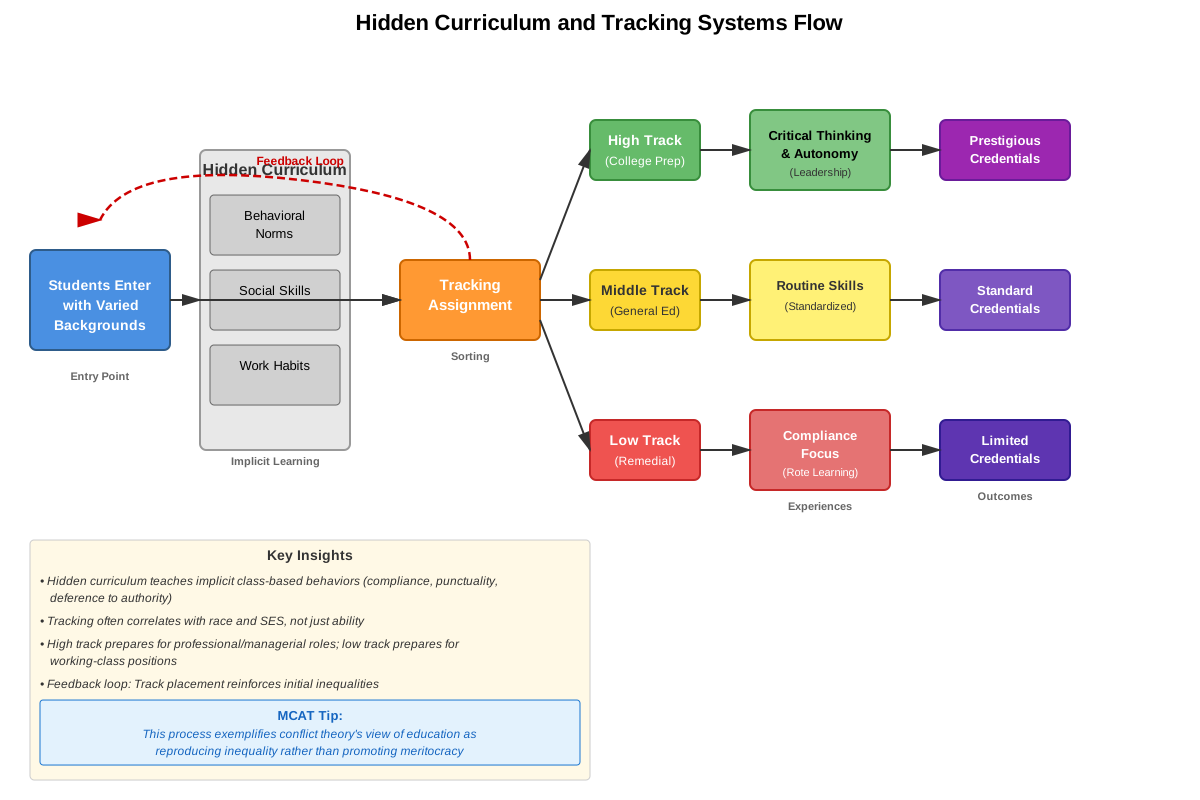
The hidden curriculum refers to lessons taught informally through the structure and culture of schooling rather than through explicit academic content. These implicit lessons teach students about authority, compliance, competition, and social hierarchies. The hidden curriculum includes:
- Obedience to authority: Students learn to follow instructions from teachers and administrators without question
- Time discipline: Adhering to schedules, bells, and deadlines prepares students for workplace expectations
- Competition: Grading systems and class rankings teach students to compete rather than collaborate
- Conformity: Dress codes, behavioral expectations, and standardized procedures emphasize fitting in
- Delayed gratification: Students learn to work for future rewards (grades, diplomas) rather than immediate satisfaction
The hidden curriculum often reinforces social class distinctions. Schools in affluent areas may emphasize creativity, critical thinking, and leadership, while schools serving working-class communities may stress rule-following, punctuality, and obedience—preparing students for different positions in the occupational hierarchy.
Tracking and Ability Grouping
Tracking (also called streaming or ability grouping) is the practice of separating students into different classes or programs based on perceived academic ability. Students may be placed in advanced, regular, or remedial tracks, often beginning in elementary school and continuing through high school.
Proponents argue tracking allows teachers to tailor instruction to student ability levels, preventing advanced students from being held back and struggling students from being overwhelmed. Critics argue tracking perpetuates inequality because:
- Track placement often reflects social background: Students from disadvantaged backgrounds are disproportionately placed in lower tracks, even when controlling for prior achievement
- Track placement becomes self-perpetuating: Lower-track students receive less challenging curriculum, less experienced teachers, and lower expectations, creating achievement gaps
- Tracking limits social mobility: Once placed in lower tracks, students rarely move upward, regardless of potential
- Tracking creates stigma: Lower-track placement negatively affects student self-concept and aspirations
Research demonstrates that tracking increases achievement gaps between high and low performers, contradicting meritocratic ideals. The practice exemplifies how educational structures can institutionalize discrimination without explicit bias.
Educational Inequality
Educational systems exhibit persistent inequalities along dimensions of socioeconomic status, race and ethnicity, and gender. These inequalities manifest in:
| Dimension | Manifestations of Inequality |
|---|---|
| Funding | Schools in wealthy districts receive more funding through property taxes; resource disparities in facilities, technology, materials |
| Teacher quality | Experienced, credentialed teachers concentrate in affluent schools; high turnover in disadvantaged schools |
| Curriculum access | Advanced Placement, honors courses, enrichment programs more available in privileged schools |
| Standardized testing | Tests reflect cultural knowledge of dominant groups; test preparation resources unequally distributed |
| Discipline | Students of color face harsher discipline for similar behaviors; school-to-prison pipeline |
| Expectations | Teacher expectations vary by student race and class; stereotype threat affects performance |
Stereotype threat occurs when individuals fear confirming negative stereotypes about their social group, which paradoxically impairs performance. For example, when reminded of stereotypes about their group's academic abilities before taking tests, students from stereotyped groups perform worse than when such stereotypes are not made salient.
Coleman Report and Educational Outcomes
The landmark 1966 Coleman Report examined educational equality in the United States and reached surprising conclusions: school resources (funding, facilities, curriculum) mattered less for student achievement than previously assumed. Instead, family background and peer effects showed stronger correlations with academic outcomes. This finding sparked ongoing debate about whether educational reform should focus on schools themselves or on broader social inequalities affecting students outside school.
The report's findings support conflict theory's emphasis on how education reflects and reproduces existing social inequalities rather than serving as an equalizing force. However, subsequent research has shown that school quality does matter, particularly for disadvantaged students, and that high-quality early childhood education can partially offset socioeconomic disadvantages.
Concept Relationships
The concepts within education sociology form an interconnected system explaining how educational institutions function and perpetuate social patterns. At the foundation, the definition of education as a social institution establishes it as a structured system serving societal needs. This connects directly to functional analysis, which identifies both manifest functions (intended purposes like knowledge transmission) and latent functions (unintended consequences like establishing social hierarchies).
The three major theoretical perspectives offer competing explanations for education's role: Functionalism → views education as promoting meritocracy and social integration → emphasizes positive functions for society. Conflict theory → views education as reproducing inequality → introduces concepts of cultural capital and credentialism → explains how privileged groups maintain advantages. Symbolic interactionism → focuses on micro-level interactions → explains self-fulfilling prophecy and labeling → shows how teacher expectations shape outcomes.
The hidden curriculum concept bridges macro and micro levels: it operates through institutional structures (macro) but affects individual socialization (micro). Hidden curriculum → teaches implicit lessons about authority and conformity → prepares students for different class positions → reinforces social reproduction.
Tracking systems exemplify how educational structures institutionalize inequality: tracking → separates students by perceived ability → often correlates with social background → provides differential curriculum and expectations → limits social mobility → perpetuates stratification. This connects tracking to both conflict theory (inequality reproduction) and symbolic interactionism (labeling effects).
Educational inequality represents the outcome of multiple mechanisms working together: unequal funding + tracking + hidden curriculum + cultural capital advantages + stereotype threat → cumulative disadvantage for marginalized groups → achievement gaps → credential disparities → occupational inequality → intergenerational transmission of disadvantage.
These education concepts connect to broader sociological topics: education links to socialization (schools as agents of secondary socialization), social stratification (education as both pathway to mobility and mechanism of reproduction), cultural transmission (education passes on cultural capital), and institutional discrimination (educational structures that disadvantage certain groups without explicit bias).
Quick check — test yourself on Education so far.
Try Flashcards →High-Yield Facts
⭐ Education serves both manifest functions (intended purposes like knowledge transmission and socialization) and latent functions (unintended consequences like childcare and establishing social hierarchies).
⭐ The hidden curriculum refers to implicit lessons taught through school structure and culture, including obedience to authority, time discipline, and conformity—often preparing students for different class positions.
⭐ Cultural capital (knowledge, skills, and cultural competencies valued by dominant groups) gives privileged students advantages in educational settings that reward middle- and upper-class cultural norms.
⭐ Tracking (ability grouping) tends to perpetuate inequality because track placement often reflects social background, provides differential curriculum quality, and becomes self-perpetuating with limited upward mobility.
⭐ Self-fulfilling prophecy in education occurs when teacher expectations about student performance cause those expectations to become reality through differential treatment and student internalization.
- Credentialism emphasizes degrees and certificates for job eligibility beyond what tasks actually require, advantaging those with resources for extended education and contributing to credential inflation.
- Conflict theory views education as reproducing social inequality across generations (social reproduction) rather than creating meritocracy, serving the interests of dominant groups.
- Functionalist perspective sees education as promoting social integration through shared values and creating meritocracy through objective evaluation of merit and talent.
- The Coleman Report found that family background and peer effects correlated more strongly with academic achievement than school resources, though subsequent research showed school quality matters especially for disadvantaged students.
- Stereotype threat occurs when awareness of negative stereotypes about one's group impairs performance, demonstrating how social psychological processes affect educational outcomes.
- Educational inequality manifests across multiple dimensions including funding disparities, teacher quality differences, curriculum access, standardized testing bias, and differential discipline practices.
- Symbolic interactionist perspective focuses on micro-level interactions in schools, examining how labeling and teacher-student interactions shape academic identities and outcomes.
Common Misconceptions
Misconception: Education is a pure meritocracy where success depends solely on individual talent and effort.
Correction: While education has meritocratic elements, substantial research demonstrates that social background, cultural capital, family resources, and institutional structures significantly influence educational outcomes independent of individual ability. Conflict theorists argue education reproduces existing inequalities more than it creates equal opportunity.
Misconception: The hidden curriculum is an intentional conspiracy by educators to indoctrinate students.
Correction: The hidden curriculum operates through institutional structures and cultural norms rather than conscious conspiracy. Most educators are unaware they are teaching implicit lessons about authority and conformity; these lessons emerge from how schools are organized (schedules, grading, hierarchies) rather than deliberate indoctrination.
Misconception: Tracking benefits all students by allowing instruction tailored to ability levels.
Correction: While tracking may benefit high-track students, research consistently shows it widens achievement gaps and disadvantages lower-track students who receive less challenging curriculum, less experienced teachers, and lower expectations. Track placement often reflects social background more than pure ability, and upward mobility between tracks is rare.
Misconception: Standardized tests provide objective, unbiased measures of student ability.
Correction: Standardized tests reflect cultural knowledge and experiences more common in privileged groups, creating systematic bias. Test preparation resources are unequally distributed, and stereotype threat can depress performance for students from negatively stereotyped groups. Tests measure achievement (what has been learned) more than innate ability.
Misconception: The manifest functions of education are more important than latent functions.
Correction: Both manifest and latent functions are sociologically significant. Latent functions like establishing social hierarchies, providing childcare, and creating peer networks profoundly affect individuals and society, even though they are unintended. Understanding latent functions is essential for complete sociological analysis.
Misconception: Cultural capital refers to financial resources families invest in education.
Correction: Cultural capital is non-financial—it includes knowledge, skills, cultural competencies, language patterns, and familiarity with dominant cultural forms. While economic capital (money) can help acquire cultural capital, they are distinct concepts. A family might have economic capital without cultural capital, or vice versa.
Misconception: Self-fulfilling prophecy means students succeed simply because they believe in themselves.
Correction: Self-fulfilling prophecy in education specifically refers to how teacher expectations influence student outcomes through differential treatment. Teachers provide more attention, encouragement, and challenging material to students they expect to succeed, which then causes those students to perform better. The mechanism operates through teacher behavior, not just student belief.
Worked Examples
Example 1: Analyzing Educational Inequality Through Theoretical Lenses
Scenario: A study finds that students from low-income families are disproportionately placed in remedial tracks, even when controlling for prior test scores. Once in remedial tracks, these students receive less experienced teachers, less challenging curriculum, and have lower graduation rates compared to students in advanced tracks. The school district argues that tracking allows teachers to provide appropriate instruction for different ability levels.
Question: Which sociological perspective best explains this pattern, and what specific concepts apply?
Analysis:
Step 1: Identify the key observations:
- Disproportionate placement by socioeconomic status (even controlling for achievement)
- Differential resources and outcomes by track
- Institutional justification based on ability differences
Step 2: Evaluate each theoretical perspective:
Functionalist perspective: Would emphasize tracking's manifest function of tailoring instruction to ability levels and efficiently sorting students for different social roles. However, this perspective struggles to explain why track placement correlates with social background independent of ability, or why the system produces unequal outcomes.
Conflict theory perspective: Best explains this pattern. Key concepts:
- Social reproduction: The tracking system reproduces class inequality across generations by providing differential education based on social background
- Institutional discrimination: The system disadvantages low-income students through structural mechanisms (tracking) without requiring explicit bias
- Legitimation of inequality: The meritocratic justification ("ability-based placement") masks how the system perpetuates privilege
- Cultural capital: Students from privileged backgrounds may perform better on assessments used for placement because tests reflect middle-class cultural knowledge
Symbolic interactionist perspective: Would focus on how track placement creates labels that become self-fulfilling prophecies—students labeled "remedial" internalize lower expectations and perform accordingly. This explains mechanisms but not the broader pattern of class-based inequality.
Step 3: Synthesize the answer:
Conflict theory best explains this pattern because it accounts for how educational structures reproduce social inequality across generations. The tracking system exemplifies social reproduction—despite meritocratic justifications, it systematically disadvantages students from low-income families through institutional discrimination. The differential resources (less experienced teachers, less challenging curriculum) provided to lower tracks ensure that initial disadvantages compound over time, limiting social mobility. The correlation between track placement and socioeconomic status (independent of prior achievement) suggests that cultural capital advantages privileged students in assessment and placement processes. The system legitimizes inequality by framing outcomes as reflecting individual ability rather than structural advantages.
Example 2: Applying Hidden Curriculum Concepts
Scenario: Dr. Martinez, a medical school professor, notices that students from elite undergraduate institutions seem more comfortable speaking up in class, questioning established practices, and proposing innovative approaches. Students from less prestigious backgrounds tend to wait for explicit instructions, follow protocols precisely, and rarely challenge authority figures. She wonders why these patterns exist despite similar academic credentials.
Question: How does the concept of hidden curriculum explain these observed differences in student behavior?
Analysis:
Step 1: Define hidden curriculum in this context:
The hidden curriculum consists of implicit lessons taught through institutional structure and culture rather than explicit content. Different educational institutions teach different hidden curricula based on the social class they primarily serve.
Step 2: Identify what different hidden curricula teach:
Elite institutions (serving upper-middle and upper-class students):
- Emphasize critical thinking, creativity, and leadership
- Encourage questioning authority and proposing alternatives
- Teach students they are future leaders who should shape systems
- Provide flexibility in how assignments are completed
- Foster confidence in challenging established practices
Less prestigious institutions (serving working and middle-class students):
- Emphasize rule-following, procedure adherence, and compliance
- Discourage questioning authority figures
- Teach students to work within existing systems
- Provide explicit instructions with less flexibility
- Foster respect for established hierarchies
Step 3: Connect to the observed pattern:
Students from elite undergraduate institutions learned through hidden curriculum that they should:
- Question established practices (they were rewarded for critical thinking)
- Speak confidently in class (participation was expected and valued)
- Propose innovations (creativity was encouraged)
- View themselves as future leaders (institutional culture conveyed this message)
Students from less prestigious backgrounds learned through hidden curriculum that they should:
- Follow protocols precisely (deviation was discouraged)
- Wait for explicit instructions (initiative was not emphasized)
- Respect authority without question (compliance was rewarded)
- Work within existing systems (their role was to execute, not design)
Step 4: Explain the sociological significance:
This pattern exemplifies how the hidden curriculum prepares students from different social backgrounds for different positions in the occupational hierarchy. Elite institutions prepare students for leadership and professional autonomy, while less prestigious institutions prepare students for positions requiring compliance and rule-following. This contributes to social reproduction—students' social class backgrounds influence what hidden curriculum they experience, which shapes their professional behaviors and trajectories, perpetuating class structures across generations.
The similar academic credentials (grades, test scores) mask these profound differences in socialization. The manifest curriculum (explicit academic content) may be similar, but the latent curriculum (implicit lessons about authority, autonomy, and one's place in hierarchies) differs substantially, affecting professional success in ways that appear to reflect individual characteristics but actually reflect differential socialization.
Exam Strategy
When approaching MCAT questions on education sociology, follow this systematic strategy:
1. Identify the theoretical perspective being tested: Most education questions require recognizing which sociological theory (functionalist, conflict, or symbolic interactionist) best explains a scenario. Look for key indicators:
- Emphasis on social integration, meritocracy, or positive functions → functionalist
- Focus on inequality reproduction, cultural capital, or credentialism → conflict theory
- Attention to teacher expectations, labeling, or micro-interactions → symbolic interactionist
2. Watch for trigger words and phrases:
- "Unintended consequences" or "informal lessons" → hidden curriculum or latent functions
- "Teacher expectations" or "labels" → self-fulfilling prophecy or labeling theory
- "Ability grouping" or "different classes based on performance" → tracking
- "Credentials required beyond job necessity" → credentialism
- "Cultural knowledge" or "middle-class advantages" → cultural capital
- "Reproducing inequality" or "maintaining class structure" → social reproduction
3. Distinguish between manifest and latent functions: Questions often present an educational practice and ask about its functions. Remember:
- Manifest = intended, obvious, explicitly stated purposes
- Latent = unintended, less obvious, implicit consequences
- Both are actual functions (not dysfunctions), just differing in intentionality
4. Apply process of elimination for theory questions:
- Eliminate functionalist answers if the scenario emphasizes inequality or disadvantage
- Eliminate conflict theory answers if the scenario emphasizes social integration or positive outcomes for all groups
- Eliminate symbolic interactionist answers if the question asks about macro-level patterns rather than individual interactions
5. Connect education to health outcomes: MCAT passages often link education to health topics. Be prepared to explain:
- How educational attainment affects health literacy and health behaviors
- How educational inequality contributes to health disparities
- How credentialism operates in medical professions
- How hidden curriculum in medical education socializes future physicians
6. Time allocation: Education questions typically require 1-1.5 minutes for discrete questions and 1.5-2 minutes for passage-based questions. If a question requires choosing between theoretical perspectives, spend time carefully evaluating each option rather than rushing—these questions reward careful analysis.
7. Beware of "common sense" answers: Education questions often include answer choices that sound correct based on everyday experience but are sociologically inaccurate. Always prioritize sociological concepts over intuitive reasoning. For example, "tracking helps all students" sounds reasonable but contradicts sociological research.
Memory Techniques
MCAT Education Functions - Mnemonic for manifest functions:
Knowledge transmission
Socialization
Placement (social)
Integration (social)
Remember: "Keep Students Properly Integrated"
Hidden Curriculum Components - Mnemonic:
Obedience to authority
Time discipline
Competition
Conformity
Delayed gratification
Remember: "OT Can Create Discipline" (OT = Occupational Therapy, linking to healthcare)
Theoretical Perspectives Quick Reference:
- Functionalist = Functions (emphasizes positive functions and integration)
- Conflict = Capital (emphasizes cultural capital and inequality)
- Symbolic Interactionist = Self-fulfilling prophecy (emphasizes micro-interactions)
Cultural Capital vs. Economic Capital:
Visualize two students:
- Student A: Wealthy family (economic capital) but no knowledge of "high culture"
- Student B: Middle-income family but extensive museum visits, classical music exposure, sophisticated vocabulary (cultural capital)
Student B has advantages in educational settings despite less money because schools reward cultural capital.
Tracking Effects Visualization:
Picture a train track that splits:
- Upper track: Gets better scenery (experienced teachers), smoother ride (challenging curriculum), faster speed (higher expectations) → reaches destination (success)
- Lower track: Gets worse scenery, rougher ride, slower speed → reaches different destination (limited opportunities)
- Once on a track, very difficult to switch (limited mobility)
Social Reproduction Cycle:
Create a mental image of a circular arrow:
Parents' social class → Cultural capital transmitted → Educational advantages → Credentials obtained → Occupational position → Becomes parents' social class for next generation → (cycle continues)
Summary
Education functions as a critical social institution that transmits knowledge, socializes individuals, and shapes social stratification patterns. Sociologists analyze education through three major theoretical perspectives: functionalism emphasizes education's positive functions in creating meritocracy and social integration; conflict theory argues education reproduces social inequality through mechanisms like cultural capital, credentialism, and tracking; and symbolic interactionism focuses on how teacher expectations and labeling create self-fulfilling prophecies. The hidden curriculum teaches implicit lessons about authority, conformity, and social hierarchies that often prepare students from different backgrounds for different class positions. Educational inequality manifests across multiple dimensions including funding, teacher quality, curriculum access, and discipline practices, with tracking systems exemplifying how institutional structures perpetuate disadvantage. Understanding education sociology is essential for the MCAT because it connects to health disparities, professional socialization, and social determinants of health, while providing frameworks for analyzing how institutions shape individual outcomes and maintain social structures across generations.
Key Takeaways
- Education serves both manifest functions (intended purposes like knowledge transmission) and latent functions (unintended consequences like establishing hierarchies), with both types being sociologically significant
- The three major theoretical perspectives offer competing explanations: functionalism emphasizes meritocracy and integration, conflict theory emphasizes inequality reproduction through cultural capital and credentialism, and symbolic interactionism emphasizes self-fulfilling prophecies and labeling effects
- The hidden curriculum teaches implicit lessons about authority, conformity, and time discipline through school structure rather than explicit content, often preparing students from different backgrounds for different class positions
- Tracking systems perpetuate inequality by providing differential curriculum quality and expectations based on perceived ability, with track placement often correlating with social background independent of actual achievement
- Cultural capital (non-financial knowledge and cultural competencies valued by dominant groups) gives privileged students systematic advantages in educational settings that reward middle- and upper-class cultural norms
- Educational inequality operates through multiple interconnected mechanisms including funding disparities, tracking, hidden curriculum, stereotype threat, and differential teacher expectations, contributing to social reproduction across generations
- Self-fulfilling prophecy occurs when teacher expectations influence student outcomes through differential treatment, demonstrating how micro-level interactions shape macro-level patterns of educational achievement
Related Topics
Social Stratification and Mobility: Understanding how education relates to broader systems of social hierarchy and movement between social positions. Mastering education sociology provides the foundation for analyzing how institutions maintain or challenge stratification systems.
Cultural Capital and Social Reproduction: Deeper exploration of Pierre Bourdieu's theories about how cultural resources transmit across generations. Education concepts provide concrete examples of how abstract theories about cultural capital operate in practice.
Socialization and Agents of Socialization: Examining how education functions as a primary agent of secondary socialization alongside family, peers, media, and religion. Understanding education enhances comprehension of how individuals internalize social norms.
Institutional Discrimination: Analyzing how organizational structures and policies create disadvantage for certain groups without requiring explicit bias. Education tracking systems exemplify institutional discrimination mechanisms.
Social Determinants of Health: Connecting educational attainment to health outcomes, health literacy, and healthcare access. Education sociology provides frameworks for understanding why educational disparities translate into health disparities.
Professionalization and Credentialism in Healthcare: Applying education concepts to medical training, licensing requirements, and healthcare hierarchies. Understanding credentialism illuminates debates about scope of practice and professional boundaries.
Practice CTA
Now that you have mastered the core concepts of education sociology, reinforce your learning by attempting practice questions and flashcards on this topic. Focus particularly on distinguishing between theoretical perspectives, identifying hidden curriculum in novel scenarios, and connecting education concepts to health-related outcomes. The more you practice applying these frameworks to MCAT-style passages, the more automatic your recognition of education sociology concepts will become on test day. Remember: education appears frequently on the MCAT, and strong mastery of this topic will significantly boost your Sociology score. You have built a solid foundation—now strengthen it through deliberate practice!
Sign up free to keep reading
Create a free AnvayaPrep account to finish this MCAT guide on Education — plus flashcards and practice questions.