Overview
Government is a fundamental social institution that plays a critical role in organizing society, maintaining order, and distributing resources and power. Within the context of Sociology and the MCAT, government represents the formal system of authority that creates and enforces rules, regulations, and policies affecting all aspects of social life. Understanding government from a sociological perspective requires examining not just its formal structures, but also how it interacts with other social structures and institutions to shape individual behavior, group dynamics, and societal outcomes.
For the MCAT, government appears frequently in passages examining health policy, healthcare access, social inequality, and public health interventions. The exam tests students' ability to analyze how governmental structures influence health outcomes, create or reduce disparities, and interact with other institutions like family, education, and the economy. Questions may present scenarios involving Medicare/Medicaid policy, public health campaigns, healthcare legislation, or the role of government in addressing social determinants of health. A strong grasp of Government Sociology enables test-takers to quickly identify power dynamics, institutional relationships, and policy implications within complex passages.
Government connects intimately with other sociological concepts including social stratification, power and authority, social movements, and collective behavior. It serves as both a product of social forces and an agent that shapes society through legislation, resource allocation, and the legitimate use of force. Understanding government's role within the broader framework of Social Structure and Institutions allows students to analyze how formal authority systems maintain social order, perpetuate or challenge inequality, and respond to social change—all high-yield themes for Government MCAT questions.
Learning Objectives
- [ ] Define Government using accurate Sociology terminology
- [ ] Explain why Government matters for the MCAT
- [ ] Apply Government to exam-style questions
- [ ] Identify common mistakes related to Government
- [ ] Connect Government to related Sociology concepts
- [ ] Distinguish between different types of governmental systems and their sociological implications
- [ ] Analyze how government legitimacy is established and maintained through Weber's framework of authority
- [ ] Evaluate the relationship between government policies and health disparities in diverse populations
Prerequisites
- Basic understanding of social institutions: Government is one of several major institutions (alongside family, education, religion, economy) that structure society; recognizing institutions as organized patterns of beliefs and behaviors is essential
- Familiarity with power and authority concepts: Government exercises both power (ability to influence others) and authority (legitimate power), making these foundational concepts necessary
- Knowledge of social stratification: Government both reflects and reinforces systems of inequality, requiring understanding of how resources and opportunities are distributed unequally
- Awareness of socialization processes: Government shapes individual behavior through laws and norms, building on how individuals learn societal expectations
Why This Topic Matters
Government appears in approximately 15-20% of MCAT Sociology passages, making it one of the highest-yield topics within Social Structure and Institutions. The MCAT frequently tests government through healthcare policy scenarios, public health interventions, and questions about institutional power and social change. Understanding government is essential for analyzing passages about healthcare access, health insurance systems, vaccination programs, environmental health regulations, and health disparities across different populations.
In clinical and real-world contexts, physicians must navigate governmental systems daily—from understanding insurance reimbursement policies to complying with healthcare regulations, from recognizing how public health policies affect patient populations to advocating for policy changes that improve health outcomes. Medical professionals work within a heavily regulated industry where government decisions directly impact clinical practice, patient access to care, and population health outcomes. The social determinants of health framework, central to modern medicine, explicitly includes government policy as a key determinant affecting health behaviors and outcomes.
On the MCAT, government typically appears in passages examining: (1) healthcare policy and reform (Medicare, Medicaid, Affordable Care Act); (2) public health interventions (vaccination mandates, smoking bans, food safety regulations); (3) health disparities and social inequality (how policies create or reduce gaps in health outcomes); (4) institutional power and social movements (how groups advocate for policy change); and (5) comparative healthcare systems (analyzing different governmental approaches to healthcare delivery). Questions often require students to identify the type of authority being exercised, analyze policy impacts on different social groups, or evaluate how governmental structures interact with other institutions.
Core Concepts
Definition and Functions of Government
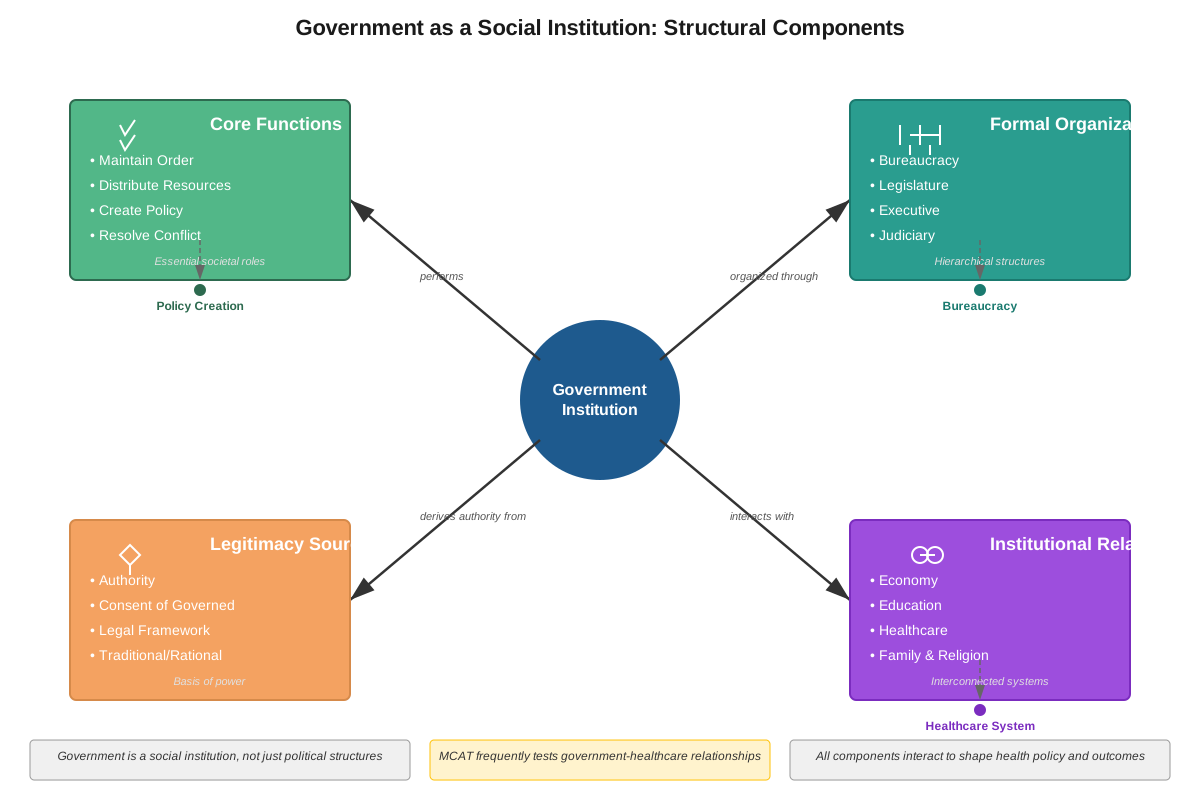
Government is the formal social institution through which power is exercised, laws are created and enforced, and societal resources are allocated. From a sociological perspective, government represents the legitimate monopoly on the use of force within a defined territory, providing the organizational structure through which collective decisions are made and implemented. Government serves several critical functions: maintaining social order and stability, protecting citizens from external threats, providing public goods and services, regulating economic activity, and mediating conflicts between groups.
The sociological study of government examines not just formal structures (constitutions, legislatures, bureaucracies) but also how governmental power is legitimized, how policies reflect and shape social stratification, and how government interacts with other institutions to produce social outcomes. Government operates at multiple levels (local, state, national, international), each with distinct powers and responsibilities that affect individuals and communities differently.
Weber's Three Types of Authority
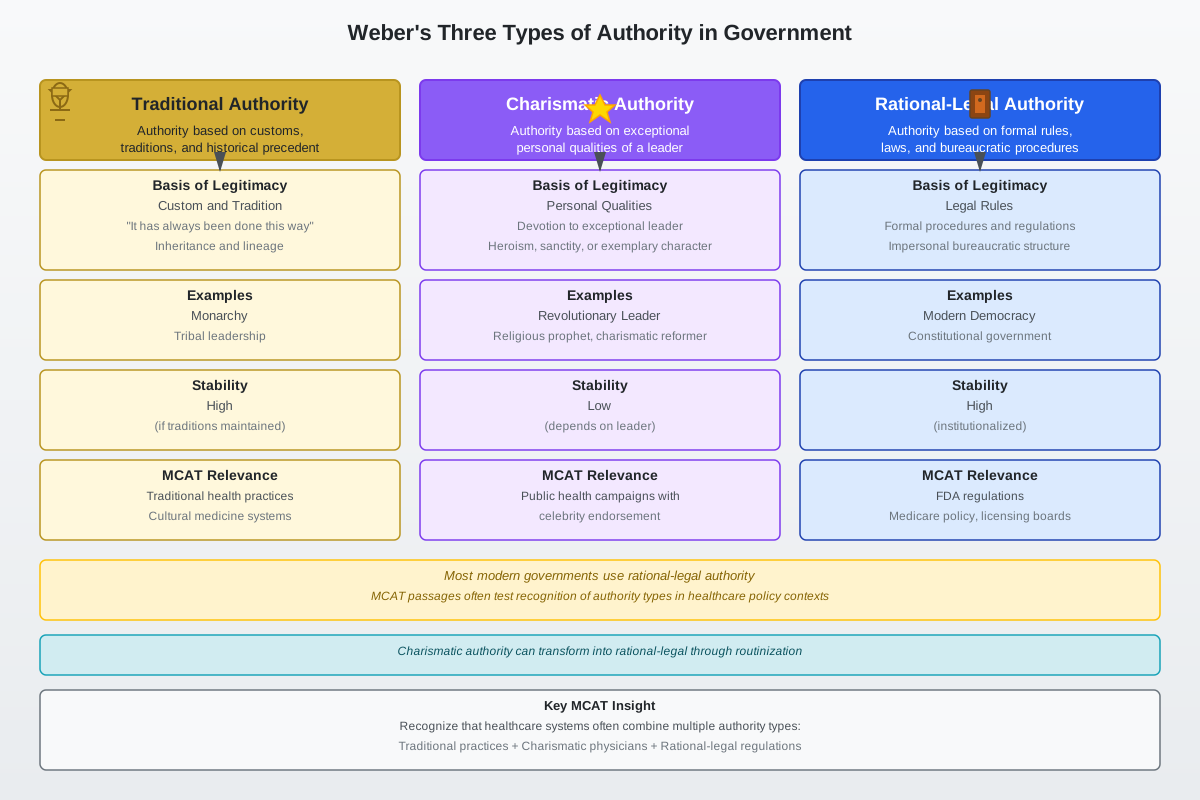
Max Weber's framework for understanding legitimate authority is essential for analyzing government on the MCAT. Authority refers to power that is perceived as legitimate by those subject to it. Weber identified three ideal types:
Traditional authority is based on long-established customs, practices, and social structures. Power is inherited or passed down through established patterns, as in monarchies or tribal leadership systems. Individuals obey because "it has always been this way." Traditional authority is stable but resistant to change and innovation.
Charismatic authority derives from the exceptional personal qualities of an individual leader. Followers believe the leader possesses extraordinary abilities, vision, or divine inspiration. This type of authority is inherently unstable because it depends on a single individual and typically faces succession crises. Revolutionary leaders, religious prophets, and transformational political figures exemplify charismatic authority.
Rational-legal authority is based on formal rules, laws, and procedures. Individuals obey not because of tradition or personal devotion but because they accept the legitimacy of the legal system and the positions within it. Modern democratic governments exemplify rational-legal authority, where officials are elected or appointed according to established procedures and exercise power within defined legal limits. This type of authority is most stable and adaptable to complex modern societies.
MCAT Exam Tip: Questions often present scenarios and ask students to identify which type of authority is being exercised. Look for keywords: "elected according to constitution" = rational-legal; "inherited throne" = traditional; "inspired followers through personal magnetism" = charismatic.
Types of Governmental Systems
Understanding different governmental systems helps analyze how power is distributed and exercised:
| Government Type | Power Distribution | Decision-Making | MCAT Relevance |
|---|---|---|---|
| Democracy | Citizens hold ultimate power through voting | Majority rule with minority rights protection | Healthcare policy debates, voting on health initiatives |
| Authoritarian | Power concentrated in single leader/small group | Top-down with limited citizen input | Public health mandates, limited healthcare choice |
| Totalitarian | Complete control over public and private life | State controls all aspects of society | Extreme public health measures, propaganda |
| Monarchy | Power held by hereditary ruler | Varies from absolute to constitutional | Traditional authority examples |
| Oligarchy | Power held by small elite group | Elite decision-making | Healthcare access limited to privileged groups |
Representative democracy, the system in the United States, involves citizens electing officials to make decisions on their behalf. This system balances direct citizen participation with practical governance of large, complex societies. Understanding representative democracy is crucial for analyzing healthcare policy formation, where elected officials create legislation affecting health insurance, public health programs, and medical regulations.
Government and Social Stratification
Government both reflects and reinforces systems of social stratification—the hierarchical arrangement of individuals into social classes based on wealth, power, and prestige. Policies can either reduce inequality (progressive taxation, social welfare programs, universal healthcare) or perpetuate it (regressive taxation, limited social services, unequal enforcement of laws).
The conflict theory perspective views government as an instrument through which dominant groups maintain their power and privilege. Laws and policies reflect the interests of those with economic and political power, while appearing neutral or beneficial to all. For example, healthcare policies that favor employer-based insurance may benefit corporations and higher-income workers while disadvantaging low-wage workers and the unemployed.
Conversely, functionalist theory views government as serving society's needs by maintaining order, providing essential services, and coordinating collective action. From this perspective, government policies represent society's collective values and needs, with healthcare policies reflecting societal decisions about balancing individual responsibility and collective welfare.
Government and Healthcare Systems
The MCAT frequently tests understanding of how different governmental approaches shape healthcare delivery and outcomes:
Single-payer systems involve government financing healthcare for all citizens, typically funded through taxation. Examples include Canada's Medicare system and the United Kingdom's National Health Service. These systems generally provide universal coverage and control costs through centralized negotiation but may face challenges with wait times and limited choice.
Multi-payer systems involve multiple insurance sources, including government programs for specific populations (elderly, poor, veterans) and private insurance for others. The United States exemplifies this approach, with Medicare (elderly), Medicaid (low-income), Veterans Affairs (veterans), and private insurance (employed/individual market). This system offers choice and innovation but creates coverage gaps and higher administrative costs.
Universal healthcare refers to systems ensuring all citizens have access to healthcare services, regardless of ability to pay. This can be achieved through various governmental approaches (single-payer, regulated private insurance, mixed systems). Understanding universal healthcare is essential for analyzing health equity and access questions on the MCAT.
Policy Formation and Implementation
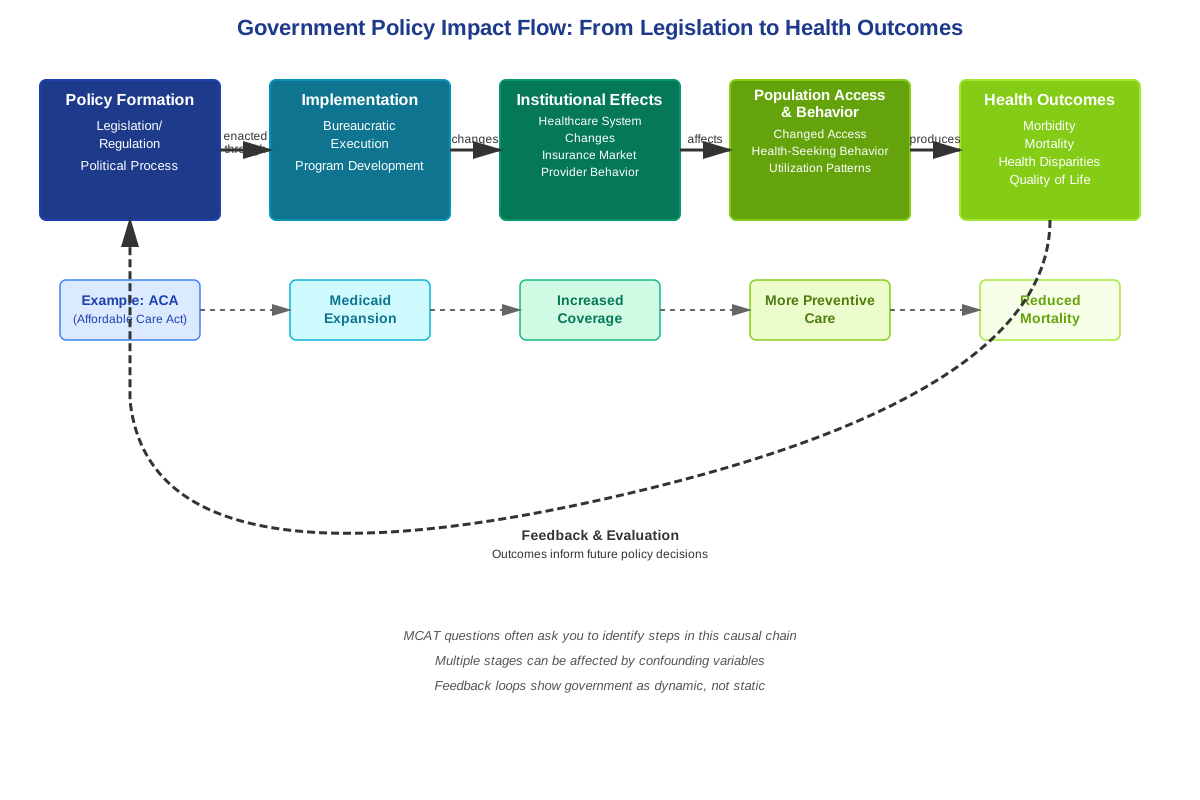
Government creates policy through a complex process involving multiple actors and stages:
- Agenda setting: Issues gain attention from policymakers through public pressure, advocacy groups, media coverage, or crisis events
- Policy formulation: Proposed solutions are developed, debated, and refined through legislative processes
- Adoption: Policies are formally enacted through legislation, executive orders, or regulatory decisions
- Implementation: Bureaucratic agencies translate policies into programs and services
- Evaluation: Policies are assessed for effectiveness, efficiency, and unintended consequences
Understanding this process helps analyze MCAT passages about healthcare reform, public health interventions, and policy impacts on health outcomes. Questions may ask about barriers to policy implementation, why certain groups are affected differently by policies, or how policies might be modified to achieve better outcomes.
Government Legitimacy and Social Contract
Legitimacy refers to the widespread belief that government authority is rightful and should be obeyed. Governments maintain legitimacy through various mechanisms: delivering effective services, protecting citizens, following established procedures, representing citizen interests, and maintaining order. When legitimacy erodes, governments face resistance, protests, and potential instability.
The social contract theory, developed by philosophers like Hobbes, Locke, and Rousseau, proposes that individuals consent to surrender some freedoms to government in exchange for protection of remaining rights and maintenance of social order. This concept underlies democratic governance and helps explain why citizens generally comply with laws and policies, including public health measures that restrict individual behavior for collective benefit.
Concept Relationships
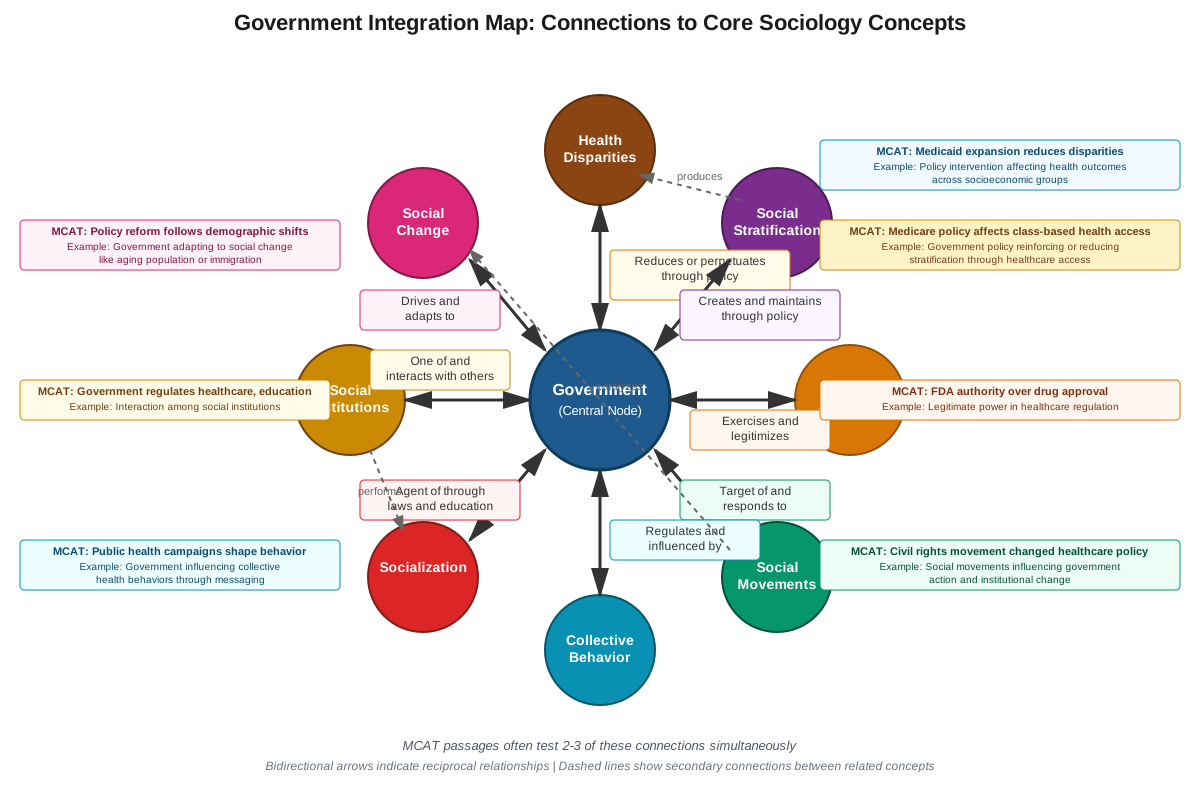
Government concepts interconnect in multiple ways that are frequently tested on the MCAT. Weber's authority types → explain how government legitimacy is established and maintained → which affects policy compliance and effectiveness. For example, rational-legal authority in modern democracies → creates formal policy-making processes → that produce healthcare legislation → which shapes health outcomes and disparities.
Government connects to social stratification through a bidirectional relationship: existing inequalities → influence who holds political power and whose interests are represented → which shapes policies → that either reduce or perpetuate stratification → affecting health disparities. This cycle is central to understanding how social determinants of health operate through governmental mechanisms.
The relationship between government and other institutions creates complex interactions: Government ↔ Economy (regulation, taxation, public spending); Government ↔ Education (funding, curriculum standards, access policies); Government ↔ Family (marriage laws, child welfare, parental leave); Government ↔ Healthcare (insurance regulation, public health programs, medical licensing). These institutional relationships frequently appear in MCAT passages requiring students to analyze how changes in one institution affect others.
Policy formation process → connects to social movements and collective behavior → as groups organize to influence government decisions → leading to policy changes → that alter institutional structures and social outcomes. Understanding this relationship helps analyze passages about healthcare advocacy, patient rights movements, and public health campaigns.
Government legitimacy → affects policy compliance → which determines policy effectiveness → influencing health outcomes. This relationship explains why public health interventions succeed or fail based on whether citizens view governmental authority as legitimate and policies as justified.
Quick check — test yourself on Government so far.
Try Flashcards →High-Yield Facts
⭐ Government is the formal institution with legitimate monopoly on the use of force within a defined territory, creating and enforcing laws and allocating resources.
⭐ Weber's three types of authority are traditional (based on custom), charismatic (based on personal qualities), and rational-legal (based on formal rules and procedures).
⭐ Rational-legal authority characterizes modern democratic governments and is the most stable form for complex societies.
⭐ Government policies can either reduce health disparities (universal healthcare, social welfare programs) or perpetuate them (unequal access, regressive policies).
⭐ The U.S. healthcare system is a multi-payer system with government programs (Medicare, Medicaid) and private insurance, creating coverage gaps and administrative complexity.
- Single-payer healthcare systems involve government financing for all citizens, typically providing universal coverage with centralized cost control.
- Policy formation involves agenda setting, formulation, adoption, implementation, and evaluation stages, each presenting opportunities for influence and barriers to change.
- Government legitimacy depends on delivering effective services, following established procedures, and representing citizen interests; loss of legitimacy leads to resistance and instability.
- Conflict theory views government as serving dominant group interests, while functionalist theory sees government as serving society's collective needs.
- Social contract theory explains why citizens comply with laws by proposing that individuals exchange some freedoms for protection and social order.
- Representative democracy involves citizens electing officials to make decisions on their behalf, balancing participation with practical governance.
- Public health interventions (vaccination mandates, smoking bans, food regulations) represent government's role in protecting population health, sometimes restricting individual freedoms for collective benefit.
Common Misconceptions
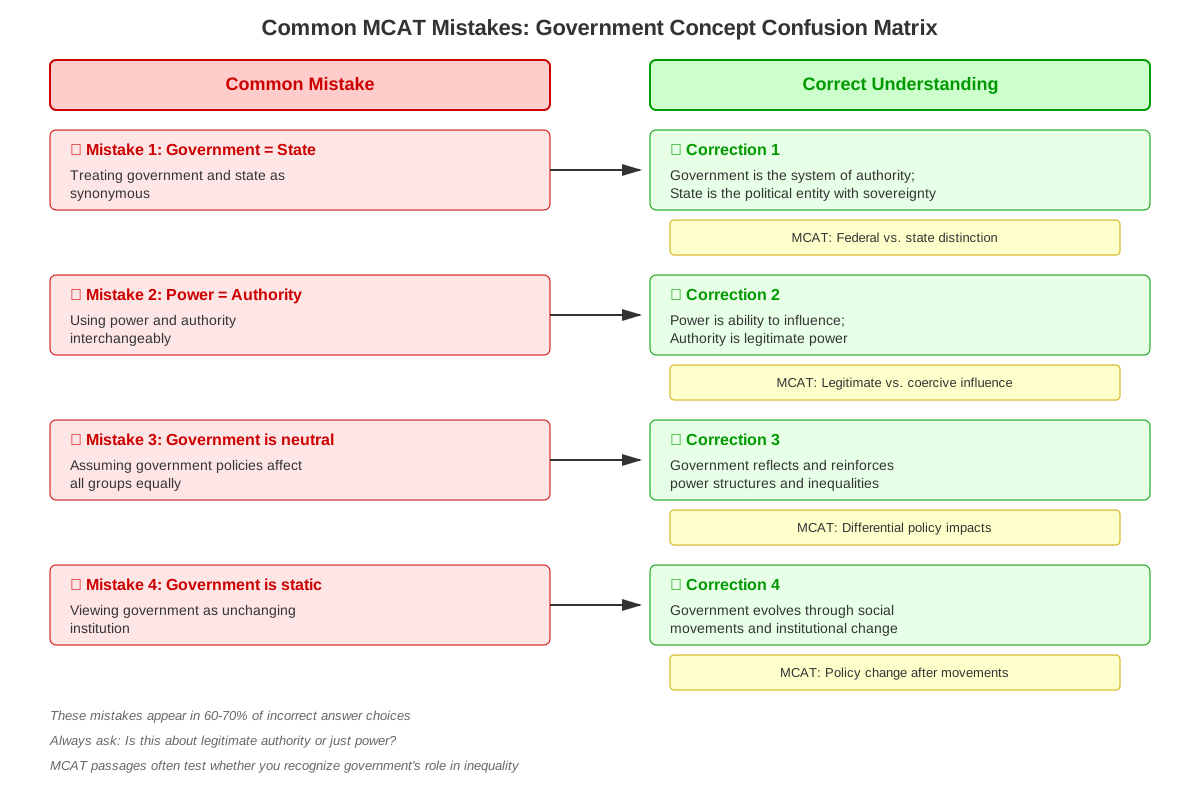
Misconception: Government and state are interchangeable terms with identical meanings.
Correction: While often used interchangeably in casual conversation, sociologically the state refers to the broader political organization including territory, population, and sovereignty, while government refers specifically to the institutions and officials who exercise state power. The state is permanent; governments change through elections or other transitions.
Misconception: Democracy means everyone participates directly in all governmental decisions.
Correction: Modern democracies are typically representative democracies where citizens elect officials to make decisions on their behalf. Direct democracy (citizens voting on every issue) is impractical for large, complex societies. The MCAT tests understanding of representative systems and how they affect policy formation.
Misconception: Charismatic authority is always positive and beneficial for society.
Correction: While charismatic leaders can inspire positive change, charismatic authority is inherently unstable and can lead to authoritarian rule, cult of personality, and succession crises. The MCAT may present scenarios where charismatic authority leads to problematic outcomes, testing students' ability to analyze authority types critically.
Misconception: Government policies affect all social groups equally.
Correction: Policies have differential impacts based on social stratification, with some groups benefiting more than others. Healthcare policies, for example, may disproportionately affect low-income populations, racial minorities, or rural communities. The MCAT frequently tests understanding of how policies create or reduce health disparities.
Misconception: Universal healthcare and single-payer healthcare are the same thing.
Correction: Universal healthcare means all citizens have access to healthcare services; single-payer is one method of achieving universal coverage through government financing. Universal coverage can also be achieved through regulated private insurance (Germany) or mixed systems (France). The MCAT may test ability to distinguish between healthcare coverage goals and financing mechanisms.
Misconception: Rational-legal authority eliminates all bias and inequality in government.
Correction: While rational-legal authority is based on formal rules and procedures, these rules can still reflect and perpetuate existing inequalities. Laws may appear neutral but have disparate impacts on different groups. The MCAT tests critical analysis of how formal governmental structures interact with social stratification.
Misconception: Government legitimacy is permanent once established.
Correction: Legitimacy must be continuously maintained through effective governance, representation, and service delivery. Governments can lose legitimacy through corruption, ineffectiveness, or failure to represent citizen interests, leading to protests, resistance, and potential regime change. Understanding legitimacy as dynamic is important for analyzing social movements and policy compliance.
Worked Examples
Example 1: Analyzing Authority Types in Healthcare Policy
Passage Scenario: A newly elected president implements a comprehensive healthcare reform program based on campaign promises. The president's personal story of overcoming illness without insurance resonated with voters, and supporters view the president as uniquely qualified to fix the healthcare system. The reform passes through Congress following constitutional procedures and is implemented by the Department of Health and Human Services according to established regulations.
Question: Which type(s) of authority are demonstrated in this scenario?
Analysis:
Step 1: Identify authority indicators in the passage
- "Elected president" and "constitutional procedures" → rational-legal authority
- "Personal story resonated" and "uniquely qualified" → charismatic authority
- "Implemented by Department of Health and Human Services according to established regulations" → rational-legal authority
Step 2: Recognize that multiple authority types can coexist
Weber's types are ideal types; real-world leaders often combine elements. The president exercises rational-legal authority through the formal position but also draws on charismatic authority through personal appeal.
Step 3: Determine which type is primary for the governmental action
The healthcare reform is enacted through constitutional procedures (Congress) and implemented through bureaucratic agencies (HHS), making rational-legal authority the primary mechanism, even though charismatic authority contributed to the president's election and public support.
Answer: The scenario demonstrates primarily rational-legal authority (formal procedures, constitutional processes, bureaucratic implementation) with elements of charismatic authority (personal appeal, unique qualification beliefs) supporting the leader's political power.
Connection to Learning Objectives: This example applies government concepts to exam-style questions by requiring identification of authority types in a healthcare policy context, demonstrating how the MCAT tests government through health-related scenarios.
Example 2: Evaluating Policy Impact on Health Disparities
Passage Scenario: A state government implements a new health insurance program requiring all residents to purchase coverage or pay a penalty. Subsidies are available for individuals earning below 200% of the federal poverty level. The program increases overall insurance coverage rates from 85% to 92%. However, analysis shows that coverage gains were concentrated among middle-income residents, while low-income residents' coverage increased only slightly. Many low-income residents report that even with subsidies, premiums remain unaffordable, and the penalty is less expensive than purchasing insurance.
Question: From a conflict theory perspective, how would a sociologist interpret these policy outcomes?
Analysis:
Step 1: Recall conflict theory's view of government
Conflict theory views government as serving dominant group interests and perpetuating inequality, even when policies appear neutral or beneficial.
Step 2: Identify who benefits and who is disadvantaged
- Middle-income residents gained coverage (benefited)
- Low-income residents gained little coverage despite being target population (disadvantaged)
- Policy appears neutral (everyone must purchase insurance) but has differential impacts
Step 3: Analyze structural barriers
- Subsidies insufficient for lowest-income residents
- Penalty less than insurance cost creates rational choice to remain uninsured
- Policy design reflects middle-class assumptions about affordability
Step 4: Connect to broader patterns of stratification
The policy perpetuates health disparities by failing to address structural barriers facing low-income populations, potentially widening the gap between middle-income and low-income health outcomes.
Answer: A conflict theorist would interpret these outcomes as demonstrating how government policies, while appearing neutral, actually serve middle-class interests and perpetuate inequality. The policy's design reflects the political power of middle-income groups while failing to adequately address low-income residents' structural barriers to coverage, thereby maintaining stratification in healthcare access and likely health outcomes.
Connection to Learning Objectives: This example connects government to related sociology concepts (conflict theory, social stratification, health disparities) and demonstrates how to apply sociological frameworks to analyze policy outcomes—a common MCAT question type.
Exam Strategy
When approaching MCAT questions on government, first identify whether the question asks about: (1) authority types and legitimacy, (2) governmental systems and structures, (3) policy formation and implementation, or (4) policy impacts on health outcomes and disparities. This categorization helps activate relevant knowledge and eliminate incorrect answers.
Trigger words for authority types: "Elected" or "constitutional" → rational-legal; "inherited" or "traditional" → traditional; "inspired followers" or "personal magnetism" → charismatic. Questions often describe a scenario and ask which authority type is demonstrated, so scan for these keywords quickly.
Trigger words for policy impact questions: "Disparities," "unequal outcomes," "differential effects," "vulnerable populations" → analyze how policies affect different social groups. These questions typically require applying conflict theory or understanding social stratification. Look for which groups benefit and which are disadvantaged.
Process-of-elimination tips: When questions present policy scenarios, eliminate answers that: (1) assume policies affect all groups equally (they rarely do), (2) confuse authority types (traditional vs. rational-legal), (3) conflate universal healthcare with single-payer systems, or (4) ignore structural barriers to policy effectiveness. MCAT answers typically require nuanced understanding of how formal structures interact with social inequality.
For passage-based questions: Identify the governmental level (local, state, national) and type of policy (healthcare, public health, regulation) early in the passage. Note which populations are discussed and any outcome data provided. Questions will likely ask about policy impacts on these specific populations or require applying sociological theories to explain outcomes.
Time allocation: Government questions are typically straightforward if you know the core concepts. Spend 60-70 seconds on discrete questions identifying authority types or governmental systems. Allocate 90-110 seconds for passage-based questions requiring policy analysis or application of sociological theories. If a question requires complex analysis of multiple institutional interactions, mark it and return if time permits—these questions can be time-consuming.
Common question formats: (1) "Which type of authority is demonstrated?" → identify keywords for Weber's types; (2) "How would a [conflict/functionalist] theorist interpret this policy?" → apply theoretical framework; (3) "Why did this policy have different effects on different groups?" → analyze structural barriers and stratification; (4) "What explains public resistance to this policy?" → consider legitimacy and social contract concepts.
Memory Techniques
Mnemonic for Weber's Authority Types - "TRC":
- Traditional = Time-honored customs (think: throne, inherited)
- Rational-legal = Rules and regulations (think: republic, constitution)
- Charismatic = Compelling personality (think: charisma, personal magnetism)
Mnemonic for Policy Formation Stages - "AFAIE":
Agenda setting → Formulation → Adoption → Implementation → Evaluation
Memory aid: "A FAIr Evaluation" (policies need fair evaluation)
Visualization for Government Functions:
Picture a government building with five pillars, each representing a core function:
- Order pillar (police badge) = maintaining social order
- Protection pillar (shield) = defending from external threats
- Services pillar (hospital/school) = providing public goods
- Regulation pillar (scales) = regulating economy and society
- Mediation pillar (gavel) = resolving conflicts
Acronym for Healthcare System Types - "SUM":
- Single-payer = government finances all healthcare
- Universal = everyone has access (goal, not method)
- Multi-payer = multiple insurance sources (U.S. system)
Memory technique for Legitimacy Maintenance:
"PROPER government maintains legitimacy":
- Protection of citizens
- Representation of interests
- Order maintenance
- Procedures followed
- Effective services
- Rights respected
Summary
Government is the formal social institution exercising legitimate authority to create and enforce laws, allocate resources, and maintain social order within a defined territory. Understanding government from a sociological perspective requires analyzing how authority is legitimized (Weber's traditional, charismatic, and rational-legal types), how governmental structures distribute power (democracy, authoritarianism, monarchy), and how policies interact with social stratification to produce differential outcomes across populations. For the MCAT, government appears most frequently in healthcare policy contexts, requiring students to analyze how governmental decisions affect health access, outcomes, and disparities. Key concepts include distinguishing between authority types, understanding policy formation and implementation processes, recognizing how different healthcare systems (single-payer, multi-payer, universal coverage) structure access to care, and applying sociological theories (conflict, functionalist) to explain policy outcomes. Government both reflects existing social inequalities and shapes future stratification through policy decisions, making it essential for understanding health disparities and social determinants of health—central themes in MCAT Sociology passages.
Key Takeaways
- Government is the formal institution with legitimate monopoly on force, creating laws and allocating resources; Weber's three authority types (traditional, charismatic, rational-legal) explain how governmental power is legitimized
- Rational-legal authority, based on formal rules and procedures, characterizes modern democratic governments and is most stable for complex societies
- Government policies have differential impacts on social groups based on stratification, either reducing or perpetuating health disparities—a frequent MCAT testing point
- The U.S. multi-payer healthcare system (Medicare, Medicaid, private insurance) differs from single-payer systems (government finances all care), though both can achieve universal coverage
- Policy formation involves multiple stages (agenda setting, formulation, adoption, implementation, evaluation), each presenting opportunities for influence and barriers to effectiveness
- Conflict theory views government as serving dominant interests, while functionalist theory sees government as serving collective needs—frameworks frequently tested for analyzing policy outcomes
- Government legitimacy depends on effective service delivery, procedural compliance, and representation; loss of legitimacy leads to resistance and reduced policy compliance
Related Topics
Social Movements and Collective Behavior: Understanding how groups organize to influence government policy connects directly to government concepts, explaining how policies change in response to social pressure and how citizens exercise power outside formal governmental structures.
Social Stratification and Inequality: Government's role in creating, maintaining, or reducing inequality is central to understanding health disparities; mastering stratification concepts enables deeper analysis of policy impacts on different social groups.
Healthcare Systems and Policy: Building on government foundations, this topic examines specific healthcare delivery models, insurance systems, and policy interventions affecting health access and outcomes—directly applicable to clinical practice.
Power and Authority: Deeper exploration of how power operates in society, including informal power structures, organizational power, and the relationship between power and social change, extends government concepts beyond formal institutions.
Social Institutions: Examining how government interacts with other major institutions (family, education, economy, religion) provides comprehensive understanding of how society is organized and how institutional changes affect health and behavior.
Practice CTA
Now that you've mastered the core concepts of government and its role in social structure and institutions, test your understanding with practice questions and flashcards. Focus on applying Weber's authority types to scenarios, analyzing policy impacts on different populations, and connecting government concepts to healthcare outcomes. Remember that government appears in approximately 15-20% of MCAT Sociology passages, making this one of your highest-yield study topics. Your ability to quickly identify authority types, analyze policy implications, and connect governmental structures to health disparities will directly translate to points on test day. Challenge yourself with timed practice to build speed and confidence—you've got this!
Sign up free to keep reading
Create a free AnvayaPrep account to finish this MCAT guide on Government — plus flashcards and practice questions.