Overview
Percent decrease is a fundamental mathematical concept that measures the relative reduction in a quantity from an original value to a new, smaller value. This topic appears frequently on the SAT and represents one of the most practical applications of percentages students will encounter both on the exam and in real-world contexts. Understanding percent decrease enables students to analyze price reductions, population declines, depreciation of assets, and any scenario where a quantity diminishes over time.
On the SAT, sat percent decrease questions test not only computational skills but also conceptual understanding and the ability to work backward from given information. These problems often appear in both the calculator and no-calculator sections, embedded within word problems that require careful reading and translation of verbal descriptions into mathematical expressions. The College Board consistently includes 2-4 questions per test that directly or indirectly involve percent decrease calculations, making this a high-yield topic for score improvement.
Mastering percent decrease strengthens broader math competencies including proportional reasoning, algebraic manipulation, and problem-solving strategies. This topic connects directly to percent increase, ratios, and linear functions, forming part of the foundational percentage skills that underpin approximately 10-15% of all SAT Math questions. Students who develop fluency with percent decrease gain confidence tackling multi-step problems and can more efficiently navigate the time constraints of the exam.
Learning Objectives
- [ ] Identify key features of percent decrease including the original value, new value, and the decrease amount
- [ ] Explain how percent decrease appears on the SAT in various question formats and contexts
- [ ] Apply percent decrease to answer SAT-style questions accurately and efficiently
- [ ] Calculate the percent decrease given original and new values using the standard formula
- [ ] Determine original values when given the final value and percent decrease
- [ ] Distinguish between percent decrease and absolute decrease in problem contexts
- [ ] Solve multi-step problems involving successive percent decreases
Prerequisites
- Basic percentage concepts: Understanding that percentages represent parts per hundred is essential for interpreting what a percent decrease means
- Fraction and decimal conversions: Converting between percentages, decimals, and fractions enables flexible problem-solving approaches
- Algebraic equation solving: Setting up and solving equations is necessary when working backward from final values to find original amounts
- Subtraction and basic arithmetic: Computing the absolute decrease (original minus new value) forms the foundation of percent decrease calculations
Why This Topic Matters
Percent decrease has immediate real-world applications that students encounter regularly: calculating sale discounts, understanding depreciation of vehicles and electronics, analyzing population trends, measuring weight loss progress, and interpreting economic indicators like unemployment rate reductions. Financial literacy depends heavily on understanding how values decrease proportionally, making this skill valuable far beyond the SAT.
On the SAT specifically, percent decrease questions appear in approximately 2-4 questions per test administration, representing roughly 4-7% of the total Math section. These questions typically appear as word problems in both multiple-choice and student-produced response formats. The College Board frequently embeds percent decrease within more complex scenarios involving tables, graphs, or multi-step reasoning, testing whether students can extract relevant information and apply the correct formula.
Common SAT question types include: calculating the percent decrease between two given values, finding an original price before a discount, determining a new value after a specified percent decrease, comparing multiple percent decreases, and analyzing scenarios with successive decreases. Questions often appear in contexts such as retail pricing, population statistics, scientific measurements, and business scenarios. The ability to quickly recognize percent decrease situations and apply the appropriate formula directly impacts both accuracy and time management on test day.
Core Concepts
The Percent Decrease Formula
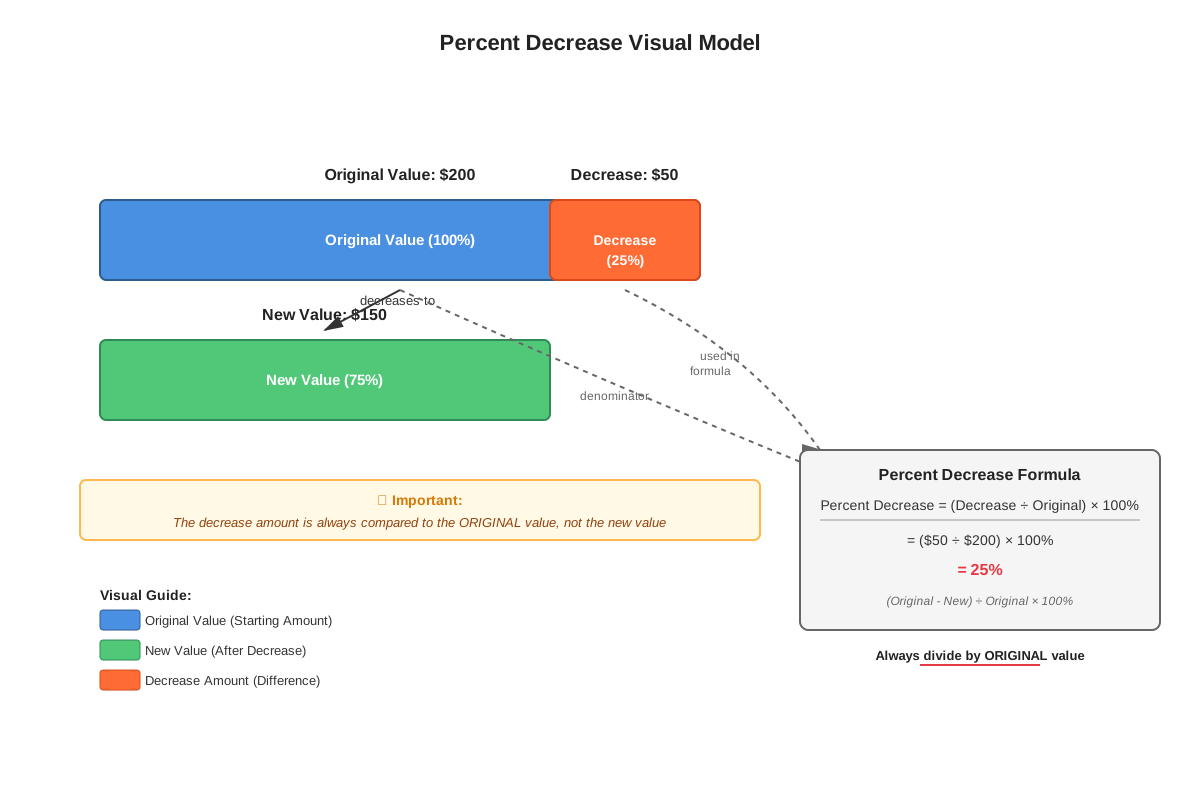
The fundamental percent decrease formula expresses the proportional reduction from an original value to a new, smaller value:
Percent Decrease = (Original Value - New Value) / Original Value × 100%Alternatively, this can be written as:
Percent Decrease = (Amount of Decrease) / Original Value × 100%The numerator represents the absolute decrease—the actual numerical difference between the starting and ending values. The denominator must always be the original (starting) value, not the new value. This distinction is critical and represents one of the most common error sources on the SAT.
For example, if a laptop's price drops from $800 to $600, the absolute decrease is $200. The percent decrease is calculated as: (200/800) × 100% = 25%. Notice that the denominator uses the original price of $800, not the sale price of $600.
Components of Percent Decrease Problems
Every percent decrease problem involves three key quantities:
- Original Value (Initial Amount): The starting quantity before any reduction occurs
- New Value (Final Amount): The resulting quantity after the decrease
- Percent Decrease: The proportional reduction expressed as a percentage
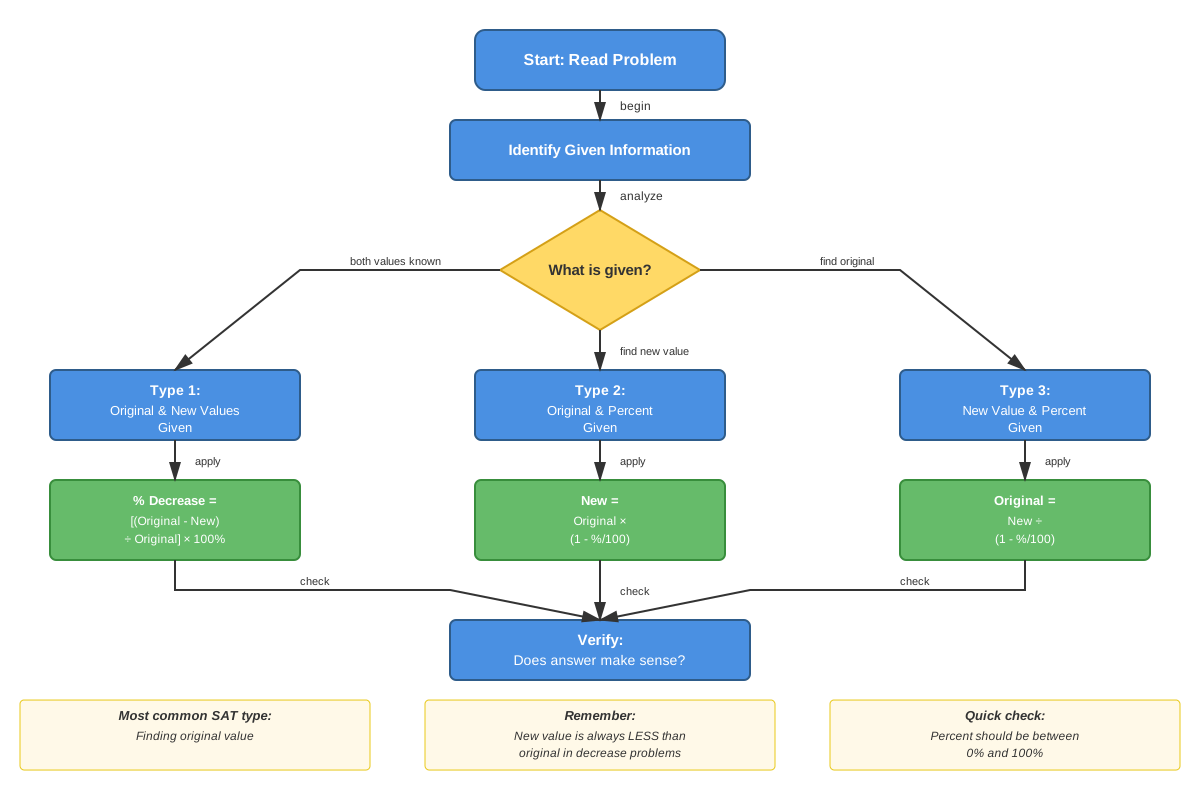
SAT questions typically provide two of these three values and ask students to find the third. Understanding which values are given and which must be calculated is the first step in solving any percent decrease problem.
| Given Information | Unknown | Solution Approach |
|---|---|---|
| Original & New Values | Percent Decrease | Use standard formula: (Original - New)/Original × 100% |
| Original Value & Percent Decrease | New Value | Calculate: New = Original × (1 - Percent/100) |
| New Value & Percent Decrease | Original Value | Solve: Original = New / (1 - Percent/100) |
Finding New Value After a Percent Decrease
When the original value and percent decrease are known, the new value can be calculated using the multiplier method:
New Value = Original Value × (1 - Percent Decrease/100)The expression (1 - Percent Decrease/100) represents the retention factor—the proportion of the original value that remains after the decrease. For a 30% decrease, the retention factor is 0.70, meaning 70% of the original value remains.
For example, if a population of 50,000 decreases by 12%, the new population is: 50,000 × (1 - 0.12) = 50,000 × 0.88 = 44,000.
This method is particularly efficient on the SAT because it combines the calculation of the decrease and the subtraction into a single step, reducing both time and potential arithmetic errors.
Finding Original Value from New Value
When a problem provides the final value after a decrease and the percent decrease, finding the original value requires working backward. This scenario frequently appears on the SAT and challenges students to set up equations correctly.
The relationship can be expressed as:
Original Value = New Value / (1 - Percent Decrease/100)For instance, if a shirt is on sale for $36 after a 20% discount, the original price is: 36 / (1 - 0.20) = 36 / 0.80 = $45.
Students often struggle with this type because it requires recognizing that the given value represents only a portion (80% in this case) of the original, then dividing to find the whole.
Successive Percent Decreases
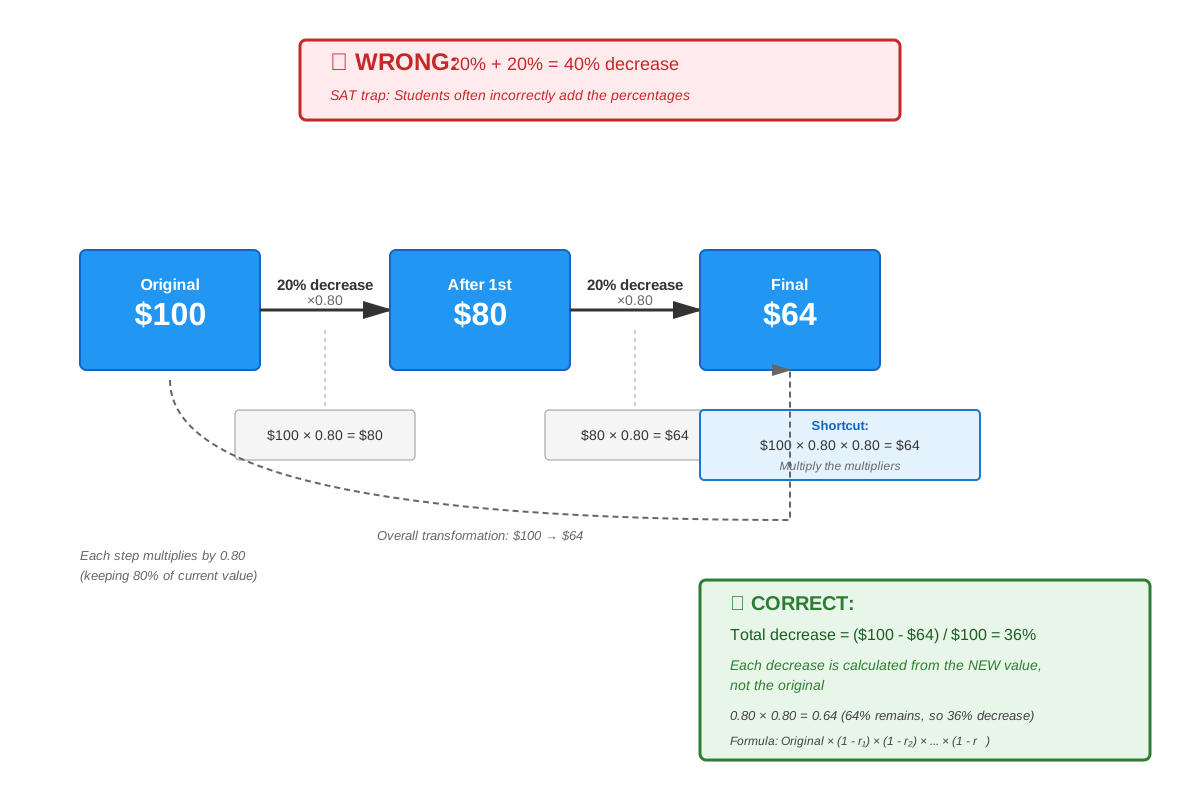
Some SAT problems involve multiple consecutive decreases, such as a price reduced by 20% and then reduced by an additional 10%. A critical concept: successive percent decreases do NOT simply add together.
For two successive decreases of p% and q%, the combined effect is:
Final Value = Original Value × (1 - p/100) × (1 - q/100)For example, a $100 item reduced by 20% then 10%:
- After first decrease: $100 × 0.80 = $80
- After second decrease: $80 × 0.90 = $72
The total decrease is $28, which is 28%—not 30% (20% + 10%). The second decrease applies to the already-reduced price, not the original price.
Percent Decrease vs. Absolute Decrease
Understanding the distinction between absolute decrease (the actual numerical change) and percent decrease (the proportional change) is essential for SAT success.
- Absolute Decrease: Original Value - New Value (measured in the same units as the values)
- Percent Decrease: (Absolute Decrease / Original Value) × 100% (dimensionless, expressed as a percentage)
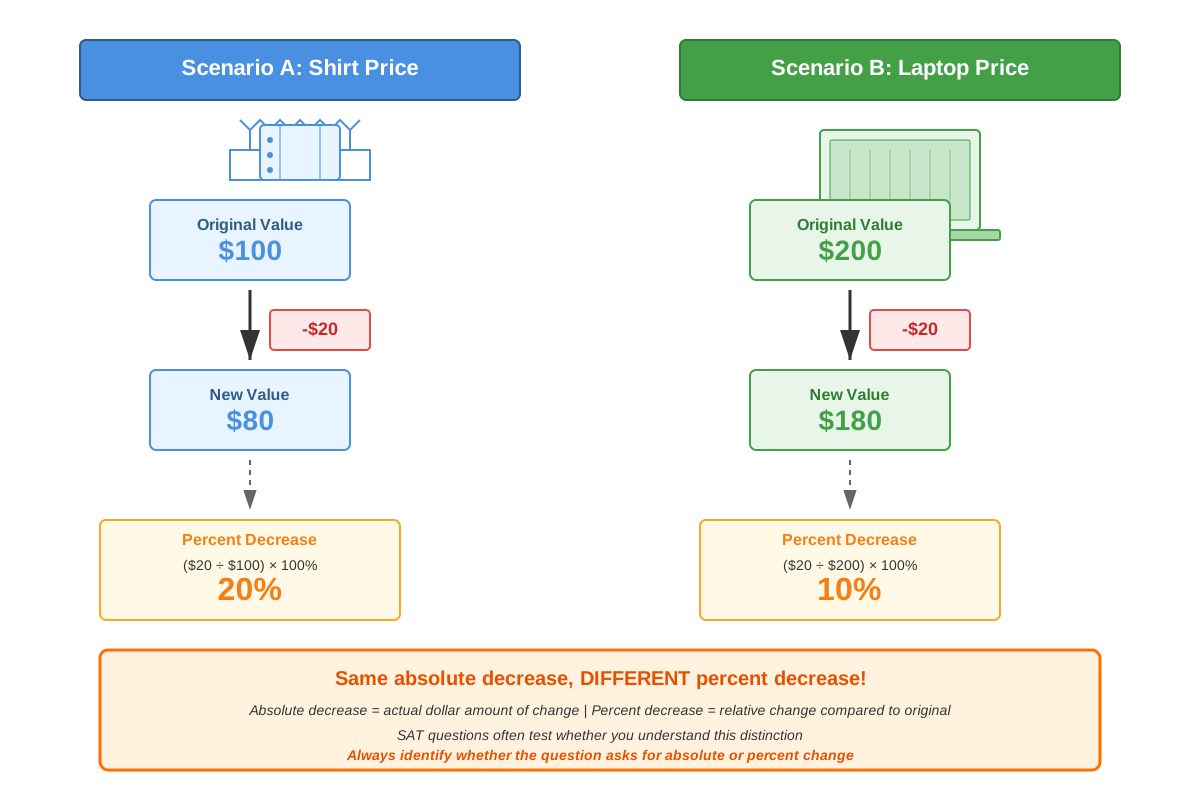
Two scenarios can have the same absolute decrease but different percent decreases. For example:
- Scenario A: $100 → $80 (absolute decrease: $20, percent decrease: 20%)
- Scenario B: $200 → $180 (absolute decrease: $20, percent decrease: 10%)
The SAT tests whether students recognize that percent decrease depends on the original value, making it a relative rather than absolute measure.
Concept Relationships
The core concepts within percent decrease form an interconnected system where understanding one relationship facilitates mastery of others. The percent decrease formula serves as the foundation, from which the multiplier method for finding new values derives directly. When students recognize that subtracting the percent decrease from 100% yields the retention factor, they can efficiently calculate new values without explicitly computing the decrease amount first.
The relationship between finding new values and finding original values represents inverse operations. If multiplying by (1 - p/100) produces the new value from the original, then dividing by (1 - p/100) recovers the original from the new value. This inverse relationship mirrors the connection between multiplication and division in basic arithmetic.
Successive percent decreases build upon single decrease calculations by applying the multiplier method repeatedly. Each decrease operates on the result of the previous decrease, creating a multiplicative chain: Original → (×0.80) → Intermediate → (×0.90) → Final. This connects to exponential decay concepts in more advanced mathematics.
The distinction between absolute and percent decrease relates to the broader mathematical concept of absolute versus relative measures, which appears throughout SAT Math in contexts like absolute value, rates of change, and proportional reasoning. Understanding that percent decrease normalizes the absolute decrease by the original value helps students recognize when to use each measure.
These concepts collectively connect to prerequisite knowledge of percentages (percent decrease is a specific application), fractions (percent decrease can be expressed as a fraction of the original), and algebra (setting up equations to find unknown values). They also relate forward to topics like percent increase, exponential functions, and compound interest, where similar multiplicative reasoning applies.
Quick check — test yourself on Percent decrease so far.
Try Flashcards →High-Yield Facts
⭐ The percent decrease formula always uses the original value in the denominator, never the new value
⭐ To find a new value after a percent decrease, multiply the original by (1 - percent/100)
⭐ Successive percent decreases multiply together; they do not add
⭐ When given the final value and percent decrease, divide by (1 - percent/100) to find the original
⭐ A 50% decrease followed by a 50% increase does NOT return to the original value
- The absolute decrease equals the original value minus the new value
- Percent decrease is always calculated as a percentage of the original, not the new value
- A 100% decrease means the value becomes zero
- Percent decrease cannot exceed 100% (the value cannot become negative in standard contexts)
- Converting the percent to a decimal before calculating often reduces arithmetic errors
- The retention factor (1 - percent/100) represents what fraction of the original remains
- Two different scenarios can have the same absolute decrease but different percent decreases
- Percent decrease problems often disguise the original value with terms like "original price," "initial population," or "starting amount"
- The SAT frequently tests whether students can work backward from a decreased value to find the original
- Percent decrease is the inverse operation of percent increase relative to the new value
Common Misconceptions
Misconception: The percent decrease is calculated using the new value as the denominator.
Correction: Percent decrease always uses the original (starting) value in the denominator. Using the new value produces an incorrect, artificially inflated percentage. For a decrease from 100 to 80, the correct calculation is 20/100 = 20%, not 20/80 = 25%.
Misconception: Successive percent decreases can be added together to find the total decrease.
Correction: Successive decreases multiply, not add. A 20% decrease followed by a 10% decrease results in a total decrease of 28% (calculated as 1 - 0.80 × 0.90 = 0.28), not 30%. Each subsequent decrease applies to the already-reduced value.
Misconception: A 50% decrease followed by a 50% increase returns to the original value.
Correction: These operations do not cancel out. Starting with 100, a 50% decrease yields 50, then a 50% increase of 50 yields 75, not 100. The increase applies to the smaller base, producing a smaller absolute increase than the original decrease.
Misconception: Percent decrease and absolute decrease are interchangeable terms.
Correction: Absolute decrease is the numerical difference (original - new), while percent decrease is the proportional change relative to the original. A $20 decrease from $100 is a 20% decrease, but a $20 decrease from $200 is only a 10% decrease.
Misconception: To find the original value, simply divide the new value by the percent decrease.
Correction: To find the original value, divide the new value by the retention factor (1 - percent/100), not by the percent decrease itself. If a value is $80 after a 20% decrease, the original is 80/0.80 = $100, not 80/0.20 = $400.
Misconception: Percent decrease can exceed 100%.
Correction: In standard contexts, percent decrease cannot exceed 100% because that would imply the value becomes negative. A 100% decrease means the entire value is lost (the new value is zero). Values cannot decrease by more than their entire amount.
Worked Examples
Example 1: Finding Percent Decrease from Two Values
Problem: A store originally sold a television for $850. During a clearance sale, the price was reduced to $637.50. What was the percent decrease in the price?
Solution:
Step 1: Identify the given information
- Original Value = $850
- New Value = $637.50
- Percent Decrease = unknown
Step 2: Calculate the absolute decrease
Absolute Decrease = Original - New = $850 - $637.50 = $212.50
Step 3: Apply the percent decrease formula
Percent Decrease = (Absolute Decrease / Original Value) × 100%
Percent Decrease = ($212.50 / $850) × 100%
Step 4: Simplify the fraction and calculate
$212.50 / $850 = 0.25
0.25 × 100% = 25%
Answer: The television's price decreased by 25%.
Connection to Learning Objectives: This example demonstrates the core application of identifying key features (original value, new value, decrease amount) and applying the standard percent decrease formula, directly addressing the first and third learning objectives.
Example 2: Finding Original Value from Final Value and Percent Decrease
Problem: After a 35% decrease in membership, a gym now has 780 members. How many members did the gym have originally? Round to the nearest whole number.
Solution:
Step 1: Identify the given information
- New Value = 780 members
- Percent Decrease = 35%
- Original Value = unknown
Step 2: Recognize the relationship
The 780 members represent what remains after a 35% decrease, meaning they represent 65% of the original membership (100% - 35% = 65%).
Step 3: Set up the equation
Original Value × (1 - 0.35) = 780
Original Value × 0.65 = 780
Step 4: Solve for the original value
Original Value = 780 / 0.65
Original Value = 1,200
Step 5: Verify the answer
Check: 1,200 × 0.65 = 780 ✓
Decrease: 1,200 - 780 = 420
Percent: 420/1,200 = 0.35 = 35% ✓
Answer: The gym originally had 1,200 members.
Connection to Learning Objectives: This example illustrates the critical skill of working backward from a final value to determine the original amount, addressing the fifth learning objective and demonstrating how percent decrease appears in SAT word problems (second learning objective).
Exam Strategy
When approaching sat percent decrease questions, begin by carefully identifying which of the three key values (original, new, percent decrease) are provided and which must be calculated. Underline or circle these values in the problem to avoid confusion. The SAT deliberately uses varied language to describe these quantities—"original price," "initial population," "starting value" all refer to the original value, while "sale price," "current population," or "reduced value" indicate the new value.
Trigger words and phrases that signal percent decrease problems include: "discount," "markdown," "reduced by," "decreased by," "dropped by," "fell by," "declined by," "depreciated," "lost," and "shrunk by." When these appear with percentage values, immediately recognize the percent decrease context. Be particularly alert for phrases like "what percent less" or "percent reduction," which directly ask for the percent decrease calculation.
For process-of-elimination on multiple-choice questions, quickly eliminate answers that violate basic percent decrease principles. If the original value is 100 and the new value is 75, the percent decrease must be less than 50% (eliminate any answer ≥50%). If a problem involves successive decreases, eliminate any answer that simply adds the percentages together. Check whether answer choices are given as percentages or decimals, and ensure your calculation matches the requested format.
Time allocation for percent decrease questions should typically be 45-90 seconds for straightforward calculations and up to 2 minutes for multi-step problems involving successive decreases or working backward from final values. If a problem requires more than 2 minutes, mark it for review and move on—these questions are designed to be solvable within this timeframe, so extended struggle suggests a conceptual misunderstanding that won't resolve under time pressure.
Use the multiplier method whenever possible rather than calculating the decrease amount separately. This reduces steps and arithmetic errors. For a 30% decrease, immediately multiply by 0.70 rather than calculating 30% of the original, then subtracting. On no-calculator sections, look for opportunities to simplify fractions before multiplying—recognizing that a 25% decrease means multiplying by 3/4 can make mental math much easier.
When problems provide the final value and percent decrease, set up an equation rather than trying to reason through the problem intuitively. Write "Original × (1 - percent/100) = New Value" and solve algebraically. This systematic approach prevents errors and works consistently across all problem variations.
Memory Techniques
Mnemonic for the percent decrease formula: "OLD Difference Over OLD" (Original value, Difference, Over, Original value). The "difference" is always (Original - New), and it's always divided by the OLD (original) value, never the new value.
Visualization strategy: Picture a container filled to a certain level (original value). When liquid is poured out (decrease), the percent decrease measures how much was removed relative to the original full amount, not relative to what remains. This mental image reinforces why the denominator must be the original value.
Acronym for successive decreases: "MNS" - Multiply, Never Sum. When dealing with successive percent decreases, always multiply the retention factors; never sum the percentages.
Retention factor memory aid: Think of the retention factor as "what's retained" or "what remains." If 30% decreases, 70% is retained, so multiply by 0.70. The retention factor is always (1 - percent decrease as a decimal).
Working backward technique: Remember "Divide by the Decimal" when finding original values. If something decreased by 20% to reach $80, divide $80 by 0.80 (the retention factor). The alliteration helps recall the operation.
Successive decrease visualization: Imagine a snowball rolling downhill, getting smaller with each rotation. Each decrease makes the snowball smaller, so the next decrease removes less absolute snow (even if the percentage is the same), illustrating why successive decreases don't simply add together.
Summary
Percent decrease measures the proportional reduction from an original value to a smaller new value, calculated by dividing the absolute decrease by the original value and multiplying by 100%. This high-yield SAT topic appears in 2-4 questions per test, embedded in word problems involving discounts, population changes, and depreciation. Mastery requires understanding three key relationships: calculating percent decrease from two values using the standard formula, finding new values by multiplying the original by (1 - percent/100), and working backward to find original values by dividing the new value by the retention factor. Critical concepts include recognizing that the denominator must always be the original value, understanding that successive decreases multiply rather than add, and distinguishing between absolute and percent decrease. Students must efficiently identify which values are given, select the appropriate formula or method, and execute calculations accurately under time pressure. Success on percent decrease questions directly impacts overall SAT Math scores and builds foundational skills for more advanced percentage applications.
Key Takeaways
- The percent decrease formula is (Original - New) / Original × 100%, with the original value always in the denominator
- Use the multiplier method—multiply by (1 - percent/100)—to efficiently find new values after a decrease
- To find the original value when given the final value and percent decrease, divide by the retention factor (1 - percent/100)
- Successive percent decreases multiply together; a 20% decrease followed by a 10% decrease yields a 28% total decrease, not 30%
- Percent decrease and absolute decrease are distinct concepts—the same absolute decrease produces different percent decreases depending on the original value
- Trigger words like "discount," "reduced by," and "declined by" signal percent decrease problems on the SAT
- Always verify that your answer makes logical sense: the new value should be smaller than the original, and the percent decrease should be between 0% and 100%
Related Topics
Percent Increase: The complementary concept to percent decrease, measuring proportional growth rather than reduction. Mastering percent decrease provides the foundation for understanding percent increase, as both use similar formulas with opposite operations.
Percent Change: A broader category encompassing both increases and decreases, often requiring students to determine which direction the change occurred. Understanding percent decrease is essential before tackling general percent change problems.
Exponential Decay: In advanced mathematics, repeated percent decreases model exponential decay functions. The retention factor in percent decrease problems directly relates to the decay factor in exponential equations.
Markup and Markdown: Business mathematics applications where percent decrease (markdown) and percent increase (markup) determine retail pricing strategies. These problems often combine both concepts in multi-step scenarios.
Compound Interest and Depreciation: Financial applications where successive percent changes occur over time periods. The multiplicative nature of successive percent decreases directly applies to calculating depreciation of assets.
Practice CTA
Now that you've mastered the core concepts of percent decrease, it's time to solidify your understanding through active practice. Attempt the practice questions to apply these formulas and strategies to SAT-style problems, and use the flashcards to reinforce key definitions and relationships. Remember, percent decrease appears on every SAT, and consistent practice with these high-yield problems will build both speed and accuracy. Each problem you solve strengthens your pattern recognition and deepens your conceptual understanding, moving you closer to your target score. Start practicing now—your future self on test day will thank you!
Sign up free to keep reading
Create a free AnvayaPrep account to finish this SAT guide on Percent decrease — plus flashcards and practice questions.