Overview
Argument structure is one of the most critical skills tested in the GRE Verbal Reasoning section, particularly within Critical Reasoning questions. Understanding how arguments are constructed—identifying premises, conclusions, assumptions, and the logical relationships between them—forms the foundation for success on multiple question types. When the GRE tests gre argument structure, it evaluates your ability to dissect complex reasoning, recognize logical patterns, and understand how evidence supports (or fails to support) a conclusion. This skill appears not only in discrete Critical Reasoning questions but also influences performance on Reading Comprehension passages that present argumentative text.
Mastering argument structure enables test-takers to quickly identify what an author is claiming, what evidence supports that claim, and what unstated assumptions bridge the gap between evidence and conclusion. This analytical framework is essential because the GRE frequently asks questions that require you to strengthen or weaken arguments, identify assumptions, evaluate reasoning, or recognize parallel logical structures. Without a solid grasp of how arguments are built, students often struggle to distinguish between relevant and irrelevant information, leading to incorrect answer choices that seem plausible but miss the logical core of the passage.
Within the broader context of Verbal Reasoning, argument structure serves as a foundational skill that connects to reading comprehension, logical reasoning, and analytical writing. The ability to map out an argument's components translates directly to better performance on inference questions, author's purpose questions, and even vocabulary-in-context questions where understanding the logical flow helps determine meaning. Furthermore, the Analytical Writing section's "Analyze an Argument" task explicitly requires students to identify and critique the structural elements of a given argument, making this topic doubly important for overall GRE success.
Learning Objectives
- [ ] Identify when Argument structure is being tested in GRE questions
- [ ] Explain the core rule or strategy behind Argument structure analysis
- [ ] Apply Argument structure principles to GRE-style questions accurately
- [ ] Distinguish between premises, conclusions, and assumptions in complex arguments
- [ ] Recognize common argument patterns and logical indicators in GRE passages
- [ ] Evaluate the strength of logical connections between evidence and claims
- [ ] Predict likely question types based on argument structure characteristics
Prerequisites
- Basic reading comprehension skills: Understanding literal meaning in academic prose is necessary before analyzing logical relationships between ideas.
- Familiarity with GRE question formats: Knowing the difference between Reading Comprehension and Critical Reasoning questions helps contextualize where argument structure appears.
- Fundamental logical reasoning: Recognizing cause-and-effect relationships and distinguishing facts from opinions provides the baseline for more sophisticated argument analysis.
Why This Topic Matters
Understanding argument structure has profound real-world applications beyond standardized testing. Legal professionals analyze arguments to build cases and identify weaknesses in opposing counsel's reasoning. Business leaders evaluate proposals by examining the logical foundation of recommendations. Scientists assess research claims by scrutinizing how evidence supports conclusions. Academic researchers critique methodologies by identifying unstated assumptions. These professional applications mirror exactly what the GRE tests: the ability to think critically about how claims are supported.
On the GRE specifically, argument structure appears with remarkable frequency and importance. Approximately 30-40% of Verbal Reasoning questions directly test argument analysis skills. Critical Reasoning questions—which appear 3-4 times per Verbal section—almost exclusively focus on argument structure. Additionally, Reading Comprehension passages frequently include argumentative text where understanding the author's logical framework is essential for answering inference, purpose, and function questions correctly. The Analytical Writing section's "Analyze an Argument" task constitutes 50% of the writing score and entirely depends on identifying structural elements.
Common manifestations in GRE passages include: scientific arguments presenting hypotheses and supporting evidence; social science passages discussing causal relationships; business scenarios evaluating proposals or explaining outcomes; historical analyses connecting events to consequences; and editorial-style passages advocating positions. The GRE deliberately constructs arguments with identifiable flaws, unstated assumptions, or gaps in reasoning, then asks questions that reward students who can pinpoint these structural features quickly and accurately.
Core Concepts
Components of an Argument
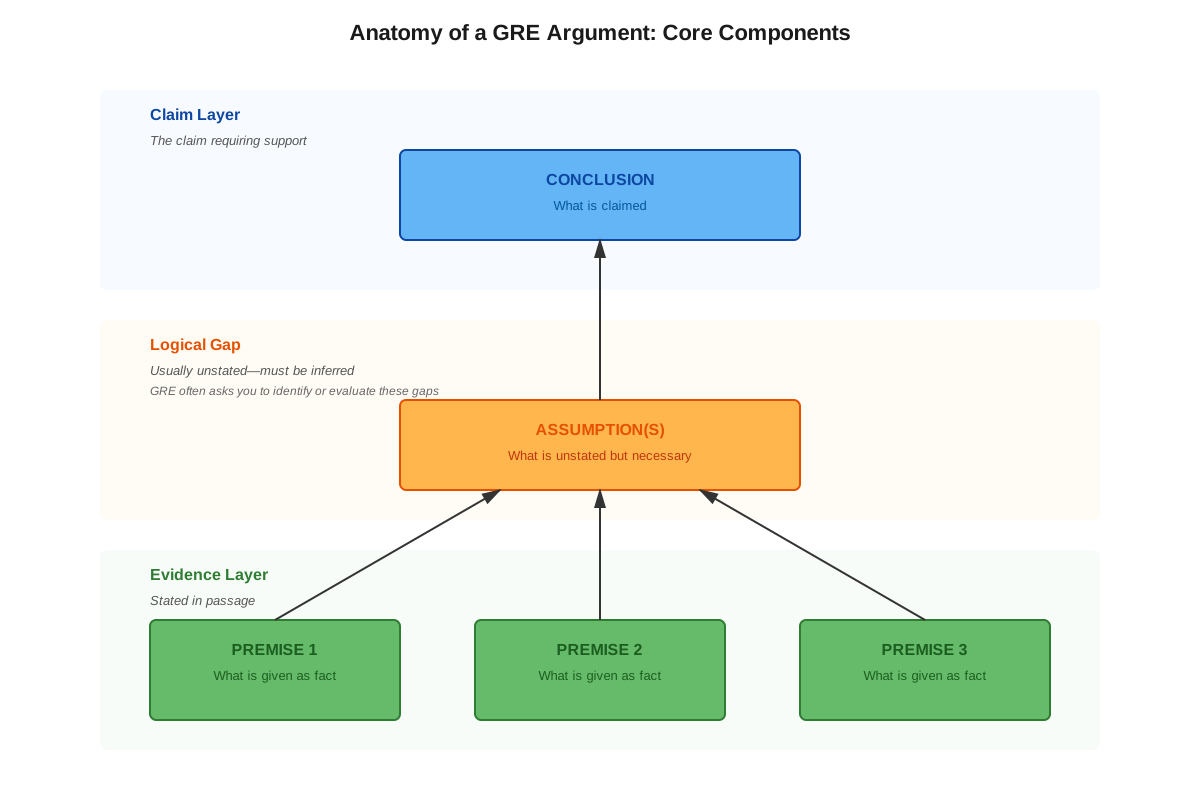
Every argument on the GRE contains specific structural elements that work together to form a logical chain. A premise is a piece of evidence, fact, or reason offered in support of a conclusion. Premises are the building blocks—the "because" statements that provide justification. A conclusion is the main claim or position the argument advocates; it's what the author wants you to believe or accept. The conclusion answers the question "What is the author trying to prove?" An assumption is an unstated premise that must be true for the argument to work; it's the logical bridge connecting stated premises to the conclusion.
Consider this simple argument: "The city should invest in public transportation because traffic congestion has increased 40% in five years." The premise is "traffic congestion has increased 40% in five years" (the evidence). The conclusion is "the city should invest in public transportation" (the claim). The assumption—unstated but necessary—is that investing in public transportation will reduce traffic congestion. Without this assumption, the premise doesn't logically support the conclusion.
Identifying Conclusions
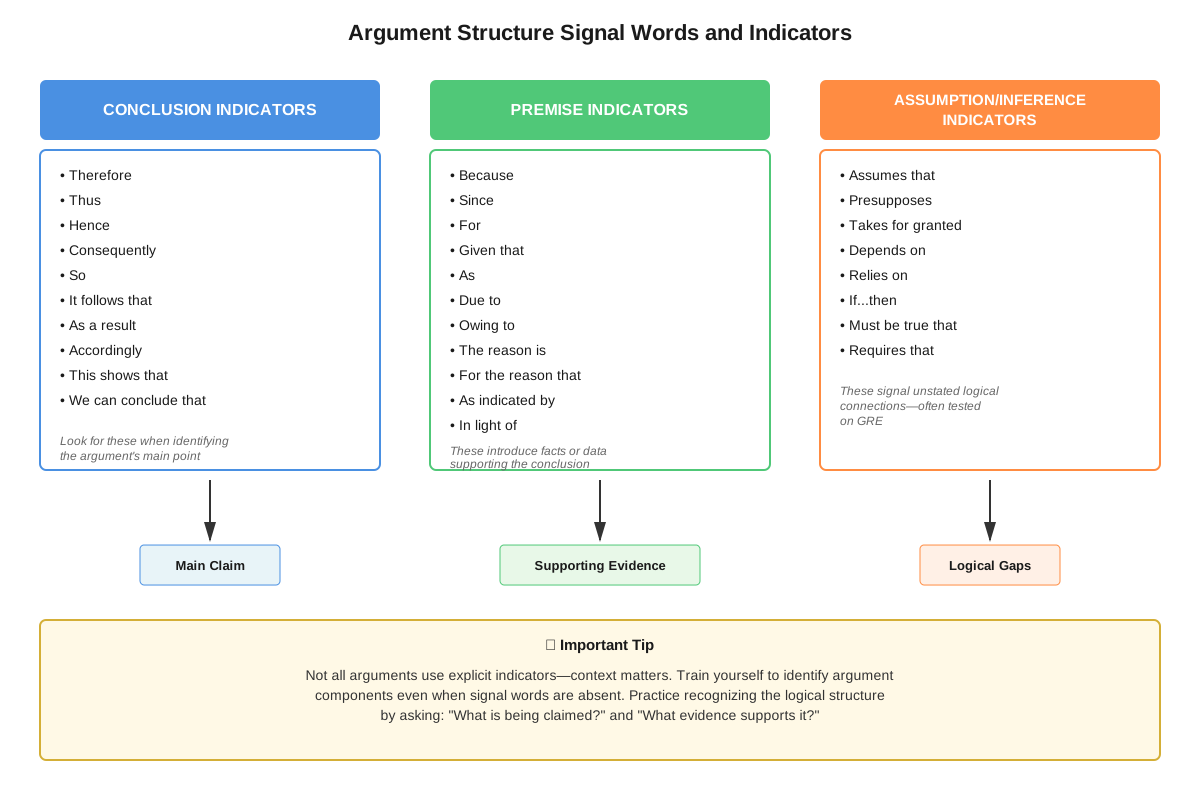
Conclusions can appear anywhere in an argument: beginning, middle, or end. Conclusion indicators are words and phrases that signal a claim is being made. Common indicators include: therefore, thus, hence, consequently, it follows that, we can conclude that, this shows that, clearly, evidently, and so. However, not all conclusions are explicitly marked, requiring readers to identify the main claim through logical analysis.
To identify conclusions when indicators are absent, ask: "What is the author's main point?" or "What does the author want me to believe?" The conclusion is typically the statement that other sentences support rather than the statement that provides support. Test each sentence by asking whether it's being used as evidence for something else or whether other statements provide evidence for it.
Identifying Premises
Premise indicators signal that evidence or reasoning is being provided. Common indicators include: because, since, for, given that, as, due to, in light of, considering that, for the reason that, and as indicated by. Premises are factual claims (or presented as such) that provide the foundation for the conclusion.
Multiple premises often work together to support a single conclusion. In complex arguments, some premises may support intermediate conclusions, which then serve as premises for the main conclusion. This creates a chain of reasoning where understanding the hierarchical relationship between claims is essential for accurate analysis.
Assumptions in Arguments
Assumptions represent the most frequently tested aspect of argument structure on the GRE. An assumption is a necessary condition for an argument to be valid—if the assumption is false, the argument falls apart. Assumptions typically fall into two categories: representativeness assumptions (that evidence is typical or applicable) and causal assumptions (that one thing causes another or that no alternative explanations exist).
To identify assumptions, look for gaps between premises and conclusions. Ask: "What must be true for this evidence to support this claim?" or "What is the author taking for granted?" Common assumption patterns include: assuming a sample is representative of a population, assuming correlation implies causation, assuming no alternative explanations exist, assuming conditions will remain constant, and assuming terms are being used consistently.
Argument Structure Patterns
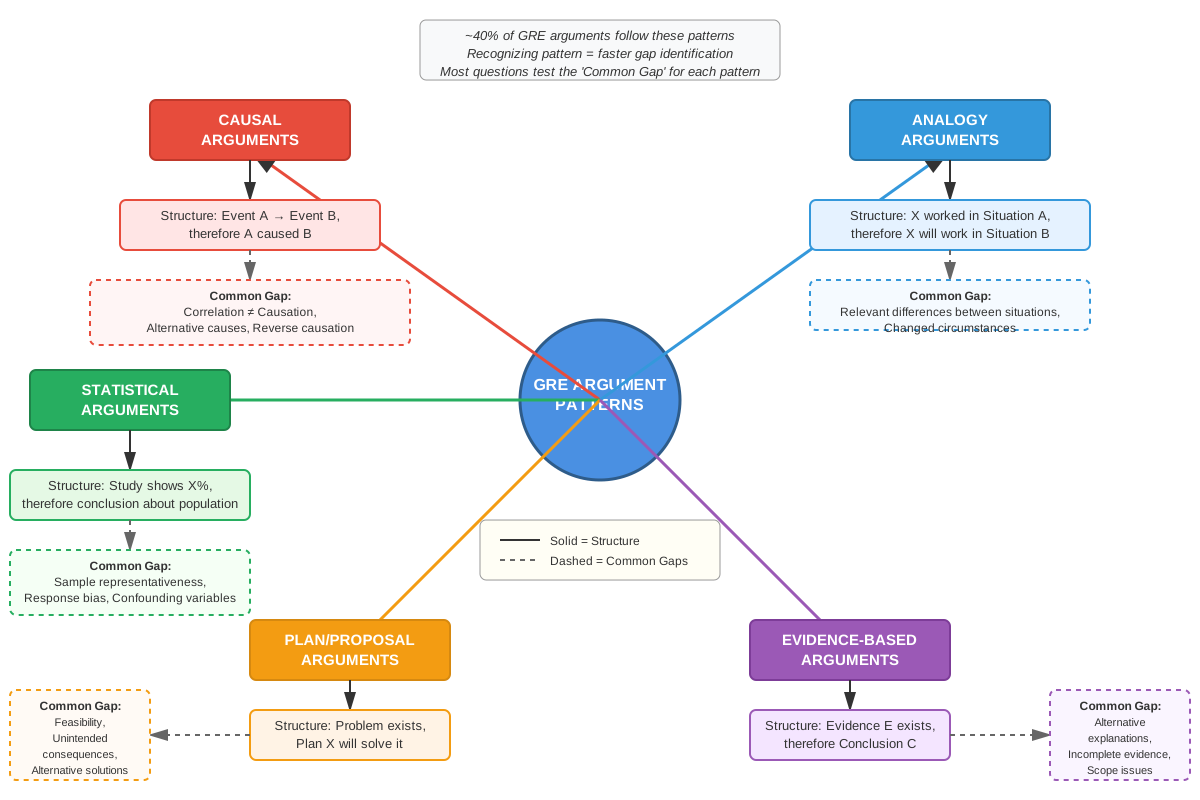
The GRE uses recurring logical patterns. The causal argument claims one thing causes another (A causes B). These arguments assume no alternative causes exist and that correlation indicates causation. The argument by analogy claims that because two things are similar in some ways, they're similar in another way. These assume the similarities are relevant to the conclusion and that differences don't undermine the comparison.
Statistical arguments use numerical data or survey results to support claims. These assume samples are representative, methodology is sound, and statistics are being interpreted correctly. Predictive arguments forecast future outcomes based on past trends or current conditions. These assume conditions will remain similar and that no intervening factors will disrupt the pattern.
| Argument Pattern | Structure | Common Assumption |
|---|---|---|
| Causal | A occurred, then B occurred → A caused B | No alternative causes; correlation = causation |
| Analogy | X has properties 1, 2, 3; Y has properties 1, 2 → Y has property 3 | Similarities are relevant; differences don't matter |
| Statistical | Survey shows X% → Conclusion about population | Sample is representative; methodology is valid |
| Predictive | Past trend X → Future outcome Y | Conditions remain constant; no disrupting factors |
Evaluating Argument Strength
Strong arguments have premises that directly and sufficiently support conclusions, with minimal logical gaps. Weak arguments contain logical fallacies, unsupported leaps, or rely on questionable assumptions. The GRE tests your ability to recognize what would strengthen or weaken an argument by filling gaps or exposing flaws.
To strengthen an argument, provide evidence that supports an assumption, eliminates alternative explanations, or demonstrates representativeness. To weaken an argument, show that an assumption is false, provide alternative explanations, or demonstrate that evidence is unrepresentative or misinterpreted.
Concept Relationships
The components of argument structure form an interconnected system where each element depends on others. Premises provide the foundation → Assumptions bridge logical gaps → Conclusions represent the claim being supported. This linear flow means that identifying one component helps locate others. When you find the conclusion, you can work backward to identify what premises support it, then determine what assumptions must be true for that support to work.
Argument structure connects directly to question types on the GRE. Understanding structure enables you to: answer assumption questions (by identifying gaps), tackle strengthen/weaken questions (by recognizing what fills or exposes gaps), handle evaluation questions (by determining what information would test assumptions), and solve parallel reasoning questions (by mapping structural patterns rather than content).
The relationship map flows as follows: Basic comprehension → Identifying argument components → Recognizing structural patterns → Evaluating logical strength → Predicting and answering questions. Each level builds on the previous, meaning mastery requires sequential development rather than isolated skill acquisition.
Quick check — test yourself on Argument structure so far.
Try Flashcards →High-Yield Facts
- ⭐ Conclusions can appear anywhere in an argument—beginning, middle, or end—not just at the end
- ⭐ Assumptions are unstated premises that must be true for the argument to work; they represent the most commonly tested element
- ⭐ Premise indicators (because, since, for) and conclusion indicators (therefore, thus, hence) help identify argument components quickly
- ⭐ Causal arguments assume no alternative explanations exist and that correlation indicates causation
- ⭐ Arguments by analogy assume relevant similarities and that differences don't undermine the comparison
- The conclusion is the statement that other sentences support, not the statement that provides support
- Statistical arguments assume samples are representative and methodology is sound
- Predictive arguments assume past conditions will continue without significant changes
- Multiple premises can work together to support a single conclusion, creating complex argument chains
- To identify assumptions, look for gaps between what's stated (premises) and what's claimed (conclusion)
- Strengthening an argument requires supporting its assumptions or eliminating alternative explanations
- Weakening an argument requires showing assumptions are false or providing alternative explanations
- The same argument can have multiple assumptions, each representing a different logical gap
- Recognizing argument patterns allows faster analysis and more accurate prediction of question types
Common Misconceptions
Misconception: The conclusion is always the last sentence in an argument.
Correction: Conclusions can appear anywhere—beginning, middle, or end. Authors often state conclusions first, then provide supporting evidence. Always identify the conclusion by its logical function (what's being proven) rather than its position.
Misconception: Premises are always facts, so they must be true.
Correction: Premises are presented as evidence, but they may be opinions, questionable claims, or even false statements. The GRE tests your ability to analyze logical structure regardless of whether premises are actually true. Accept premises as given for the purpose of analyzing the argument's internal logic.
Misconception: An assumption is just something the author believes.
Correction: An assumption is specifically an unstated premise that must be true for the argument to be valid. It's not merely a belief but a necessary logical connection. If an assumption is false, the argument completely fails, even if the premises are true.
Misconception: Strengthening an argument means agreeing with the conclusion.
Correction: Strengthening means providing evidence that makes the logical connection between premises and conclusion more solid, regardless of whether you personally agree. You might strengthen an argument you disagree with by showing its assumptions are valid.
Misconception: Complex arguments with multiple premises are always stronger than simple arguments.
Correction: Argument strength depends on logical validity, not complexity. A simple argument with solid logical connections is stronger than a complex argument with multiple unsupported leaps. More premises can actually create more assumptions and potential weaknesses.
Misconception: If an argument contains true statements, it must be a good argument.
Correction: An argument can have true premises and a true conclusion but still be logically flawed if the premises don't actually support the conclusion. The GRE tests logical structure, not factual accuracy.
Worked Examples
Example 1: Identifying Argument Structure
Passage: "City officials should implement a bike-sharing program downtown. A recent survey showed that 65% of downtown workers live within five miles of their workplace. Additionally, bike-sharing programs in similar-sized cities have reduced traffic congestion by an average of 12%. Given the current parking shortage and air quality concerns, a bike-sharing program would address multiple urban challenges simultaneously."
Analysis:
Step 1 - Identify the conclusion: The main claim is "City officials should implement a bike-sharing program downtown." This appears in the first sentence and represents what the author wants to prove. The word "should" indicates a recommendation, which is typically a conclusion.
Step 2 - Identify the premises:
- Premise 1: "65% of downtown workers live within five miles of their workplace"
- Premise 2: "Bike-sharing programs in similar-sized cities have reduced traffic congestion by 12%"
- Premise 3: "Current parking shortage exists"
- Premise 4: "Air quality concerns exist"
Step 3 - Identify assumptions:
- Assumption 1: Workers who live within five miles would actually use a bike-sharing program (representativeness)
- Assumption 2: This city is sufficiently similar to the other cities where programs succeeded (analogy)
- Assumption 3: A bike-sharing program would reduce parking demand and improve air quality (causal)
- Assumption 4: No significant barriers (cost, weather, safety) would prevent program success
Step 4 - Classify the argument pattern: This is primarily a predictive argument by analogy—using evidence from other cities to predict outcomes in this city.
Connection to learning objectives: This example demonstrates how to systematically identify when argument structure is being tested and apply the core strategy of breaking arguments into components.
Example 2: Evaluating Strengthen/Weaken Scenarios
Passage: "The Riverside Museum's new pricing strategy will increase annual revenue. By raising admission from $15 to $25, the museum expects to generate more income despite potentially lower attendance. Last year, 100,000 visitors paid $15 each, generating $1.5 million. Museum administrators project that even if attendance drops to 70,000 visitors, revenue would reach $1.75 million."
Question: Which of the following, if true, would most WEAKEN the argument?
Analysis:
Step 1 - Map the argument structure:
- Conclusion: New pricing strategy will increase annual revenue
- Premise 1: Current revenue is $1.5 million (100,000 × $15)
- Premise 2: Projected revenue is $1.75 million (70,000 × $25)
- Assumption: Attendance won't drop below 70,000 visitors
Step 2 - Identify the critical assumption: The argument assumes that raising prices by 67% will only reduce attendance by 30%. This is a significant assumption about price elasticity and visitor behavior.
Step 3 - Determine what would weaken this: Evidence showing attendance would drop more dramatically than projected, or evidence of additional costs not considered, would weaken the argument.
Step 4 - Evaluate answer choices (hypothetical):
- (A) "Similar museums that raised prices by 50% or more experienced attendance drops of 60-70%." ← This weakens the argument by showing the attendance projection is unrealistic.
- (B) "The museum's collection includes several popular exhibits." ← This might strengthen by suggesting demand is inelastic.
- (C) "Operating costs have increased 10% annually." ← Irrelevant to whether revenue increases.
- (D) "Nearby museums charge $20-30 for admission." ← This might strengthen by suggesting the price is competitive.
Connection to learning objectives: This example shows how understanding argument structure enables accurate application to GRE-style questions, specifically by identifying assumptions that answer choices can target.
Exam Strategy
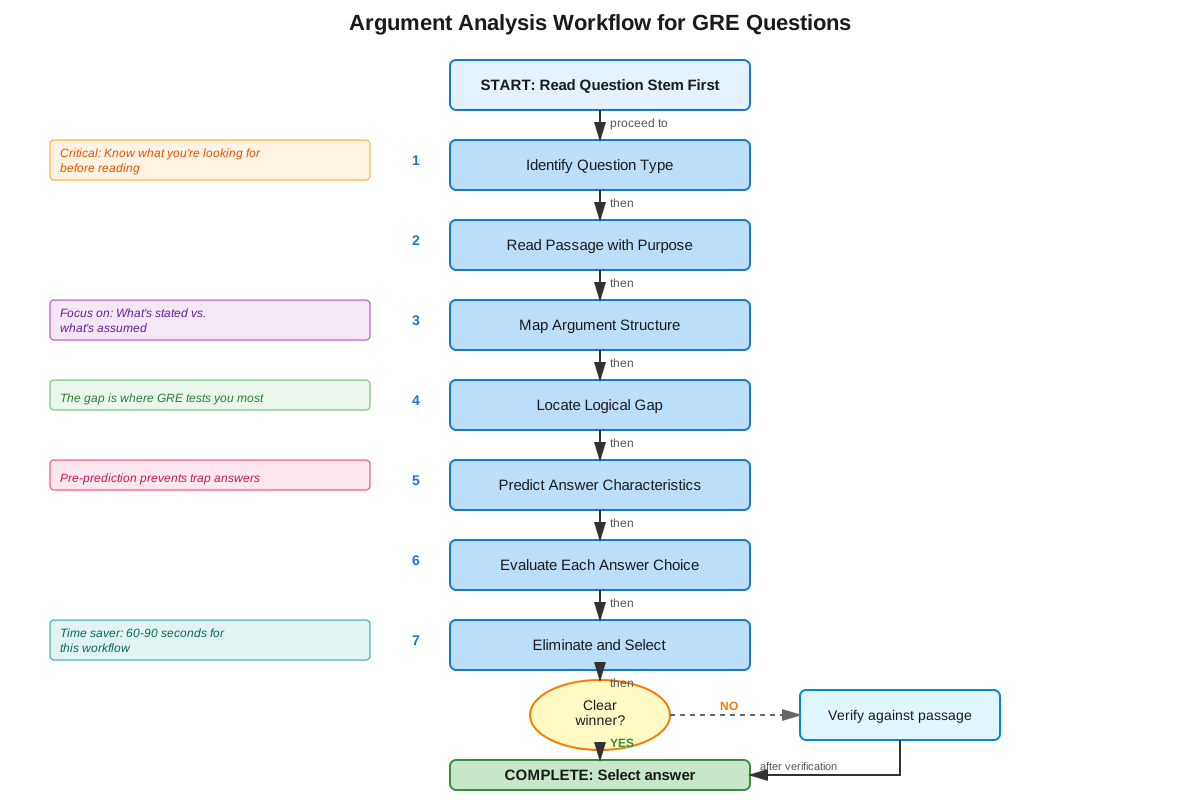
When approaching GRE questions testing argument structure, follow a systematic process. First, read actively for structure, not just content. As you read, mentally label sentences as premises or conclusions. Circle or note conclusion indicators (therefore, thus) and premise indicators (because, since). This structural reading takes 15-20 seconds but saves time by preventing re-reading.
Trigger words and phrases signal specific question types. "Assumption" questions use phrases like "depends on which assumption," "presupposes which of the following," or "relies on which assumption." "Strengthen" questions ask what would "support," "provide evidence for," or "justify" the conclusion. "Weaken" questions ask what would "undermine," "cast doubt on," or "call into question" the argument. "Evaluate" questions ask what information would be "most useful to know" or "most important to determine." Recognizing these triggers immediately tells you what to look for.
For process of elimination, use these argument-structure-specific strategies:
- Eliminate answers that address the wrong component (e.g., answers about premises when the question asks about assumptions)
- Eliminate answers that strengthen when you need to weaken, or vice versa
- Eliminate answers that are irrelevant to the logical gap between premises and conclusion
- Eliminate answers that are too extreme or absolute unless the argument itself is extreme
- Eliminate answers that introduce new topics not connected to the argument's scope
Time allocation should follow this pattern: 30 seconds to read and map the argument structure, 15 seconds to identify the specific logical gap or assumption the question targets, 45 seconds to evaluate answer choices, 10 seconds to confirm your selection. This 100-second approach (1:40) keeps you on pace while ensuring thorough analysis.
Exam Tip: If you're stuck between two answers, return to the conclusion and ask which answer choice has a more direct logical relationship to the main claim. The correct answer almost always connects directly to the conclusion, not to peripheral details.
Memory Techniques
PICA - Remember the four core components: Premises, Indicators, Conclusion, Assumptions. When analyzing any argument, work through PICA systematically.
"Because Therefore" - Premises come after "because" (or similar words), conclusions come after "therefore" (or similar words). Mentally insert these words if they're not explicit to test whether you've correctly identified components.
The Bridge Metaphor - Visualize premises as one side of a river, the conclusion as the other side, and assumptions as the bridge connecting them. If the bridge (assumption) collapses, you can't get from premises to conclusion. This helps remember that assumptions are necessary connections.
SCAN for Assumptions - Sample representativeness, Causation vs. correlation, Alternative explanations, No change assumptions. These four categories cover most GRE argument assumptions.
Strengthen = Support the Bridge; Weaken = Break the Bridge - When answering strengthen/weaken questions, visualize either reinforcing or destroying the assumption bridge. This prevents confusion about which direction you're working.
Summary
Argument structure forms the analytical foundation for GRE Verbal Reasoning success, requiring students to dissect how claims are supported through premises, connected by assumptions, and organized to reach conclusions. Mastery involves systematically identifying these components regardless of their order in the passage, recognizing common patterns like causal arguments and arguments by analogy, and understanding that assumptions represent unstated but necessary logical bridges. The GRE tests this skill through multiple question types—assumption, strengthen, weaken, and evaluate questions—all of which reward students who can quickly map logical relationships and identify gaps in reasoning. Success requires moving beyond surface-level reading to structural analysis, asking not just "what does this say?" but "how does this evidence support this claim?" and "what must be true for this reasoning to work?" Students who master argument structure gain a decisive advantage because they can predict question types, eliminate wrong answers efficiently, and select correct answers with confidence based on logical analysis rather than intuition.
Key Takeaways
- Argument structure analysis requires identifying three core components: premises (evidence), conclusions (claims), and assumptions (unstated logical bridges)
- Conclusions can appear anywhere in a passage; identify them by function (what's being proven) rather than position
- Assumptions represent the most frequently tested element and are found by identifying gaps between stated premises and claimed conclusions
- Common argument patterns (causal, analogy, statistical, predictive) each have characteristic assumptions that the GRE repeatedly tests
- Strengthening arguments means supporting assumptions or eliminating alternatives; weakening means exposing false assumptions or providing alternatives
- Systematic structural reading (labeling components as you read) saves time and improves accuracy across all Critical Reasoning question types
- Recognizing trigger words in questions immediately reveals what structural element to focus on for efficient answer selection
Related Topics
Logical Fallacies: Understanding common reasoning errors (ad hominem, false dichotomy, slippery slope) builds on argument structure knowledge by identifying specific types of flawed assumptions and invalid logical connections.
Inference Questions in Reading Comprehension: Mastering argument structure enables better performance on inference questions because both require understanding what must be true based on stated information and logical relationships.
Analytical Writing - Analyze an Argument: The essay task explicitly requires identifying and critiquing argument structure components, making this topic essential for both Verbal and Writing sections.
Strengthen/Weaken Question Strategies: Advanced techniques for these specific question types build directly on foundational argument structure skills by focusing on assumption manipulation.
Parallel Reasoning Questions: These questions require mapping argument structure abstractly, testing whether you can recognize identical logical patterns across different content areas.
Practice CTA
Now that you understand the fundamental principles of argument structure, it's time to cement your knowledge through active practice. Attempt the practice questions designed for this topic, focusing on applying the systematic approach outlined in this guide. Use the flashcards to reinforce your ability to quickly identify premises, conclusions, and assumptions. Remember that argument structure is a skill that improves dramatically with deliberate practice—each question you analyze strengthens your pattern recognition and speeds up your structural reading. You've built the foundation; now construct mastery through application!
Sign up free to keep reading
Create a free AnvayaPrep account to finish this GRE guide on Argument structure — plus flashcards and practice questions.