Overview
Developing examples is one of the most critical skills tested in the GRE Analytical Writing section, particularly in the Issue and Argument essays. This skill involves the ability to generate, select, and elaborate on specific, relevant examples that support your thesis and strengthen your analytical arguments. Strong examples transform abstract claims into concrete, persuasive reasoning that demonstrates critical thinking—the primary quality GRE graders seek.
The ability to develop examples effectively separates high-scoring essays (5.0–6.0) from mediocre ones (3.0–4.0). While many test-takers can construct grammatically correct sentences and organize basic paragraphs, GRE developing examples requires demonstrating depth of thought through specific illustrations drawn from history, current events, literature, personal observation, or hypothetical scenarios. Graders explicitly look for essays that move beyond vague generalizations to provide detailed, well-explained examples that directly connect to the argument being made.
Within the broader context of Analytical Writing Style, developing examples sits at the intersection of content generation and persuasive technique. It builds upon fundamental skills like thesis development and paragraph organization while serving as the foundation for more advanced techniques like counterargument integration and nuanced analysis. Mastering this topic enables test-takers to produce essays that demonstrate intellectual engagement, critical reasoning, and the ability to support abstract ideas with concrete evidence—all essential components of graduate-level academic writing.
Learning Objectives
- [ ] Identify when Developing examples is being tested in GRE Analytical Writing prompts
- [ ] Explain the core rule or strategy behind Developing examples in essay construction
- [ ] Apply Developing examples to GRE-style questions accurately and effectively
- [ ] Generate multiple relevant examples for a given thesis within time constraints
- [ ] Evaluate the quality and relevance of potential examples before including them
- [ ] Elaborate on examples with sufficient detail to demonstrate critical thinking
- [ ] Connect examples explicitly to the main argument or claim being supported
Prerequisites
- Basic essay structure: Understanding of introduction, body paragraphs, and conclusion is necessary because examples must be strategically placed within organized paragraphs
- Thesis statement construction: Ability to formulate a clear position is essential because examples must directly support the thesis
- Paragraph development: Knowledge of topic sentences and supporting details provides the framework within which examples function
- Reading comprehension: Ability to analyze GRE prompts ensures that examples address the actual question being asked
Why This Topic Matters
In real-world academic and professional contexts, the ability to support claims with specific examples is fundamental to persuasive writing, research proposals, policy recommendations, and business communications. Graduate programs value this skill because it demonstrates the capacity to move from theoretical understanding to practical application—a hallmark of advanced scholarship.
On the GRE, developing examples appears in 100% of Analytical Writing tasks. Both the Issue essay and Argument essay require test-takers to support their analysis with specific examples. According to ETS scoring guidelines, essays receiving scores of 5.0 or higher consistently feature "well-chosen examples" that are "clearly relevant" and "thoughtfully developed." Conversely, essays scoring 3.0 or below typically suffer from "limited development" and "inadequate examples."
This topic appears in exam passages through prompts that explicitly or implicitly demand illustration. Issue prompts may ask test-takers to "discuss the extent to which you agree or disagree" with a claim—requiring examples that demonstrate when the claim holds true or fails. Argument prompts require test-takers to identify logical flaws, which necessitates providing specific examples of alternative explanations or counterexamples that expose weaknesses in the argument's reasoning.
Core Concepts
What Constitutes an Effective Example
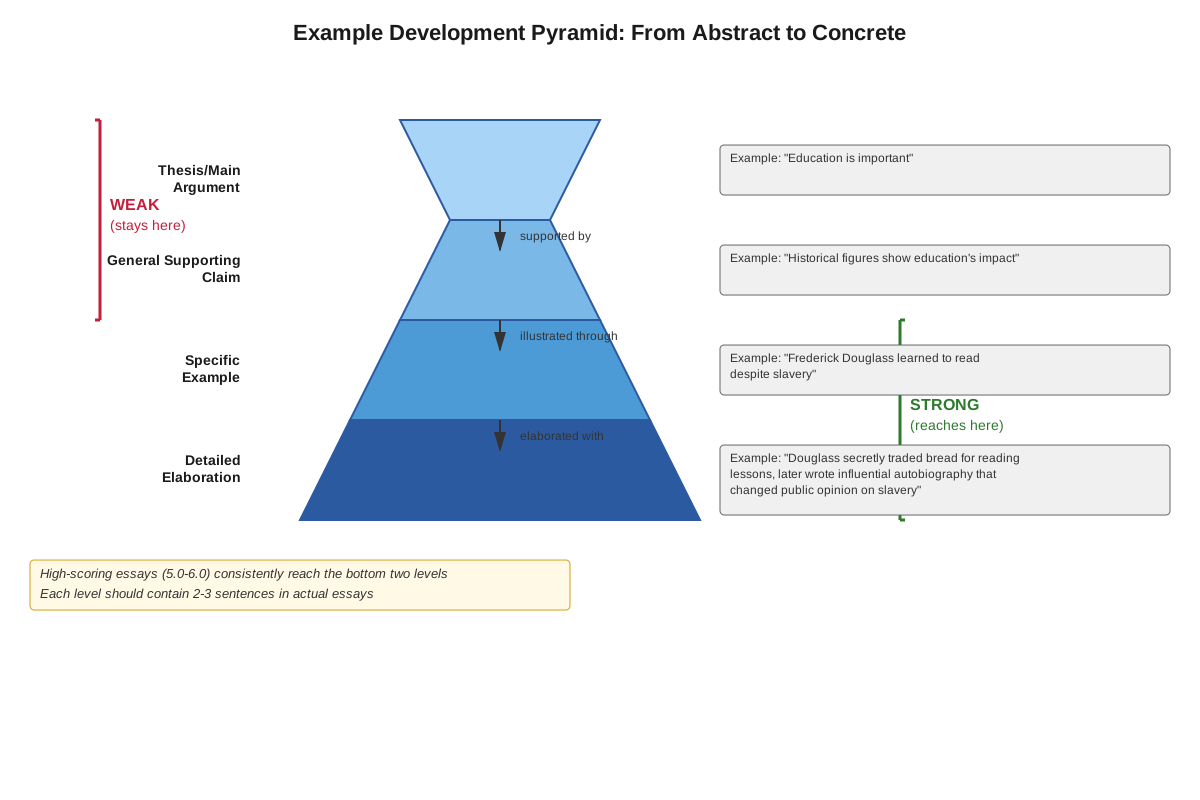
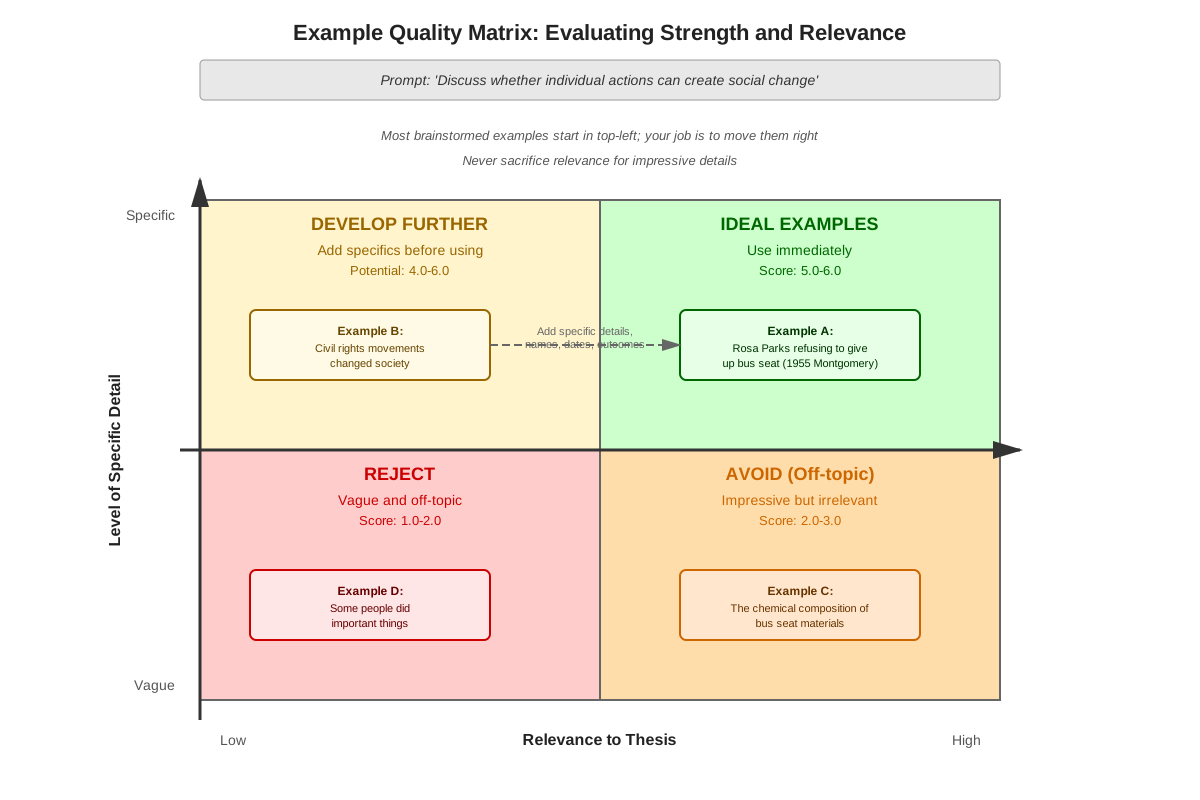
An effective example in GRE Analytical Writing possesses three essential characteristics: specificity, relevance, and development. Specificity means the example includes concrete details rather than vague generalizations. Instead of writing "many companies have failed due to poor leadership," a specific example would reference "Enron's collapse in 2001, driven by executives Kenneth Lay and Jeffrey Skilling's fraudulent accounting practices." Relevance ensures the example directly supports the claim being made—it must clearly connect to the thesis and the specific point of the paragraph. Development refers to the depth of explanation provided; the writer must elaborate on how and why the example supports the argument rather than simply mentioning it.
Types of Examples for GRE Essays
Test-takers can draw from several categories of examples, each with distinct advantages:
| Example Type | Advantages | Considerations |
|---|---|---|
| Historical events | Widely recognized; demonstrate knowledge; provide temporal perspective | Must be accurate; avoid obscure references graders may not know |
| Current events | Show awareness of contemporary issues; highly relevant | Risk of inaccuracy; may date quickly |
| Literary references | Demonstrate cultural literacy; often rich in detail | Must be well-known works; avoid plot summary |
| Scientific/technological developments | Concrete and verifiable; show analytical thinking | Require accurate understanding; avoid excessive technical detail |
| Personal observations | Authentic and specific; easy to develop | Must maintain academic tone; avoid overly anecdotal approach |
| Hypothetical scenarios | Flexible and controllable; can be tailored precisely | Must be realistic and plausible; require careful development |
The Example Development Process
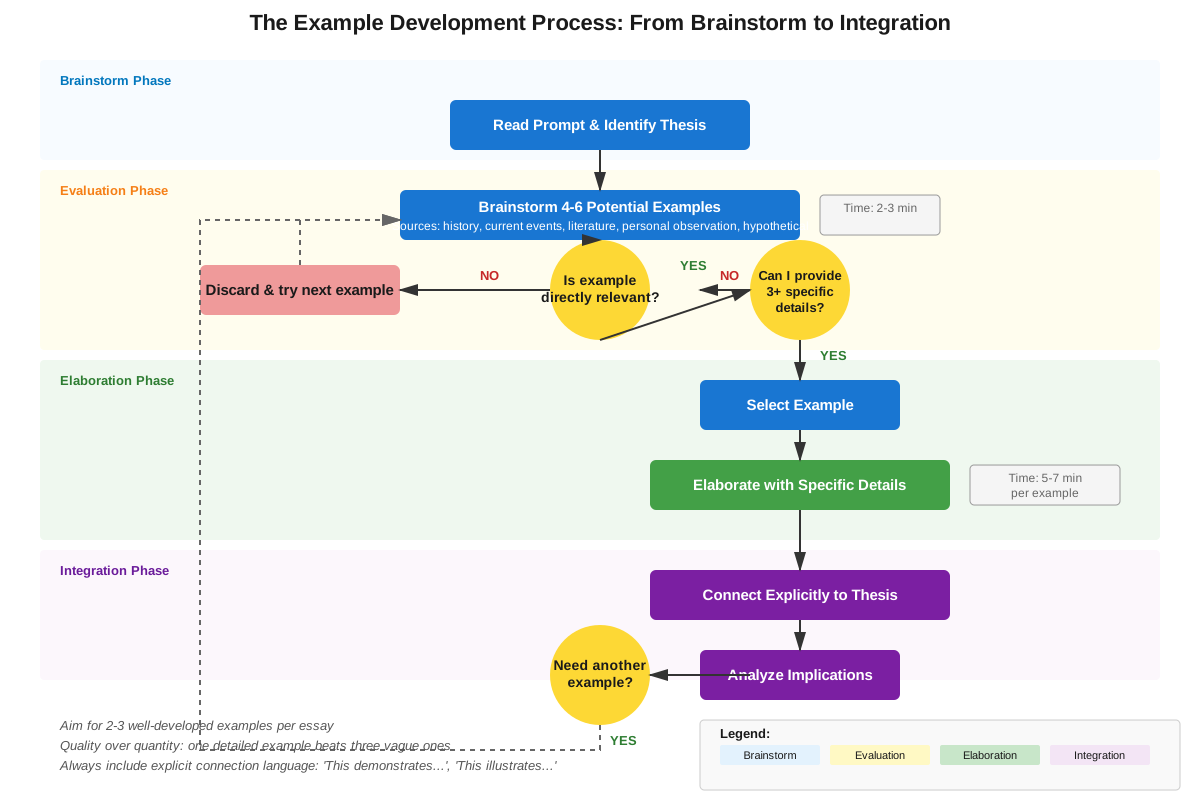
Developing examples follows a systematic four-step process that ensures quality and relevance:
- Generate: Brainstorm multiple potential examples during the planning phase (2-3 minutes). Consider various domains—history, science, business, arts, politics—to identify the strongest candidates.
- Select: Choose examples based on three criteria: your knowledge depth (can you provide specific details?), direct relevance (does it clearly support your point?), and diversity (do your examples come from different domains to show breadth?).
- Introduce: Present the example with sufficient context. Include who, what, when, and where as appropriate. This typically requires 1-2 sentences.
- Elaborate: Explain the significance of the example in 2-4 sentences. Answer "so what?"—explicitly connect the example to your claim. This is where critical thinking becomes visible.
Balancing Breadth and Depth
A common dilemma in timed essay writing involves choosing between multiple brief examples or fewer detailed examples. For GRE essays, depth generally outweighs breadth. A single well-developed example that includes specific details and thorough analysis demonstrates stronger critical thinking than three superficially mentioned examples. The ideal body paragraph typically contains one primary example developed over 4-6 sentences, potentially supplemented by a brief secondary example for additional support.
Connecting Examples to Arguments
The most critical aspect of developing examples is the explicit connection between the example and the claim it supports. Many test-takers make the error of presenting an example and assuming the connection is obvious. High-scoring essays always include transitional phrases and explanatory sentences that make the logical relationship clear. Phrases like "This demonstrates that...," "This example illustrates how...," and "The significance of this case lies in..." signal to graders that the writer understands the analytical purpose of the example.
Domain-Specific Example Strategies
For Issue essays, examples should demonstrate when a principle applies or fails, showing nuanced understanding. If the prompt claims "Competition is ultimately more beneficial than detrimental to society," examples might include both competitive scenarios with positive outcomes (technological innovation driven by market competition) and negative outcomes (environmental degradation from unregulated corporate competition).
For Argument essays, examples serve a different function: exposing logical flaws. Here, examples often take the form of alternative explanations or counterexamples. If an argument claims "The decline in downtown foot traffic is due to the new parking fees," an effective example might describe alternative explanations: "The decline could instead result from the recent opening of a suburban shopping center, which has drawn customers away regardless of parking costs."
Concept Relationships
The skill of developing examples builds directly upon thesis statement construction—the thesis determines what kinds of examples are relevant. Without a clear thesis, example selection becomes unfocused and arbitrary. Similarly, paragraph organization provides the structural framework within which examples function; each body paragraph's topic sentence identifies the specific claim that examples must support.
Developing examples enables more advanced analytical writing techniques. Once test-takers can generate strong examples, they can progress to counterargument integration, where examples illustrate opposing viewpoints before refutation. The skill also supports nuanced analysis, as sophisticated examples often contain complexity that allows writers to acknowledge limitations while maintaining their overall position.
The relationship map flows as follows:
Thesis Statement → determines → Relevant Example Selection → requires → Specific Detail Generation → enables → Analytical Elaboration → produces → Persuasive Paragraph → combines with other paragraphs → High-Scoring Essay
Additionally, reading comprehension of the prompt ensures examples address the actual question, while time management determines how many examples can be developed within the 30-minute essay window.
High-Yield Facts
⭐ GRE graders explicitly evaluate "the quality and relevance of examples" as a primary scoring criterion for both Issue and Argument essays
⭐ One well-developed example with specific details outperforms three vague, underdeveloped examples in scoring
⭐ Examples must include explicit connection statements that link the illustration to the claim being supported
⭐ Historical and current events examples are most commonly used in high-scoring essays, appearing in approximately 75% of 6.0-scored responses
⭐ The ideal example development includes: introduction (1-2 sentences), specific details (2-3 sentences), and analytical connection (1-2 sentences)
- Hypothetical examples are acceptable and can be highly effective if developed with realistic, plausible details
- Personal observations should maintain academic tone and avoid excessive informality or emotional language
- Examples drawn from multiple domains (history, science, business, etc.) demonstrate intellectual breadth
- Factual accuracy matters less than logical coherence; minor historical imprecision is acceptable if the example's logic is sound
- Each body paragraph should contain at least one fully developed example; paragraphs without examples typically receive lower scores
Quick check — test yourself on Developing examples so far.
Try Flashcards →Common Misconceptions
Misconception: Examples must be factually perfect and historically precise to receive credit. → Correction: While accuracy is preferable, GRE graders prioritize logical coherence and analytical depth over perfect factual recall. A slightly imprecise date or name does not invalidate an example if the overall logic and relevance are sound.
Misconception: More examples always lead to higher scores. → Correction: Quality trumps quantity in GRE Analytical Writing. A single example developed with specific details and thorough analysis demonstrates stronger critical thinking than multiple superficial mentions. Graders look for depth of thought, not breadth of references.
Misconception: Personal examples are inappropriate for academic essays. → Correction: Personal observations are acceptable and can be highly effective when presented in academic tone. The key is maintaining analytical distance and avoiding overly emotional or informal language. Phrases like "In my observation of workplace dynamics..." are perfectly appropriate.
Misconception: The connection between example and claim is obvious and doesn't need explicit statement. → Correction: High-scoring essays always include explicit connection statements. What seems obvious to the writer may not be clear to the grader. Phrases like "This demonstrates that..." or "This example illustrates how..." are essential for showing analytical thinking.
Misconception: Only famous historical events or well-known figures make acceptable examples. → Correction: While recognizable examples have advantages, lesser-known examples are equally valid if developed with sufficient context. A detailed example from local politics or a specific business case study can be more effective than a vague reference to World War II.
Misconception: Hypothetical examples are weaker than real-world examples. → Correction: Well-constructed hypothetical scenarios can be just as persuasive as historical examples, particularly when they allow precise illustration of a logical principle. The key is making them realistic and plausible rather than far-fetched.
Worked Examples
Worked Example 1: Issue Essay
Prompt: "The best way to teach is to praise positive actions and ignore negative ones."
Thesis: While positive reinforcement has value, effective teaching requires addressing negative actions through constructive feedback rather than ignoring them.
Example Development:
Introduction of example: "The field of medical education provides a compelling illustration of why ignoring negative actions proves inadequate. In surgical training programs, residents learn complex procedures where mistakes can have life-threatening consequences."
Specific details: "When a surgical resident makes an error in technique—such as improper suturing that could lead to post-operative complications—attending physicians must provide immediate corrective feedback. Simply praising the resident's successful steps while ignoring the flawed technique would allow dangerous habits to persist and potentially harm future patients."
Analytical connection: "This example demonstrates that in high-stakes learning environments, ignoring negative actions is not merely ineffective but potentially harmful. The teaching approach must match the consequences of the skill being learned. While praise motivates continued effort, constructive criticism of errors is essential for developing competence in critical skills."
Analysis of effectiveness: This example succeeds because it (1) provides specific context (surgical training), (2) includes concrete details (improper suturing, post-operative complications), (3) explains consequences (dangerous habits, patient harm), and (4) explicitly connects to the thesis through analytical statements about high-stakes learning environments.
Worked Example 2: Argument Essay
Prompt: An argument claims: "The recent 20% increase in sales at Zorblatt's clothing stores is due to their new advertising campaign. Therefore, other retailers should adopt similar advertising strategies."
Task: Identify logical flaws and provide examples of alternative explanations.
Example Development:
Introduction of example: "The argument fails to consider alternative explanations for the sales increase that have nothing to do with advertising effectiveness."
Specific details: "For instance, the 20% sales increase could result from seasonal factors entirely independent of the advertising campaign. If Zorblatt launched their campaign in November, the sales increase might simply reflect typical holiday shopping patterns that occur annually regardless of advertising. Additionally, the increase could stem from a competitor's closure during the same period, redirecting customers to Zorblatt by default rather than through advertising persuasion."
Analytical connection: "These alternative explanations reveal that the argument commits the post hoc fallacy—assuming that because the advertising preceded the sales increase, it must have caused the increase. Without evidence ruling out these alternative factors, the recommendation that other retailers adopt similar strategies rests on an unsubstantiated causal claim."
Analysis of effectiveness: This example succeeds in the Argument essay context by (1) identifying the specific logical flaw (post hoc fallacy), (2) providing concrete alternative explanations (seasonal patterns, competitor closure), (3) explaining why these alternatives matter (they break the causal chain), and (4) connecting back to the argument's conclusion about what other retailers should do.
Exam Strategy
When approaching GRE Analytical Writing questions, allocate 2-3 minutes during the planning phase specifically to example generation. Create a brief list of potential examples before beginning to write. This prevents mid-essay panic when an example is needed but none comes to mind.
Trigger words that signal the need for examples include: "discuss," "explain," "illustrate," "demonstrate," "provide reasons," and "support your position." When these appear in prompts, graders expect concrete illustrations, not just abstract reasoning.
For process-of-elimination in example selection, ask three questions: (1) Can I provide specific details? (2) Does this directly support my point? (3) Will the grader understand the reference? If any answer is "no," choose a different example.
Time allocation for example development within each body paragraph should follow the 40-30-30 rule: 40% of paragraph time on the example itself (introduction and details), 30% on analytical elaboration (connecting to the claim), and 30% on transitions and topic sentence. For a 6-minute body paragraph, this means approximately 2.5 minutes developing the example, 2 minutes on analysis, and 1.5 minutes on framing.
Exam Tip: If you cannot recall specific details for a historical example, shift to a hypothetical scenario. It's better to develop a detailed hypothetical example than to include a vague historical reference that lacks specificity.
Red flags that indicate insufficient example development: (1) examples mentioned in a single sentence without elaboration, (2) no explicit connection between example and claim, (3) vague language like "many people" or "throughout history" without specific references, and (4) examples that seem tangentially related rather than directly relevant.
Memory Techniques
SIRED - The five-step example development process:
- Select the example during planning
- Introduce with context (who, what, when, where)
- Relate specific details
- Explain the significance
- Demonstrate the connection to your claim
The 3-D Rule for example quality: Detailed, Directly relevant, Developed with analysis
Visualization strategy: Picture your example as a bridge. The example itself is the bridge structure, but without the connection statements (the roadway), the bridge doesn't actually connect your claim to your conclusion. Always build the complete bridge.
Domain diversity acronym - HELPS: When brainstorming examples, consider:
- History
- Economics/Business
- Literature/Arts
- Politics/Current Events
- Science/Technology
The "So What?" Test: After writing each example, mentally ask "So what?" If you cannot immediately articulate why the example matters for your argument, add 1-2 sentences of analytical connection.
Summary
Developing examples is the cornerstone skill of high-scoring GRE Analytical Writing, transforming abstract arguments into concrete, persuasive analysis. Effective examples possess three essential qualities: specificity (concrete details rather than vague generalizations), relevance (direct connection to the thesis), and development (thorough elaboration with analytical connection). Test-takers should prioritize depth over breadth, fully developing one strong example rather than superficially mentioning multiple examples. The systematic process involves generating options during planning, selecting based on knowledge depth and relevance, introducing with sufficient context, and elaborating with explicit connection statements that demonstrate critical thinking. Examples can be drawn from history, current events, literature, science, personal observation, or hypothetical scenarios—all are equally valid when developed with specific details and clear analytical purpose. The key distinction between adequate and excellent essays lies not in the examples themselves but in the quality of elaboration and the explicit connection to the argument being supported.
Key Takeaways
- One well-developed example with specific details consistently outperforms multiple vague references in GRE scoring
- Every example requires explicit connection statements that link the illustration to the claim—never assume the relationship is obvious
- The ideal example development includes introduction (1-2 sentences), specific details (2-3 sentences), and analytical elaboration (1-2 sentences)
- Examples can be drawn from any domain (history, current events, personal observation, hypothetical scenarios) as long as they are specific, relevant, and thoroughly developed
- Allocate 2-3 minutes during planning specifically to example generation to avoid mid-essay panic
- Graders explicitly evaluate "quality and relevance of examples" as a primary scoring criterion for both Issue and Argument essays
- The "So What?" test ensures adequate analytical connection: if you cannot articulate why the example matters, add connection statements
Related Topics
Counterargument Integration: Once you master developing examples for your own position, the next step is using examples to illustrate opposing viewpoints before refutation, demonstrating sophisticated analytical thinking.
Thesis Development and Refinement: Strong examples depend on clear thesis statements; advancing your thesis-writing skills ensures your examples remain focused and relevant.
Analytical Transitions: Connecting examples to claims requires sophisticated transitional phrases and logical connectors that make relationships explicit.
Argument Analysis Techniques: In Argument essays, examples serve the specific function of exposing logical flaws; deepening your understanding of logical fallacies enhances your ability to generate relevant counterexamples.
Time Management in Timed Writing: Balancing example development with other essay components requires strategic time allocation skills specific to the 30-minute essay format.
Practice CTA
Now that you understand the principles of developing examples, it's time to apply these strategies to actual GRE prompts. The practice questions and flashcards will help you internalize the SIRED process and develop the instinct for generating specific, relevant examples under time pressure. Remember: example development is a skill that improves dramatically with deliberate practice. Each practice essay you write strengthens your ability to quickly identify relevant examples and elaborate on them with analytical depth. Your investment in mastering this high-yield skill will directly translate to higher Analytical Writing scores.
Sign up free to keep reading
Create a free AnvayaPrep account to finish this GRE guide on Developing examples — plus flashcards and practice questions.