Overview
Explaining reasoning is a fundamental skill tested throughout the GRE Analytical Writing section, particularly in both the "Analyze an Issue" and "Analyze an Argument" tasks. This competency involves articulating the logical connections between claims, evidence, and conclusions in a clear, coherent manner that demonstrates sophisticated critical thinking. When test-takers explain their reasoning effectively, they make explicit the thought processes that connect premises to conclusions, showing evaluators not just what they think, but why they think it and how they arrived at their position.
The ability to explain reasoning distinguishes high-scoring essays from mediocre ones on the GRE. While many test-takers can state positions or identify flaws in arguments, fewer can systematically unpack the logical machinery underlying their analysis. GRE explaining reasoning requires writers to serve as guides for readers, illuminating each step of their analytical journey. This means providing explicit warrants for claims, anticipating questions readers might have, and building logical bridges between ideas rather than expecting readers to infer connections independently.
Within the broader context of Analytical Writing Style, explaining reasoning serves as the connective tissue that transforms a collection of observations into a cohesive analytical essay. It works in concert with other stylistic elements like clarity, precision, and organization to create persuasive academic prose. Strong reasoning explanations demonstrate command of logical relationships, causal connections, and inferential thinking—all qualities that GRE evaluators specifically assess when scoring essays on the 0-6 scale.
Learning Objectives
- [ ] Identify when Explaining reasoning is being tested in GRE Analytical Writing prompts
- [ ] Explain the core rule or strategy behind Explaining reasoning in academic writing
- [ ] Apply Explaining reasoning to GRE-style questions accurately and effectively
- [ ] Distinguish between adequate and inadequate reasoning explanations in sample essays
- [ ] Construct explicit logical bridges between claims and supporting evidence
- [ ] Recognize and eliminate reasoning gaps that weaken analytical writing
- [ ] Evaluate the sufficiency of reasoning explanations in timed writing conditions
Prerequisites
- Basic argument structure: Understanding premises, conclusions, and supporting evidence is essential because explaining reasoning requires identifying the components being connected
- Logical connectors and transitions: Familiarity with words like "therefore," "because," "consequently," and "thus" matters because these signal reasoning relationships
- Claim-evidence relationships: Recognizing how evidence supports claims provides the foundation for explaining why that support works
- Academic writing conventions: Knowledge of formal essay structure helps because reasoning explanations must fit coherently within organized paragraphs
Why This Topic Matters
In professional and academic contexts, the ability to explain reasoning clearly separates competent analysts from exceptional ones. Scientists must explain why experimental results support their hypotheses, lawyers must articulate why evidence proves their cases, and business leaders must justify strategic decisions with transparent logic. The GRE tests this skill because graduate programs require students who can not only think critically but also communicate their thinking processes to diverse audiences.
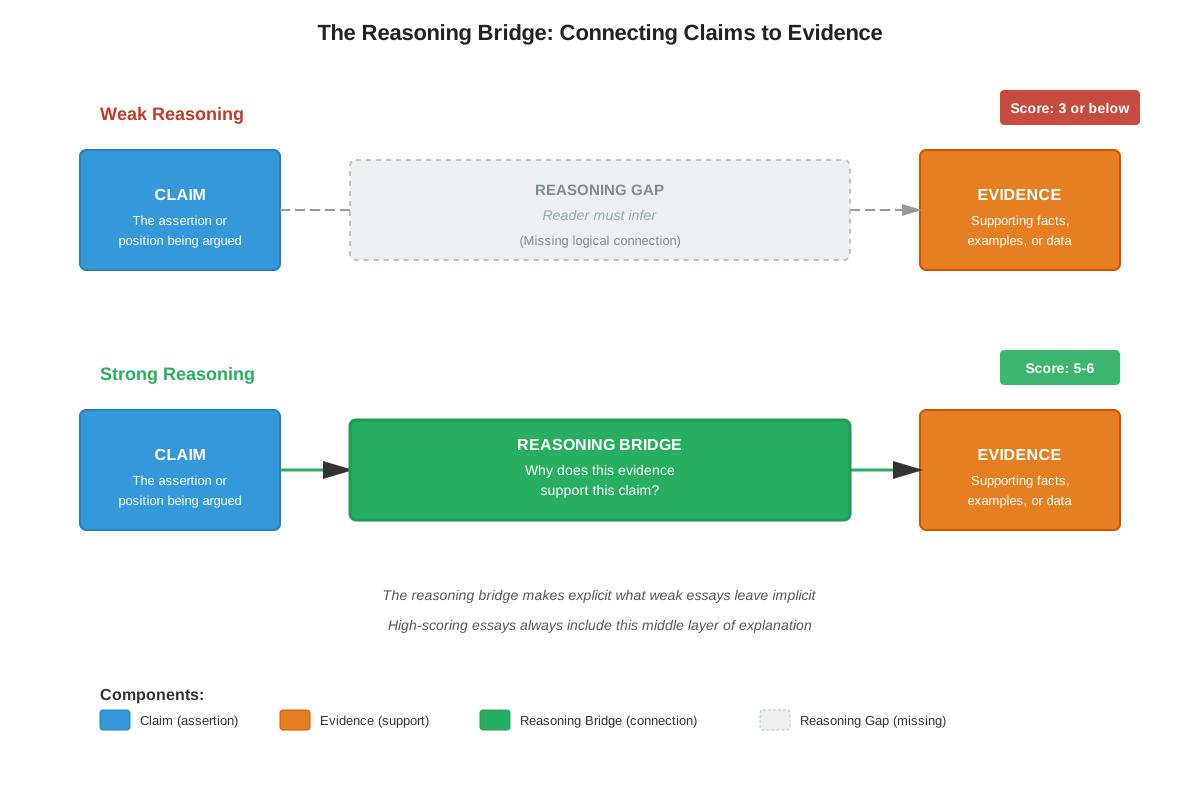
On the GRE Analytical Writing section, explaining reasoning appears in approximately 100% of high-scoring essays (those receiving scores of 5 or 6). The official scoring rubric explicitly rewards essays that "develop ideas cogently" and "convey ideas fluently and precisely," both of which depend on clear reasoning explanations. Conversely, essays scoring 3 or below typically exhibit "limited development" and fail to explain how their points connect logically.
This topic manifests in several common exam scenarios: when analyzing whether an argument's conclusion follows from its premises, when evaluating the strength of evidence, when considering alternative explanations, when assessing assumptions, and when developing original positions on complex issues. Test-takers who master explaining reasoning can transform potentially vague statements like "This argument is weak" into sophisticated analyses like "This argument is weak because it assumes without justification that correlation implies causation, when alternative explanations such as reverse causality or confounding variables could equally account for the observed relationship."
Core Concepts
The Nature of Reasoning Explanation
Explaining reasoning means making explicit the logical connections that link claims to evidence, premises to conclusions, or observations to interpretations. Rather than simply asserting that A leads to B, effective reasoning explanation shows the mechanism by which A produces B, the conditions under which this relationship holds, and why this connection is valid or problematic.
The fundamental principle underlying reasoning explanation is that readers cannot read minds. What seems obvious to the writer may not be apparent to the reader. High-quality analytical writing therefore includes explicit "because" statements, causal explanations, and logical warrants that illuminate the path from evidence to conclusion. This transparency allows readers to evaluate the soundness of the analysis rather than merely accepting or rejecting conclusions based on agreement.
Components of Effective Reasoning Explanation
Effective reasoning explanations contain several essential elements working in concert:
| Component | Function | Example Signal Words |
|---|---|---|
| Claim | States the position or conclusion | "The argument fails," "This suggests," "Therefore" |
| Evidence | Provides the supporting material | "The data shows," "According to," "For instance" |
| Warrant | Explains why evidence supports claim | "Because," "This demonstrates that," "The reason is" |
| Backing | Justifies the warrant itself | "Given that," "Considering," "In light of" |
| Qualification | Acknowledges limitations | "Unless," "Except when," "To the extent that" |
The warrant represents the most critical component for GRE purposes. While many test-takers include claims and evidence, fewer provide explicit warrants explaining why the evidence actually supports the claim. For example, stating "The survey had only 100 respondents, so the argument is weak" provides claim and evidence but lacks warrant. Adding "because such a small sample size increases the margin of error and reduces confidence that the results represent the broader population" supplies the missing reasoning explanation.
Levels of Reasoning Depth
Reasoning explanations exist on a continuum from shallow to deep:
- Surface level: Simply restating the claim in different words without adding explanatory content
- Basic level: Providing one-step reasoning that directly connects evidence to claim
- Intermediate level: Unpacking the logical mechanism and addressing potential objections
- Advanced level: Exploring implications, considering alternatives, and examining underlying assumptions
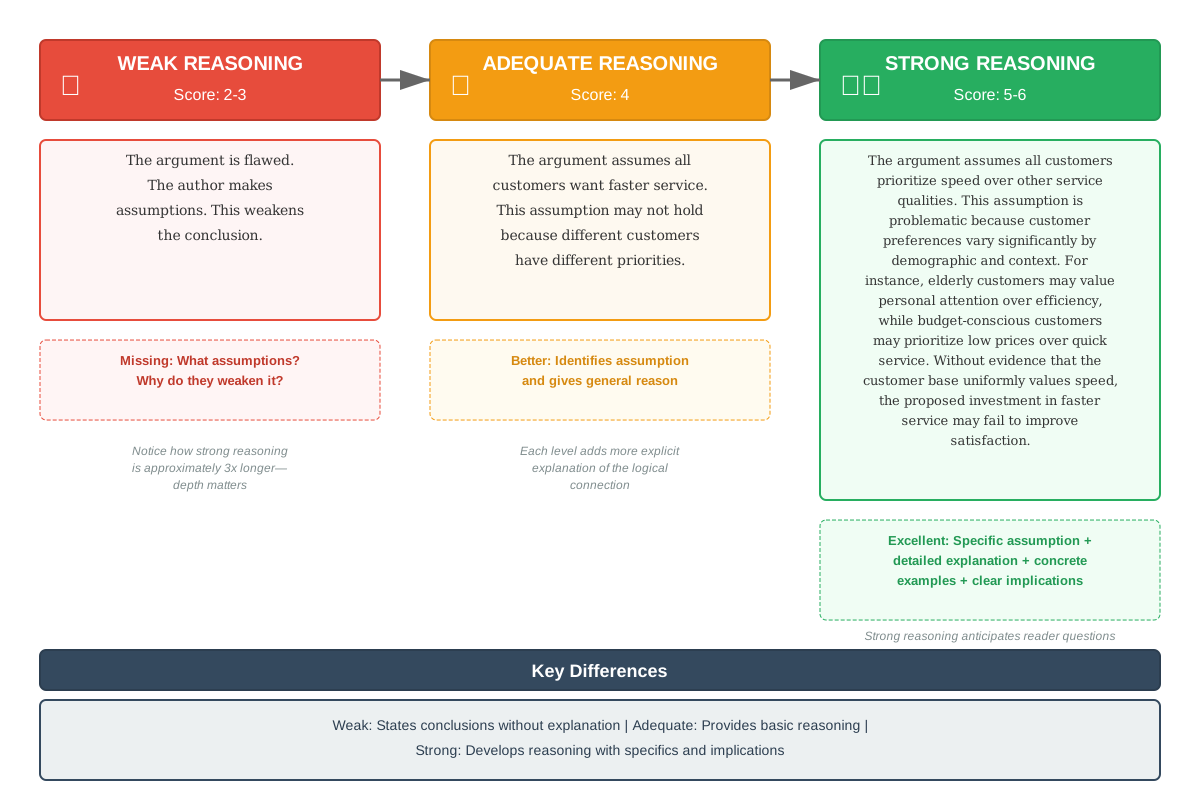
GRE essays scoring 5-6 typically operate at intermediate to advanced levels, while essays scoring 3-4 remain at basic to intermediate levels. The difference lies not in vocabulary or sentence complexity but in the thoroughness of logical explanation.
The "So What?" Test
A practical technique for ensuring adequate reasoning explanation involves applying the "So What?" test to each claim. After stating a point, writers should ask themselves: "Why does this matter? What does this prove? How does this connect to my larger argument?" If the answer isn't already explicit in the text, additional reasoning explanation is needed.
For instance, consider this statement: "The argument assumes that the new policy will not have unintended consequences." Applying the "So What?" test reveals that readers need to know: Why is this assumption problematic? What unintended consequences might occur? Why should we doubt the policy will work as planned? A complete reasoning explanation addresses these questions: "This assumption is problematic because complex social policies typically produce unforeseen effects due to the interconnected nature of social systems. For example, a policy designed to reduce traffic congestion by raising parking fees might inadvertently harm local businesses that depend on convenient customer access, thereby undermining economic goals that may be equally important to policymakers."
Causal Reasoning Explanation
Many GRE arguments involve causal claims, making causal reasoning explanation particularly important. When explaining why a causal relationship is or isn't established, effective writers address:
- Temporal sequence: Does the cause precede the effect?
- Correlation strength: How closely are the variables associated?
- Alternative explanations: What other factors might account for the observed relationship?
- Mechanism: Through what process does the cause produce the effect?
- Consistency: Does the relationship hold across different contexts?
Simply noting that "correlation doesn't prove causation" represents weak reasoning explanation. Strong explanation specifies which alternative causal scenarios are plausible and why they undermine the argument's conclusion.
Reasoning Chains
Complex analytical writing often requires reasoning chains—sequences of connected inferences where each conclusion becomes a premise for the next step. Explaining reasoning in chains demands particular care because readers must follow multiple logical steps. Effective strategies include:
- Numbering or sequencing steps explicitly
- Using consistent terminology throughout the chain
- Pausing to summarize intermediate conclusions
- Checking that no links are missing or assumed
For example: "First, the argument assumes that customer satisfaction correlates with repeat purchases. Second, it assumes that the survey accurately measures satisfaction. Third, it assumes that current satisfaction levels will persist into the future. Each assumption introduces uncertainty, and because the conclusion depends on all three holding simultaneously, the compound probability of error is substantial."
Concept Relationships
The concepts within explaining reasoning form an interconnected system. The nature of reasoning explanation provides the foundational understanding that informs all other elements. This foundation supports the components of effective reasoning explanation, which serve as the building blocks for constructing clear logical connections. These components operate at different levels of reasoning depth, with more sophisticated explanations incorporating more components and addressing them more thoroughly.
The "So What?" test functions as a diagnostic tool that helps writers identify where reasoning explanation is insufficient, prompting them to add warrants, backing, or qualifications. This test proves especially valuable when constructing reasoning chains, where each link must be explicitly explained to maintain logical continuity. Causal reasoning explanation represents a specialized application of these general principles to the specific domain of cause-effect relationships, which appear frequently in GRE arguments.
These concepts connect to prerequisite knowledge of argument structure by building upon basic claim-evidence relationships and extending them with explicit warrants. They relate to broader Analytical Writing Style concepts by providing the logical substance that organization and clarity help communicate. Mastering explaining reasoning enables progression to more advanced topics like sophisticated counterargument development and nuanced position articulation.
Relationship map: Nature of reasoning → Components (claim, evidence, warrant) → Levels of depth → Diagnostic tools ("So What?" test) → Specialized applications (causal reasoning, reasoning chains) → Integration with broader writing style
High-Yield Facts
⭐ The warrant—the explanation of why evidence supports a claim—is the most commonly missing element in mediocre GRE essays
⭐ Reasoning explanation should be explicit enough that a skeptical reader could follow the logic without filling in gaps
⭐ Every major claim in a GRE essay should be followed by a "because" statement or equivalent reasoning explanation
⭐ Identifying an argument's flaw without explaining why it's problematic earns minimal credit on the GRE
⭐ Causal claims require explanation of mechanism, not just assertion of correlation
- Reasoning chains longer than three steps typically require intermediate summaries to maintain clarity
- The "So What?" test helps identify where additional reasoning explanation is needed
- Effective reasoning explanation anticipates and addresses potential reader questions
- Qualification words (unless, except, provided that) strengthen reasoning by acknowledging limitations
- Concrete examples make abstract reasoning explanations more accessible and persuasive
- Reasoning explanation should connect each paragraph's main point back to the essay's thesis
- Transitional phrases that signal reasoning relationships (therefore, consequently, thus) guide readers through logical connections
- Explaining why alternative explanations are less plausible strengthens the primary reasoning
- Reasoning explanation distinguishes between necessary and sufficient conditions in logical relationships
- The depth of reasoning explanation, not vocabulary complexity, primarily determines GRE essay scores
Quick check — test yourself on Explaining reasoning so far.
Try Flashcards →Common Misconceptions
Misconception: Stating a position clearly is the same as explaining reasoning → Correction: Stating what you think is distinct from explaining why you think it. Reasoning explanation requires articulating the logical process that leads from evidence to conclusion, not just asserting the conclusion confidently.
Misconception: Sophisticated vocabulary demonstrates strong reasoning → Correction: Word choice and reasoning quality are independent dimensions. An essay can use simple language while providing thorough reasoning explanations, or employ advanced vocabulary while leaving logical gaps. GRE evaluators prioritize logical coherence over lexical sophistication.
Misconception: Readers will understand obvious connections without explanation → Correction: What seems obvious to the writer often isn't apparent to readers. The "curse of knowledge" makes writers overestimate how much readers can infer. Explicit reasoning explanation ensures shared understanding.
Misconception: Longer explanations are always better → Correction: Reasoning explanation should be sufficient, not excessive. The goal is clarity and completeness, not verbosity. A concise explanation that addresses the key logical connection is superior to a rambling one that obscures the point.
Misconception: Explaining reasoning means repeating the same point in different words → Correction: True reasoning explanation adds new information—specifically, the logical warrant connecting evidence to claim. Mere repetition or paraphrasing without adding explanatory content doesn't constitute reasoning explanation.
Misconception: Identifying a logical fallacy by name is sufficient reasoning explanation → Correction: Naming a fallacy (e.g., "ad hominem," "slippery slope") is a starting point, not an endpoint. Effective reasoning explanation shows specifically how the fallacy operates in the particular argument and why it undermines the conclusion.
Misconception: Reasoning explanation is only necessary for complex points → Correction: Even seemingly straightforward claims benefit from brief reasoning explanation. What appears simple to the writer may not be obvious to all readers, and explicit explanation demonstrates analytical rigor.
Worked Examples
Example 1: Analyzing an Argument
Prompt excerpt: "The following appeared in a memo from the director of a city's transportation department: 'Five years ago, we increased parking fees in the downtown area, and traffic congestion decreased by 15%. Therefore, to further reduce congestion, we should raise parking fees again.'"
Weak response (insufficient reasoning explanation):
"This argument is flawed because it assumes that raising parking fees will reduce congestion. The argument also doesn't consider other factors. Therefore, the conclusion is not well-supported."
Analysis of weakness: This response identifies a problem but doesn't explain why it's problematic. It lacks warrants connecting the observations to the evaluation. The reader is left wondering: Why is the assumption problematic? What other factors matter? How do these issues undermine the conclusion?
Strong response (effective reasoning explanation):
"This argument is flawed because it assumes that the correlation between increased parking fees and reduced congestion five years ago establishes a causal relationship that will hold in the future. However, this assumption is problematic for several reasons. First, the 15% reduction in congestion might have resulted from factors unrelated to parking fees, such as economic recession reducing commuter traffic, new public transportation options becoming available, or businesses relocating outside downtown. Without ruling out these alternative explanations, we cannot confidently attribute the congestion reduction to parking fees alone. Second, even if parking fees did cause the initial reduction, the relationship may not be linear or repeatable. The first fee increase might have affected the most price-sensitive drivers, while remaining drivers may be less responsive to additional increases because they have no viable alternatives. Third, the five-year gap means current conditions may differ substantially from those when the original policy was implemented, making historical correlation an unreliable predictor of future results. Because the argument fails to address these concerns, its conclusion that raising fees again will further reduce congestion remains inadequately supported."
Analysis of strength: This response provides explicit reasoning explanation at multiple levels. It identifies the problematic assumption, explains why it's problematic (alternative explanations exist), provides concrete examples of alternatives, explains why even a genuine past causal relationship might not repeat (diminishing returns, changed conditions), and connects these points back to the overall evaluation. Each claim includes a warrant explaining its significance.
Example 2: Developing an Issue Position
Prompt excerpt: "Some people believe that universities should require all students to take courses outside their major field of study. Others believe students should focus exclusively on their chosen field. Discuss which view aligns more closely with your position."
Weak response (insufficient reasoning explanation):
"I believe students should take courses outside their major because it makes them well-rounded. Exposure to different subjects is valuable. Therefore, universities should require diverse coursework."
Analysis of weakness: This response states a position but doesn't explain the reasoning behind it. Why does being "well-rounded" matter? How does exposure to different subjects create value? What's the mechanism connecting diverse coursework to beneficial outcomes? The logical connections remain implicit.
Strong response (effective reasoning explanation):
"Universities should require students to take courses outside their major field because such exposure develops cognitive flexibility that proves valuable in complex professional environments. When students engage with diverse disciplines—say, an engineering major studying philosophy or a literature major taking statistics—they encounter different methodological approaches, evidentiary standards, and modes of reasoning. This intellectual cross-training strengthens their ability to approach problems from multiple angles, a skill increasingly essential in modern workplaces where challenges rarely fall neatly within single disciplinary boundaries. For example, a computer scientist who has studied ethics is better equipped to anticipate the societal implications of artificial intelligence systems, while a business major with biology coursework can more effectively evaluate healthcare industry opportunities. Moreover, exposure to unfamiliar fields combats the intellectual insularity that can develop when students interact exclusively with like-minded peers in their major. By requiring diverse coursework, universities ensure that graduates possess not just deep expertise in one area but also the breadth of perspective necessary to apply that expertise responsibly and creatively in varied contexts."
Analysis of strength: This response explains the reasoning behind the position through multiple layers. It identifies the mechanism (cognitive flexibility development), explains how that mechanism operates (encountering different methodologies), connects the mechanism to real-world value (complex professional environments), provides concrete examples (computer scientist studying ethics), and addresses why this outcome matters (responsible and creative expertise application). Each step in the reasoning chain is explicitly articulated.
Exam Strategy
When approaching GRE Analytical Writing tasks, implement these strategies for effective reasoning explanation:
Trigger word recognition: Watch for prompt language that explicitly demands reasoning explanation, such as "explain how," "discuss the extent to which," "evaluate the reasoning," or "provide reasons." These phrases signal that mere assertion will be insufficient—the response must include explicit logical explanation.
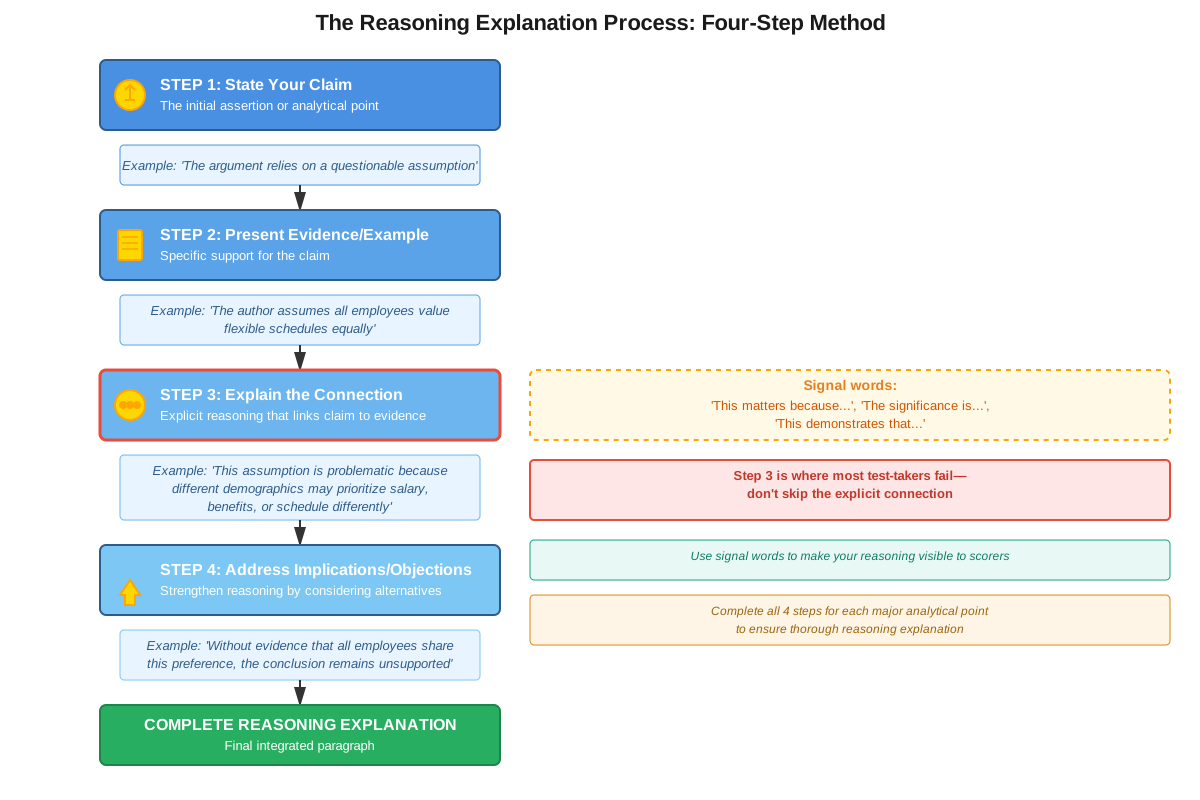
The "because" insertion technique: After drafting each major claim, insert the word "because" and complete the sentence. If you cannot articulate a clear "because" statement, your reasoning explanation is incomplete. This simple technique forces explicit warrant articulation.
Pre-writing reasoning maps: Before drafting, spend 1-2 minutes creating a brief reasoning map that connects your main points. For each major claim, jot down the evidence and the warrant linking them. This planning prevents reasoning gaps in the final essay.
Paragraph-level reasoning checks: Each body paragraph should follow a consistent pattern: (1) topic sentence stating the main claim, (2) evidence or example supporting the claim, (3) explicit explanation of why the evidence supports the claim (the warrant), and (4) connection back to the thesis. If any paragraph lacks step 3, reasoning explanation is insufficient.
Time allocation: Reserve approximately 30-40% of your writing time for reasoning explanation. If you spend 30 minutes on an essay, dedicate 10-12 minutes specifically to developing warrants and logical connections, not just stating claims and evidence.
Process of elimination for self-editing: When reviewing your draft, identify any sentence that makes a claim or draws a conclusion. Ask: "Have I explained why this is true or why it matters?" If not, add 1-2 sentences of reasoning explanation. This systematic approach catches gaps that might otherwise go unnoticed under time pressure.
Depth over breadth: On the GRE, thoroughly explaining the reasoning behind 2-3 well-developed points is superior to superficially addressing 5-6 points. Prioritize depth of reasoning explanation over quantity of observations.
Exam Tip: If you find yourself writing "obviously," "clearly," or "it is evident that," stop and ask whether you've actually explained the reasoning. These phrases often signal places where writers assume connections are self-evident when they actually require explanation.
Memory Techniques
The CREW acronym for complete reasoning explanation:
- Claim: State your position
- Reason: Provide the warrant (why the claim is valid)
- Evidence: Supply supporting examples or data
- Warrant extension: Explain why the evidence supports the reason
The Bridge Visualization: Picture each claim and piece of evidence as islands. Reasoning explanation is the bridge connecting them. If readers can't walk from evidence island to claim island without jumping, you need a stronger bridge (more explicit reasoning explanation).
The Skeptical Reader Technique: Imagine a skeptical professor reading your essay who constantly asks "Why?" and "So what?" after each sentence. Your reasoning explanation should preemptively answer these questions before they're asked.
The Three-Layer Method for causal reasoning:
- Surface: State the correlation
- Middle: Explain the mechanism
- Deep: Address alternatives
Remembering these three layers ensures comprehensive causal reasoning explanation.
The "Because Chain" Exercise: Practice extending reasoning by creating chains: "X is true because Y, and Y matters because Z, and Z connects to the thesis because W." This trains the habit of multi-level reasoning explanation.
Summary
Explaining reasoning represents the critical skill of making logical connections explicit in analytical writing. On the GRE, this means going beyond stating positions or identifying argument flaws to articulate why claims are valid, how evidence supports conclusions, and what mechanisms underlie logical relationships. Effective reasoning explanation includes warrants that connect evidence to claims, addresses potential objections, considers alternative explanations, and operates at sufficient depth to guide readers through complex analytical thinking. The most common deficiency in mediocre GRE essays is insufficient reasoning explanation—writers state what they think without explaining why they think it. High-scoring essays distinguish themselves by providing explicit "because" statements, unpacking causal mechanisms, and building logical bridges that allow skeptical readers to follow the analytical journey. Mastering this skill requires moving beyond the assumption that obvious connections need no explanation and instead treating every logical step as requiring explicit articulation. The practical application involves systematic techniques like the "So What?" test, the "because" insertion method, and paragraph-level reasoning checks that ensure no logical gaps remain in the final essay.
Key Takeaways
- Reasoning explanation means articulating the logical connections between claims and evidence, not just asserting conclusions
- The warrant—the explanation of why evidence supports a claim—is the most frequently missing element in weak GRE essays
- Every major claim should be followed by explicit reasoning that answers "Why?" and "So what?"
- Effective reasoning explanation anticipates reader questions and addresses them preemptively
- Causal reasoning requires explaining mechanisms and considering alternative explanations, not just noting correlations
- Depth of reasoning explanation, not vocabulary sophistication, primarily determines GRE Analytical Writing scores
- Systematic techniques like the "because" insertion method and "So What?" test help identify and fill reasoning gaps
Related Topics
Argument Analysis Techniques: Building on explaining reasoning, this topic covers systematic approaches to identifying and evaluating logical flaws, assumptions, and evidence quality in GRE argument tasks. Mastering reasoning explanation provides the foundation for articulating why specific argument elements succeed or fail.
Evidence Integration: This topic explores how to effectively incorporate examples, data, and supporting material into analytical writing. Strong reasoning explanation is essential for showing how integrated evidence actually supports the claims being made.
Counterargument Development: Advanced analytical writing includes anticipating and addressing opposing viewpoints. Explaining reasoning becomes more complex when evaluating multiple perspectives and articulating why one position is stronger than alternatives.
Logical Fallacies and Reasoning Errors: This topic catalogs common patterns of flawed reasoning. Understanding these patterns enhances the ability to explain why specific reasoning succeeds or fails in GRE arguments.
Practice CTA
Now that you understand the principles and strategies behind explaining reasoning, it's time to apply these concepts to actual GRE-style prompts. The practice questions and flashcards will help you internalize the techniques covered in this guide and develop the automatic habits that lead to high-scoring essays. Remember: explaining reasoning is a skill that improves with deliberate practice. Each practice essay is an opportunity to strengthen your ability to make logical connections explicit and guide readers through sophisticated analytical thinking. Approach the practice materials with the goal of implementing at least one new reasoning explanation technique in each response, and you'll see measurable improvement in the clarity and persuasiveness of your analytical writing.
Sign up free to keep reading
Create a free AnvayaPrep account to finish this GRE guide on Explaining reasoning — plus flashcards and practice questions.