Overview
The counterargument is one of the most critical elements of a high-scoring GRE Analytical Writing essay, particularly in the "Analyze an Issue" task. A counterargument involves acknowledging, presenting, and then refuting opposing viewpoints to your main thesis. This sophisticated rhetorical technique demonstrates intellectual maturity, critical thinking depth, and the ability to engage with complex ideas from multiple perspectives—all qualities that GRE graders explicitly look for when evaluating essays.
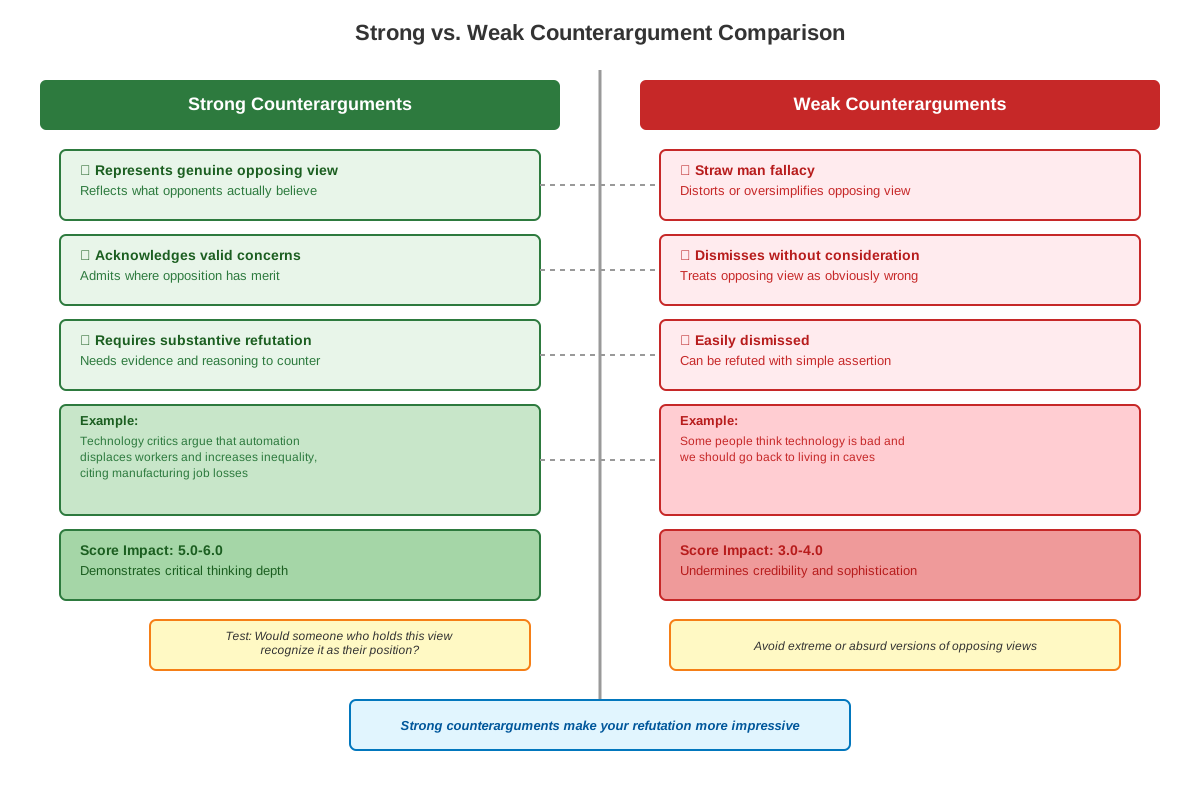
Mastering GRE counterargument strategies is essential because essays that only present one-sided arguments, regardless of how well-written, typically score in the 3.0-4.0 range. In contrast, essays that thoughtfully address counterarguments and explain why the main position remains stronger despite valid opposing concerns routinely achieve scores of 5.0-6.0. The ability to anticipate objections and respond to them persuasively shows that a writer has thoroughly considered the issue from all angles rather than simply advocating for a predetermined position.
Within the broader context of Analytical Writing, counterarguments serve as the bridge between basic argumentation and advanced critical analysis. While thesis statements establish your position and body paragraphs develop supporting reasons, counterarguments add the dimension of dialectical reasoning that transforms a competent essay into an exceptional one. This skill connects directly to other essential writing elements including logical reasoning, evidence evaluation, and nuanced conclusion development.
Learning Objectives
- [ ] Identify when Counterargument is being tested in GRE Analytical Writing prompts
- [ ] Explain the core rule or strategy behind Counterargument construction and refutation
- [ ] Apply Counterargument to GRE-style questions accurately and effectively
- [ ] Construct counterarguments that genuinely represent opposing viewpoints rather than straw man fallacies
- [ ] Integrate counterarguments seamlessly into essay structure without disrupting logical flow
- [ ] Evaluate the strength of potential counterarguments to determine which ones merit inclusion
- [ ] Employ appropriate transitional language to signal counterargument presentation and refutation
Prerequisites
- Basic essay structure: Understanding of introduction, body paragraphs, and conclusion organization is necessary because counterarguments must be positioned strategically within this framework
- Thesis statement construction: The ability to articulate a clear position is essential because counterarguments respond to and ultimately reinforce the main thesis
- Logical reasoning fundamentals: Familiarity with cause-and-effect relationships and evidence evaluation enables effective refutation of opposing viewpoints
- Paragraph development skills: Competence in developing ideas with supporting details ensures counterargument paragraphs are sufficiently substantive
Why This Topic Matters
In professional and academic contexts, the ability to acknowledge and address opposing viewpoints is fundamental to persuasive communication. Lawyers must anticipate opposing counsel's arguments, business leaders must consider alternative strategies before making decisions, and researchers must address potential criticisms of their methodologies. The counterargument skill tested on the GRE directly translates to these real-world applications of critical thinking.
On the GRE Analytical Writing section, counterarguments appear in virtually every high-scoring "Analyze an Issue" essay. According to ETS scoring guidelines, essays receiving scores of 5 or 6 consistently "develop the position fully with compelling reasons and/or persuasive examples" while also demonstrating "facility with the conventions of standard written English." The inclusion of counterarguments is explicitly mentioned in sample 6-point essays as a distinguishing feature. Approximately 85-90% of essays scoring 5.0 or higher contain at least one well-developed counterargument paragraph.
The GRE "Analyze an Issue" task presents prompts that are deliberately constructed to have multiple defensible positions. Common prompt structures include statements about education policy, technology's impact on society, government responsibilities, or the value of various approaches to problem-solving. These prompts inherently invite counterargument because they address complex issues without single correct answers. Recognizing this design helps test-takers understand that acknowledging complexity through counterarguments is not a weakness but rather an expected component of sophisticated analysis.
Core Concepts
Definition and Purpose of Counterargument
A counterargument is a position or reasoning that opposes your main thesis, presented fairly and then systematically refuted to strengthen your overall argument. Unlike simply ignoring opposing views, incorporating counterarguments demonstrates that you have considered alternative perspectives and can explain why your position remains superior despite legitimate objections. The purpose extends beyond mere acknowledgment—effective counterarguments serve three critical functions: they show intellectual honesty, they preemptively address reader skepticism, and they provide opportunities to reinforce your main points through contrast.
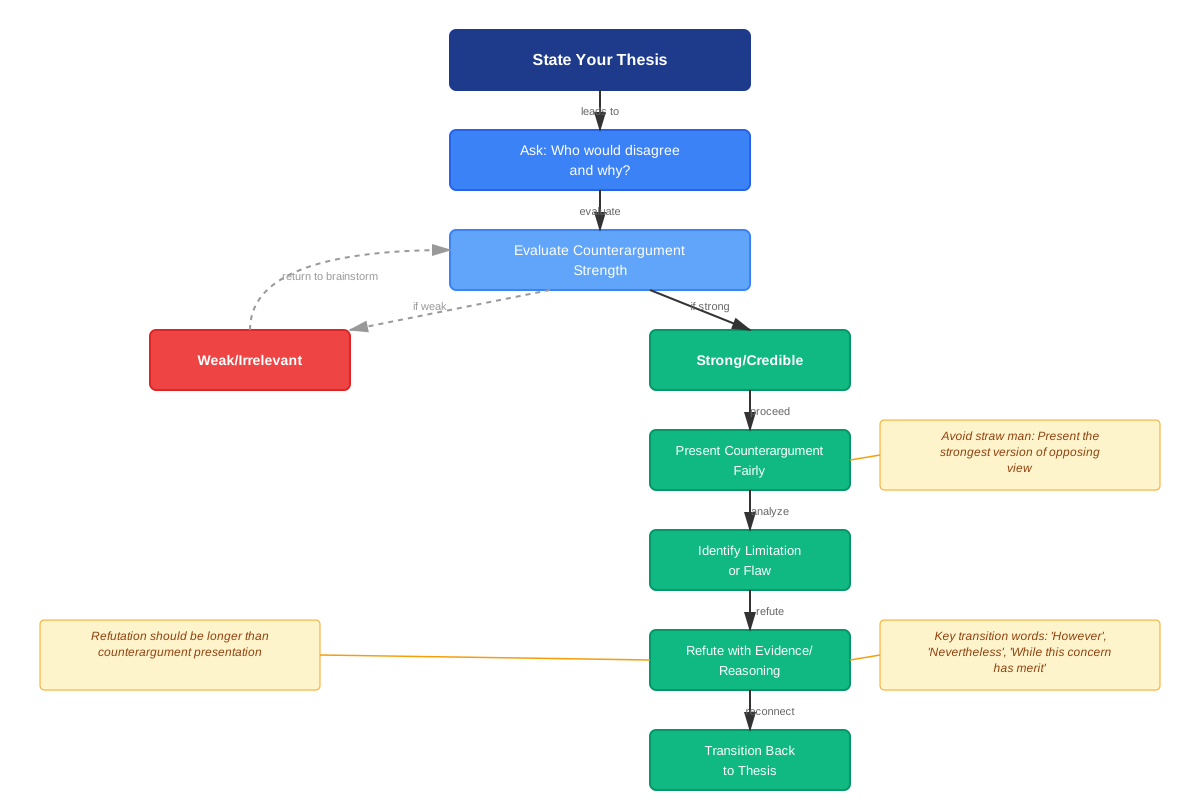
The structure of a counterargument typically follows a three-part pattern: presentation (fairly stating the opposing view), acknowledgment (recognizing any valid elements), and refutation (explaining why your position is ultimately stronger). This pattern differs fundamentally from a straw man fallacy, where an opposing view is misrepresented to make it easier to attack. GRE graders are trained to recognize authentic engagement with complexity versus superficial treatment of opposing views.
Types of Counterarguments
Concession-based counterarguments acknowledge that opposing viewpoints have some merit in specific contexts or under certain conditions, but argue that these situations are limited or outweighed by broader considerations. For example, if arguing that technology improves education, a concession-based counterargument might acknowledge that excessive screen time can be problematic for young children, but then explain that proper implementation guidelines and age-appropriate usage mitigate these concerns.
Rebuttal-based counterarguments directly challenge the logic, evidence, or assumptions underlying opposing positions. These counterarguments identify flaws in reasoning, point out contradictory evidence, or reveal unstated assumptions that weaken the opposing view. For instance, if an opposing view claims that standardized testing is unnecessary because teacher evaluations suffice, a rebuttal might point out that teacher evaluations lack the objectivity and comparability that standardized measures provide.
Alternative explanation counterarguments accept the same evidence or observations as the opposing view but offer a different interpretation that supports your thesis. This sophisticated approach demonstrates that the same facts can lead to different conclusions depending on analytical framework. If opponents cite declining test scores as evidence that modern education is failing, an alternative explanation might interpret those same scores as reflecting more inclusive education systems that now test previously excluded populations.
Strategic Placement in Essay Structure
| Placement Option | Advantages | Disadvantages | Best Used When |
|---|---|---|---|
| Dedicated paragraph after body paragraphs | Clear organization; thorough development | May seem disconnected from main arguments | Multiple counterarguments need addressing |
| Integrated within body paragraphs | Seamless flow; direct comparison | Requires careful transitions; can confuse readers | Counterargument directly relates to specific supporting point |
| Early in essay (paragraph 2) | Addresses skepticism immediately; clears path for positive arguments | May give too much prominence to opposing view | Opposing view is particularly strong or well-known |
| Before conclusion | Provides final opportunity to reinforce thesis | May leave readers with opposing view too fresh in mind | Counterargument serves as springboard to nuanced conclusion |
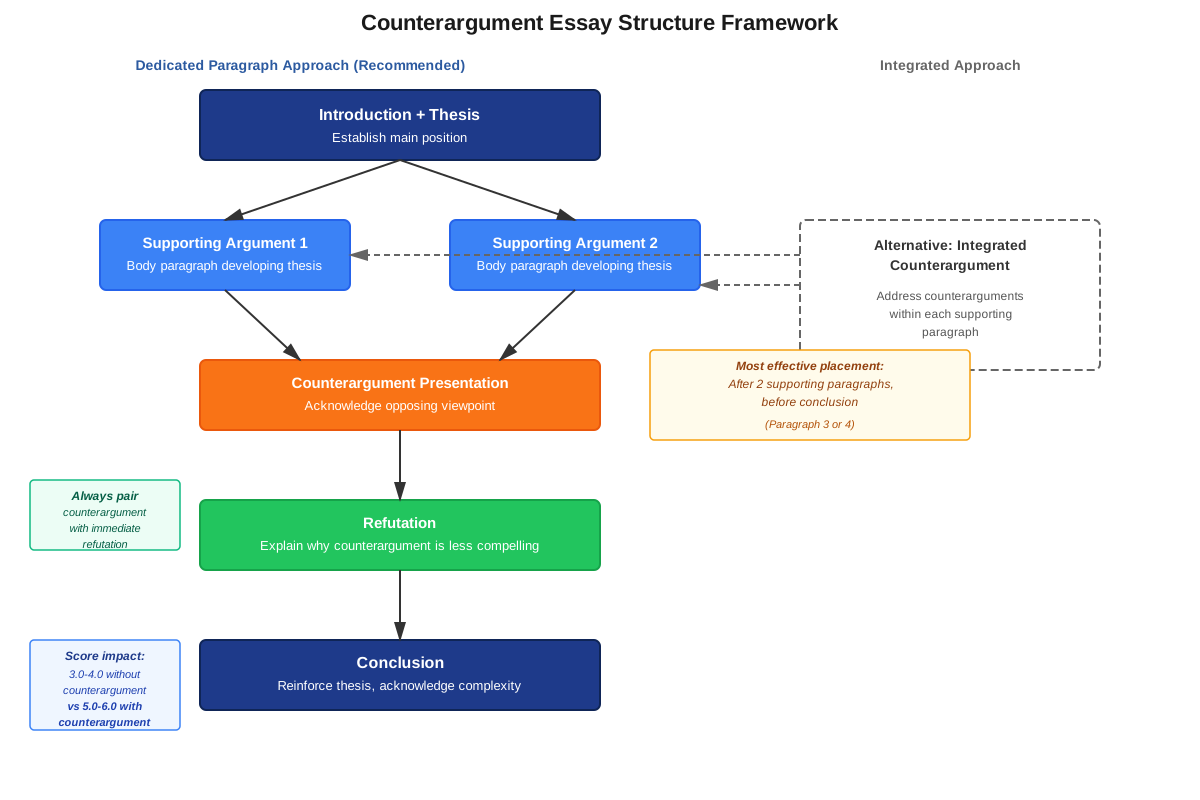
The most common and effective placement for GRE essays is a dedicated paragraph positioned after the main supporting paragraphs but before the conclusion. This structure allows full development of your positive case before addressing objections, while still leaving room for a strong concluding paragraph that synthesizes your complete argument.
Transitional Language for Counterarguments
Effective counterargument paragraphs employ specific transitional phrases that signal shifts in perspective. When introducing the opposing view, phrases like "Critics might argue that," "Some may contend that," "An alternative perspective suggests that," or "Opponents of this view claim that" clearly indicate you are presenting a position you will challenge. These phrases are crucial because they prevent reader confusion about whether you are supporting or opposing the ideas being presented.
When pivoting from presentation to refutation, transitional phrases such as "However, this view fails to consider," "While this concern has some validity, it overlooks," "This argument is problematic because," or "Upon closer examination, this reasoning proves flawed" signal the shift to your response. The strength of your refutation often depends on the clarity of this transition—readers must understand precisely when you stop presenting the opposing view and begin dismantling it.
Refutation Techniques
Evidence-based refutation involves presenting facts, statistics, examples, or expert testimony that contradict the opposing position. This approach is particularly effective when the counterargument relies on empirical claims. For instance, if an opposing view suggests that remote work decreases productivity, evidence-based refutation might cite studies showing productivity gains in remote work environments across multiple industries.
Logic-based refutation identifies reasoning errors in the opposing argument, such as false dichotomies, hasty generalizations, or faulty causal reasoning. This technique demonstrates analytical sophistication by showing that even if the opposing view's premises were accepted, its conclusions would not necessarily follow. For example, an argument claiming "either we implement strict regulations or innovation will cease" presents a false dichotomy that logic-based refutation can expose by identifying middle-ground alternatives.
Values-based refutation challenges the underlying priorities or assumptions of the opposing view. This approach argues that even if the opposing position achieves its stated goals, those goals are less important than the values your position upholds. For instance, an opposing view might prioritize efficiency while your refutation emphasizes that equity considerations should take precedence even at some cost to efficiency.
Balancing Fairness and Persuasiveness
The most challenging aspect of counterargument construction is presenting opposing views fairly enough to demonstrate genuine engagement while still maintaining a persuasive refutation. Charitable interpretation—presenting the strongest version of the opposing argument rather than a weakened caricature—is essential for credibility. GRE graders can distinguish between writers who genuinely grapple with complexity and those who set up easy targets.
However, fairness must be balanced with persuasiveness. After presenting the counterargument charitably, the refutation must be decisive enough to leave readers convinced that your position remains superior. This balance is achieved through acknowledging limited validity ("While this concern is understandable in specific contexts...") while demonstrating broader inadequacy ("...it fails to account for the majority of situations where...").
Concept Relationships
The counterargument concept connects directly to thesis development because the strength of your main position determines which opposing views are most relevant to address. A nuanced thesis that acknowledges complexity naturally invites counterargument, while an overly simplistic thesis may struggle to engage meaningfully with opposing perspectives. The relationship flows bidirectionally: thesis → identifies relevant counterarguments → counterarguments refine and strengthen thesis.
Within the essay structure, counterarguments link to body paragraph development through contrast and comparison. Each main supporting paragraph builds the positive case for your position, while the counterargument paragraph serves as a foil that highlights why alternative approaches are insufficient. This relationship can be visualized as: Supporting Evidence A → Supporting Evidence B → Supporting Evidence C → Counterargument (shows why opposing view fails) → Conclusion (synthesizes complete argument including counterargument refutation).
Counterarguments also connect to logical reasoning skills because effective refutation requires identifying reasoning patterns, evaluating evidence quality, and recognizing unstated assumptions. The analytical skills used to construct counterarguments parallel those needed for the "Analyze an Argument" essay task, creating synergy across the Analytical Writing section. The relationship flows: Logical reasoning skills → enable counterargument identification → enable effective refutation → demonstrate critical thinking throughout essay.
Finally, counterarguments relate to conclusion development by providing material for nuanced final statements. Rather than simply restating the thesis, conclusions can reference the counterargument refutation to show that the position has been tested against alternatives and proven superior. This relationship transforms conclusions from mere summaries into demonstrations of thorough analysis: Counterargument refutation → provides evidence of comprehensive thinking → enables sophisticated conclusion → elevates overall essay score.
Quick check — test yourself on Counterargument so far.
Try Flashcards →High-Yield Facts
⭐ Essays that include well-developed counterarguments score an average of 0.5-1.0 points higher than essays of similar quality without counterarguments
⭐ The counterargument paragraph should typically be 4-6 sentences: 2-3 sentences presenting the opposing view and 2-3 sentences refuting it
⭐ Effective counterarguments address the strongest opposing position, not the easiest to refute
⭐ Transitional phrases signaling counterargument presentation are essential for clarity and should appear in the first sentence of the counterargument section
⭐ Refutation must be substantive—simply stating "this view is wrong" without explanation provides no analytical value
- Counterarguments can appear in multiple locations within an essay, but dedicated paragraphs after main body paragraphs are most common in high-scoring responses
- The opposing view should be presented fairly and accurately to demonstrate intellectual honesty and avoid straw man fallacies
- Conceding minor points to the opposition before refuting the main claim strengthens credibility without weakening your position
- Counterarguments that connect back to your thesis statement create stronger coherence than those that introduce entirely new considerations
- Time management is crucial—counterargument development should take approximately 3-4 minutes of the 30-minute writing period
Common Misconceptions
Misconception: Including a counterargument weakens your essay by giving credibility to opposing views → Correction: Counterarguments actually strengthen essays by demonstrating thorough analysis and the ability to defend your position against challenges. GRE graders view counterarguments as evidence of sophisticated thinking, not weakness.
Misconception: Counterarguments should present the weakest possible opposing view to make refutation easier → Correction: Effective counterarguments address the strongest reasonable opposing position. Refuting weak arguments (straw man fallacy) demonstrates poor critical thinking and reduces essay scores.
Misconception: The counterargument paragraph should be as long as main body paragraphs → Correction: Counterargument paragraphs are typically shorter than main supporting paragraphs because they serve a supporting role. Spending too much time on counterarguments can make your essay appear uncertain about its main position.
Misconception: Every possible opposing view must be addressed → Correction: High-scoring essays typically address one or two major counterarguments thoroughly rather than superficially mentioning many opposing views. Depth of analysis matters more than breadth of coverage.
Misconception: Refutation requires completely dismissing the opposing view as having no merit whatsoever → Correction: Effective refutation often acknowledges limited validity in the opposing view while explaining why your position is superior overall. This nuanced approach demonstrates sophisticated thinking rather than dogmatic reasoning.
Misconception: Counterarguments are only necessary for controversial topics → Correction: Even for prompts where your position seems obvious, addressing potential objections demonstrates thorough analysis. GRE prompts are designed to have multiple defensible positions, so counterarguments are always relevant.
Worked Examples
Example 1: Technology in Education Prompt
Prompt: "The best way to teach is to praise positive actions and ignore negative ones."
Sample Counterargument Paragraph:
"Critics of this approach might argue that ignoring negative behaviors allows problematic patterns to become entrenched, particularly when those behaviors affect other students' learning. According to this view, a student who disrupts class discussions or fails to complete assignments needs corrective feedback, not silence, to understand expectations and modify behavior. This concern has merit in situations involving safety or severe disruption. However, this counterargument overlooks the distinction between ignoring minor negative behaviors and addressing serious issues. The original statement advocates focusing on positive reinforcement as the primary teaching strategy, not as the exclusive response to all situations. Research in behavioral psychology demonstrates that positive reinforcement creates more sustainable behavior change than punishment-focused approaches, even when occasional corrective feedback is necessary for serious issues. Furthermore, many behaviors that teachers perceive as 'negative' are actually neutral actions that receive disproportionate attention, distracting from the positive behaviors that deserve recognition. Thus, while extreme situations may require direct intervention, the general principle of emphasizing positive actions remains the most effective teaching approach."
Analysis: This counterargument paragraph demonstrates several key techniques. It opens with a clear transitional phrase ("Critics of this approach might argue") that signals the opposing view. The counterargument is presented fairly—it represents a legitimate concern about ignoring problematic behaviors. The paragraph includes a partial concession ("This concern has merit in situations involving safety or severe disruption"), which demonstrates intellectual honesty. The refutation then employs multiple techniques: clarifying the original position to show the counterargument misinterprets it, citing research evidence, and explaining why the general principle holds despite exceptions. The paragraph concludes by reinforcing the main thesis while acknowledging the counterargument's limited validity.
Example 2: Government Responsibility Prompt
Prompt: "Governments should focus on solving the immediate problems of today rather than on trying to solve the anticipated problems of the future."
Sample Counterargument Paragraph:
"Proponents of future-focused governance might contend that many of today's most pressing problems—climate change, infrastructure decay, and public health crises—resulted from previous governments' failure to anticipate and prevent foreseeable challenges. From this perspective, addressing only immediate concerns perpetuates a reactive cycle that ultimately proves more costly and less effective than proactive planning. While this argument correctly identifies the dangers of short-term thinking, it presents a false dichotomy between present and future concerns. Effective governance need not choose between addressing immediate problems and anticipating future challenges; rather, governments must balance both priorities. Moreover, the counterargument fails to account for the political and practical realities that make future-focused policies difficult to implement when current crises demand resources and attention. A government that neglects citizens' immediate needs—unemployment, crime, or economic instability—will lack the public support and political capital necessary to pursue long-term initiatives. Therefore, while future planning certainly deserves consideration, immediate problems must take priority to maintain the social stability and public trust that enable any governance at all."
Analysis: This example demonstrates a sophisticated approach to counterargument. It presents the opposing view as having legitimate concerns rooted in historical evidence. The refutation employs multiple strategies: identifying a false dichotomy in the opposing argument, introducing practical considerations (political realities), and explaining causal relationships (immediate problems must be solved to create conditions for addressing future concerns). The paragraph maintains a respectful tone toward the opposing view while decisively defending the main position. The final sentence explicitly reinforces the thesis while acknowledging that future planning has value, demonstrating the nuanced thinking that characterizes high-scoring essays.
Exam Strategy
When approaching GRE "Analyze an Issue" prompts, immediately identify potential counterarguments during the 2-3 minute planning phase. Ask yourself: "What would someone who disagrees with my position argue?" and "What are the strongest objections to my thesis?" Jot down 1-2 counterarguments during planning, but select only the strongest one for development in your essay. This planning prevents the common mistake of addressing weak or irrelevant opposing views.
Trigger words in prompts that signal counterargument opportunities include "should," "must," "best," "only," "always," and "never." These absolute or prescriptive terms inherently invite opposition because they claim universal applicability. When you see these words, recognize that the prompt is designed to have multiple defensible positions, making counterargument inclusion essential for a high score.
For time allocation, dedicate approximately 3-4 minutes to counterargument development within your 30-minute writing period. This typically means 5-7 minutes for planning, 18-20 minutes for writing (with 3-4 minutes on the counterargument paragraph), and 3-4 minutes for revision. If time runs short, a brief counterargument (3-4 sentences) is better than none, but avoid sacrificing your main supporting paragraphs to develop an elaborate counterargument.
Process-of-elimination for counterargument selection: Eliminate opposing views that are easily dismissed (straw man arguments), that require extensive background explanation, or that are tangential to your main thesis. Select counterarguments that directly challenge your core reasoning, that a reasonable person might genuinely hold, and that you can refute using logic or evidence accessible within the essay. The strongest counterarguments to address are those that initially seem compelling but reveal flaws upon closer examination.
Exam Tip: If you find yourself struggling to refute a counterargument you've presented, that may indicate you've chosen the wrong thesis position. During planning, test your thesis by considering whether you can effectively respond to major objections. If not, consider adjusting your position to one you can defend more successfully.
Position your counterargument paragraph strategically based on essay flow. If your main supporting paragraphs build momentum effectively, place the counterargument after them (typically as the fourth paragraph in a five-paragraph essay). If you anticipate reader skepticism from the outset, address the counterargument earlier (as the second paragraph) to clear obstacles before building your positive case. Most commonly, the fourth-paragraph placement works best because it allows full development of your position before addressing objections.
Memory Techniques
PAR mnemonic for counterargument structure: Present the opposing view fairly, Acknowledge any limited validity, Refute by showing why your position is superior. This three-step sequence ensures complete counterargument development.
STAR technique for identifying strong counterarguments: Strong (addresses your core argument, not peripheral points), Testable (based on logic or evidence you can engage with), Actual (represents views people genuinely hold), Refutable (has weaknesses you can identify and explain). Use STAR during planning to select which counterargument to develop.
Visualization strategy: Picture a courtroom where you must defend your position against a skilled opposing attorney. The counterargument paragraph is your opportunity to anticipate the opposition's strongest point and preemptively dismantle it before the jury (graders) deliberates. This mental image reinforces that counterarguments demonstrate confidence in your position, not weakness.
Transitional phrase bank: Memorize 3-4 phrases for introducing counterarguments ("Critics might argue," "Some contend that," "An alternative view suggests") and 3-4 phrases for pivoting to refutation ("However, this overlooks," "This reasoning proves flawed because," "Upon closer examination"). Having these phrases readily available prevents hesitation during writing and ensures clear signaling of perspective shifts.
Summary
Counterarguments are essential components of high-scoring GRE Analytical Writing essays that demonstrate sophisticated critical thinking by acknowledging and refuting opposing viewpoints. Effective counterarguments present the strongest reasonable opposition to your thesis, acknowledge any limited validity in opposing concerns, and then systematically explain why your position remains superior through evidence-based, logic-based, or values-based refutation. The typical structure involves a dedicated paragraph of 4-6 sentences positioned after main supporting paragraphs, using clear transitional language to signal perspective shifts. Success requires balancing fairness in presenting opposing views with persuasiveness in refutation, avoiding both straw man fallacies and excessive concession. Strategic counterargument development distinguishes competent essays (3.0-4.0 range) from exceptional ones (5.0-6.0 range) by showing that writers have thoroughly considered multiple perspectives and can defend their positions against legitimate challenges. Time management, careful selection of which counterarguments to address, and integration with overall essay structure are crucial for effective implementation within the 30-minute writing period.
Key Takeaways
- Counterarguments are not optional for high-scoring GRE essays—they are expected elements that demonstrate critical thinking depth and typically raise scores by 0.5-1.0 points
- Present the strongest reasonable opposing view, not the easiest to refute, to demonstrate genuine intellectual engagement rather than superficial analysis
- Use the PAR structure: Present opposing view, Acknowledge limited validity, Refute by showing your position's superiority
- Clear transitional phrases are essential for signaling when you present the counterargument versus when you refute it
- Counterargument paragraphs should be substantive but shorter than main supporting paragraphs, typically 4-6 sentences taking 3-4 minutes to write
- Effective refutation requires explaining why the opposing view is inadequate, not simply asserting that it is wrong
- Strategic placement (usually after main body paragraphs) and connection back to your thesis create coherence and reinforce your overall argument
Related Topics
Thesis Statement Development: Mastering counterarguments enables more nuanced thesis construction because understanding potential objections helps refine your main position to be more defensible and sophisticated.
Logical Fallacies: Recognizing common reasoning errors enhances counterargument refutation by enabling identification of flaws in opposing arguments, including straw man fallacies, false dichotomies, and hasty generalizations.
Evidence Evaluation: The skills used to assess evidence quality in counterargument refutation transfer directly to analyzing the strength of claims in the "Analyze an Argument" essay task.
Conclusion Development: Advanced conclusion techniques build on counterargument refutation to create sophisticated final paragraphs that synthesize multiple perspectives rather than merely restating the thesis.
Paragraph Transitions: Smooth integration of counterarguments into essay flow requires mastery of transitional phrases and coherence techniques that connect ideas across paragraphs.
Practice CTA
Now that you understand the essential role counterarguments play in GRE Analytical Writing success, practice applying these strategies to sample prompts. Work through the practice questions to identify potential counterarguments, develop refutations, and integrate these elements into complete essays. Use the flashcards to reinforce key transitional phrases and structural patterns until counterargument development becomes automatic. Remember that counterarguments are not obstacles to overcome but opportunities to demonstrate the sophisticated critical thinking that distinguishes exceptional essays. With focused practice, you will develop the confidence to address opposing views effectively and elevate your Analytical Writing scores to the 5.0-6.0 range. Your ability to engage with complexity through counterarguments will serve you not only on test day but throughout your academic and professional career.
Sign up free to keep reading
Create a free AnvayaPrep account to finish this GRE guide on Counterargument — plus flashcards and practice questions.