Overview
Strengthen questions represent a critical question type within GRE Reading Comprehension that tests a student's ability to evaluate and enhance logical arguments. These questions ask test-takers to identify which piece of additional information, if true, would make an argument's conclusion more likely to be valid or its reasoning more convincing. Unlike questions that simply test comprehension, strengthen questions require active engagement with the logical structure of an argument, demanding that students understand not just what is stated, but what assumptions underlie the reasoning and what evidence would make those assumptions more defensible.
Mastering GRE strengthen questions is essential because they appear regularly on the exam and directly assess critical reasoning skills that graduate programs value highly. These questions evaluate whether students can distinguish between relevant and irrelevant information, identify logical gaps in arguments, and recognize what types of evidence would address those gaps. The ability to strengthen arguments is fundamentally connected to analytical thinking—a core competency the GRE measures across all sections.
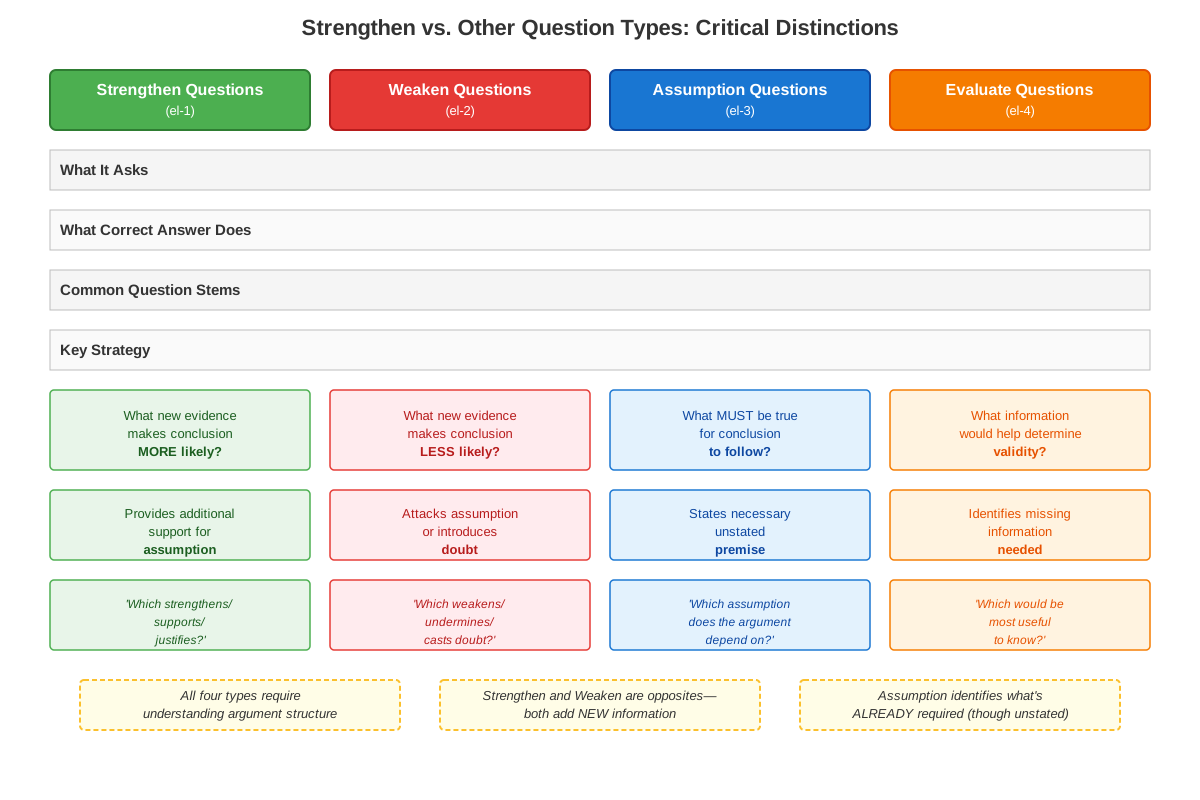
Within the broader landscape of Verbal Reasoning, strengthen questions belong to the family of critical reasoning tasks that also includes weaken, assumption, and evaluate questions. All these question types share a common foundation: they require understanding argument structure (premises, conclusions, and assumptions). However, strengthen questions specifically test the constructive side of critical thinking—the ability to build up rather than tear down an argument. This makes them particularly valuable for assessing whether students can think like researchers, lawyers, or policy analysts who must regularly evaluate what evidence would support various claims.
Learning Objectives
By the end of this study guide, students should be able to:
- [ ] Identify when Strengthen questions is being tested
- [ ] Explain the core rule or strategy behind Strengthen questions
- [ ] Apply Strengthen questions to GRE-style questions accurately
- [ ] Distinguish between answer choices that strengthen an argument versus those that are merely consistent with it
- [ ] Recognize the most common types of assumptions that strengthen questions target
- [ ] Evaluate the relative strength of different strengthening answer choices
- [ ] Avoid common trap answers that appear to strengthen but actually don't
Prerequisites
Students should have the following foundational knowledge before studying strengthen questions:
- Basic argument structure: Understanding of premises, conclusions, and how they connect is essential because strengthen questions require identifying what part of an argument needs support
- Reading comprehension fundamentals: Ability to extract main ideas and supporting details from passages, as strengthen questions build upon accurate comprehension of the original argument
- Logical reasoning basics: Familiarity with cause-and-effect relationships and conditional statements, since many strengthen questions involve causal arguments that need additional support
Why This Topic Matters
Strengthen questions appear with high frequency on the GRE, typically comprising 10-15% of all Reading Comprehension questions. This translates to approximately 2-3 strengthen questions per Verbal Reasoning section, making them one of the most common critical reasoning question types students will encounter. Given the adaptive nature of the GRE, performing well on these questions can significantly impact the difficulty level of subsequent questions and ultimately affect overall scores.
Beyond exam performance, the skills tested by strengthen questions have profound real-world applications. Graduate students constantly evaluate research claims, assess whether evidence supports conclusions, and determine what additional data would make findings more convincing. Professionals in law, business, medicine, and public policy regularly engage in this type of reasoning when building cases, developing strategies, or making evidence-based decisions. The ability to identify what would make an argument stronger is fundamental to persuasive writing, critical analysis, and scientific thinking.
On the GRE, strengthen questions typically appear in several formats. They may follow short argument passages (3-5 sentences) that present a claim with supporting evidence, or they may be embedded within longer reading comprehension passages where students must identify what would support a specific claim made by the author. Common phrasings include "Which of the following, if true, would most strengthen the argument?" or "The argument would be most strengthened by evidence that..." Understanding these patterns helps students quickly recognize when they're facing a strengthen question and activate the appropriate analytical approach.
Core Concepts
Understanding Argument Structure
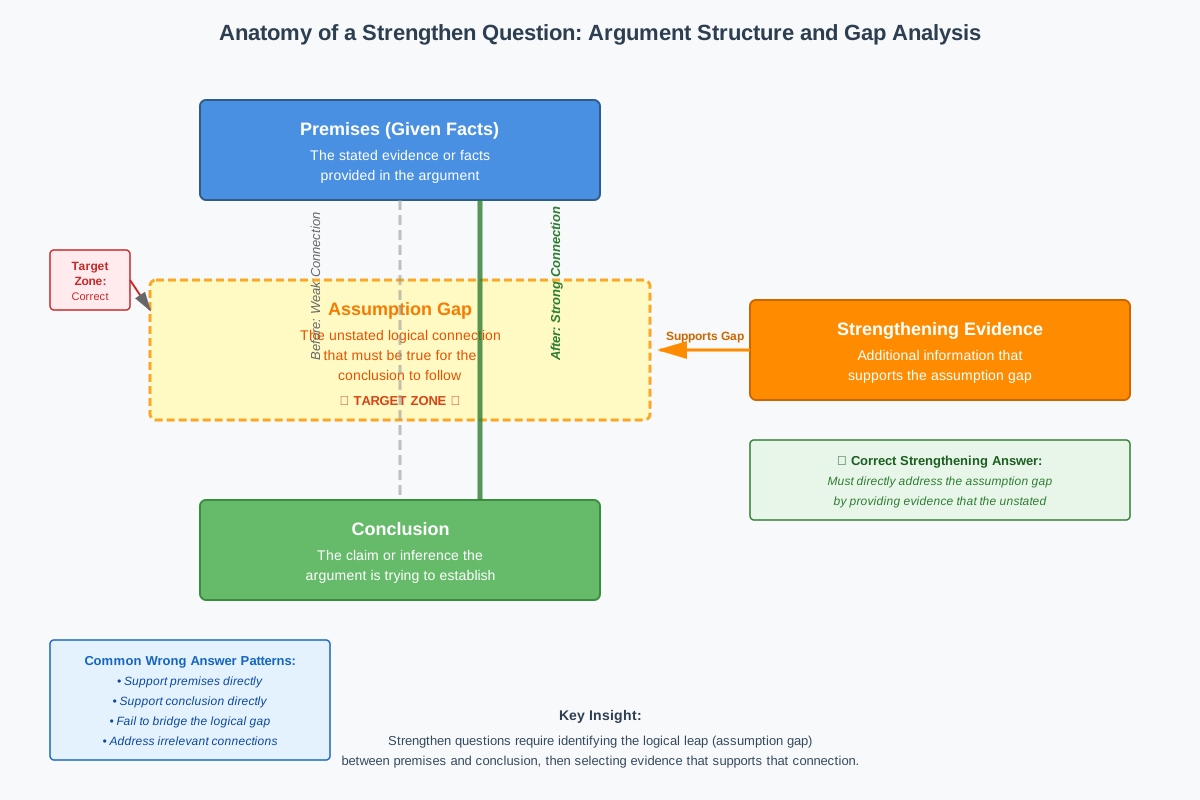
Before strengthening an argument, students must first understand its anatomy. Every argument contains premises (statements offered as evidence) and a conclusion (the claim the argument is trying to establish). Between these explicit components lies the assumption—an unstated belief that must be true for the premises to actually support the conclusion. Strengthen questions fundamentally test whether students can identify these assumptions and recognize what evidence would make them more plausible.
Consider this simple argument: "Sales of ice cream increased in July. Therefore, the new advertising campaign was successful." The premise is the sales increase; the conclusion is that advertising caused it. The assumption is that no other factors (like summer weather) explain the sales increase. To strengthen this argument, we need evidence that makes this assumption more defensible—perhaps data showing that sales increased more than typical seasonal patterns would predict, or that competitors without new campaigns didn't see similar increases.
The Core Strategy for Strengthen Questions
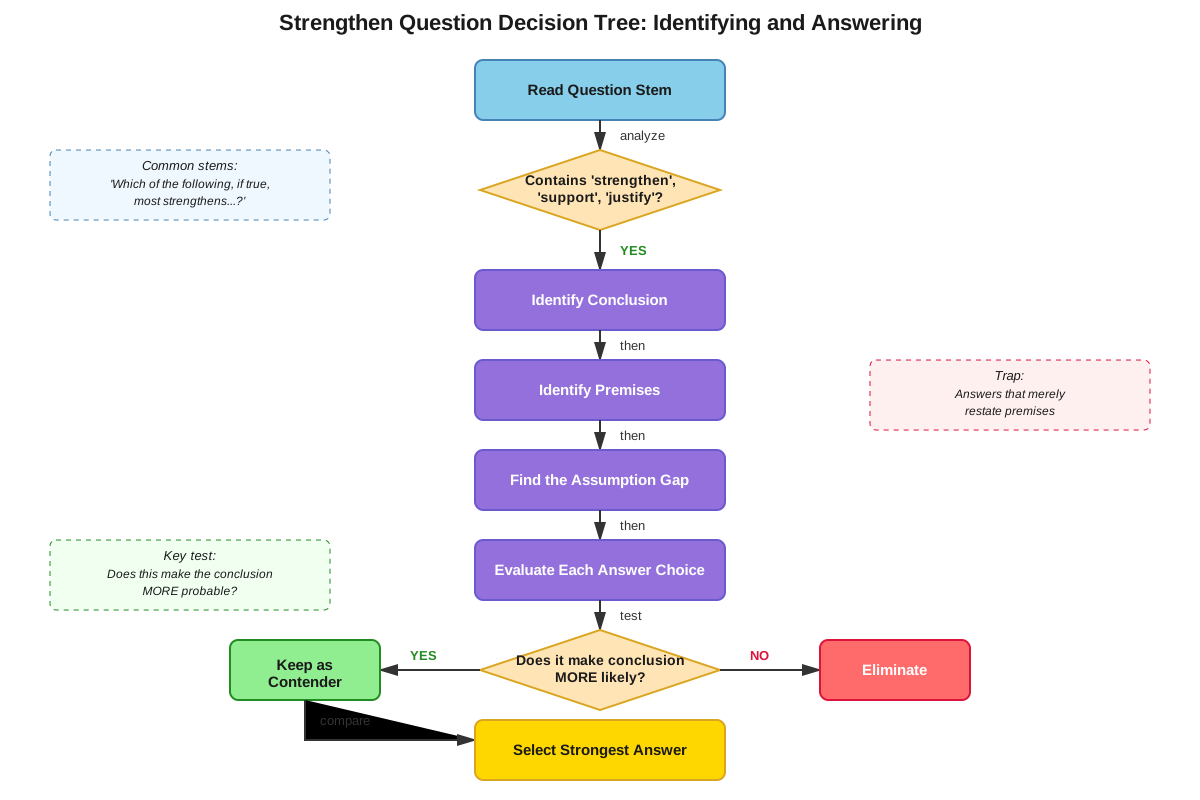
The fundamental approach to strengthen questions involves a four-step process:
- Identify the conclusion: Determine exactly what claim the argument is trying to establish
- Identify the premises: Note what evidence is offered in support
- Find the gap: Determine what assumption connects the premises to the conclusion
- Select the answer that fills the gap: Choose the option that makes the assumption more likely to be true
This process works because strengthen questions don't ask students to make arguments bulletproof—they ask what would make them more convincing. The correct answer doesn't need to prove the conclusion definitively; it simply needs to provide additional support that wasn't present in the original argument.
Types of Arguments Commonly Strengthened
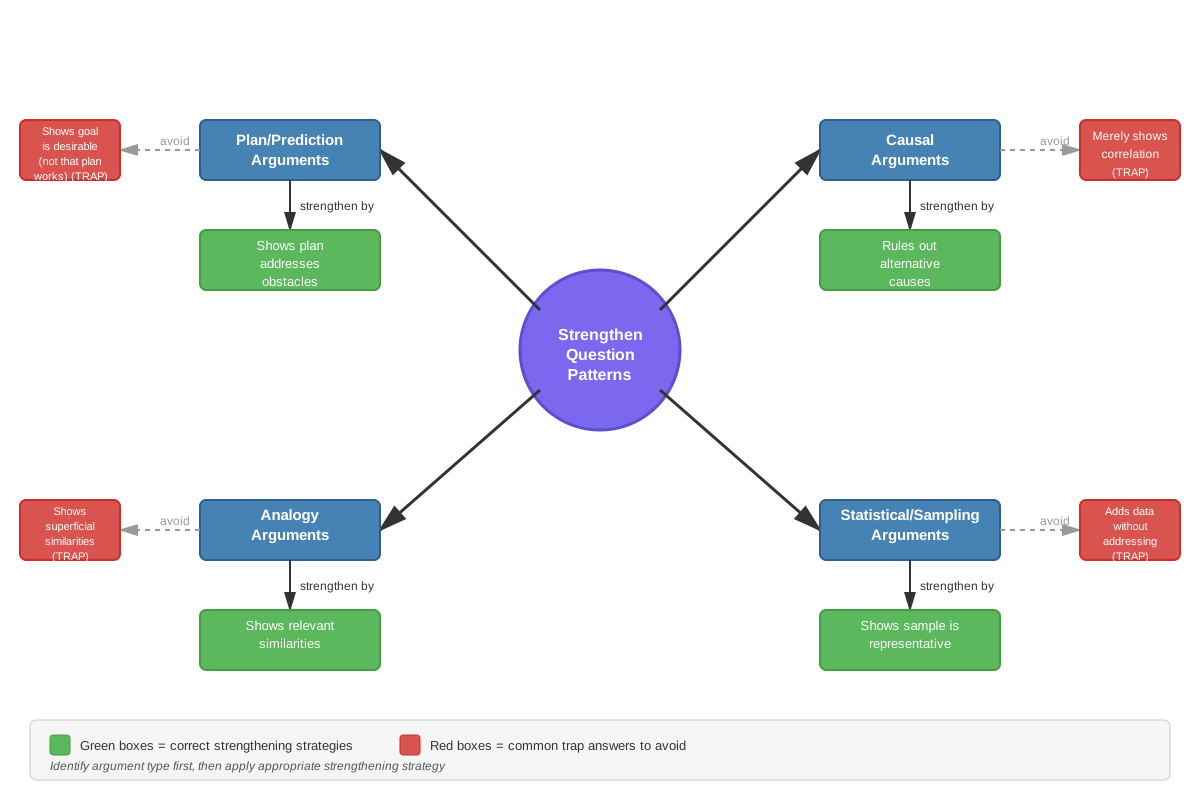
Causal Arguments are the most frequently tested type in strengthen questions. These arguments claim that X causes Y based on observed correlation or temporal sequence. To strengthen causal arguments, look for evidence that:
- Rules out alternative causes
- Shows the cause precedes the effect
- Demonstrates a mechanism linking cause and effect
- Provides additional instances of the correlation
Analogical Arguments draw conclusions about one situation based on similarities to another. These are strengthened by evidence that:
- Highlights additional relevant similarities between the compared situations
- Shows that differences between the situations are not relevant to the conclusion
- Provides examples of the analogy holding in other cases
Statistical/Survey Arguments draw conclusions from data or polling. These are strengthened by evidence that:
- Shows the sample is representative of the population
- Indicates the sample size is adequate
- Demonstrates that the methodology was sound
- Rules out confounding variables
What Strengthening Actually Means
A critical distinction exists between information that strengthens an argument and information that is merely consistent with it. An answer choice strengthens an argument only if it makes the conclusion more likely to be true than it was before. Information can be true and relevant without actually strengthening the argument.
For example, if an argument concludes that "increasing police patrols will reduce crime," learning that "crime is a serious problem in the city" is consistent with the argument but doesn't strengthen it. This information doesn't make it more likely that patrols will reduce crime. However, learning that "in similar cities, increased patrols correlated with crime reduction" does strengthen the argument by providing evidence that the proposed solution has worked elsewhere.
Degrees of Strengthening
Not all strengthening answer choices are equally strong. The GRE often includes multiple answers that technically strengthen an argument, but one strengthens it more than the others. Students must evaluate the relative impact of each option. Generally, evidence that:
- Directly addresses the central assumption is stronger than evidence addressing peripheral concerns
- Rules out major alternative explanations is stronger than evidence ruling out minor ones
- Provides quantitative support is often stronger than qualitative support
- Addresses the specific situation is stronger than general background information
Concept Relationships
The concepts within strengthen questions form an interconnected logical framework. Understanding argument structure is the foundation that enables identification of assumptions, which in turn allows recognition of what evidence would fill logical gaps. This process of gap-filling is what strengthening fundamentally accomplishes. The relationship flows as follows:
Argument Structure → Assumption Identification → Gap Recognition → Strengthening Evidence Selection
Strengthen questions connect closely to other critical reasoning question types. Assumption questions ask what must be true for an argument to work; strengthen questions ask what additional evidence would make those assumptions more plausible. Weaken questions are the mirror image—they ask what evidence would make assumptions less plausible. Evaluate questions ask what information would help determine whether an argument is strong or weak. Understanding strengthen questions therefore builds a foundation for mastering this entire family of question types.
The relationship to basic reading comprehension is also crucial. Students cannot strengthen an argument they haven't accurately understood. Misreading the conclusion or premises leads to selecting answers that strengthen the wrong claim. Similarly, understanding logical reasoning patterns (especially causation, correlation, and conditional logic) enables students to quickly recognize what types of evidence would support different argument structures.
High-Yield Facts
- ⭐ Strengthen questions ask for evidence that makes the conclusion MORE likely to be true, not necessarily proven beyond doubt
- ⭐ The correct answer will address the gap between premises and conclusion, typically by supporting an unstated assumption
- ⭐ Causal arguments are the most common type tested and are strengthened by ruling out alternative causes
- ⭐ Information can be true and relevant without actually strengthening an argument—it must make the conclusion more probable
- ⭐ The correct answer often provides new information not mentioned in the original argument
- Strengthen questions typically use phrases like "most strengthens," "provides the most support for," or "if true, would most justify"
- Answer choices that merely restate premises do not strengthen arguments—they add no new support
- Evidence that the premises are true doesn't strengthen the argument; the question assumes premises are true
- Strengthening an argument is different from proving it—even strong arguments can have false conclusions
- The correct answer doesn't need to be the only thing that would strengthen the argument, just the best option among the choices given
Quick check — test yourself on Strengthen questions so far.
Try Flashcards →Common Misconceptions
Misconception: Any answer choice that is consistent with the argument strengthens it.
Correction: Strengthening requires making the conclusion more likely to be true. An answer can be consistent with an argument (not contradicting it) without providing additional support. For example, if an argument claims "the new policy will save money," stating "the policy was recently implemented" is consistent but doesn't strengthen the claim about saving money.
Misconception: The correct answer must prove the conclusion is true.
Correction: Strengthen questions ask what makes the conclusion more likely or more convincing, not what proves it definitively. Even after strengthening, the argument may still have weaknesses. The standard is comparative—which answer provides the most additional support—not absolute proof.
Misconception: Strengthening the premises strengthens the argument.
Correction: Strengthen questions assume the premises are already true. Providing evidence that a premise is accurate doesn't add support to the argument. The gap that needs strengthening is between the premises and conclusion, not the truth of the premises themselves.
Misconception: Longer or more detailed answer choices are more likely to strengthen the argument.
Correction: The length or complexity of an answer choice has no correlation with its strengthening power. A concise statement that directly addresses the central assumption is far stronger than a lengthy statement that provides tangential information.
Misconception: If an argument has multiple weaknesses, the correct answer must address all of them.
Correction: The correct answer typically addresses the most significant gap or assumption in the argument. It doesn't need to fix every potential weakness. Students should focus on which answer provides the most substantial additional support, even if other concerns remain.
Misconception: Background information that provides context strengthens the argument.
Correction: General context or background information, while potentially interesting, doesn't strengthen an argument unless it specifically makes the connection between premises and conclusion more plausible. For instance, historical background about an industry doesn't strengthen a prediction about that industry's future unless it directly supports the reasoning behind the prediction.
Worked Examples
Example 1: Causal Argument
Passage: "City officials note that traffic accidents at the intersection of Main and Oak Streets have decreased by 40% since a new traffic light was installed six months ago. They conclude that the new traffic light has significantly improved safety at that intersection."
Question: Which of the following, if true, would most strengthen the city officials' conclusion?
Answer Choices:
A) Traffic accidents have increased at other intersections in the city during the same period
B) The intersection of Main and Oak Streets is one of the busiest in the city
C) Traffic lights are generally considered effective safety measures
D) Weather conditions during the six-month period were typical for the region
E) The city installed traffic lights at three other intersections during the same period
Analysis:
First, identify the conclusion: The new traffic light improved safety at the intersection.
Second, identify the premises: Accidents decreased 40% after the light was installed.
Third, find the gap: The argument assumes the traffic light caused the decrease, but other factors could explain it—perhaps traffic volume decreased, weather improved, or there's a citywide trend of fewer accidents.
Fourth, evaluate each answer:
- Choice A strengthens the argument significantly. If accidents increased elsewhere but decreased at this intersection, it suggests something specific to this location (the traffic light) caused the improvement rather than a citywide trend. This rules out an important alternative explanation.
- Choice B provides context but doesn't strengthen the causal claim. Knowing the intersection is busy doesn't make it more likely the light caused the decrease.
- Choice C offers general background but doesn't address whether this specific light caused this specific decrease.
- Choice D is somewhat strengthening because it rules out the possibility that unusually good weather caused fewer accidents. However, it's not as strong as Choice A.
- Choice E actually weakens the argument slightly by suggesting the decrease might be part of a broader pattern.
Correct Answer: A
This answer most directly addresses the assumption that the traffic light, rather than other factors, caused the decrease by ruling out a citywide trend.
Example 2: Analogical Argument
Passage: "The Brookfield School District implemented a new mathematics curriculum that emphasizes problem-solving over memorization. Within two years, students' standardized test scores in mathematics improved by an average of 15%. The superintendent of the neighboring Riverside School District has proposed adopting the same curriculum, arguing that it will similarly improve mathematics performance in Riverside schools."
Question: Which of the following, if true, would most strengthen the superintendent's argument?
Answer Choices:
A) Brookfield and Riverside have similar student demographics and comparable funding levels
B) Problem-solving skills are important for success in advanced mathematics courses
C) Teachers in Riverside have expressed interest in professional development opportunities
D) Standardized test scores are a widely accepted measure of student achievement
E) The new curriculum has been adopted by several other school districts nationwide
Analysis:
The conclusion is that the curriculum will improve performance in Riverside.
The premises are that it worked in Brookfield, improving scores by 15%.
The gap is the assumption that what worked in Brookfield will work in Riverside—an analogical argument that assumes relevant similarities between the districts.
Evaluating the choices:
- Choice A directly strengthens the analogy by showing that the two districts are similar in ways likely to affect curriculum effectiveness. If demographics and funding are comparable, the curriculum is more likely to produce similar results.
- Choice B supports the general value of problem-solving but doesn't address whether the curriculum will work specifically in Riverside.
- Choice C is tangentially relevant but doesn't strengthen the claim that the curriculum will improve scores.
- Choice D defends the measurement tool but doesn't make it more likely the curriculum will work in Riverside.
- Choice E shows the curriculum is popular but doesn't indicate whether it's effective in districts similar to Riverside.
Correct Answer: A
Analogical arguments are strengthened by evidence of relevant similarities between the compared situations. Choice A provides exactly this type of evidence.
Exam Strategy
When approaching GRE strengthen questions, students should develop a systematic process that maximizes accuracy while managing time effectively. Begin by reading the question stem first to confirm it's asking for strengthening (not weakening or assumption). This primes the mind to look for gaps while reading the argument.
Trigger words and phrases that signal strengthen questions include:
- "Most strengthens"
- "Provides the most support for"
- "If true, would most justify"
- "Best supports the conclusion that"
- "Most helps to explain"
- "Additional evidence that would support"
When reading the argument, actively identify the conclusion by looking for conclusion indicators like "therefore," "thus," "consequently," or "suggests that." Mark or mentally note the conclusion, as this is what needs strengthening. Then identify the premises and ask yourself: "What must be true for these premises to actually support this conclusion?"
Process-of-elimination strategies are particularly effective for strengthen questions:
- Eliminate answers that weaken the argument: Some answer choices do the opposite of what's asked
- Eliminate answers that are irrelevant: Information that doesn't connect to the argument's reasoning, even if true
- Eliminate answers that merely restate premises: These add no new support
- Eliminate answers that are consistent but don't strengthen: These are common trap answers
Among remaining choices, select the one that most directly addresses the central assumption or gap in reasoning. When two answers both strengthen, choose the one that provides more substantial or direct support.
Time allocation for strengthen questions should be approximately 1.5-2 minutes per question. Spend 30-45 seconds understanding the argument structure and identifying the gap, then 45-60 seconds evaluating answer choices. If stuck between two answers, consider which addresses a more fundamental assumption—this is usually correct.
Exam Tip: If you find yourself thinking "this answer could be true" or "this makes sense," stop and ask instead: "Does this make the conclusion MORE likely to be true than it was before?" This shift in thinking helps avoid trap answers.
Memory Techniques
The GAPS Acronym for strengthen questions:
- Gap: Identify the gap between premises and conclusion
- Assumption: Determine what assumption bridges that gap
- Plug: Look for an answer that plugs the gap
- Support: Select the answer providing the most support
The "Bridge Builder" Visualization: Picture the premises as one side of a river and the conclusion as the other side. The assumption is a partially built bridge connecting them. The correct answer provides additional materials that make the bridge stronger and more stable. Wrong answers either build on the wrong part of the river (irrelevant), add materials to the shore (restate premises), or actually remove materials (weaken).
The Three C's of Causal Strengthening:
- Correlation confirmed in other instances
- Competing causes ruled out
- Connection mechanism demonstrated
The "More Likely" Mantra: Before selecting an answer, repeat: "Does this make the conclusion MORE likely?" This simple question prevents many common errors.
Summary
Strengthen questions test the ability to identify what additional evidence would make an argument's conclusion more convincing. These questions require understanding argument structure (premises, conclusions, and assumptions), recognizing the gap between what's stated and what's concluded, and selecting evidence that makes the unstated assumptions more plausible. The core strategy involves four steps: identify the conclusion, identify the premises, find the gap, and select the answer that fills it. Strengthen questions most commonly test causal arguments, which are strengthened by ruling out alternative explanations, but also test analogical and statistical arguments. The key distinction students must master is between information that merely is consistent with an argument versus information that actually makes the conclusion more probable. Success requires avoiding common traps like answers that restate premises, provide general background, or seem relevant without actually adding support to the specific reasoning chain.
Key Takeaways
- Strengthen questions ask what makes a conclusion more likely to be true, not what proves it definitively
- The correct answer addresses the gap between premises and conclusion by supporting an unstated assumption
- Causal arguments (the most common type) are strengthened by ruling out alternative causes
- Information can be true and relevant without strengthening—it must increase the probability of the conclusion
- Use the four-step process: identify conclusion, identify premises, find the gap, select the gap-filler
- Eliminate answers that weaken, are irrelevant, restate premises, or are merely consistent without strengthening
- Focus on which answer provides the most direct and substantial support to the central reasoning
Related Topics
Weaken Questions: The mirror image of strengthen questions, these ask what evidence would make an argument less convincing. Mastering strengthen questions provides the foundation for understanding weaken questions, as both require identifying assumptions.
Assumption Questions: These directly ask what must be true for an argument to work. Understanding assumptions is the bridge between strengthen and weaken questions, as strengthen questions essentially ask what would make assumptions more plausible.
Evaluate Questions: These ask what information would help determine whether an argument is strong or weak. Success with strengthen questions enables tackling evaluate questions, which require understanding what would both strengthen and weaken an argument.
Inference Questions: While different from strengthen questions, these also require careful logical reasoning and understanding of what can be concluded from given information.
Practice CTA
Now that you've mastered the core concepts and strategies for strengthen questions, it's time to put your knowledge into action. Attempt the practice questions to reinforce these skills and build the pattern recognition that leads to consistent success on test day. Each practice question you complete strengthens your ability to quickly identify assumptions and select the best strengthening evidence. Remember, expertise in strengthen questions comes not just from understanding the concepts, but from applying them repeatedly until the process becomes automatic. Review the flashcards to cement the key distinctions and strategies in your memory. Your investment in mastering this high-frequency question type will pay dividends across your entire GRE Verbal Reasoning score!
Sign up free to keep reading
Create a free AnvayaPrep account to finish this GRE guide on Strengthen questions — plus flashcards and practice questions.