Overview
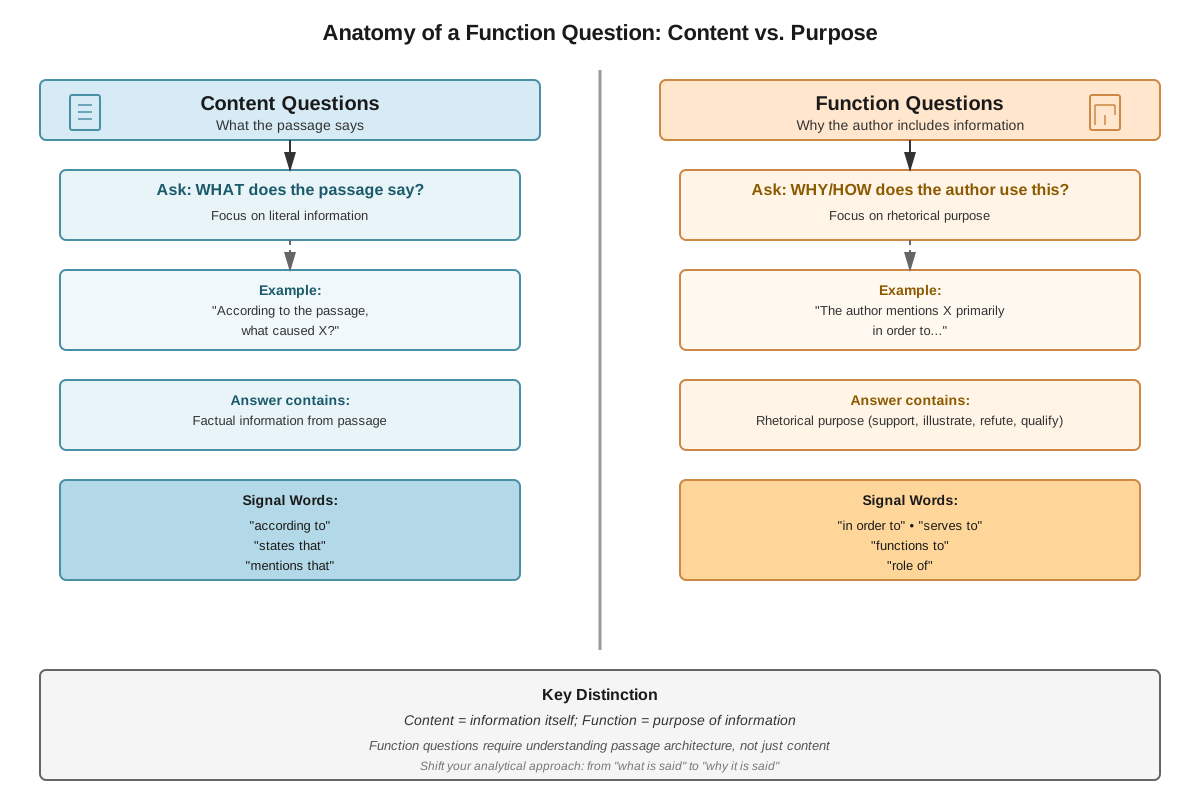
Function questions represent one of the most sophisticated and frequently tested question types in GRE Reading Comprehension. Unlike detail questions that ask "what" the passage says, or inference questions that ask "what can be concluded," GRE function questions ask "why" or "how" an author uses a particular piece of information, example, or rhetorical device. These questions assess a student's ability to understand the architecture of an argument—recognizing how individual components work together to support the author's overall purpose.
Mastering function questions is essential for achieving a competitive GRE Verbal Reasoning score because they appear in approximately 25-30% of all reading comprehension questions. These questions require students to step back from the content itself and analyze the author's strategic choices: Why did the author include this example? What role does this paragraph play in the overall argument? How does this detail support or challenge a claim? This meta-cognitive skill—thinking about thinking—distinguishes high scorers from average performers.
Function questions connect deeply to other Verbal Reasoning concepts, particularly argument structure, author's purpose, and logical reasoning. They require students to understand not just what passages say, but how passages are constructed. This architectural understanding enhances performance across all reading comprehension question types, as recognizing functional relationships helps students navigate complex passages more efficiently, predict where arguments are heading, and eliminate incorrect answer choices that confuse content with purpose.
Learning Objectives
- [ ] Identify when Function questions is being tested
- [ ] Explain the core rule or strategy behind Function questions
- [ ] Apply Function questions to GRE-style questions accurately
- [ ] Distinguish between content-based questions and function-based questions
- [ ] Analyze the rhetorical purpose of specific passage elements (examples, quotations, counterarguments)
- [ ] Evaluate answer choices by matching functional language to passage structure
- [ ] Predict common functional roles before reading answer choices
Prerequisites
- Basic reading comprehension skills: Understanding literal meaning is necessary before analyzing why information is presented
- Familiarity with argument structure: Recognizing claims, evidence, and conclusions helps identify how components function within arguments
- Understanding of passage types: Knowing whether a passage is argumentative, explanatory, or comparative provides context for functional analysis
- Vocabulary for rhetorical purposes: Terms like "support," "refute," "illustrate," and "qualify" describe functional relationships
Why This Topic Matters
Function questions test a critical thinking skill that extends far beyond standardized testing. In academic research, professional writing, and analytical reading, understanding why information is presented—not just what is presented—enables deeper comprehension and more sophisticated analysis. This skill helps students evaluate the strength of arguments, recognize persuasive techniques, and construct their own well-organized writing.
On the GRE specifically, function questions appear in 2-3 questions per Verbal Reasoning section, making them one of the most reliable question types. They typically appear with medium to long passages (3-5 paragraphs) where complex argument structures provide multiple opportunities to test functional understanding. The ETS (Educational Testing Service) consistently includes function questions because they effectively discriminate between students who merely comprehend content and those who understand rhetorical strategy.
Function questions commonly appear in several recognizable formats: questions asking about the purpose of a specific paragraph, the role of an example or quotation, why the author mentions a particular detail, or how a sentence relates to the surrounding context. These questions often reference specific line numbers or quoted phrases, directing students to analyze a particular passage element. Recognizing these patterns allows students to shift immediately into functional analysis mode, saving valuable time and improving accuracy.
Core Concepts
Defining Function Questions
Function questions ask students to identify the rhetorical or structural purpose of a passage element rather than its content. The distinguishing characteristic is the focus on "why" or "how" rather than "what." These questions use specific trigger language that signals functional analysis: "in order to," "serves to," "functions to," "the author mentions X primarily to," or "the purpose of the second paragraph is to."
The fundamental principle underlying function questions is that every element in a well-constructed passage serves a specific purpose within the author's overall argument or explanation. Authors don't include information randomly; each example, detail, counterargument, or qualification plays a strategic role. Function questions test whether students can identify these roles.
Common Functional Roles
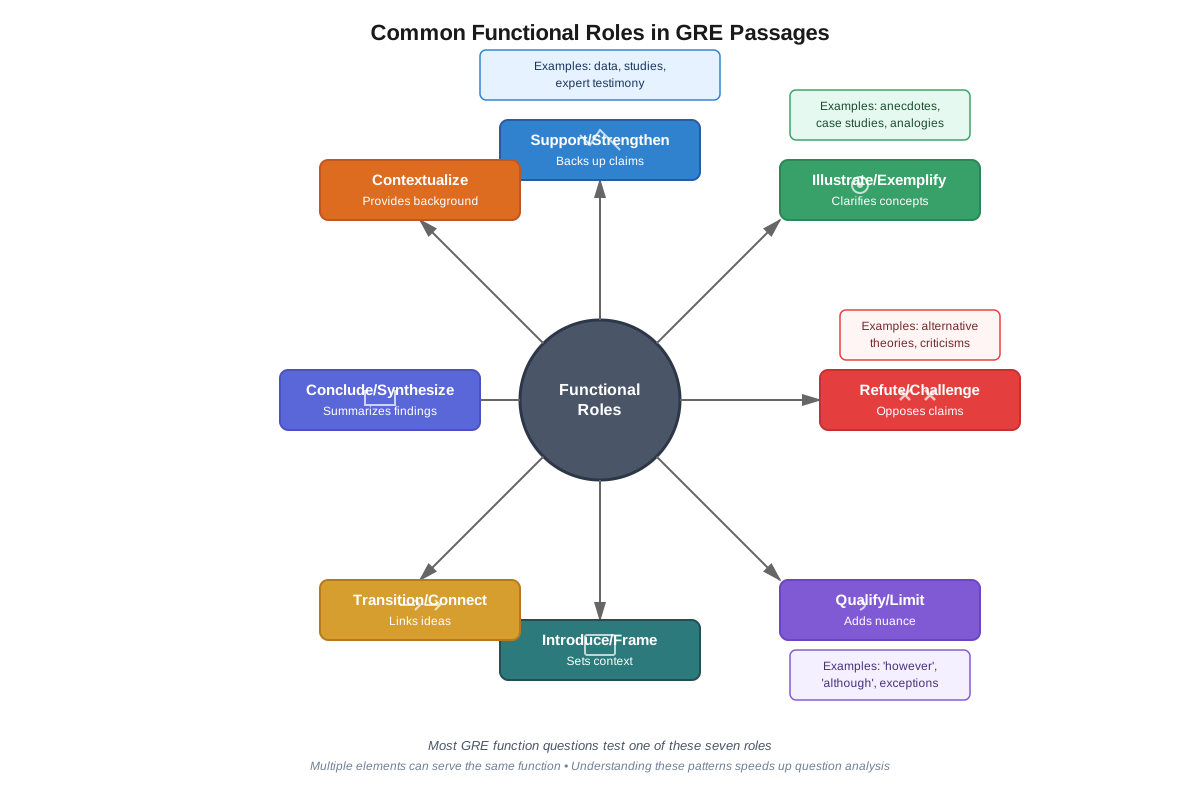
Understanding the typical functions that passage elements serve provides a framework for analyzing any function question. The following table outlines the most frequently tested functional roles:
| Functional Role | Description | Common Trigger Phrases |
|---|---|---|
| Provide evidence/support | Offers data, examples, or reasoning that strengthens a claim | "to support," "to illustrate," "to demonstrate" |
| Present a counterargument | Introduces an opposing view or challenge to the main argument | "to acknowledge," "to present an alternative," "to contrast" |
| Refute/challenge | Argues against a position or shows its limitations | "to refute," "to undermine," "to cast doubt on" |
| Qualify/nuance | Adds conditions, limitations, or complexity to a claim | "to qualify," "to clarify," "to distinguish" |
| Introduce a topic | Establishes the subject or question the passage will address | "to introduce," "to raise the question," "to establish" |
| Provide context | Offers background information necessary for understanding | "to provide background," "to explain," "to contextualize" |
| Illustrate with example | Uses a specific case to make an abstract concept concrete | "to exemplify," "to provide an instance," "to show how" |
| Transition/connect | Links ideas or shifts between topics | "to transition," "to connect," "to shift focus" |
Analyzing Question Stems
The language of function question stems provides crucial clues about what type of analysis is required. Consider these common patterns:
- "The author mentions X in order to..." - Requires identifying the purpose of a specific detail
- "The primary purpose of the second paragraph is to..." - Asks for the overall function of a paragraph within the passage structure
- "The author's discussion of X serves primarily to..." - Focuses on how a topic or example functions in the argument
- "Which of the following best describes the function of the highlighted sentence?" - Requires analyzing how a sentence relates to surrounding context
- "The author refers to X most likely in order to..." - Asks students to infer the strategic reason for including information
Each pattern requires students to move beyond content comprehension to structural analysis. The key is recognizing that the answer will describe a relationship or purpose, not restate content.
The Relationship Between Content and Function
A critical distinction for mastering function questions is understanding that content (what is said) differs from function (why it is said). Consider this example:
Content: "Studies show that meditation reduces cortisol levels by 15%."
Possible Functions:
- To provide evidence supporting the claim that meditation reduces stress
- To illustrate the measurable effects of meditation
- To contrast with earlier studies showing no effect
- To introduce a specific mechanism by which meditation works
The same content can serve different functions depending on context. Function questions require students to analyze the surrounding passage to determine which role the content actually plays. This is why reading the referenced lines in isolation often leads to errors—functional analysis requires understanding the broader argument structure.
Mapping Passage Architecture
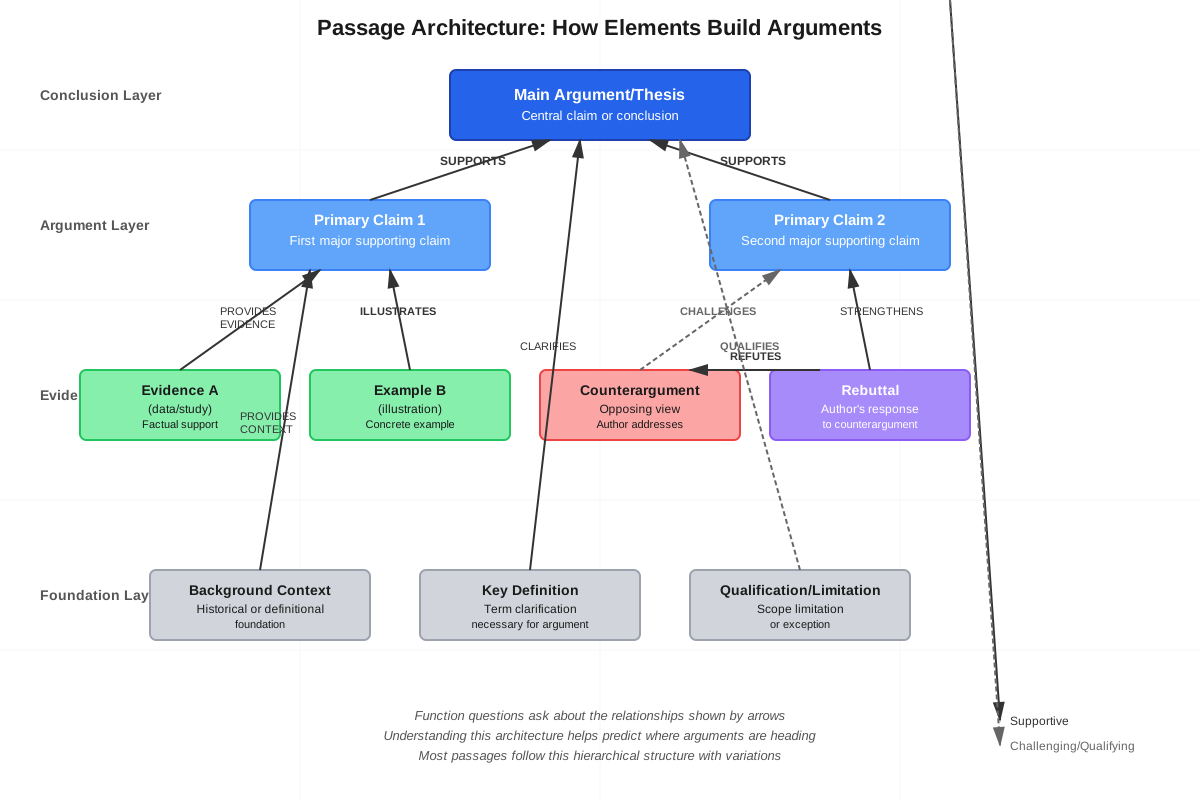
Successful function question analysis depends on understanding overall passage structure. Before attempting function questions, students should mentally map the passage architecture:
- Identify the main claim or thesis - What is the author's primary argument or explanation?
- Recognize major sections - How is the passage organized? (e.g., problem-solution, comparison-contrast, chronological)
- Note transitions and signposts - Words like "however," "moreover," "for example" signal functional relationships
- Track the argument flow - How does each paragraph build on or modify previous paragraphs?
This architectural understanding allows students to quickly identify how any specific element functions within the whole. For instance, if the main claim appears in paragraph one, and paragraph two begins with "However," students can predict that paragraph two likely presents a counterargument or complication.
Eliminating Wrong Answers
Function questions often include wrong answers that fall into predictable categories:
- Content restatements: Answers that describe what is said rather than why it's said
- Scope errors: Answers that are too broad (claiming a paragraph does what the whole passage does) or too narrow (claiming a paragraph only does what one sentence does)
- Misidentified relationships: Answers that reverse the relationship (claiming evidence is a conclusion, or vice versa)
- Out-of-scope functions: Answers that describe purposes not present in the passage
- Extreme language: Answers using absolute terms when the function is more moderate
Recognizing these patterns enables efficient elimination, often narrowing choices to two contenders before careful analysis of the passage.
Concept Relationships
Function questions integrate multiple reading comprehension skills into a unified analytical approach. The relationship map flows as follows:
Passage Structure Recognition → enables → Identifying Main Claims → which allows → Determining How Details Support Claims → leading to → Functional Analysis
Understanding argument structure (claims, evidence, counterarguments) provides the foundation for functional analysis. Students must first recognize what role different elements play in arguments generally before they can identify specific functional roles in particular passages.
Author's purpose connects directly to function questions because the overall purpose (to argue, explain, compare, etc.) determines what functions individual elements can serve. In an argumentative passage, examples typically function as evidence; in an explanatory passage, they typically function as illustrations.
Inference skills support function question analysis because determining why an author includes information often requires inferring unstated purposes. The author rarely explicitly states "I'm including this example to support my claim"—students must infer this relationship from context.
The relationship between function questions and other question types is complementary: mastering function questions improves performance on main idea questions (by understanding how parts relate to the whole), detail questions (by recognizing which details are structurally important), and inference questions (by understanding the implications of functional relationships).
High-Yield Facts
⭐ Function questions ask "why" or "how" an author uses information, not "what" the information says
⭐ Common trigger phrases include "in order to," "serves to," "functions to," and "the purpose of"
⭐ Every passage element serves a specific rhetorical purpose within the author's overall argument
⭐ The most common functional roles are: provide evidence, present counterargument, qualify a claim, and illustrate with example
⭐ Wrong answers often restate content instead of identifying function
- Function questions appear in approximately 25-30% of GRE reading comprehension questions
- Analyzing the sentence before and after the referenced text usually reveals functional relationships
- Paragraph-level function questions require understanding how the paragraph fits into the overall passage structure
- Examples and quotations typically function to support, illustrate, or provide evidence for claims
- Counterarguments are often introduced to be refuted or to show the complexity of an issue
- Transition words ("however," "moreover," "for example") signal functional relationships between ideas
Quick check — test yourself on Function questions so far.
Try Flashcards →Common Misconceptions
Misconception: Function questions can be answered by understanding only the referenced lines.
Correction: Function questions require understanding context—how the referenced element relates to surrounding paragraphs and the overall argument. Reading only the highlighted sentence often leads to choosing content restatements rather than functional descriptions.
Misconception: If an answer choice accurately describes content in the passage, it must be correct.
Correction: Function questions require answers that describe purpose or role, not content. An answer can be factually accurate about what the passage says while being completely wrong about why the author included that information.
Misconception: The function of an example is always "to provide an example."
Correction: While examples do provide instances, their specific function depends on what they're exemplifying and why. An example might function to support a claim, to illustrate a mechanism, to show an exception, or to introduce a concept. The specific functional role must be identified.
Misconception: Longer, more detailed answer choices are more likely to be correct.
Correction: Function question answers should be precise and focused. Overly detailed answers often include content restatements or scope errors. The correct answer typically uses concise functional language.
Misconception: Function questions are just asking for the main idea of a paragraph.
Correction: While some function questions ask about paragraph purpose, they specifically ask how that paragraph functions within the larger passage structure—not just what the paragraph is about. A paragraph's main idea is its content; its function is its role in the argument.
Misconception: All examples serve the same function in every passage.
Correction: The function of an example depends entirely on context. In one passage, an example might support the author's thesis; in another, it might illustrate a problem with a theory; in a third, it might show an exception to a general rule. Context determines function.
Worked Examples
Example 1: Identifying the Function of an Example
Passage Excerpt:
"Traditional economic theory assumes that consumers make rational decisions based on complete information. However, behavioral economists have demonstrated significant departures from this model. For instance, studies show that consumers consistently overvalue items they already own—a phenomenon known as the endowment effect. In one experiment, participants who were given coffee mugs demanded an average of $7 to sell them, while participants without mugs were willing to pay only $3 to acquire identical mugs. This irrational attachment to owned items contradicts the assumption that people assign consistent values to goods regardless of ownership."
Question: The author mentions the coffee mug experiment primarily in order to:
(A) Explain the methodology used in behavioral economics research
(B) Provide evidence for a departure from traditional economic assumptions
(C) Illustrate the difference between selling and buying prices
(D) Demonstrate that consumers make irrational decisions about all purchases
(E) Support the claim that traditional economic theory is completely invalid
Analysis:
Step 1: Identify the passage structure. The passage begins with traditional economic theory (rational consumers), introduces a challenge ("However, behavioral economists..."), and then provides a specific example (coffee mug experiment).
Step 2: Determine what claim the example relates to. The example follows the statement about the "endowment effect" and "significant departures from this model."
Step 3: Analyze the functional relationship. The coffee mug experiment provides concrete data showing how consumers behave irrationally regarding owned items, which supports the claim that behavioral economics has found departures from traditional theory.
Step 4: Evaluate answer choices:
- (A) is a content restatement—it describes what the experiment is, not why the author mentions it
- (B) correctly identifies the function: providing evidence for departures from traditional assumptions
- (C) is too narrow—this is what the experiment shows, but not why the author includes it in this argument
- (D) contains extreme language ("all purchases") not supported by the passage
- (E) is too extreme—the passage challenges assumptions but doesn't claim the theory is "completely invalid"
Answer: (B)
Connection to Learning Objectives: This example demonstrates how to identify function questions (objective 1), apply the strategy of analyzing context and relationships (objective 2), and accurately select answers that describe purpose rather than content (objective 3).
Example 2: Determining Paragraph Function
Passage Structure:
Paragraph 1: Introduces the discovery of exoplanets and early assumptions that they would resemble planets in our solar system
Paragraph 2: Describes "hot Jupiters"—gas giants orbiting very close to their stars—and explains why they surprised astronomers
Paragraph 3: Presents theories about how hot Jupiters might have formed through planetary migration
Paragraph 4: Discusses recent observations that challenge migration theories and suggest alternative formation mechanisms
Question: The primary function of the third paragraph is to:
(A) Provide evidence that hot Jupiters exist
(B) Explain a theoretical framework developed to account for unexpected observations
(C) Argue that planetary migration is the only explanation for hot Jupiters
(D) Describe the characteristics that make hot Jupiters different from other planets
(E) Introduce new observations that contradict earlier theories
Analysis:
Step 1: Understand the overall passage flow. The passage moves from discovery → surprising findings → explanation → complications to explanation.
Step 2: Identify paragraph 3's role in this structure. It comes after the surprising discovery (hot Jupiters) and before challenges to explanations. It's positioned as an attempt to explain the surprising findings.
Step 3: Determine the specific function. Paragraph 3 presents migration theories as explanations for how hot Jupiters could exist despite initial expectations.
Step 4: Evaluate choices:
- (A) is incorrect—hot Jupiters' existence was established in paragraph 2
- (B) correctly identifies the function: explaining unexpected observations through theory
- (C) contains extreme language ("only explanation") and misrepresents the paragraph's purpose
- (D) describes paragraph 2's function, not paragraph 3's
- (E) describes paragraph 4's function, not paragraph 3's
Answer: (B)
Connection to Learning Objectives: This example shows how to recognize function questions at the paragraph level (objective 1), apply the strategy of mapping passage architecture (objective 2), and distinguish between different paragraphs' functional roles (objective 4).
Exam Strategy
Approaching Function Questions Systematically
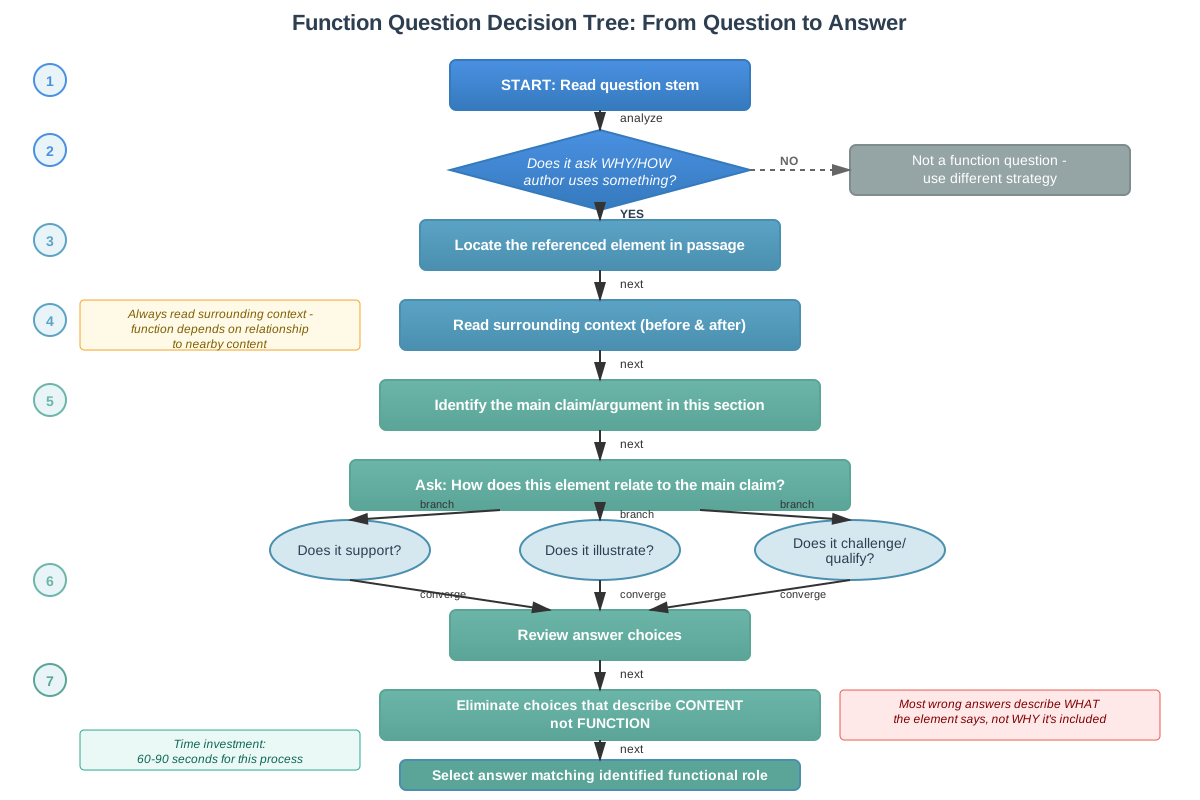
When encountering a function question, follow this strategic process:
- Identify the question type immediately - Look for trigger words like "in order to," "serves to," "function," or "purpose"
- Read the referenced text in context - Always read at least one sentence before and after the referenced portion
- Identify the local claim - What point is the author making in this section?
- Determine the relationship - How does the referenced element relate to that claim? (supports, challenges, qualifies, illustrates, etc.)
- Predict the answer - Before reading choices, formulate your own functional description
- Eliminate content restatements - Cross out any answer that describes what is said rather than why
- Check scope - Ensure the answer matches the scope of the question (sentence-level, paragraph-level, or passage-level)
Trigger Words and Phrases
Recognize these question stem patterns instantly:
- "The author mentions X in order to..."
- "The primary purpose of [paragraph/sentence] is to..."
- "X serves primarily to..."
- "The function of the highlighted sentence is to..."
- "The author discusses X most likely to..."
- "The author's reference to X primarily serves to..."
When you see these phrases, immediately shift to functional analysis mode rather than content comprehension mode.
Process of Elimination Tips
First elimination pass - Remove answers that:
- Simply restate content without describing purpose
- Use extreme or absolute language ("only," "completely," "never")
- Describe functions not present in the passage
Second elimination pass - Remove answers that:
- Have scope errors (too broad or too narrow)
- Reverse relationships (claim evidence is a conclusion)
- Describe the function of a different passage element
Final selection - Between remaining choices, select the answer that:
- Uses precise functional language matching the passage structure
- Accurately describes the relationship to surrounding context
- Matches the scope of the question
Time Allocation
Function questions typically require 60-90 seconds:
- 15-20 seconds: Read question and identify referenced text
- 20-30 seconds: Read context and determine function
- 15-20 seconds: Predict answer
- 15-20 seconds: Evaluate and eliminate choices
If a function question is taking longer than 90 seconds, make your best elimination-based guess and move forward. These questions reward structural understanding more than extended analysis.
Exam Tip: If you're struggling between two answer choices, reread the sentence immediately before the referenced text. This sentence often contains the claim that the referenced element supports or relates to, clarifying the functional relationship.
Memory Techniques
The PIERS Mnemonic
Remember the five most common functional roles with PIERS:
- Provide evidence/support
- Illustrate with example
- Explain/provide context
- Refute/challenge
- Show complexity/qualify
When analyzing any passage element, ask: "Which PIERS function does this serve?"
The "Why Chain" Technique
For any referenced text, create a mental "why chain":
- What does this say? (content)
- Why is the author saying this? (immediate function)
- How does this support the larger argument? (structural function)
This chain moves from content to function to structure, ensuring complete functional analysis.
Visualization Strategy
Picture the passage as a building:
- Foundation = main thesis/claim
- Support beams = major evidence and reasoning
- Walls = explanations and context
- Windows = examples and illustrations
- Roof = conclusion or implications
When asked about a passage element's function, visualize what architectural role it plays in the building.
The "Content vs. Function" Flashcard Method
For practice passages, create mental flashcards:
- Front: What does this paragraph/example say?
- Back: What function does it serve in the argument?
This trains the brain to automatically distinguish content from function.
Summary
Function questions assess the sophisticated skill of analyzing why authors include specific information rather than merely understanding what that information conveys. These questions appear frequently on the GRE (25-30% of reading comprehension questions) and distinguish high-scoring students who understand argument architecture from those who only comprehend content. Mastering function questions requires recognizing trigger language in question stems, understanding common functional roles (providing evidence, presenting counterarguments, qualifying claims, illustrating concepts), and analyzing passage elements within their broader context. The key strategy involves reading referenced text with surrounding sentences, identifying the local claim being made, determining how the element relates to that claim, and selecting answers that describe purpose rather than content. Wrong answers typically restate content, contain scope errors, or misidentify relationships. Success depends on mapping overall passage structure, predicting functional roles before reading answer choices, and systematically eliminating answers that confuse what is said with why it is said. Students who master function questions develop transferable analytical skills that enhance performance across all reading comprehension question types.
Key Takeaways
- Function questions ask "why" or "how" authors use information, not "what" the information says—always distinguish content from purpose
- Trigger phrases like "in order to," "serves to," and "the purpose of" immediately signal function questions requiring structural analysis
- The five most common functional roles (PIERS) are: Provide evidence, Illustrate, Explain, Refute, and Show complexity
- Always read referenced text with surrounding context—functional relationships emerge from how elements connect to nearby claims
- Wrong answers typically restate content, contain scope errors, or use extreme language; eliminate these systematically
- Predict the functional role before reading answer choices to avoid being misled by attractive but incorrect options
- Understanding passage architecture (main claim, supporting evidence, counterarguments, qualifications) enables quick functional analysis
Related Topics
Argument Structure Analysis: Understanding how claims, evidence, and reasoning connect provides the foundation for identifying functional relationships. Mastering function questions naturally leads to stronger argument analysis skills.
Author's Purpose and Tone: Recognizing overall authorial intent helps predict what functions specific elements will serve. Function questions represent micro-level analysis of the same skills tested in purpose questions.
Inference Questions: Many inference questions require understanding functional relationships to draw valid conclusions. The analytical skills developed through function questions transfer directly to inference question success.
Paragraph Organization: Understanding how paragraphs are structured internally and how they connect to each other enhances function question performance, particularly for paragraph-level function questions.
Critical Reasoning: The GRE Verbal section's argument-based questions test similar skills—identifying how evidence supports conclusions, recognizing assumptions, and evaluating argument structure.
Practice CTA
Now that you understand the core strategies for analyzing function questions, it's time to apply these skills to authentic GRE-style passages. The practice questions and flashcards will reinforce your ability to distinguish content from function, recognize common functional roles, and eliminate wrong answers efficiently. Remember: function questions reward strategic thinking about passage architecture, not just content comprehension. Each practice question you complete strengthens the analytical patterns that lead to consistent high performance. Approach practice deliberately, analyzing not just which answer is correct but why the wrong answers fail—this meta-cognitive awareness is exactly what function questions test and what separates good scores from great ones.
Sign up free to keep reading
Create a free AnvayaPrep account to finish this GRE guide on Function questions — plus flashcards and practice questions.