Overview
Extreme answer traps represent one of the most pervasive and challenging obstacles students face in GRE Reading Comprehension. These deceptive answer choices use absolute language, sweeping generalizations, or overstated claims that go beyond what the passage actually supports. The GRE test-makers deliberately craft these options to appeal to test-takers who recognize a connection between the answer choice and passage content but fail to notice that the answer choice makes a stronger, broader, or more definitive claim than the passage warrants. Understanding how to identify and avoid these traps is essential for achieving a competitive Verbal Reasoning score.
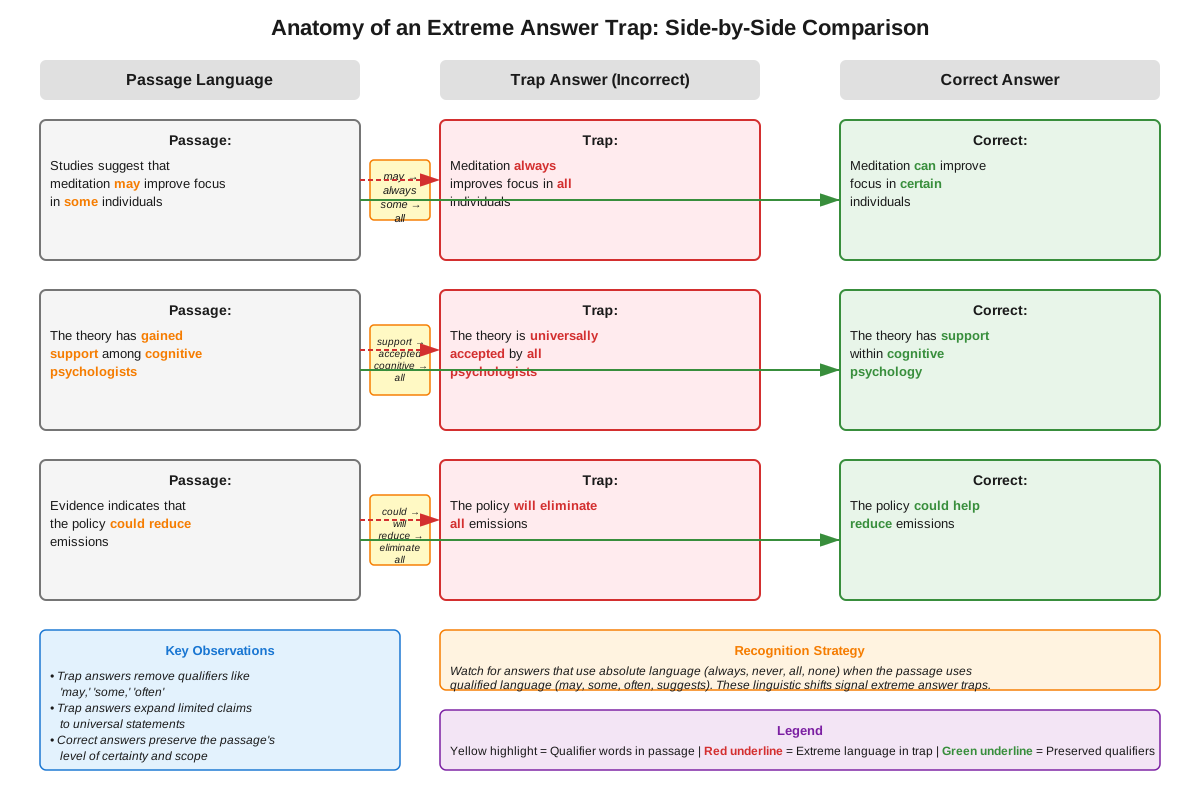
The significance of mastering GRE extreme answer traps cannot be overstated. These traps appear across virtually all Reading Comprehension question types—from main idea and detail questions to inference and author's purpose questions. Students who fall for extreme answers often do so because they're reading quickly under time pressure, recognizing familiar concepts from the passage without carefully evaluating whether the answer choice accurately reflects the passage's scope, tone, and level of certainty. The passage might suggest something is "often" true, while the trap answer states it is "always" true. The passage might present one scholar's theory, while the trap answer claims this theory is "universally accepted."
Within the broader context of Verbal Reasoning, extreme answer traps connect directly to critical reading skills that the GRE assesses: precision in comprehension, attention to authorial tone and qualification, and the ability to distinguish between what is stated, implied, and overstated. Mastering this concept strengthens overall reading comprehension abilities and reinforces the fundamental GRE principle that correct answers must be fully supported by passage evidence without requiring additional assumptions or accepting exaggerated claims.
Learning Objectives
- [ ] Identify when Extreme answer traps is being tested
- [ ] Explain the core rule or strategy behind Extreme answer traps
- [ ] Apply Extreme answer traps to GRE-style questions accurately
- [ ] Recognize specific linguistic markers that signal extreme language in answer choices
- [ ] Distinguish between appropriately strong language and unsupported extreme claims
- [ ] Evaluate answer choices by comparing their scope and certainty level to passage statements
- [ ] Develop a systematic process for eliminating extreme answers during timed conditions
Prerequisites
- Basic Reading Comprehension skills: Understanding main ideas, supporting details, and passage structure is necessary before learning to identify subtle distortions in answer choices
- Familiarity with GRE question types: Knowing the difference between inference, detail, and main idea questions helps contextualize when extreme traps are most likely to appear
- Understanding of passage-based evidence: The ability to locate and evaluate textual support is fundamental to recognizing when an answer goes beyond what the passage states
- Awareness of author's tone: Recognizing whether an author writes tentatively, assertively, or neutrally provides the baseline for evaluating whether answer choices match the passage's level of certainty
Why This Topic Matters
Extreme answer traps matter because they represent the single most common reason students miss Reading Comprehension questions they should answer correctly. Research on GRE performance indicates that extreme answers appear in approximately 60-70% of Reading Comprehension questions as distractor options, making them the test-makers' preferred method for creating plausible but incorrect choices. These traps are particularly insidious because they often contain accurate information from the passage—the problem lies not in factual incorrectness but in the degree or scope of the claim.
In real-world applications, the skill of identifying extreme claims translates directly to critical thinking abilities essential for graduate-level academic work. Graduate students must constantly evaluate research claims, distinguish between well-supported conclusions and overstatements, and recognize when authors hedge their claims with appropriate qualifications. The GRE tests this skill because it predicts success in academic environments where precision in interpretation matters.
On the exam itself, extreme answer traps appear most frequently in inference questions (where students must avoid going too far beyond the text), main idea questions (where extreme answers often capture only one aspect of a balanced passage), and "according to the passage" detail questions (where extreme answers distort specific claims). They also appear in author's attitude questions, where an extreme answer might characterize the author as "vehemently opposed" when the passage shows only "skeptical concern." Understanding these patterns allows strategic test-takers to approach each question type with heightened awareness of where extreme traps are most likely to lurk.
Core Concepts
Definition and Characteristics of Extreme Answers
An extreme answer trap is an answer choice that makes a claim stronger, broader, more absolute, or more definitive than what the passage supports. These answers typically contain language that eliminates nuance, removes qualifications, or extends the scope of a passage claim beyond its original boundaries. The key characteristic distinguishing extreme answers from correct answers is the mismatch between the certainty level or scope in the passage and the certainty level or scope in the answer choice.
Extreme answers manifest in several distinct forms:
- Absolute language: Words like "always," "never," "all," "none," "impossible," "must," "cannot," "only," "exclusively," and "invariably"
- Superlative claims: Phrases like "the most important," "the primary cause," "the sole reason," or "the best explanation" when the passage presents multiple factors or uses less definitive language
- Universal generalizations: Extending a claim about "some" or "many" to "all" or about a specific context to all contexts
- Temporal extremes: Changing "often" to "always," "rarely" to "never," or "sometimes" to "constantly"
- Categorical statements: Removing conditional language like "may," "might," "could," "suggests," or "appears to"
The Spectrum of Certainty
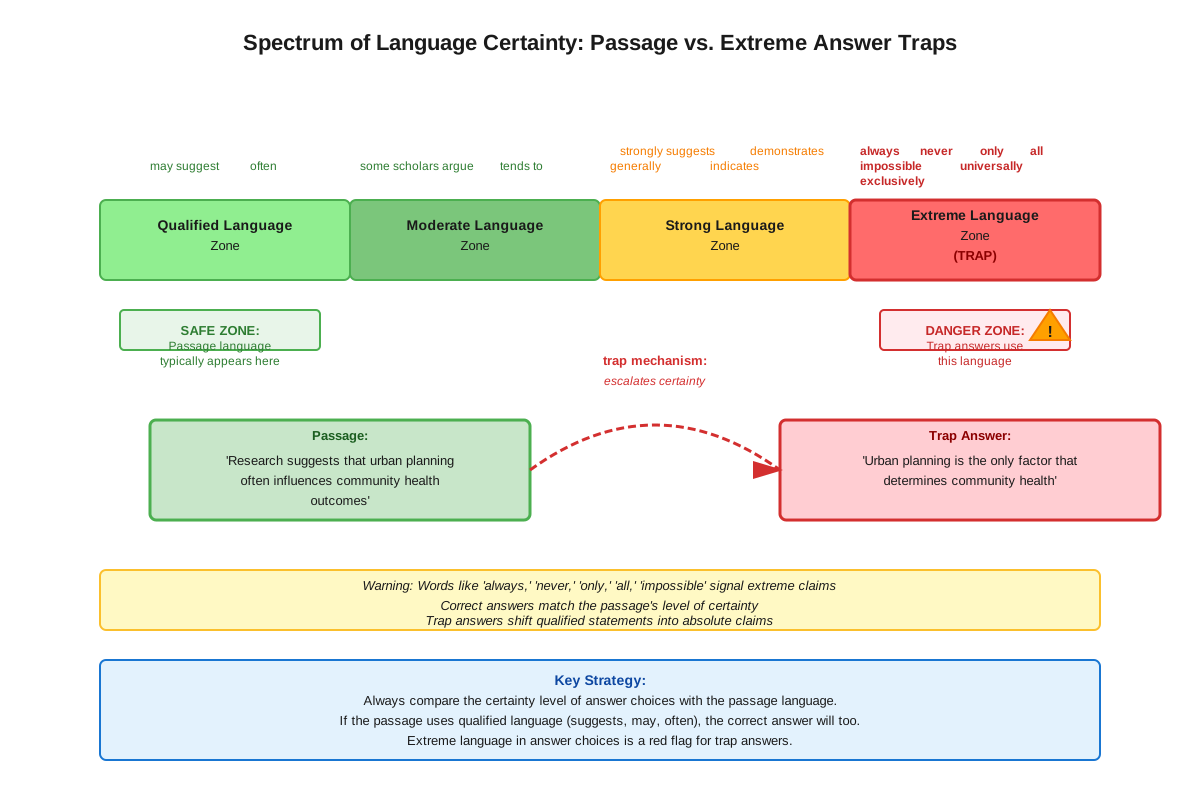
Understanding extreme answers requires recognizing that both passages and answer choices exist on a spectrum of certainty. Passages carefully calibrate their claims using specific language that indicates the author's confidence level and the scope of applicability.
| Certainty Level | Passage Language Examples | Extreme Trap Language |
|---|---|---|
| Low certainty | "may," "might," "could," "possibly," "suggests" | "definitely," "certainly," "proves" |
| Moderate certainty | "often," "frequently," "many," "tends to," "generally" | "always," "invariably," "all" |
| Qualified certainty | "some scholars argue," "one theory suggests," "in certain contexts" | "experts agree," "it is established," "universally" |
| Conditional certainty | "if X, then Y," "when conditions permit," "under these circumstances" | "X causes Y," "Y results," "this produces" |
The GRE rewards test-takers who can precisely match the certainty level between passage and answer. A passage stating "many economists believe" cannot support an answer claiming "economists agree" or "the economic consensus holds." Similarly, a passage describing what "typically occurs" cannot support an answer about what "always happens."
Scope Distortion
Beyond certainty level, extreme answers often distort the scope of passage claims. Scope refers to the breadth, range, or domain to which a claim applies. A passage might discuss a phenomenon in one specific context, time period, or population, while an extreme answer extends that claim to all contexts, all time periods, or all populations.
Common scope distortions include:
- Temporal scope expansion: Passage discusses 19th-century practices → Answer claims this applies to "throughout history"
- Geographic scope expansion: Passage examines European examples → Answer states this is true "worldwide" or "universally"
- Population scope expansion: Passage describes behavior in one demographic → Answer claims this applies to "all people" or "humans generally"
- Disciplinary scope expansion: Passage presents one field's perspective → Answer claims "scholars agree" or "research shows" without qualification
- Causal scope expansion: Passage identifies one contributing factor → Answer claims this is "the reason" or "the cause"
Recognizing Appropriate Strong Language
A critical nuance in avoiding extreme answer traps is recognizing that not all strong language is extreme. The GRE includes correct answers with definitive language when the passage itself uses definitive language. The key is alignment: the answer's strength must match the passage's strength.
For example, if a passage states "The experiment definitively proved that the compound was toxic," an answer saying "The experiment proved the compound's toxicity" is not extreme—it accurately reflects the passage's certainty level. Conversely, if the passage says "The experiment suggested the compound might be toxic," the same answer would be extreme.
Test-takers must avoid the opposite error of always choosing the weakest, most hedged answer. When passages make strong claims, correct answers reflect that strength. The strategy is not to avoid all strong language but to ensure the answer's language matches the passage's language in both certainty and scope.
Context-Dependent Extremity
Whether language qualifies as extreme depends entirely on passage context. The word "revolutionary" might be extreme if the passage describes something as "innovative" but appropriate if the passage itself uses "revolutionary." The phrase "completely transformed" might be extreme if the passage discusses "significant changes" but accurate if the passage describes a "total transformation."
This context-dependency means students cannot simply memorize a list of "extreme words to avoid." Instead, they must develop the habit of constantly comparing answer choice language to passage language, asking: "Does this answer use stronger, broader, or more absolute language than the passage used?"
The Appeal of Extreme Answers
Understanding why extreme answers are tempting helps students resist them. Extreme answers appeal to test-takers for several psychological reasons:
- Recognition without verification: Students recognize concepts from the passage and select the answer without carefully checking whether it accurately represents the passage's claims
- Overconfidence in comprehension: After reading a passage, students may feel they understand the "gist" and select answers that align with their general impression rather than specific textual evidence
- Time pressure: Under time constraints, students may not take the extra seconds needed to compare the answer's scope and certainty to the passage's
- Confirmation bias: If students form an opinion while reading, they may gravitate toward answers that strongly confirm that opinion, even if the passage was more measured
- Impressive language: Extreme answers often sound more authoritative, comprehensive, or "complete" than correctly qualified answers
Concept Relationships
The concept of extreme answer traps connects to multiple aspects of GRE Reading Comprehension strategy. At its foundation, identifying extreme answers requires precise reading comprehension → which enables accurate evaluation of answer choice language → which leads to successful elimination of trap answers → which results in selection of correctly qualified answers.
Extreme answer traps relate directly to inference questions, where the challenge is distinguishing between what the passage implies (appropriate inference) and what goes beyond the passage (extreme inference). They also connect to tone and attitude questions, where extreme answers might exaggerate the author's position (changing "concerned" to "alarmed" or "skeptical" to "dismissive").
The relationship to scope and purpose questions is equally important. Main idea questions often include extreme answers that capture only one aspect of a multi-faceted passage or that overstate the passage's central claim. Purpose questions may include extreme answers that attribute motives or intentions the passage doesn't support.
Understanding extreme answers also reinforces the broader GRE principle of passage-based evidence. Every correct answer must be fully defensible using only information in the passage, without requiring outside knowledge or accepting claims that extend beyond textual support. This principle connects extreme answer recognition to the fundamental skill of textual analysis that underlies all Reading Comprehension success.
High-Yield Facts
⭐ Extreme answer traps appear in 60-70% of Reading Comprehension questions as distractor options, making them the most common type of wrong answer on the GRE.
⭐ Words like "always," "never," "all," "none," "only," "must," and "cannot" are red flags that require careful verification against the passage.
⭐ The correct answer's certainty level and scope must match the passage's certainty level and scope—not stronger, not broader.
⭐ If a passage uses qualified language ("may," "some," "often," "suggests"), correct answers will typically maintain that qualification.
⭐ Extreme answers often contain accurate information from the passage but distort it by removing nuance or expanding scope.
- Superlatives ("most important," "primary," "best") are extreme unless the passage explicitly makes that superlative claim.
- Causal language ("causes," "results in," "produces") is extreme if the passage only shows correlation or uses tentative language ("may contribute to," "is associated with").
- Temporal absolutes ("throughout history," "has always been") are extreme unless the passage explicitly discusses that entire time span.
- Universal claims ("all scholars," "everyone," "in every case") are extreme unless the passage genuinely makes that universal statement.
- Extreme answers in inference questions go beyond what the passage implies, while correct inferences stay within reasonable bounds of textual support.
Quick check — test yourself on Extreme answer traps so far.
Try Flashcards →Common Misconceptions
Misconception: All strong or definitive language in answer choices is automatically extreme and wrong.
Correction: Strong language is only extreme if it exceeds the strength of language in the passage. When passages make definitive claims, correct answers reflect that definitiveness. The key is alignment, not weakness.
Misconception: The correct answer is always the most cautiously worded or heavily qualified option.
Correction: Overly cautious answers can be wrong if they understate what the passage clearly establishes. If a passage states something definitively, an answer that hedges with "might" or "possibly" would be incorrect.
Misconception: If an answer contains information from the passage, it cannot be an extreme trap.
Correction: Extreme answers typically do contain passage information—the problem is that they distort it by making it more absolute, broader in scope, or more certain than the passage supports. Factual accuracy doesn't prevent extremity.
Misconception: Extreme answer traps only appear in inference questions.
Correction: While common in inference questions, extreme traps appear across all question types including main idea, detail, purpose, tone, and function questions. Any question type can include answers that overstate passage claims.
Misconception: Identifying extreme answers is about memorizing a list of "bad words" to avoid.
Correction: Context determines whether language is extreme. The same word might be extreme in one context and appropriate in another. The strategy is comparing answer language to passage language, not avoiding specific words.
Misconception: If most of an answer choice is correct, minor extreme language doesn't matter.
Correction: On the GRE, an answer must be entirely correct to be the right choice. Even one word that makes a claim too extreme, broad, or absolute can render an otherwise accurate answer incorrect.
Worked Examples
Example 1: Inference Question
Passage excerpt: "Recent studies of urban wildlife have shown that coyotes in metropolitan areas often modify their hunting behaviors, with many individuals shifting to nocturnal activity patterns to avoid human contact. Researchers observed that approximately 60% of urban coyotes in the study exhibited this behavioral adaptation."
Question: The passage suggests which of the following about urban coyotes?
Answer choices:
A) Urban coyotes always hunt at night to avoid humans.
B) Most urban coyotes in the study adapted their activity patterns.
C) Coyotes cannot survive in urban environments without changing their behavior.
D) All urban wildlife modifies behavior in response to human presence.
E) Urban coyotes exclusively hunt during nocturnal hours.
Analysis:
Choice A is extreme. The passage says "many" coyotes shift to nocturnal patterns and "often" modify behaviors—not "always." The word "always" makes an absolute claim the passage doesn't support.
Choice B is correct. The passage states "approximately 60% of urban coyotes in the study exhibited this behavioral adaptation." Since 60% represents "most," this answer accurately reflects the passage's scope and certainty without exaggeration.
Choice C is extreme in two ways. First, "cannot survive" is absolute language the passage doesn't use. Second, the passage discusses what coyotes do, not what they must do to survive. This answer extends beyond textual support.
Choice D is extreme through scope expansion. The passage discusses only coyotes, not "all urban wildlife." This answer illegitimately generalizes from one species to all species.
Choice E is extreme. "Exclusively" means only and always, but the passage indicates this is a pattern for "many" coyotes, not all, and doesn't claim they never hunt during other times.
Key lesson: Notice how the correct answer (B) maintains the passage's qualifications ("most" aligns with "approximately 60%") while all wrong answers introduce extreme language that goes beyond textual support.
Example 2: Main Idea Question
Passage excerpt: "The debate over the origins of the Indus Valley script remains unresolved. While some scholars argue that the symbols represent a full writing system capable of recording language, others contend that they served primarily as religious or administrative markers without linguistic content. Recent computational analyses have provided interesting data, but neither position has achieved consensus in the academic community. The limited number of symbols and the brevity of most inscriptions complicate efforts to definitively categorize the script."
Question: Which of the following best describes the main point of the passage?
Answer choices:
A) The Indus Valley script has been proven to be a complete writing system.
B) Scholars universally reject the theory that Indus Valley symbols represent language.
C) The nature of the Indus Valley script remains a matter of scholarly disagreement.
D) Computational analysis has definitively resolved questions about the Indus Valley script.
E) The Indus Valley script is impossible to interpret due to insufficient evidence.
Analysis:
Choice A is extreme. The passage explicitly states the debate "remains unresolved" and that neither position "has achieved consensus." Claiming the script "has been proven" to be anything contradicts the passage's emphasis on ongoing uncertainty.
Choice B is extreme through the word "universally" and by misrepresenting the debate. The passage indicates "some scholars argue" the symbols represent language, so scholars don't universally reject this theory. This answer also uses extreme language ("universally") unsupported by the passage.
Choice C is correct. This answer accurately captures the passage's main point—that disagreement persists—without overstating the situation. It matches the passage's tone of unresolved debate and avoids extreme claims.
Choice D is extreme. The passage says computational analyses "have provided interesting data" but explicitly states "neither position has achieved consensus." Claiming these analyses "definitively resolved" questions directly contradicts the passage.
Choice E is extreme. While the passage mentions complications in categorizing the script, it doesn't claim interpretation is "impossible." This answer uses absolute language ("impossible") that goes beyond the passage's measured discussion of challenges.
Key lesson: Main idea questions often include extreme answers that overstate one aspect of the passage or claim more certainty than the passage expresses. The correct answer reflects the passage's overall tone and level of certainty.
Exam Strategy
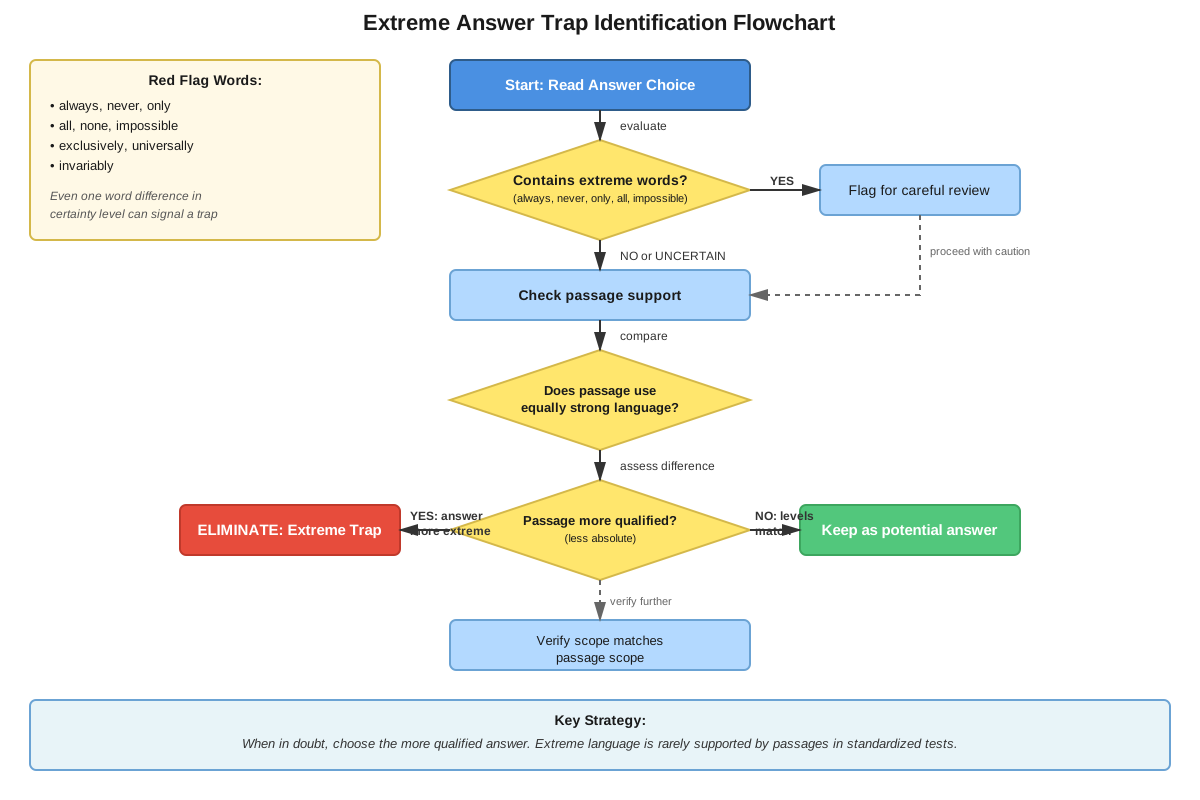
When approaching GRE Reading Comprehension questions, implement this systematic process for identifying and eliminating extreme answer traps:
Step 1: Read the question stem carefully to understand what type of support the correct answer requires. Inference questions allow slightly more flexibility than detail questions, but both require passage support.
Step 2: Before looking at answers, formulate your own answer based on the passage. This prevents extreme answers from seeming appealing simply because they sound authoritative.
Step 3: As you read each answer choice, actively compare its language to the passage. Ask: "Is this claim as strong as the passage's claim, or stronger? Is this scope as broad as the passage's scope, or broader?"
Step 4: Flag trigger words that signal potential extremity:
- Absolutes: always, never, all, none, only, must, cannot, impossible
- Superlatives: most, best, primary, sole, exclusively
- Universals: everyone, everything, in all cases, throughout
- Definitives: proves, establishes, demonstrates (when passage uses tentative language)
Step 5: When you identify extreme language, verify it against the passage. Sometimes strong language is appropriate. Check whether the passage uses equally strong language.
Step 6: Use process of elimination strategically. Extreme answers are often the easiest to eliminate quickly, allowing you to focus on distinguishing between remaining choices.
Exam Tip: If you're down to two answers and one is more qualified while the other is more definitive, return to the passage to check which level of certainty the passage actually uses. Don't assume the qualified answer is automatically correct.
Time allocation: Spend approximately 5-10 seconds per answer choice actively comparing its language to the passage. This small time investment prevents careless errors and is more efficient than re-reading the passage after selecting a wrong answer.
For inference questions specifically: Remember that correct inferences must be true based on the passage but aren't explicitly stated. Extreme answers in inference questions often take a valid inference one step too far. The correct inference stays within reasonable bounds of what the passage implies.
Memory Techniques
SCAN Acronym for evaluating answer choices:
- Scope: Does the answer's scope match the passage's scope?
- Certainty: Does the answer's certainty level match the passage's?
- Absolutes: Does the answer contain absolute language requiring verification?
- Nuance: Does the answer preserve the passage's nuance and qualifications?
The Matching Game Visualization: Picture the passage and answer choice as puzzle pieces. They must fit together perfectly—same shape (scope), same size (certainty), same edges (qualifications). If the answer piece is bigger, broader, or more rigid than the passage piece, it doesn't fit.
The "Says Who?" Test: When you encounter strong claims in answer choices, mentally ask "Says who?" If the passage says it, the answer is fine. If the answer makes the claim without passage support, it's extreme.
The Qualifier Checklist: Memorize common qualifiers that passages use and ensure answers maintain them:
- Some → not "all"
- Often → not "always"
- May/might → not "must/will"
- Suggests → not "proves"
- One factor → not "the cause"
The Scope Boundary Visualization: Imagine the passage draws a circle around what it discusses (specific time, place, population, or context). Extreme answers step outside that circle. Visualize whether the answer stays within the passage's boundaries.
Summary
Extreme answer traps represent the most prevalent type of incorrect answer in GRE Reading Comprehension, appearing in the majority of questions across all question types. These traps use language that is too absolute, too broad in scope, or too certain compared to what the passage actually supports. Success in avoiding these traps requires developing the habit of carefully comparing answer choice language to passage language, checking that certainty levels match, scopes align, and qualifications are preserved. The key insight is that extreme answers often contain accurate information from the passage but distort it through exaggeration, overgeneralization, or removal of nuance. Mastering this concept requires moving beyond simply recognizing "extreme words" to developing sophisticated judgment about whether strong language is appropriate in context. By systematically evaluating each answer choice against the passage's specific claims and maintaining awareness of common extreme language patterns, test-takers can consistently eliminate these traps and select answers that accurately reflect passage content without overstatement.
Key Takeaways
- Extreme answer traps are the most common type of wrong answer on GRE Reading Comprehension, appearing in 60-70% of questions
- The correct answer's certainty level and scope must match the passage—not stronger, broader, or more absolute
- Words like "always," "never," "all," "only," and "must" are red flags requiring careful verification against passage language
- Extreme answers often contain accurate passage information but distort it by removing qualifications or expanding scope
- Context determines whether language is extreme—the same word might be appropriate in one context and extreme in another
- Systematically compare each answer choice to the passage using the SCAN framework: Scope, Certainty, Absolutes, Nuance
- Not all strong language is extreme; when passages make definitive claims, correct answers reflect that strength
Related Topics
Inference Questions and Logical Reasoning: Understanding extreme answer traps provides the foundation for mastering inference questions, where the challenge is distinguishing between reasonable inferences and unsupported leaps. This topic builds directly on extreme answer recognition skills.
Author's Tone and Attitude: Identifying extreme answers in tone questions requires recognizing when answer choices exaggerate the author's position, making this a natural extension of extreme answer trap mastery.
Scope and Main Idea Questions: These question types frequently feature extreme answers that overstate the passage's central claim or extend beyond its boundaries, making extreme answer recognition essential.
Trap Answer Patterns: Beyond extreme answers, the GRE uses other systematic trap patterns including "right answer, wrong question" and "true but unsupported" traps. Mastering extreme answers prepares students to recognize these related patterns.
Evidence-Based Reading: The broader skill of supporting all answer choices with specific textual evidence underlies extreme answer recognition and represents the fundamental approach to all GRE Reading Comprehension.
Practice CTA
Now that you understand how to identify and avoid extreme answer traps, it's time to put this knowledge into practice. Attempt the practice questions associated with this topic, actively applying the SCAN framework and comparing answer choice language to passage language. As you work through questions, notice how often extreme answers appear and how much easier they become to spot once you know what to look for. Use the flashcards to reinforce your recognition of extreme language patterns and scope distortions. Remember: every extreme answer you successfully eliminate brings you one step closer to your target GRE score. This skill is highly learnable and improves rapidly with deliberate practice—you've got this!
Sign up free to keep reading
Create a free AnvayaPrep account to finish this GRE guide on Extreme answer traps — plus flashcards and practice questions.