Overview
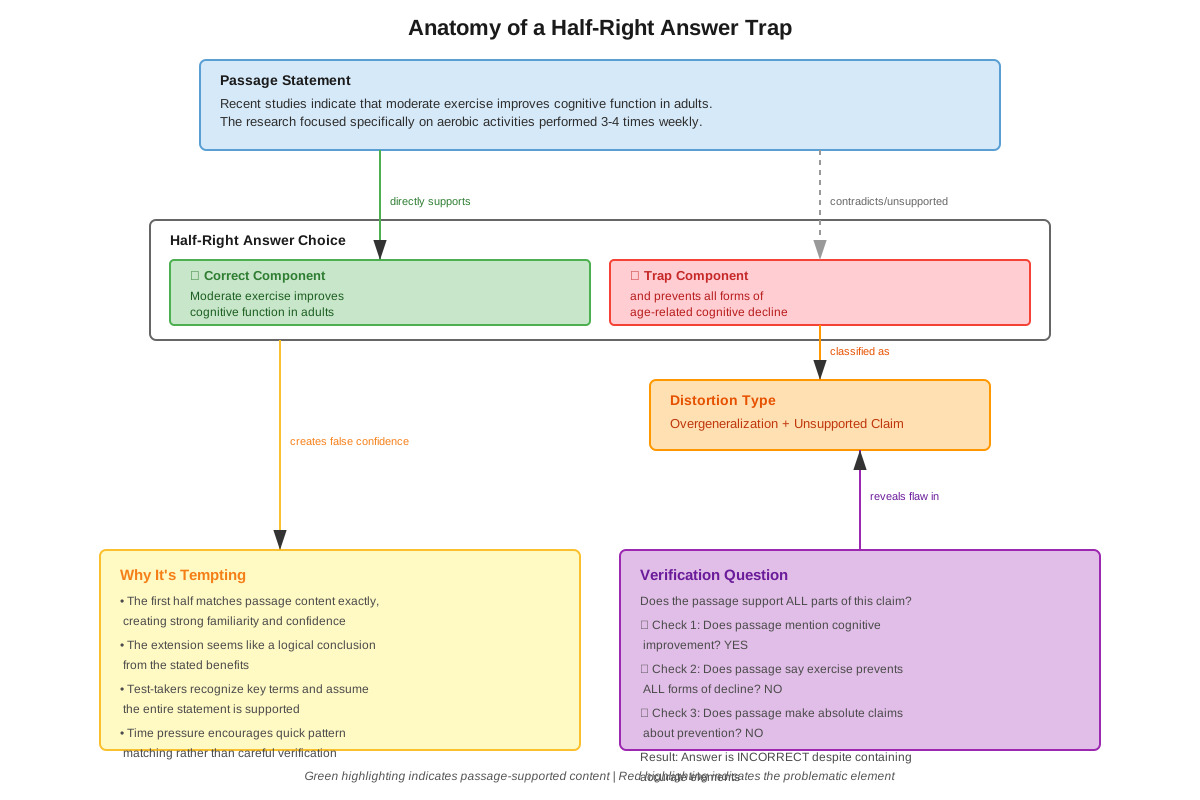
Half-right answer traps represent one of the most insidious and frequently encountered wrong answer types on the GRE Verbal Reasoning section. These deceptive options contain elements of truth drawn directly from the passage, making them appear correct at first glance. However, they also include subtle distortions, omissions, or additions that render them ultimately incorrect. The test makers deliberately craft these answers to exploit common reading errors: superficial skimming, incomplete passage analysis, and the tendency to select answers that "sound familiar" rather than those that precisely match what the passage states.
Understanding and identifying GRE half-right answer traps is crucial because they appear in virtually every Reading Comprehension question type, from main idea questions to inference questions to detail-oriented questions. Students who cannot distinguish between "mostly correct" and "completely correct" will consistently lose points on questions they believe they've answered correctly. This false confidence makes half-right traps particularly dangerous—test-takers often don't realize they need to improve in this area because the wrong answers they select seem reasonable.
Within the broader context of Verbal Reasoning, mastering half-right answer traps connects directly to critical reading skills, precise textual analysis, and the ability to evaluate answer choices against strict logical criteria. This skill builds upon foundational reading comprehension abilities while preparing students for more advanced trap types. Success with half-right traps requires moving beyond passive reading to active verification: checking every component of an answer choice against the passage before selection.
Learning Objectives
- [ ] Identify when Half-right answer traps is being tested
- [ ] Explain the core rule or strategy behind Half-right answer traps
- [ ] Apply Half-right answer traps to GRE-style questions accurately
- [ ] Distinguish between answer choices that are partially correct versus completely correct
- [ ] Analyze the specific components of answer choices that make them half-right rather than fully correct
- [ ] Develop a systematic verification process to eliminate half-right traps before selecting a final answer
Prerequisites
- Basic Reading Comprehension Skills: The ability to understand main ideas, supporting details, and passage structure is essential because identifying half-right traps requires knowing what the passage actually says versus what it seems to say.
- Understanding of GRE Question Types: Familiarity with different Reading Comprehension question formats (main idea, detail, inference, purpose) helps recognize where half-right traps most commonly appear.
- Vocabulary Foundation: A working GRE vocabulary enables students to detect subtle word choice differences that distinguish correct answers from half-right traps.
Why This Topic Matters
Half-right answer traps appear in approximately 60-70% of all GRE Reading Comprehension questions, making them the single most common wrong answer type test-takers encounter. Unlike obviously incorrect answers that contradict the passage or introduce completely irrelevant information, half-right traps require careful analysis to eliminate. Students who master this skill typically see score improvements of 2-4 points in Verbal Reasoning because they stop falling for answers that "almost work."
In real-world applications, the ability to identify half-right information translates directly to critical thinking skills valued in graduate education and professional settings. Academic research, legal analysis, medical diagnosis, and business strategy all require distinguishing between partially accurate information and completely reliable conclusions. The precision demanded by half-right trap recognition trains students to read with heightened attention to detail and logical rigor.
On the GRE, half-right traps most commonly appear in:
- Inference questions where the trap combines a valid inference with an unsupported leap
- Detail questions where the trap includes accurate information from the wrong part of the passage
- Main idea questions where the trap captures only one aspect of the passage's central argument
- Purpose questions where the trap correctly identifies a secondary purpose but misses the primary one
- Strengthen/Weaken questions where the trap affects the argument but in the opposite direction claimed
Core Concepts
Definition and Anatomy of Half-Right Answer Traps
A half-right answer trap is an incorrect answer choice that contains some accurate information from or about the passage but fails to be completely correct due to one or more fatal flaws. These answers are specifically designed to attract test-takers who recognize familiar content without verifying every component of the answer choice. The "half-right" designation reflects that these answers typically get 40-80% of the content correct while introducing critical errors that make them wrong.
The anatomy of a half-right trap typically includes:
- Accurate anchor content: True information that appears in the passage, creating initial recognition and comfort
- Subtle distortion: A small but significant change in meaning, scope, or relationship
- Strategic placement: The accurate portion usually appears first, encouraging quick selection before the error is noticed
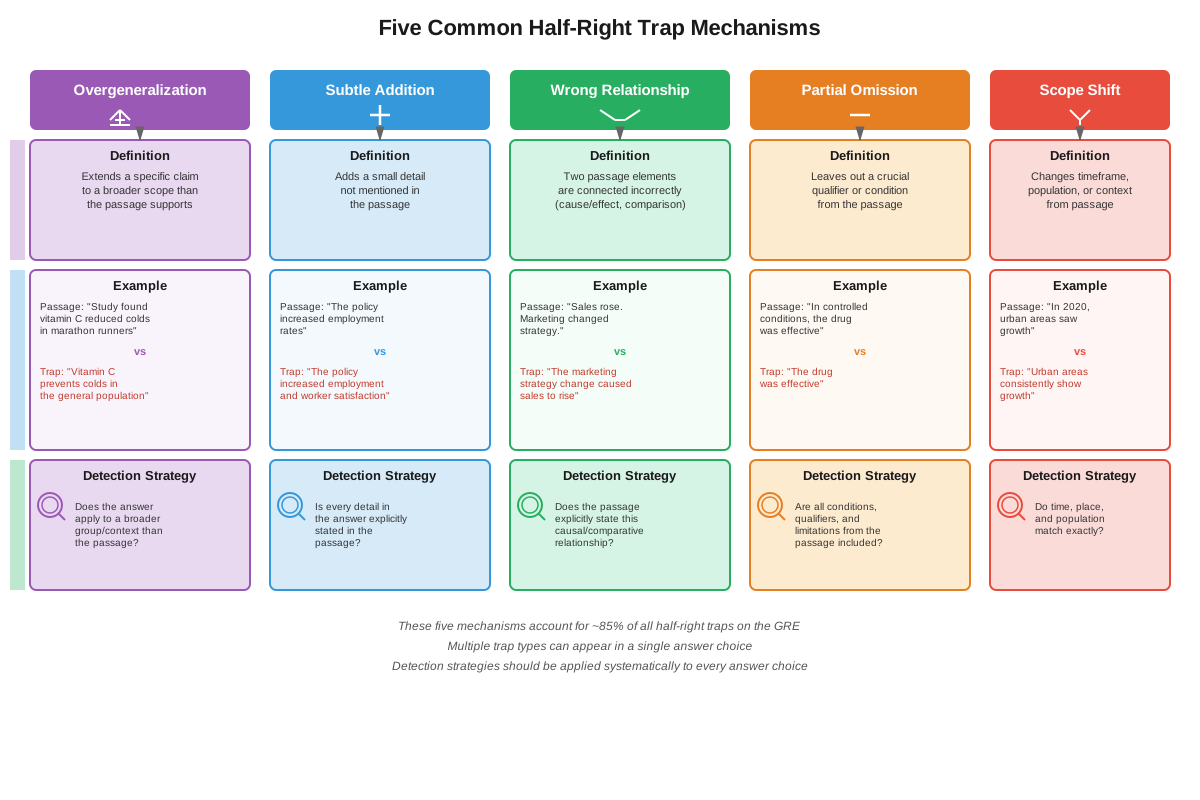
Types of Half-Right Distortions
Half-right traps employ several distinct distortion techniques:
| Distortion Type | Mechanism | Example Pattern |
|---|---|---|
| Scope Shift | Changes "some" to "all" or "always" to "sometimes" | Passage: "Many scientists support..." → Trap: "All scientists support..." |
| Relationship Reversal | Flips cause-effect or comparison relationships | Passage: "A causes B" → Trap: "B causes A" |
| Detail Transplant | Combines accurate details from different passage sections | Passage discusses X in paragraph 1, Y in paragraph 3 → Trap: "X and Y work together" |
| Extreme Language | Adds absolute terms not present in passage | Passage: "suggests" → Trap: "proves definitively" |
| Temporal Distortion | Changes timing, sequence, or duration | Passage: "historically" → Trap: "currently" |
| Partial Omission | Leaves out a crucial qualifying phrase | Passage: "effective when combined with Z" → Trap: "effective" (omits condition) |
The Recognition Process
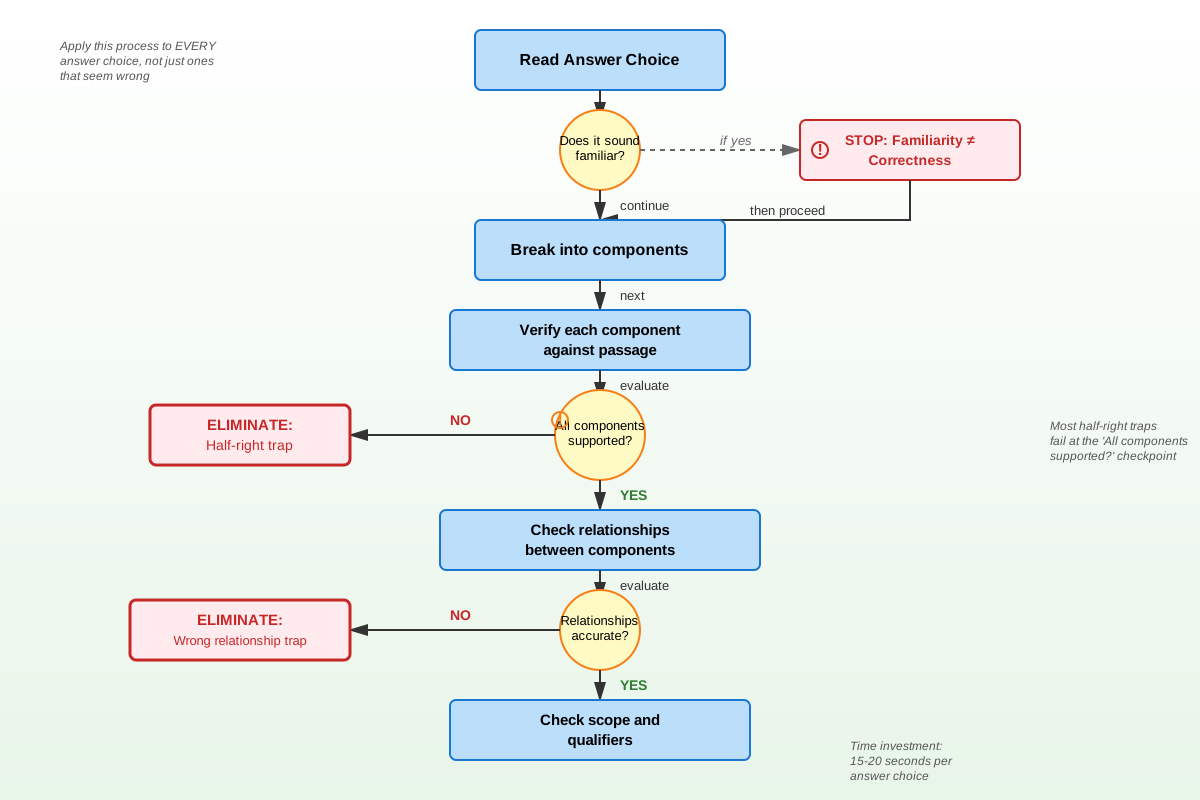
Identifying half-right traps requires a systematic three-phase verification process:
Phase 1: Initial Assessment
- Read the answer choice completely before evaluating
- Note which parts trigger recognition from the passage
- Resist the urge to select based on familiarity alone
Phase 2: Component Analysis
- Break the answer choice into distinct claims or components
- Verify each component individually against the passage
- Check for scope, relationship, and qualification accuracy
Phase 3: Holistic Verification
- Confirm that all components work together correctly
- Ensure no subtle shifts in meaning have occurred
- Verify that the answer addresses what the question actually asks
The "One Wrong Word" Principle
Many half-right traps hinge on a single word that shifts the meaning just enough to make the answer incorrect. These words often involve:
- Quantifiers: all, some, most, few, many, never, always
- Modifiers: only, primarily, exclusively, mainly, partially
- Certainty markers: proves, suggests, demonstrates, implies, indicates
- Comparatives: more, less, better, worse, superior, inferior
A passage might state: "The study suggests that increased exercise may improve cardiovascular health in adults over 50." A half-right trap might read: "The study proves that exercise improves cardiovascular health in all adults." This trap includes accurate elements (study, exercise, cardiovascular health) but distorts the certainty level (suggests → proves), the degree of improvement (may improve → improves), and the population scope (adults over 50 → all adults).
Context Dependency
Half-right traps often exploit context dependency—the principle that information is only accurate within its specific passage context. An answer choice might be:
- Generally true in the real world but not supported by this specific passage
- Accurate for one scenario discussed but not for the scenario the question asks about
- Correct if certain assumptions are made but those assumptions aren't stated in the passage
This is why GRE Reading Comprehension demands passage-based reasoning rather than outside knowledge. The correct answer must be defensible using only the information provided, while half-right traps often require importing external assumptions to work.
The Attraction Mechanism
Understanding why half-right traps are attractive helps in resisting them:
- Cognitive fluency: Familiar content feels correct, triggering premature confidence
- Confirmation bias: Test-takers seek information that confirms their initial understanding
- Time pressure: Under stress, partial verification feels sufficient
- Satisficing: The tendency to select the first "good enough" answer rather than the best answer
- Anchoring effect: The accurate portion anchors judgment, making the distortion harder to notice
Concept Relationships
The concepts within half-right answer traps form an interconnected system. The definition and anatomy establishes what these traps are, which enables recognition of the specific types of distortions employed. Understanding distortion types informs the recognition process, which applies the "one wrong word" principle during component analysis. Context dependency explains why answers that seem reasonable still fail verification, while the attraction mechanism reveals why these traps work psychologically, reinforcing the need for systematic verification.
This topic connects to prerequisite knowledge by building upon basic reading comprehension—students must first understand what the passage says before they can identify when an answer distorts it. The skill also relates to other trap types: extreme answer traps (which take half-right distortions to obvious extremes), out-of-scope traps (which are 0% right rather than half-right), and reversal traps (a specific type of half-right trap involving relationship flips).
Relationship map: Accurate passage comprehension → Recognition of familiar content in answer → Systematic component verification → Detection of subtle distortion → Elimination of half-right trap → Selection of fully correct answer
High-Yield Facts
⭐ Half-right answer traps appear in 60-70% of GRE Reading Comprehension questions, making them the most common wrong answer type.
⭐ A single incorrect word—especially quantifiers like "all," "never," or "only"—can make an otherwise accurate answer choice wrong.
⭐ Half-right traps typically place accurate information first to trigger recognition and premature selection.
⭐ The correct answer must be 100% defensible from the passage; 80% accuracy still means the answer is wrong.
⭐ Detail transplant traps combine accurate information from different passage sections in ways the passage never connects.
- Half-right traps exploit cognitive fluency—familiar content feels correct even when subtly distorted.
- Scope shifts (changing "some" to "all" or "may" to "will") are among the most common half-right distortions.
- Relationship reversals flip cause-effect, comparison, or temporal sequences while keeping the same elements.
- Extreme language traps add certainty or absoluteness not present in the original passage.
- Context-dependent information may be generally true but unsupported by the specific passage.
- Partial omissions leave out crucial qualifying phrases or conditions that change meaning.
- Half-right traps in inference questions often combine a valid inference with an unsupported logical leap.
- Time pressure increases susceptibility to half-right traps by encouraging satisficing rather than thorough verification.
Quick check — test yourself on Half-right answer traps so far.
Try Flashcards →Common Misconceptions
Misconception: If an answer choice contains accurate information from the passage, it must be correct.
Correction: Accuracy of individual components doesn't guarantee overall correctness. Half-right traps deliberately include true information while introducing subtle distortions. Every part of an answer must be verified, and all parts must work together correctly.
Misconception: Half-right traps only appear in detail questions where specific facts are tested.
Correction: Half-right traps appear across all question types, including main idea, inference, purpose, and function questions. They're particularly common in inference questions where they combine valid reasoning with unsupported conclusions.
Misconception: If you can't find anything obviously wrong with an answer, it's probably correct.
Correction: Half-right traps are designed to avoid obvious errors. The absence of glaring mistakes doesn't confirm correctness. Active verification—checking each component against the passage—is required rather than passive error-scanning.
Misconception: The longest or most detailed answer is usually correct because it's most specific.
Correction: Length and detail don't indicate correctness. Half-right traps often include extensive accurate detail to appear authoritative while embedding a single fatal flaw. Evaluate based on accuracy, not comprehensiveness.
Misconception: If an answer "sounds right" based on the passage's general theme, it's likely correct.
Correction: General thematic alignment differs from precise textual support. Half-right traps often align with the passage's overall topic while distorting specific claims. The GRE rewards precision, not thematic approximation.
Misconception: You should trust your first instinct when an answer feels familiar.
Correction: Familiarity indicates recognition of passage content but doesn't verify accuracy. Half-right traps exploit this recognition response. First instincts should trigger careful verification, not immediate selection.
Worked Examples
Example 1: Detail Question with Scope Shift
Passage Excerpt:
"Recent studies have shown that certain Mediterranean diet components, particularly olive oil and fish rich in omega-3 fatty acids, may contribute to reduced inflammation in patients with rheumatoid arthritis. Researchers observed that participants who incorporated these elements into their diets for at least six months reported modest improvements in joint pain and mobility, though results varied considerably among individuals."
Question: According to the passage, what effect does the Mediterranean diet have on rheumatoid arthritis patients?
Half-Right Trap Answer: "The Mediterranean diet reduces inflammation and improves joint pain and mobility in rheumatoid arthritis patients."
Analysis:
Let's break this answer into components and verify each:
- "The Mediterranean diet reduces inflammation" - The passage says "certain Mediterranean diet components...may contribute to reduced inflammation." This is a scope shift from "certain components may contribute" to "the diet reduces." The trap changes possibility to certainty and specific components to the entire diet.
- "improves joint pain and mobility" - The passage states participants "reported modest improvements." The trap omits "modest" and "reported," removing important qualifications.
- "in rheumatoid arthritis patients" - This is accurate.
Why it's half-right: The answer contains true elements (Mediterranean diet, inflammation, joint pain, mobility, rheumatoid arthritis) but distorts scope (certain components → entire diet), certainty (may contribute → reduces), and degree (modest improvements → improvements).
Correct Answer: "Certain components of the Mediterranean diet may contribute to modest improvements in symptoms for some rheumatoid arthritis patients."
This answer preserves all qualifications: "certain components" (not the whole diet), "may contribute" (not definitive), "modest improvements" (not dramatic), and acknowledges individual variation.
Example 2: Inference Question with Detail Transplant
Passage Excerpt:
"The Industrial Revolution transformed manufacturing through mechanization, enabling mass production of goods previously crafted by hand. In textile production, this shift occurred rapidly between 1760 and 1840, with water-powered looms replacing manual weaving. However, in furniture making, mechanization progressed much more slowly, as the complexity and customization required for quality furniture resisted standardization until the early 20th century. Skilled craftsmen remained essential to furniture production throughout the 1800s."
Question: The passage suggests which of the following about mechanization during the Industrial Revolution?
Half-Right Trap Answer: "Mechanization enabled rapid transformation of both textile and furniture manufacturing between 1760 and 1840."
Analysis:
Component verification:
- "Mechanization enabled rapid transformation" - True for textiles specifically.
- "of both textile and furniture manufacturing" - This is a detail transplant. The passage discusses both industries but explicitly states they mechanized at different rates. Textiles: "rapidly between 1760 and 1840." Furniture: "much more slowly...until the early 20th century."
- "between 1760 and 1840" - This timeframe applies only to textiles, not furniture.
Why it's half-right: The answer accurately identifies that the passage discusses mechanization in both textiles and furniture, and correctly cites the 1760-1840 timeframe. However, it transplants the rapid transformation and timeframe from textiles to furniture, creating a false equivalence the passage explicitly contradicts.
Correct Answer: "The pace of mechanization varied significantly across different industries, with some resisting standardization longer than others."
This answer captures the passage's actual inference about differential mechanization rates without incorrectly combining details from different sections.
Exam Strategy
Approaching Questions Systematically
When facing GRE Reading Comprehension questions, implement this anti-trap protocol:
- Answer the question yourself first (5-10 seconds): Before looking at choices, formulate what the correct answer should address based on the passage. This prevents answer choices from anchoring your thinking.
- Read all choices completely: Never select an answer after reading only the first half. Half-right traps often place the distortion at the end.
- Verify, don't just recognize: When an answer feels familiar, that's a signal to verify carefully, not to select immediately.
- Check every component: Break complex answers into distinct claims and verify each against the passage.
- Watch for qualifier shifts: Pay special attention to words indicating scope, certainty, frequency, and degree.
Trigger Words and Phrases
High-Alert Words in Answer Choices (these often signal half-right traps):
- Absolute quantifiers: all, every, none, never, always, only, exclusively
- Certainty markers: proves, demonstrates conclusively, establishes definitively
- Extreme comparatives: most important, primary factor, sole reason, best explanation
- Unqualified causation: causes, results in, leads to (without "may" or "can")
- Temporal absolutes: currently, now, today (when passage discusses history)
Protective Qualifiers (correct answers often include these):
- Hedging language: may, might, can, could, suggests, indicates
- Scope limiters: some, certain, particular, specific
- Degree modifiers: modest, significant, partial, limited
- Conditional phrases: when combined with, under certain conditions, in some cases
Process of Elimination Strategy
Use this hierarchy when eliminating answers:
First pass - Eliminate answers that:
- Contradict the passage directly
- Introduce topics never mentioned
- Are completely out of scope
Second pass - Scrutinize remaining answers for:
- Scope shifts (too broad or too narrow)
- Relationship distortions (reversed cause-effect)
- Qualifier changes (certainty, frequency, degree)
- Detail transplants (accurate information incorrectly combined)
Final verification - For the last two choices:
- Map each component back to specific passage sentences
- Confirm no subtle word changes alter meaning
- Verify the answer addresses what the question actually asks
Time Allocation
- Initial passage read: 2-3 minutes (don't rush; accurate comprehension prevents trap susceptibility)
- Per question: 60-90 seconds
- Question analysis: 10 seconds
- Answer evaluation: 40-60 seconds
- Final verification: 10-20 seconds
If you're consistently spending more than 90 seconds per question, you may be over-analyzing. If you're spending less than 60 seconds, you may be falling for traps due to insufficient verification.
Exam Tip: If you've eliminated three answers and are choosing between two, and one "feels more familiar," choose the other one. Half-right traps are designed to feel familiar. The correct answer often requires more careful reasoning to confirm.
Memory Techniques
The VERIFY Acronym
Use VERIFY to check answer choices systematically:
- Verify each component individually
- Examine qualifiers (scope, certainty, degree)
- Review relationships (cause-effect, comparison, sequence)
- Inspect for detail transplants
- Flag extreme or absolute language
- Yield only when 100% defensible
The "Half-Right Red Flags" Mnemonic
Remember SCARED for common half-right distortions:
- Scope shifts (some → all, may → will)
- Certainty inflation (suggests → proves)
- Absolute language (always, never, only)
- Relationship reversals (cause ↔ effect)
- Extreme comparatives (most, best, primary)
- Detail transplants (combining unconnected information)
Visualization Strategy
Picture answer choices as puzzle pieces that must fit the passage perfectly. A half-right trap is like a puzzle piece that's 80% correct shape—it looks like it should fit, but forcing it in distorts the picture. The correct answer clicks into place without any forcing or distortion. If you're mentally "making" an answer work by adding assumptions or ignoring qualifiers, it's likely a half-right trap.
The "100% Rule" Mantra
Repeat this principle: "80% right = 100% wrong." The GRE doesn't award partial credit for answer choices. An answer that's mostly correct but contains one fatal flaw is just as wrong as an answer that's completely off-base. This mantra combats the satisficing tendency that makes half-right traps effective.
Summary
Half-right answer traps represent the most sophisticated and frequently encountered wrong answer type on GRE Reading Comprehension, appearing in approximately 60-70% of questions. These deceptive options contain substantial accurate content drawn from the passage, making them feel correct while incorporating subtle but fatal distortions. The six primary distortion types—scope shifts, relationship reversals, detail transplants, extreme language, temporal distortions, and partial omissions—each exploit different aspects of imprecise reading. Success requires moving beyond recognition-based selection to systematic verification, checking every component of an answer choice against the passage before selection. The key principle is that 80% accuracy still means 100% wrong; the GRE demands complete correctness, not approximate correctness. By implementing the VERIFY protocol, watching for SCARED red flags, and maintaining vigilance against familiar-feeling answers, test-takers can dramatically improve their ability to distinguish between half-right traps and fully correct answers, typically resulting in 2-4 point score improvements in Verbal Reasoning.
Key Takeaways
- Half-right answer traps appear in 60-70% of GRE Reading Comprehension questions, making them the most critical trap type to master
- These traps contain substantial accurate content (40-80%) while introducing subtle distortions that make them ultimately incorrect
- The six main distortion types are scope shifts, relationship reversals, detail transplants, extreme language, temporal distortions, and partial omissions
- A single incorrect word—especially quantifiers, certainty markers, or extreme comparatives—can make an otherwise accurate answer wrong
- Systematic verification of every answer component against the passage is essential; recognition and familiarity should trigger careful checking, not immediate selection
- The correct answer must be 100% defensible from the passage; "mostly right" equals completely wrong on the GRE
- Implementing the VERIFY protocol and watching for SCARED red flags provides a systematic approach to identifying and eliminating half-right traps
Related Topics
Extreme Answer Traps: Building on half-right trap recognition, extreme answer traps take distortions to more obvious levels, using language that's too strong or absolute. Mastering half-right traps makes extreme traps easier to identify since they represent the same distortion types amplified.
Inference Questions: Half-right traps appear most frequently in inference questions, where they combine valid reasoning with unsupported leaps. Understanding half-right traps is essential preparation for mastering inference question strategies.
Scope and Purpose Questions: These question types are particularly vulnerable to half-right traps that capture partial aspects of the passage's scope or purpose while missing the complete picture. The verification skills developed here apply directly.
Critical Reasoning: The component analysis and logical verification skills used to identify half-right traps transfer directly to Critical Reasoning questions, where answer choices often contain partially relevant information that doesn't fully address the argument's logical structure.
Practice CTA
Now that you understand the mechanics and recognition strategies for half-right answer traps, it's time to apply this knowledge. Attempt the practice questions designed specifically for this topic, paying special attention to implementing the VERIFY protocol and watching for SCARED red flags. Use the flashcards to reinforce recognition of the six distortion types and common trigger words. Remember: every half-right trap you successfully identify and eliminate represents a point you've protected on test day. The difference between a good GRE score and a great one often comes down to mastering exactly this skill—the ability to distinguish between "sounds right" and "is completely right." You've got the tools; now build the habit through deliberate practice.
Sign up free to keep reading
Create a free AnvayaPrep account to finish this GRE guide on Half-right answer traps — plus flashcards and practice questions.