Overview
Reading for argument is one of the most critical skills tested in the GRE Verbal Reasoning section, appearing in approximately 40% of all Reading Comprehension questions. Unlike reading for main ideas or specific details, reading for argument requires test-takers to analyze the logical structure of a passage—identifying claims, evidence, assumptions, and the relationships between them. This analytical approach goes beyond surface-level comprehension to evaluate how authors build and support their positions.
The GRE specifically tests whether students can distinguish between an author's conclusion and the premises that support it, recognize unstated assumptions that bridge logical gaps, identify potential weaknesses in reasoning, and understand how evidence functions within an argumentative framework. These skills are essential not only for success on the exam but also for graduate-level academic work, where critical evaluation of scholarly arguments is fundamental. Students who master GRE reading for argument techniques consistently perform better on inference questions, strengthen/weaken questions, and assumption questions—three high-frequency question types that together comprise a substantial portion of the Verbal Reasoning score.
Within the broader context of Verbal Reasoning, reading for argument serves as the analytical backbone that supports other reading comprehension skills. While reading for main ideas helps identify what an author is saying, reading for argument reveals how and why the author makes their case. This skill integrates closely with critical reasoning, logical structure analysis, and inference-making—all essential competencies for achieving scores in the 160+ range on the Verbal section.
Learning Objectives
- [ ] Identify when Reading for argument is being tested
- [ ] Explain the core rule or strategy behind Reading for argument
- [ ] Apply Reading for argument to GRE-style questions accurately
- [ ] Distinguish between conclusions, premises, and assumptions in complex passages
- [ ] Evaluate the strength of evidence and identify logical gaps in arguments
- [ ] Predict how new information would strengthen or weaken an argument
- [ ] Recognize common argument structures and reasoning patterns in GRE passages
Prerequisites
- Basic reading comprehension skills: Understanding literal meaning and main ideas provides the foundation for deeper argumentative analysis
- Familiarity with passage structure: Recognizing how paragraphs relate to each other helps identify where arguments are developed and supported
- Vocabulary at GRE level: Comprehending complex academic language is necessary before analyzing the logical relationships within that language
- Ability to identify author's purpose: Understanding why an author writes something enables recognition of argumentative intent versus descriptive content
Why This Topic Matters
Reading for argument represents a fundamental shift from passive reading to active critical analysis—a skill that graduate programs value highly because it mirrors the analytical thinking required in advanced coursework and research. In professional contexts, the ability to evaluate arguments critically is essential for legal reasoning, policy analysis, scientific research evaluation, and business strategy development. The GRE tests this skill because it predicts success in graduate-level work where students must constantly assess the validity of claims, identify weaknesses in reasoning, and construct well-supported arguments of their own.
On the GRE specifically, argument-based questions appear in multiple forms across the Verbal Reasoning section. Approximately 4-6 questions per Verbal section directly test argument analysis skills through Reading Comprehension passages. These questions typically ask test-takers to identify assumptions, evaluate evidence, determine what would strengthen or weaken an argument, or recognize the logical structure of reasoning. Additionally, the Analytical Writing section's "Analyze an Argument" task requires sustained application of these same skills for 30 minutes.
Common manifestations in GRE passages include scientific arguments presenting hypotheses and supporting evidence, historical arguments explaining causal relationships between events, social science arguments proposing theories about human behavior, and literary criticism arguments interpreting texts. The passages often contain subtle logical gaps, unstated assumptions, or evidence that doesn't fully support the conclusion—precisely the elements that separate high-scoring test-takers from average performers.
Core Concepts
The Anatomy of an Argument
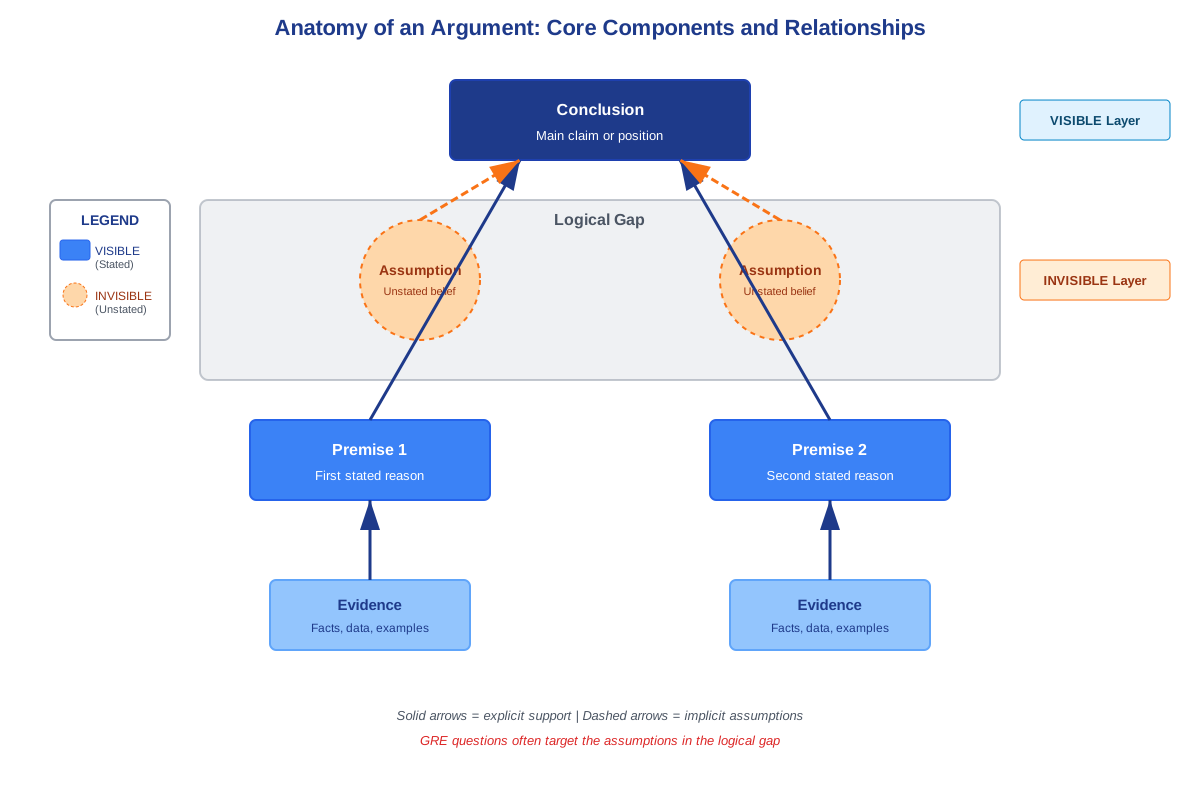
Every argument on the GRE contains three essential components: premises (evidence or reasons), a conclusion (the main claim being argued), and assumptions (unstated beliefs that must be true for the argument to work). The premise provides the factual or logical foundation—these are statements presented as evidence. The conclusion is what the author wants the reader to accept based on that evidence. Assumptions are the invisible bridges connecting premises to conclusions; they represent gaps in reasoning that the author takes for granted.
For example, if a passage states "Company X's profits increased 20% after implementing flexible work schedules; therefore, flexible schedules improve productivity," the premise is the profit increase, the conclusion is that flexible schedules improve productivity, and a key assumption is that the profit increase resulted from improved productivity rather than other factors like market conditions or new products.
Identifying Conclusions vs. Premises
The most fundamental skill in reading for argument is distinguishing what an author is trying to prove (conclusion) from what they're using as proof (premises). Conclusion indicators include words and phrases like "therefore," "thus," "consequently," "suggests that," "demonstrates that," and "it follows that." Premise indicators include "because," "since," "given that," "as evidenced by," and "for the reason that."
However, GRE passages often omit these explicit indicators, requiring readers to identify logical relationships through context. The conclusion is typically the most controversial or debatable claim—the statement that requires support. Premises are usually more factual or less controversial statements that provide that support. A useful test: ask "What is the author trying to convince me of?" (conclusion) versus "What reasons does the author give?" (premises).
Types of Evidence and Their Functions
Evidence in GRE arguments takes several forms, each with different persuasive strength:
| Evidence Type | Description | Strength Level | Common Usage |
|---|---|---|---|
| Statistical data | Numerical information, percentages, quantitative studies | High (if representative) | Scientific and social science passages |
| Expert testimony | Opinions from authorities in the field | Medium to High | Academic and technical passages |
| Analogies | Comparisons to similar situations | Medium | Explanatory passages |
| Anecdotal evidence | Specific examples or cases | Low to Medium | Illustrative purposes |
| Historical precedent | Past events as predictors | Medium | Historical and policy passages |
Understanding evidence types helps evaluate argument strength. GRE questions frequently ask whether evidence adequately supports a conclusion or what additional evidence would strengthen an argument.
Recognizing Assumptions
Assumptions are unstated premises that must be true for an argument's logic to hold. The GRE tests assumption recognition more than any other single argument skill. There are two main types:
- Necessary assumptions: Must be true for the conclusion to follow logically. If a necessary assumption is false, the argument completely falls apart.
- Sufficient assumptions: If true, would guarantee the conclusion, but aren't required for the argument to work.
To identify assumptions, look for gaps between evidence and conclusion. Ask: "What must the author believe for this reasoning to make sense?" or "What if this connecting idea were false—would the argument still work?" Common assumption categories include causal assumptions (X caused Y rather than correlation), representativeness assumptions (a sample represents the whole), and comparison assumptions (two things are sufficiently similar).
Argument Structures and Patterns
GRE passages employ recognizable argument structures:
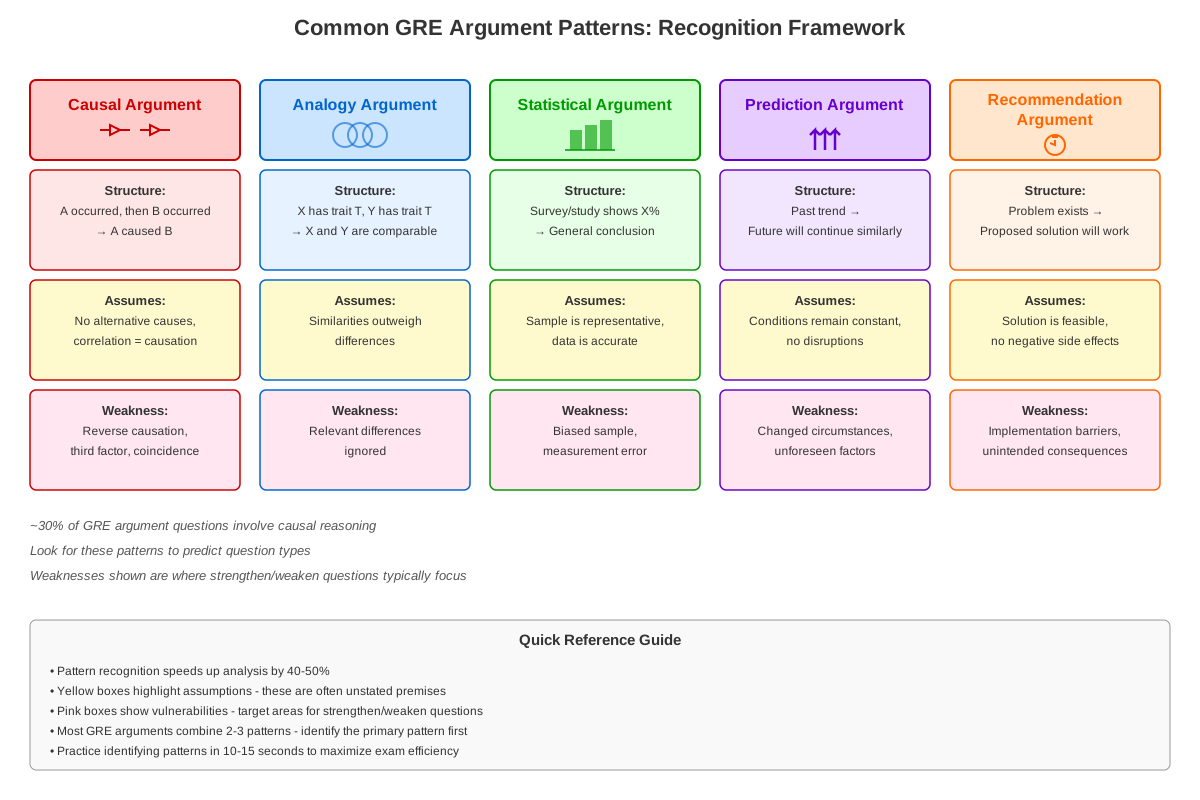
Causal Arguments: Claim that X causes Y based on correlation or temporal sequence. Vulnerable to alternative explanations, reverse causation, or confounding variables.
Analogical Arguments: Argue that because A and B are similar in some ways, they're similar in the relevant way. Vulnerable to relevant differences between the compared items.
Statistical Arguments: Draw conclusions from data or samples. Vulnerable to sampling bias, statistical significance issues, or misinterpretation of data.
Predictive Arguments: Use past or present evidence to predict future outcomes. Vulnerable to changed circumstances or false assumptions about continuity.
Recognizing these patterns helps anticipate weaknesses and predict what questions might ask.
Strengthening and Weakening Arguments
Many GRE questions ask what would strengthen or weaken an argument. Strengtheners typically eliminate alternative explanations, provide additional supporting evidence, or confirm key assumptions. Weakeners introduce alternative explanations, provide contradictory evidence, or show that assumptions are false.
The most effective strengtheners and weakeners address the argument's core assumptions rather than peripheral details. For instance, if an argument assumes that correlation implies causation, evidence establishing the causal mechanism strengthens the argument, while evidence of an alternative cause weakens it.
Scope and Degree in Arguments
Arguments can fail due to scope problems (conclusion broader than evidence supports) or degree problems (conclusion stronger than evidence warrants). If evidence shows "some improvement" but the conclusion claims "dramatic transformation," there's a degree problem. If evidence concerns one city but the conclusion applies to all cities, there's a scope problem.
GRE wrong answers frequently exploit these issues by making claims that go beyond what the passage supports. Careful readers track exactly what the evidence establishes and ensure conclusions don't overreach.
Concept Relationships
The concepts within reading for argument form an integrated analytical framework. The process begins with identifying conclusions and premises → which enables recognizing the logical structure → which reveals gaps where assumptions exist → which allows evaluation of evidence quality → which determines argument strength → which predicts what would strengthen or weaken the reasoning.
This topic connects to prerequisite knowledge of basic reading comprehension by building on the ability to identify main ideas (conclusions are often main ideas in argumentative passages) and supporting details (which often function as premises). The skill of reading for argument also enables progression to more advanced topics like comparative passage analysis, where students must evaluate competing arguments, and complex inference questions, where understanding argumentative structure helps determine what must be true based on the passage.
The relationship between assumptions and evidence is particularly crucial: assumptions represent what's missing, while evidence represents what's present. Together, they determine whether an argument succeeds or fails. Similarly, understanding argument structure (causal, analogical, statistical, predictive) directly informs the evaluation of evidence quality, since different structures require different types of support.
High-Yield Facts
⭐ The conclusion is what the author wants to prove; premises are the reasons offered as proof; assumptions are unstated beliefs connecting them.
⭐ Assumption questions are the most common argument-based question type on the GRE, appearing in approximately 30% of argument questions.
⭐ Correlation does not prove causation—this is the single most exploited logical gap in GRE passages.
⭐ Evidence that eliminates alternative explanations is stronger than evidence that merely supports one explanation.
⭐ The scope of the conclusion must match the scope of the evidence—overgeneralization is a common argument flaw.
- Necessary assumptions, if false, destroy the argument; sufficient assumptions, if true, guarantee the conclusion.
- Analogical arguments are only as strong as the similarity between the compared items in relevant respects.
- Statistical arguments require representative samples—biased samples invalidate conclusions.
- Temporal sequence (A before B) does not establish causation (A caused B).
- Expert testimony is only strong evidence when the expert has relevant credentials and no conflicts of interest.
- Strengtheners often work by confirming assumptions; weakeners often work by showing assumptions are false.
- The most tempting wrong answers in argument questions address peripheral issues rather than core assumptions.
- Predictive arguments assume future conditions will resemble past conditions—changed circumstances weaken them.
- Evidence quality matters more than evidence quantity—one highly relevant study outweighs multiple tangential examples.
- Arguments can be valid in structure but unsound if premises are false—the GRE tests both logical structure and factual accuracy.
Quick check — test yourself on Reading for argument so far.
Try Flashcards →Common Misconceptions
Misconception: The longest or most complex sentence in a passage is always the conclusion.
Correction: Conclusions can be stated simply and may appear anywhere in the passage—beginning, middle, or end. Identify conclusions by their logical function (what's being argued) rather than sentence length or position.
Misconception: If evidence supports a conclusion, the argument is strong.
Correction: Evidence must adequately support the conclusion without logical gaps. An argument can have some supporting evidence but still be weak if key assumptions are questionable or alternative explanations exist.
Misconception: Assumptions are the same as inferences.
Correction: Assumptions are unstated premises required for an argument to work; inferences are conclusions drawn from stated information. Assumptions fill gaps in reasoning; inferences extend reasoning to new conclusions.
Misconception: To weaken an argument, you must prove the conclusion is false.
Correction: Weakening an argument only requires showing that the reasoning is flawed or that the evidence doesn't adequately support the conclusion. The conclusion could still be true even if the argument for it is weak.
Misconception: All evidence mentioned in a passage equally supports the main argument.
Correction: Passages often include background information, counterarguments, or tangential details that don't directly support the main conclusion. Distinguish between evidence that directly supports the argument and information included for other purposes.
Misconception: Causal language ("causes," "leads to," "results in") always indicates a conclusion.
Correction: Causal language can appear in both premises and conclusions. A premise might state "X causes Y" as established fact, while a conclusion might claim "therefore, Z causes W" as something being argued.
Misconception: The author's opinion is always explicitly stated.
Correction: Authors often present arguments through careful selection and arrangement of evidence without explicitly stating "I believe" or "I argue." The conclusion represents the author's position even when not explicitly attributed.
Worked Examples
Example 1: Identifying Argument Components
Passage: "Archaeological evidence shows that the ancient city of Petra experienced a severe drought lasting several decades around 300 CE. Historical records indicate that Petra's population declined dramatically during this same period. Therefore, the drought caused Petra's population decline."
Question: Which of the following is an assumption required by the argument?
Step 1 - Identify the conclusion: The conclusion is the claim being argued: "the drought caused Petra's population decline." The word "therefore" signals this conclusion.
Step 2 - Identify the premises:
- Premise 1: Petra experienced a severe drought around 300 CE
- Premise 2: Petra's population declined during the same period
Step 3 - Identify the logical gap: The premises establish correlation (drought and decline happened together) but the conclusion claims causation (drought caused the decline). What's missing?
Step 4 - Determine the assumption: The argument assumes that no other significant factor caused the population decline. If warfare, disease, economic collapse, or trade route changes caused the decline, the drought might be coincidental. The argument also assumes the drought was severe enough to drive people away and that people couldn't adapt to the drought conditions.
Step 5 - Evaluate answer choices (hypothetical):
- (A) "The drought was the only significant hardship Petra faced during this period" - CORRECT. This is a necessary assumption. If false (if other major problems existed), the argument fails.
- (B) "Petra was larger than other cities in the region" - Incorrect. Size comparison is irrelevant to whether drought caused decline.
- (C) "Droughts always cause population decline" - Incorrect. Too extreme; the argument only claims this drought caused this decline.
Connection to learning objectives: This example demonstrates identifying when argument analysis is being tested (assumption question), applying the core strategy (finding gaps between premises and conclusion), and accurately analyzing GRE-style questions.
Example 2: Evaluating Evidence Strength
Passage: "A recent study found that students who took handwritten notes scored 15% higher on conceptual questions than students who typed notes on laptops. This demonstrates that handwriting enhances learning more effectively than typing. Schools should therefore ban laptops from classrooms to improve educational outcomes."
Question: Which of the following, if true, most weakens the argument?
Step 1 - Map the argument structure:
- Evidence: One study showing handwritten notes correlated with better performance on one test type
- Conclusion 1: Handwriting enhances learning more than typing (causal claim)
- Conclusion 2: Schools should ban laptops (policy recommendation)
Step 2 - Identify assumptions:
- The study's sample was representative
- The 15% difference was due to handwriting vs. typing, not other factors
- Conceptual questions adequately measure overall learning
- Benefits of handwriting outweigh all benefits of laptops
- What works in the study context applies to all classroom situations
Step 3 - Determine what would weaken the argument: Information that challenges any of these assumptions would weaken the reasoning. The strongest weakener would provide an alternative explanation for the results or show that the conclusion doesn't follow from the evidence.
Step 4 - Evaluate answer choices (hypothetical):
- (A) "Students who handwrote notes spent more time studying overall" - STRONG WEAKENER. Provides alternative explanation: maybe study time, not handwriting method, caused better performance.
- (B) "Some students prefer typing to handwriting" - Weak. Preference doesn't address whether handwriting improves learning.
- (C) "The study included only 50 students" - Moderate weakener. Small sample size raises questions about generalizability but doesn't directly challenge the causal claim.
- (D) "Laptops provide access to research resources during class" - STRONG WEAKENER. Shows significant benefit of laptops that might outweigh handwriting advantages, undermining the policy recommendation.
Step 5 - Select the best answer: Choice (A) most directly weakens the core causal claim by providing an alternative explanation for the observed results.
Connection to learning objectives: This example shows how to evaluate evidence quality, identify multiple assumptions in complex arguments, and predict what information would weaken reasoning—all essential skills for GRE argument questions.
Exam Strategy
Recognizing Argument Questions
Argument questions use specific trigger language. Watch for questions asking about:
- "The argument depends on which assumption..."
- "Which of the following, if true, would most strengthen/weaken..."
- "The author's reasoning is vulnerable to criticism because..."
- "The argument proceeds by..."
- "Which of the following principles underlies the argument..."
These phrasings signal that the question tests argument analysis rather than factual recall or main idea identification.
Systematic Approach to Argument Questions
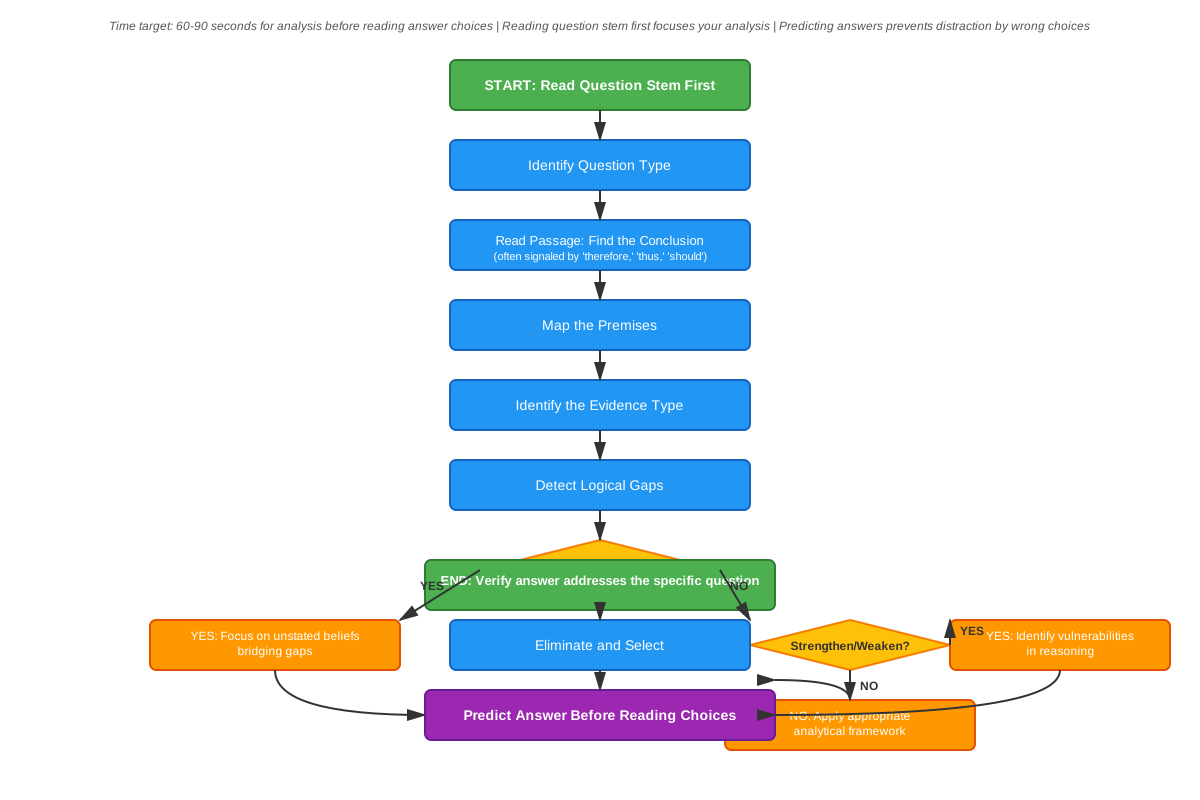
- Read actively for structure (30-45 seconds): As you read, mentally label sentences as evidence, conclusion, or background. Don't get lost in details—focus on logical relationships.
- Identify the conclusion first (10-15 seconds): Ask "What is the author trying to prove?" Circle or mentally note conclusion indicators.
- Map the support (15-20 seconds): Identify what evidence supports the conclusion and how it's supposed to work.
- Spot the gap (10-15 seconds): What's missing? What must be true for this reasoning to work? This is where assumptions hide.
- Predict before looking at choices (10 seconds): Based on the gap you identified, predict what the answer should address.
- Eliminate systematically (30-45 seconds): Wrong answers typically address irrelevant issues, are too extreme, or focus on peripheral details rather than core assumptions.
Time Management
Allocate approximately 2 minutes per argument question. If a passage has multiple questions, spend slightly more time on initial analysis (90 seconds) since that investment pays off across multiple questions. Don't spend more than 30 seconds on any single answer choice—if you can't decide, flag it and move on.
Process of Elimination Tips
Eliminate answers that:
- Address issues not mentioned in the passage
- Are too extreme (using "always," "never," "only," "must") unless the passage is equally extreme
- Confuse necessary and sufficient conditions
- Strengthen when the question asks for weakening, or vice versa
- Focus on tangential details rather than the core logical connection
- Reverse the causal relationship stated in the passage
Keep answers that:
- Directly address the gap between evidence and conclusion
- Use moderate language matching the passage's tone
- Connect to the passage's key terms and concepts
- Address the scope and degree of the conclusion
Common Trap Patterns
The GRE frequently includes wrong answers that are factually true or relevant to the passage topic but don't address the specific logical relationship being tested. These "tempting but wrong" answers often discuss interesting related issues that don't affect whether the conclusion follows from the premises. Always return to the specific question: Does this answer choice affect the logical connection between this evidence and this conclusion?
Memory Techniques
CAP Mnemonic for Argument Components:
- Conclusion: What's being argued
- Assumptions: What's unstated but required
- Premises: What's offered as proof
SCAN for Assumptions:
- Scope: Does the conclusion go beyond the evidence's scope?
- Causation: Does the argument assume causation from correlation?
- Alternatives: Does the argument ignore other explanations?
- Necessity: What must be true for this reasoning to work?
STAR for Strengthening/Weakening:
- Support assumptions (strengthens) or Show assumptions false (weakens)
- Target the core logical gap, not peripheral issues
- Alternative explanations: eliminate them (strengthens) or introduce them (weakens)
- Relevance: ensure the answer choice directly affects the argument's logic
Visualization Strategy: Picture arguments as bridges. The conclusion is the destination, premises are the starting point, and assumptions are the invisible support beams. If a support beam is removed (assumption proven false), the bridge collapses. This mental image helps identify what's structurally necessary for the argument to stand.
The "So What?" Test: After identifying what seems like a conclusion, ask "So what is the author arguing based on this?" If there's a further claim, that's likely the main conclusion. This prevents mistaking intermediate conclusions or premises for the main point.
Summary
Reading for argument is the analytical skill of dissecting how authors build logical cases for their claims. Mastery requires distinguishing conclusions from premises, identifying unstated assumptions that bridge logical gaps, evaluating evidence quality and relevance, and predicting what would strengthen or weaken reasoning. The GRE tests this skill extensively because it reflects critical thinking essential for graduate study. Success depends on systematic analysis: identify what's being argued (conclusion), what supports it (premises), what's missing (assumptions), and whether the logic holds. The most common argument structures—causal, analogical, statistical, and predictive—each have characteristic vulnerabilities that GRE questions exploit. High scorers recognize that correlation doesn't prove causation, that evidence must match the scope and degree of conclusions, and that eliminating alternative explanations strengthens arguments more than merely providing supporting examples. By actively reading for logical structure rather than passively absorbing content, test-takers can consistently identify assumptions, evaluate reasoning, and select correct answers even in complex passages.
Key Takeaways
- Arguments consist of three components: conclusions (claims being argued), premises (supporting evidence), and assumptions (unstated beliefs connecting them)
- Identify conclusions by asking "What is the author trying to prove?" rather than relying solely on indicator words
- Assumptions are logical gaps—they're what must be true for the reasoning to work but isn't explicitly stated
- Correlation never proves causation on the GRE—this is the most frequently tested logical gap
- Strengthen/weaken questions target core assumptions, not peripheral details—focus on what directly affects the logical connection
- Evidence scope must match conclusion scope—overgeneralization is a common and testable flaw
- Systematic analysis beats intuition—use a consistent process to map argument structure before evaluating answer choices
Related Topics
Critical Reasoning in Analytical Writing: The "Analyze an Argument" essay task requires extended application of the same skills covered here—identifying assumptions, evaluating evidence, and assessing logical structure. Mastering reading for argument provides the analytical foundation for scoring 5.0+ on this essay.
Inference Questions in Reading Comprehension: Strong inference skills depend on understanding what a passage's evidence actually supports versus what goes beyond it—a direct application of scope and degree analysis from argument reading.
Logical Reasoning Patterns: Advanced study of formal logic structures (modus ponens, modus tollens, conditional reasoning) builds on the informal logic tested in reading for argument, enabling faster recognition of argument patterns.
Comparative Passage Analysis: When GRE passages present competing viewpoints, reading for argument skills enable evaluation of which position has stronger support and where each argument's vulnerabilities lie.
Practice CTA
Now that you understand the framework for reading for argument, it's time to apply these strategies to actual GRE-style questions. The practice questions and flashcards will reinforce your ability to quickly identify conclusions, spot assumptions, and evaluate reasoning under timed conditions. Remember: argument analysis is a skill that improves dramatically with deliberate practice. Each question you work through strengthens your pattern recognition and speeds up your analytical process. Approach the practice materials systematically, using the strategies outlined in this guide, and you'll see measurable improvement in both accuracy and confidence. Your ability to dissect arguments is one of the highest-yield skills for Verbal Reasoning success—invest the time to master it.
Sign up free to keep reading
Create a free AnvayaPrep account to finish this GRE guide on Reading for argument — plus flashcards and practice questions.