Overview
Reading for structure is one of the most powerful yet underutilized strategies for conquering GRE Reading Comprehension passages. Rather than getting lost in dense details or struggling to remember every fact, this approach trains test-takers to identify the organizational blueprint of a passage—how ideas connect, where arguments shift direction, and what role each paragraph plays in the author's overall purpose. On the GRE, understanding structure allows students to navigate complex academic prose efficiently, predict where information will appear, and answer questions with confidence even when specific details have faded from memory.
The GRE Verbal Reasoning section consistently presents passages from diverse disciplines—natural sciences, social sciences, humanities, and business—often featuring challenging vocabulary and sophisticated argumentation. Many test-takers instinctively focus on absorbing content, attempting to memorize facts and examples. However, the exam frequently tests comprehension of how ideas relate rather than recall of isolated details. GRE reading for structure shifts the focus from "what does the passage say?" to "how is the passage organized?" and "why did the author include each component?" This metacognitive approach transforms reading from a passive absorption exercise into an active analytical process.
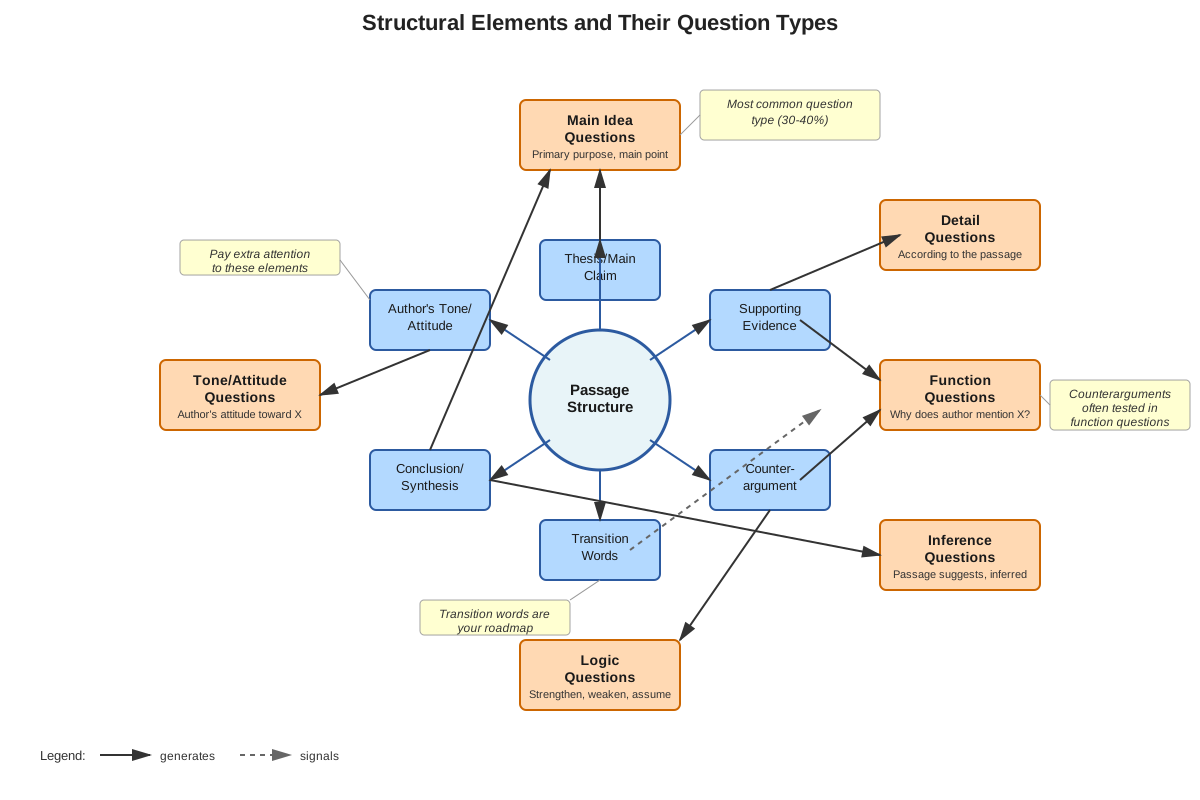
Within the broader Verbal Reasoning framework, reading for structure serves as the foundation for all Reading Comprehension question types. Whether answering main idea questions, inference questions, function questions, or logic questions, recognizing structural elements—such as thesis statements, supporting evidence, counterarguments, and transitions—provides the roadmap needed to locate relevant information quickly and eliminate incorrect answer choices systematically. Mastering this skill creates efficiency gains that compound across the entire exam, freeing up cognitive resources and time for more challenging questions.
Learning Objectives
- [ ] Identify when Reading for structure is being tested
- [ ] Explain the core rule or strategy behind Reading for structure
- [ ] Apply Reading for structure to GRE-style questions accurately
- [ ] Distinguish between structural elements (thesis, support, contrast, conclusion) in academic passages
- [ ] Create mental or written structural maps while reading under timed conditions
- [ ] Predict question types based on structural features of a passage
- [ ] Use structural understanding to eliminate answer choices that misrepresent passage organization
Prerequisites
- Basic reading comprehension skills: Ability to understand college-level prose is essential, as GRE passages assume academic literacy and sophisticated vocabulary.
- Familiarity with argument structure: Understanding claims, evidence, and conclusions helps identify how authors build their cases.
- Awareness of common passage types: Recognizing whether a passage is explanatory, argumentative, or comparative provides initial structural clues.
- Time management fundamentals: Reading for structure is most effective when practiced within realistic time constraints (approximately 3-4 minutes per passage).
Why This Topic Matters
Reading for structure represents a paradigm shift that separates high-scoring test-takers from those who struggle with Reading Comprehension. In real-world academic and professional contexts, the ability to quickly grasp how complex documents are organized—whether research papers, policy briefs, or technical reports—enables efficient information extraction and critical evaluation. This skill transcends test preparation, forming the foundation for graduate-level coursework and knowledge work careers.
On the GRE specifically, Reading Comprehension accounts for approximately half of the Verbal Reasoning score. Each Verbal section typically contains 1-2 long passages (approximately 450 words), 2-3 short passages (approximately 150 words), and 1 argument passage, with 1-4 questions per passage. Structural understanding is explicitly tested through function questions (e.g., "The author mentions X in order to..."), organization questions (e.g., "Which of the following best describes the organization of the passage?"), and purpose questions (e.g., "The primary purpose of the passage is to..."). However, structural awareness also accelerates performance on detail questions, inference questions, and vocabulary-in-context questions by helping test-takers locate relevant passage sections rapidly.
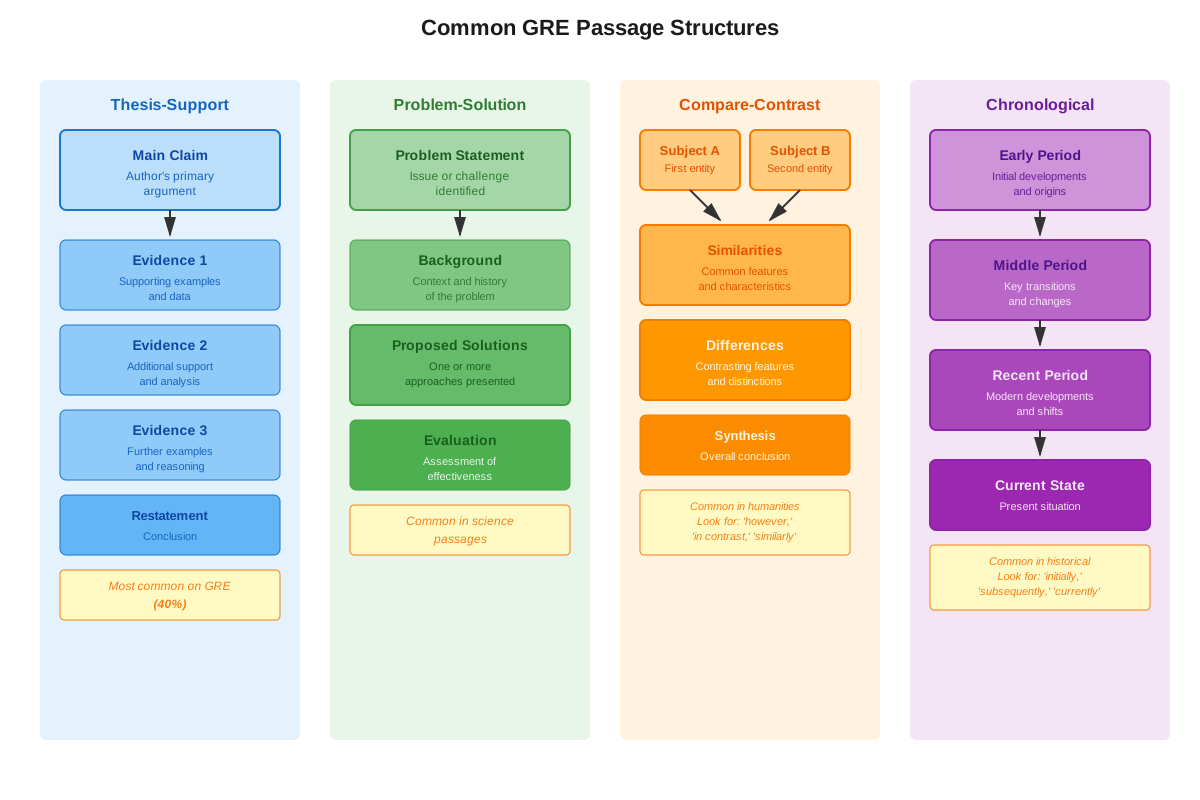
Common structural patterns on the GRE include: presenting a theory then challenging it; describing a phenomenon then explaining its causes; comparing two perspectives; tracing historical development; and presenting a problem then evaluating solutions. Recognizing these patterns within the first paragraph allows strategic reading of subsequent paragraphs, with attention focused on transitions, contrasts, and the author's evaluative language rather than granular details.
Core Concepts
The Structural Reading Framework
The foundation of reading for structure involves shifting attention from content absorption to architectural analysis. Instead of asking "What is this passage about?" (a content question), structural readers ask "How is this passage built?" and "What is each part doing?" This framework recognizes that GRE passages follow predictable organizational patterns, and identifying these patterns early creates a mental scaffold for processing information.
The structural reading process involves three simultaneous activities: identifying paragraph functions, tracking logical relationships, and noting the author's attitude. Paragraph functions describe what role each paragraph plays—introducing a topic, presenting evidence, offering a counterargument, providing an example, or drawing a conclusion. Logical relationships capture how ideas connect through contrast (however, although, despite), causation (because, therefore, consequently), addition (moreover, furthermore, additionally), or exemplification (for instance, such as). Author attitude reveals whether the writer supports, criticizes, remains neutral toward, or qualifies the ideas presented.
Key Structural Elements
Every GRE passage contains several essential structural components, though not always in the same order:
Main Idea/Thesis: The central claim or primary focus of the passage, typically appearing in the first or second paragraph. On the GRE, the main idea is often nuanced—not simply "this passage is about photosynthesis" but rather "this passage argues that recent discoveries about photosynthesis challenge traditional models of energy conversion."
Background/Context: Information establishing the framework for understanding the main discussion, often including definitions, historical context, or descriptions of prevailing views. This material sets up what will be challenged, explained, or analyzed.
Supporting Evidence: Data, examples, studies, or logical reasoning that substantiate the main claim. The GRE frequently includes specific details here—dates, names, percentages—that test-takers need not memorize but should know where to locate.
Contrasts/Counterarguments: Alternative perspectives, opposing theories, or limitations to the main argument. Transition words like "however," "yet," "although," and "despite" signal these crucial structural shifts. The GRE loves testing whether students recognize when the author is presenting an opposing view versus their own position.
Conclusions/Implications: The author's final assessment, broader significance, or future directions. Sometimes this appears as explicit conclusions; other times as subtle evaluative language suggesting importance or limitations.
Structural Patterns on the GRE
| Pattern Type | Description | Typical Organization | Key Transitions |
|---|---|---|---|
| Theory-Challenge | Presents established view, then critiques or refines it | Para 1: Old theory; Para 2-3: Problems/new evidence; Para 4: Revised understanding | "However," "Recent findings," "This view overlooks" |
| Phenomenon-Explanation | Describes observable fact, then explains causes/mechanisms | Para 1: Description of phenomenon; Para 2-3: Causal analysis or competing explanations | "Because," "This results from," "The reason for" |
| Comparison-Contrast | Examines two or more perspectives, theories, or approaches | Para 1: Introduction; Para 2: Perspective A; Para 3: Perspective B; Para 4: Synthesis or evaluation | "In contrast," "Similarly," "Unlike," "Whereas" |
| Problem-Solution | Identifies an issue, then evaluates potential responses | Para 1-2: Problem description; Para 3-4: Proposed solutions and assessment | "To address this," "One approach," "However, this solution" |
| Historical Development | Traces evolution of ideas or discoveries chronologically | Para 1: Early stage; Para 2: Middle developments; Para 3: Current understanding | "Initially," "Subsequently," "Eventually," "Currently" |
Active Reading Techniques
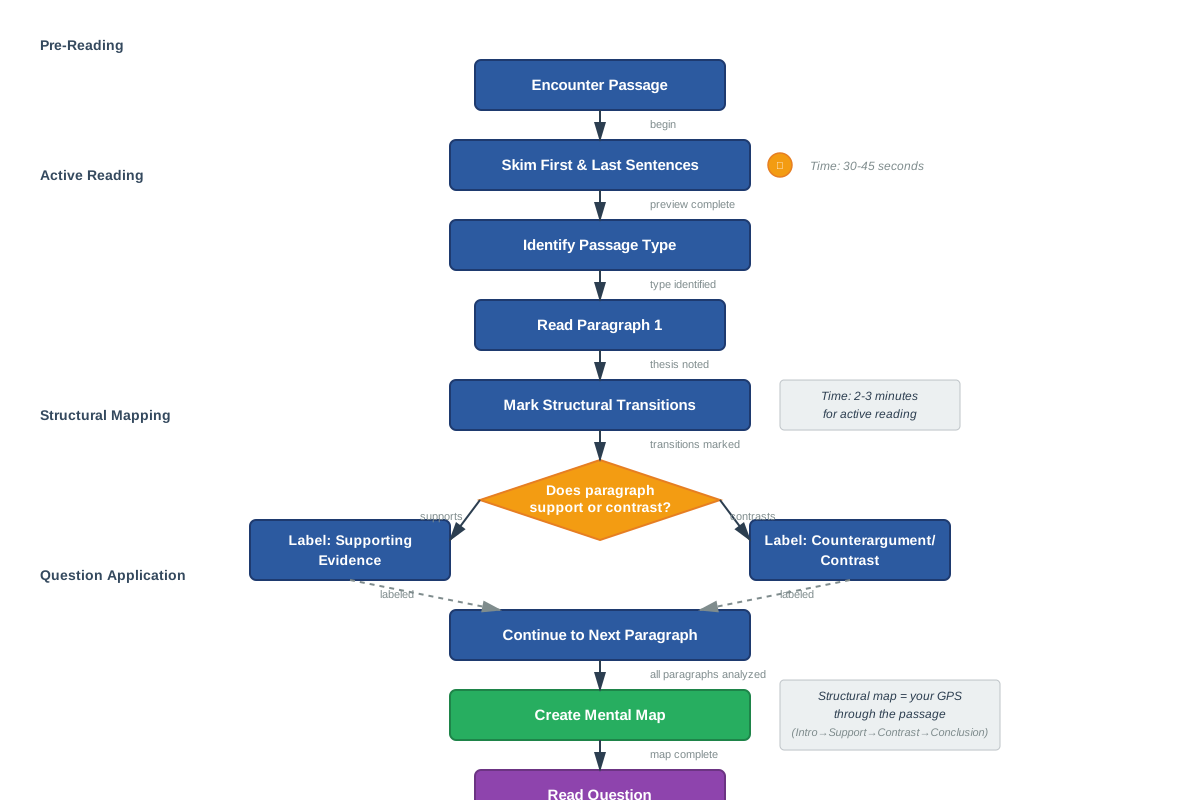
Effective structural reading requires active engagement rather than passive absorption. Annotation (either mental or written) marks key structural elements: circling transition words, bracketing the thesis, noting paragraph functions in margins. On the computer-based GRE, where physical annotation is impossible, test-takers must develop mental annotation habits, perhaps using the scratch paper to jot brief structural notes like "P1: old theory, P2: problems, P3: new approach."
Predictive reading leverages structural awareness to anticipate what comes next. After reading a paragraph that presents a traditional theory, skilled readers expect the next paragraph to either provide supporting evidence or introduce challenges. This anticipation creates engagement and improves retention. When predictions prove incorrect, the surprise itself becomes memorable, highlighting important structural turns.
Structural mapping creates a visual or mental representation of passage organization. A simple map might look like: "P1: Intro phenomenon → P2: Traditional explanation → P3: BUT new data contradicts → P4: Alternative explanation proposed." This map serves as a reference when answering questions, allowing rapid location of relevant information.
The Role of Transitions
Transition words and phrases function as structural signposts, alerting readers to logical relationships and organizational shifts. Mastering transitions is perhaps the highest-yield component of structural reading. Contrast transitions (however, nevertheless, yet, although, despite, in contrast, on the other hand) signal that the author is shifting direction—introducing an opposing view, presenting contradictory evidence, or qualifying a claim. These moments are heavily tested on the GRE.
Continuation transitions (moreover, furthermore, additionally, similarly, likewise) indicate that the author is building on the previous point, adding supporting evidence or extending an argument. Causal transitions (because, since, therefore, thus, consequently, as a result) reveal cause-effect relationships crucial for inference questions. Example transitions (for instance, for example, such as, to illustrate) introduce specific cases that exemplify general principles—details that need not be memorized but whose location should be noted.
Author's Purpose and Tone
Understanding why the author wrote the passage and their attitude toward the subject matter provides crucial structural insight. The author's purpose might be to challenge a misconception, explain a phenomenon, compare competing theories, advocate for a position, or trace historical development. Identifying this purpose early—usually possible after the first paragraph—guides expectations for the rest of the passage.
Author's tone ranges from neutral/objective (common in scientific explanations) to critical/skeptical (when challenging theories) to enthusiastic/supportive (when advocating positions). Tone is conveyed through word choice: "merely," "unfortunately," and "fails to account for" suggest criticism, while "importantly," "successfully," and "demonstrates" suggest approval. The GRE frequently tests whether students can distinguish the author's view from views the author is merely describing.
Concept Relationships
Reading for structure serves as the integrative framework connecting all Reading Comprehension skills. The structural approach builds upon basic reading comprehension by adding a metacognitive layer—not just understanding what the passage says, but analyzing how it's constructed. This architectural awareness enables efficient answering of all question types: main idea questions directly test structural understanding; detail questions become easier when structure reveals where information resides; inference questions often hinge on recognizing logical relationships between structural components.
The relationship between structural elements follows a hierarchical pattern: Main Idea (top level) → Paragraph Functions (mid level) → Specific Details (bottom level). Understanding this hierarchy prevents getting lost in details while maintaining awareness of where those details fit in the larger argument. Transitions connect structural elements, making relationships explicit: a "however" transition signals that the upcoming content contrasts with the preceding content, while a "therefore" transition indicates that the upcoming content follows logically from what came before.
The structural patterns described earlier relate to each other through common underlying principles. The Theory-Challenge pattern is essentially a specialized form of Comparison-Contrast (old theory vs. new understanding). The Problem-Solution pattern often incorporates Phenomenon-Explanation (explaining why the problem exists). Recognizing these meta-patterns allows flexible application of structural reading across diverse passage types.
Structural reading also connects forward to question-answering strategies. Function questions explicitly test structural understanding ("The author mentions X in order to..."), requiring recognition of how specific details support larger arguments. Organization questions ask students to describe passage structure directly. Even vocabulary-in-context questions benefit from structural awareness, as understanding a word's function in the argument aids in selecting the appropriate synonym.
High-Yield Facts
⭐ The first paragraph typically establishes the passage's main structural pattern—invest extra attention here to predict organization.
⭐ Transition words (however, moreover, therefore) are the highest-yield elements for understanding structure—circle or mentally note every transition.
⭐ Function questions ("The author mentions X in order to...") directly test structural understanding and appear on virtually every GRE exam.
⭐ The author's thesis often appears at the end of the first paragraph or beginning of the second paragraph, frequently following a "however" or "but" transition.
⭐ When the passage presents someone else's view, the author's own position typically appears after a contrast transition—distinguish carefully between views described and views endorsed.
- Approximately 50% of Reading Comprehension questions can be answered more efficiently using structural understanding than by rereading for details.
- Paragraph functions typically include: introduce topic, provide background, present main argument, offer supporting evidence, acknowledge counterarguments, and draw conclusions.
- The GRE favors passages that challenge conventional wisdom or present nuanced positions rather than straightforward explanations.
- Structural maps need not be elaborate—simple abbreviations like "P1: old view, P2: problems, P3: new view" suffice for navigation.
- Author attitude is often revealed through subtle word choices (qualifiers like "merely," "only," "unfortunately") rather than explicit statements.
- The most common structural pattern on GRE science passages is Phenomenon-Explanation; on humanities passages, Theory-Challenge or Historical Development.
- Questions asking about "primary purpose" or "main idea" test whether you identified the passage's overall structure, not whether you remember specific details.
Quick check — test yourself on Reading for structure so far.
Try Flashcards →Common Misconceptions
Misconception: Reading for structure means skimming or reading superficially without understanding content.
Correction: Structural reading is a form of deep, active reading that focuses on relationships and organization while still comprehending content. The goal is understanding how ideas connect, not ignoring what those ideas are.
Misconception: Every detail in the passage must be memorized to answer questions correctly.
Correction: The GRE tests comprehension and reasoning, not memorization. Structural reading allows you to locate details when needed rather than memorizing them upfront. Knowing "Paragraph 3 discusses specific examples of the phenomenon" is more useful than trying to remember those examples.
Misconception: The main idea is always stated explicitly in the first sentence.
Correction: While the first paragraph usually introduces the main topic, the author's actual thesis or primary purpose often emerges after presenting background or conventional views, typically signaled by a contrast transition like "however" or "yet."
Misconception: When the passage describes someone's theory or perspective, that represents the author's view.
Correction: Authors frequently present others' views to set up their own argument. The phrase "Some scholars argue..." or "Traditional interpretations suggest..." indicates the author is describing a view, not necessarily endorsing it. The author's position typically follows a contrast transition.
Misconception: Structural reading takes too much time and should only be used on difficult passages.
Correction: With practice, structural reading becomes automatic and actually saves time by preventing rereading and enabling rapid question answering. It should be applied to every passage, becoming the default reading mode.
Misconception: All paragraphs in a passage are equally important.
Correction: Paragraphs serve different functions with varying importance. The paragraph containing the thesis is crucial; paragraphs providing examples or background details are less critical for most questions. Structural reading helps prioritize attention appropriately.
Misconception: Transition words are just stylistic flourishes without substantive meaning.
Correction: Transitions are structural signposts that reveal logical relationships and organizational shifts. A "however" signals a crucial turn in the argument; a "for example" indicates supporting detail. These words are among the most important in the passage.
Worked Examples
Example 1: Theory-Challenge Passage
Passage Excerpt:
"For decades, linguists accepted the critical period hypothesis, which posits that language acquisition must occur before puberty to achieve native-like proficiency. This view, championed by Lenneberg in the 1960s, seemed supported by observations of feral children and late-learning second language speakers who rarely achieved native fluency. However, recent longitudinal studies have revealed significant problems with this interpretation. Researchers tracking adult immigrants over twenty-year periods found that while initial learning rates were slower than children's, ultimate attainment varied dramatically based on factors like motivation, learning environment, and practice intensity rather than age alone. Moreover, neuroimaging studies show that adult learners can activate the same brain regions as native speakers when sufficient immersion occurs. These findings suggest that the critical period hypothesis, while containing some truth about learning rate differences, overstates age as a determinant of ultimate language proficiency."
Structural Analysis:
Step 1 - Identify the pattern: The first sentence presents an established theory ("linguists accepted the critical period hypothesis"). The word "However" in the third sentence signals a structural shift—this is a Theory-Challenge pattern.
Step 2 - Map paragraph functions:
- Sentences 1-2: Present traditional view (critical period hypothesis) and its supporting evidence
- Sentence 3 (starting with "However"): Signal shift to challenges
- Sentences 4-5: Present new evidence contradicting the traditional view
- Final sentence: Author's conclusion/synthesis
Step 3 - Note the author's position: The author is challenging the traditional view. The phrase "overstates age as a determinant" reveals the author's nuanced position—not complete rejection, but qualification of the hypothesis.
Step 4 - Predict likely questions:
- Main purpose: "To challenge an established theory about language acquisition"
- Function question: "The author mentions neuroimaging studies in order to provide evidence against the critical period hypothesis"
- Inference: "The author would likely agree that motivation plays a significant role in adult language learning"
Application to a sample question:
"The primary purpose of the passage is to..."
Using structural understanding, we know this is a Theory-Challenge pattern where the author questions an established view. The correct answer will reflect this structure: something like "question the validity of a widely accepted hypothesis" or "present evidence that complicates a traditional theory." Wrong answers might say "describe the history of linguistic research" (too broad/neutral) or "argue that adults learn languages better than children" (too extreme—the author qualifies, not reverses, the hypothesis).
Example 2: Phenomenon-Explanation Passage
Passage Excerpt:
"Urban planners have long observed that cities with populations exceeding one million consistently exhibit a phenomenon known as superlinear scaling: as city size doubles, economic productivity and innovation increase by approximately 115%, rather than the expected 100%. This pattern holds across diverse cultures and economic systems, from Tokyo to São Paulo to London. The explanation for this disproportionate increase lies in network effects. As cities grow, the number of potential interactions between individuals increases exponentially rather than linearly. A city of two million doesn't simply have twice as many people as a city of one million—it has exponentially more possible connections, collaborations, and exchanges of ideas. These intensified social networks accelerate information flow, facilitate specialization, and create opportunities for novel combinations of skills and knowledge. Consequently, larger cities become innovation engines, generating patents, artistic works, and new businesses at rates that exceed their population growth."
Structural Analysis:
Step 1 - Identify the pattern: The first sentence describes an observed phenomenon (superlinear scaling in cities). The phrase "The explanation for this" in the fourth sentence explicitly signals a Phenomenon-Explanation pattern.
Step 2 - Map paragraph functions:
- Sentences 1-2: Describe the phenomenon (superlinear scaling) and establish its universality
- Sentence 3 ("The explanation..."): Transition to causal analysis
- Sentences 4-6: Explain the mechanism (network effects, exponential connections)
- Final sentence: Describe the consequences/implications
Step 3 - Track causal relationships: The passage establishes a clear causal chain: City growth → Exponential increase in possible connections → Intensified social networks → Accelerated information flow → Increased innovation and productivity. Understanding this chain is crucial for inference questions.
Step 4 - Note what's emphasized: The author focuses on explaining why the phenomenon occurs (network effects) rather than just describing that it occurs. This emphasis suggests questions will test understanding of the mechanism.
Application to a sample question:
"According to the passage, which of the following contributes to the superlinear scaling observed in large cities?"
Structural understanding reveals that the mechanism is explained in sentences 4-6: exponential growth in possible connections and intensified social networks. The correct answer will reference these network effects. Wrong answers might mention factors not discussed (like government policy or infrastructure) or confuse the phenomenon itself (superlinear scaling) with its cause (network effects).
Exam Strategy
Approaching Passages Strategically
When encountering a GRE Reading Comprehension passage, implement a structured approach: First 30 seconds - Read the first paragraph carefully, identifying the topic and predicting the structural pattern. Look for transition words that signal whether the author will challenge, explain, compare, or trace development. Next 2-3 minutes - Read the remaining paragraphs with attention to paragraph functions and transitions rather than memorizing details. Create a mental or written structural map. Final 30 seconds - Before looking at questions, articulate the main idea and author's purpose to yourself.
Trigger Words and Phrases
Certain words and phrases signal that structural understanding is being tested:
Function questions use phrases like "in order to," "serves to," "functions to," or "the author mentions X primarily to." These explicitly test whether you understand what role a detail plays in the larger argument.
Organization questions ask "which of the following best describes the organization of the passage" or "the author develops the argument primarily by." These require recognizing the overall structural pattern.
Purpose questions use "primary purpose," "main point," or "primarily concerned with." These test whether you identified the passage's overarching goal and structure.
When you see these trigger phrases, immediately think structurally rather than diving back into content details. Ask: "What was this paragraph doing?" not "What did this paragraph say?"
Process of Elimination Tips
For function questions, eliminate answers that:
- Describe what the detail says rather than what it does (content vs. function)
- Misidentify the structural role (e.g., saying something is a counterargument when it's actually supporting evidence)
- Are too narrow or too broad relative to the detail's actual scope
For main idea/purpose questions, eliminate answers that:
- Focus on details from one paragraph rather than the whole passage
- Are too neutral when the author takes a position, or too extreme when the author is balanced
- Describe a structural pattern that doesn't match the passage (e.g., "compare two theories" when the passage actually challenges one theory)
For organization questions, eliminate answers that:
- List structural elements in the wrong order
- Include elements not present in the passage
- Mischaracterize the relationship between parts (e.g., saying the author "refutes" when they actually "qualifies")
Time Allocation
Allocate approximately 3-4 minutes for reading a long passage with structural awareness, then 1-1.5 minutes per question. Investing time upfront in structural understanding pays dividends by accelerating question answering and reducing rereading. If a question requires locating a specific detail, your structural map should enable you to identify the relevant paragraph in seconds rather than rereading the entire passage.
For passages where you're struggling to identify structure, focus on finding the thesis and noting where major transitions occur. Even a partial structural understanding (knowing where the author's main claim appears and where they present contrasting views) dramatically improves question-answering efficiency.
Memory Techniques
The MAPS Acronym
Remember the four key elements to track while reading for structure using MAPS:
- Main idea: What is the author's central claim or primary focus?
- Attitude: What is the author's tone and position toward the subject?
- Purpose: Why did the author write this passage?
- Structure: How is the passage organized (pattern and paragraph functions)?
After reading each passage, quickly verify you can answer all four MAPS questions before proceeding to questions.
The Transition Trio
Group transitions into three categories using CAC:
- Contrast: however, yet, although, despite, nevertheless, in contrast
- Addition: moreover, furthermore, additionally, similarly, likewise
- Causation: because, therefore, thus, consequently, as a result, since
When you encounter a transition, immediately categorize it as C, A, or C to understand the logical relationship being signaled.
Visualization Strategy
Visualize passage structure as a building: The main idea is the foundation, each paragraph is a floor, and transitions are the staircases connecting floors. Some staircases go up (addition/continuation), some go sideways (contrast/shift), and some show how lower floors support upper floors (causation). This spatial metaphor helps remember where information appeared and how parts relate.
The "However" Rule
Create a simple memory rule: "The author's real position usually comes after 'however.'" When a passage presents a traditional view or someone else's theory, the author's own perspective typically appears after a contrast transition. This rule helps distinguish views described from views endorsed—one of the most commonly tested distinctions on the GRE.
Summary
Reading for structure transforms GRE Reading Comprehension from a memory challenge into an analytical exercise. By focusing on how passages are organized—identifying structural patterns like Theory-Challenge or Phenomenon-Explanation, tracking paragraph functions, noting transitions, and distinguishing the author's position from views merely described—test-takers gain a powerful framework for efficient reading and accurate question answering. The structural approach recognizes that the GRE tests comprehension of relationships and organization rather than recall of isolated facts. Mastering this skill requires shifting from passive content absorption to active architectural analysis, asking "How is this built?" and "What is each part doing?" rather than attempting to memorize every detail. With practice, structural reading becomes automatic, enabling rapid identification of main ideas, efficient location of supporting details, and confident elimination of answer choices that misrepresent passage organization. This foundational skill supports all Reading Comprehension question types and creates time savings that compound across the entire Verbal Reasoning section.
Key Takeaways
- Reading for structure focuses on passage organization and relationships rather than memorizing content details—understand the blueprint, not just the materials.
- The first paragraph establishes the structural pattern—invest extra attention here to predict how the passage will unfold and what the author's purpose is.
- Transition words are structural signposts—"however," "moreover," and "therefore" reveal logical relationships and organizational shifts that are heavily tested.
- Distinguish between views the author describes and views the author endorses—the author's position typically appears after contrast transitions like "however" or "yet."
- Create mental or written structural maps noting paragraph functions and the overall pattern—this map enables rapid question answering and reduces rereading.
- Function questions explicitly test structural understanding—when you see "in order to" or "serves to," think about what role the detail plays in the larger argument.
- Structural reading saves time rather than consuming it—the upfront investment in understanding organization pays dividends through efficient question answering and reduced rereading.
Related Topics
Main Idea and Primary Purpose Questions: Building directly on structural reading, this topic focuses specifically on identifying and articulating the passage's central claim and author's overarching goal—skills that require recognizing overall passage organization.
Inference Questions: Structural understanding enables stronger inferences by revealing logical relationships between ideas, helping distinguish between what the passage states explicitly and what follows logically from the structure.
Function and Logic Questions: These question types explicitly test structural awareness, asking why the author included specific details or how parts of the argument relate—mastering structure is prerequisite to excelling on these questions.
Author's Tone and Attitude: Recognizing the author's position requires distinguishing it from other views presented in the passage, a skill that depends on structural awareness of where different perspectives appear and how they're signaled.
Argument Analysis: The Analytical Writing section's "Analyze an Argument" task requires identifying structural elements like assumptions, evidence, and logical connections—skills that transfer directly from reading for structure in comprehension passages.
Practice CTA
Now that you understand the principles and strategies of reading for structure, it's time to apply these concepts to authentic GRE-style passages. The practice questions and flashcards will reinforce your ability to identify structural patterns, track paragraph functions, and leverage organizational understanding to answer questions efficiently and accurately. Remember: structural reading is a skill that improves dramatically with deliberate practice. Each passage you analyze strengthens your pattern recognition and makes the approach more automatic. Approach the practice materials with the MAPS framework in mind, actively noting transitions and paragraph functions. Your investment in mastering this foundational skill will pay dividends across every Reading Comprehension passage you encounter on test day. You've got this!
Sign up free to keep reading
Create a free AnvayaPrep account to finish this GRE guide on Reading for structure — plus flashcards and practice questions.