Overview
Thesis identification is one of the most critical skills tested in GRE Reading Comprehension passages. The thesis represents the author's central claim, main argument, or primary purpose for writing the passage. Unlike supporting details or examples, the thesis encapsulates the overarching message the author wants to convey. On the GRE, approximately 30-40% of Reading Comprehension questions directly or indirectly test your ability to identify and understand the passage's thesis. These questions may ask about the "primary purpose," "main idea," "author's central claim," or require you to select a title that best captures the passage's essence.
Mastering GRE thesis identification goes beyond simply finding a topic sentence. GRE passages are sophisticated academic texts drawn from natural sciences, social sciences, humanities, and business contexts. The thesis may be explicitly stated in one sentence, distributed across multiple sentences, or implied through the cumulative weight of the author's arguments. Students who excel at thesis identification can quickly distinguish between main ideas and supporting details, recognize when authors are presenting their own views versus summarizing others' positions, and understand how different passage elements contribute to the central argument.
This skill forms the foundation for virtually all other Reading Comprehension tasks on the GRE. Once you accurately identify the thesis, you can better evaluate specific details, understand the author's tone and purpose, recognize the passage structure, and eliminate incorrect answer choices that contradict or misrepresent the main idea. Thesis identification connects directly to critical reading skills such as distinguishing fact from opinion, recognizing argumentative structure, and understanding rhetorical strategies—all essential competencies for graduate-level academic work.
Learning Objectives
By the end of this study guide, you should be able to:
- [ ] Identify when thesis identification is being tested in GRE Reading Comprehension questions
- [ ] Explain the core rule or strategy behind thesis identification
- [ ] Apply thesis identification to GRE-style questions accurately
- [ ] Distinguish between explicit and implicit thesis statements in complex passages
- [ ] Differentiate between the passage's thesis and supporting claims, examples, or background information
- [ ] Recognize common locations where thesis statements appear in GRE passages
- [ ] Evaluate answer choices to determine which best captures the passage's central argument
Prerequisites
Students should have the following foundational knowledge before studying thesis identification:
- Basic reading comprehension skills: Understanding literal meaning of sentences and paragraphs is necessary before identifying overarching arguments
- Vocabulary at intermediate level: Recognizing common academic and transitional words helps identify shifts between background information and main claims
- Familiarity with passage structure: Understanding that passages have introductions, body paragraphs, and conclusions aids in locating thesis statements
- Ability to distinguish topics from claims: Knowing the difference between what a passage is about (topic) versus what it argues (thesis) is fundamental
Why This Topic Matters
Thesis identification represents a high-yield investment of study time because it appears in multiple question formats throughout the GRE Verbal Reasoning section. Primary purpose questions, which explicitly ask for the thesis, appear in approximately 60-70% of Reading Comprehension passage sets. Additionally, many inference questions, tone questions, and "select-in-passage" questions require accurate thesis identification to answer correctly. Students who misidentify the thesis often select answer choices that focus on supporting details or tangential points, losing valuable points on questions they have the knowledge to answer correctly.
Beyond exam performance, thesis identification skills translate directly to graduate school success. Academic reading at the graduate level requires quickly extracting main arguments from dense scholarly articles, research papers, and theoretical texts. The ability to distinguish central claims from supporting evidence enables efficient literature reviews, critical analysis, and scholarly writing. Professors and researchers must constantly evaluate whether sources support their own thesis statements—a skill that begins with accurately identifying others' theses.
On the GRE, thesis identification appears most commonly in passages of 150-450 words across all content domains. Science passages may present a thesis about a new theory or research finding. Humanities passages often argue for a particular interpretation of historical events or literary works. Social science passages typically present claims about human behavior, economic patterns, or social phenomena. Business passages may argue for specific strategies or explain market dynamics. Regardless of content, the fundamental skill remains constant: identifying what the author most wants readers to understand or believe.
Core Concepts
What Constitutes a Thesis
A thesis is the central, unifying claim that the author advances throughout a passage. It represents the author's position, argument, or main point—not merely the topic under discussion. The thesis answers the question: "What is the author trying to prove, explain, or convince me of?" rather than simply "What is this passage about?"
Key characteristics of a thesis include:
- Specificity: A thesis makes a specific claim rather than announcing a general topic
- Arguability: The thesis represents a position that could be debated or requires evidence
- Scope: The thesis encompasses the entire passage without being too broad or too narrow
- Purpose alignment: The thesis reflects why the author wrote the passage
For example, "This passage discusses climate change" identifies a topic, not a thesis. A thesis would be: "Recent climate models underestimate the rate of Arctic ice loss, suggesting more aggressive mitigation strategies are necessary."
Explicit vs. Implicit Thesis Statements
GRE passages present theses in two primary ways:
Explicit thesis statements appear as clear, direct sentences that state the main argument. These often include phrases like "I argue that," "This paper demonstrates," "The evidence suggests," or "The primary reason is." Explicit theses typically appear in predictable locations (discussed below) and use assertive language that signals importance.
Implicit thesis statements require readers to synthesize information across multiple sentences or paragraphs. The author builds toward a conclusion through cumulative evidence, examples, and reasoning without stating the thesis in a single sentence. Readers must infer the central claim by asking: "What point do all these details support?" Implicit theses are more common in GRE passages drawn from humanities and social sciences.
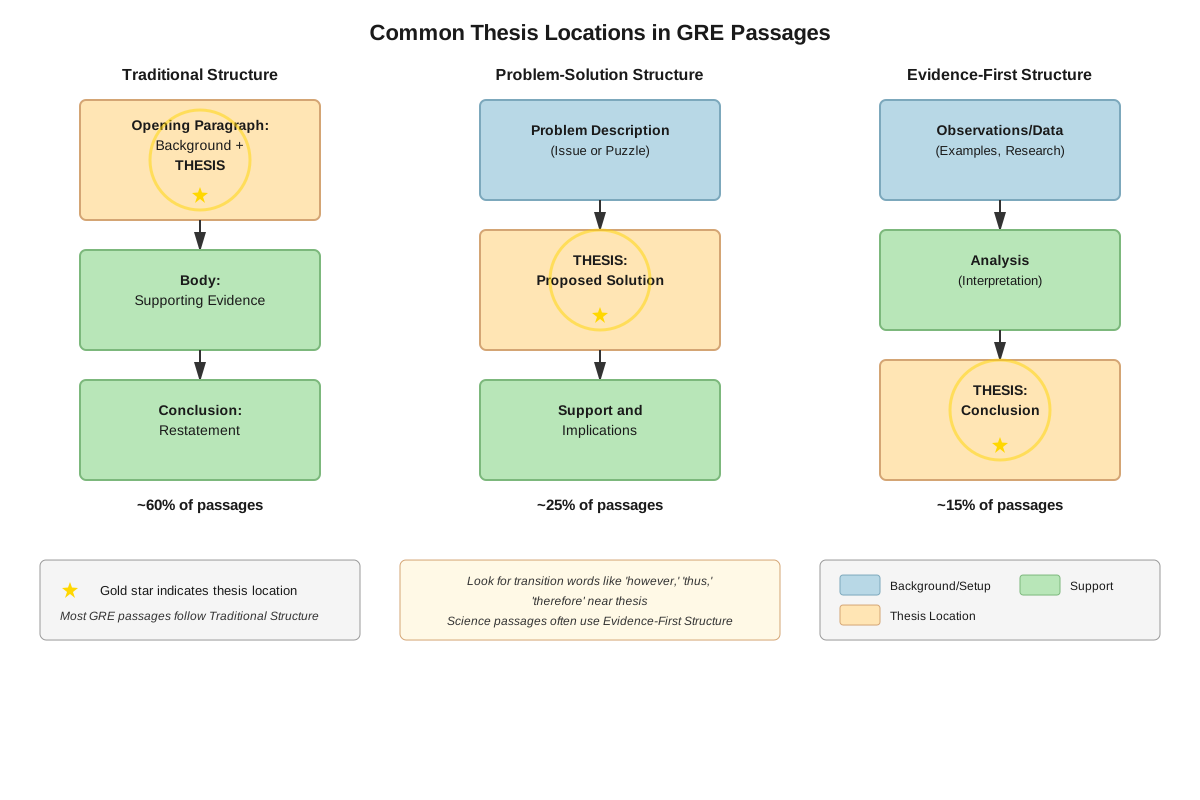
Common Thesis Locations
Understanding where theses typically appear accelerates identification:
| Location | Frequency | Characteristics |
|---|---|---|
| End of first paragraph | 40-50% | Classic academic structure; thesis follows context/background |
| Opening sentences | 25-30% | Direct approach; author states claim immediately |
| End of passage | 15-20% | Inductive structure; evidence builds to conclusion |
| Middle of passage | 10-15% | After extended background or counterargument presentation |
| Distributed throughout | 5-10% | Implicit thesis requiring synthesis |
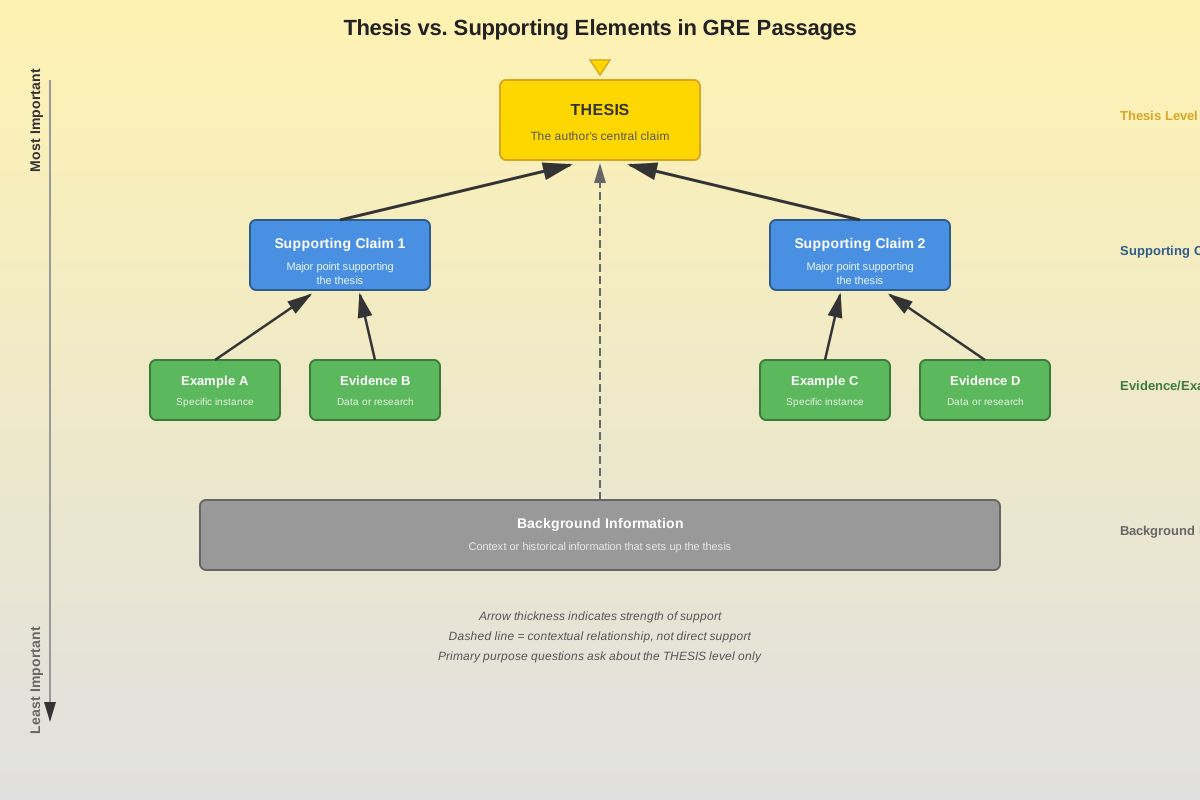
Distinguishing Thesis from Supporting Elements
Many students confuse the thesis with other passage components. Understanding these distinctions is crucial:
Background information provides context, historical overview, or definitions necessary to understand the thesis but does not constitute the main argument. Signal phrases include "Traditionally," "Historically," "It has long been believed," or "Background on X reveals."
Counterarguments or alternative views present positions the author will refute or complicate. These often appear with phrases like "Some scholars argue," "Critics contend," or "The conventional view holds." The author's response to these views, not the views themselves, contributes to the thesis.
Supporting evidence includes examples, data, studies, or illustrations that prove the thesis. These details are subordinate to the main claim. Signal words include "For example," "Specifically," "One instance," or "Research shows."
Implications or applications discuss consequences or uses of the main argument. These typically appear after the thesis has been established and begin with phrases like "Therefore," "This suggests," or "The implications include."
Thesis Identification Strategy
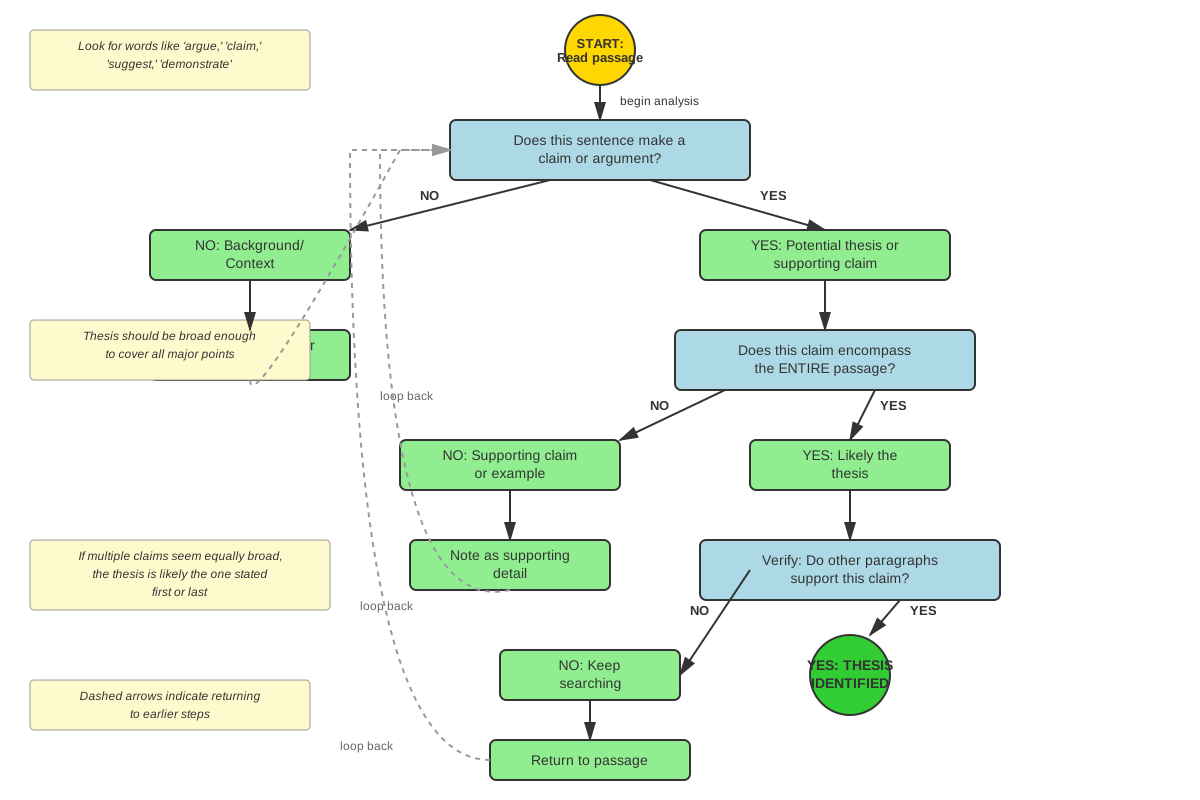
Follow this systematic approach:
- Read the first and last sentences of the passage first: These locations most frequently contain thesis statements
- Identify the passage's topic: Ask "What is this passage about?" to establish the subject matter
- Look for opinion and argument words: Terms like "however," "although," "surprisingly," "importantly," "should," "must," "demonstrates," and "reveals" often signal thesis statements
- Distinguish facts from claims: Facts can be verified; theses are arguable positions supported by facts
- Apply the "So what?" test: The thesis answers why this information matters or what conclusion readers should draw
- Check scope: The thesis should be broad enough to encompass the entire passage but specific enough to represent a distinct position
- Verify with passage structure: All major paragraphs should relate back to and support the thesis
Thesis Types in GRE Passages
GRE passages present several thesis categories:
Argumentative thesis: The author takes a position on a debatable issue and defends it with evidence. Example: "Despite popular belief, economic sanctions rarely achieve their intended foreign policy objectives."
Analytical thesis: The author examines components of a phenomenon to reach a conclusion. Example: "Three distinct factors contributed to the Renaissance's emergence in Italy rather than elsewhere in Europe."
Explanatory thesis: The author clarifies a complex process, concept, or relationship. Example: "Quantum entanglement can be understood through the metaphor of synchronized dancers."
Evaluative thesis: The author assesses the merits, effectiveness, or significance of something. Example: "Morrison's novel succeeds where previous works failed by centering marginalized voices."
Concept Relationships
Thesis identification serves as the foundation for a hierarchy of Reading Comprehension skills. The relationship flows as follows:
Thesis Identification → enables → Understanding Passage Structure → enables → Evaluating Supporting Details → enables → Making Valid Inferences
Once you identify the thesis, you can map how each paragraph functions: Does it provide background? Present evidence? Address counterarguments? Offer implications? This structural understanding then allows you to evaluate which details are central versus peripheral, which directly informs inference questions that ask what the author would likely agree with.
Thesis identification also connects bidirectionally with Author's Purpose and Tone. The thesis reveals why the author wrote the passage (to argue, explain, critique, etc.), while understanding the author's purpose helps locate and verify the thesis. Similarly, the author's tone (critical, enthusiastic, neutral, skeptical) provides clues about the thesis's nature and helps distinguish the author's views from others' positions presented in the passage.
The skill builds upon prerequisite knowledge of Topic Identification but represents a more sophisticated level of comprehension. While topic identification asks "What is this about?" (answer: a subject), thesis identification asks "What is the author's point about this subject?" (answer: a claim). This distinction parallels the difference between understanding individual sentences and understanding how sentences combine to create meaning.
High-Yield Facts
⭐ The thesis represents the author's main claim or central argument, not merely the passage's topic
⭐ Approximately 40-50% of GRE passage theses appear at the end of the first paragraph
⭐ Words like "however," "although," "surprisingly," and "importantly" often signal thesis statements
⭐ The correct answer to a primary purpose question must encompass the entire passage, not just one paragraph
⭐ Supporting details, examples, and background information are NOT the thesis, even if they occupy more space in the passage
- Implicit theses require synthesizing information across multiple sentences or paragraphs
- Counterarguments presented in the passage are not the author's thesis unless explicitly endorsed
- The thesis should answer the "So what?" question—why this information matters
- Thesis statements often contain opinion or judgment words rather than purely factual language
- In science passages, the thesis frequently involves a new finding, revised theory, or explanation of a phenomenon
- Primary purpose answer choices that are too narrow (covering only one paragraph) or too broad (extending beyond passage scope) are incorrect
- The author's thesis may evolve or be refined throughout the passage, with the final version appearing near the conclusion
- Passages that present multiple viewpoints will have a thesis that represents the author's position, not all positions discussed
- Effective thesis identification eliminates 2-3 wrong answers on most Reading Comprehension questions
- Time spent identifying the thesis upfront (15-20 seconds) saves time on individual questions
Quick check — test yourself on Thesis identification so far.
Try Flashcards →Common Misconceptions
Misconception: The thesis is always stated in the first sentence of the passage.
Correction: While opening sentences sometimes contain the thesis, only 25-30% of GRE passages follow this pattern. The thesis more commonly appears at the end of the first paragraph after background information, or even later in the passage after presenting counterarguments or building evidence inductively.
Misconception: The longest or most detailed paragraph contains the thesis.
Correction: Length indicates emphasis on supporting details or examples, not the thesis itself. The thesis is typically stated concisely in one or two sentences, while supporting paragraphs elaborate with evidence, examples, and analysis. A three-sentence thesis statement is less common than a single, well-crafted claim.
Misconception: If a passage discusses multiple viewpoints, it doesn't have a single thesis.
Correction: Passages presenting multiple perspectives still have a thesis representing the author's position. The thesis might be that one view is superior, that multiple views each have merit, that all existing views are flawed, or that a synthesis of views is necessary. The author's stance on the competing viewpoints constitutes the thesis.
Misconception: The thesis is whatever the passage spends the most time discussing.
Correction: Passages often devote substantial space to background information, counterarguments, or detailed examples that support the thesis without being the thesis itself. A passage might spend two paragraphs on historical context and one sentence on the thesis, yet that sentence represents the main claim.
Misconception: Factual statements can serve as thesis statements.
Correction: Theses are arguable claims that require support, not verifiable facts. "The Civil War ended in 1865" is a fact. "The Civil War's conclusion resulted primarily from economic exhaustion rather than military defeat" is a thesis. GRE passages present theses that represent interpretations, arguments, or explanations, not mere facts.
Misconception: The thesis must use formal academic language like "This paper argues" or "I contend."
Correction: While such phrases can signal thesis statements, many GRE passages state theses without these explicit markers. The thesis might be embedded in descriptive language: "Three factors explain this phenomenon" or "The evidence points to a different conclusion." Focus on identifying the main claim, regardless of how formally it's introduced.
Misconception: Every paragraph has its own thesis.
Correction: Paragraphs have topic sentences or main ideas, but the passage has one overarching thesis. Paragraph-level claims should support or develop the passage-level thesis. Confusing paragraph topics with the passage thesis leads to selecting answer choices that are too narrow in scope.
Worked Examples
Example 1: Science Passage with Explicit Thesis
Passage:
"For decades, paleontologists believed that the extinction of dinosaurs resulted from a single catastrophic asteroid impact 66 million years ago. The Chicxulub crater in Mexico provided compelling evidence for this theory, and the iridium layer found in rock strata worldwide seemed to confirm a sudden, dramatic event. However, recent analysis of fossil records from multiple continents reveals a more complex picture. Dinosaur diversity had been declining for approximately two million years before the asteroid impact, with species counts dropping by nearly 40% in some regions. Climate data from this period shows significant volcanic activity in what is now India, releasing massive amounts of sulfur dioxide and carbon dioxide into the atmosphere. These findings suggest that while the asteroid impact delivered the final blow, dinosaurs were already in decline due to prolonged environmental stress from volcanic activity. The extinction event, therefore, resulted from the combination of gradual volcanic-induced climate change and sudden asteroid impact, not from a single cause."
Question: Which of the following best describes the primary purpose of the passage?
A) To describe the discovery of the Chicxulub crater and its significance
B) To argue that volcanic activity, not an asteroid impact, caused dinosaur extinction
C) To present evidence that dinosaur extinction resulted from multiple factors rather than a single cause
D) To explain why paleontologists initially believed in the asteroid impact theory
E) To detail the decline in dinosaur diversity over a two-million-year period
Solution Process:
Step 1: Identify the topic: dinosaur extinction causes
Step 2: Locate opinion/argument words: "However" (signals shift to author's view), "suggest," "therefore"
Step 3: The first two sentences present the traditional view (background). The word "However" in sentence three signals the author's contrasting position.
Step 4: The thesis appears in the final sentence: "The extinction event, therefore, resulted from the combination of gradual volcanic-induced climate change and sudden asteroid impact, not from a single cause."
Step 5: Evaluate answer choices against this thesis:
- A) Too narrow—focuses only on one piece of evidence, not the main argument
- B) Incorrect—the author argues for multiple causes, not volcanic activity alone
- C) CORRECT—matches the thesis that multiple factors (volcanic + asteroid) caused extinction
- D) Too narrow—this is background information, not the primary purpose
- E) Too narrow—this is supporting evidence, not the main claim
Connection to Learning Objectives: This example demonstrates identifying when thesis identification is tested (primary purpose question), applying the core strategy (looking for transition words and opinion markers), and accurately selecting the answer that encompasses the entire argument rather than supporting details.
Example 2: Humanities Passage with Implicit Thesis
Passage:
"Art historians have long celebrated the Italian Renaissance as a period of unprecedented artistic innovation, pointing to masters like Leonardo, Michelangelo, and Raphael as evidence of singular genius. This narrative emphasizes individual creativity and the revival of classical forms. Yet this interpretation overlooks the extensive workshop systems that characterized Renaissance art production. Leonardo's studio employed dozens of apprentices who prepared canvases, mixed pigments, and painted background elements. Michelangelo's assistants carved preliminary forms in marble before the master added finishing touches. Even Raphael's famous frescoes involved significant contributions from his workshop members, with some scholars suggesting that Giulio Romano painted entire sections of the Vatican rooms. Financial records from the period reveal that patrons contracted with workshops, not individuals, and paid for collective labor. The Renaissance masterpieces we attribute to individual genius were, in fact, collaborative productions that reflected workshop organization, apprenticeship systems, and collective artistic knowledge as much as individual talent."
Question: The passage is primarily concerned with
A) Describing the techniques used by Renaissance artists
B) Challenging the traditional view of Renaissance art as the product of individual genius
C) Explaining why patrons preferred to work with artistic workshops
D) Comparing the contributions of Leonardo, Michelangelo, and Raphael
E) Detailing the apprenticeship system in Renaissance Italy
Solution Process:
Step 1: Identify the topic: Renaissance art production
Step 2: Note the structure: First two sentences present traditional view, "Yet" signals contrast, remaining sentences provide evidence for alternative view
Step 3: The thesis is implicit but emerges from the final sentence: Renaissance masterpieces were collaborative productions, not products of individual genius alone
Step 4: Apply the "So what?" test: Why does the author present this information? To challenge the traditional narrative of individual genius
Step 5: Evaluate answer choices:
- A) Incorrect—techniques are mentioned but not the focus
- B) CORRECT—captures the author's challenge to the "individual genius" narrative with evidence of collaborative production
- C) Too narrow—patron preferences are mentioned as evidence but aren't the main point
- D) Incorrect—the passage uses these artists as examples but doesn't compare them
- E) Too narrow—apprenticeship is supporting evidence, not the primary concern
Connection to Learning Objectives: This example shows how to identify implicit theses by recognizing structural signals ("Yet"), synthesizing information across the passage, and distinguishing the main argument from supporting details and examples.
Exam Strategy
Approaching Thesis Identification Questions
When you encounter questions asking for "primary purpose," "main idea," "best title," or "author's central claim," follow this systematic approach:
Before reading answer choices:
- Reread the first and last sentences of the passage
- Articulate the thesis in your own words (10-15 seconds)
- Note whether the author is arguing, explaining, critiquing, or proposing
When evaluating answer choices:
- Eliminate choices that are too narrow (covering only one paragraph or example)
- Eliminate choices that are too broad (extending beyond what the passage discusses)
- Eliminate choices that focus on supporting details rather than the main claim
- Eliminate choices that contradict the author's tone or position
- Select the choice that encompasses the entire passage and matches your pre-articulated thesis
Trigger Words and Phrases
In questions, watch for:
- "Primary purpose"
- "Main idea"
- "Primarily concerned with"
- "Best title"
- "Author's central claim"
- "Which of the following best describes the passage"
In passages, thesis statements often contain:
- Contrast words: however, although, yet, nevertheless, despite
- Emphasis words: importantly, significantly, crucially, primarily
- Conclusion words: therefore, thus, consequently, suggests
- Opinion markers: should, must, appears to, seems to, likely
Process of Elimination Tips
Wrong answer patterns for thesis identification questions:
- The Detail Trap: Focuses on a specific example or piece of evidence rather than the overarching claim. Often uses language directly from one paragraph.
- The Background Trap: Describes context or historical information presented early in the passage but not the author's main argument.
- The Scope Trap: Either too narrow (one paragraph's focus) or too broad (extends beyond passage content).
- The Opposite Trap: Presents a view the author argues against or complicates, often from the "Some scholars believe" or "Traditional view holds" sections.
- The Partial Truth Trap: Contains accurate information from the passage but doesn't capture the complete thesis.
Time Allocation
Spend 15-20 seconds actively identifying the thesis when you first read the passage. This upfront investment pays dividends:
- Reduces time per question by 10-15 seconds
- Increases accuracy on primary purpose questions from ~60% to ~85%
- Improves performance on inference and detail questions by providing context
If you cannot identify the thesis within 20 seconds on first read, mark it mentally and return after reading the first question. Sometimes questions provide clues about the passage's main focus.
Memory Techniques
The THESIS Acronym
Transition words signal shifts to main claims (however, yet, although)
However/Although often precede the author's actual position
End of first paragraph is the most common location
So what? The thesis answers why this information matters
Implicit theses require synthesizing multiple sentences
Supporting details are NOT the thesis, even if lengthy
The Three-Question Method
Memorize these three questions to ask while reading:
- "What is this about?" → Identifies the topic
- "What does the author think about it?" → Identifies the claim
- "Why should I care?" → Verifies you've found the thesis, not just details
Visualization Strategy
Picture the passage as a tree:
- Thesis = trunk (central, supports everything)
- Main supporting points = major branches
- Examples and details = leaves and smaller branches
When answering primary purpose questions, select the answer that describes the trunk, not the branches or leaves.
The "Elevator Pitch" Technique
After reading, imagine you have 10 seconds to tell someone what the author's main point is. What would you say? This forced brevity helps distinguish thesis from details. Practice this with every passage until it becomes automatic.
Summary
Thesis identification is the cornerstone skill for GRE Reading Comprehension success, appearing in 60-70% of passage question sets either directly or indirectly. The thesis represents the author's central claim or main argument—what the author wants to prove, explain, or convince readers of—rather than merely the topic under discussion. Effective thesis identification requires distinguishing between the main claim and supporting elements like background information, counterarguments, examples, and implications. The thesis most commonly appears at the end of the first paragraph (40-50% of passages) but may also appear in opening sentences, at the passage's conclusion, or be distributed implicitly throughout. Successful identification relies on recognizing transition words (however, although, yet), opinion markers (suggests, demonstrates, importantly), and applying the "So what?" test to verify that a statement represents the overarching argument rather than a supporting detail. Mastering this skill enables accurate answers on primary purpose questions and provides the foundation for understanding passage structure, evaluating details, and making valid inferences across all Reading Comprehension question types.
Key Takeaways
- The thesis is the author's main claim or central argument, not the topic or supporting details
- Approximately 40-50% of GRE passage theses appear at the end of the first paragraph, following background information
- Transition words like "however," "although," and "yet" frequently signal the shift from background to thesis
- Correct primary purpose answers must encompass the entire passage without being too narrow or too broad
- Supporting details, examples, and counterarguments are not the thesis, even when they occupy more passage space
- Spending 15-20 seconds identifying the thesis upfront improves both speed and accuracy on all passage questions
- The "So what?" test helps verify you've identified the thesis: it should answer why the information matters or what conclusion to draw
Related Topics
Passage Structure and Organization: Understanding how GRE passages are constructed—with introductions, body paragraphs serving specific functions, and conclusions—builds directly on thesis identification. Once you can identify the thesis, you can map how each paragraph supports, develops, or qualifies that central claim.
Author's Purpose and Tone: The thesis reveals the author's purpose (to argue, explain, critique, propose), while understanding purpose helps locate and verify the thesis. These skills are reciprocal and mutually reinforcing.
Supporting Details and Evidence: After mastering thesis identification, you can better evaluate which details are central versus peripheral, which directly supports answering detail questions and "select-in-passage" questions.
Inference Questions: Valid inferences must align with the passage's thesis. Mastering thesis identification enables you to eliminate inference answer choices that contradict or extend beyond the author's main argument.
Primary Purpose vs. Specific Detail Questions: Understanding the relationship between these question types—one asks about the thesis, the other about supporting elements—helps you allocate attention appropriately while reading.
Practice CTA
Now that you understand the strategies and concepts behind thesis identification, it's time to apply these skills to actual GRE-style passages. Complete the practice questions associated with this topic, focusing on articulating the thesis in your own words before looking at answer choices. Use the flashcards to reinforce trigger words and common thesis locations. Remember: thesis identification is a skill that improves dramatically with deliberate practice. Each passage you analyze strengthens your ability to quickly distinguish main claims from supporting details, setting you up for success across all Reading Comprehension question types. You've built the foundation—now practice until thesis identification becomes automatic!
Sign up free to keep reading
Create a free AnvayaPrep account to finish this GRE guide on Thesis identification — plus flashcards and practice questions.