Overview
Paragraph role questions represent a sophisticated category of Reading Comprehension items on the GRE that test a student's ability to understand how individual paragraphs function within the broader architecture of a passage. Rather than asking about specific details or the author's overall purpose, these questions require test-takers to identify the structural function that a particular paragraph serves—whether it introduces a theory, provides supporting evidence, presents a counterargument, or transitions between ideas. Mastering GRE paragraph role questions is essential because they appear with high frequency on the exam and demand a meta-level understanding of passage organization that goes beyond surface-level comprehension.
These questions challenge students to think like architects examining a building's blueprint rather than tourists admiring its facade. Each paragraph in a GRE passage serves a specific structural purpose, and recognizing these purposes allows test-takers to navigate complex academic prose more efficiently. The ability to identify paragraph roles enhances overall reading comprehension, improves passage mapping skills, and directly supports performance on other question types, including primary purpose and passage structure questions.
Within the broader context of Verbal Reasoning, paragraph role questions bridge the gap between detail-oriented comprehension and holistic passage analysis. They require students to synthesize information about both the content of a paragraph and its relationship to surrounding paragraphs, making them an excellent diagnostic tool for assessing true reading comprehension mastery. Success on these questions correlates strongly with overall Verbal Reasoning performance, as they test the analytical skills that underpin all advanced reading tasks.
Learning Objectives
- [ ] Identify when Paragraph role is being tested
- [ ] Explain the core rule or strategy behind Paragraph role
- [ ] Apply Paragraph role to GRE-style questions accurately
- [ ] Distinguish between content-based and function-based answer choices
- [ ] Map the structural organization of multi-paragraph passages efficiently
- [ ] Recognize the six most common paragraph functions that appear on the GRE
- [ ] Eliminate incorrect answer choices by identifying scope and function mismatches
Prerequisites
- Basic passage comprehension skills: Understanding main ideas and supporting details provides the foundation for recognizing how paragraphs support those ideas structurally.
- Familiarity with argument structure: Recognizing claims, evidence, and counterarguments helps identify when paragraphs serve these specific functions.
- Vocabulary for discussing text structure: Terms like "contrast," "support," "introduce," and "qualify" are essential for understanding both questions and answer choices.
- Ability to identify topic sentences and transitions: These textual markers often signal a paragraph's structural role within the passage.
Why This Topic Matters
Paragraph role questions appear in approximately 15-20% of all Reading Comprehension questions on the GRE, making them one of the most frequently tested question types. Unlike detail questions that can sometimes be answered through targeted scanning, paragraph role questions require holistic passage understanding, making them both challenging and high-value for score differentiation. Students who master this question type gain a significant competitive advantage, as these questions often separate mid-range scorers from those achieving top percentile results.
In real-world applications, the ability to identify paragraph roles translates directly to graduate-level academic success. Graduate students must constantly analyze how scholars structure arguments in journal articles, how researchers present findings in studies, and how theorists build complex multi-part arguments. The analytical skills developed through paragraph role practice—recognizing when an author is introducing background information versus presenting original research, or distinguishing between primary arguments and qualifying statements—are fundamental to academic literacy at the graduate level.
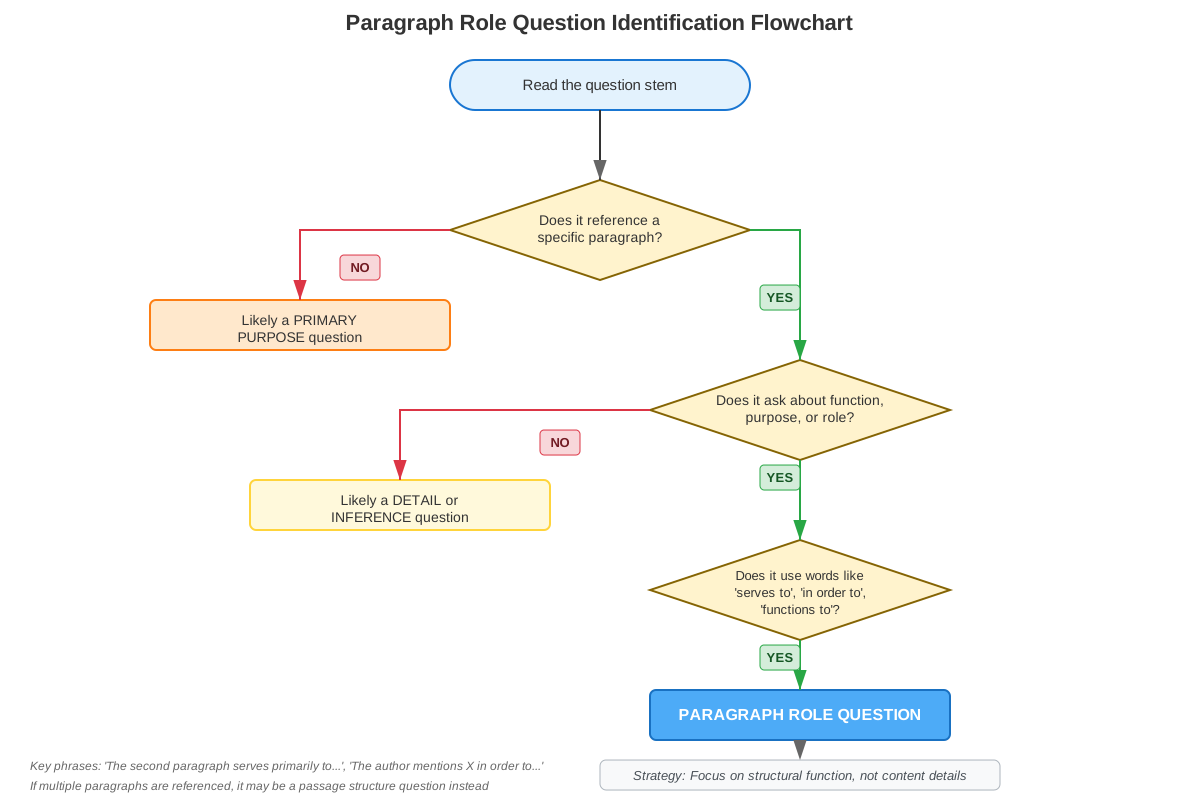
On the GRE, paragraph role questions typically appear with passages of medium to long length (3-5 paragraphs) and often target the second, third, or fourth paragraphs rather than opening or closing paragraphs. Common question stems include: "The primary purpose of the second paragraph is to...", "The author mentions [topic] in the third paragraph in order to...", and "Which of the following best describes the function of the highlighted sentence?" These questions reward students who actively map passage structure while reading rather than those who passively absorb content.
Core Concepts
Understanding Paragraph Role vs. Paragraph Content
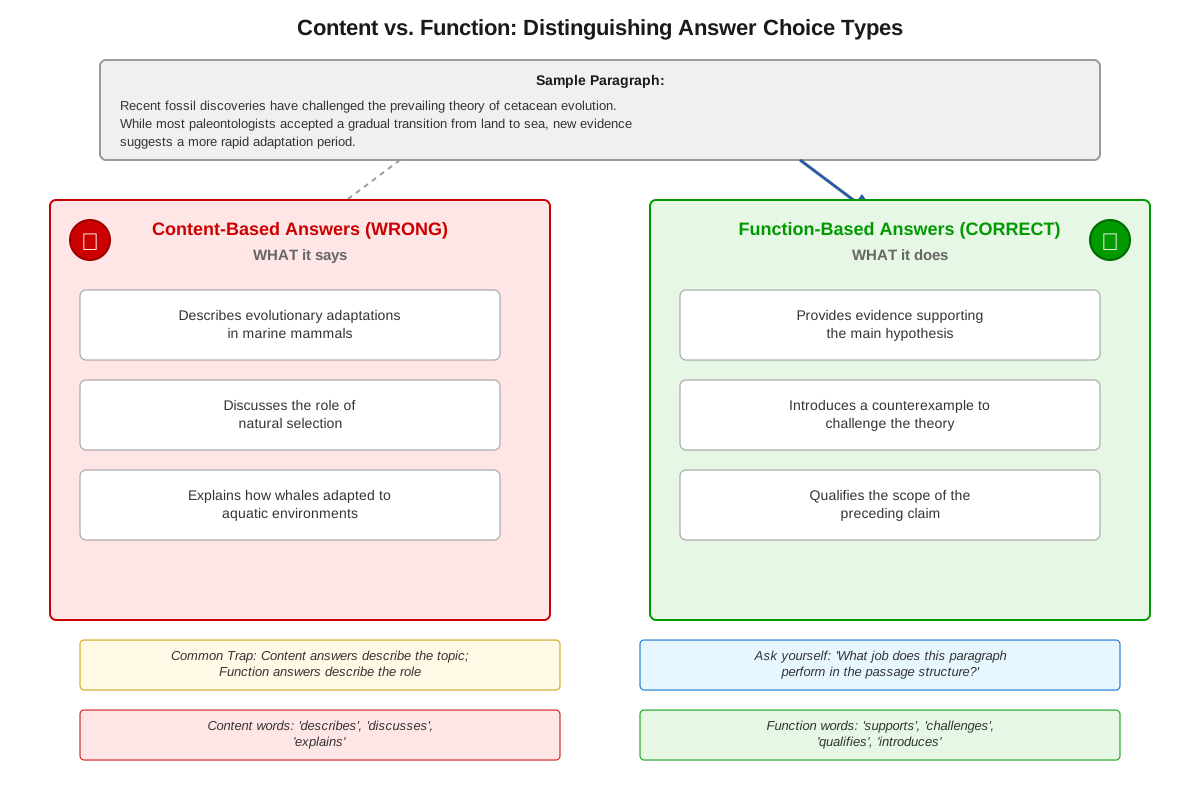
The fundamental distinction in paragraph role questions lies between what a paragraph says (content) and why the author included it (function). Content refers to the specific information, examples, or arguments presented—the facts, data, theories, or descriptions that fill the paragraph. Function, by contrast, refers to the structural purpose the paragraph serves in advancing the author's overall argument or exposition. A paragraph might contain information about "the economic factors contributing to urbanization in 19th-century England" (content), but its function might be "to provide historical context for a contemporary theory" or "to present evidence supporting the author's main claim."
GRE test-makers deliberately craft incorrect answer choices that accurately describe paragraph content but misidentify paragraph function. Students who focus exclusively on what information appears in a paragraph, rather than why that information appears, consistently fall for these traps. The key to success lies in asking: "What job does this paragraph perform in the passage's overall structure?"
The Six Primary Paragraph Functions
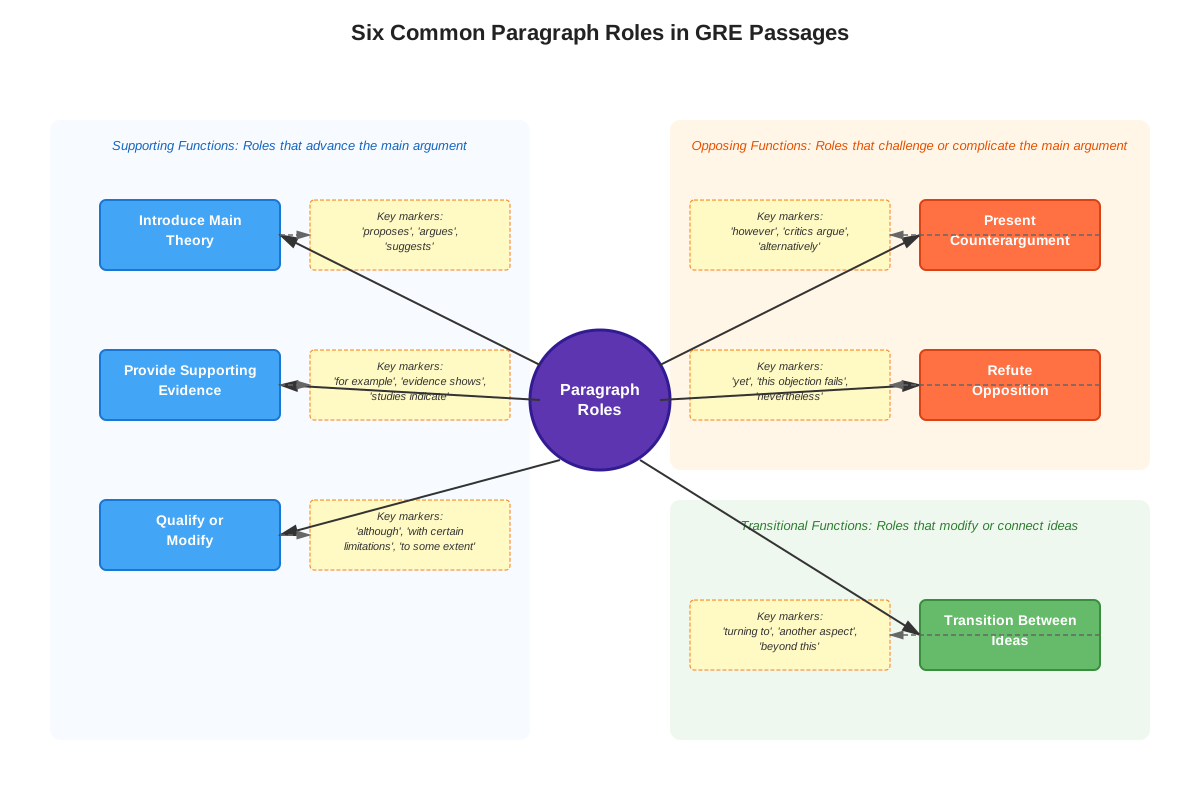
Through analysis of official GRE materials, six paragraph functions emerge as the most commonly tested:
1. Introduction/Background: These paragraphs establish context, define terms, present historical background, or introduce a topic that will be discussed in greater depth. They typically appear early in passages and set the stage for the author's main argument or analysis. Signal phrases include "traditionally," "historically," "it has long been thought," and "background on this issue includes."
2. Presentation of Main Argument/Thesis: These paragraphs articulate the author's primary claim, central thesis, or main point. They often appear in the first or second paragraph and contain the passage's most important assertion. Look for definitive language, strong claims, and statements that other paragraphs seem to support or develop.
3. Supporting Evidence/Examples: These paragraphs provide data, examples, case studies, or other evidence that supports claims made elsewhere in the passage. They serve a subordinate function, bolstering rather than introducing new major claims. Transition words like "for example," "specifically," "evidence for this includes," and "this is illustrated by" signal this function.
4. Counterargument/Alternative View: These paragraphs present opposing viewpoints, alternative theories, or potential objections to the author's position. They often begin with transitions like "however," "critics argue," "an alternative explanation," or "some scholars contend." Crucially, these paragraphs present views the author will typically challenge or qualify, not endorse.
5. Rebuttal/Response: These paragraphs respond to counterarguments, address objections, or explain why alternative views are inadequate. They often follow counterargument paragraphs and include phrases like "however," "yet," "this view overlooks," or "a closer examination reveals."
6. Qualification/Limitation: These paragraphs acknowledge limitations of the author's argument, specify conditions under which claims hold true, or add nuance to earlier assertions. They often include words like "although," "while," "it should be noted," or "this applies primarily to."
Structural Markers and Transition Analysis
Effective paragraph role identification depends heavily on recognizing structural markers—words and phrases that signal relationships between ideas and indicate paragraph function. These markers appear most frequently at paragraph beginnings and endings, serving as signposts for the reader.
| Marker Type | Common Words/Phrases | Typical Function Indicated |
|---|---|---|
| Contrast | However, Nevertheless, Yet, Despite, Although | Counterargument or qualification |
| Addition | Moreover, Furthermore, Additionally, Also | Supporting evidence or extension |
| Causation | Therefore, Thus, Consequently, As a result | Conclusion or logical consequence |
| Exemplification | For example, For instance, Specifically, Such as | Supporting evidence or illustration |
| Temporal | Previously, Traditionally, Recently, Currently | Background or context-setting |
| Concession | Admittedly, While it is true, Granted | Qualification or acknowledgment |
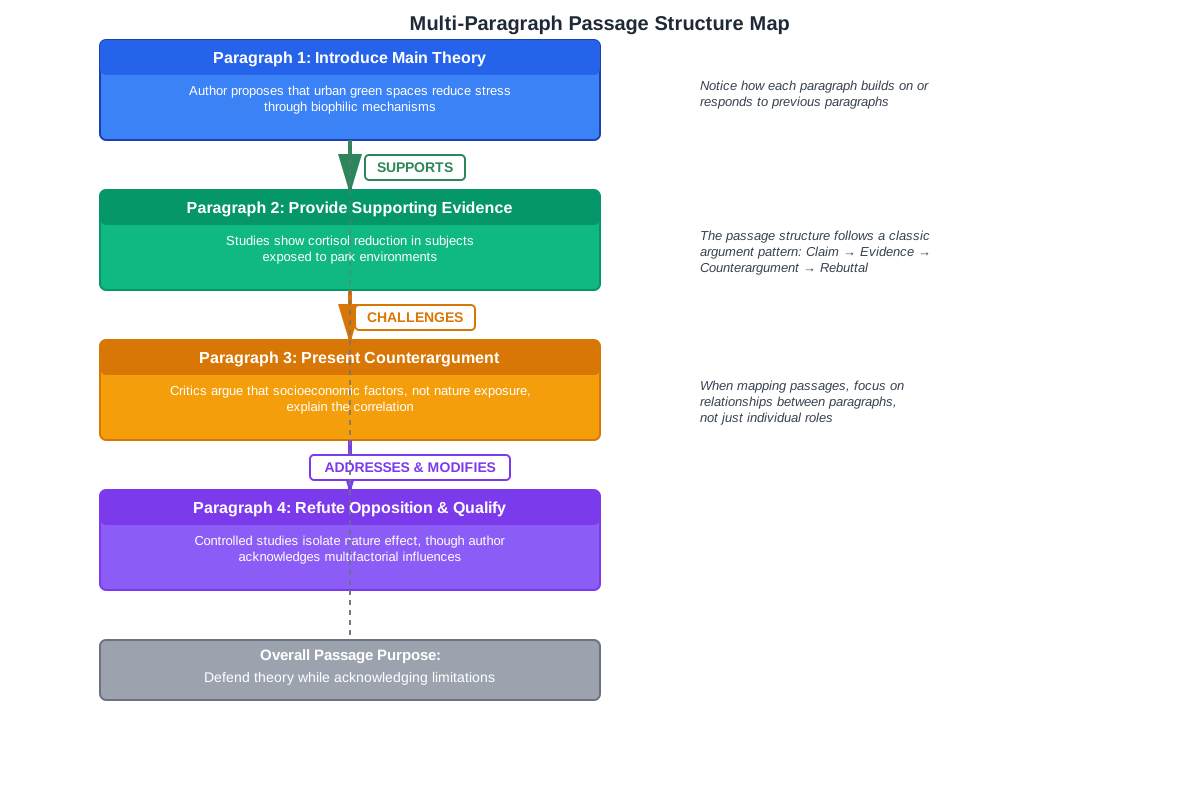
Beyond individual transition words, the relationship between consecutive paragraphs provides crucial context. A paragraph that begins with "This view, however, overlooks..." is almost certainly presenting a rebuttal to the previous paragraph's content. A paragraph starting with "This phenomenon can be observed in..." likely provides supporting examples for a claim made earlier.
The Content-Function Trap
The most sophisticated trap in paragraph role questions involves answer choices that accurately describe paragraph content while mischaracterizing paragraph function. Consider a paragraph that describes three studies showing positive effects of a particular medication. An incorrect answer might state: "to describe research on medication effectiveness"—which accurately captures the content. The correct answer might state: "to provide evidence supporting the author's claim that the medication shows promise"—which captures both content and function.
The distinction lies in recognizing that the paragraph's purpose isn't merely to describe research (a neutral, informational function) but to support a specific argument (a persuasive, structural function). Students must train themselves to ask: "Is this paragraph just presenting information, or is it using that information to accomplish a specific argumentative goal?"
Scope Matching in Answer Choices
Correct answers to paragraph role questions must match the scope of the paragraph in question—neither too broad nor too narrow. An answer that describes the function of the entire passage is too broad for a single-paragraph question. An answer that describes only one sentence or example within the paragraph is too narrow. The correct answer captures the primary function of the complete paragraph without extending beyond it.
For example, if a three-paragraph passage discusses a scientific theory, and the second paragraph presents two experiments supporting that theory, the correct answer for "What is the function of the second paragraph?" should reference supporting the theory (connecting to the broader passage) while specifically mentioning evidence or experiments (capturing the paragraph's specific content). An answer stating "to present the author's main thesis" would be too broad (that's the first paragraph's job), while "to describe the methodology of the first experiment" would be too narrow (that's only part of the paragraph).
Concept Relationships
The concepts within paragraph role analysis form an interconnected system where each element reinforces the others. Structural markers serve as the primary textual evidence for identifying paragraph functions, while understanding content-function distinction prevents misidentification of those functions. The relationship flows as follows:
Structural Markers → Paragraph Functions → Content-Function Analysis → Scope Matching → Correct Answer Selection
Structural markers provide initial clues about function, which must then be verified against the paragraph's actual role in the passage. This verification requires distinguishing content from function, ensuring the identified function matches the paragraph's scope, and finally selecting an answer that accurately captures that function.
Paragraph role analysis also connects deeply to prerequisite knowledge of argument structure. Recognizing counterarguments depends on understanding what constitutes an opposing view; identifying supporting evidence requires knowing what counts as evidence versus mere description. These connections mean that weakness in argument analysis will manifest as difficulty with paragraph role questions.
Furthermore, paragraph role mastery enhances performance on related question types. Students who can identify paragraph functions can more easily answer primary purpose questions (which ask about the function of the entire passage), passage structure questions (which ask about the relationship between multiple paragraphs), and even some inference questions (which often require understanding why the author included specific information).
High-Yield Facts
⭐ Paragraph role questions ask about function (why the paragraph is there), not content (what information it contains).
⭐ The most common incorrect answers accurately describe paragraph content but misidentify paragraph function.
⭐ Transition words at paragraph beginnings are the strongest clues to paragraph function.
⭐ Counterargument paragraphs present views the author typically disagrees with or qualifies, not endorses.
⭐ Supporting evidence paragraphs serve a subordinate function—they bolster claims made elsewhere rather than introducing new primary claims.
- Paragraph role questions appear in approximately 15-20% of all Reading Comprehension questions on the GRE.
- The six most common paragraph functions are: introduction/background, main argument, supporting evidence, counterargument, rebuttal, and qualification.
- Correct answers must match the scope of the specific paragraph—neither too broad (describing the whole passage) nor too narrow (describing only one sentence).
- Paragraphs that begin with "However," "Nevertheless," or "Yet" typically present counterarguments or rebuttals.
- The second and third paragraphs of multi-paragraph passages are most frequently targeted by paragraph role questions.
- Effective paragraph role analysis requires reading the entire passage, not just the paragraph in question, to understand structural relationships.
- Answer choices using vague language like "discuss" or "describe" are often incorrect because they fail to capture specific structural functions.
- Paragraphs serving qualification functions often include words like "although," "while," or "it should be noted."
- The relationship between consecutive paragraphs provides essential context for identifying individual paragraph functions.
- Students who actively map passage structure while reading answer paragraph role questions 30-40% faster than those who must re-read after seeing the question.
Quick check — test yourself on Paragraph role so far.
Try Flashcards →Common Misconceptions
Misconception: Paragraph role questions can be answered by reading only the paragraph mentioned in the question. → Correction: Understanding a paragraph's function requires knowing how it relates to the passage's overall structure and surrounding paragraphs. The second paragraph's function as "providing supporting evidence" only makes sense if you know what claim from the first paragraph it supports.
Misconception: If an answer choice accurately describes information in the paragraph, it must be correct. → Correction: Many incorrect answers accurately describe paragraph content while misidentifying paragraph function. An answer stating "describes economic factors" might be factually accurate but wrong if the paragraph's function is "provides evidence against a theory" using those economic factors.
Misconception: Counterargument paragraphs present views the author agrees with. → Correction: Counterargument paragraphs typically present opposing views or alternative theories that the author will challenge, qualify, or explain as inadequate. The author includes these views to address them, not to endorse them.
Misconception: The longest paragraph in a passage must contain the main argument. → Correction: Paragraph length doesn't determine function. Supporting evidence paragraphs are often longer than thesis paragraphs because they contain multiple examples or detailed data, while the main argument might be stated concisely.
Misconception: Transition words like "however" always indicate counterarguments. → Correction: While "however" often signals contrast, context determines whether that contrast introduces a counterargument (opposing view), a rebuttal (response to an opposing view), or a qualification (limitation of the author's own claim). The relationship to surrounding content is crucial.
Misconception: Background/introduction paragraphs only appear at the beginning of passages. → Correction: While introductory material typically appears early, authors sometimes introduce new subtopics or provide background information in later paragraphs when shifting to a new aspect of their argument.
Misconception: If a paragraph contains the author's opinion, it must be presenting the main argument. → Correction: Authors express opinions throughout passages—in rebuttals, qualifications, and even when introducing topics. The main argument paragraph specifically presents the central thesis, not just any authorial opinion.
Worked Examples
Example 1: Three-Paragraph Science Passage
Passage Structure:
Paragraph 1: Introduces the traditional view that coral reefs form only in shallow, warm waters with specific salinity levels. Notes that this view has been widely accepted for decades.
Paragraph 2: Describes recent discoveries of coral formations in deep, cold waters off the coast of Norway. Provides specific details about depth, temperature, and the species involved.
Paragraph 3: Argues that these discoveries require scientists to revise their understanding of coral reef formation and suggests that temperature tolerance may be more variable than previously thought.
Question: The primary purpose of the second paragraph is to:
(A) Challenge the traditional understanding of coral reef formation
(B) Provide evidence that contradicts long-held assumptions about coral habitats
(C) Describe the methodology used in recent coral reef research
(D) Explain why coral reefs form in cold water environments
(E) Introduce the main argument of the passage
Analysis:
First, identify what the second paragraph contains (content): descriptions of coral discoveries in deep, cold waters with specific details about location and conditions.
Next, determine why the author included this paragraph (function): These discoveries serve as evidence that contradicts the traditional view presented in Paragraph 1. The paragraph doesn't argue or explain (that's Paragraph 3's job)—it presents factual findings.
Now evaluate each answer:
(A) "Challenge the traditional understanding" - This describes what the discoveries themselves do, but the paragraph's function is to present those discoveries, not to challenge anything directly. The challenging happens in Paragraph 3. Too strong/wrong function.
(B) "Provide evidence that contradicts long-held assumptions" - This accurately captures both content (evidence = the discoveries) and function (contradicts = relates to the traditional view in Paragraph 1, sets up the argument in Paragraph 3). Correct.
(C) "Describe the methodology" - The paragraph mentions discoveries but doesn't detail research methods. Content mismatch.
(D) "Explain why coral reefs form in cold water" - The paragraph describes that they form there but doesn't explain why. Explanation appears in Paragraph 3. Wrong function.
(E) "Introduce the main argument" - The main argument appears in Paragraph 3. This paragraph provides evidence for that argument. Too broad.
Answer: B
Key Lesson: The second paragraph serves a supporting function (providing evidence) rather than an argumentative function (making claims). It bridges the traditional view (Paragraph 1) and the new interpretation (Paragraph 3).
Example 2: Four-Paragraph Humanities Passage
Passage Structure:
Paragraph 1: Presents the author's thesis that 19th-century British novels reflected anxieties about industrialization more than previously recognized.
Paragraph 2: Analyzes three novels by Charles Dickens, showing how industrial imagery appears in descriptions of urban settings and character relationships.
Paragraph 3: Acknowledges that some literary scholars argue these industrial references are merely incidental details reflecting the time period rather than deliberate thematic choices.
Paragraph 4: Responds by pointing out that the industrial imagery appears at structurally significant moments in the novels and is associated with negative character outcomes, suggesting deliberate artistic choice.
Question: The third paragraph serves primarily to:
(A) Provide additional evidence supporting the author's interpretation
(B) Present an alternative scholarly perspective on industrial imagery in Victorian novels
(C) Explain why some scholars have overlooked industrial themes in 19th-century literature
(D) Qualify the author's argument by acknowledging its limitations
(E) Introduce a new aspect of the author's thesis
Analysis:
Content: The paragraph describes what "some literary scholars argue"—specifically, that industrial references are incidental rather than thematic.
Function: This presents a view that opposes the author's thesis from Paragraph 1. The author doesn't endorse this view (Paragraph 4 argues against it), but includes it to address potential objections.
Evaluate answers:
(A) "Additional evidence supporting" - The paragraph presents an opposing view, not supporting evidence. Wrong function.
(B) "Present an alternative scholarly perspective" - This accurately describes both content (what other scholars think) and function (presenting an opposing interpretation that the author will address). Correct.
(C) "Explain why some scholars have overlooked" - The paragraph states what scholars believe, not why they believe it or what they've overlooked. Content mismatch.
(D) "Qualify the author's argument by acknowledging its limitations" - Qualification means the author adds nuance to their own argument. Here, the author presents others' objections, not limitations they accept. Wrong function.
(E) "Introduce a new aspect of the author's thesis" - This presents opposition to the thesis, not a new aspect of it. Wrong function.
Answer: B
Key Lesson: Counterargument paragraphs present views the author will address or rebut. The function is to acknowledge alternative perspectives, not to support the author's position. The relationship to Paragraph 4 (which rebuts this view) confirms the counterargument function.
Exam Strategy
When approaching paragraph role questions on the GRE, implement this systematic process:
Step 1: Identify the Question Type - Recognize paragraph role questions through stems like "The primary purpose of the [X] paragraph is to...", "The author mentions [topic] in paragraph [X] in order to...", or "Which of the following best describes the function of the highlighted portion?"
Step 2: Review Your Passage Map - Before looking at answer choices, consult the structural notes you made while reading. What function did you identify for this paragraph? How does it relate to surrounding paragraphs?
Step 3: Articulate Function in Your Own Words - Mentally state the paragraph's function: "This paragraph provides examples supporting the claim from paragraph 1" or "This paragraph presents a counterargument that the author will challenge."
Step 4: Eliminate Content-Only Answers - Cross out any answer choice that merely describes what information appears in the paragraph without indicating why that information is there or what structural purpose it serves.
Step 5: Check Scope - Eliminate answers that are too broad (describing the whole passage's purpose) or too narrow (describing only one sentence or example).
Step 6: Verify Relationships - Ensure the remaining answer accurately describes how the paragraph relates to surrounding paragraphs and the passage's overall structure.
Exam Tip: Trigger phrases in answer choices can help identify correct answers. Look for functional language like "provide evidence for," "present an objection to," "qualify the claim that," "introduce the context for," rather than purely descriptive language like "discuss," "describe," or "mention."
Time Allocation: Spend 30-45 seconds on paragraph role questions. If you've mapped the passage effectively during your initial reading, these questions should be among the fastest to answer. If you find yourself re-reading extensively, your passage mapping strategy needs improvement.
Process of Elimination Priorities:
- First, eliminate answers that describe content without indicating function
- Second, eliminate answers with scope problems (too broad or too narrow)
- Third, eliminate answers that misidentify the paragraph's relationship to surrounding content
- Finally, choose between remaining answers by checking which better captures the specific structural role
Common Trap Patterns to Avoid:
- Answers that use the word "describe" or "discuss" without specifying what structural purpose that description serves
- Answers that accurately quote or paraphrase paragraph content but don't explain the paragraph's function
- Answers that confuse counterarguments (opposing views) with rebuttals (responses to opposing views)
- Answers that attribute the main argument function to supporting paragraphs
Memory Techniques
The SPICE Mnemonic for the six primary paragraph functions:
- Supporting evidence
- Presentation of main argument
- Introduction/background
- Counterargument
- Explanation/rebuttal (responds to counterarguments)
- (Plus Qualification as a bonus sixth function)
The "Why Not What" Mantra: When approaching paragraph role questions, repeat "Why not what" to remind yourself to focus on function rather than content. Ask "Why did the author include this?" not "What does this paragraph say?"
The Traffic Light Visualization:
- Green paragraphs = Go forward with the author's argument (thesis, supporting evidence, rebuttals)
- Yellow paragraphs = Caution/qualification (limitations, conditions, nuances)
- Red paragraphs = Stop/opposing view (counterarguments, alternative theories)
This helps you quickly categorize paragraphs while reading and remember their structural relationships.
The Building Blocks Analogy: Visualize passages as buildings where:
- Foundation = Introduction/background (sets up everything else)
- Main structure = Thesis/main argument (the building's purpose)
- Support beams = Supporting evidence (holds up the main structure)
- Inspection reports = Counterarguments (potential problems to address)
- Repairs = Rebuttals (fixing the problems identified)
- Warning signs = Qualifications (limitations on the building's use)
Transition Word Categories: Remember CHEAT for the most important transition word categories:
- Contrast (however, nevertheless, yet)
- Help/support (moreover, furthermore, additionally)
- Example (for instance, specifically, such as)
- Admit/concede (admittedly, granted, while it is true)
- Therefore/conclude (thus, consequently, as a result)
Summary
Paragraph role questions test the ability to identify the structural function that individual paragraphs serve within GRE Reading Comprehension passages. Success requires distinguishing between paragraph content (what information appears) and paragraph function (why the author included it). The six most common paragraph functions—introduction/background, presentation of main argument, supporting evidence, counterargument, rebuttal, and qualification—account for the vast majority of correct answers. Effective strategy involves mapping passage structure during initial reading, recognizing structural markers (especially transition words), eliminating answer choices that describe content without indicating function, and ensuring scope matches the specific paragraph in question. The most sophisticated trap involves answer choices that accurately describe paragraph content while misidentifying structural function. Students must train themselves to ask "Why did the author include this paragraph?" rather than "What does this paragraph say?" Mastery of paragraph role analysis enhances performance across all Reading Comprehension question types by developing meta-level awareness of passage organization and authorial intent.
Key Takeaways
- Paragraph role questions ask about structural function (why the paragraph exists) rather than informational content (what the paragraph says)
- The six primary paragraph functions are: introduction/background, main argument, supporting evidence, counterargument, rebuttal, and qualification
- Transition words at paragraph beginnings provide the strongest clues to paragraph function
- The most common incorrect answers accurately describe content but misidentify function—always ask "Why did the author include this?"
- Correct answers must match paragraph scope: neither too broad (whole passage) nor too narrow (single sentence)
- Counterargument paragraphs present opposing views the author will typically challenge, not endorse
- Effective passage mapping during initial reading makes paragraph role questions among the fastest to answer
Related Topics
Primary Purpose Questions: These ask about the function of the entire passage rather than individual paragraphs. Mastering paragraph role analysis provides the foundation for identifying overall passage purpose, as the passage's primary purpose typically aligns with the function of the paragraph containing the main argument.
Passage Structure Questions: These questions ask about relationships between multiple paragraphs or the overall organization of the passage. Understanding individual paragraph functions is essential for recognizing how those functions combine to create passage structure.
Author's Tone and Attitude: Identifying whether a paragraph presents the author's view or an opposing perspective (crucial for paragraph role) directly supports questions about authorial attitude and tone.
Inference Questions: Many inference questions require understanding why the author included specific information—essentially a paragraph or sentence-level role question. The analytical skills developed through paragraph role practice transfer directly to inference question success.
Practice CTA
Now that you've mastered the core concepts of paragraph role analysis, it's time to put your knowledge into action. Attempt the practice questions to test your ability to distinguish content from function, identify structural markers, and eliminate trap answers. Work through the flashcards to reinforce the six primary paragraph functions and common transition words. Remember: paragraph role questions reward active, structural reading. Each practice question you complete strengthens your ability to map passages efficiently and recognize authorial intent—skills that will elevate your performance across all Reading Comprehension question types. You've built the foundation; now construct your mastery through deliberate practice.
Sign up free to keep reading
Create a free AnvayaPrep account to finish this GRE guide on Paragraph role — plus flashcards and practice questions.