Overview
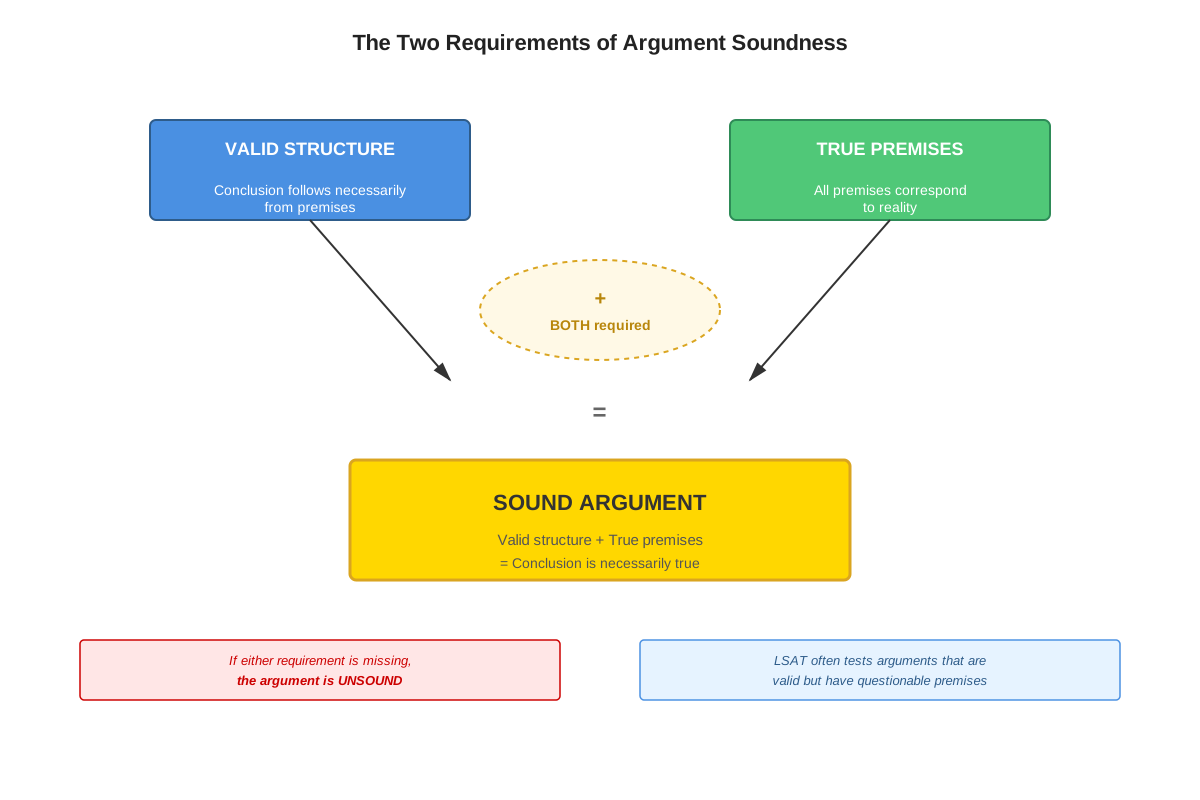
Argument soundness is a foundational concept in formal logic that plays a critical role in LSAT Logical Reasoning sections. While the LSAT rarely uses the technical term "soundness" explicitly, understanding this concept is essential for evaluating the strength and validity of arguments throughout the exam. An argument is sound when it meets two crucial conditions: it must be logically valid (the conclusion follows necessarily from the premises) AND all of its premises must actually be true. This dual requirement makes soundness the gold standard for argument evaluation, representing the highest level of argumentative strength.
For LSAT test-takers, mastering lsat argument soundness provides a systematic framework for dissecting complex arguments and identifying their weaknesses. The LSAT frequently tests whether students can distinguish between arguments that are merely valid in structure versus those that are both valid and supported by true premises. This distinction appears across multiple question types, including Strengthen/Weaken questions, Flaw questions, Necessary Assumption questions, and Sufficient Assumption questions. Understanding soundness helps students recognize when an argument's structure is solid but its factual foundation is questionable, or conversely, when premises might be true but fail to support the conclusion logically.
Within the broader landscape of logical reasoning and argument fundamentals, soundness represents the intersection of two critical evaluation criteria: formal validity and factual accuracy. While validity concerns the logical relationship between premises and conclusion, soundness adds the requirement of truth, making it a more stringent and comprehensive standard. This concept connects directly to assumption identification, premise evaluation, and conclusion assessment—all core skills tested repeatedly on the LSAT. By understanding soundness, students develop a mental checklist for argument evaluation that proves invaluable under timed testing conditions.
Learning Objectives
- [ ] Identify how Argument soundness appears in LSAT questions
- [ ] Explain the reasoning pattern behind Argument soundness
- [ ] Apply Argument soundness to solve LSAT-style problems accurately
- [ ] Distinguish between valid arguments and sound arguments in LSAT contexts
- [ ] Evaluate whether premises in an argument are actually true or merely assumed
- [ ] Recognize how LSAT questions exploit the gap between validity and soundness
- [ ] Construct counterexamples that demonstrate why valid arguments may be unsound
Prerequisites
- Basic argument structure: Understanding premises, conclusions, and inference indicators is essential because soundness evaluation requires identifying these components before assessing their logical relationships and truth values.
- Validity concepts: Familiarity with what makes an argument valid (conclusion following necessarily from premises) is required because soundness builds upon validity as a foundational requirement.
- Premise vs. conclusion identification: The ability to distinguish supporting statements from claims being supported is necessary because soundness requires separate evaluation of premise truth and logical structure.
- Conditional reasoning basics: Understanding if-then relationships helps recognize when conclusions follow necessarily from premises, which is the validity component of soundness.
Why This Topic Matters
Understanding argument soundness provides a systematic approach to the most fundamental task on the LSAT: determining whether arguments are strong or weak, and precisely why. In real-world applications, this skill translates directly to legal reasoning, where attorneys must evaluate whether arguments are not only logically structured but also factually supported. Judges, lawyers, and legal scholars constantly assess whether legal arguments meet both the structural and evidentiary standards required for persuasiveness—exactly what soundness evaluation entails.
On the LSAT, concepts related to argument soundness appear in approximately 60-70% of Logical Reasoning questions across all question types. While the exam rarely asks "Is this argument sound?" directly, it constantly tests the component skills: Can you identify when premises are questionable? Can you recognize when a conclusion doesn't follow even if premises were true? Can you spot the difference between an argument that's structurally valid but factually dubious versus one that's both valid and well-supported?
Common LSAT manifestations include:
- Flaw questions that identify arguments with questionable premises or assumptions
- Strengthen/Weaken questions that test premise truth by adding or removing factual support
- Necessary Assumption questions that reveal unstated premises required for validity
- Sufficient Assumption questions that complete the logical structure to ensure validity
- Evaluate questions that ask what information would determine premise truth
- Method of Reasoning questions that describe how premises relate to conclusions
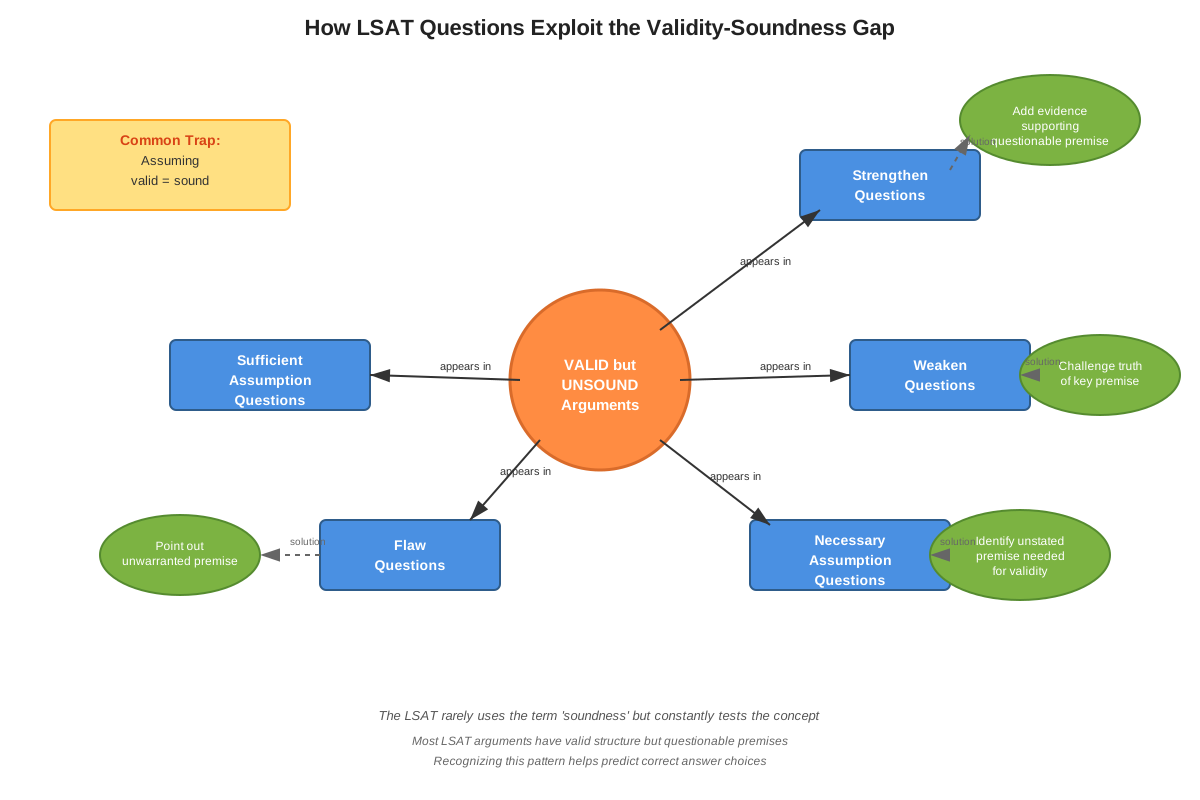
The LSAT exploits the gap between validity and soundness systematically. Many incorrect answer choices in Strengthen questions, for example, improve an argument's validity without addressing whether its premises are true. Similarly, many arguments presented in Flaw questions are valid in structure but rely on demonstrably false or highly questionable premises. Recognizing these patterns dramatically improves accuracy and speed.
Core Concepts
Defining Argument Soundness
Argument soundness is a technical term in formal logic that describes arguments meeting two mandatory criteria simultaneously. First, the argument must be valid—meaning the conclusion follows necessarily from the premises through proper logical structure. If the premises were true, the conclusion would have to be true; there's no logical possibility of true premises yielding a false conclusion in a valid argument. Second, all premises must actually be true in reality, not merely assumed or hypothetical.
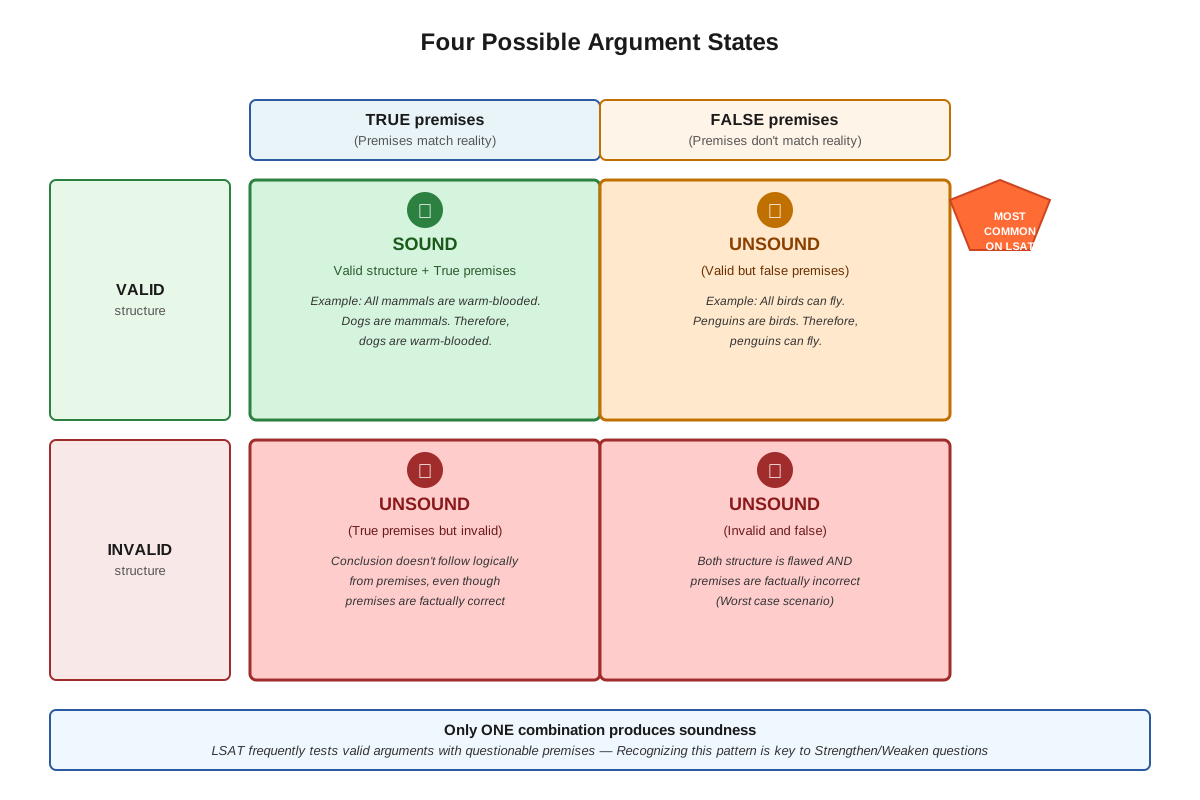
This dual requirement makes soundness exceptionally demanding. An argument can be valid but unsound (if premises are false), and an argument can have true premises but be unsound (if the conclusion doesn't follow logically). Only when both conditions are satisfied does an argument achieve soundness.
Consider this example:
Valid but Unsound Argument:
- Premise 1: All LSAT test-takers are over 7 feet tall.
- Premise 2: Maria is an LSAT test-taker.
- Conclusion: Therefore, Maria is over 7 feet tall.
This argument is perfectly valid—IF the premises were true, the conclusion would necessarily follow. However, Premise 1 is obviously false, making the argument unsound despite its valid structure.
The Two Components of Soundness
| Component | Definition | LSAT Testing Focus | Evaluation Question |
|---|---|---|---|
| Validity | Conclusion follows necessarily from premises | Assumption questions, logical structure | "Does the conclusion follow IF premises are true?" |
| Premise Truth | All premises are actually true in reality | Strengthen/Weaken, Flaw questions | "Are the premises actually true?" |
Understanding this distinction is crucial because the LSAT frequently presents arguments that satisfy one component but not the other. Many LSAT arguments are valid in structure but rely on questionable premises—these are the targets of Weaken questions. Conversely, some arguments present true premises but draw conclusions that don't logically follow—these appear in Flaw questions about reasoning errors.
Validity Without Soundness
The LSAT regularly exploits the difference between valid and sound arguments. A valid argument guarantees that IF the premises are true, THEN the conclusion must be true. But validity says nothing about whether premises are actually true. This creates a critical vulnerability that LSAT questions target relentlessly.
Example of Valid but Unsound Reasoning:
- Premise: Every student who studies for 100+ hours scores 180 on the LSAT.
- Premise: Jordan studied for 100+ hours.
- Conclusion: Jordan scored 180 on the LSAT.
The logical structure is impeccable (valid), but the first premise is factually false—many students study extensively without achieving perfect scores. The argument is unsound.
True Premises Without Validity
Less commonly but still importantly, arguments can present true premises while failing to establish validity. The premises might all be accurate statements about reality, but the conclusion simply doesn't follow from them logically.
Example:
- Premise: The LSAT tests logical reasoning skills. (True)
- Premise: Logical reasoning is important for law school. (True)
- Conclusion: Therefore, everyone should attend law school. (Doesn't follow)
Both premises are true, but they don't support this particular conclusion. The argument lacks validity and therefore cannot be sound, despite having true premises.
Soundness in LSAT Context
While the LSAT rarely uses the term "soundness" explicitly, the exam constantly tests whether students can identify the two components separately and together. When a Strengthen question asks you to support an argument, it's often asking you to provide evidence that a questionable premise is actually true—moving the argument closer to soundness. When a Necessary Assumption question asks what must be true for the conclusion to follow, it's testing the validity component of soundness.
The LSAT's implicit soundness evaluation framework:
- Identify the argument structure (premises and conclusion)
- Assess validity: Does the conclusion follow IF premises are true?
- Assess premise truth: Are the premises actually true or merely assumed?
- Identify gaps: What's missing for the argument to be both valid and factually supported?
Assumptions and Soundness
Assumptions represent the bridge between validity and soundness in LSAT arguments. An assumption is an unstated premise that must be true for the argument to work. There are two types:
Necessary assumptions are required for validity—without them, the conclusion doesn't follow logically even if stated premises are true. Sufficient assumptions, when added, guarantee that the conclusion follows from the premises.
Both assumption types relate directly to soundness. For an argument to be sound, all necessary assumptions must not only exist but also be true. The LSAT frequently presents arguments that are valid only if certain assumptions hold, then asks whether those assumptions are justified—essentially testing whether the argument could be sound.
Evaluating Soundness: A Systematic Approach
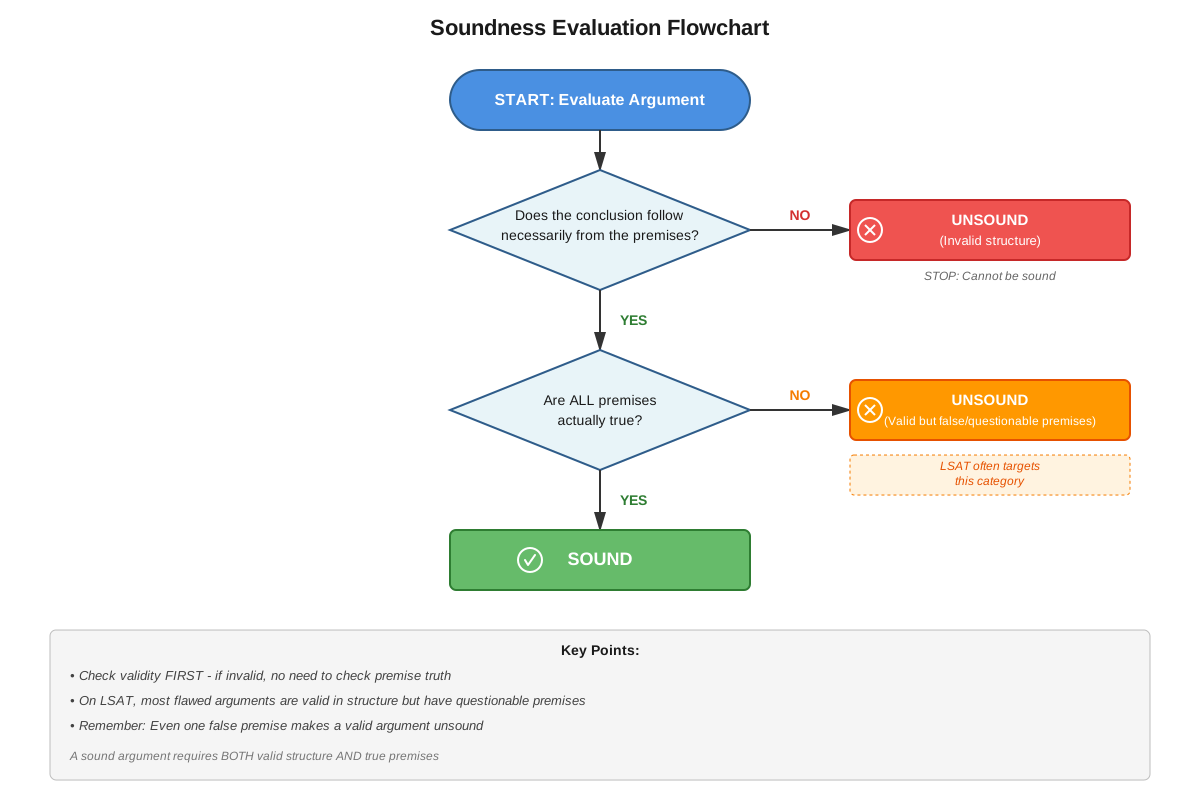
To evaluate argument soundness on the LSAT:
- Identify the conclusion: What claim is being made?
- Identify stated premises: What evidence or reasons are provided?
- Test validity: Assume premises are true—must the conclusion follow?
- Identify assumptions: What unstated premises are required for validity?
- Evaluate premise truth: Are stated premises actually true or questionable?
- Evaluate assumption truth: Are required assumptions justified or dubious?
This systematic approach transforms soundness from an abstract concept into a practical evaluation tool. Most LSAT questions target one or more of these steps, asking you to identify assumptions (step 4), evaluate whether premises are true (step 5), or determine what would strengthen or weaken the argument (steps 5-6).
Concept Relationships
The concept of argument soundness sits at the intersection of multiple fundamental logical reasoning concepts, serving as an integrative framework that combines structural and factual evaluation.
Validity → Soundness: Validity is a necessary but insufficient condition for soundness. An argument must first be valid before soundness can even be considered. This means soundness evaluation always begins with validity assessment. On the LSAT, questions about logical structure and whether conclusions follow from premises are testing the validity component that underlies soundness.
Premise Truth → Soundness: The second necessary condition for soundness is premise truth. This connects soundness to evidence evaluation, factual support, and empirical claims. LSAT Strengthen and Weaken questions primarily target this component, asking whether premises are adequately supported or can be undermined.
Assumptions → Soundness: Assumptions represent unstated premises required for validity. For an argument to be sound, these assumptions must not only exist but also be true. This creates a direct connection between assumption identification questions and soundness evaluation. When the LSAT asks for a necessary assumption, it's identifying a premise that must be true for the argument to have any chance at soundness.
Soundness → Argument Strength: Soundness represents maximum argument strength—a sound argument is as strong as deductive arguments can be. This connects to the broader concept of argument evaluation that spans the entire Logical Reasoning section. Understanding soundness provides the framework for assessing all argument types.
Textual relationship map:
Premise Identification → Conclusion Identification → Validity Assessment → Assumption Identification → Premise Truth Evaluation → Soundness Determination → Argument Strength AssessmentQuick check — test yourself on Argument soundness so far.
Try Flashcards →High-Yield Facts
⭐ An argument is sound if and only if it is valid AND all its premises are true.
⭐ Validity concerns logical structure; soundness concerns both structure and factual accuracy.
⭐ The LSAT rarely uses the term "soundness" but constantly tests its component concepts.
⭐ A valid argument with even one false premise is unsound, regardless of how strong the logical structure is.
⭐ Strengthen questions often target the premise truth component of soundness by providing evidence for questionable premises.
- Soundness is a binary property—arguments are either sound or unsound, with no middle ground.
- An argument can have true premises and a true conclusion yet still be unsound if the conclusion doesn't follow logically from the premises (lacks validity).
- Weaken questions typically attack either premise truth or the assumptions required for validity, both of which are necessary for soundness.
- Necessary Assumption questions identify premises that must be true for an argument to be valid, which is required for soundness.
- Flaw questions often identify arguments that appear valid but rely on questionable premises, making them unsound.
- Sufficient Assumption questions provide premises that guarantee validity, addressing one component of soundness.
- Most LSAT arguments are deliberately unsound—the test asks you to identify why they fail.
- Recognizing the difference between "the conclusion follows IF premises are true" (validity) and "the conclusion is actually established" (soundness) is crucial for LSAT success.
Common Misconceptions
Misconception: If an argument's conclusion is true, the argument must be sound.
Correction: Soundness requires valid structure AND true premises. An argument can reach a true conclusion through invalid reasoning or false premises, making it unsound. The conclusion's truth is independent of the argument's soundness.
Misconception: A persuasive or convincing argument is necessarily sound.
Correction: Persuasiveness is psychological; soundness is logical. Many persuasive arguments are unsound because they rely on false premises or invalid reasoning. The LSAT frequently presents convincing-sounding arguments that are logically flawed.
Misconception: If premises are true, the argument is sound.
Correction: True premises are necessary but insufficient for soundness. The argument must also be valid—the conclusion must follow logically from those true premises. An argument with true premises but invalid structure is unsound.
Misconception: Validity and soundness are the same thing.
Correction: Validity concerns only logical structure (whether the conclusion follows IF premises are true), while soundness requires both valid structure AND actually true premises. Validity is one component of soundness, not equivalent to it.
Misconception: The LSAT doesn't test soundness because it doesn't use that term.
Correction: The LSAT constantly tests soundness concepts without using the technical term. Strengthen/Weaken questions test premise truth, Assumption questions test validity requirements, and Flaw questions identify failures of either component. Understanding soundness provides the framework for all these question types.
Misconception: An argument with one false premise can still be sound if the other premises are strong enough.
Correction: Soundness requires ALL premises to be true. Even a single false premise renders an argument unsound, regardless of how many true premises it contains or how strong the logical structure is.
Misconception: Inductive arguments can be sound.
Correction: Soundness is a property of deductive arguments only. Inductive arguments are evaluated as strong or weak, not sound or unsound, because their conclusions don't follow necessarily from premises even when premises are true.
Worked Examples
Example 1: Identifying Unsoundness in an LSAT-Style Argument
Argument: "Every lawyer who graduated from a top-10 law school passes the bar exam on the first attempt. Chen graduated from a top-10 law school. Therefore, Chen passed the bar exam on the first attempt."
Question: Which of the following best describes this argument?
Step 1 - Identify the structure:
- Premise 1: Every lawyer from top-10 schools passes the bar on first attempt
- Premise 2: Chen graduated from a top-10 school
- Conclusion: Chen passed the bar on first attempt
Step 2 - Assess validity:
The argument follows a valid logical form (universal statement + particular case = particular conclusion). IF both premises were true, the conclusion would necessarily follow. The argument is VALID.
Step 3 - Assess premise truth:
Premise 2 might be true (Chen's graduation is a factual claim that could be verified). However, Premise 1 is highly questionable—it's extremely unlikely that EVERY lawyer from top-10 schools passes on the first attempt. Some surely fail despite their educational pedigree.
Step 4 - Determine soundness:
Because Premise 1 is almost certainly false, the argument is UNSOUND despite being valid. This is exactly the type of argument the LSAT presents in Flaw questions or asks you to weaken.
Connection to learning objectives: This example demonstrates how to identify the gap between validity and soundness, showing how LSAT arguments can be structurally perfect yet factually flawed.
Example 2: Distinguishing Between Validity and Soundness Issues
Argument: "Most successful entrepreneurs have strong networking skills. Strong networking skills require regular social interaction. Therefore, most successful entrepreneurs enjoy solitude."
Question: The argument is flawed because it:
Step 1 - Identify the structure:
- Premise 1: Most successful entrepreneurs have strong networking skills (likely true)
- Premise 2: Strong networking skills require regular social interaction (likely true)
- Conclusion: Most successful entrepreneurs enjoy solitude
Step 2 - Assess premise truth:
Both premises are plausible and likely true. The factual foundation seems solid.
Step 3 - Assess validity:
Here's the problem: even IF both premises are true, the conclusion doesn't follow. In fact, the conclusion contradicts what the premises suggest. If successful entrepreneurs have networking skills that require social interaction, they likely DON'T enjoy solitude. The logical structure is broken.
Step 4 - Determine soundness:
The argument is UNSOUND because it lacks validity, even though the premises might be true. This demonstrates that soundness requires BOTH components—you can't have soundness with true premises if the reasoning is invalid.
Step 5 - LSAT application:
This would appear in a Flaw question where the correct answer might state: "The argument draws a conclusion that contradicts what its premises support" or "The argument fails to establish a logical connection between premises and conclusion."
Connection to learning objectives: This example shows how to apply soundness evaluation to identify that an argument fails due to validity problems rather than premise truth problems, demonstrating the distinct components that soundness requires.
Exam Strategy
Approaching Soundness-Related Questions
When encountering LSAT questions that test soundness concepts, use this systematic approach:
1. Identify the question type first: Different question types target different components of soundness. Strengthen/Weaken questions typically target premise truth; Assumption questions target validity requirements; Flaw questions may target either or both.
2. Separate validity from premise truth: Ask yourself two distinct questions:
- "IF the premises were true, would the conclusion follow?" (validity)
- "Are the premises actually true or well-supported?" (premise truth)
3. Look for the gap: Most LSAT arguments are deliberately unsound. Your job is identifying whether they fail on validity, premise truth, or both.
Trigger Words and Phrases
Watch for these indicators that soundness concepts are being tested:
Validity indicators:
- "The argument assumes that..."
- "The conclusion follows logically if..."
- "The argument's reasoning is flawed because..."
- "Which of the following is an assumption required..."
Premise truth indicators:
- "The argument would be strengthened if..."
- "Which of the following, if true, most weakens..."
- "The argument depends on which of the following being true..."
- "The argument is vulnerable to criticism because it fails to establish..."
Combined soundness indicators:
- "The argument is questionable because..."
- "A flaw in the argument is that it..."
- "The argument would be more persuasive if..."
Process of Elimination Tips
For Strengthen questions:
- Eliminate answers that improve validity without addressing questionable premises
- Eliminate answers that support irrelevant premises
- Keep answers that provide evidence for the most questionable premise
For Weaken questions:
- Eliminate answers that attack the conclusion directly without undermining premises
- Keep answers that show a key premise is false or questionable
- Keep answers that reveal an assumption is unjustified
For Flaw questions:
- Eliminate answers that describe valid reasoning patterns
- Keep answers that identify false or questionable premises
- Keep answers that identify gaps in logical structure
Time Allocation
Soundness evaluation should be quick once mastered:
- 10-15 seconds: Identify argument structure (premises and conclusion)
- 10-15 seconds: Assess validity (does conclusion follow?)
- 10-15 seconds: Identify the most questionable premise or assumption
- 20-30 seconds: Evaluate answer choices based on your analysis
Total time per question: 50-75 seconds for the soundness evaluation component, leaving time for careful answer choice analysis.
Memory Techniques
The "TV" Mnemonic for Soundness
Remember TV to recall the two components of soundness:
- Truth (all premises must be true)
- Validity (conclusion must follow logically)
Both channels must work for the argument to broadcast clearly!
The "Foundation and Frame" Visualization
Visualize an argument as a building:
- Foundation = Premise truth (must be solid and real)
- Frame = Validity (must be structurally sound)
- Soundness = Both foundation and frame are solid
A building with a perfect frame but crumbling foundation will collapse (valid but unsound). A building with a solid foundation but broken frame will also collapse (true premises but invalid). You need both.
The Two-Question Checklist
Before concluding an argument is sound, ask:
- "IF true, THEN true?" (validity check)
- "Actually true?" (premise truth check)
Both answers must be "yes" for soundness.
The VATS Acronym for Argument Evaluation
Validity - Does the conclusion follow?
Assumptions - What's unstated but required?
Truth - Are premises actually true?
Soundness - Do all components check out?
Summary
Argument soundness represents the gold standard for deductive arguments, requiring both valid logical structure and true premises. While the LSAT rarely uses this technical term explicitly, understanding soundness provides the foundational framework for evaluating arguments across all Logical Reasoning question types. A sound argument guarantees its conclusion through both impeccable logic and factual accuracy—if premises are true and the reasoning is valid, the conclusion must be true. However, most LSAT arguments are deliberately unsound, containing either questionable premises, invalid reasoning, or both. Success on the LSAT requires systematically identifying which component of soundness fails: the validity component (tested through Assumption and Flaw questions) or the premise truth component (tested through Strengthen and Weaken questions). By separating these two requirements and evaluating each independently, test-takers can quickly diagnose argument weaknesses and predict correct answers. The concept of soundness integrates all fundamental argument evaluation skills—premise identification, conclusion recognition, assumption detection, and evidence assessment—into a unified framework that applies across the entire Logical Reasoning section.
Key Takeaways
- Soundness requires TWO mandatory components: valid logical structure AND true premises—both must be present simultaneously
- The LSAT constantly tests soundness concepts without using the term, primarily through Strengthen, Weaken, Assumption, and Flaw questions
- Validity concerns structure; soundness concerns structure PLUS truth—this distinction is crucial for accurate LSAT performance
- Most LSAT arguments are deliberately unsound—your task is identifying whether they fail on validity, premise truth, or both
- A single false premise renders an argument unsound regardless of how many true premises exist or how valid the structure is
- Strengthen questions typically target premise truth while Assumption questions typically target validity requirements—both components of soundness
- Understanding soundness provides a systematic framework for evaluating all arguments, making it one of the highest-yield concepts in Logical Reasoning
Related Topics
Validity and Deductive Reasoning: Explores the logical structure component of soundness in greater depth, examining various valid argument forms and how to recognize when conclusions follow necessarily from premises. Mastering soundness provides the foundation for understanding why validity alone is insufficient.
Assumptions in Arguments: Examines unstated premises required for arguments to work, directly connecting to the validity component of soundness. Understanding soundness helps clarify why identifying assumptions matters—they must be true for arguments to be sound.
Strengthen and Weaken Questions: Applies soundness concepts to specific question types that target premise truth. Mastering soundness enables you to predict what information would make questionable premises more or less credible.
Formal Logic and Conditional Reasoning: Builds on soundness by exploring specific logical structures where validity can be tested rigorously. Understanding soundness provides the conceptual foundation for recognizing when conditional arguments are both valid and factually supported.
Argument Evaluation and Flaw Questions: Applies the complete soundness framework to identify specific reasoning errors. Mastering soundness gives you the vocabulary and concepts to articulate precisely why arguments fail.
Practice CTA
Now that you understand the foundational concept of argument soundness and how it appears throughout LSAT Logical Reasoning, you're ready to apply this knowledge to practice questions. The flashcards will help you internalize the key distinctions between validity and soundness, while practice questions will challenge you to identify these concepts under timed conditions. Remember: every Logical Reasoning question is ultimately testing whether you can evaluate arguments systematically. Soundness provides that system. Approach each practice question by asking the two critical questions: "Does the conclusion follow IF premises are true?" and "Are the premises actually true?" With consistent practice, this framework will become automatic, dramatically improving both your accuracy and speed. You've built the foundation—now it's time to construct mastery through deliberate practice!
Sign up free to keep reading
Create a free AnvayaPrep account to finish this LSAT guide on Argument soundness — plus flashcards and practice questions.