Overview
No omitted variable assumptions represent a critical reasoning pattern that appears frequently throughout LSAT Logical Reasoning sections. This type of assumption occurs when an argument draws a causal or correlational conclusion based on observed data while failing to consider that other unmentioned factors might explain the relationship. When test-takers encounter assumption questions involving omitted variables, they must identify what the argument takes for granted: that no other relevant factors are influencing the outcome beyond those explicitly mentioned.
Understanding this concept is essential because the LSAT regularly tests whether students can recognize gaps in causal reasoning. An argument might observe that two phenomena occur together and conclude one causes the other, but this reasoning only holds if no third variable is responsible for both observations or if no alternative explanation exists. The ability to spot these logical gaps separates high-scoring test-takers from those who struggle with the Logical Reasoning section.
This topic connects intimately with broader concepts in LSAT no omitted variable assumptions reasoning, including causal reasoning, correlation versus causation, and the structure of sufficient versus necessary assumptions. Mastering no omitted variable assumptions provides the foundation for understanding how arguments can be strengthened, weakened, or evaluated—skills tested across multiple question types beyond just assumption questions themselves.
Learning Objectives
- [ ] Identify how No omitted variable assumptions appears in LSAT questions
- [ ] Explain the reasoning pattern behind No omitted variable assumptions
- [ ] Apply No omitted variable assumptions to solve LSAT-style problems accurately
- [ ] Distinguish between omitted variable assumptions and other assumption types
- [ ] Recognize trigger language that signals potential omitted variable issues
- [ ] Evaluate answer choices to determine which correctly identifies the omitted variable assumption
- [ ] Predict likely omitted variables before reviewing answer choices
Prerequisites
- Basic understanding of argument structure: Recognizing premises and conclusions is essential because omitted variable assumptions create gaps between evidence and conclusion.
- Familiarity with causal reasoning: No omitted variable assumptions most commonly appear in causal arguments, so understanding how causal claims function is foundational.
- Knowledge of necessary versus sufficient assumptions: Distinguishing what an argument requires (necessary) from what would guarantee its conclusion (sufficient) helps identify the specific assumption at play.
- Experience with correlation and causation: Understanding that correlation does not automatically imply causation underlies why omitted variables matter.
Why This Topic Matters
In real-world contexts, omitted variable reasoning affects critical thinking in medicine, policy-making, business decisions, and scientific research. When a company observes that sales increased after launching a new advertising campaign, assuming the campaign caused the increase ignores potential omitted variables like seasonal trends, competitor actions, or economic conditions. Legal reasoning—the foundation of the LSAT—constantly requires attorneys to identify alternative explanations and unexamined factors that might undermine or support a case.
On the LSAT, no omitted variable assumptions appear with remarkable frequency. Approximately 15-20% of all assumption questions involve identifying an omitted variable that the argument fails to consider. These questions also appear in Strengthen, Weaken, and Flaw question types, making this concept one of the highest-yield topics across the entire Logical Reasoning section. Test-makers favor this pattern because it efficiently tests sophisticated analytical thinking.
Common manifestations include arguments about studies showing correlations, business decisions based on observed trends, policy recommendations based on statistical relationships, and historical explanations that attribute outcomes to single causes. The LSAT presents these scenarios across diverse contexts—from archaeological findings to economic policies to medical treatments—requiring students to recognize the underlying logical structure regardless of subject matter.
Core Concepts
The Basic Structure of Omitted Variable Assumptions
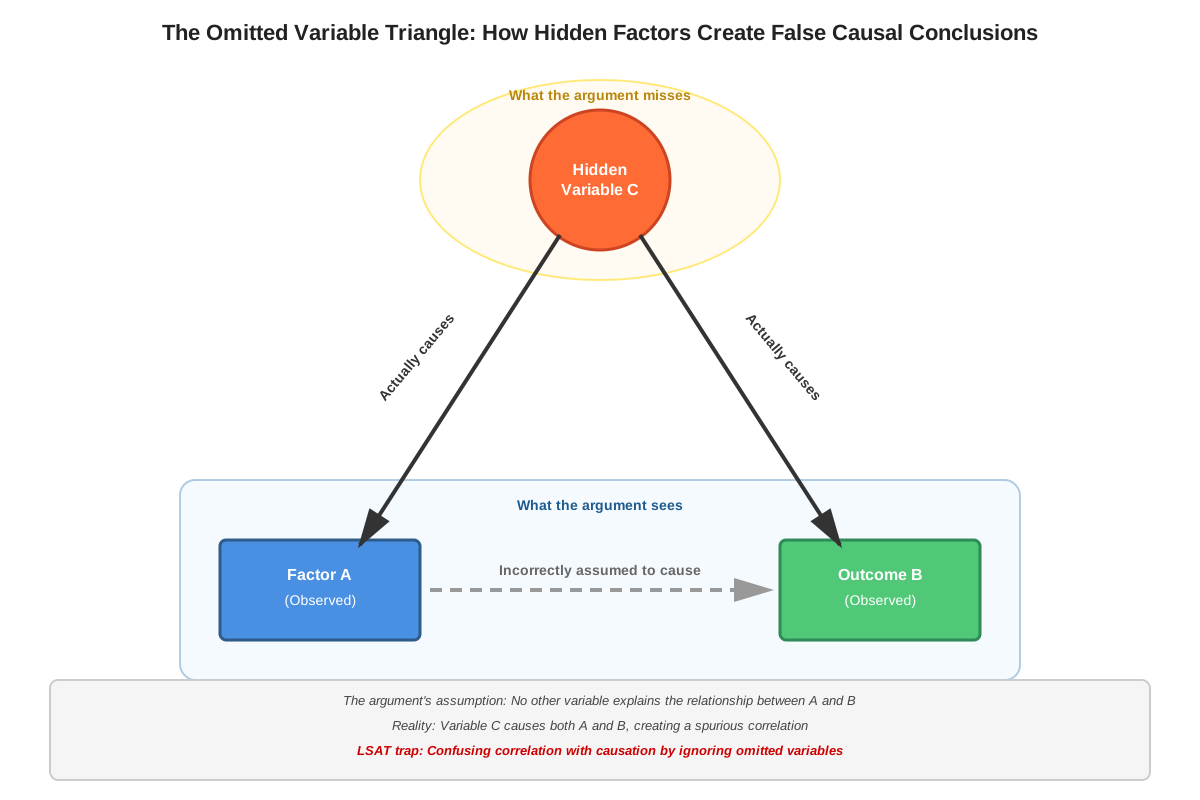
A no omitted variable assumption occurs when an argument's reasoning depends on the unstated premise that no other factors beyond those mentioned could explain the observed relationship or outcome. The argument structure typically follows this pattern:
- Premise: X and Y are correlated (or X preceded Y)
- Conclusion: X caused Y (or X explains Y)
- Hidden assumption: No other variable Z could explain the relationship between X and Y
The logical gap exists because the argument moves from observation to causal explanation without ruling out alternative factors. The assumption "fills" this gap by asserting that other explanations have been eliminated or don't exist.
Distinguishing Features of Omitted Variable Arguments
Arguments vulnerable to omitted variable assumptions share several characteristics:
Causal language: The conclusion typically uses causal terminology like "caused," "resulted in," "led to," "responsible for," "explains why," or "the reason for." This signals that the argument is making a causal claim based on observational evidence.
Limited evidence: The premises provide correlation, temporal sequence, or association but don't establish causation. The argument observes that two things happen together or in sequence without demonstrating a causal mechanism.
Scope narrowness: The argument focuses on specific factors while the real world contains numerous variables. This narrowness creates vulnerability to omitted variables.
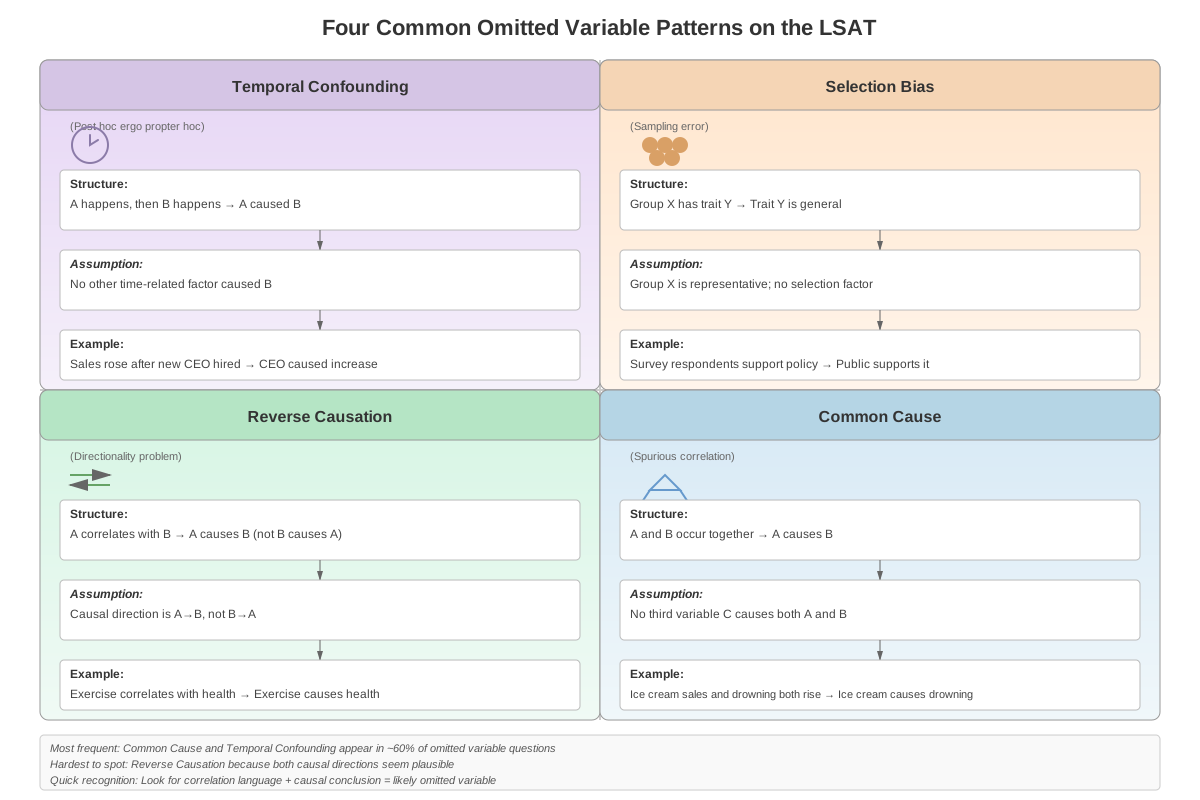
Types of Omitted Variables
Understanding the categories of omitted variables helps predict what assumptions an argument might make:
| Omitted Variable Type | Description | Example |
|---|---|---|
| Common Cause | A third factor causes both observed phenomena | Ice cream sales and drowning rates both increase in summer (temperature is the common cause) |
| Confounding Factor | An unmentioned variable influences the outcome | A drug appears effective, but patients taking it also exercise more |
| Reverse Causation | The effect actually causes what's claimed as the cause | Successful companies invest in training (but perhaps success enables training investment) |
| Temporal Coincidence | Events occur together by chance or due to unrelated cycles | Stock market performance and sports championships correlating randomly |
| Selection Bias | The sample differs from the population in relevant ways | Survey respondents differ from non-respondents in ways affecting results |
The Logical Mechanism
The reasoning flaw operates through incomplete elimination of alternatives. Sound causal reasoning requires either:
- Experimental control that isolates variables
- Logical elimination of alternative explanations
- Demonstration of causal mechanism
When arguments lack these elements, they implicitly assume no omitted variables matter. The assumption functions as a necessary condition—without it, the conclusion doesn't follow from the premises. If an omitted variable exists that could explain the observations, the argument's causal conclusion becomes unjustified.
Identifying the Assumption in Questions
When an LSAT question asks for the assumption in an omitted variable argument, the correct answer typically:
- Negates the existence of alternative explanations
- Rules out specific confounding factors
- Asserts that no other relevant differences exist between compared groups
- States that the mentioned factor is the only significant influence
The assumption bridges the gap between "X and Y are associated" and "X causes Y" by essentially saying "nothing else explains this relationship."
Context Variations
Omitted variable assumptions appear across diverse argument contexts:
Comparative arguments: "City A implemented policy X and has lower crime than City B, so policy X reduces crime." (Assumes no other differences between cities explain the crime rate difference)
Before-and-after arguments: "After installing speed cameras, accidents decreased, so cameras prevent accidents." (Assumes no other changes occurred simultaneously)
Study-based arguments: "People who drink coffee have lower rates of disease Y, so coffee prevents disease Y." (Assumes no other differences between coffee drinkers and non-drinkers explain the health difference)
Historical explanations: "Civilization Z collapsed after drought began, so drought caused the collapse." (Assumes no other factors contributed to the collapse)
Concept Relationships
No omitted variable assumptions connect to several fundamental logical reasoning concepts. The relationship flows from basic causal reasoning principles: understanding that causation requires more than correlation provides the foundation for recognizing when arguments make unjustified causal leaps.
This topic directly relates to necessary assumptions because the assumption that no omitted variables exist is required for the argument's conclusion to follow. Without this assumption, alternative explanations remain viable, and the conclusion becomes unsupported. The relationship can be mapped as:
Correlation/Temporal Sequence → Causal Claim → Requires Assumption → No Omitted Variables
The concept also connects to Strengthen and Weaken questions. Information that rules out alternative explanations strengthens arguments with omitted variable vulnerabilities, while information introducing new variables weakens them. This creates the pathway:
Omitted Variable Assumption → Vulnerability to Weakening → Opportunity for Strengthening
Additionally, Flaw questions often identify omitted variable problems, describing them as "fails to consider alternative explanations" or "takes for granted that no other factors are relevant." Understanding omitted variables thus enables recognition of this common flaw pattern.
The relationship to Method of Agreement and Difference reasoning (Mill's Methods) is also significant. Sound causal reasoning requires showing that the effect occurs when the cause is present and doesn't occur when the cause is absent, with all other factors held constant. Omitted variable assumptions represent failures to satisfy the "all other factors held constant" requirement.
High-Yield Facts
⭐ No omitted variable assumptions occur when arguments conclude causation from correlation without ruling out alternative explanations
⭐ The correct answer to an omitted variable assumption question typically negates the existence of other relevant factors
⭐ Approximately 15-20% of assumption questions involve omitted variable reasoning patterns
⭐ Causal language in conclusions ("caused," "resulted in," "explains") signals potential omitted variable issues
⭐ Comparative arguments are especially vulnerable to omitted variable problems when groups differ in multiple ways
- Omitted variable assumptions are necessary assumptions—the argument requires them to be valid
- Common wrong answers introduce sufficient assumptions that would guarantee the conclusion but aren't necessary
- The negation test works effectively: if negating the assumption destroys the argument, it's necessary
- Temporal sequence alone never establishes causation without ruling out omitted variables
- Arguments based on observational studies are more vulnerable than those based on controlled experiments
- The omitted variable doesn't need to be the actual cause—it just needs to be a plausible alternative explanation
- Multiple omitted variables might exist, but the assumption only needs to rule out relevant ones
- Context-specific knowledge isn't required; the logical structure remains consistent across topics
Quick check — test yourself on No omitted variable assumptions so far.
Try Flashcards →Common Misconceptions
Misconception: The assumption must state the specific omitted variable that actually explains the relationship. → Correction: The assumption only needs to assert that no other relevant factors exist; it doesn't need to identify what those factors might be. The correct answer typically says something like "no other differences between the groups are relevant" rather than naming specific variables.
Misconception: If the argument mentions multiple factors, it can't have an omitted variable assumption. → Correction: Even when arguments acknowledge some factors, they can still assume no additional unmentioned factors matter. The assumption concerns variables not discussed, regardless of how many the argument does mention.
Misconception: Omitted variable assumptions only appear in arguments about scientific studies. → Correction: While common in study-based arguments, omitted variable assumptions appear in business reasoning, historical explanations, policy arguments, and any context where causal claims are made from observational evidence.
Misconception: The correct answer will always use the phrase "no other factors." → Correction: Correct answers express the assumption in various ways: "the only relevant difference," "no other changes occurred," "the groups are otherwise similar," or "no alternative explanation exists." Recognizing the concept matters more than specific wording.
Misconception: Omitted variable assumptions are the same as sufficient assumptions. → Correction: Omitted variable assumptions are necessary assumptions—required for the argument to work. Sufficient assumptions would guarantee the conclusion but often go beyond what's necessary. The distinction is crucial for selecting correct answers.
Misconception: If an argument acknowledges uncertainty with words like "probably" or "likely," it doesn't make omitted variable assumptions. → Correction: Even probabilistic conclusions require assuming that no omitted variables make the conclusion unlikely. Hedged language doesn't eliminate the logical gap between correlation and causation.
Misconception: The omitted variable must be something the argument's author should have known about. → Correction: The logical flaw exists regardless of whether the omitted variable is obvious or obscure. The assumption concerns what the reasoning requires, not what the author should have considered.
Worked Examples
Example 1: Comparative Business Argument
Argument: "Company A implemented flexible work schedules last year and saw a 15% increase in employee productivity, while Company B maintained traditional schedules and saw only a 3% increase. Therefore, flexible work schedules increase productivity."
Question: Which of the following is an assumption required by the argument?
Analysis:
Step 1: Identify the conclusion—flexible work schedules increase productivity (causal claim).
Step 2: Identify the evidence—Company A (with flexible schedules) had higher productivity gains than Company B (without flexible schedules).
Step 3: Recognize the logical gap—the argument assumes the schedule difference explains the productivity difference, but other factors might be responsible.
Step 4: Predict the assumption—no other relevant differences between the companies explain the productivity difference.
Step 5: Evaluate answer choices:
- (A) "Company A's employees prefer flexible schedules" - This doesn't address whether other factors explain productivity; it's about preference, not causation. Eliminate.
- (B) "No other significant differences between Company A and Company B account for the difference in productivity gains" - This directly states that no omitted variables explain the outcome. Strong candidate.
- (C) "Flexible schedules always increase productivity in every industry" - This is too strong (sufficient assumption) and uses extreme language ("always," "every"). Eliminate.
- (D) "Company B will implement flexible schedules next year" - This is about future actions, not about what the current argument assumes. Eliminate.
- (E) "Employee productivity is the most important measure of company success" - This is about what matters most, not about what explains the productivity difference. Eliminate.
Correct Answer: (B)
Connection to Learning Objectives: This example demonstrates how to identify omitted variable assumptions in comparative arguments and apply the reasoning pattern to eliminate incorrect answers systematically.
Example 2: Historical Causation Argument
Argument: "Archaeological evidence shows that the ancient city of Mohenjo-daro was abandoned around 1900 BCE, the same period when the Indus River changed course. This indicates that the river's course change caused the city's abandonment."
Question: The argument's conclusion follows logically if which one of the following is assumed?
Analysis:
Step 1: Identify the conclusion—the river's course change caused the abandonment (causal claim from temporal correlation).
Step 2: Identify the evidence—both events occurred around the same time.
Step 3: Recognize the pattern—temporal coincidence is being used to infer causation, creating vulnerability to omitted variables.
Step 4: Consider possible omitted variables—climate change, invasion, disease, economic collapse, or other environmental factors could explain the abandonment.
Step 5: Predict the assumption—no other factors caused or significantly contributed to the abandonment.
Step 6: Evaluate answer choices:
- (A) "The Indus River was the city's only water source" - This would strengthen the argument but goes beyond what's necessary; even if other water sources existed, the river change could still be the cause. Eliminate.
- (B) "No other significant factors contributed to the abandonment of Mohenjo-daro" - This rules out omitted variables, making it a necessary assumption. Strong candidate.
- (C) "Other cities along the Indus River were also abandoned at this time" - This might strengthen the argument but isn't necessary; the argument is specifically about Mohenjo-daro. Eliminate.
- (D) "The inhabitants of Mohenjo-daro depended heavily on river trade" - This provides context but doesn't rule out alternative explanations. Eliminate.
- (E) "River course changes always cause nearby cities to be abandoned" - This is too extreme and reverses the logical direction (sufficient rather than necessary). Eliminate.
Correct Answer: (B)
Connection to Learning Objectives: This example shows how omitted variable assumptions appear in historical reasoning and demonstrates the importance of distinguishing necessary from sufficient assumptions.
Exam Strategy
Recognition Triggers
Watch for these signals that indicate potential omitted variable assumptions:
- Causal conclusions: "caused," "resulted in," "led to," "responsible for," "explains," "the reason"
- Comparative evidence: Arguments comparing two groups, time periods, or situations
- Study language: "research shows," "studies indicate," "data reveals"
- Temporal sequence: "after X occurred, Y happened"
- Correlation language: "associated with," "linked to," "correlated with"
Systematic Approach
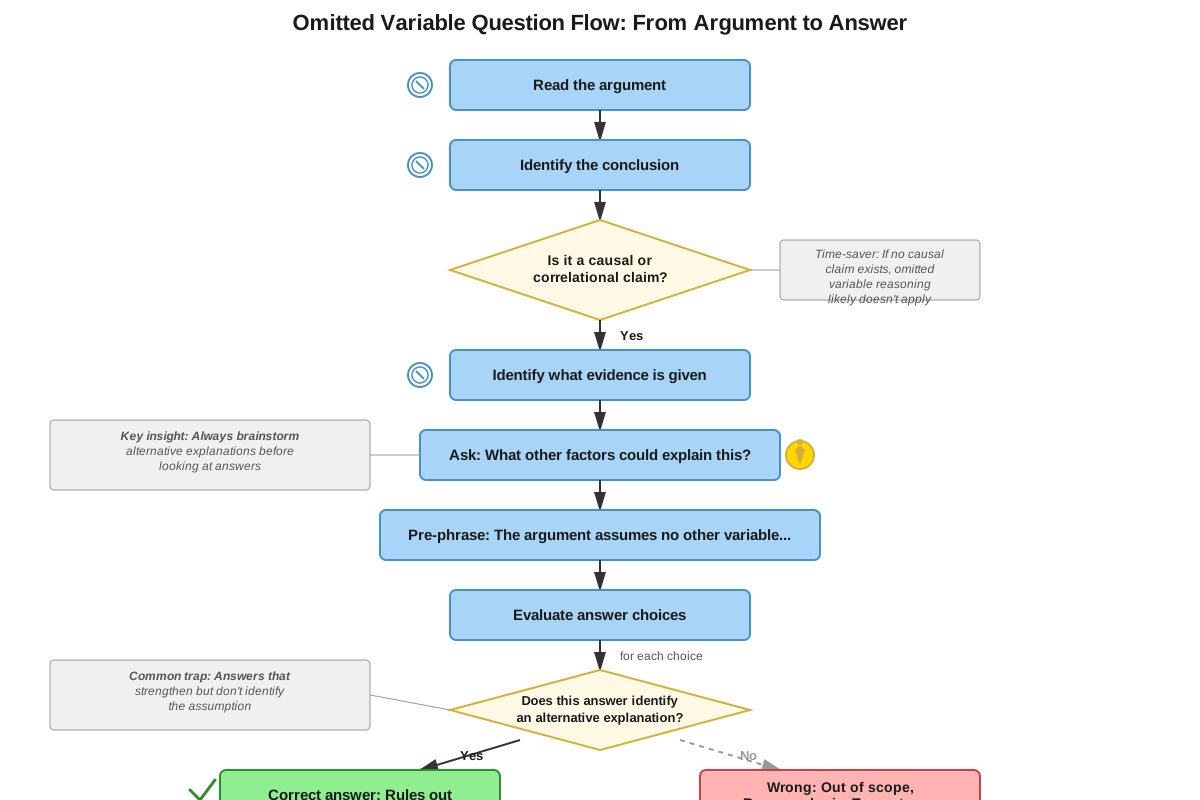
When facing an assumption question with potential omitted variables:
- Identify the conclusion type: Is it making a causal claim?
- Examine the evidence: Is it correlational, comparative, or temporal?
- Spot the gap: What alternative explanations could exist?
- Predict the assumption: The argument assumes no other factors explain the relationship
- Apply the negation test: If you negate the assumption, does the argument fall apart?
Answer Choice Evaluation
Correct answers typically:
- Use language like "no other factors," "the only relevant difference," "no alternative explanation"
- Are modest in scope (necessary, not sufficient)
- Directly address the gap between evidence and conclusion
- Pass the negation test
Wrong answers typically:
- Go beyond what's necessary (sufficient assumptions)
- Address irrelevant aspects of the argument
- Use extreme language ("always," "never," "only")
- Introduce new topics not connected to the logical gap
- Strengthen the argument without being necessary
Time Management
Omitted variable assumption questions are typically medium difficulty. Allocate:
- 30 seconds: Reading and understanding the argument
- 15 seconds: Identifying the gap and predicting the assumption
- 45 seconds: Evaluating answer choices
- Total: 90 seconds per question
Exam Tip: If you're stuck between two answers, apply the negation test. Negate each answer and ask: "Does this destroy the argument?" The one that does is the necessary assumption.
Common Traps
Trap 1: The "Sounds Good" Sufficient Assumption - Answer choices that would guarantee the conclusion but aren't necessary. These are tempting because they strengthen the argument significantly.
Trap 2: The Relevant But Unnecessary Detail - Answers that relate to the topic but don't address the specific logical gap between premises and conclusion.
Trap 3: The Reverse Assumption - Answers that state what the argument concludes rather than what it assumes.
Memory Techniques
The "OTHER" Acronym
Remember what omitted variable assumptions rule out:
- Other explanations don't exist
- Temporal coincidence isn't the whole story
- Hidden factors aren't responsible
- Evidence gaps are filled
- Rival causes are eliminated
Visualization Strategy
Picture the argument as a bridge:
- One side: The evidence (correlation, temporal sequence, comparison)
- Other side: The conclusion (causal claim)
- The gap: Alternative explanations (omitted variables)
- The assumption: A support beam that says "no other bridges exist"
When you see the gap, you know the argument assumes no other way across exists.
The Negation Test Mantra
"If I negate this assumption and the argument crumbles, it's necessary. If the argument still stands, keep looking."
Pattern Recognition Phrase
When you see: "X and Y are related, therefore X causes Y"
Think: "Assumes no Z explains both X and Y"
Summary
No omitted variable assumptions represent a fundamental reasoning pattern where arguments draw causal conclusions from correlational or comparative evidence while implicitly assuming that no unmentioned factors explain the observed relationship. This assumption type appears frequently across LSAT Logical Reasoning sections, particularly in assumption questions but also in strengthen, weaken, and flaw questions. The core logical gap occurs when arguments move from "X and Y are associated" to "X causes Y" without ruling out alternative explanations. Recognizing this pattern requires identifying causal language in conclusions, correlational evidence in premises, and the space between them where omitted variables could exist. Correct answers to these questions typically assert that no other relevant factors, differences, or explanations account for the observed relationship. Mastering this concept requires understanding that these are necessary assumptions—required for the argument to work—rather than sufficient assumptions that would guarantee the conclusion. The ability to spot omitted variable vulnerabilities and predict the required assumptions before reviewing answer choices significantly improves accuracy and speed on test day.
Key Takeaways
- No omitted variable assumptions occur when arguments conclude causation from correlation without ruling out alternative explanations—this is one of the most frequently tested patterns in LSAT Logical Reasoning
- Causal language in conclusions ("caused," "resulted in," "explains") combined with correlational evidence creates the classic setup for omitted variable assumptions
- Correct answers typically negate the existence of other relevant factors rather than naming specific variables, using phrases like "no other differences" or "no alternative explanation"
- These assumptions are necessary (required for the argument) rather than sufficient (guaranteeing the conclusion)—distinguishing between these is crucial for answer selection
- The negation test provides a reliable method for confirming necessary assumptions: if negating the statement destroys the argument, it's necessary
- Omitted variable reasoning appears across diverse contexts—business, science, history, policy—but the underlying logical structure remains consistent
- Recognizing this pattern quickly allows for prediction of correct answers before reviewing choices, significantly improving accuracy and time management
Related Topics
Causal Reasoning Fundamentals: Understanding the broader principles of how causation differs from correlation provides the foundation for recognizing omitted variable assumptions. Mastering this topic enables deeper analysis of all causal arguments.
Strengthen and Weaken Questions: Once omitted variable assumptions are understood, applying this knowledge to strengthen questions (by ruling out alternatives) and weaken questions (by introducing omitted variables) becomes straightforward.
Flaw Questions: Many flaw questions identify omitted variable problems using language like "fails to consider alternative explanations." Understanding the assumption pattern helps recognize and articulate the flaw.
Necessary vs. Sufficient Assumptions: Distinguishing between what an argument requires and what would guarantee its conclusion is essential for selecting correct answers in assumption questions.
Method of Reasoning Questions: Some questions ask test-takers to describe how arguments reason from evidence to conclusion, and recognizing omitted variable patterns helps identify flawed causal reasoning.
Practice CTA
Now that you understand no omitted variable assumptions, it's time to cement this knowledge through active practice. Work through the practice questions to apply these concepts to actual LSAT-style problems, and use the flashcards to reinforce the key patterns and triggers you've learned. Remember: recognizing these assumptions quickly and accurately is a skill that improves dramatically with deliberate practice. Each question you analyze strengthens your ability to spot these patterns instantly on test day. You've built the foundation—now build the speed and confidence that will translate directly into points on your LSAT score.
Sign up free to keep reading
Create a free AnvayaPrep account to finish this LSAT guide on No omitted variable assumptions — plus flashcards and practice questions.