Overview
No reverse causation assumptions represent a critical reasoning pattern tested extensively in LSAT Logical Reasoning sections, particularly within assumption questions. When an argument presents a causal relationship—claiming that X causes Y—it typically assumes that the causal arrow points in only one direction. The argument presumes that Y does not cause X, or that the relationship isn't bidirectional. This assumption becomes vulnerable when the reverse causal relationship could equally explain the observed correlation.
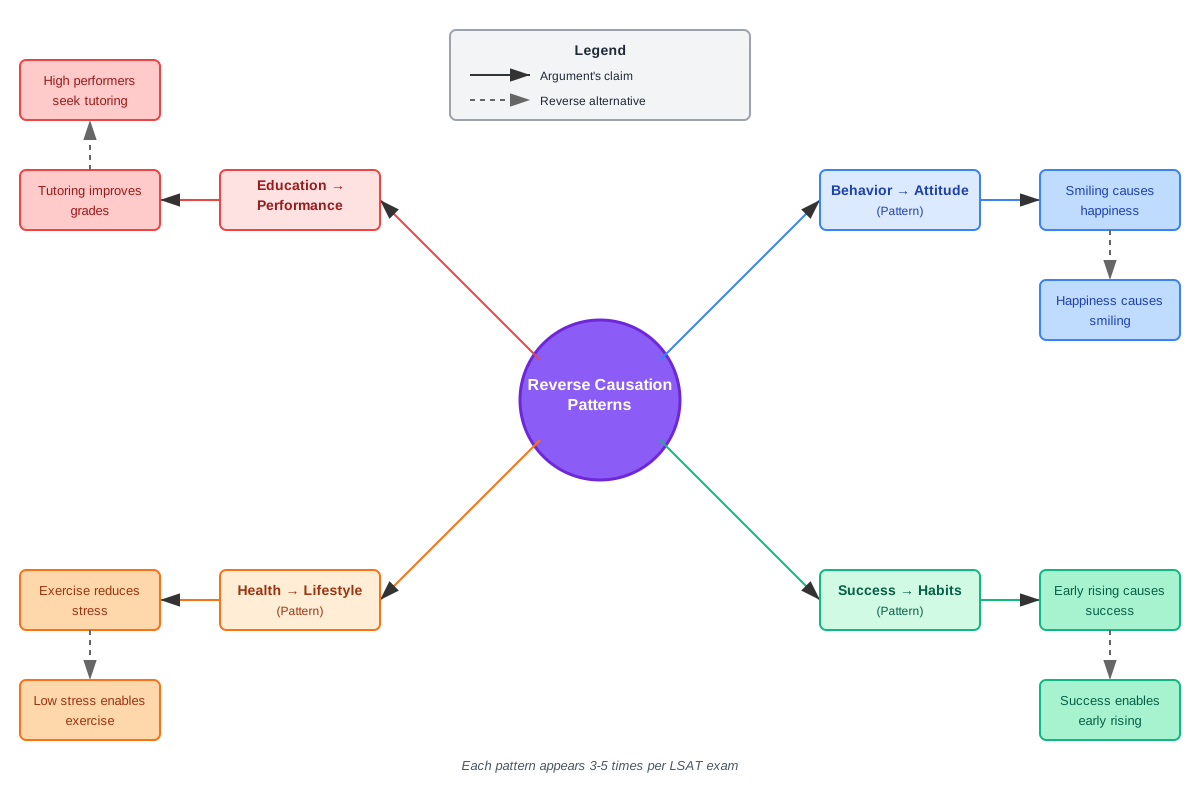
Understanding this reasoning pattern is essential because the LSAT frequently tests whether students can identify unstated assumptions that arguments rely upon to reach their conclusions. When an argument observes that two phenomena occur together and concludes one causes the other, it must assume away alternative explanations—including the possibility that causation runs in the opposite direction. For instance, if an argument claims "People who exercise regularly have lower stress levels; therefore, exercise reduces stress," it assumes that having lower stress doesn't cause people to exercise more frequently. Without recognizing this assumption, students cannot effectively evaluate the argument's logical structure.
This topic connects fundamentally to broader concepts in causal reasoning, including correlation versus causation, alternative explanations, and the sufficient conditions required for establishing causal claims. Mastering lsat no reverse causation assumptions enables students to deconstruct arguments more effectively, identify logical gaps, and select correct answers on some of the most challenging question types. This skill appears not only in assumption questions but also in strengthen, weaken, and flaw questions where causal reasoning plays a central role.
Learning Objectives
- [ ] Identify how No reverse causation assumptions appears in LSAT questions
- [ ] Explain the reasoning pattern behind No reverse causation assumptions
- [ ] Apply No reverse causation assumptions to solve LSAT-style problems accurately
- [ ] Distinguish between forward causation, reverse causation, and bidirectional causation in argument structures
- [ ] Recognize trigger language that signals potential reverse causation vulnerabilities
- [ ] Evaluate answer choices to determine which correctly identifies a reverse causation assumption
- [ ] Construct counterexamples that exploit reverse causation to weaken causal arguments
Prerequisites
- Basic understanding of causal reasoning: Recognizing when arguments make causal claims versus merely describing correlations is fundamental to identifying where reverse causation assumptions might exist.
- Familiarity with argument structure: Students must be able to identify premises, conclusions, and the logical gap between them to spot unstated assumptions.
- Knowledge of assumption question types: Understanding what makes something a "necessary assumption" versus a "sufficient assumption" helps determine when reverse causation represents a logical vulnerability.
- Correlation versus causation distinction: Recognizing that correlation does not establish causation provides the foundation for understanding why reverse causation remains a viable alternative explanation.
Why This Topic Matters
In real-world reasoning, reverse causation errors plague scientific studies, policy debates, and everyday decision-making. Consider the classic example: "Successful people wake up early; therefore, waking up early causes success." This reasoning fails to consider that success might enable people to structure their schedules differently, or that both factors might stem from a third cause. Recognizing reverse causation assumptions helps develop critical thinking skills applicable far beyond standardized testing.
On the LSAT, reverse causation assumptions appear with remarkable frequency. Approximately 15-20% of assumption questions involve some form of causal reasoning vulnerability, and reverse causation represents one of the most common patterns within this category. These questions appear across all three scored Logical Reasoning sections (in older LSAT formats) and continue to feature prominently in the current single Logical Reasoning section. The LSAT tests this concept because legal reasoning constantly requires evaluating causal claims—determining liability, establishing intent, or assessing policy consequences all depend on correctly identifying causal relationships.
This topic typically appears in several question formats: necessary assumption questions asking what the argument "requires" or "depends on," sufficient assumption questions seeking what would "allow the conclusion to be properly drawn," and flaw questions identifying errors in reasoning. The arguments often present observational data showing two phenomena occurring together, then conclude one causes the other without adequately ruling out reverse causation. Students who master this pattern gain significant strategic advantages, as these questions become highly predictable once the underlying structure is recognized.
Core Concepts
The Basic Structure of Reverse Causation
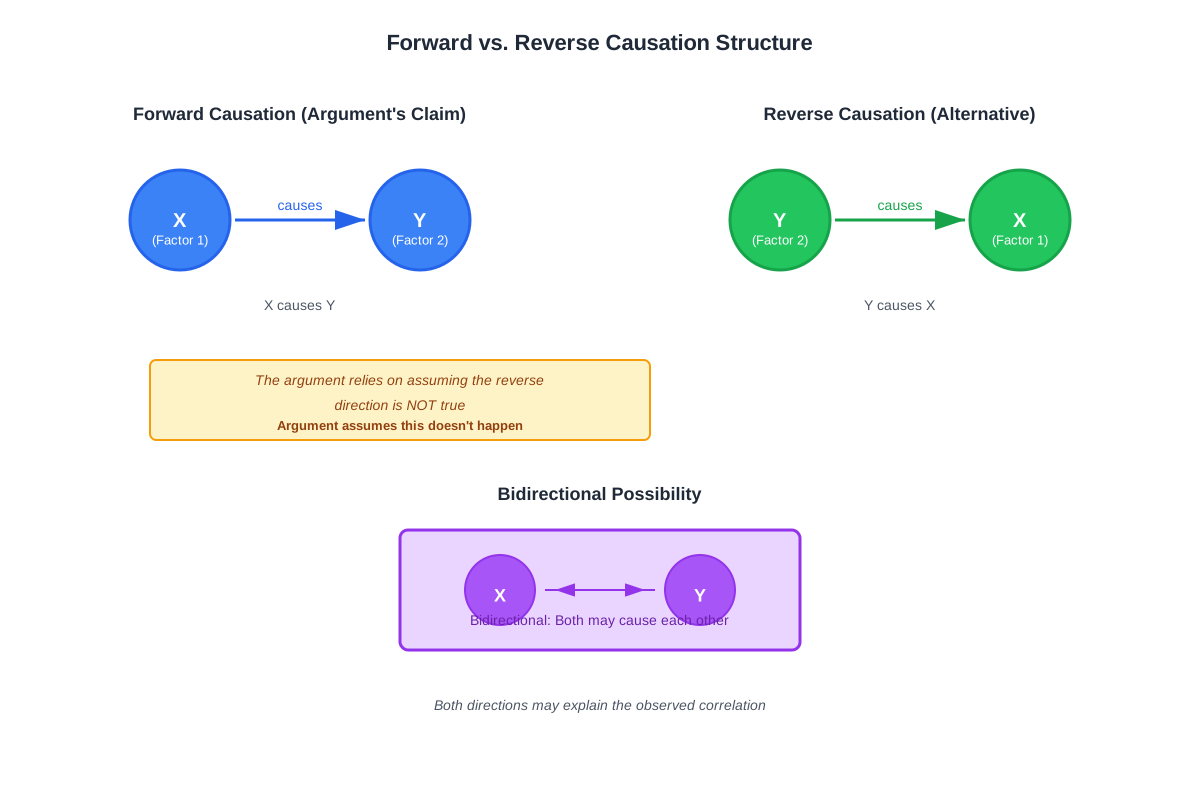
No reverse causation assumptions occur when an argument establishes a causal relationship in one direction (X → Y) while implicitly assuming the relationship doesn't run in the opposite direction (Y → X). The argument observes a correlation between two variables and attributes causation to one specific direction without justification for excluding the reverse possibility.
The fundamental logical structure follows this pattern:
- Premise: X and Y are correlated (they occur together)
- Conclusion: X causes Y
- Unstated Assumption: Y does not cause X
This assumption becomes necessary because if Y could cause X, the observed correlation could be explained without accepting the argument's causal conclusion. The argument's validity depends on ruling out this alternative explanation, even though the argument never explicitly addresses it.
Identifying Causal Language
Recognizing when arguments make causal claims is the first step in identifying potential reverse causation assumptions. Causal indicators include:
- "Causes," "leads to," "results in," "produces," "brings about"
- "Because of," "due to," "as a result of," "stems from"
- "Responsible for," "accounts for," "explains why"
- "Increases," "decreases," "raises," "lowers" (when implying causation)
When these terms appear, the argument asserts a directional relationship. The LSAT exploits the gap between correlation (which is bidirectional) and causation (which is unidirectional) to create logical vulnerabilities.
The Three Causal Possibilities
When two phenomena correlate, three primary explanations exist:
| Possibility | Description | Example |
|---|---|---|
| Forward Causation | X causes Y (the argument's conclusion) | Exercise causes reduced stress |
| Reverse Causation | Y causes X (the alternative the argument assumes away) | Reduced stress causes increased exercise |
| Common Cause | Z causes both X and Y | Genetic factors cause both exercise tendency and stress resilience |
Arguments vulnerable to reverse causation assumptions typically acknowledge only the first possibility while ignoring the second. The third possibility (common cause) represents a different type of assumption, though both often appear together in comprehensive causal reasoning.
How Reverse Causation Creates Logical Gaps
The logical gap emerges because correlation alone cannot establish causal direction. Consider this argument structure:
Premise: Studies show that people who read frequently have larger vocabularies.
Conclusion: Therefore, reading frequently causes vocabulary growth.
This argument assumes that having a larger vocabulary doesn't cause people to read more frequently. However, the reverse seems equally plausible: people with larger vocabularies might find reading more enjoyable and accessible, leading them to read more often. The observed correlation could result from either causal direction (or both operating simultaneously).
The assumption becomes necessary because if reverse causation were true, the conclusion wouldn't follow from the premise. The argument's logical structure collapses if the causal arrow points the opposite direction.
Distinguishing Reverse Causation from Other Assumptions
Reverse causation assumptions differ from other common assumption types:
- No alternative cause assumptions: These rule out third variables causing both observed phenomena, while reverse causation specifically addresses whether the effect might cause the supposed cause.
- Representative sample assumptions: These concern whether data accurately reflects the broader population, not the direction of causal relationships.
- Temporal assumptions: These address whether the cause preceded the effect, while reverse causation questions whether the roles of cause and effect are reversed.
Understanding these distinctions prevents confusion when evaluating answer choices. An answer choice might correctly identify an assumption the argument makes without being the reverse causation assumption specifically.
Bidirectional Causation
Some relationships involve bidirectional causation, where X causes Y and Y causes X, creating a feedback loop. For example, economic growth might increase educational investment, while educational investment promotes economic growth. When arguments ignore this possibility, they assume the relationship is unidirectional. This represents a more sophisticated version of the reverse causation assumption, where the argument presumes not just that Y doesn't cause X, but that causation flows exclusively in one direction.
Temporal Sequence and Reverse Causation
Arguments sometimes attempt to establish causal direction by showing temporal sequence—that X preceded Y. However, this doesn't always eliminate reverse causation concerns. Consider: "People who became anxious later developed insomnia; therefore, anxiety causes insomnia." Even with temporal sequence, reverse causation remains possible if early-stage insomnia (not yet diagnosed) caused the anxiety, or if both resulted from an earlier common cause. The temporal argument assumes that the measured timing reflects the actual causal sequence.
Concept Relationships
The concept of reverse causation assumptions connects intimately with the broader framework of causal reasoning in logical reasoning. Understanding correlation versus causation provides the foundation: correlation is symmetric (if X correlates with Y, then Y correlates with X), but causation is directional (X causing Y differs fundamentally from Y causing X). This asymmetry creates the logical space where reverse causation assumptions operate.
Relationship map:
- Correlation observation → Causal claim → Requires no reverse causation assumption
- No reverse causation assumption → Connects to no alternative cause assumption (both rule out competing explanations)
- Causal reasoning → Appears in assumption questions, strengthen/weaken questions, and flaw questions
- Reverse causation vulnerability → Can be exploited to weaken arguments or identified as a flaw
- Temporal sequence claims → Attempt to address reverse causation concerns (but don't always succeed)
The concept also relates to necessary versus sufficient assumptions. A reverse causation assumption is typically necessary—the argument requires it to be true for the conclusion to follow. If reverse causation were possible, the argument's conclusion wouldn't be supported by its premises. This distinguishes it from sufficient assumptions, which would guarantee the conclusion but aren't required for the argument's basic logical structure.
Within assumption questions specifically, reverse causation assumptions represent one of several predictable patterns. Others include assumptions about representativeness, about terms having consistent meanings, and about no alternative explanations existing. Recognizing these patterns enables systematic approach to assumption questions rather than relying on intuition alone.
High-Yield Facts
⭐ When an argument concludes X causes Y based on correlation, it necessarily assumes Y does not cause X.
⭐ Reverse causation assumptions are most vulnerable when both causal directions seem equally plausible from the evidence presented.
⭐ Temporal sequence (X before Y) does not automatically eliminate reverse causation if early stages of Y could have caused X.
⭐ Answer choices stating "assumes that [effect] is not a cause of [supposed cause]" typically identify reverse causation assumptions.
⭐ Arguments using causal language ("causes," "leads to," "results in") while presenting correlational evidence are prime candidates for reverse causation vulnerabilities.
- Reverse causation assumptions appear in approximately 15-20% of causal reasoning questions on the LSAT.
- Bidirectional causation (feedback loops) represents a more complex version where both causal directions operate simultaneously.
- Eliminating reverse causation doesn't prove forward causation—alternative causes might still explain the correlation.
- The negation test confirms reverse causation assumptions: if Y could cause X, the argument's conclusion no longer follows.
- Reverse causation assumptions differ from common cause assumptions, though arguments often make both simultaneously.
- Experimental design (randomization, control groups) attempts to eliminate reverse causation concerns in scientific contexts.
- Arguments about human behavior are particularly susceptible to reverse causation because psychological states often have reciprocal relationships.
Quick check — test yourself on No reverse causation assumptions so far.
Try Flashcards →Common Misconceptions
Misconception: If the argument shows X happened before Y, reverse causation is impossible.
Correction: Temporal sequence helps but doesn't eliminate reverse causation if early, undetected stages of Y could have caused X, or if both stem from an earlier common cause. The argument must assume the measured temporal sequence reflects the true causal sequence.
Misconception: Reverse causation assumptions only appear in necessary assumption questions.
Correction: While most common in necessary assumption questions, reverse causation reasoning appears in strengthen questions (evidence ruling out reverse causation strengthens the argument), weaken questions (evidence suggesting reverse causation weakens it), and flaw questions (failing to consider reverse causation constitutes a reasoning error).
Misconception: Identifying a reverse causation assumption means the argument is definitely wrong.
Correction: Identifying an assumption reveals what the argument depends on, not whether the conclusion is false. The argument might be correct; it simply requires this assumption to be valid. Assumptions represent logical gaps, not necessarily fatal flaws.
Misconception: All causal arguments make reverse causation assumptions.
Correction: Only arguments that conclude causation from correlational evidence make this assumption. Arguments that provide mechanistic explanations, experimental evidence, or other support for causal direction may not rely on assuming away reverse causation.
Misconception: Reverse causation and common cause assumptions are the same thing.
Correction: These are distinct assumptions. Reverse causation assumes Y doesn't cause X (reversing the proposed causal arrow), while common cause assumes no third variable Z causes both X and Y. An argument might make one, both, or neither assumption depending on its structure.
Misconception: Strong correlation makes reverse causation less likely.
Correction: Correlation strength indicates how reliably X and Y occur together but says nothing about causal direction. Even perfect correlation (1.0) doesn't establish whether X causes Y, Y causes X, or both result from a common cause.
Worked Examples
Example 1: Classic Reverse Causation
Argument: "Recent studies have found that employees who work in offices with windows report higher job satisfaction than those in windowless offices. Therefore, having windows in the office causes increased job satisfaction."
Question: Which of the following is an assumption required by the argument?
Answer Choices:
(A) Employees who are satisfied with their jobs are not more likely to seek out offices with windows.
(B) Job satisfaction is the most important factor in employee retention.
(C) Offices with windows are not more expensive to rent than windowless offices.
(D) Natural light has psychological benefits for most people.
(E) The studies included a representative sample of office workers.
Analysis:
Step 1: Identify the argument structure.
- Premise: Correlation between windows and job satisfaction
- Conclusion: Windows cause job satisfaction (causal claim)
Step 2: Recognize the causal reasoning pattern.
The argument moves from correlation to causation, making it vulnerable to reverse causation.
Step 3: Articulate the reverse causation assumption.
The argument assumes that job satisfaction doesn't cause employees to obtain offices with windows. If satisfied employees were more likely to secure windowed offices (perhaps because satisfaction correlates with seniority or performance), the correlation could be explained without windows causing satisfaction.
Step 4: Evaluate answer choices.
- (A) Directly states the reverse causation assumption—the argument requires that satisfaction doesn't cause window access. CORRECT
- (B) Addresses importance of satisfaction but doesn't address the causal direction issue.
- (C) Concerns cost, which is irrelevant to whether windows cause satisfaction.
- (D) Would strengthen the argument but isn't necessary—the argument could work even without this being true.
- (E) Addresses sample representativeness, a different assumption type.
Step 5: Apply the negation test.
If we negate (A): "Employees who are satisfied ARE more likely to seek out offices with windows." This would destroy the argument because it provides an alternative explanation for the correlation. This confirms (A) is a necessary assumption.
Connection to learning objectives: This example demonstrates identifying reverse causation in LSAT questions, explaining the reasoning pattern (correlation to causation with unstated directional assumption), and applying the concept to select the correct answer.
Example 2: Temporal Sequence Complication
Argument: "A longitudinal study tracked 1,000 adults over ten years. Researchers found that participants who developed chronic pain during the study period were significantly more likely to experience depression afterward. This demonstrates that chronic pain causes depression."
Question: The argument's reasoning is most vulnerable to criticism on the grounds that it fails to consider whether:
Answer Choices:
(A) Depression might have causes other than chronic pain.
(B) The early stages of depression might have increased sensitivity to pain, leading to chronic pain diagnoses.
(C) Some participants might have experienced both chronic pain and depression before the study began.
(D) The sample size was adequate to draw reliable conclusions.
(E) Chronic pain affects all individuals in the same way.
Analysis:
Step 1: Identify the argument structure.
- Premise: Temporal sequence—pain developed, then depression followed
- Conclusion: Pain causes depression
Step 2: Recognize the sophisticated reverse causation pattern.
The argument uses temporal sequence to suggest causal direction, but this doesn't eliminate reverse causation if early-stage depression (not yet diagnosed) could have caused increased pain sensitivity or pain reporting.
Step 3: Evaluate answer choices.
- (A) Identifies alternative causes (common cause assumption), not reverse causation.
- (B) Identifies the reverse causation possibility despite temporal sequence—early depression causing pain rather than pain causing depression. CORRECT
- (C) Addresses pre-existing conditions but doesn't challenge the causal direction for those who developed conditions during the study.
- (D) Concerns sample size adequacy, not causal direction.
- (E) Addresses variation in effects, not whether the causal direction is correct.
Step 4: Understand why temporal sequence doesn't eliminate the vulnerability.
Even though depression was measured after pain chronicity, subclinical depression could have existed earlier, affecting pain perception and reporting. The argument assumes the measured temporal sequence reflects the true causal sequence—a form of reverse causation assumption.
Connection to learning objectives: This example shows how reverse causation assumptions can persist even when arguments attempt to establish causal direction through temporal sequence, demonstrating sophisticated application of the concept.
Exam Strategy
Recognizing Reverse Causation Questions
Trigger phrases in question stems that often signal reverse causation:
- "Assumes that..." or "depends on the assumption that..."
- "Requires which of the following?"
- "Vulnerable to criticism on the grounds that it fails to consider..."
- "Takes for granted that..."
Trigger patterns in arguments:
- Causal language ("causes," "leads to," "results in") combined with correlational evidence
- Studies showing two phenomena occurring together
- Conclusions about what "explains" or "accounts for" an observed pattern
- Arguments lacking mechanistic explanations for how causation operates
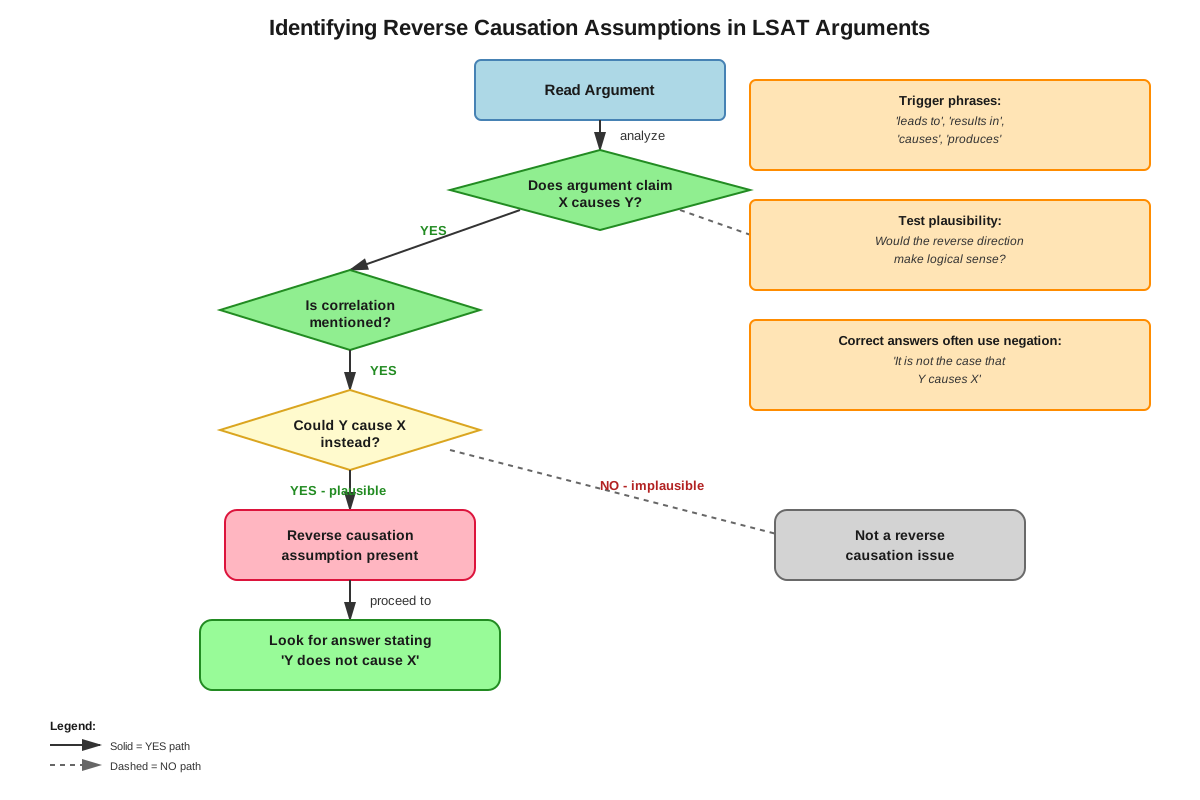
Systematic Approach
- Identify the conclusion: Locate the causal claim (X causes Y).
- Examine the evidence: Determine whether premises provide correlational data or actual causal evidence.
- Ask the reverse causation question: "Could Y cause X instead?" If this seems plausible, the argument likely makes a reverse causation assumption.
- Predict the answer: Before reading choices, articulate: "The argument assumes Y doesn't cause X."
- Evaluate choices systematically: Look for answers stating the effect doesn't cause the supposed cause.
Process of Elimination Tips
Eliminate answers that:
- Address different assumption types (representativeness, alternative causes, term consistency)
- Strengthen the argument without being necessary for it
- Introduce irrelevant considerations (cost, ethics, frequency)
- Are too extreme or absolute when the argument requires only modest assumptions
Favor answers that:
- Explicitly address causal direction
- Use language like "is not a cause of" or "does not lead to"
- Directly connect the conclusion's effect to its supposed cause
- Pass the negation test (negating them destroys the argument)
Time Allocation
Reverse causation questions typically require 60-90 seconds once the pattern is recognized. Spend:
- 15-20 seconds: Reading and identifying the argument structure
- 10-15 seconds: Recognizing the causal reasoning pattern and predicting the assumption
- 25-40 seconds: Evaluating answer choices
- 10-15 seconds: Confirming with negation test if needed
Exam Tip: If you identify causal language in the conclusion but only correlational evidence in the premises, immediately consider reverse causation. This pattern recognition can save 20-30 seconds per question.
Common Wrong Answer Patterns
Alternative cause answers: These state "assumes no other factor causes Y" rather than "assumes Y doesn't cause X." While arguments often make both assumptions, the question might specifically target reverse causation.
Sufficient but not necessary answers: These would guarantee the conclusion if true but aren't required for the argument's basic logic. Reverse causation assumptions are necessary—the argument collapses without them.
Scope mismatches: Answers addressing different variables than those in the causal claim, or addressing frequency/magnitude rather than causal direction.
Memory Techniques
The "Arrow Flip" Visualization
When you see a causal argument, visualize: X → Y
Immediately ask: "Does the argument assume it's not Y → X?"
Picture flipping the arrow. If the flipped version seems plausible, the argument makes a reverse causation assumption.
The "CAUSE" Acronym
Correlation presented
Argument claims causation
Unstated assumption about direction
Supposed cause might be effect
Evaluate whether effect could cause the supposed cause
The Negation Shortcut
For any suspected reverse causation assumption, quickly negate it: "What if the effect DOES cause the supposed cause?" If this destroys the argument, you've identified a necessary assumption.
The "Job Interview" Analogy
Remember: "Successful people interview well" could mean success causes interview skills OR interview skills cause success. Just like this everyday example, LSAT arguments often present correlations where causation could run either direction. This relatable analogy helps recall the concept under test pressure.
Rhyme for Retention
"When causes are claimed from patterns observed,
Remember the arrow might be reversed."
Summary
No reverse causation assumptions represent a fundamental pattern in LSAT logical reasoning, particularly within assumption questions. When arguments conclude that X causes Y based on correlational evidence, they necessarily assume that Y does not cause X—that the causal arrow points in only one direction. This assumption becomes vulnerable when the reverse causal relationship could equally explain the observed correlation. Recognizing this pattern requires identifying causal language in conclusions, examining whether premises provide genuine causal evidence or merely correlational data, and asking whether the supposed effect could plausibly cause the supposed cause. The LSAT tests this concept extensively because legal reasoning constantly requires evaluating causal claims, and reverse causation represents one of the most common logical vulnerabilities in causal arguments. Mastering this topic enables students to systematically approach causal reasoning questions, predict correct answers before reading choices, and eliminate wrong answers efficiently. The key insight is that correlation is bidirectional while causation is unidirectional, creating a logical gap that arguments must bridge through assumptions about causal direction.
Key Takeaways
- Causal conclusions from correlational evidence always require assuming the causal arrow doesn't point in the reverse direction—this is the core principle underlying all reverse causation questions.
- Temporal sequence helps establish causation but doesn't eliminate reverse causation if early stages of the effect could have caused the supposed cause—sophisticated LSAT questions exploit this limitation.
- Answer choices stating "assumes [effect] does not cause [supposed cause]" typically identify reverse causation assumptions—this language pattern signals correct answers.
- The negation test confirms reverse causation assumptions: if the effect COULD cause the supposed cause, the argument collapses—use this to verify suspected assumptions.
- Reverse causation differs from common cause assumptions—the former addresses whether Y causes X, while the latter addresses whether Z causes both X and Y.
- Approximately 15-20% of causal reasoning questions involve reverse causation—making this a high-yield pattern worth mastering thoroughly.
- Recognizing causal language ("causes," "leads to," "results in") paired with correlational evidence immediately signals potential reverse causation vulnerabilities—this pattern recognition accelerates question solving.
Related Topics
Common Cause Assumptions: After mastering reverse causation, students should study how arguments assume no third variable causes both observed phenomena. This completes the framework of causal reasoning vulnerabilities.
Strengthen and Weaken Questions with Causal Reasoning: Understanding reverse causation assumptions enables more sophisticated analysis of how evidence can support or undermine causal arguments.
Flaw Questions: Reverse causation frequently appears as a reasoning flaw—"fails to consider that the supposed effect might cause the supposed cause." Mastering the assumption version facilitates recognizing the flaw version.
Necessary vs. Sufficient Assumptions: Deepening understanding of assumption types helps distinguish when reverse causation represents a necessary assumption versus when other assumption types are being tested.
Conditional Reasoning and Causation: Exploring how causal relationships differ from conditional relationships (if-then statements) prevents confusion between these distinct logical structures.
Practice CTA
Now that you understand the reasoning pattern behind no reverse causation assumptions, it's time to cement this knowledge through active practice. Attempt the practice questions associated with this topic, focusing on identifying causal language, articulating the reverse causation assumption before reading answer choices, and applying the negation test to confirm your selections. Use the flashcards to reinforce trigger phrases and common wrong answer patterns. Remember: recognizing this pattern becomes automatic with deliberate practice, transforming these questions from challenging puzzles into reliable points on test day. Each practice question you complete strengthens your ability to spot reverse causation assumptions instantly, giving you a significant strategic advantage on one of the LSAT's most frequently tested reasoning patterns.
Sign up free to keep reading
Create a free AnvayaPrep account to finish this LSAT guide on No reverse causation assumptions — plus flashcards and practice questions.