Overview
Overly broad assumptions represent one of the most frequently tested vulnerabilities in logical reasoning on the LSAT. These assumptions occur when an argument's reasoning jumps from specific evidence to a sweeping generalization that extends far beyond what the premises actually support. Understanding this pattern is crucial because the LSAT consistently tests whether students can identify when an argument relies on an assumption that is unnecessarily expansive or universal in scope.
In the context of assumption questions, recognizing overly broad assumptions allows test-takers to pinpoint the exact gap between an argument's evidence and its conclusion. The LSAT frequently presents arguments that move from limited observations (such as a study of one demographic group) to broad conclusions (about all people everywhere), or from specific circumstances to universal principles. These logical leaps require assumptions that claim "what's true in this narrow case is true in all cases"—assumptions that are vulnerable precisely because of their excessive scope.
This topic connects intimately with other Logical Reasoning concepts including necessary assumptions, sufficient assumptions, and flaw identification. While necessary assumption questions ask what must be true for an argument to work, overly broad assumptions often represent the difference between what must minimally be true and what the argument actually assumes. Similarly, many strengthen and weaken questions hinge on whether evidence can support or undermine these expansive claims. Mastering LSAT overly broad assumptions provides a framework for analyzing argument scope across multiple question types, making it a high-leverage skill for improving overall Logical Reasoning performance.
Learning Objectives
- [ ] Identify how overly broad assumptions appears in LSAT questions
- [ ] Explain the reasoning pattern behind overly broad assumptions
- [ ] Apply overly broad assumptions to solve LSAT-style problems accurately
- [ ] Distinguish between appropriately scoped assumptions and overly broad ones
- [ ] Recognize the specific language markers that signal overly broad assumptions
- [ ] Evaluate answer choices by assessing whether they address scope issues in arguments
- [ ] Predict the most likely overly broad assumption before reviewing answer choices
Prerequisites
- Basic argument structure: Understanding premises, conclusions, and the gap between them is essential because overly broad assumptions specifically concern how premises fail to fully support conclusions.
- Necessary vs. sufficient conditions: Recognizing the difference helps identify when arguments assume something must always be true (sufficient) rather than just in the specific case discussed.
- Scope and degree concepts: Familiarity with how arguments can shift in scope (from specific to general) or degree (from "some" to "all") provides the foundation for recognizing when assumptions become overly broad.
- Standard assumption question formats: Knowing how the LSAT phrases assumption questions ("assumes which one of the following," "depends on assuming that") enables efficient question recognition.
Why This Topic Matters
Overly broad assumptions appear with remarkable frequency on the LSAT, making them one of the highest-yield patterns to master. Approximately 15-20% of all Logical Reasoning questions involve identifying, evaluating, or exploiting overly broad assumptions. This pattern appears across multiple question types: assumption questions (both necessary and sufficient), flaw questions, strengthen/weaken questions, and even some parallel reasoning questions.
In real-world contexts, recognizing overly broad assumptions is fundamental to critical thinking in law, policy, and business. Attorneys must identify when opposing counsel makes sweeping claims based on limited evidence. Policymakers must avoid generalizing from narrow studies to entire populations. The skill of scope analysis—determining whether a conclusion legitimately follows from its premises or requires an overly expansive assumption—transfers directly to legal reasoning and case analysis.
On the LSAT specifically, overly broad assumptions commonly appear in arguments about:
- Scientific studies that generalize from limited samples to entire populations
- Historical examples used to support universal principles
- Expert testimony in one domain applied to unrelated domains
- Causal claims that assume no alternative explanations exist
- Recommendations that assume what worked in one context will work everywhere
The test-makers favor this pattern because it tests genuine analytical ability rather than memorized content. Students who can quickly identify scope shifts and overly expansive claims gain significant time advantages and accuracy improvements across the Logical Reasoning section.
Core Concepts
Definition and Structure of Overly Broad Assumptions
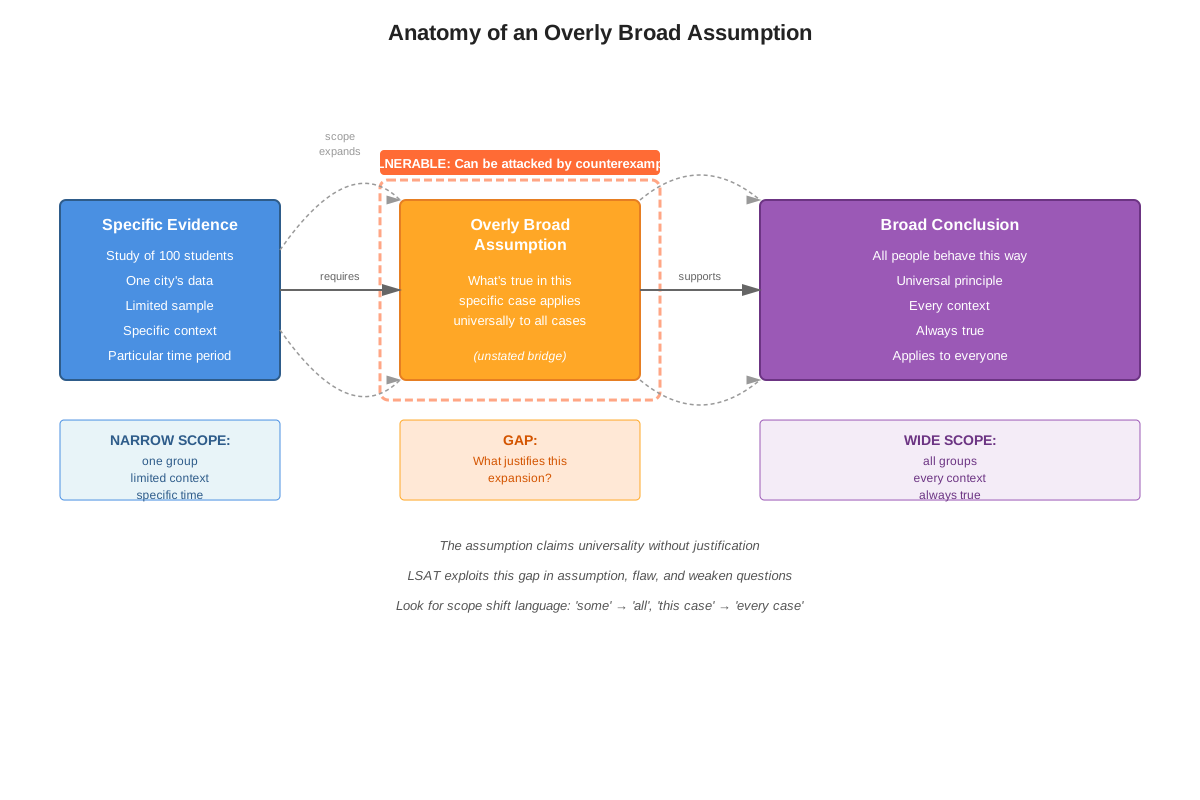
An overly broad assumption is an unstated premise that extends beyond what is necessary to connect an argument's evidence to its conclusion. These assumptions claim universality, completeness, or applicability across contexts when the argument's premises only support a more limited claim. The defining characteristic is excessive scope—the assumption covers more ground than the evidence warrants.
The structure typically follows this pattern:
- Premise: Evidence about a specific case, limited sample, or particular context
- Conclusion: A claim that applies more broadly than the premise
- Overly Broad Assumption: An unstated belief that what's true in the specific case is true universally, or that no exceptions or alternative factors exist
For example:
- Premise: A study of 100 college students showed improved memory after taking vitamin B12
- Conclusion: Everyone should take vitamin B12 to improve their memory
- Overly Broad Assumption: What worked for these 100 college students will work for all people (children, elderly, those with different health conditions, etc.)
The Scope Gap: Specific to General
The most common manifestation of overly broad assumptions involves a scope gap where premises discuss a narrow category but the conclusion addresses a much wider one. This creates a logical vulnerability that LSAT questions exploit.
| Premise Scope | Conclusion Scope | Overly Broad Assumption |
|---|---|---|
| One company's experience | All businesses | Assumes no relevant differences between this company and all others |
| Urban areas | All geographic locations | Assumes rural, suburban, and other areas are identical to urban ones |
| Current conditions | All time periods | Assumes conditions won't change or have never been different |
| One expert's opinion | Universal truth | Assumes this expert is infallible and no other perspectives matter |
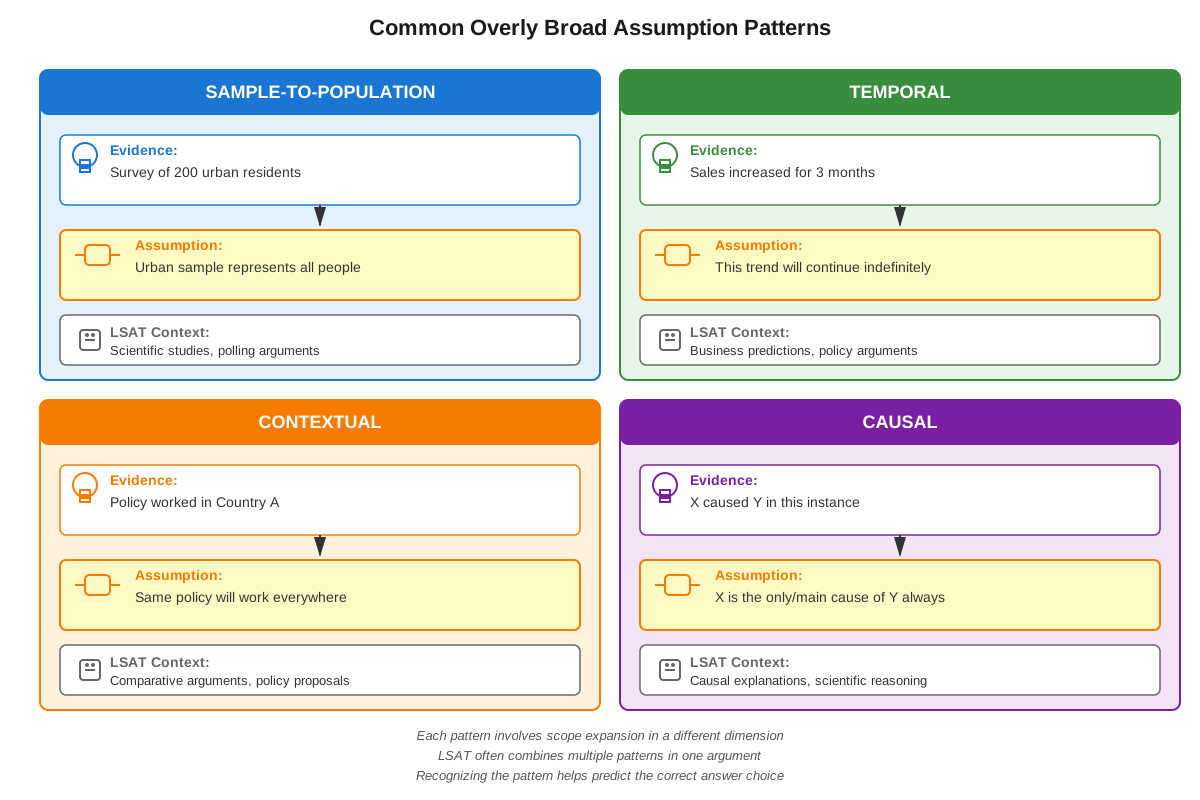
Temporal and Contextual Overgeneralization
Overly broad assumptions frequently involve temporal overgeneralization—assuming that what's true now has always been true or will always remain true. Arguments might cite current trends and conclude they're permanent, or reference historical examples and assume those lessons apply unchanged to modern contexts.
Similarly, contextual overgeneralization occurs when arguments assume that factors relevant in one setting are equally relevant in all settings. An argument might discuss what motivates employees in tech startups and conclude the same factors motivate all workers, ignoring differences in industry, culture, age demographics, and economic conditions.
The "No Exceptions" Assumption
Many overly broad assumptions take the form of implicit "no exceptions" claims. The argument proceeds as if:
- No counterexamples exist to the pattern described
- No alternative explanations could account for the evidence
- No relevant differences distinguish the cases being compared
- No limiting factors constrain the conclusion's applicability
For instance, an argument concluding that "exercise prevents depression" based on a correlation study assumes there are no cases where exercise fails to prevent depression, no other factors that might explain the correlation, and no differences between study participants and the general population.
Degree Shifts and Quantifier Inflation
Overly broad assumptions often involve degree shifts where premises support a modest claim but the conclusion makes a stronger one:
- Premise uses "some," "many," or "often" → Conclusion uses "all," "always," or "never"
- Premise shows "correlation" → Conclusion claims "causation"
- Premise demonstrates "can" or "might" → Conclusion asserts "will" or "must"
This quantifier inflation requires assuming that what's true to some degree is true absolutely, or that what's possible is inevitable—both overly broad leaps.
Comparative Assumptions
When arguments compare two things and conclude one is superior or that a strategy successful in one context will work in another, they often rely on comparative assumptions that are overly broad. These assumptions claim:
- The two things being compared are similar in all relevant respects
- No significant differences exist that would affect the comparison
- Success factors from one context transfer completely to another
For example: "City A reduced traffic by building a subway system. Therefore, City B should build a subway to reduce its traffic." This assumes Cities A and B are sufficiently similar in population density, geography, existing infrastructure, budget, and citizen preferences—an overly broad assumption that ignores potentially crucial differences.
Concept Relationships
The concepts within overly broad assumptions form an interconnected system. Scope gaps serve as the foundation, representing the fundamental mismatch between premise and conclusion scope. These gaps manifest through specific patterns: temporal overgeneralization (scope across time), contextual overgeneralization (scope across situations), and degree shifts (scope of intensity or frequency).
The "no exceptions" assumption acts as the mechanism that enables these scope gaps—it's the implicit claim that allows arguments to leap from specific to general. Comparative assumptions represent a special case where the scope gap involves assuming similarity between two distinct entities or contexts.
This topic connects to prerequisite knowledge through:
- Argument structure → Overly broad assumptions represent a specific type of gap between premises and conclusions
- Necessary vs. sufficient conditions → Overly broad assumptions often confuse what's sufficient in one case with what's necessary in all cases
- Scope and degree → These foundational concepts directly enable recognition of when assumptions become overly broad
The relationship map flows as follows:
Specific Evidence → requires → Scope Gap → filled by → Overly Broad Assumption → manifests as → Temporal/Contextual Overgeneralization, Degree Shifts, or No Exceptions Claims → vulnerable to → Counterexamples, Alternative Explanations, or Relevant Differences
High-Yield Facts
⭐ Overly broad assumptions most commonly involve generalizing from a limited sample or specific context to a universal conclusion without justification for the scope expansion.
⭐ The presence of absolute language in conclusions ("all," "always," "never," "only") paired with qualified language in premises ("some," "many," "often") signals a likely overly broad assumption.
⭐ Arguments that cite a single example, study, or expert opinion and draw broad conclusions almost always rely on overly broad assumptions about representativeness or universal applicability.
⭐ Temporal scope shifts—assuming current conditions are permanent or historical patterns will continue unchanged—represent one of the three most common forms of overly broad assumptions on the LSAT.
⭐ Comparative arguments that recommend adopting a strategy successful elsewhere assume no relevant differences exist between contexts, which is typically an overly broad assumption.
- Overly broad assumptions differ from necessary assumptions in degree: a necessary assumption is the minimum required, while an overly broad assumption claims more than necessary.
- Correct answers to assumption questions addressing overly broad assumptions often include limiting language ("in most cases," "generally," "typically") rather than absolute claims.
- Flaw questions frequently describe overly broad assumptions using phrases like "takes for granted that," "presumes without justification that," or "fails to consider that."
- Strengthen questions can be answered by providing evidence that the assumed broad applicability is actually justified (narrowing the scope gap).
- Weaken questions targeting overly broad assumptions typically present counterexamples, relevant differences, or alternative explanations that show the assumption doesn't hold universally.
- Arguments about causation almost always contain overly broad assumptions that no alternative causes exist or that the causal relationship holds in all cases.
- Expert opinion arguments frequently assume the expert's knowledge in one domain transfers completely to related domains—an overly broad assumption about expertise scope.
- Statistical arguments often assume that sample characteristics perfectly represent population characteristics, which is typically overly broad without evidence of representative sampling.
Quick check — test yourself on Overly broad assumptions so far.
Try Flashcards →Common Misconceptions
Misconception: Any assumption in an argument is automatically an overly broad assumption.
Correction: Not all assumptions are overly broad. Arguments require assumptions to connect premises to conclusions, but only those assumptions that claim more universality or applicability than the evidence supports qualify as overly broad. An assumption can be necessary and appropriately scoped.
Misconception: Overly broad assumptions only appear in assumption questions.
Correction: While assumption questions directly test this concept, overly broad assumptions appear across question types. Flaw questions ask students to identify the overly broad assumption as a reasoning error. Strengthen/weaken questions often hinge on whether evidence supports or undermines an overly broad assumption. Even some method of reasoning questions describe arguments that rely on overly broad generalizations.
Misconception: If an argument mentions "some" or "many" in its conclusion, it cannot contain an overly broad assumption.
Correction: Overly broad assumptions can exist even when conclusions use qualified language. The issue is whether the scope of the conclusion exceeds what the premises support. An argument might have premises about one specific case and conclude "many cases are similar," which still requires the overly broad assumption that this one case is representative of many others.
Misconception: The correct answer to an assumption question will always explicitly state "not all cases are different" or similar limiting language.
Correction: While correct answers often include appropriate scope limitations, they may also address the overly broad assumption by stating what must be true for the argument to work without explicitly calling out the scope issue. The key is identifying answers that, if false, would reveal the assumption as overly broad.
Misconception: Overly broad assumptions are always about generalizing from small samples to large populations.
Correction: While sample-to-population generalization is common, overly broad assumptions take many forms: assuming no exceptions exist, assuming temporal permanence, assuming contextual similarity, assuming expert infallibility, assuming no alternative explanations, and assuming causal relationships are universal. Recognizing the variety of manifestations is crucial for comprehensive mastery.
Misconception: If an argument cites an expert or study, it cannot be making an overly broad assumption.
Correction: Arguments citing experts or studies frequently make overly broad assumptions about the applicability of that expertise or research. They might assume one study's findings apply to all populations, or that an expert's knowledge in one domain extends to all related domains. The presence of authoritative sources doesn't eliminate scope issues.
Worked Examples
Example 1: Scientific Study Generalization
Argument: "A recent study of 200 adults aged 25-35 in urban areas found that those who meditated for 20 minutes daily reported lower stress levels than those who did not meditate. Therefore, meditation is an effective stress-reduction technique for people."
Question: Which one of the following is an assumption required by the argument?
Analysis:
- Identify the premise scope: The study examined 200 adults, specifically aged 25-35, specifically in urban areas
- Identify the conclusion scope: "People" (all people, or at least people generally)
- Recognize the scope gap: The conclusion extends from a narrow demographic (young urban adults) to people broadly
- Identify the overly broad assumption: The argument assumes what's true for 25-35-year-old urban adults is true for people generally—including children, elderly, rural residents, etc.
Predicted answer: The argument must assume that the results from this specific demographic are representative of people more broadly, or that there are no relevant differences between this study group and other populations that would affect meditation's effectiveness.
Evaluation of answer choices:
- (A) "Most people experience stress in their daily lives" - This doesn't address the scope gap between the study population and "people" generally. Even if true, it doesn't justify extending the study's findings.
- (B) "The stress-reduction benefits observed in 25-35-year-old urban adults apply to people of other ages and living situations" - ⭐ CORRECT. This directly addresses the overly broad assumption by stating that the specific study population's results extend to the broader population referenced in the conclusion.
- (C) "Meditation has no negative side effects" - This is irrelevant to whether the scope expansion is justified.
- (D) "The study participants accurately reported their stress levels" - This addresses study validity but not the scope gap.
Connection to learning objectives: This example demonstrates how to identify overly broad assumptions (objective 1), explains the reasoning pattern of generalizing from limited samples (objective 2), and shows the application process for solving assumption questions (objective 3).
Example 2: Historical Analogy
Argument: "In the 1950s, City X addressed its housing shortage by relaxing zoning regulations, which led to a construction boom and solved the problem within five years. City Y currently faces a housing shortage. Therefore, City Y should relax its zoning regulations to solve its housing crisis."
Question: The argument's reasoning is most vulnerable to criticism on the grounds that it:
Analysis:
- Identify the premise scope: One city (X) in one time period (1950s) with one successful outcome
- Identify the conclusion scope: A different city (Y) in a different time period (current) should adopt the same strategy
- Recognize the scope gap: The argument moves from one specific historical case to a recommendation for a different context
- Identify the overly broad assumption: The argument assumes that the factors that made the strategy successful in 1950s City X are present in current City Y—that no relevant differences exist between the contexts
Predicted answer: The flaw involves assuming that what worked in one specific historical context will work in a different context without considering potentially relevant differences in economic conditions, construction costs, available land, population growth rates, or other factors.
Evaluation of answer choices:
- (A) "fails to consider that correlation does not establish causation" - While the argument does assume causation, the primary vulnerability is the scope issue, not the causal inference itself.
- (B) "takes for granted that no relevant differences exist between City X in the 1950s and City Y today that would affect whether relaxing zoning regulations would be successful" - ⭐ CORRECT. This precisely identifies the overly broad assumption that the historical case directly applies to the current situation.
- (C) "relies on the testimony of experts without establishing their credentials" - No experts are mentioned.
- (D) "assumes that housing shortages have only one cause" - The argument doesn't make claims about causes of shortages, only about solutions.
Connection to learning objectives: This example shows how overly broad assumptions appear in comparative/analogical reasoning (objective 1), demonstrates the pattern of assuming contextual similarity without justification (objective 2), and illustrates application to flaw questions (objective 3).
Exam Strategy
Systematic Approach to Overly Broad Assumption Questions
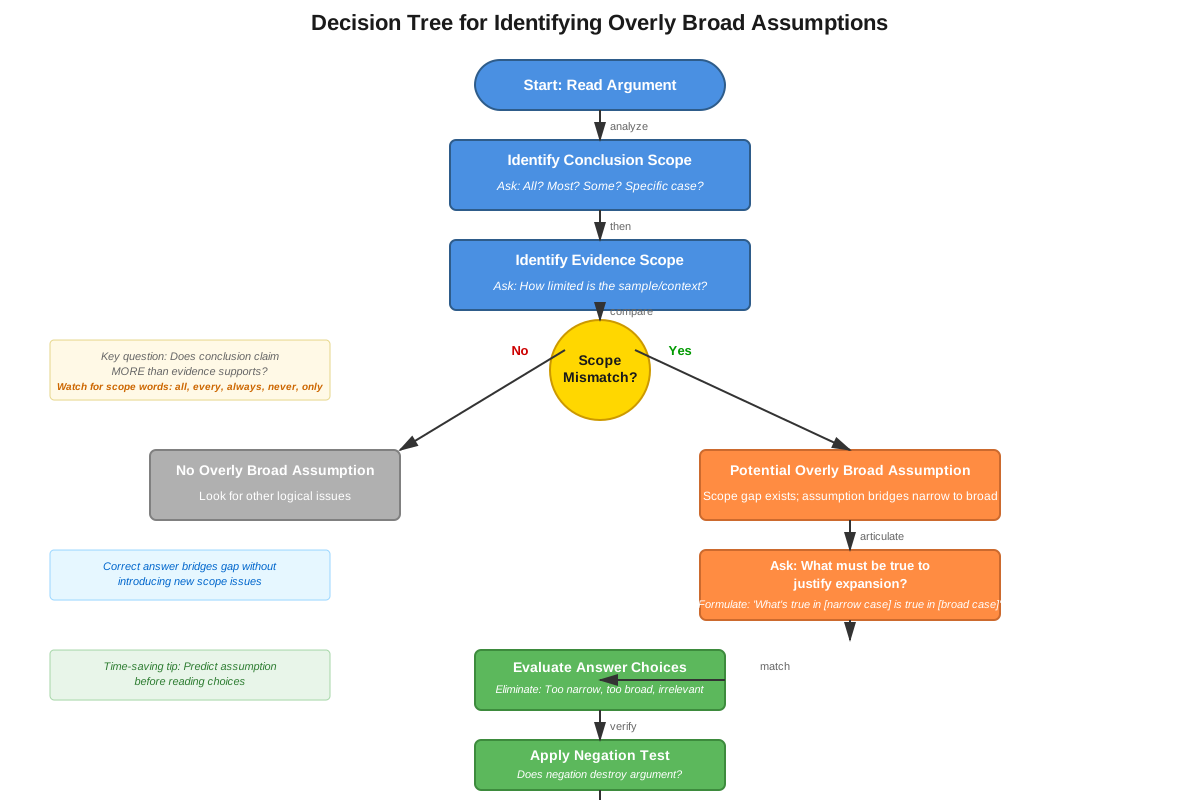
When encountering any Logical Reasoning question, immediately assess whether scope issues might be relevant:
- Read the conclusion first to identify its scope (who/what/when/where it applies to)
- Read the premises and note their scope
- Compare scopes - if the conclusion is broader than the premises, an overly broad assumption likely exists
- Predict the assumption before reading answer choices: "This argument assumes that [specific premise scope] applies to [broader conclusion scope]"
- Evaluate answer choices by testing whether they address the scope gap
Trigger Words and Phrases
In conclusions, watch for:
- Absolute quantifiers: "all," "every," "always," "never," "only," "must"
- Universal recommendations: "should," "ought to," "needs to"
- Broad categories: "people," "businesses," "governments" (without qualifiers)
- Temporal universality: "will," "is" (implying permanence)
In premises, watch for:
- Qualified quantifiers: "some," "many," "often," "typically"
- Specific examples: "one study," "a recent case," "in this instance"
- Limited contexts: specific locations, time periods, demographics
- Single sources: "one expert," "a researcher," "according to"
The gap between these signals an overly broad assumption.
Process of Elimination Strategy
For assumption questions:
- Eliminate answers that are too narrow - they don't bridge the scope gap
- Eliminate answers that are irrelevant to the scope issue
- Eliminate answers that are overly broad themselves - correct answers often include appropriate limiting language
- Keep answers that address the specific scope gap identified in your prediction
For flaw questions:
- Eliminate answers describing flaws not present in the argument
- Keep answers that mention: "takes for granted," "presumes without justification," "fails to consider," "overlooks the possibility"
- Prioritize answers that explicitly mention scope issues, generalization, or assuming similarity
Time Allocation
Overly broad assumption questions should take approximately 1:00-1:30 minutes:
- 20 seconds: Read and identify question type
- 30 seconds: Read argument, identify scope gap, predict assumption
- 30-40 seconds: Evaluate answer choices using prediction
If stuck between two answers, apply the negation test for assumption questions: negate each answer and see which one, when negated, destroys the argument. The correct assumption, when negated, will make the argument fall apart by exposing the scope gap as unjustified.
Memory Techniques
The SCOPE Acronym
Specific premises → Conclusion Overgeneralizes → Presuming Expansion is justified
This reminds you that overly broad assumptions involve specific evidence, overgeneralized conclusions, and the presumption that expanding scope is warranted.
The "Three Ts" of Overgeneralization
Temporal: Assuming time doesn't matter (past = present = future)
Territorial: Assuming place doesn't matter (here = there = everywhere)
Typological: Assuming type doesn't matter (this case = all cases)
Visualization Strategy
Picture the argument as a spotlight:
- The premises illuminate a small, specific area (one study, one example, one context)
- The conclusion claims to illuminate a vast area (all people, all situations, all times)
- The overly broad assumption is the unjustified belief that the small spotlight actually covers the vast area
When you see a scope gap, visualize this spotlight expanding without justification—this makes the logical flaw concrete and memorable.
The "Representative" Question
For any argument generalizing from specific to general, ask: "Is this case REPRESENTATIVE?"
- Relevant similarities exist?
- Exceptions ruled out?
- Population characteristics matched?
- Replicable in other contexts?
- Evidence of broad applicability?
- Sample size adequate?
- External factors controlled?
- No alternative explanations?
- Temporal stability established?
- Assumptions about similarity justified?
- Transferability demonstrated?
- Inferences appropriately limited?
- Variability accounted for?
- Expertise domain appropriate?
If the answer to these questions is "no" or "unclear," an overly broad assumption likely exists.
Summary
Overly broad assumptions represent a critical vulnerability in logical reasoning that the LSAT tests extensively across multiple question types. These assumptions occur when arguments leap from specific, limited evidence to broad, sweeping conclusions without justification for the scope expansion. The core pattern involves a scope gap: premises discuss a narrow category (specific sample, single example, particular context, limited time period) while conclusions make claims about much broader categories (all people, all situations, all times). This gap requires an unstated assumption that what's true in the specific case is true universally—an assumption that's "overly broad" because it claims more than the evidence supports. Recognizing this pattern requires careful attention to the scope of both premises and conclusions, noting shifts in quantifiers (from "some" to "all"), temporal scope (from "now" to "always"), contextual scope (from "here" to "everywhere"), and categorical scope (from "this type" to "all types"). Mastering overly broad assumptions enables students to quickly identify argument vulnerabilities, predict correct answers before reading choices, and efficiently eliminate incorrect options across assumption, flaw, strengthen, and weaken questions.
Key Takeaways
- Overly broad assumptions involve scope gaps where conclusions extend beyond what premises support, requiring unjustified assumptions about universal applicability, permanence, or similarity across contexts.
- The most common pattern is generalizing from limited samples, specific examples, or particular contexts to broad populations or universal principles without evidence that the generalization is warranted.
- Trigger signals include absolute language in conclusions ("all," "always," "must") paired with qualified language in premises ("some," "often," "one study"), indicating a scope expansion that requires assumption.
- Three primary forms dominate LSAT questions: temporal overgeneralization (assuming time doesn't matter), contextual overgeneralization (assuming situation doesn't matter), and comparative assumptions (assuming no relevant differences exist).
- Effective strategy involves identifying scope gaps before reading answer choices, predicting the assumption that bridges the gap, and selecting answers that address the specific scope issue without being overly broad themselves.
- Overly broad assumptions appear across question types: directly in assumption questions, as flaws in flaw questions, as vulnerabilities in strengthen/weaken questions, and as reasoning patterns in method questions.
- The negation test confirms correct assumptions: when negated, the correct answer exposes the scope gap as unjustified and makes the argument collapse.
Related Topics
Necessary Assumptions: Understanding the minimum assumptions required for arguments provides contrast with overly broad assumptions, which claim more than the minimum necessary. Mastering overly broad assumptions helps distinguish between what must be true and what the argument actually assumes.
Sufficient Assumptions: These guarantee an argument's conclusion follows from its premises. Recognizing overly broad assumptions helps identify when sufficient assumption answer choices are too strong or expansive, claiming more than needed to make the argument work.
Flaw Questions: Many flaws involve overly broad assumptions, particularly "unwarranted generalization" and "overlooking relevant differences." The skills developed here transfer directly to identifying and articulating these flaws.
Strengthen and Weaken Questions: These frequently test whether evidence supports or undermines overly broad assumptions. Understanding the scope gaps in arguments enables prediction of what evidence would strengthen (justify the scope expansion) or weaken (show the expansion is unjustified) the reasoning.
Causal Reasoning: Causal arguments often contain overly broad assumptions that no alternative causes exist or that causal relationships hold universally. Mastering scope analysis enhances causal reasoning skills.
Practice CTA
Now that you understand overly broad assumptions—their patterns, manifestations, and strategic importance—it's time to cement this knowledge through active practice. Attempt the practice questions designed for this topic, focusing on identifying scope gaps before reading answer choices. Use the flashcards to reinforce recognition of trigger words and common patterns. Remember: recognizing overly broad assumptions is a skill that improves dramatically with deliberate practice. Each question you analyze strengthens your ability to spot scope issues instantly, giving you a significant advantage on test day. The investment you make in mastering this high-yield topic will pay dividends across the entire Logical Reasoning section!
Sign up free to keep reading
Create a free AnvayaPrep account to finish this LSAT guide on Overly broad assumptions — plus flashcards and practice questions.