Overview
Conditional reversal is one of the most frequently tested logical flaws on the LSAT Logical Reasoning section. This error occurs when an argument incorrectly reverses the direction of a conditional statement, treating "if A, then B" as though it means "if B, then A." Understanding this flaw is absolutely essential for success on flaw questions, which consistently appear in every LSAT administration and account for a significant portion of Logical Reasoning points.
The importance of mastering conditional reversal extends beyond flaw questions alone. This reasoning pattern appears across multiple question types including Necessary Assumption, Sufficient Assumption, and Strengthen/Weaken questions. When test-takers fail to recognize conditional reversal, they often select trap answers that seem superficially correct but actually commit the same logical error as the flawed argument. The LSAT deliberately constructs answer choices that exploit common misunderstandings of conditional logic, making this topic a high-yield area for score improvement.
Within the broader landscape of logical reasoning, conditional reversal represents one of several formal logical errors that the LSAT tests systematically. It sits alongside related flaws such as conditional negation (denying the antecedent or affirming the consequent) and forms part of the foundational conditional logic framework that underlies much of LSAT reasoning. Mastering conditional reversal provides the analytical tools needed to dissect complex arguments, identify structural weaknesses, and confidently eliminate incorrect answer choices under timed conditions.
Learning Objectives
- [ ] Identify how Conditional reversal appears in LSAT questions
- [ ] Explain the reasoning pattern behind Conditional reversal
- [ ] Apply Conditional reversal to solve LSAT-style problems accurately
- [ ] Distinguish conditional reversal from other conditional logic errors (negation, contrapositive)
- [ ] Recognize trap answer choices that exploit conditional reversal confusion
- [ ] Construct valid contrapositives to test argument validity
- [ ] Evaluate whether an argument's conclusion follows logically from conditional premises
Prerequisites
- Basic conditional logic notation: Understanding "if...then" statements is essential because conditional reversal specifically involves mishandling these logical structures
- Sufficient and necessary conditions: Recognizing which element is sufficient versus necessary allows identification of when these relationships are improperly reversed
- Argument structure analysis: The ability to identify premises and conclusions enables spotting where the logical error occurs in the reasoning chain
- Contrapositive formation: Knowing the valid logical equivalent of a conditional helps distinguish correct reasoning from reversal errors
Why This Topic Matters
Conditional reversal appears with remarkable frequency on the LSAT, making it one of the highest-yield topics for focused study. Research on LSAT question patterns shows that conditional logic errors, including reversal, appear in approximately 15-20% of all Logical Reasoning questions across various question types. Flaw questions specifically test conditional reversal in roughly 2-3 questions per test, and these questions often appear at medium to high difficulty levels where correct answers significantly impact scaled scores.
Beyond raw frequency, conditional reversal matters because it represents a systematic thinking error that affects everyday reasoning. Legal professionals must constantly evaluate whether evidence supports conclusions, whether precedents apply to new cases, and whether statutory conditions have been satisfied. The ability to recognize when someone has reversed a conditional relationship—claiming that meeting a necessary condition guarantees an outcome, or that a sufficient condition is the only way to achieve a result—is fundamental to legal analysis.
On the LSAT, conditional reversal appears in multiple contexts: arguments about policies (if a policy is implemented, certain results follow), causal reasoning (if a cause is present, an effect occurs), categorical statements (if something belongs to a category, it has certain properties), and rule application (if conditions are met, rules apply). The test writers deliberately embed this flaw in arguments that sound persuasive on first reading, requiring careful logical analysis to detect the error. Students who master conditional reversal gain a significant advantage in quickly identifying flawed reasoning and eliminating incorrect answer choices.
Core Concepts
The Structure of Conditional Statements
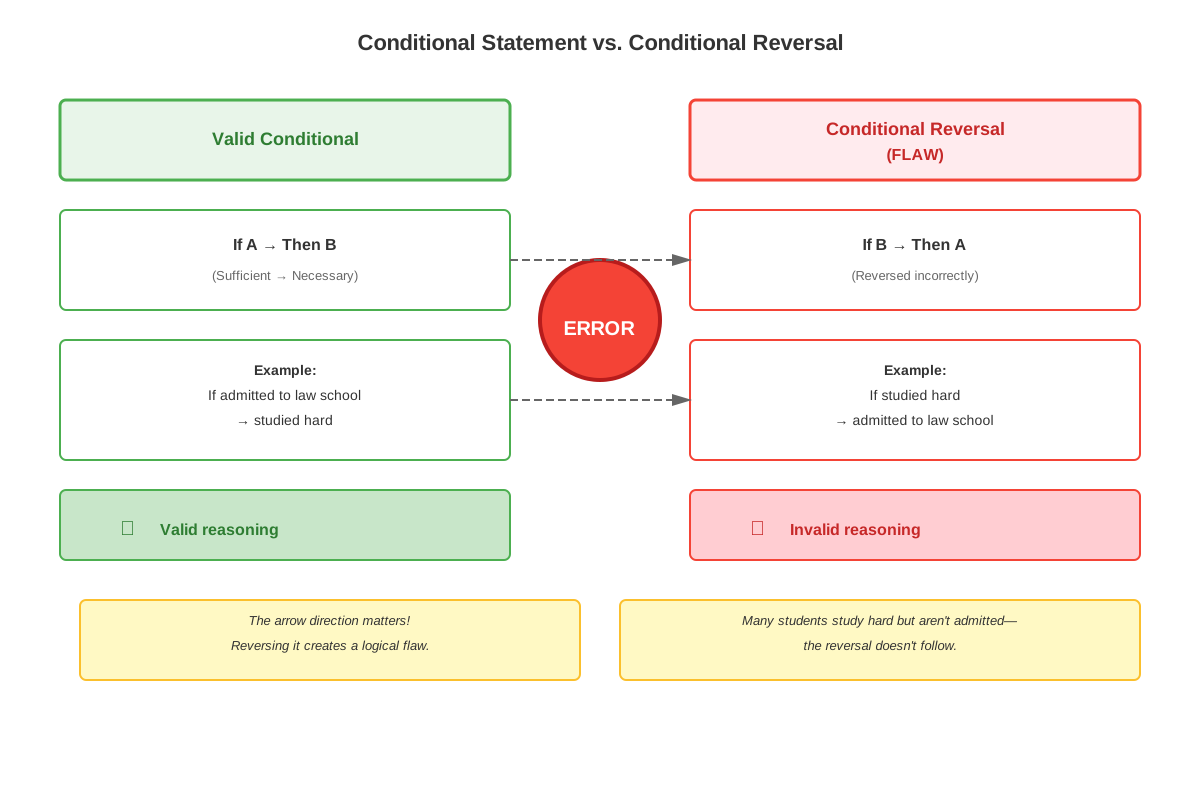
A conditional statement establishes a relationship between two elements using an "if...then" structure. The standard form is: "If A, then B," where A is the sufficient condition (its presence is sufficient to guarantee B) and B is the necessary condition (it must be present whenever A is present). This relationship flows in only one direction—from sufficient to necessary.
Consider the statement: "If someone is a lawyer, then they passed the bar exam." Being a lawyer (A) is sufficient to know that the person passed the bar exam (B). Passing the bar exam is necessary for being a lawyer. This does NOT mean that everyone who passed the bar exam is a lawyer—some may have passed but chosen different careers.
What Is Conditional Reversal?
Conditional reversal occurs when an argument treats a conditional statement as though it works in both directions. The error involves taking "If A, then B" and incorrectly concluding "If B, then A." This reversal fundamentally misunderstands the logical relationship between sufficient and necessary conditions.
The reversed statement treats the necessary condition as though it were sufficient. In our lawyer example, conditional reversal would conclude: "If someone passed the bar exam, then they are a lawyer." This is clearly invalid—passing the bar exam is necessary for being a lawyer but not sufficient (one must also be admitted to practice, maintain good standing, etc.).
The Logical Structure of the Error
The formal structure of conditional reversal can be represented as:
Valid Premise: A → B (If A, then B)
Invalid Conclusion: B → A (If B, then A)
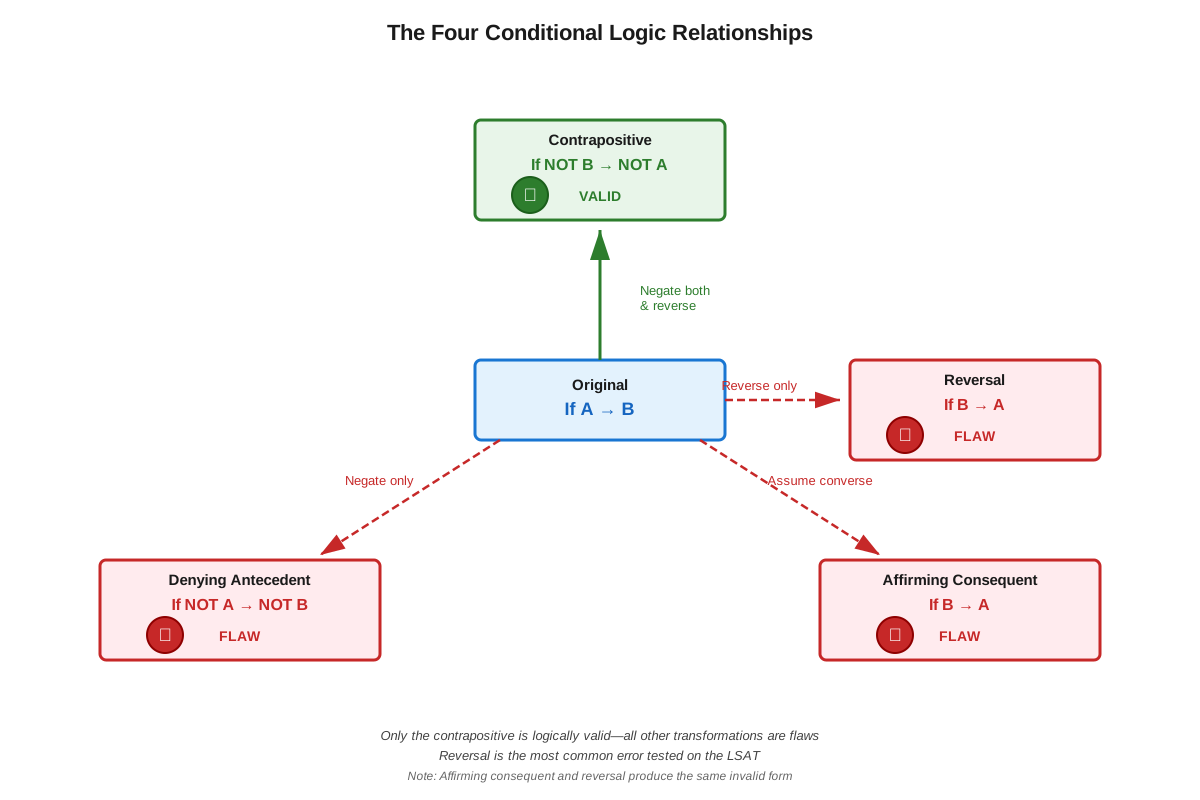
This error is distinct from the contrapositive, which IS a valid logical operation:
Valid Premise: A → B
Valid Contrapositive: ¬B → ¬A (If not B, then not A)
The contrapositive reverses AND negates both elements, creating a logically equivalent statement. Conditional reversal only reverses without negating, creating an invalid inference.
How Conditional Reversal Appears in Arguments
On the LSAT, conditional reversal typically appears in arguments with the following structure:
- Premise: Establishes a conditional relationship (If X, then Y)
- Premise: States that the necessary condition is present (Y is true)
- Conclusion: Incorrectly concludes the sufficient condition must be present (Therefore, X is true)
Example argument: "All successful entrepreneurs take calculated risks. Maria takes calculated risks. Therefore, Maria must be a successful entrepreneur."
The premise establishes: If successful entrepreneur → takes calculated risks. The argument then observes that Maria takes calculated risks and reverses the conditional to conclude she's a successful entrepreneur. This commits conditional reversal because taking calculated risks is necessary but not sufficient for entrepreneurial success.
Recognizing Reversal in Natural Language
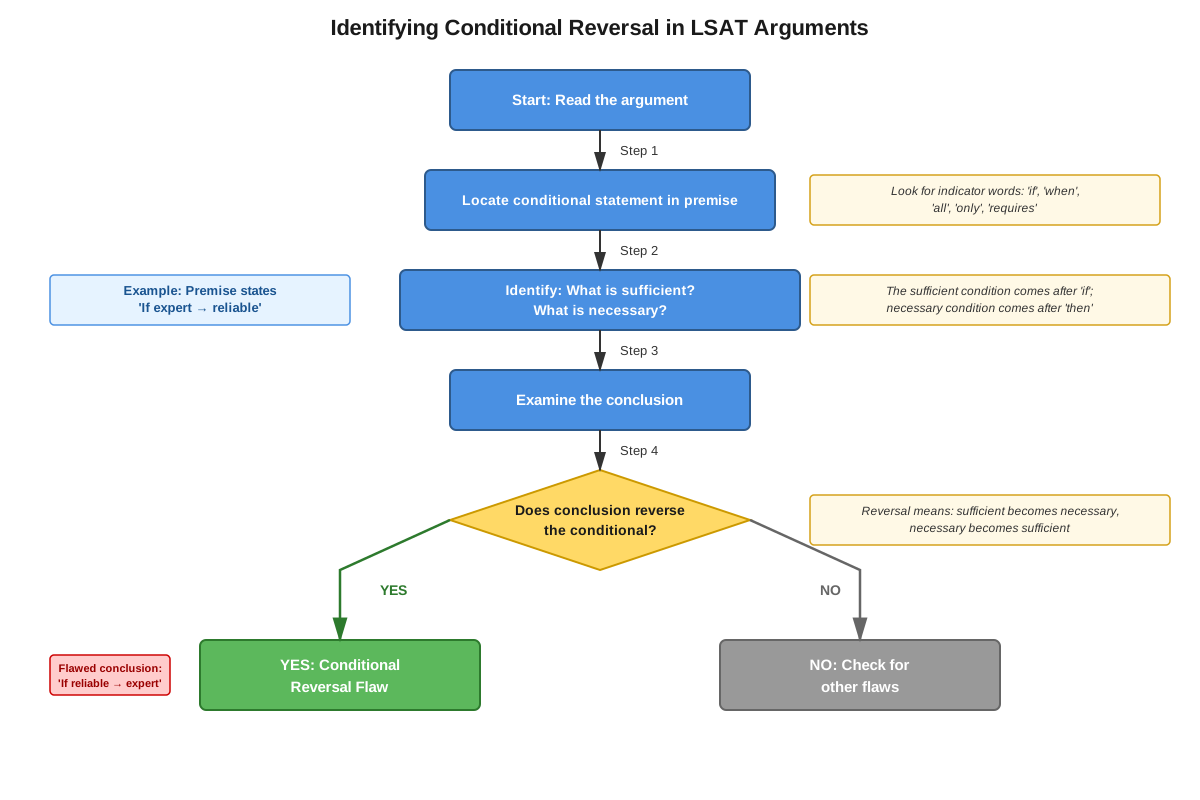
The LSAT rarely presents conditional statements in formal "if...then" language. Instead, arguments use various linguistic constructions that mask the conditional structure:
| Conditional Indicator | Example | Logical Form |
|---|---|---|
| If...then | If it rains, the game is cancelled | Rain → Cancelled |
| All | All doctors have medical degrees | Doctor → Medical degree |
| Only | Only members can vote | Vote → Member |
| Requires/Needs | Success requires hard work | Success → Hard work |
| When/Whenever | When prices rise, demand falls | Prices rise → Demand falls |
Conditional reversal can occur with any of these linguistic forms. The key is identifying the sufficient and necessary conditions, then checking whether the argument reverses their relationship.
The Psychology Behind the Error
Conditional reversal is such a common error because human reasoning naturally seeks bidirectional relationships. When we learn "If A, then B," we intuitively (but incorrectly) assume "If B, then A" might also be true. This cognitive bias makes conditional reversal particularly insidious—arguments that commit this error often sound convincing because they align with intuitive reasoning patterns.
The LSAT exploits this tendency by constructing arguments where the reversal seems plausible. The content of the argument may involve familiar scenarios where the reversed relationship happens to be true in many cases, even though it doesn't logically follow. This is why formal logical analysis, rather than intuitive assessment, is essential for identifying conditional reversal.
Concept Relationships
Conditional reversal exists within a network of related logical concepts that frequently appear together on the LSAT. Understanding these relationships strengthens the ability to identify and analyze this flaw.
Conditional Logic Foundation → Conditional Reversal: The basic understanding of sufficient and necessary conditions provides the framework for recognizing when these relationships are improperly reversed. Without grasping the unidirectional nature of conditional statements, identifying reversal becomes impossible.
Conditional Reversal ↔ Conditional Negation Errors: These are parallel errors in conditional reasoning. While reversal switches the direction (A→B becomes B→A), negation errors improperly negate without reversing (A→B leads to ¬A→¬B or B→¬A). Both appear frequently in flaw questions, and distinguishing between them is crucial.
Contrapositive Formation ← Conditional Reversal: Understanding the valid contrapositive (A→B becomes ¬B→¬A) helps identify invalid reversal by contrast. When an argument reverses without negating, recognizing that it differs from the valid contrapositive immediately flags the error.
Conditional Reversal → Necessary vs. Sufficient Assumption Questions: The distinction between necessary and sufficient conditions directly relates to conditional reversal. Arguments that reverse conditionals often require necessary assumptions to become valid, making this flaw relevant to assumption question types.
Flaw Question Strategy ← Conditional Reversal Recognition: Identifying conditional reversal is a specific application of the broader skill of flaw identification. This particular flaw has characteristic answer choice language ("fails to consider that," "takes for granted that") that appears consistently across flaw questions.
High-Yield Facts
⭐ Conditional reversal occurs when an argument treats "If A, then B" as though it means "If B, then A"
⭐ The error confuses necessary conditions with sufficient conditions
⭐ Conditional reversal is distinct from the contrapositive, which reverses AND negates both terms validly
⭐ On flaw questions, conditional reversal is often described as "taking for granted that the stated condition is the only way to achieve the result"
⭐ The presence of the necessary condition does NOT guarantee the presence of the sufficient condition
- Conditional reversal appears in approximately 2-3 questions per LSAT administration
- Arguments committing conditional reversal often sound intuitively plausible, making them effective trap answers
- The linguistic indicators "all," "only," "requires," and "when" can all introduce conditional relationships subject to reversal
- Recognizing conditional reversal requires identifying both the original conditional and the reversed inference
- Valid reasoning from a conditional requires either affirming the sufficient condition or denying the necessary condition (contrapositive)
- Conditional reversal can appear in both the argument stimulus and in incorrect answer choices
- The error becomes more difficult to detect when multiple conditional statements are chained together
- Time pressure increases the likelihood of missing conditional reversal, making pattern recognition essential
Quick check — test yourself on Conditional reversal so far.
Try Flashcards →Common Misconceptions
Misconception: If a conditional statement is true, then its reverse must also be true in most cases.
Correction: The reverse of a conditional statement has no logical relationship to the original. "If A, then B" tells us nothing about what happens when B is true. The reverse might be true, false, or sometimes true, but it doesn't follow logically from the original statement.
Misconception: Conditional reversal and the contrapositive are the same thing.
Correction: The contrapositive is a valid logical operation that reverses AND negates both terms (A→B becomes ¬B→¬A). Conditional reversal only reverses without negating (A→B incorrectly becomes B→A), making it an invalid inference. The contrapositive is always logically equivalent to the original; the reversal is not.
Misconception: When an argument commits conditional reversal, the conclusion is necessarily false.
Correction: Conditional reversal means the conclusion doesn't follow logically from the premises, not that the conclusion is false. The conclusion might happen to be true for other reasons not stated in the argument. The flaw is in the reasoning structure, not necessarily in the truth value of the conclusion.
Misconception: Conditional reversal only appears in arguments using explicit "if...then" language.
Correction: Conditional relationships appear in many linguistic forms including "all," "only," "requires," "when," and "every." Conditional reversal can occur with any of these constructions. Recognizing the underlying conditional structure regardless of surface language is essential.
Misconception: If most B's are A's, then reversing the conditional is acceptable.
Correction: Logical validity doesn't depend on statistical frequency. Even if 99% of B's happen to be A's, the inference from B to A still doesn't follow logically from "If A, then B." The LSAT tests logical structure, not probabilistic reasoning. An argument that reverses a conditional commits a flaw regardless of real-world frequencies.
Worked Examples
Example 1: Classic Conditional Reversal
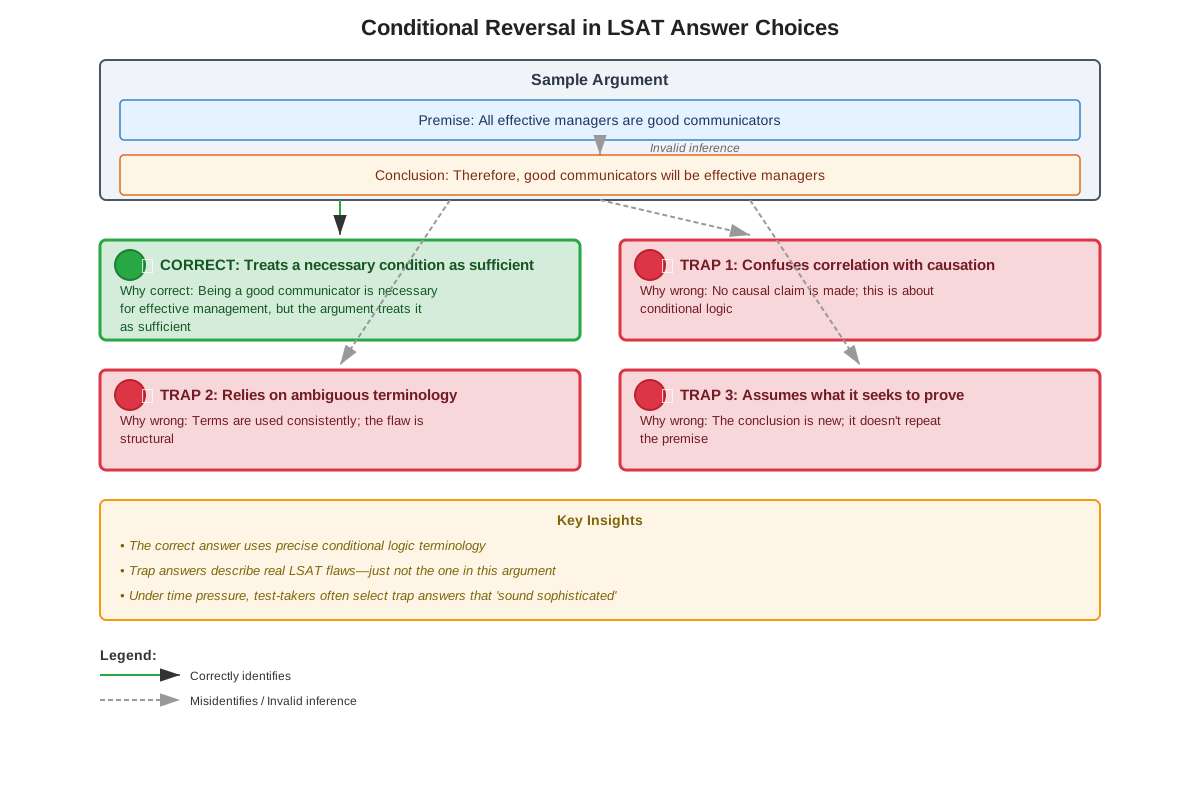
Argument: "All effective leaders possess strong communication skills. Jordan possesses strong communication skills. Therefore, Jordan is an effective leader."
Analysis:
Step 1: Identify the conditional statement in the premises.
"All effective leaders possess strong communication skills" translates to: If effective leader → strong communication skills.
Step 2: Identify what the argument establishes about the necessary condition.
The second premise states that Jordan possesses strong communication skills (the necessary condition is present).
Step 3: Identify what the argument concludes.
The conclusion states that Jordan is an effective leader (the sufficient condition is present).
Step 4: Evaluate the logical structure.
The argument observes that the necessary condition is present and concludes that the sufficient condition must be present. This reverses the conditional relationship. The valid inference would be the contrapositive: If someone lacks strong communication skills → they are not an effective leader. The argument instead commits conditional reversal.
Step 5: Identify the flaw.
The argument "takes for granted that strong communication skills are sufficient for effective leadership" or "fails to consider that strong communication skills might be necessary but not sufficient for effective leadership."
Connection to Learning Objectives: This example demonstrates how to identify conditional reversal in LSAT questions (Objective 1), explains the reasoning pattern of treating a necessary condition as sufficient (Objective 2), and shows the step-by-step process for analyzing such arguments (Objective 3).
Example 2: Conditional Reversal in Policy Context
Argument: "The new safety regulation requires that all construction sites have a designated safety officer. The Riverside construction project has a designated safety officer. Therefore, the Riverside project must be in compliance with the new safety regulation."
Analysis:
Step 1: Identify the conditional structure.
"The regulation requires that all construction sites have a designated safety officer" means: If in compliance with regulation → has designated safety officer.
Step 2: Map the argument's reasoning.
Premise: Compliance → Safety officer
Premise: Riverside has a safety officer
Conclusion: Riverside is in compliance
Step 3: Recognize the reversal.
The argument observes the necessary condition (safety officer) and concludes the sufficient condition (compliance) must be present. This reverses the conditional.
Step 4: Identify why this is flawed.
Having a safety officer is necessary for compliance but not sufficient. The regulation might have additional requirements (training protocols, equipment standards, reporting procedures) that Riverside hasn't met. The presence of one necessary condition doesn't guarantee all conditions are satisfied.
Step 5: Predict the flaw description.
The argument "treats a necessary condition for compliance as though it were a sufficient condition" or "overlooks the possibility that the regulation might have requirements beyond having a designated safety officer."
Connection to Learning Objectives: This example shows conditional reversal in a practical policy context (Objective 1), demonstrates how to distinguish necessary from sufficient conditions (Objective 4), and illustrates how to apply systematic analysis to complex arguments (Objective 3).
Exam Strategy
Identifying Conditional Reversal Questions
When approaching flaw questions on the LSAT, certain trigger words in the argument signal potential conditional reversal:
- "All," "every," "any," "each" (establishing sufficient conditions)
- "Only," "requires," "needs," "must" (establishing necessary conditions)
- "If," "when," "whenever" (explicit conditional indicators)
When these words appear, immediately diagram the conditional relationship and track whether the argument properly applies it.
Answer Choice Language
Conditional reversal in flaw question answer choices typically appears in these forms:
- "takes for granted that [necessary condition] is sufficient for [sufficient condition]"
- "fails to consider that [necessary condition] might be present without [sufficient condition]"
- "treats a condition necessary for [outcome] as though it were sufficient"
- "presumes, without justification, that [necessary condition] is the only requirement for [outcome]"
- "overlooks the possibility that [necessary condition] could be satisfied without [sufficient condition] being present"
Process of Elimination Strategy
- Diagram first: Before reading answer choices, diagram the conditional relationship and identify whether reversal occurred
- Eliminate non-structural flaws: Conditional reversal is a formal logical error; eliminate answers describing content-based problems (sampling errors, causal confusion, etc.) unless they also capture the reversal
- Match the direction: Ensure the answer choice correctly identifies which condition is treated as sufficient when it's actually necessary
- Verify completeness: The correct answer should capture both that a condition is necessary AND that the argument treats it as sufficient
Time Management
Conditional reversal questions typically require 60-90 seconds once the pattern is recognized. Invest time upfront in diagramming the conditional relationship (15-20 seconds) to avoid confusion when evaluating answer choices. This upfront investment prevents the need to re-read the argument multiple times, ultimately saving time.
Exam Tip: If an argument establishes "All A's are B's" and then observes "X is a B," immediately flag potential conditional reversal. This pattern appears so frequently that recognizing it should become automatic.
Common Trap Answers
The LSAT constructs trap answers that:
- Describe the contrapositive as though it were a flaw (it's not—the contrapositive is valid)
- Identify a different flaw that isn't present in the argument
- Correctly identify that the argument makes an unwarranted assumption but mischaracterize what that assumption is
- Reverse the reversal (describing the argument as treating something sufficient as necessary when it does the opposite)
Memory Techniques
The "One-Way Street" Visualization
Imagine conditional statements as one-way streets. "If A, then B" means traffic flows from A to B only. Conditional reversal is like driving the wrong way down this street—you're trying to go from B to A when the street only permits A to B travel. The contrapositive is like a valid alternate route that goes from "not B" to "not A."
The "N-S Flip" Mnemonic
Necessary becomes Sufficient when you FLIP the conditional. This mnemonic reminds you that conditional reversal treats a necessary condition as though it were sufficient—the roles flip incorrectly.
The "SWAN" Acronym
Sufficient leads to What's necessary
Affirming necessary
Never proves sufficient
This acronym captures the core error: affirming that the necessary condition is present never proves the sufficient condition is present.
The "Lawyer-Bar" Anchor Example
Memorize one clear example as an anchor: "All lawyers passed the bar" does NOT mean "everyone who passed the bar is a lawyer." When you encounter potential conditional reversal, mentally substitute this familiar example to test whether the reasoning pattern matches.
Contrapositive Comparison Chart
Keep this mental comparison chart:
VALID: A → B, therefore ¬B → ¬A (reverse AND negate)
INVALID: A → B, therefore B → A (reverse only)
Summary
Conditional reversal represents one of the most testable logical flaws on the LSAT, appearing consistently across multiple question types with particular frequency in flaw questions. This error occurs when an argument incorrectly treats a conditional statement as bidirectional, concluding that "If B, then A" follows from "If A, then B." The fundamental mistake involves confusing necessary conditions with sufficient conditions—observing that a necessary condition is present and concluding that the sufficient condition must therefore be present. Mastering conditional reversal requires three core competencies: recognizing conditional relationships regardless of their linguistic presentation, understanding the unidirectional nature of conditional logic, and distinguishing invalid reversal from the valid contrapositive operation. Success on LSAT questions testing this concept depends on systematic diagramming of conditional relationships, careful tracking of which element is sufficient versus necessary, and recognition of characteristic answer choice language describing the flaw. The ability to quickly identify and analyze conditional reversal provides a significant advantage on test day, as this pattern appears predictably and can be evaluated efficiently once the underlying structure is recognized.
Key Takeaways
- Conditional reversal treats "If A, then B" as though it means "If B, then A," confusing necessary and sufficient conditions
- The error appears in 15-20% of Logical Reasoning questions across various question types, making it high-yield for focused study
- Valid reasoning from conditionals requires either affirming the sufficient condition or using the contrapositive (reverse AND negate)
- Recognizing conditional reversal requires identifying the underlying logical structure regardless of surface language ("all," "only," "requires," etc.)
- Flaw question answer choices describe conditional reversal as "treating a necessary condition as sufficient" or "taking for granted that the condition is the only way to achieve the result"
- The presence of a necessary condition never proves the sufficient condition is present—this is the core logical principle violated by conditional reversal
- Systematic diagramming of conditional relationships prevents confusion and enables rapid identification of reversal errors under timed conditions
Related Topics
Conditional Negation Errors: After mastering conditional reversal, study related errors like denying the antecedent (If A→B, observing ¬A, concluding ¬B) and affirming the consequent. These errors complete the picture of common conditional logic mistakes.
Necessary vs. Sufficient Assumptions: Understanding conditional reversal directly supports analysis of assumption questions, where distinguishing necessary from sufficient conditions determines correct answers.
Formal Logic and Conditional Chains: Advanced conditional reasoning involves multiple linked conditionals (If A→B and B→C, then A→C). Conditional reversal becomes more difficult to detect in complex chains, making this a natural progression.
Contrapositive Applications: Deeper study of when and how to use contrapositives in LSAT arguments builds on the foundation of distinguishing valid contrapositive reasoning from invalid reversal.
Causal Reasoning Flaws: Many causal arguments involve conditional structures, and conditional reversal often appears in causal contexts (confusing necessary causal conditions with sufficient ones).
Practice CTA
Now that you understand the logical structure and common presentations of conditional reversal, the next critical step is applying this knowledge to actual LSAT questions. Work through the practice questions systematically, diagramming each conditional relationship before evaluating answer choices. Use the flashcards to reinforce recognition of conditional indicators and flaw descriptions. Remember that conditional reversal is one of the most predictable patterns on the LSAT—investing time now to master this concept will pay dividends across multiple questions on test day. Each practice question you analyze strengthens your pattern recognition and increases your speed, transforming conditional reversal from a potential trap into a reliable opportunity to gain points.
Sign up free to keep reading
Create a free AnvayaPrep account to finish this LSAT guide on Conditional reversal — plus flashcards and practice questions.