Overview
DNA replication is one of the most fundamental processes in molecular biology, ensuring that genetic information is accurately transmitted from one generation to the next. Within this intricate process, the leading strand represents one of two distinct pathways by which the DNA double helix is duplicated. Understanding the leading strand is essential for MCAT success because it forms the foundation for comprehending DNA replication mechanisms, which appear frequently in both passage-based and discrete questions in the Molecular Biology and Genetics section of the exam.
The leading strand is synthesized continuously in the 5' to 3' direction toward the replication fork, contrasting sharply with the lagging strand's discontinuous synthesis. This distinction is not merely academic—it reflects fundamental biochemical constraints imposed by DNA polymerase enzymes and has profound implications for understanding mutation rates, DNA repair mechanisms, and cellular responses to replication stress. For the MCAT, students must grasp not only the mechanics of leading strand synthesis but also how this process integrates with the broader replication machinery, including helicases, primases, and single-strand binding proteins.
The leading strand Biology concepts tested on the MCAT extend beyond simple memorization. Test-makers frequently present experimental scenarios involving replication inhibitors, mutations in replication enzymes, or comparative analyses of prokaryotic versus eukaryotic replication. A solid understanding of leading strand synthesis enables students to tackle complex passages about DNA damage, cancer biology, and genetic engineering—all high-yield topics that build upon foundational replication knowledge.
Learning Objectives
- [ ] Define leading strand using accurate Biology terminology
- [ ] Explain why leading strand matters for the MCAT
- [ ] Apply leading strand concepts to exam-style questions
- [ ] Identify common mistakes related to leading strand synthesis
- [ ] Connect leading strand to related Biology concepts
- [ ] Compare and contrast leading strand synthesis with lagging strand synthesis
- [ ] Explain the role of specific enzymes in leading strand synthesis
- [ ] Predict the consequences of mutations affecting leading strand replication
Prerequisites
- DNA structure and antiparallel nature: Understanding that DNA strands run in opposite directions (5' to 3' and 3' to 5') is essential because DNA polymerase can only synthesize in the 5' to 3' direction
- DNA polymerase function: Knowledge that DNA polymerase adds nucleotides to the 3'-OH group of a growing strand explains why continuous synthesis is possible on the leading strand
- Complementary base pairing: Familiarity with A-T and G-C pairing rules is necessary to understand how the template strand directs new strand synthesis
- Basic enzyme kinetics: Understanding how enzymes function helps explain the processivity and speed of leading strand synthesis
- Semi-conservative replication: Knowing that each new DNA molecule contains one original and one new strand provides context for why both leading and lagging strands are necessary
Why This Topic Matters
Clinical and Real-World Significance
Leading strand synthesis is critical for maintaining genomic stability. Errors in leading strand replication contribute to mutations that can lead to cancer, genetic disorders, and aging. Many chemotherapeutic agents and antiviral medications specifically target DNA replication machinery, making understanding of leading strand synthesis relevant to pharmacology and clinical medicine. For instance, nucleoside analogs used in cancer treatment can be preferentially incorporated during leading strand synthesis, causing chain termination and cell death.
MCAT Exam Statistics
Leading strand concepts appear in approximately 3-5% of MCAT Biology questions, either as discrete items or within passage-based questions. The topic most commonly appears in:
- Passage-based questions involving experimental manipulation of replication (40% of occurrences)
- Discrete questions testing basic replication mechanics (30% of occurrences)
- Integrated passages connecting replication to mutation, repair, or cell cycle (30% of occurrences)
Common Exam Presentations
The MCAT frequently presents leading strand concepts through:
- Diagrams of replication forks requiring identification of leading versus lagging strands
- Experimental scenarios involving temperature-sensitive mutants of replication enzymes
- Comparative passages contrasting prokaryotic and eukaryotic replication
- Questions about the directionality of synthesis and the role of specific enzymes
- Clinical vignettes involving drugs that inhibit DNA replication
Core Concepts
Definition and Basic Mechanism
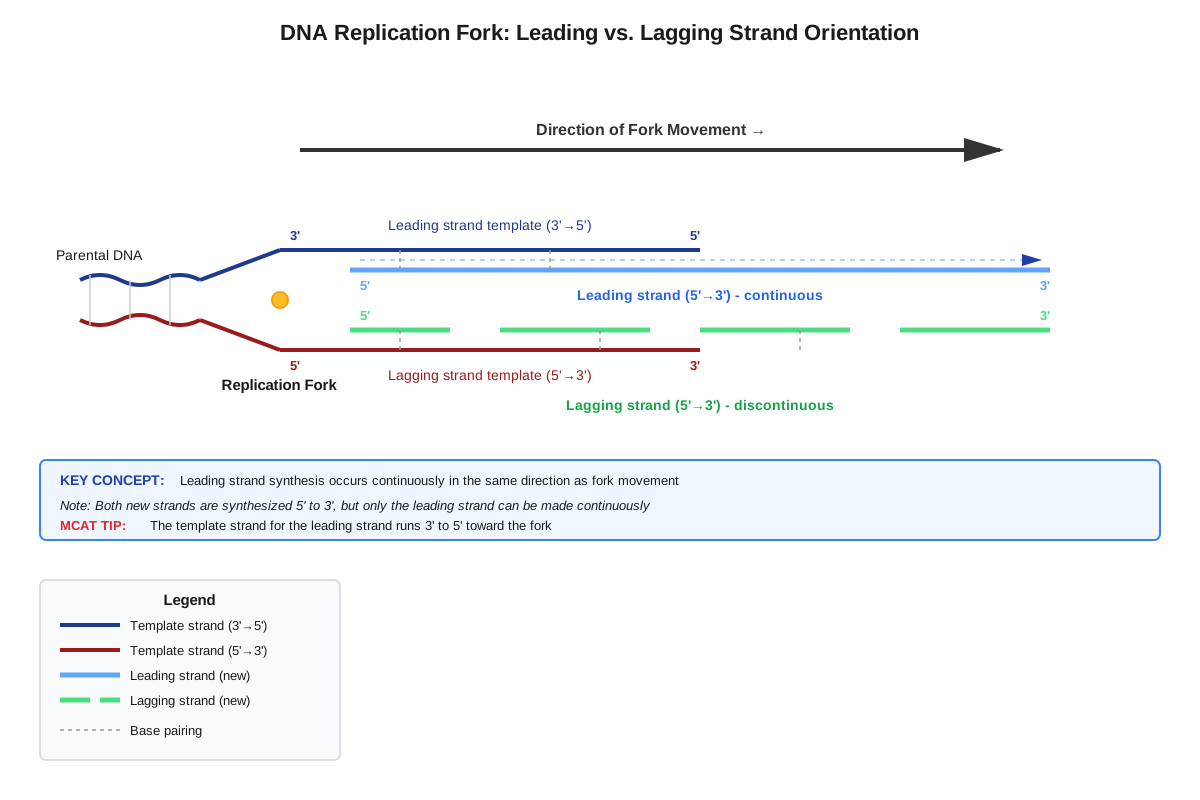
The leading strand is the newly synthesized DNA strand that is replicated continuously in the 5' to 3' direction toward the advancing replication fork. During DNA replication, the double helix is unwound by helicase, creating a Y-shaped structure called the replication fork. Because the two parental DNA strands are antiparallel, and because DNA polymerase can only synthesize DNA in the 5' to 3' direction, the two new strands must be synthesized differently.
On the leading strand, the template strand runs in the 3' to 5' direction, which allows DNA polymerase to synthesize the new strand continuously as the replication fork opens. This continuous synthesis is possible because the polymerase moves in the same direction as the replication fork is advancing. The leading strand requires only a single RNA primer to initiate synthesis, after which DNA polymerase III (in prokaryotes) or DNA polymerase δ (in eukaryotes) can synthesize the entire strand without interruption.
Directionality and the Replication Fork
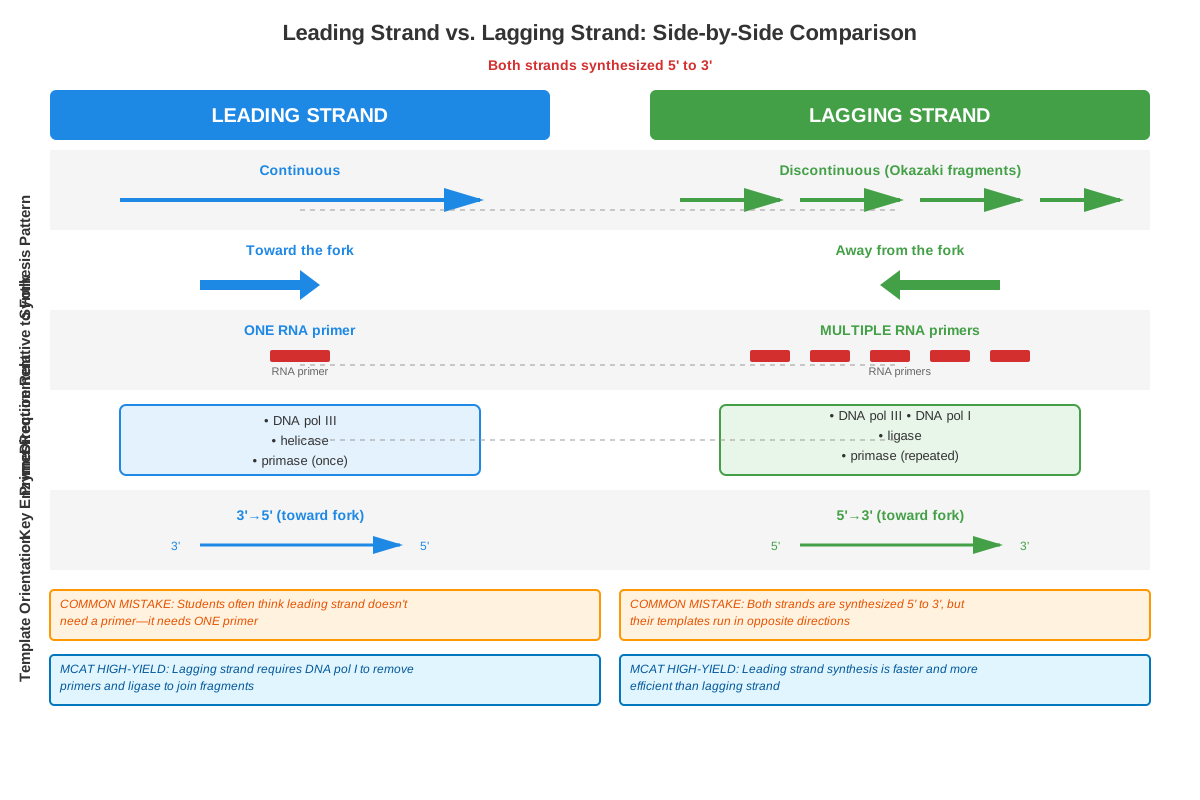
Understanding directionality is crucial for MCAT success. The replication fork moves in one direction along the DNA molecule, but because the two template strands are antiparallel, one strand (the leading strand) can be synthesized toward the fork while the other (the lagging strand) must be synthesized away from it.
Consider a replication fork moving from left to right:
- The template strand for the leading strand runs 3' to 5' from left to right
- The new leading strand is synthesized 5' to 3' from left to right
- Synthesis occurs continuously as the fork advances
- The polymerase remains associated with the replication fork throughout synthesis
This continuous synthesis makes the leading strand more efficient and less error-prone than the lagging strand, which must be synthesized in short fragments.
Enzymes Involved in Leading Strand Synthesis
Multiple enzymes coordinate to synthesize the leading strand:
| Enzyme | Function in Leading Strand Synthesis | Prokaryotic Version | Eukaryotic Version |
|---|---|---|---|
| Helicase | Unwinds the DNA double helix ahead of the replication fork | DnaB | MCM2-7 complex |
| Primase | Synthesizes a single RNA primer to initiate synthesis | DnaG | Pol α-primase |
| DNA Polymerase | Synthesizes the new DNA strand continuously | Pol III | Pol δ |
| Single-strand binding proteins (SSB) | Stabilize unwound DNA and prevent reannealing | SSB | RPA |
| Topoisomerase | Relieves tension created by unwinding | DNA gyrase (Type II) | Topoisomerase I and II |
| Sliding clamp | Increases polymerase processivity | β-clamp | PCNA |
| Clamp loader | Loads the sliding clamp onto DNA | γ-complex | RFC |
Initiation of Leading Strand Synthesis
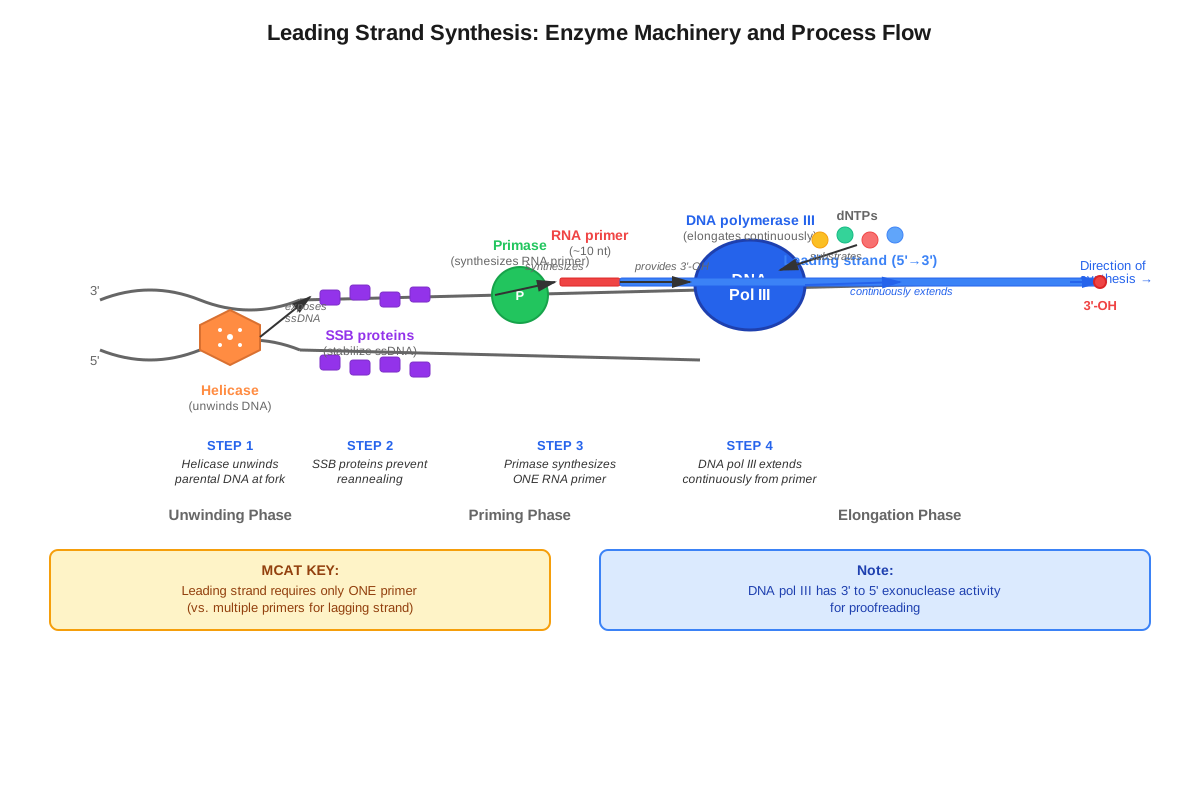
Leading strand synthesis begins with the synthesis of a short RNA primer by primase. This primer provides the essential 3'-OH group that DNA polymerase requires to begin adding deoxyribonucleotides. Unlike the lagging strand, which requires multiple primers (one for each Okazaki fragment), the leading strand needs only one primer at the origin of replication.
The process follows these steps:
- Helicase unwinds the DNA double helix at the origin of replication
- Single-strand binding proteins coat the exposed single-stranded DNA
- Primase synthesizes a short RNA primer (approximately 10 nucleotides) complementary to the template strand
- DNA polymerase recognizes the primer-template junction
- The sliding clamp is loaded onto the DNA by the clamp loader
- DNA polymerase begins continuous synthesis in the 5' to 3' direction
Continuous Synthesis and Processivity
The hallmark of leading strand synthesis is its continuous nature. Once initiated, DNA polymerase remains associated with the template strand and synthesizes DNA without dissociating until it reaches the end of the template or encounters a termination signal. This high processivity (the number of nucleotides added before the enzyme dissociates) is enhanced by the sliding clamp, which encircles the DNA and tethers the polymerase to the template.
In prokaryotes, DNA polymerase III can add approximately 1,000 nucleotides per second with a processivity exceeding 500,000 nucleotides. In eukaryotes, DNA polymerase δ synthesizes at approximately 50 nucleotides per second with similarly high processivity. This efficiency is critical for rapidly replicating large genomes.
Coordination with the Replisome
The leading strand polymerase does not work in isolation but is part of a larger protein complex called the replisome. This molecular machine coordinates the synthesis of both leading and lagging strands. The replisome contains:
- Two DNA polymerase molecules (one for each strand)
- Helicase at the front of the replication fork
- Primase associated with helicase
- Multiple accessory proteins
The leading strand polymerase maintains continuous contact with the replication fork, moving forward as helicase unwinds the DNA. This coordination ensures that synthesis keeps pace with fork progression and that the newly synthesized DNA is immediately protected from damage.
Proofreading and Fidelity
DNA polymerases possess 3' to 5' exonuclease activity, allowing them to proofread newly synthesized DNA. When an incorrect nucleotide is incorporated, the polymerase can detect the mismatch, reverse direction, remove the incorrect nucleotide, and then resume forward synthesis. This proofreading function is particularly important for the leading strand because errors are not diluted across multiple fragments as they are on the lagging strand.
The overall error rate after proofreading is approximately 1 error per 10^7 nucleotides synthesized. Additional mismatch repair systems can further reduce this error rate to approximately 1 per 10^10 nucleotides, ensuring high fidelity in DNA replication.
Concept Relationships
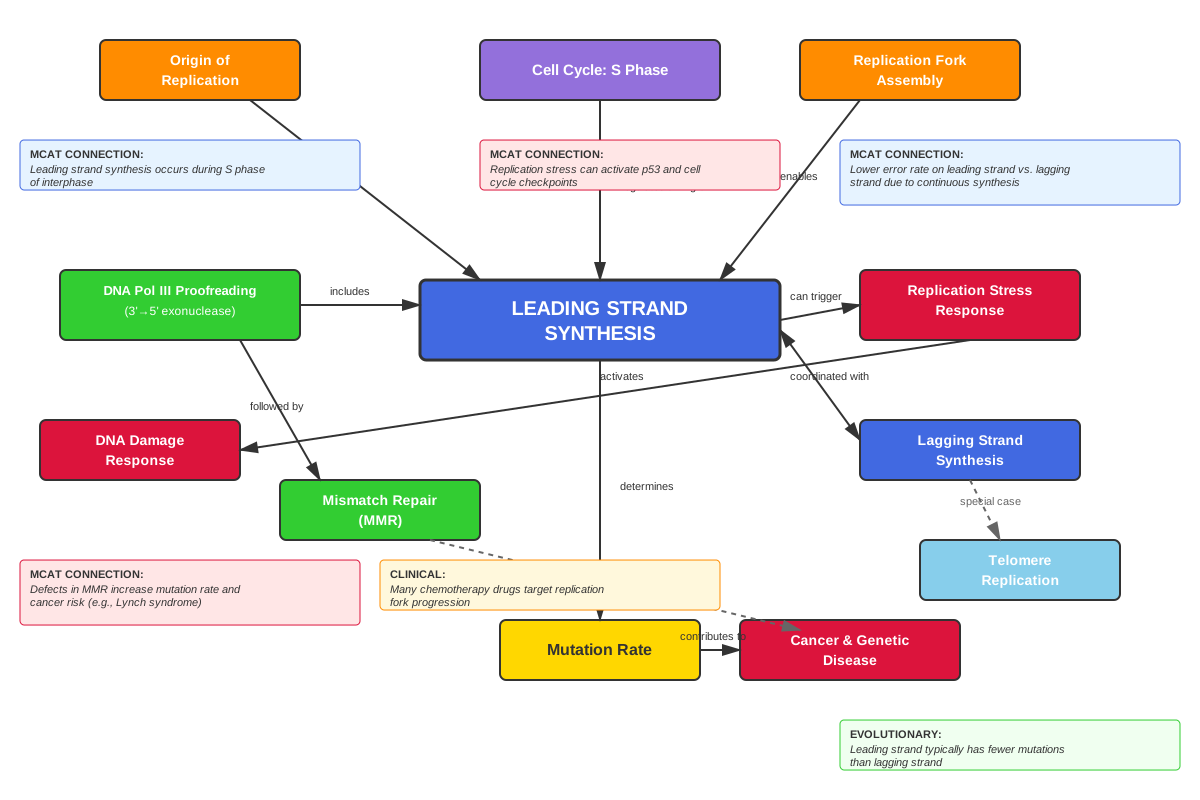
The leading strand concept sits at the intersection of multiple molecular biology principles. DNA structure (antiparallel strands) → necessitates → directional constraints on polymerase → results in → leading and lagging strand synthesis patterns.
The leading strand connects directly to enzyme specificity: DNA polymerase's requirement for a 3'-OH group → determines → continuous synthesis on the leading strand. This relationship extends to primer synthesis: primase creates RNA primers → enables → DNA polymerase initiation → allows → leading strand synthesis to begin.
The concept also relates to energy metabolism: nucleoside triphosphates (dNTPs) → provide energy for → phosphodiester bond formation → drives → leading strand elongation. Understanding this connection helps explain why rapidly dividing cells require high nucleotide pools.
Furthermore, leading strand synthesis → influences → mutation rates and patterns → affects → genetic variation and disease. The continuous nature of leading strand synthesis → results in → different error profiles compared to lagging strand → contributes to → strand-specific mutation biases observed in cancer genomes.
The coordination between leading and lagging strand synthesis → requires → the replisome complex → demonstrates → the importance of protein-protein interactions in molecular biology. This relationship appears frequently in MCAT passages about replication regulation and cell cycle control.
High-Yield Facts
⭐ The leading strand is synthesized continuously in the 5' to 3' direction toward the replication fork
⭐ Only one RNA primer is required to initiate leading strand synthesis (versus multiple primers for the lagging strand)
⭐ DNA polymerase III (prokaryotes) or DNA polymerase δ (eukaryotes) synthesizes the leading strand
⭐ The template strand for the leading strand runs 3' to 5' in the direction of fork movement
⭐ Leading strand synthesis is more efficient and has fewer opportunities for error than lagging strand synthesis
- The sliding clamp (β-clamp in prokaryotes, PCNA in eukaryotes) increases polymerase processivity on the leading strand
- Helicase unwinds DNA ahead of the replication fork, creating the single-stranded template for leading strand synthesis
- Single-strand binding proteins (SSB or RPA) prevent the template strand from reannealing or forming secondary structures
- Topoisomerases relieve the tension created by unwinding, preventing supercoiling ahead of the replication fork
- DNA polymerase has 3' to 5' exonuclease activity for proofreading during leading strand synthesis
- The replisome coordinates leading and lagging strand synthesis simultaneously
- Leading strand synthesis proceeds at approximately 1,000 nucleotides per second in prokaryotes
Quick check — test yourself on Leading strand so far.
Try Flashcards →Common Misconceptions
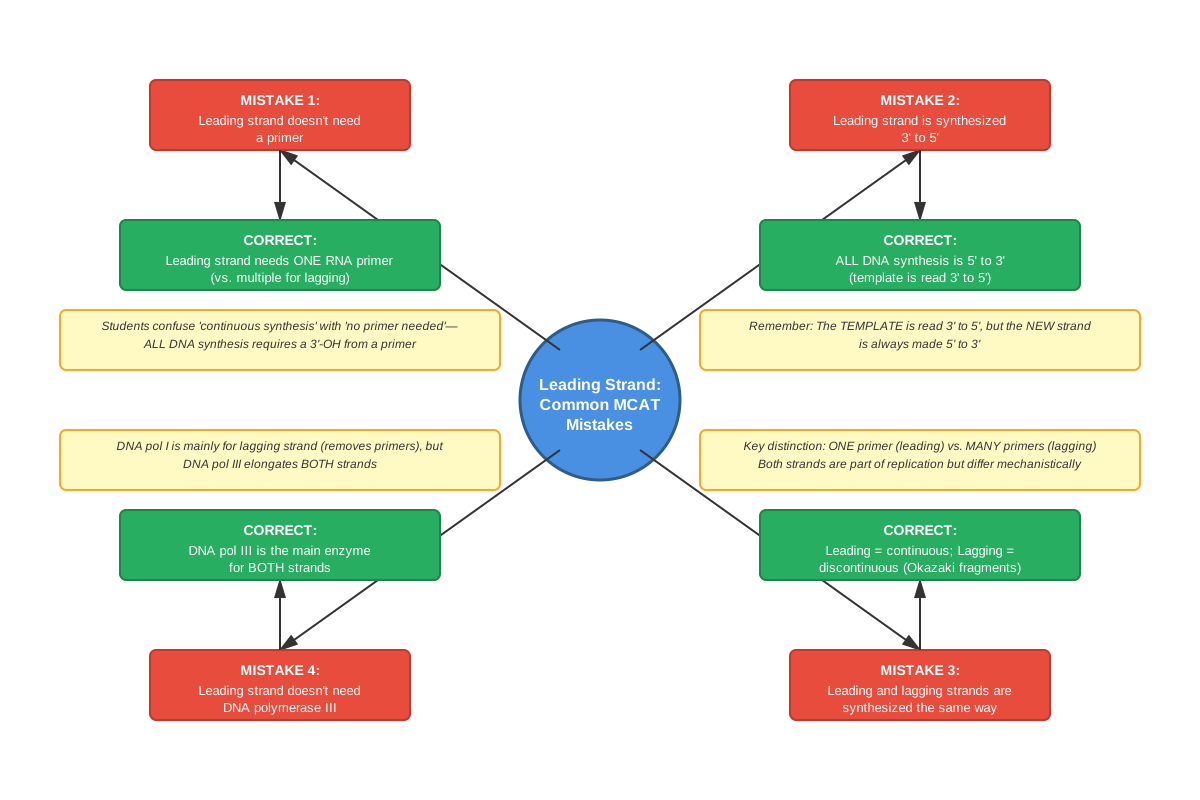
Misconception: The leading strand is synthesized away from the replication fork
Correction: The leading strand is synthesized toward the replication fork in the same direction the fork is moving. This continuous synthesis toward the fork is what distinguishes it from the lagging strand, which is synthesized away from the fork in short fragments.
Misconception: DNA polymerase can synthesize DNA in both 5' to 3' and 3' to 5' directions
Correction: DNA polymerase can only synthesize DNA in the 5' to 3' direction by adding nucleotides to the 3'-OH group of the growing strand. This directional constraint is why leading and lagging strands must be synthesized differently despite both being replicated simultaneously.
Misconception: The leading strand requires multiple primers like the lagging strand
Correction: The leading strand requires only a single RNA primer at the origin of replication to initiate synthesis. Once started, synthesis continues without interruption until the end of the template is reached. The lagging strand requires multiple primers because it is synthesized in short Okazaki fragments.
Misconception: The same template strand serves as the template for the leading strand at all replication forks
Correction: Which strand serves as the leading strand template depends on the direction of replication fork movement. At bidirectional replication origins, both parental strands serve as leading strand templates, but for different replication forks moving in opposite directions.
Misconception: Leading strand synthesis is error-free because it is continuous
Correction: While leading strand synthesis has fewer opportunities for error than lagging strand synthesis (which involves multiple priming and ligation events), it still incorporates errors at a rate of approximately 1 per 10^5 to 10^7 nucleotides before proofreading. The proofreading function of DNA polymerase and subsequent mismatch repair reduce this error rate significantly.
Misconception: The leading strand is always the top strand in a diagram
Correction: The designation of leading versus lagging strand depends on the direction of replication fork movement and the orientation of the template strands, not on how the DNA is drawn in a diagram. Students must identify the direction of fork movement and the template strand orientation to correctly identify which strand is the leading strand.
Worked Examples
Example 1: Identifying Leading and Lagging Strands
Question: A replication fork is moving from left to right along a DNA molecule. The top parental strand runs 5' to 3' from left to right, and the bottom parental strand runs 3' to 5' from left to right. Which parental strand serves as the template for the leading strand, and in which direction is the leading strand synthesized?
Solution:
Step 1: Identify the direction of replication fork movement
- The fork is moving left to right
Step 2: Recall that DNA polymerase synthesizes only in the 5' to 3' direction
- The new strand must be built 5' to 3'
Step 3: Determine which template allows continuous synthesis toward the fork
- For synthesis to proceed toward the fork (left to right), the template must run 3' to 5' from left to right
- The bottom parental strand runs 3' to 5' from left to right
Step 4: Identify the template and direction of synthesis
- Template: bottom parental strand (3' to 5' from left to right)
- New leading strand: synthesized 5' to 3' from left to right
- This synthesis is continuous and moves toward the advancing fork
Answer: The bottom parental strand (running 3' to 5' from left to right) serves as the template for the leading strand. The leading strand is synthesized 5' to 3' from left to right, continuously toward the advancing replication fork.
Connection to Learning Objectives: This example demonstrates the application of leading strand concepts to visual/diagrammatic questions common on the MCAT. It requires understanding of antiparallel DNA structure, polymerase directionality, and the relationship between template orientation and synthesis direction.
Example 2: Experimental Analysis of Replication
Question: Researchers create a temperature-sensitive mutant of DNA polymerase III in E. coli that loses its processivity at 42°C but retains its catalytic activity. When cells are shifted to 42°C during active DNA replication, what effect would you predict on leading strand synthesis compared to normal conditions?
Solution:
Step 1: Understand the normal function of DNA polymerase III
- DNA Pol III synthesizes both leading and lagging strands in prokaryotes
- High processivity allows continuous synthesis of the leading strand
- Processivity is enhanced by the β-clamp sliding clamp
Step 2: Analyze the mutation's effect
- The mutant enzyme retains catalytic activity (can still add nucleotides)
- The mutant loses processivity (dissociates more frequently from DNA)
- At 42°C, the enzyme will add fewer nucleotides before dissociating
Step 3: Predict effects on leading strand synthesis
- Leading strand synthesis normally proceeds continuously without interruption
- Reduced processivity will cause the polymerase to dissociate frequently
- Each dissociation requires reassociation before synthesis can continue
- This will slow the overall rate of leading strand synthesis
Step 4: Consider secondary effects
- Frequent dissociation may expose single-stranded DNA to damage
- The replication fork may stall if leading strand synthesis cannot keep pace
- The cell may activate checkpoint mechanisms to halt replication
Answer: Leading strand synthesis would be significantly slowed at 42°C. Although the mutant polymerase can still catalyze nucleotide addition, its reduced processivity would cause frequent dissociation from the template strand. This would convert the normally continuous leading strand synthesis into a more discontinuous process, requiring multiple rounds of polymerase binding and dissociation. The overall replication rate would decrease, and the cell might experience replication stress.
Connection to Learning Objectives: This example requires applying knowledge of leading strand synthesis to an experimental scenario, a common MCAT question format. It tests understanding of enzyme processivity, the continuous nature of leading strand synthesis, and the ability to predict consequences of molecular perturbations.
Exam Strategy
Approaching MCAT Questions on Leading Strand
When encountering questions about DNA replication and the leading strand:
- Immediately identify the direction of replication fork movement - This is often shown in diagrams and is essential for determining which strand is which
- Check the orientation of template strands - Look for 5' and 3' labels; the leading strand template runs 3' to 5' toward the fork
- Remember the "one primer rule" - If a question mentions multiple primers, it's likely referring to the lagging strand
- Consider the enzyme involved - DNA Pol III (prokaryotes) or Pol δ (eukaryotes) for leading strand; Pol I for lagging strand processing
Trigger Words and Phrases
Watch for these key phrases that signal leading strand concepts:
- "Continuous synthesis" → leading strand
- "Toward the replication fork" → leading strand
- "Single primer" → leading strand
- "High processivity" → leading strand synthesis
- "5' to 3' direction" → applies to both strands but helps determine which is which
- "Template strand orientation" → key to identifying leading vs. lagging
Process of Elimination Tips
When answering multiple-choice questions:
- Eliminate answers that suggest bidirectional synthesis by a single polymerase - DNA polymerase only works 5' to 3'
- Eliminate answers that confuse leading and lagging strand characteristics - If an answer says the leading strand requires multiple primers, it's wrong
- Eliminate answers that ignore the antiparallel nature of DNA - Both strands cannot be synthesized the same way
- Be cautious of answers that oversimplify - Replication requires multiple enzymes, not just polymerase
Time Allocation
For discrete questions on leading strand: 60-90 seconds
- Quickly identify what's being asked (definition, mechanism, or comparison)
- Apply core concepts directly
- Don't overthink simple questions
For passage-based questions: 1-2 minutes per question after passage reading
- Reference the passage for specific experimental details
- Apply general leading strand knowledge to the specific scenario
- Draw quick diagrams if needed to visualize replication fork orientation
Exam Tip: If a passage presents a replication fork diagram without clear 5' and 3' labels, use the direction of synthesis indicated by arrows or the position of primers to determine strand orientation. The MCAT expects you to work backward from these clues.
Memory Techniques
Mnemonics
"LEADING = Lone primer, Efficient, Advancing, Directional, Immediate, No gaps, Grows continuously"
- Lone primer (only one needed)
- Efficient (continuous synthesis)
- Advancing (toward the fork)
- Directional (5' to 3')
- Immediate (synthesis begins right away)
- No gaps (continuous)
- Grows continuously
Visualization Strategy
The "Zipper Model": Imagine the replication fork as a zipper being pulled open. The leading strand is like a thread being sewn continuously along one side of the opening zipper, following right behind the zipper pull (helicase). The thread (DNA polymerase) never stops or lifts off—it just keeps sewing continuously as the zipper opens. This contrasts with the lagging strand, which would be like sewing with multiple separate stitches.
Directional Memory Aid
"Template Toward, Leading Forward": The template strand for the leading strand runs toward the fork (3' to 5' in the direction of fork movement), and the leading strand itself is synthesized forward toward the fork (5' to 3' in the direction of fork movement). Both point the same direction as the fork moves.
Enzyme Association
"Pol III/δ = Leading": Remember that DNA Polymerase III (prokaryotes) or δ (delta, eukaryotes) synthesizes the leading strand. The "III" or "δ" can remind you of "continuous" (three letters, like III) or "delta" sounds like "dealt a" continuous strand.
Summary
The leading strand is the continuously synthesized DNA strand during replication, proceeding in the 5' to 3' direction toward the advancing replication fork. Its synthesis requires only a single RNA primer and is catalyzed by DNA polymerase III in prokaryotes or DNA polymerase δ in eukaryotes. The continuous nature of leading strand synthesis distinguishes it from the discontinuous lagging strand synthesis and results from the antiparallel structure of DNA combined with the directional constraints of DNA polymerase. Understanding leading strand synthesis requires integrating knowledge of DNA structure, enzyme function, and the coordination of multiple proteins within the replisome. For MCAT success, students must be able to identify leading versus lagging strands in diagrams, predict the effects of mutations or inhibitors on replication, and explain the mechanistic basis for continuous synthesis. The leading strand concept connects to broader topics including mutation mechanisms, DNA repair, cell cycle regulation, and the development of therapeutic agents targeting replication.
Key Takeaways
- The leading strand is synthesized continuously in the 5' to 3' direction toward the replication fork, requiring only one RNA primer
- DNA polymerase can only synthesize in the 5' to 3' direction, which combined with antiparallel DNA structure necessitates different synthesis mechanisms for leading and lagging strands
- The template strand for the leading strand runs 3' to 5' in the direction of fork movement, allowing continuous synthesis
- DNA polymerase III (prokaryotes) or DNA polymerase δ (eukaryotes) synthesizes the leading strand with high processivity enhanced by sliding clamps
- Leading strand synthesis is coordinated with lagging strand synthesis within the replisome complex, ensuring efficient and accurate DNA replication
- Understanding leading strand synthesis is essential for interpreting MCAT questions about replication mechanisms, mutations, and therapeutic interventions
- The continuous nature of leading strand synthesis results in fewer opportunities for error compared to the discontinuous lagging strand synthesis
Related Topics
Lagging Strand Synthesis: Understanding the discontinuous synthesis of the lagging strand in Okazaki fragments provides essential contrast to leading strand synthesis and completes the picture of bidirectional replication. Mastery of leading strand concepts makes lagging strand mechanisms more comprehensible.
DNA Polymerase Structure and Function: Deeper exploration of polymerase catalytic mechanisms, proofreading activity, and structural domains builds on leading strand knowledge and explains how these enzymes achieve high fidelity and processivity.
Origins of Replication: Learning how replication initiates at specific chromosomal locations and how bidirectional replication forks are established provides context for where and when leading strand synthesis begins.
DNA Repair Mechanisms: Understanding how cells detect and correct replication errors extends leading strand knowledge to include post-replication quality control, connecting to mutation and cancer biology.
Cell Cycle Regulation: Exploring how cells control when DNA replication occurs and how replication is coordinated with cell division demonstrates the broader biological context of leading strand synthesis.
Telomeres and Telomerase: Investigating the special challenges of replicating chromosome ends reveals limitations of leading strand synthesis and introduces specialized mechanisms for maintaining genome integrity.
Practice CTA
Now that you've mastered the core concepts of leading strand synthesis, it's time to reinforce your understanding through active practice. Attempt the practice questions and flashcards associated with this topic to test your ability to apply these concepts in exam-style scenarios. Focus on questions that require you to interpret replication fork diagrams, predict experimental outcomes, and integrate leading strand knowledge with other molecular biology concepts. Remember, the MCAT rewards not just memorization but the ability to apply fundamental principles to novel situations. Each practice question you complete strengthens your neural pathways and builds the confidence you need to excel on test day. You've built a strong foundation—now put it to work!
Sign up free to keep reading
Create a free AnvayaPrep account to finish this MCAT guide on Leading strand — plus flashcards and practice questions.