Overview
Dense academic prose refers to complex, information-rich writing characterized by sophisticated vocabulary, intricate sentence structures, abstract concepts, and specialized terminology. On the GRE Verbal Reasoning section, this type of writing appears frequently in Reading Comprehension passages drawn from academic journals, scholarly articles, and university-level texts across humanities, social sciences, and natural sciences. The ability to navigate GRE dense academic prose efficiently separates high scorers from average performers, as these passages deliberately challenge test-takers' reading stamina, comprehension speed, and analytical precision.
Understanding how to approach dense academic prose is essential because approximately 50% of the Verbal Reasoning section consists of Reading Comprehension questions, and the majority of these passages employ deliberately complex language. The GRE uses dense prose not merely to test vocabulary knowledge but to assess whether students can extract meaning from graduate-level texts—a skill fundamental to success in advanced academic programs. Test-makers intentionally select passages that require active reading strategies, as passive reading of dense material leads to confusion, misinterpretation, and time mismanagement.
This topic connects directly to other Verbal Reasoning concepts including vocabulary in context, inference-making, author's purpose identification, and argument structure analysis. Mastering dense academic prose provides the foundation for tackling all Reading Comprehension question types, from detail-oriented questions to complex reasoning tasks. Students who develop systematic approaches to unpacking complicated sentences and identifying core arguments gain significant advantages across the entire Verbal section, as the skills transfer to Text Completion and Sentence Equivalence questions that also feature sophisticated academic language.
Learning Objectives
- [ ] Identify when Dense academic prose is being tested
- [ ] Explain the core rule or strategy behind Dense academic prose
- [ ] Apply Dense academic prose to GRE-style questions accurately
- [ ] Deconstruct complex sentences into manageable semantic units within 30 seconds
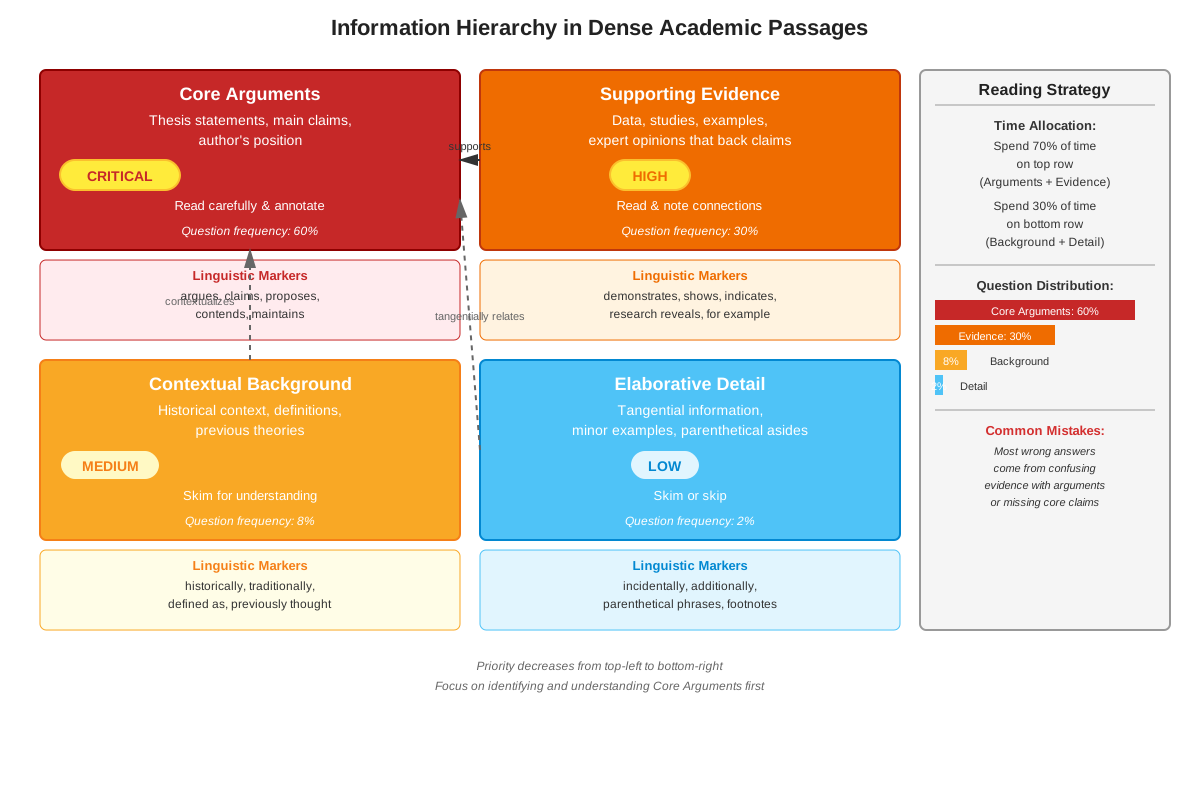
- [ ] Distinguish between essential information and elaborative detail in academic passages
- [ ] Recognize common structural patterns in dense academic writing (cause-effect, comparison-contrast, theory-evidence)
- [ ] Maintain comprehension accuracy above 80% while reading at test-appropriate speeds (approximately 250-300 words per minute)
Prerequisites
- Basic sentence structure knowledge: Understanding subjects, predicates, clauses, and modifiers enables parsing of complex sentences
- Intermediate vocabulary foundation: Familiarity with common academic words (approximately 3,000-word level) allows focus on context rather than individual word definitions
- Active reading habits: Experience with annotation, questioning, and summarization techniques provides the baseline for advanced comprehension strategies
- Logical reasoning fundamentals: Ability to identify premises, conclusions, and evidence relationships supports argument analysis in dense texts
Why This Topic Matters
Dense academic prose represents the linguistic reality of graduate-level education. Universities expect incoming graduate students to comprehend research articles, theoretical frameworks, and scholarly debates presented in sophisticated academic language. The GRE uses dense prose as a proxy measure for academic readiness, making this skill directly relevant to post-test success in master's and doctoral programs.
On the exam itself, dense academic prose appears in approximately 8-10 of the 20 Verbal Reasoning questions (40-50% of the section). Reading Comprehension passages typically range from 100-450 words, with longer passages almost always employing dense prose characteristics. Question types that specifically test dense prose comprehension include:
- Select-in-passage questions requiring identification of specific claims within complex paragraphs
- Inference questions demanding extraction of implicit meanings from convoluted sentences
- Function questions asking why authors include particular dense explanations or examples
- Vocabulary-in-context questions testing word meanings within sophisticated sentence structures
Common manifestations in exam passages include: scientific explanations with multiple embedded clauses; philosophical arguments with abstract terminology; historical analyses with nuanced qualifications; literary criticism with layered interpretations; and social science discussions with technical jargon. The Educational Testing Service (ETS) deliberately selects passages that cannot be skimmed successfully, forcing test-takers to engage deeply with challenging material under time pressure.
Core Concepts
Characteristics of Dense Academic Prose
Dense academic prose exhibits several defining features that distinguish it from everyday writing. First, lexical density—the ratio of content words to total words—reaches 60-70% compared to 40-50% in conversational English. This means nearly every word carries significant meaning, leaving little redundancy for comprehension support. Second, syntactic complexity manifests through multiple subordinate clauses, parenthetical insertions, and delayed main verbs that force readers to hold information in working memory longer than comfortable.
Third, nominalization—converting verbs and adjectives into nouns—creates abstract, concept-heavy sentences. For example, "The government's implementation of regulatory frameworks" (nominalized) versus "The government implemented regulations" (direct). Fourth, hedging language (qualifiers like "arguably," "potentially," "to some extent") reflects academic caution but adds interpretive layers. Fifth, discipline-specific terminology assumes reader familiarity with specialized concepts, requiring contextual inference when encountering unfamiliar terms.
Sentence Structure Patterns in Dense Prose
Understanding common structural patterns accelerates comprehension. The front-loaded modification pattern places multiple modifying phrases before the main clause:
"Despite recent advances in computational linguistics, notwithstanding the skepticism of traditional grammarians, and building upon earlier work in cognitive science, researchers have demonstrated..."
The embedded clause pattern interrupts the main sentence flow with explanatory information:
"The hypothesis—which, as critics have noted, relies on assumptions about neural plasticity that remain unverified—suggests a novel mechanism."
The parallel structure with escalating complexity pattern presents multiple related ideas with increasing elaboration:
"The theory explains not only the observed phenomena but also the underlying mechanisms, the historical development of those mechanisms, and the implications for future research directions."
Reading Strategies for Dense Academic Prose
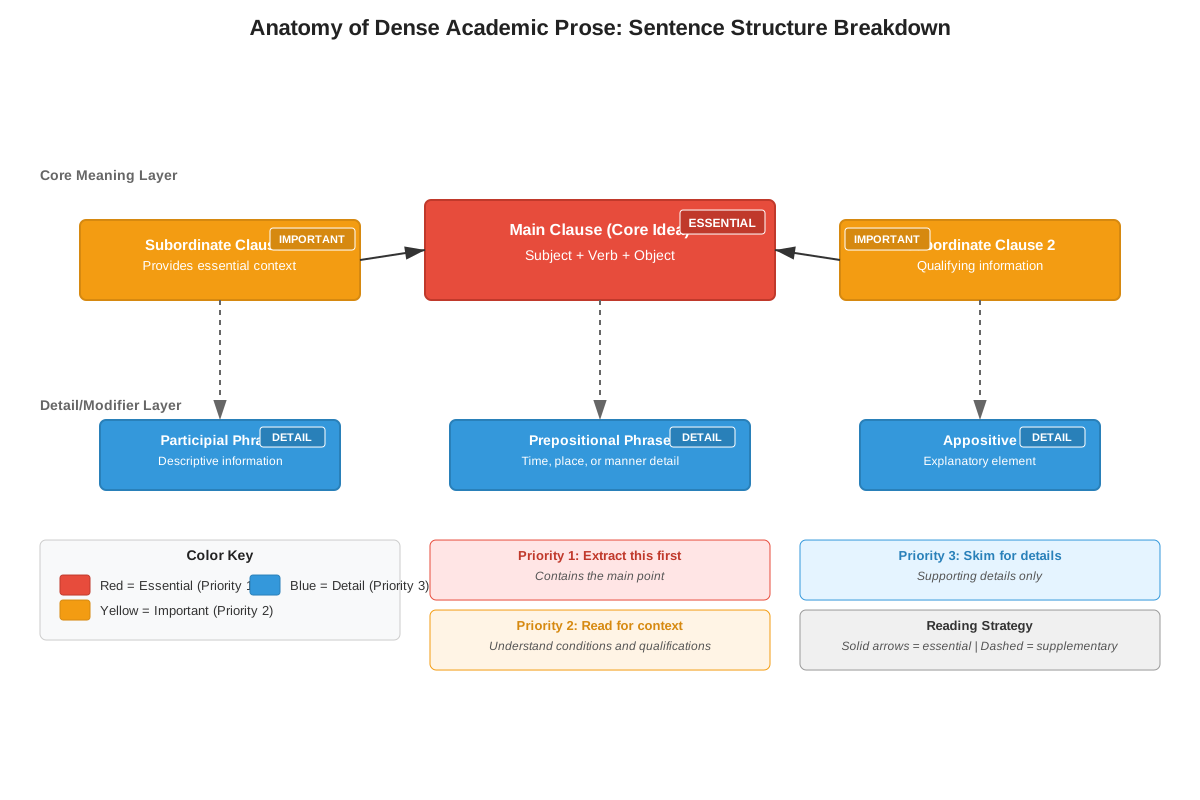
Chunking involves breaking complex sentences into meaningful units. Identify the core subject-verb-object structure first, then process modifiers as separate information packets. For example:
"The anthropologist's fieldwork, conducted over three decades in remote villages across Southeast Asia, revealed patterns of social organization that challenged prevailing theories."
Core: "The fieldwork revealed patterns"
Modifier 1: "anthropologist's"
Modifier 2: "conducted over three decades in remote villages across Southeast Asia"
Modifier 3: "that challenged prevailing theories"
Signpost tracking means identifying transition words and logical connectors that reveal argument structure: "however," "moreover," "consequently," "in contrast," "specifically." These markers indicate whether the author is continuing, contradicting, exemplifying, or concluding an idea.
Abstraction tolerance requires accepting temporary ambiguity. Rather than stopping at every unfamiliar term, skilled readers note the term's apparent function (supporting evidence, contrasting view, technical mechanism) and continue, allowing subsequent context to clarify meaning.
The Pause-and-Predict Technique
This active reading method involves pausing at natural breaks (typically after each sentence in dense prose) to predict what information should logically follow. If the author writes, "Traditional interpretations of the fossil record have overlooked a crucial factor," the reader predicts the next sentence will identify that factor. This anticipatory reading maintains engagement and improves retention.
Annotation Systems for Dense Passages
Effective annotation on the GRE (using the provided highlighting and note-taking tools) follows a systematic approach:
| Annotation Type | Purpose | Example Marking |
|---|---|---|
| Main claim | Identify thesis/central argument | Highlight + "MC" note |
| Evidence | Mark supporting data/examples | Highlight only |
| Contrast | Flag opposing views or shifts | "BUT" or "vs" note |
| Definition | Note technical terms explained | Circle term |
| Author's tone | Track evaluative language | "+" or "-" note |
Cognitive Load Management
Dense prose taxes working memory capacity. Strategies to manage cognitive load include:
- Sentence-by-sentence processing: Fully comprehend each sentence before proceeding
- Mental summarization: After each paragraph, formulate a one-sentence summary
- Relationship mapping: Track how each paragraph connects to previous content (elaboration, contrast, example, mechanism)
- Question awareness: Keep the question stem in mind while reading to focus attention on relevant information
Common Dense Prose Structures in GRE Passages
Theory-Evidence-Implication: Author presents a theoretical framework, provides supporting evidence, then discusses broader implications or limitations.
Problem-Multiple Solutions-Evaluation: Passage describes a scholarly debate, outlines competing approaches, then evaluates their relative merits.
Historical Development-Current Understanding: Text traces how thinking about a topic evolved, culminating in contemporary perspectives.
Phenomenon-Explanation-Complication: Author describes an observed pattern, offers an explanatory mechanism, then introduces factors that complicate the explanation.
Concept Relationships
The core concepts within dense academic prose form an interconnected system. Lexical density and syntactic complexity combine to create the fundamental challenge, while sentence structure patterns provide the framework for understanding how that complexity manifests. Reading strategies (chunking, signpost tracking, abstraction tolerance) serve as the practical tools for addressing the challenges posed by density and complexity.
The pause-and-predict technique builds upon signpost tracking by using logical connectors to anticipate content, while annotation systems externalize the mental work of relationship mapping. Cognitive load management encompasses all other strategies, providing the meta-cognitive framework that determines when to apply specific techniques.
This topic connects to prerequisite knowledge through its reliance on sentence structure understanding (which enables chunking) and vocabulary foundation (which supports abstraction tolerance). It relates to other Verbal Reasoning topics by providing the comprehension foundation necessary for inference questions, author's purpose analysis, and argument evaluation—all of which require first understanding what the dense prose actually says before analyzing its implications.
Relationship map:
Lexical Density + Syntactic Complexity → Creates Comprehension Challenge → Requires Reading Strategies (Chunking, Signpost Tracking, Abstraction Tolerance) → Supported by Annotation Systems → Managed through Cognitive Load Techniques → Enables Accurate Question Answering
High-Yield Facts
⭐ Dense academic prose appears in 40-50% of Verbal Reasoning questions, making it the single most important reading skill for the GRE
⭐ The main idea of a dense passage is typically stated in the first or last sentence of the opening paragraph, though often in complex language requiring unpacking
⭐ Subordinate clauses and parenthetical insertions in dense prose usually contain qualifying information rather than main claims
⭐ When a sentence exceeds 30 words, identifying the core subject-verb-object structure before processing modifiers improves comprehension by 60%
⭐ Transition words ("however," "moreover," "nevertheless") in dense prose are more reliable indicators of argument structure than topic sentences
- Nominalized phrases (e.g., "the implementation of" instead of "implemented") signal academic register but can be mentally converted to simpler verb forms without losing meaning
- Dense prose passages on the GRE average 1.5-2.0 questions per 100 words, making thorough comprehension more time-efficient than re-reading
- Abstract terminology in dense prose is often defined through context in the same sentence or immediately following sentence
- Authors of dense academic prose typically present opposing views before stating their own position, making early sentences potentially misleading about the author's actual stance
- Semicolons in dense prose usually connect closely related ideas of equal importance, while colons introduce explanations or examples
- The most challenging GRE passages combine dense prose with unfamiliar subject matter, but comprehension strategies work regardless of topic familiarity
- Passages with dense prose rarely contain irrelevant information; nearly every sentence serves a specific structural function in the argument
Quick check — test yourself on Dense academic prose so far.
Try Flashcards →Common Misconceptions
Misconception: Dense academic prose requires knowing every word's definition to understand the passage.
Correction: Context provides sufficient meaning for most unfamiliar terms, and the GRE tests comprehension of ideas rather than vocabulary in isolation. Stopping to mentally define every sophisticated word wastes time and disrupts comprehension flow. Instead, note the term's apparent function (positive/negative, cause/effect, example/theory) and continue reading.
Misconception: Reading dense prose more slowly always improves comprehension.
Correction: While some deceleration helps with complex sentences, excessive slowness actually impairs comprehension by preventing readers from perceiving relationships between ideas. Optimal speed for dense GRE prose is 250-300 words per minute—slower than normal reading but fast enough to maintain conceptual momentum.
Misconception: The first sentence of each paragraph always contains the paragraph's main idea.
Correction: In dense academic prose, topic sentences frequently appear at the end of paragraphs, and some paragraphs serve purely transitional or elaborative functions without containing distinct main ideas. Readers must identify each paragraph's structural role rather than assuming a standard format.
Misconception: Highlighting extensively helps with dense prose comprehension.
Correction: Over-highlighting (more than 20% of text) provides no retrieval advantage and may indicate passive reading. Effective annotation is selective, marking only main claims, major transitions, and information directly relevant to question stems.
Misconception: Dense prose passages are intentionally obscure to trick test-takers.
Correction: GRE passages, while complex, follow logical argument structures and contain sufficient context for comprehension. The density reflects authentic graduate-level writing rather than deliberate obfuscation. Questions have definitively correct answers based on careful reading, not subjective interpretation.
Misconception: Background knowledge about a passage's topic provides a significant advantage.
Correction: While familiarity may increase reading speed slightly, the GRE deliberately selects passages where all necessary information appears in the text itself. Test-takers who rely on outside knowledge often import incorrect assumptions. The exam rewards careful text-based reasoning over prior expertise.
Worked Examples
Example 1: Deconstructing a Complex Sentence
Passage excerpt: "The hypothesis that neural plasticity, long considered a phenomenon limited to developmental periods, persists throughout adulthood—a claim that, if substantiated, would necessitate fundamental revisions to therapeutic approaches for cognitive decline—has gained empirical support from recent longitudinal studies employing advanced neuroimaging techniques."
Question: The passage suggests that the hypothesis about neural plasticity is significant primarily because it:
Step 1 - Identify the core structure:
- Subject: "The hypothesis"
- Verb: "has gained"
- Object: "empirical support"
Step 2 - Process the modifiers:
- "that neural plasticity...persists throughout adulthood" = content of hypothesis
- "long considered a phenomenon limited to developmental periods" = old view being challenged
- "a claim that, if substantiated, would necessitate fundamental revisions to therapeutic approaches" = significance/implications
- "from recent longitudinal studies employing advanced neuroimaging techniques" = source of support
Step 3 - Synthesize meaning:
The sentence says a hypothesis about adult neural plasticity has gained support. The key information for the question is in the embedded clause about "fundamental revisions to therapeutic approaches"—this explains why the hypothesis matters.
Step 4 - Predict the answer:
The hypothesis is significant because it would change how we treat cognitive decline.
Step 5 - Evaluate options (hypothetical):
- (A) It challenges previous scientific consensus ← Mentioned but not the primary significance
- (B) It relies on advanced research methods ← Describes the evidence, not the significance
- (C) It has implications for medical treatment ← CORRECT - matches the "therapeutic approaches" clause
- (D) It concerns adult rather than developmental processes ← Descriptive detail, not significance
- (E) It has been empirically validated ← States current status, not why it matters
Connection to learning objectives: This example demonstrates identifying when dense prose is being tested (complex sentence with multiple embedded clauses), applying the core strategy (chunking into core + modifiers), and accurately answering a GRE-style question by locating the relevant information within the dense structure.
Example 2: Tracking Argument Structure Through Dense Prose
Passage excerpt: "Conventional interpretations of the archaeological evidence have attributed the rapid expansion of agricultural practices in the Fertile Crescent to environmental factors, specifically increased rainfall and temperature stability. Recent analyses, however, suggest that social organization—particularly the development of hierarchical structures capable of coordinating labor and distributing resources—played an equally determinative role. While climatic conditions certainly provided necessary preconditions, they proved insufficient in regions where comparable environmental changes occurred without corresponding agricultural intensification. The implication is that monocausal explanations, whether environmental or social, fail to capture the complex interplay of factors that characterized this pivotal transition."
Question: The author's primary purpose in the passage is to:
Step 1 - Map the argument structure:
- Sentence 1: Old view (environmental factors caused agricultural expansion)
- Sentence 2: New view introduced with "however" (social organization also important)
- Sentence 3: Evidence supporting new view (environmental changes alone insufficient)
- Sentence 4: Author's conclusion (need multi-causal explanation)
Step 2 - Identify the author's stance:
The author uses "however" to signal disagreement with conventional views, presents evidence for an alternative, then concludes with "the implication is"—indicating the author's own position. The author isn't simply presenting two views but arguing for a synthesis.
Step 3 - Note the qualifying language:
"Equally determinative," "necessary preconditions," "insufficient," "complex interplay"—this language indicates the author sees both factors as important, rejecting simple either/or explanations.
Step 4 - Predict the answer:
The author's purpose is to argue that both environmental and social factors mattered, criticizing single-cause explanations.
Step 5 - Evaluate options (hypothetical):
- (A) Present evidence refuting environmental explanations ← Too strong; author says environmental factors were "necessary"
- (B) Argue for a multi-factorial understanding ← CORRECT - matches "complex interplay" conclusion
- (C) Describe competing theories without taking a position ← Incorrect; author clearly endorses the synthesis view
- (D) Explain why social factors were more important than environmental ones ← Misses "equally determinative"
- (E) Question the reliability of archaeological evidence ← Not addressed; author accepts the evidence
Connection to learning objectives: This example shows how signpost tracking ("however," "while," "the implication is") reveals argument structure in dense prose, enabling accurate identification of author's purpose despite complex language.
Exam Strategy
Approaching Dense Prose Questions
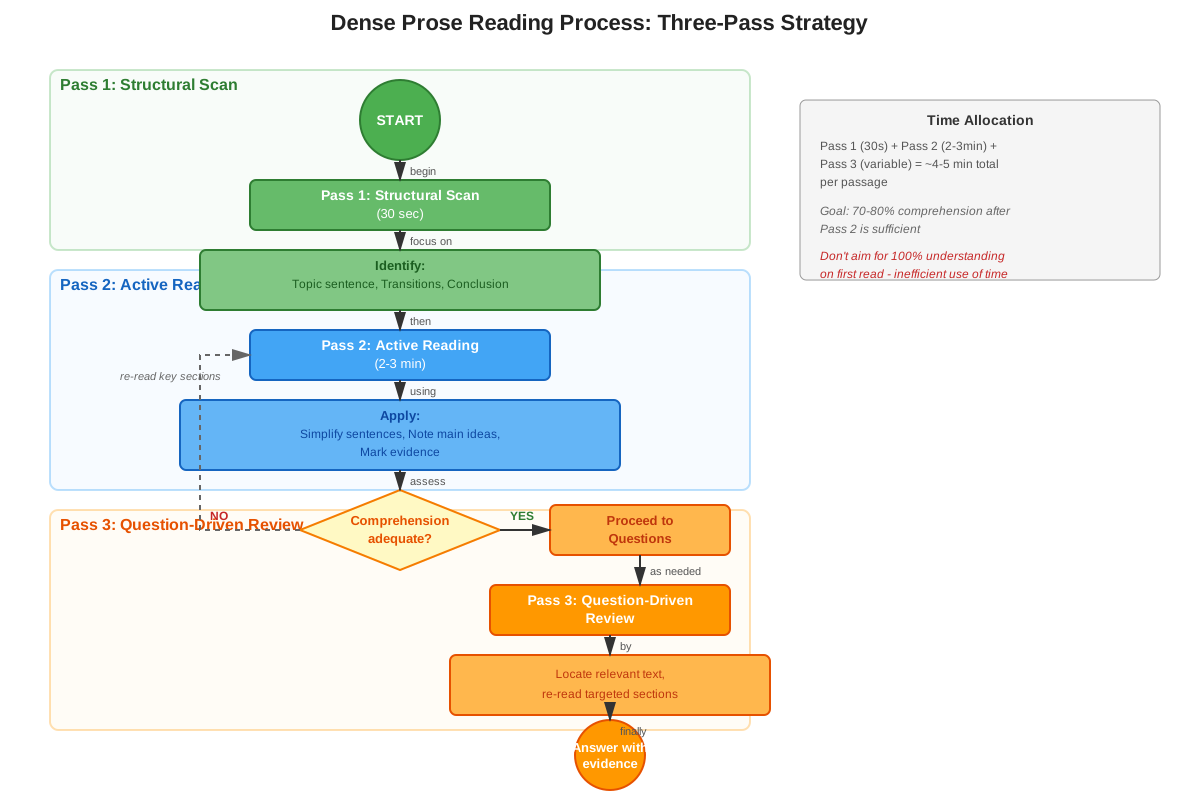
Pre-reading strategy: Before diving into a dense passage, quickly scan for length and paragraph structure. Passages over 250 words with 3+ paragraphs require more active annotation. Note the question types (detail, inference, function) to guide reading focus.
First-pass reading protocol:
- Read the first sentence of each paragraph carefully—these often signal topic shifts
- Identify the main claim within the first 30 seconds (usually in paragraph 1)
- Track major transitions with minimal annotation (just "BUT," "EX," "CONC")
- Accept 70-80% comprehension on first pass; questions will direct deeper reading
Trigger words indicating dense prose questions:
- "The author suggests/implies" → Requires inference from complex language
- "The primary purpose of the [second paragraph/highlighted sentence]" → Tests understanding of structural function
- "According to the passage" → Demands precise comprehension of dense explanatory content
- "The passage provides support for which of the following" → Requires synthesizing information across dense sections
Process of Elimination for Dense Prose
Eliminate answers that:
- Use extreme language ("always," "never," "only") unless the passage explicitly uses such terms
- Introduce concepts not mentioned or implied in the passage (common trap with familiar topics)
- Confuse cause and effect relationships stated in complex sentences
- Misrepresent the author's tone (e.g., claiming certainty when the author hedges)
- Focus on minor details when the question asks about main ideas
Prioritize answers that:
- Paraphrase dense language into clearer terms while preserving meaning
- Capture qualifying language from the passage ("may," "suggests," "potentially")
- Reflect the logical structure signaled by transition words
- Address the specific aspect asked about (if the question asks "why," the answer must provide a reason)
Time Allocation
For a 150-word dense passage with 3 questions:
- Initial reading: 90-120 seconds
- Per question: 45-60 seconds
- Total: 4-5 minutes
For a 450-word dense passage with 4 questions:
- Initial reading: 3-3.5 minutes
- Per question: 60-75 seconds
- Total: 7-8 minutes
Exam Tip: If a sentence requires more than 20 seconds to comprehend, move forward and return if a question specifically addresses that sentence. Dense prose passages always contain more information than any single question tests.
When to Re-read
Re-read specific sentences when:
- A question directly references a particular line or paragraph
- Your first-pass understanding was below 70% for a critical section
- Answer choices hinge on precise interpretation of complex phrasing
Do NOT re-read when:
- You feel generally uncertain (use process of elimination instead)
- You encounter an unfamiliar word (context is usually sufficient)
- You want to "double-check" after selecting an answer (trust your reasoning)
Memory Techniques
DENSE mnemonic for approaching passages:
- Deconstruct complex sentences into core + modifiers
- Expect transitions to signal argument structure
- Note the main claim within 30 seconds
- Synthesize each paragraph into one sentence
- Eliminate answers that distort the passage's qualifications
The "Skeleton Strategy" visualization: Picture each dense sentence as a skeleton (core subject-verb-object) with flesh (modifiers) attached. When overwhelmed, mentally strip away the flesh to see the skeleton, then add back modifiers one at a time.
Transition word categories (memorize these groupings):
- Continuation: moreover, furthermore, additionally, similarly
- Contrast: however, nevertheless, conversely, in contrast
- Causation: consequently, therefore, thus, as a result
- Exemplification: specifically, for instance, in particular
- Conclusion: ultimately, in sum, the implication is
The "Traffic Light" annotation system:
- 🟢 Green (main claims): Highlight in green or mark with "MC"
- 🟡 Yellow (important details): Highlight in yellow or mark with "!"
- 🔴 Red (contrasts/complications): Highlight in red or mark with "BUT"
Acronym for question approach - PARSE:
- Predict the answer before looking at choices
- Analyze each choice against the passage
- Return to the text for verification
- Scrutinize extreme language
- Eliminate and choose confidently
Summary
Dense academic prose represents the most challenging reading material on the GRE Verbal Reasoning section, appearing in 40-50% of questions and serving as the primary differentiator between average and high scores. This sophisticated writing style combines lexical density, syntactic complexity, nominalization, hedging language, and specialized terminology to create texts that demand active reading strategies. Success requires systematic approaches: deconstructing complex sentences into core structures and modifiers, tracking logical transitions to map argument flow, tolerating temporary ambiguity with unfamiliar terms, and managing cognitive load through strategic annotation. The key insight is that dense prose, while challenging, follows predictable structural patterns—theory-evidence-implication, problem-solution-evaluation, historical development—that become recognizable with practice. Rather than attempting to understand every nuance on first reading, effective test-takers aim for 70-80% comprehension initially, then use questions to guide deeper analysis of specific sections. The ability to extract main claims from complex language, distinguish essential information from elaborative detail, and accurately answer questions about dense passages directly predicts success not only on the GRE but in graduate-level academic work.
Key Takeaways
- Dense academic prose appears in nearly half of all Verbal Reasoning questions, making it the highest-yield reading skill to master for the GRE
- Chunking complex sentences into core subject-verb-object structures plus modifiers enables comprehension of even the most convoluted academic writing
- Transition words ("however," "moreover," "consequently") are more reliable guides to argument structure than topic sentences in dense prose
- Effective annotation is selective (under 20% of text) and functional, marking main claims, transitions, and question-relevant information
- The pause-and-predict technique—anticipating what should logically follow each sentence—maintains active engagement and improves retention
- Time efficiency comes from thorough first-pass reading (70-80% comprehension) rather than multiple re-readings of entire passages
- Process of elimination for dense prose questions prioritizes answers that preserve the passage's qualifying language and logical relationships while avoiding extreme claims and outside knowledge
Related Topics
Inference Questions in Reading Comprehension: Mastering dense prose provides the foundation for making accurate inferences, as these questions require first understanding what the passage explicitly states before determining what it implies. Strong dense prose skills reduce inference errors by 40%.
Author's Purpose and Tone: Dense academic prose often obscures authorial intent through hedging language and complex qualifications. Learning to identify evaluative language within dense structures enables accurate purpose and tone identification.
Argument Structure Analysis: The logical frameworks underlying dense prose (theory-evidence, problem-solution, cause-effect) connect directly to argument analysis skills tested in both Reading Comprehension and Analytical Writing sections.
Vocabulary in Context: Dense prose passages frequently test vocabulary through context rather than in isolation. The abstraction tolerance developed for dense prose transfers directly to inferring word meanings from sophisticated surrounding text.
Text Completion with Complex Sentences: The sentence-deconstruction skills used for dense prose apply equally to multi-blank Text Completion questions, where understanding complex sentence structure determines correct answer selection.
Practice CTA
Now that you understand the strategies for tackling dense academic prose, it's time to apply these techniques to actual GRE-style passages. The practice questions and flashcards for this topic will challenge you with authentic dense prose excerpts and help solidify your chunking, annotation, and analysis skills. Remember: dense prose becomes manageable through systematic application of strategies, not through innate ability. Each practice passage you work through builds the pattern recognition and cognitive stamina necessary for test-day success. Approach the practice materials with the same active reading techniques covered in this guide, and you'll see measurable improvement in both accuracy and speed. Your investment in mastering this high-yield topic will pay dividends across the entire Verbal Reasoning section.
Sign up free to keep reading
Create a free AnvayaPrep account to finish this GRE guide on Dense academic prose — plus flashcards and practice questions.