Overview
Unsupported answer traps represent one of the most pervasive and challenging obstacles students face in GRE Reading Comprehension. These deceptive answer choices appear plausible at first glance but lack direct textual evidence from the passage. The GRE test makers deliberately craft these options to exploit common reading habits: making assumptions, drawing on outside knowledge, or extending the author's argument beyond what is explicitly stated or strongly implied. Recognizing and avoiding these traps is not merely helpful—it is essential for achieving a competitive Verbal Reasoning score.
The fundamental challenge with unsupported answer traps lies in their sophisticated construction. Unlike obviously incorrect answers, these choices often contain vocabulary from the passage, address topics the passage discusses, or present statements that seem logically connected to the passage's themes. However, they fail the critical test: they cannot be defended using only the information provided in the text. Students who fall for these traps typically do so because they bring external knowledge to the question, make reasonable but unwarranted inferences, or confuse "possibly true" with "supported by the passage."
Understanding GRE unsupported answer traps connects directly to the broader skill of evidence-based reading that underlies all Reading Comprehension questions. This topic intersects with inference questions, main idea questions, and detail questions—essentially every question type requires the ability to distinguish between what the passage actually supports and what merely sounds reasonable. Mastering this skill transforms test-takers from passive readers into active evidence-hunters who can confidently eliminate wrong answers and select responses that the passage genuinely justifies.
Learning Objectives
- [ ] Identify when Unsupported answer traps is being tested
- [ ] Explain the core rule or strategy behind Unsupported answer traps
- [ ] Apply Unsupported answer traps to GRE-style questions accurately
- [ ] Distinguish between strongly implied information and unsupported speculation
- [ ] Trace answer choices back to specific textual evidence within 30 seconds
- [ ] Recognize the five most common patterns of unsupported answer construction
- [ ] Develop a systematic verification process for eliminating unsupported options
Prerequisites
- Basic reading comprehension skills: The ability to understand main ideas, supporting details, and passage structure forms the foundation for identifying what is and isn't supported
- Familiarity with GRE question types: Understanding the difference between inference, detail, and purpose questions helps recognize when support requirements vary
- Vocabulary at intermediate level: Recognizing passage vocabulary prevents misinterpretation that leads to selecting unsupported answers
- Ability to identify passage scope: Knowing what topics the passage addresses versus what it omits is crucial for spotting out-of-scope answer traps
Why This Topic Matters
Unsupported answer traps appear in approximately 60-70% of all GRE Reading Comprehension questions, making them the single most common wrong answer type across all question categories. Whether facing a detail question, inference question, or purpose question, test-takers must constantly guard against selecting answers that sound reasonable but lack textual support. The ETS (Educational Testing Service) deliberately includes these traps because they effectively discriminate between students who read carefully and those who rely on assumptions or external knowledge.
In real-world applications, the skill of identifying unsupported claims translates directly to critical thinking in academic research, professional analysis, and everyday information consumption. Graduate programs value students who can distinguish between what a source actually says and what readers might infer or assume. This ability prevents misrepresentation of research, reduces logical fallacies in argumentation, and promotes intellectual honesty.
On the GRE specifically, unsupported answer traps most commonly appear in: inference questions (where the trap extends beyond what can be reasonably concluded), EXCEPT questions (where four answers are supported and one is not), strengthen/weaken questions (where the trap introduces irrelevant information), and detail questions (where the trap distorts or exaggerates passage information). Recognizing these patterns across question types enables systematic elimination and significantly improves accuracy.
Core Concepts
Definition of Unsupported Answers
An unsupported answer trap is an answer choice that cannot be defended using only the information explicitly stated or strongly implied in the passage. These answers fail the "evidence test"—if asked to point to specific lines or sentences that justify the answer, a test-taker cannot do so convincingly. The key distinction lies between what is possible given the passage and what is supported by the passage. Many unsupported answers present statements that could be true in the real world or that logically might follow from the passage, but the passage itself provides insufficient evidence to confirm them.
The GRE operates on a strict evidence-based standard: correct answers must be defensible through direct quotation or clear paraphrase of passage content. This standard applies even to inference questions, which require going slightly beyond the text—but only to conclusions that follow necessarily or with high probability from stated information. Unsupported answers violate this standard by introducing new information, making unwarranted logical leaps, or distorting passage claims.
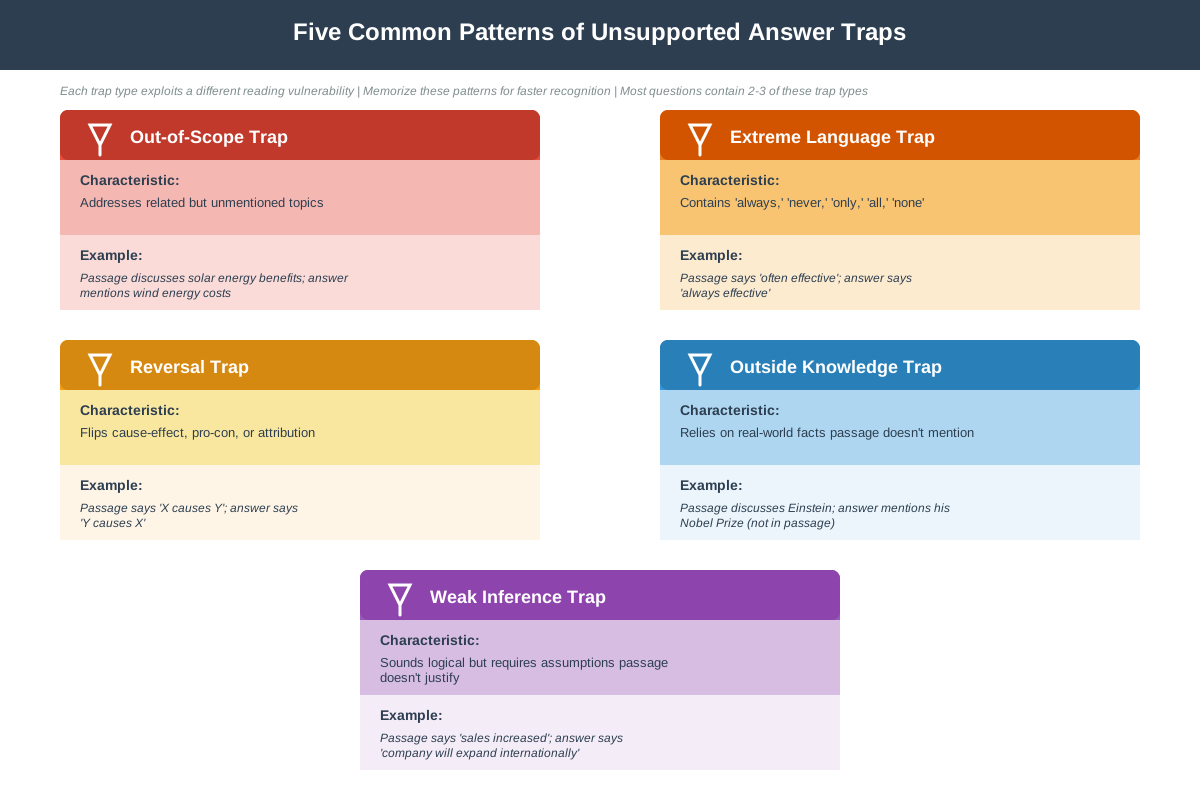
Five Common Patterns of Unsupported Answers
| Pattern | Description | Example Context |
|---|---|---|
| Out-of-Scope | Introduces topics, concepts, or details the passage never addresses | Passage discusses 19th-century literature; answer mentions 20th-century film |
| Extreme Language | Uses absolute terms (always, never, only, all) when passage uses qualified language (often, may, some) | Passage: "Many scientists believe"; Answer: "All scientists agree" |
| Reversal | States the opposite of what the passage supports | Passage indicates X caused Y; answer suggests Y caused X |
| Distortion | Takes passage information and twists, exaggerates, or misrepresents it | Passage: "Sales increased 10%"; Answer: "Sales skyrocketed dramatically" |
| Outside Knowledge | Relies on facts or assumptions from external knowledge rather than passage content | Passage discusses a historical event; answer requires knowing dates not mentioned |
The Evidence-Tracing Process
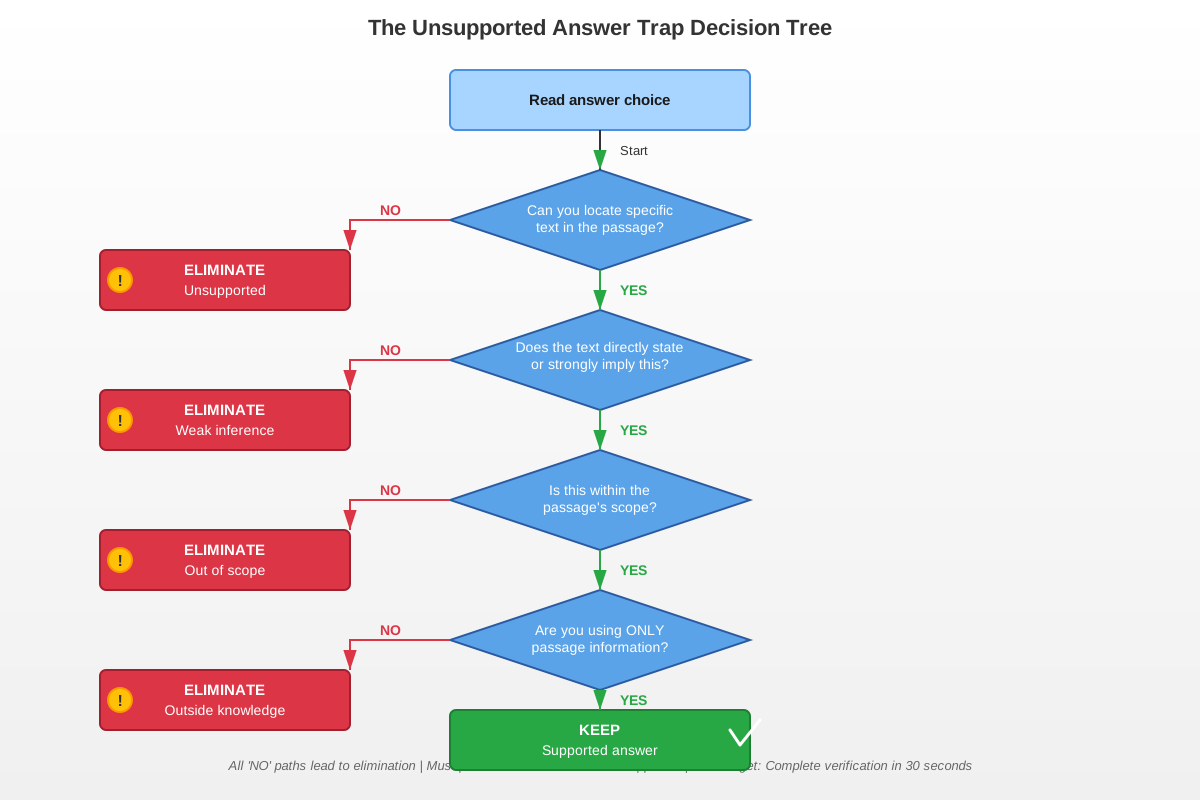
To systematically avoid unsupported answer traps, effective test-takers employ a three-step verification process:
- Read the answer choice completely: Resist the urge to select an answer immediately upon seeing familiar words or concepts
- Ask "Where does the passage say this?": Mentally or physically locate the specific lines that would support this answer
- Verify exact match: Confirm that the passage information actually supports the answer without requiring additional assumptions
This process transforms answer evaluation from a passive recognition task into an active evidence-hunting mission. When an answer cannot survive this scrutiny—when no specific passage location supports it—it is unsupported regardless of how reasonable it sounds.
The Scope Boundary Principle
Every GRE passage has defined scope boundaries—limits on what topics, time periods, perspectives, and details it addresses. Unsupported answers frequently violate these boundaries by:
- Extending beyond the passage's time frame (discussing periods not mentioned)
- Introducing stakeholders or groups the passage never references
- Addressing causes or effects the passage doesn't establish
- Making comparisons the passage doesn't draw
- Attributing views to the author that the passage doesn't express
Recognizing scope boundaries requires active reading that notes not just what the passage says, but what it doesn't say. Strong test-takers develop a mental map of passage scope during their initial read, making it easier to spot out-of-scope answers during question evaluation.
Inference Versus Speculation
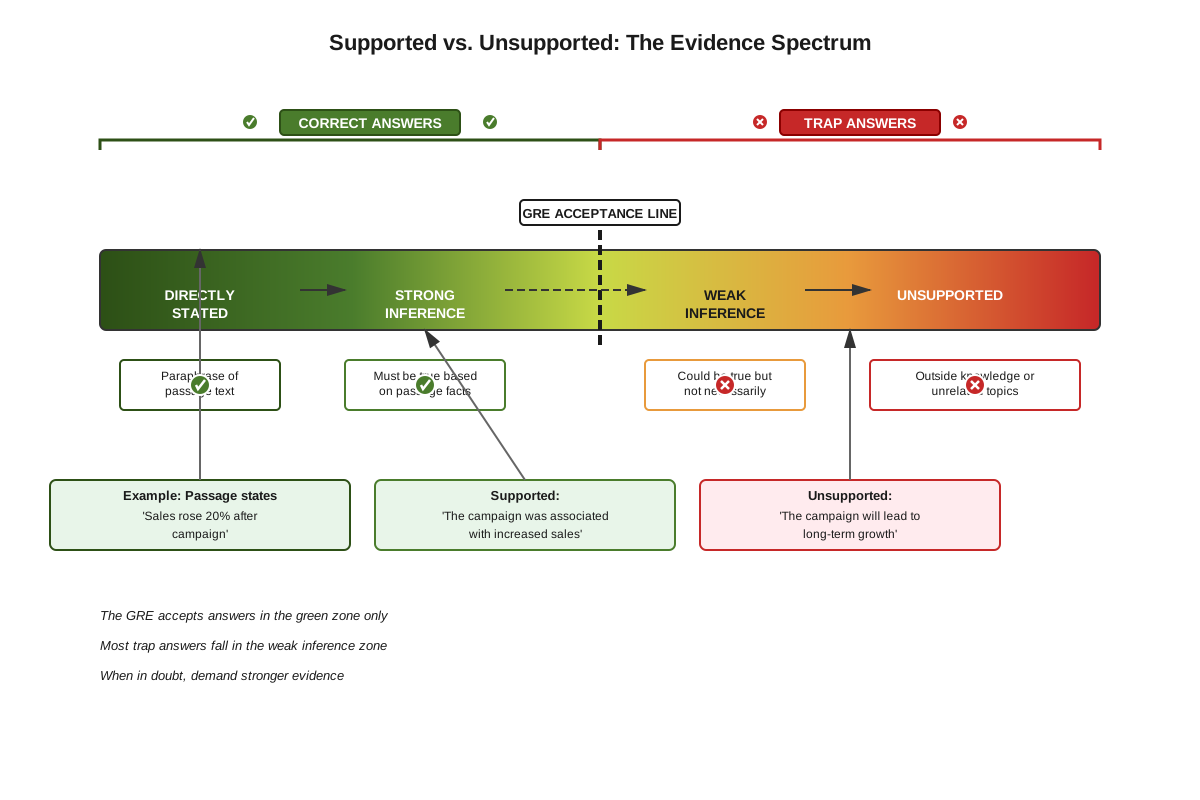
A critical distinction exists between valid inference (supported) and speculation (unsupported). Valid inferences follow logically and necessarily from passage information, requiring only minimal, reasonable assumptions that any reader would make. Speculation, by contrast, requires substantial additional assumptions, external knowledge, or logical leaps that go beyond what the passage establishes.
For example, if a passage states "The experiment failed to produce the expected results, forcing the research team to reconsider their hypothesis," a valid inference would be "The researchers' initial hypothesis was likely incorrect." This follows directly from the stated information. However, "The researchers lacked adequate funding" would be speculation—it might explain the failure, but the passage provides no evidence for this specific cause.
The "Could Be True" Trap
Perhaps the most insidious form of unsupported answer is the "could be true" trap—statements that are possible, plausible, or even likely in the real world, but that the passage doesn't actually support. These answers exploit the natural human tendency to evaluate statements based on general knowledge rather than textual evidence.
The GRE doesn't ask "Which of these could possibly be true?" but rather "Which of these does the passage support?" This distinction is crucial. An answer might be factually accurate, logically sound, and entirely reasonable—yet still be wrong if the passage doesn't provide evidence for it. Training yourself to ignore real-world plausibility and focus exclusively on textual support is essential for avoiding this trap.
Concept Relationships
The core concepts within unsupported answer traps form an interconnected system of recognition and elimination strategies. The Evidence-Tracing Process serves as the central methodology, directly addressing all five Common Patterns of Unsupported Answers. When applying the evidence-tracing process, test-takers simultaneously check for scope violations (Scope Boundary Principle), distinguish between valid inference and speculation (Inference Versus Speculation), and resist the pull of real-world plausibility ("Could Be True" Trap).
This topic connects to prerequisite knowledge by building on basic reading comprehension—the ability to identify what a passage says enables recognition of what it doesn't say. The relationship flows: Basic Comprehension → Scope Recognition → Evidence Tracing → Unsupported Answer Elimination.
Textual relationship map:
Passage Scope Definition → establishes boundaries for → Evidence-Tracing Process → which identifies → Five Common Patterns → leading to → Systematic Elimination → resulting in → Correct Answer Selection
Additionally, mastering unsupported answer traps enhances performance on related topics like inference questions, strengthen/weaken questions, and assumption identification—all of which require precise understanding of what the passage does and doesn't establish.
High-Yield Facts
⭐ Unsupported answers appear in 60-70% of GRE Reading Comprehension questions as wrong answer choices
⭐ The correct answer must be defensible by pointing to specific passage text or clear paraphrases
⭐ "Could be true" does not equal "supported by the passage"—this distinction eliminates most traps
⭐ Extreme language (always, never, only, all) in answers usually signals unsupported claims when the passage uses qualified language
⭐ Out-of-scope answers introduce topics, time periods, or details the passage never addresses
- Inference questions still require textual support—they ask for reasonable conclusions, not speculation
- If you cannot identify where the passage supports an answer within 30 seconds, it is likely unsupported
- Answers containing passage vocabulary are not automatically supported—check the actual claim being made
- The passage's scope boundaries (what it does and doesn't discuss) are your primary defense against unsupported answers
- Reversals and distortions often use passage language but twist the meaning or relationship
- EXCEPT questions specifically ask you to identify the one unsupported answer among supported options
- Author's opinion questions require explicit textual evidence of the author's view, not reasonable assumptions
Quick check — test yourself on Unsupported answer traps so far.
Try Flashcards →Common Misconceptions
Misconception: If an answer uses words and phrases from the passage, it must be supported.
Correction: Unsupported answers frequently incorporate passage vocabulary to appear legitimate. The specific claim or relationship the answer asserts must be supported, not just the individual words. Always verify that the answer's complete meaning matches passage content.
Misconception: Inference questions allow you to make reasonable assumptions based on general knowledge.
Correction: Even inference questions require textual support. Valid inferences must follow necessarily or with high probability from stated passage information. Bringing in outside knowledge or making assumptions not grounded in the text leads directly to unsupported answer traps.
Misconception: If an answer seems obviously true or factually accurate, it's probably correct.
Correction: The GRE tests reading comprehension, not general knowledge. An answer can be factually true in the real world yet completely unsupported by the passage. Always ask "Does THIS passage support THIS claim?" rather than "Is this claim true?"
Misconception: Longer, more detailed answers are more likely to be supported because they contain more information.
Correction: Length and detail do not indicate support. In fact, longer answers often contain unsupported elements precisely because they include more claims that must each be verified. Every component of an answer must be supported, regardless of length.
Misconception: If the passage discusses a topic generally, answers about specific aspects of that topic are automatically supported.
Correction: General discussion of a topic does not support specific claims about that topic. For example, if a passage discusses "economic factors in the Industrial Revolution," an answer about "the specific role of textile manufacturing in Manchester's economy" would be unsupported unless the passage specifically addresses that detail.
Misconception: Eliminating obviously wrong answers is sufficient; the remaining answer must be correct.
Correction: The GRE often includes multiple plausible-sounding answers, with only one truly supported. After eliminating obvious wrong answers, you must actively verify that your selected answer has clear textual support rather than simply choosing the "least wrong" option.
Worked Examples
Example 1: Detail Question with Unsupported Trap
Passage Excerpt:
"The development of the printing press in the 15th century revolutionized information dissemination across Europe. Prior to Gutenberg's innovation, books were painstakingly copied by hand, making them expensive and rare. The printing press enabled mass production of texts, which gradually increased literacy rates among the merchant class and contributed to the spread of Renaissance ideas beyond aristocratic circles."
Question: According to the passage, which of the following was a result of the printing press?
Answer Choices:
(A) Books became affordable for all social classes
(B) Literacy rates increased among merchants
(C) The aristocracy lost its monopoly on education
(D) Renaissance ideas originated in merchant communities
(E) Hand-copied books became completely obsolete
Analysis:
(A) Unsupported: The passage states books became less expensive and rare, but never claims they became "affordable for ALL social classes." This is an extreme language trap—the passage supports increased accessibility but not universal affordability.
(B) SUPPORTED: The passage explicitly states the printing press "gradually increased literacy rates among the merchant class." This is a direct paraphrase of passage content with clear textual support.
(C) Unsupported: While the passage indicates Renaissance ideas spread "beyond aristocratic circles," it never discusses the aristocracy's "monopoly on education" or claims this monopoly was lost. This answer introduces a concept (monopoly) and a topic (education broadly) that the passage doesn't address.
(D) Unsupported: The passage states Renaissance ideas spread TO merchant communities, not that they originated IN merchant communities. This is a reversal/distortion trap.
(E) Unsupported: The passage says books were previously "copied by hand" and the printing press enabled "mass production," but never claims hand-copying became "completely obsolete." This is extreme language unsupported by the text.
Correct Answer: (B)
Key Lesson: Even when multiple answers address passage topics, only one can be defended through direct textual evidence. Answers (A), (C), (D), and (E) all relate to passage themes but make claims the passage doesn't support.
Example 2: Inference Question with "Could Be True" Trap
Passage Excerpt:
"Recent studies of coral reef ecosystems have revealed unexpected resilience in certain species. While many coral populations have declined dramatically due to ocean warming, researchers identified several reef systems where coral coverage has remained stable or even increased slightly. These resilient reefs share common characteristics: they are located in areas with strong water circulation, experience regular upwelling of cooler deep water, and host diverse populations of herbivorous fish that control algae growth."
Question: The passage suggests which of the following about coral reefs?
Answer Choices:
(A) Strong water circulation prevents all coral decline
(B) Herbivorous fish populations are declining in most reef systems
(C) Certain environmental conditions may help some reefs withstand warming
(D) Ocean warming will eventually destroy even resilient reef systems
(E) Coral resilience depends primarily on water temperature
Analysis:
(A) Unsupported: Extreme language trap. The passage indicates strong circulation is associated with resilient reefs but never claims it "prevents ALL coral decline." This goes beyond what can be inferred.
(B) Unsupported: "Could be true" trap. While this might explain why some reefs are declining, the passage never discusses herbivorous fish populations in declining reefs—only that resilient reefs have these populations. This requires outside speculation.
(C) SUPPORTED: This is a valid inference. The passage describes environmental conditions (circulation, upwelling, herbivorous fish) shared by resilient reefs, supporting the inference that these conditions "may help" reefs withstand warming. The qualified language ("may help," "some reefs") matches the passage's tone.
(D) Unsupported: "Could be true" trap. This might be true based on general climate knowledge, but the passage never discusses the long-term fate of resilient reefs. This brings in outside assumptions about future outcomes.
(E) Unsupported: Distortion trap. While temperature is mentioned (cooler deep water upwelling), the passage lists multiple factors and never claims temperature is "primary." This oversimplifies and distorts the passage's multi-factor explanation.
Correct Answer: (C)
Key Lesson: Valid inferences use qualified language that matches passage tone and follow necessarily from stated information. Answers that sound plausible but require additional assumptions or outside knowledge are unsupported, even in inference questions.
Exam Strategy
Systematic Approach to Avoiding Unsupported Answers
When approaching any Reading Comprehension question, implement this four-step process:
- Read the question stem carefully: Note whether it asks for what is "stated," "suggested," "implied," or "according to the passage"—all require textual support
- Predict before looking at answers: Based on passage content, anticipate what a supported answer might say
- Evaluate each answer with the evidence test: For each option, ask "Where exactly does the passage support this?"
- Verify your selection: Before finalizing, confirm you can point to specific passage text that defends your choice
Trigger Words and Red Flags
Question stem triggers that signal high risk of unsupported answer traps:
- "According to the passage"
- "The passage suggests"
- "It can be inferred"
- "The author indicates"
Answer choice red flags that often signal unsupported content:
- Extreme absolutes: always, never, only, all, none, every, must
- Comparatives without passage basis: more than, less than, better, worse
- Causal claims: caused, resulted in, led to (when passage shows only correlation)
- Scope violations: introducing new time periods, groups, or topics
- Certainty language when passage is tentative: definitely, certainly, proves
Process of Elimination Strategy
Use this hierarchy to eliminate unsupported answers efficiently:
- First pass—eliminate obvious violations: Remove answers that introduce topics clearly outside passage scope (15-20 seconds)
- Second pass—check extreme language: Eliminate answers with absolutes when passage uses qualified language (10-15 seconds)
- Third pass—verify remaining answers: For remaining 2-3 options, actively locate textual support for each (30-45 seconds)
- Final verification: Confirm your selected answer by identifying the specific passage location that supports it (10 seconds)
Time Allocation Tip: Spend 60-90 seconds per Reading Comprehension question. Allocate 30-40 seconds of this time specifically to verifying textual support, as this prevents costly errors from unsupported answer traps.
The "Point to It" Test
Before selecting any answer, perform the "point to it" test: Imagine you must defend your answer to a skeptical examiner by pointing to specific passage sentences. If you cannot identify clear textual support within 20-30 seconds, the answer is likely unsupported. This mental exercise forces active verification rather than passive recognition.
Memory Techniques
SCOPE Acronym for Unsupported Answer Recognition
Speculation—Does the answer require assumptions beyond passage content?
Comparisons—Does the answer make comparisons the passage doesn't draw?
Out-of-bounds—Does the answer introduce topics outside passage scope?
Possible ≠ Proven—Could be true doesn't mean supported by passage
Extreme language—Does the answer use absolutes when passage is qualified?
Visualization Strategy: The Evidence Chain
Visualize each answer choice as a chain connecting to the passage. A supported answer has a strong, visible chain you can trace directly to specific passage text. An unsupported answer has a broken chain—you cannot trace a clear connection to textual evidence. When evaluating answers, mentally "pull the chain" to see if it holds or breaks.
The Three-Question Mantra
Before selecting any answer, mentally recite:
- "Where does the passage say this?"
- "Am I adding my own assumptions?"
- "Can I point to specific text?"
This mantra creates a consistent verification habit that prevents impulsive selection of unsupported answers.
Mnemonic for Common Unsupported Patterns: "ORED"
Out-of-scope
Reversal
Extreme language
Distortion
When an answer feels wrong but you cannot articulate why, check if it matches one of these ORED patterns.
Summary
Unsupported answer traps represent the most prevalent wrong answer type in GRE Reading Comprehension, appearing in the majority of questions across all question types. These traps succeed by presenting plausible-sounding statements that lack direct textual evidence, exploiting test-takers' tendencies to rely on outside knowledge, make unwarranted assumptions, or confuse "possibly true" with "supported by the passage." The five most common patterns—out-of-scope, extreme language, reversal, distortion, and outside knowledge—account for nearly all unsupported answers. Mastering this topic requires developing a systematic evidence-tracing process: reading answers completely, asking "Where does the passage say this?", and verifying exact textual support before selection. The fundamental principle is absolute: correct answers must be defensible through specific passage text or clear paraphrases, regardless of real-world plausibility or general knowledge. Success depends on recognizing passage scope boundaries, distinguishing valid inference from speculation, and resisting the "could be true" trap. By implementing the SCOPE framework, performing the "point to it" test, and maintaining disciplined verification habits, test-takers can systematically eliminate unsupported answers and significantly improve Reading Comprehension accuracy.
Key Takeaways
- Unsupported answers appear in 60-70% of questions as wrong answer choices—recognizing them is essential for GRE success
- The correct answer must always be defensible by pointing to specific passage text; "could be true" is insufficient
- Five patterns dominate unsupported answers: out-of-scope, extreme language, reversal, distortion, and outside knowledge
- Implement the three-question verification process: Where does the passage say this? Am I adding assumptions? Can I point to specific text?
- Passage scope boundaries define what is and isn't supported—answers that introduce new topics, time periods, or details are typically unsupported
- Even inference questions require textual support—valid inferences follow necessarily from stated information without requiring speculation
- Extreme language (always, never, only, all) in answers usually signals unsupported claims when passages use qualified language (often, may, some)
Related Topics
Inference Questions: Building on unsupported answer trap recognition, inference questions specifically test the ability to draw conclusions that go slightly beyond explicit text while remaining fully supported. Mastering unsupported answer traps provides the foundation for distinguishing valid inferences from speculation.
Strengthen and Weaken Questions: These question types require identifying which new information would support or undermine passage arguments. Understanding what constitutes textual support helps recognize which answer choices are relevant versus out-of-scope.
EXCEPT Questions: These questions ask test-takers to identify the one answer NOT supported by the passage among four supported options. This directly applies unsupported answer trap recognition in reverse.
Author's Tone and Purpose: Determining author's attitude or purpose requires evidence-based reading to avoid attributing unsupported views or intentions. The same verification skills prevent selecting answers that project assumptions onto the author.
Passage Mapping and Active Reading: Developing strong passage comprehension and scope awareness during initial reading makes unsupported answer recognition faster and more accurate during question evaluation.
Practice CTA
Now that you understand the mechanics of unsupported answer traps and have learned systematic strategies for avoiding them, it's time to apply these skills to authentic GRE-style questions. The practice questions and flashcards will reinforce your ability to identify textual support, recognize common trap patterns, and verify answers with confidence. Remember: every practice question is an opportunity to strengthen your evidence-tracing habits and build the disciplined reading approach that leads to score improvements. Approach each practice item with the verification mindset—always ask "Where does the passage say this?"—and you'll develop the instincts that separate high scorers from average performers. Your investment in mastering this high-yield topic will pay dividends across every Reading Comprehension question you encounter on test day.
Sign up free to keep reading
Create a free AnvayaPrep account to finish this GRE guide on Unsupported answer traps — plus flashcards and practice questions.