Overview
Passage mapping is a strategic reading technique that transforms how students approach GRE Reading Comprehension passages. Rather than passively reading through dense academic texts and hoping to retain information, passage mapping involves actively creating a mental or physical outline of the passage's structure, main ideas, and logical flow as you read. This technique is particularly crucial for the GRE because the exam presents challenging passages from diverse disciplines—natural sciences, social sciences, humanities, and business—often with complex arguments, multiple viewpoints, and deliberately obscure details designed to test comprehension under time pressure.
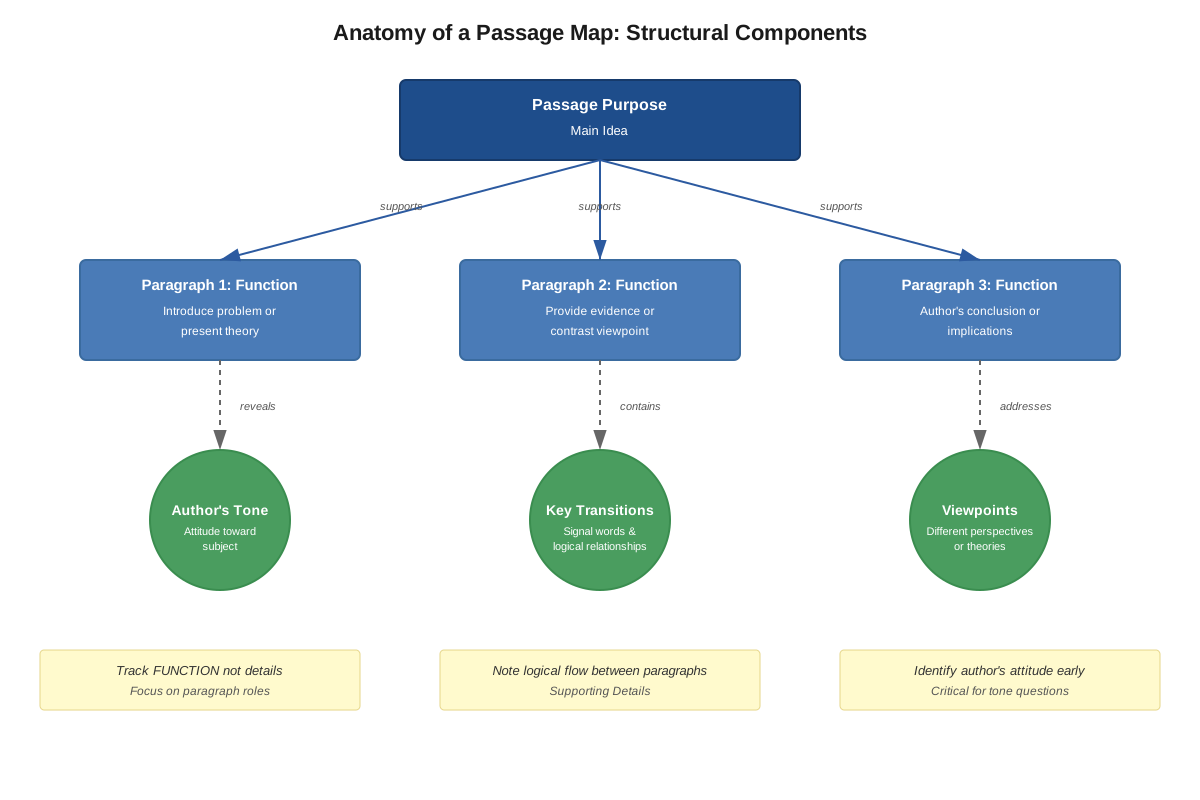
The fundamental principle behind gre passage mapping is that understanding the architecture of a passage is more valuable than memorizing its details. When students create a passage map, they identify the purpose of each paragraph, track the author's tone and attitude, note transitions between ideas, and recognize the overall argument structure. This approach allows test-takers to answer questions efficiently by knowing exactly where to locate specific information rather than re-reading entire passages under time constraints.
Within the broader context of GRE Verbal Reasoning, passage mapping serves as the foundational skill that enables success across all Reading Comprehension question types. Whether facing main idea questions, detail questions, inference questions, or author's purpose questions, a well-constructed passage map provides the framework for quickly eliminating wrong answers and identifying correct ones. This technique integrates seamlessly with other critical reading skills such as identifying argument structure, recognizing rhetorical devices, and distinguishing between primary and supporting ideas—all essential competencies for achieving a competitive Verbal Reasoning score.
Learning Objectives
- [ ] Identify when passage mapping is being tested
- [ ] Explain the core rule or strategy behind passage mapping
- [ ] Apply passage mapping to GRE-style questions accurately
- [ ] Construct effective passage maps within 3-4 minutes for typical GRE passages
- [ ] Distinguish between essential structural elements and minor details during active reading
- [ ] Use passage maps to predict question types before reading the questions
- [ ] Adapt mapping strategies to different passage types (argumentative, explanatory, comparative)
Prerequisites
- Basic reading comprehension skills: Understanding literal meaning of academic texts is necessary before learning structural analysis techniques
- Familiarity with paragraph structure: Recognizing topic sentences and supporting details helps identify the function of each paragraph in a passage
- Understanding of argument components: Knowledge of claims, evidence, and conclusions enables tracking of logical flow in passages
- Time management fundamentals: Basic awareness of GRE timing constraints provides context for why efficient reading strategies matter
Why This Topic Matters
Passage mapping represents one of the highest-yield strategies for GRE Verbal Reasoning success because it directly addresses the exam's most challenging section: Reading Comprehension. On the GRE, approximately 50% of Verbal Reasoning questions come from Reading Comprehension passages, making this skill essential for achieving competitive scores. Students who master passage mapping typically see score improvements of 3-5 points on the Verbal section because they can answer questions more accurately and efficiently.
In real-world applications, passage mapping mirrors the critical reading skills required in graduate school and professional settings. Graduate students must quickly synthesize complex research articles, legal professionals must extract key arguments from lengthy documents, and business analysts must identify main conclusions from dense reports. The ability to rapidly construct mental models of complex texts translates directly to academic and career success beyond the GRE.
On the exam itself, passage mapping appears in every Reading Comprehension set, which typically includes 1-6 questions per passage. The GRE presents passages ranging from one paragraph (approximately 100 words) to long passages (approximately 450 words), with most falling in the medium range (200-350 words). Common passage types include scientific explanations with competing theories, historical analyses with multiple perspectives, literary criticism, and social science research discussions. Each of these formats benefits from systematic mapping that captures the passage's organizational structure and argumentative flow.
Core Concepts
The Fundamental Purpose of Passage Mapping
Passage mapping serves as an active reading strategy that converts passive text consumption into engaged structural analysis. The core principle is that the GRE tests understanding of how ideas relate to each other, not memorization of specific facts. When students create a passage map, they externalize their comprehension by noting the function of each paragraph, the relationships between ideas, and the author's overall purpose. This technique addresses the fundamental challenge of GRE Reading Comprehension: passages contain far more information than any test-taker can remember, but questions focus on structure, purpose, and logical relationships that a good map captures perfectly.
Essential Elements of an Effective Passage Map
A complete passage map includes four critical components that work together to create a comprehensive understanding:
- Paragraph-by-paragraph function labels: Each paragraph receives a brief 3-5 word description of its role (e.g., "introduces problem," "presents solution 1," "critiques solution 1," "author's position")
- Main idea identification: The passage's central claim or thesis, typically found in the introduction or conclusion, anchored in your map
- Tone and attitude markers: Notes about whether the author is neutral, critical, supportive, or ambivalent toward ideas presented
- Structural transitions: Recognition of contrast words (however, but, although), continuation words (furthermore, additionally), and causal relationships (therefore, because, consequently)
The Passage Mapping Process
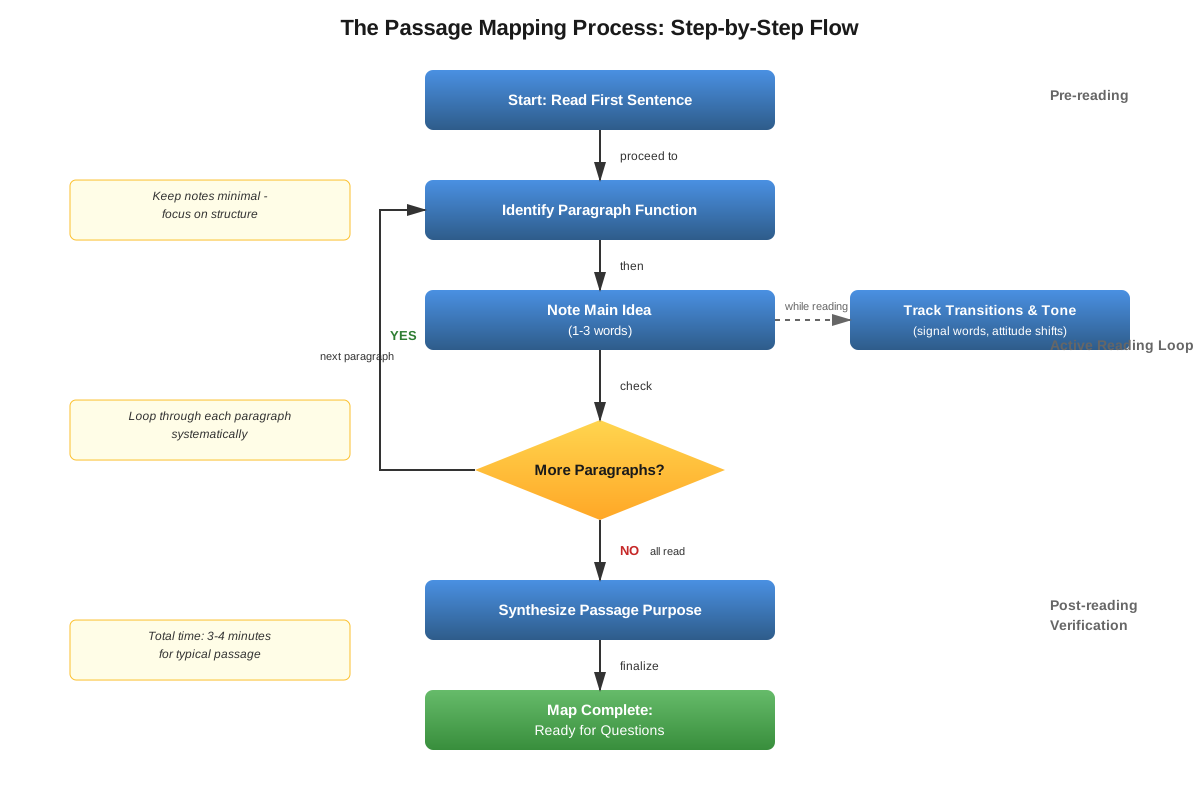
The systematic approach to creating an effective passage map follows this sequence:
- Read the first paragraph actively while asking: "What is the author introducing? Is this background, a problem, a theory, or a position?"
- Pause briefly after each paragraph (2-3 seconds) to mentally summarize its function in your own words
- Note structural signals such as "traditionally believed," "recent research suggests," "critics argue," or "the author contends"
- Track shifts in perspective when the passage moves from describing others' views to presenting the author's position
- Identify the passage type (explanatory, argumentative, comparative) to predict likely question types
- Create physical or mental notes using abbreviations: MP (main point), Auth (author's view), Trad (traditional view), Crit (criticism), Ex (example)
Passage Types and Mapping Adaptations
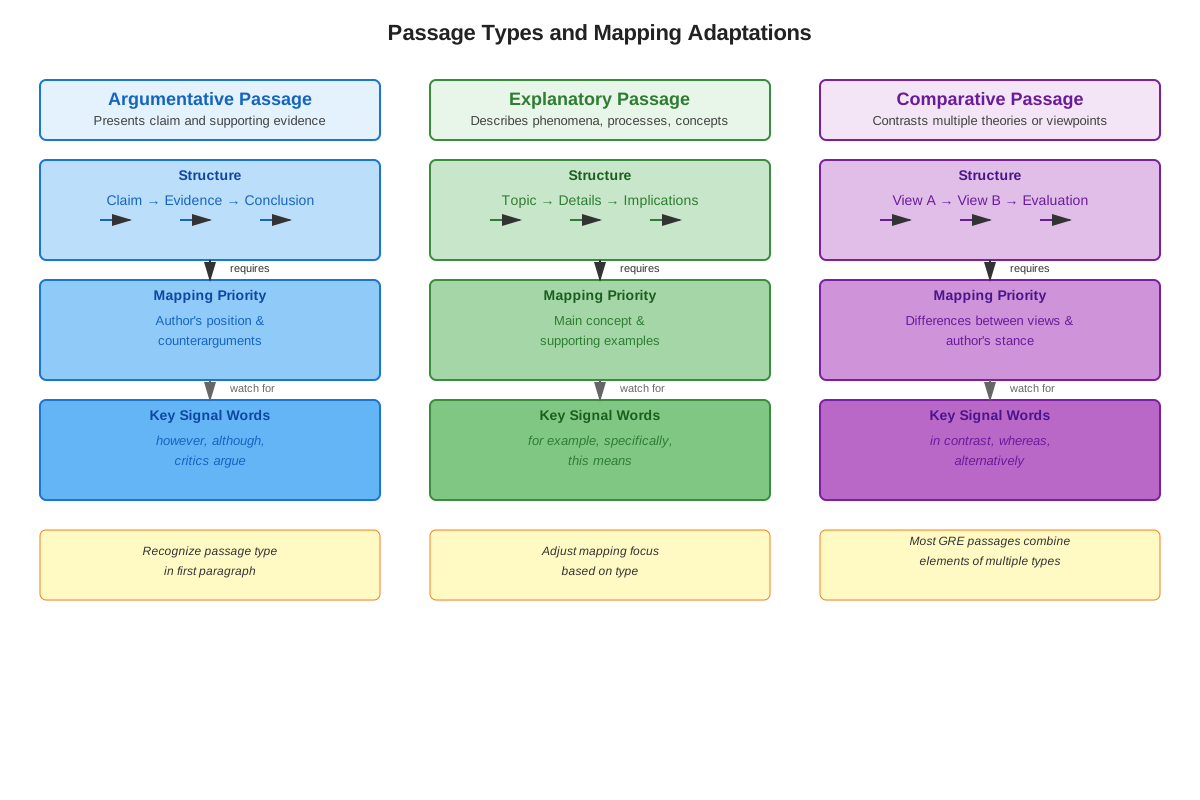
Different passage structures require tailored mapping approaches:
| Passage Type | Structural Pattern | Mapping Focus |
|---|---|---|
| Theory Explanation | Introduces phenomenon → Presents theory → Provides evidence → Discusses implications | Track what the theory explains and what evidence supports it |
| Argument Critique | Presents argument → Identifies weaknesses → Offers alternative or conclusion | Distinguish between the argument being critiqued and the author's critique |
| Comparative Analysis | Introduces topic → Describes approach A → Describes approach B → Evaluates both | Note similarities, differences, and author's preference (if stated) |
| Historical Development | Past understanding → New discovery/idea → Current understanding | Track chronological progression and what changed |
| Problem-Solution | Identifies problem → Discusses attempted solutions → Evaluates effectiveness | Map which solutions work, which fail, and why |
Recognizing Passage Mapping Opportunities
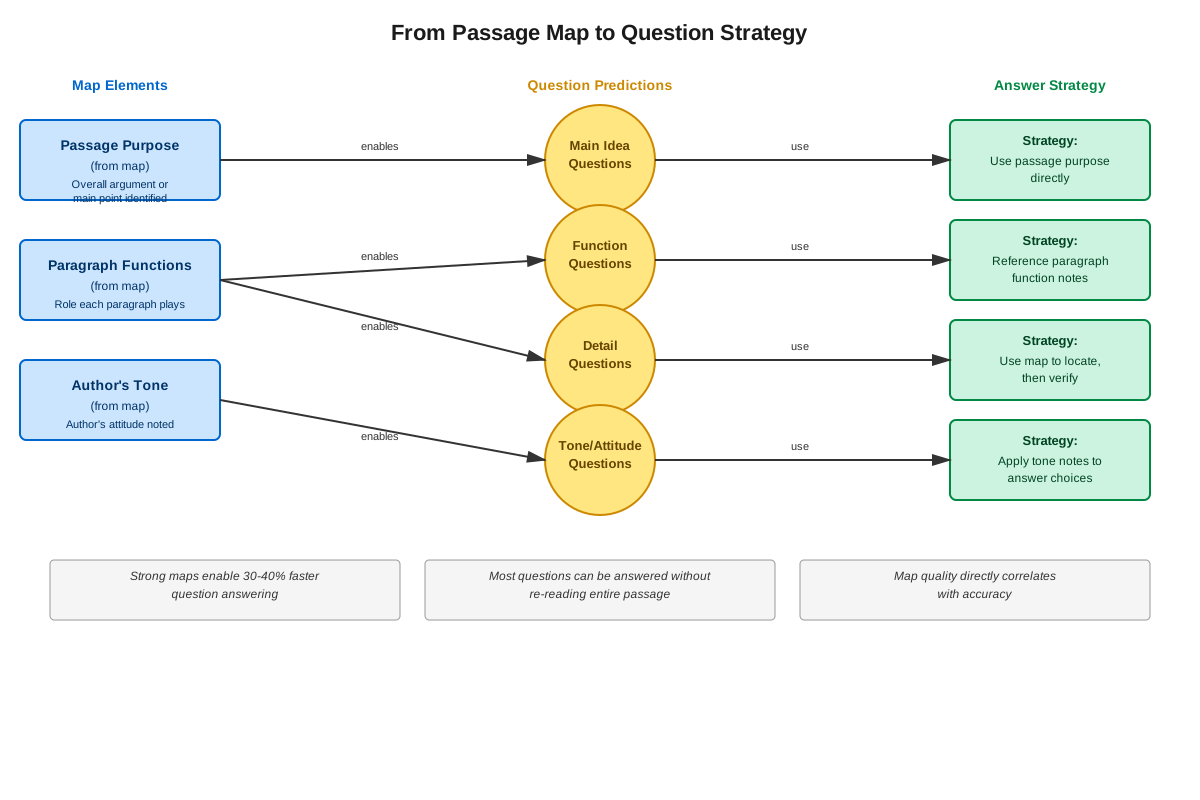
Passage mapping applies to every Reading Comprehension question, but certain question types particularly reward strong mapping:
- Main idea/primary purpose questions: Directly answered by your overall passage map
- Function questions: "The author mentions X in order to..." requires knowing paragraph functions
- Structure questions: "Which of the following best describes the organization..." tests your structural understanding
- Attitude questions: Your tone markers guide these answers
- Location-based questions: Your map tells you exactly where to find specific information
The Relationship Between Mapping and Question Answering
A well-constructed passage map creates a two-way relationship with question answering. First, the map enables rapid question answering by providing a reference framework—when a question asks about paragraph 3, your map reminds you that paragraph 3 "critiques the traditional theory." Second, questions themselves can validate or refine your map—if you struggle with a main idea question, it signals that your initial map may have missed the passage's true purpose, prompting strategic re-reading of key sentences.
Common Mapping Notation Systems
Effective passage mappers develop personalized shorthand that captures maximum information with minimal writing:
- Arrows: → (leads to), ← (caused by), ↔ (mutual relationship)
- Symbols: + (positive/support), - (negative/criticism), ? (question/problem), ! (surprising/important)
- Abbreviations: Auth (author), Trad (traditional view), Sci (scientists), Crit (critics), Ex (example), Ev (evidence)
- Brackets: [background], [main point], [counterargument], [conclusion]
Concept Relationships
Passage mapping functions as the central hub connecting multiple Reading Comprehension skills. The mapping process begins with active reading techniques, which provide the attentional focus necessary to identify structural elements rather than getting lost in details. Active reading feeds into passage mapping by ensuring that each paragraph is processed for its function, not just its content.
The passage map then enables efficient question answering by creating a mental index of where information appears and how ideas relate. This relationship flows in both directions: strong mapping improves question accuracy, while practicing questions reveals which mapping elements matter most. Passage mapping supports inference questions by clarifying what the author explicitly states versus what must be inferred, and it facilitates tone and attitude questions by tracking evaluative language throughout the passage.
Within the passage mapping process itself, paragraph function identification leads to overall structure recognition, which determines the passage type classification. Understanding passage type predicts likely question types, which guides where to focus attention during reading. This creates a virtuous cycle: better mapping → faster question answering → more time for careful reading → even better mapping.
Passage mapping also connects to the broader skill of argument analysis. When a passage presents an argument, the map captures the claim, evidence, assumptions, and conclusion—elements that appear across multiple GRE question types. Similarly, passage mapping integrates with vocabulary in context skills, as understanding a paragraph's function helps determine the meaning of unfamiliar words based on their role in the argument.
High-Yield Facts
⭐ Passage mapping should take 3-4 minutes maximum for a typical GRE passage, leaving adequate time for questions
⭐ The first and last sentences of each paragraph contain the highest concentration of structural information
⭐ Approximately 70% of GRE Reading Comprehension questions can be answered using only your passage map without re-reading
⭐ Contrast words (however, but, yet, although) signal the most important structural shifts in GRE passages
⭐ The author's own position typically appears in the final paragraph or is signaled by phrases like "in fact," "actually," or "the author argues"
- Passages with multiple viewpoints always require tracking whose view is being presented in each paragraph
- Detail questions deliberately ask about information from different paragraphs to test whether you can locate information efficiently
- The GRE frequently places the main idea in the second paragraph rather than the first, after providing background context
- Mapping tone is particularly crucial for passages in humanities and social sciences where the author's attitude drives the argument
- Physical note-taking for passage maps should use no more than 15-20 words total to avoid time waste
Quick check — test yourself on Passage mapping so far.
Try Flashcards →Common Misconceptions
Misconception: Passage mapping means writing detailed notes about every paragraph → Correction: Effective passage mapping uses minimal notation (3-5 words per paragraph) focusing on function, not content. The goal is to create a mental framework, not transcribe the passage.
Misconception: You should map every detail and example in the passage → Correction: Examples and specific details should be noted only by location (e.g., "Ex in para 3"), not content. The GRE tests whether you can find details when needed, not whether you memorized them.
Misconception: Passage mapping takes too much time and slows down reading → Correction: Initial practice may feel slow, but skilled mappers actually save time by avoiding multiple re-readings. The 3-4 minutes spent mapping saves 5-7 minutes during question answering.
Misconception: All passages follow the same structure, so one mapping approach works for everything → Correction: GRE passages vary significantly in structure (argumentative, explanatory, comparative, chronological). Effective mappers adapt their approach based on passage type identified in the first paragraph.
Misconception: The main idea is always in the first paragraph → Correction: GRE passages frequently begin with background information or a traditional view before presenting the main idea in paragraph two or even the conclusion. Mapping the entire passage before identifying the main idea prevents this error.
Misconception: Passage mapping is only useful for long passages → Correction: Even short single-paragraph passages benefit from mapping that identifies the claim, evidence, and conclusion structure. The technique scales to all passage lengths.
Misconception: You need to understand every sentence to create an effective map → Correction: Passage mapping succeeds even when some sentences contain unfamiliar vocabulary or complex syntax. Focus on what you do understand about each paragraph's function and relationship to others.
Worked Examples
Example 1: Science Passage with Theory Critique
Passage:
"For decades, scientists attributed the extinction of large mammals at the end of the Pleistocene epoch primarily to climate change, noting the correlation between rising temperatures and species disappearance. However, recent archaeological evidence has challenged this climate-centric explanation. Excavations across multiple continents reveal that human populations expanded into new territories at precisely the times when megafauna extinctions accelerated, suggesting that human hunting may have been the decisive factor. While climate change undoubtedly stressed these populations, the temporal and geographic coincidence of human arrival and extinction events provides compelling evidence that anthropogenic factors played the dominant role. This revised understanding has significant implications for current conservation efforts, as it suggests that human impact on ecosystems has been profound for far longer than previously recognized."
Mapping Process:
After Paragraph 1 (sentences 1-2): "Trad view: climate caused extinction"
After Paragraph 1 (sentence 3): "New evidence challenges this"
After Paragraph 1 (sentences 4-5): "Human hunting = main cause; evidence = timing matches"
After Paragraph 1 (final sentence): "Implications for conservation"
Complete Passage Map:
- Structure: Traditional theory → Challenge → New theory + evidence → Implications
- Author's tone: Supportive of new theory (note "compelling evidence")
- Main point: Human hunting, not climate, primarily caused Pleistocene extinctions
- Passage type: Theory critique with alternative explanation
Applying the Map to Questions:
Question: "The primary purpose of the passage is to..."
Using the map: The structure shows "traditional theory → challenge → new theory," which indicates the purpose is to present an alternative explanation. The correct answer will mention challenging the climate explanation and proposing human hunting as the cause.
Question: "The author's attitude toward the 'revised understanding' can best be described as..."
Using the map: The tone marker noted "compelling evidence" and supportive language, indicating the author favors the new theory. Look for answer choices suggesting approval or acceptance.
Example 2: Comparative Analysis Passage
Passage:
"Two competing approaches dominate contemporary urban planning: New Urbanism and Smart Growth. New Urbanism emphasizes walkable neighborhoods with mixed-use development, traditional architectural styles, and reduced automobile dependence, drawing inspiration from pre-automobile city design. Smart Growth, while sharing some goals with New Urbanism, focuses more broadly on regional planning, environmental sustainability, and efficient use of existing infrastructure rather than aesthetic considerations. Critics of New Urbanism argue that its nostalgic architectural requirements increase costs and limit affordability, while Smart Growth advocates face accusations of being too technocratic and insufficiently attentive to community character. Despite these differences, both approaches represent significant improvements over post-war suburban sprawl, and many successful developments incorporate elements of both philosophies."
Mapping Process:
After sentence 1: "Two approaches: New Urbanism vs Smart Growth"
After sentence 2: "NU = walkable, mixed-use, traditional design"
After sentence 3: "SG = regional planning, environment, infrastructure"
After sentence 4: "Criticisms of both"
After sentence 5: "Both better than sprawl; can combine"
Complete Passage Map:
- Structure: Introduce two approaches → Describe NU → Describe SG → Criticisms → Author's synthesis
- Author's tone: Balanced, sees value in both
- Main point: NU and SG differ but both improve on sprawl and can be combined
- Passage type: Comparative analysis with synthesis
Applying the Map to Questions:
Question: "According to the passage, New Urbanism and Smart Growth differ primarily in..."
Using the map: Paragraph functions show NU focuses on walkability/design while SG focuses on regional/environmental aspects. Return to sentences 2-3 for specific differences.
Question: "The author would most likely agree with which of the following statements?"
Using the map: The final sentence shows the author's position: both approaches have merit and can be combined. Correct answer will reflect this balanced, integrative view.
Exam Strategy
Approaching GRE Reading Comprehension with Passage Mapping
Begin every Reading Comprehension set by investing 3-4 minutes in active reading with simultaneous mapping. This upfront time investment pays dividends by enabling faster, more accurate question answering. Read with a pencil in hand (or finger on screen for computer-based testing) to maintain active engagement, but write sparingly—your goal is mental organization, not transcription.
Trigger Words That Signal Mapping Opportunities
Certain phrases indicate critical structural elements that must appear in your map:
- Contrast triggers: "however," "but," "yet," "although," "despite," "in contrast," "on the other hand" → Mark these prominently as they signal argument shifts
- Author's voice: "in fact," "actually," "indeed," "the author argues/contends/suggests" → These reveal the author's own position versus others' views
- Traditional view markers: "traditionally," "historically," "long believed," "conventional wisdom" → Usually precedes a challenge or revision
- Evidence introduction: "recent research," "studies show," "evidence suggests" → Indicates support for a claim
- Conclusion signals: "therefore," "thus," "consequently," "this suggests" → Points to main takeaways
Process of Elimination Using Your Map
When evaluating answer choices, use your passage map to eliminate options systematically:
- For main idea questions: Eliminate choices that focus on details from only one paragraph or that contradict your overall structure map
- For function questions: Eliminate choices that misidentify the paragraph's role in the argument structure
- For detail questions: Use your map to locate the relevant paragraph, then eliminate choices that distort or contradict the specific information
- For inference questions: Eliminate choices that go beyond what your map shows the passage supports or that contradict established information
Time Allocation Strategy
Distribute your Reading Comprehension time according to this proven framework:
- Short passages (1 paragraph): 2 minutes reading/mapping, 1 minute per question
- Medium passages (2-3 paragraphs): 3-4 minutes reading/mapping, 1-1.5 minutes per question
- Long passages (4-5 paragraphs): 4-5 minutes reading/mapping, 1-1.5 minutes per question
If you find yourself re-reading the entire passage for multiple questions, your initial map was insufficient. Practice creating more comprehensive maps that capture paragraph functions and structural relationships.
Adapting to Computer-Based Testing
For computer-based GRE administration, develop a hybrid mapping approach: create minimal physical notes on scratch paper (paragraph numbers with 2-3 word functions) while building a more detailed mental map. The physical notes serve as memory anchors, while the mental map contains the full structural understanding. Practice this hybrid approach during preparation to build comfort with the format.
Memory Techniques
The MAPS Acronym for Passage Mapping Elements
Main idea - What's the passage's central claim or purpose?
Attitude - What's the author's tone toward the subject?
Paragraph functions - What role does each paragraph play?
Structure - How do the parts connect (contrast, support, chronology)?
Visualization Strategy: The Building Metaphor
Imagine each passage as a building where paragraphs are floors. The foundation (first paragraph) establishes the topic. Middle floors develop the argument with evidence, counterarguments, or comparisons. The roof (final paragraph) provides the conclusion or implications. Structural elements (transitions, contrast words) are the staircases connecting floors. This spatial metaphor helps recall where information appears.
The "Three-Second Pause" Technique
After each paragraph, pause for exactly three seconds and ask: "What did this paragraph DO?" Not what did it say, but what function did it serve? This brief pause cements the structural understanding without consuming excessive time.
Color-Coding Mental Categories
Assign mental "colors" to different elements:
- Red = Author's own position or main claim
- Blue = Traditional/opposing views
- Green = Evidence and examples
- Yellow = Transitions and structural shifts
During reading, mentally "highlight" sentences in these colors to organize information spatially in memory.
The Acronym CRAFT for Passage Types
Comparative - Two or more approaches/theories/views
Refutation - Challenges existing theory
Analytical - Examines components of a phenomenon
Functional - Explains how something works
Temporal - Traces historical development
Identifying passage type in the first paragraph activates the appropriate mapping framework.
Summary
Passage mapping transforms GRE Reading Comprehension from a memory test into a strategic exercise in structural analysis. By actively identifying paragraph functions, tracking the author's tone, noting structural transitions, and recognizing overall passage architecture, test-takers create a mental framework that enables rapid, accurate question answering. The technique succeeds because GRE questions test understanding of relationships and structure rather than memorization of details. An effective passage map captures the essential elements—main idea, paragraph functions, author's attitude, and argument structure—in minimal notation that serves as a reference during question answering. Mastery requires practice adapting the core technique to different passage types (explanatory, argumentative, comparative, chronological) while maintaining efficient time management. Students who invest 3-4 minutes in creating comprehensive passage maps typically answer questions more accurately and avoid time-consuming re-reading, leading to measurable score improvements on the Verbal Reasoning section.
Key Takeaways
- Passage mapping is an active reading strategy that captures structure and relationships, not details, enabling efficient question answering for all Reading Comprehension types
- Effective maps include four elements: paragraph functions (3-5 words each), main idea, author's tone, and structural transitions marked by contrast and conclusion words
- The mapping process should take 3-4 minutes maximum, using minimal notation while building a comprehensive mental framework of the passage architecture
- Different passage types (theory critique, comparative analysis, problem-solution, historical development) require adapted mapping approaches that reflect their unique structures
- Approximately 70% of questions can be answered using only your passage map, with strategic re-reading of specific sentences only when necessary for detail questions
- Trigger words like "however," "in fact," "traditionally," and "recent research" signal critical structural elements that must appear in your map
- The first and last sentences of paragraphs contain the highest concentration of structural information and deserve focused attention during mapping
Related Topics
Argument Structure Analysis: Building on passage mapping skills, this topic focuses specifically on identifying claims, evidence, assumptions, and conclusions in argumentative passages, enabling success on both Reading Comprehension and Analytical Writing sections.
Inference Questions: Mastering passage mapping provides the foundation for inference questions, which require understanding what the passage implies beyond explicit statements—your structural map reveals what conclusions are supported.
Author's Purpose and Tone: This advanced topic extends passage mapping's attention to authorial attitude, teaching students to identify subtle rhetorical strategies and evaluative language that reveal the author's intentions.
Reading Comprehension Question Types: With passage mapping mastered, students can efficiently tackle all six major question types (main idea, detail, inference, function, structure, and tone) using their structural framework.
Time Management for Verbal Reasoning: Passage mapping integrates into broader time management strategies, helping students allocate their 30 minutes per Verbal section optimally across Reading Comprehension, Text Completion, and Sentence Equivalence questions.
Practice CTA
Now that you understand the principles and techniques of passage mapping, it's time to apply these strategies to actual GRE-style passages. Complete the practice questions associated with this topic, focusing on creating comprehensive passage maps before attempting to answer questions. Use the flashcards to reinforce key concepts like paragraph function identification and structural transition recognition. Remember: passage mapping feels slow initially but becomes faster and more intuitive with consistent practice. Each passage you map strengthens your structural reading skills and builds the mental frameworks that lead to higher Verbal Reasoning scores. Commit to mapping every practice passage for the next two weeks, and you'll see measurable improvement in both speed and accuracy.
Sign up free to keep reading
Create a free AnvayaPrep account to finish this GRE guide on Passage mapping — plus flashcards and practice questions.