Overview
Scientific passages represent one of the three major passage types students encounter in the GRE Verbal Reasoning section, alongside humanities and social science passages. These passages present content drawn from natural sciences (biology, chemistry, physics, astronomy, geology) and typically feature explanations of phenomena, research findings, theoretical frameworks, or scientific debates. Unlike passages that focus on argumentation or literary analysis, GRE scientific passages emphasize the presentation of factual information, causal relationships, experimental evidence, and technical processes.
Mastering scientific passages is essential for GRE success because they appear in approximately 30-40% of Reading Comprehension questions and often prove challenging for students without strong science backgrounds. The GRE does not test specialized scientific knowledge; rather, it assesses the ability to comprehend complex technical material, follow logical relationships between concepts, distinguish between hypotheses and evidence, and synthesize information presented in dense, terminology-rich prose. Students who develop systematic approaches to scientific passages gain significant competitive advantages, as these passages frequently contain the most difficult vocabulary and syntactically complex sentences in the Verbal section.
Within the broader context of GRE Verbal Reasoning, scientific passages serve as the primary vehicle for testing advanced reading comprehension skills under time pressure. They connect directly to critical reasoning abilities tested throughout the exam, requiring students to identify main ideas, understand supporting details, make inferences, evaluate arguments, and analyze text structure—all while navigating unfamiliar scientific terminology and abstract concepts. Success with scientific passages builds transferable skills applicable to all Reading Comprehension question types and strengthens overall performance on the Verbal section.
Learning Objectives
- [ ] Identify when Scientific passages is being tested
- [ ] Explain the core rule or strategy behind Scientific passages
- [ ] Apply Scientific passages to GRE-style questions accurately
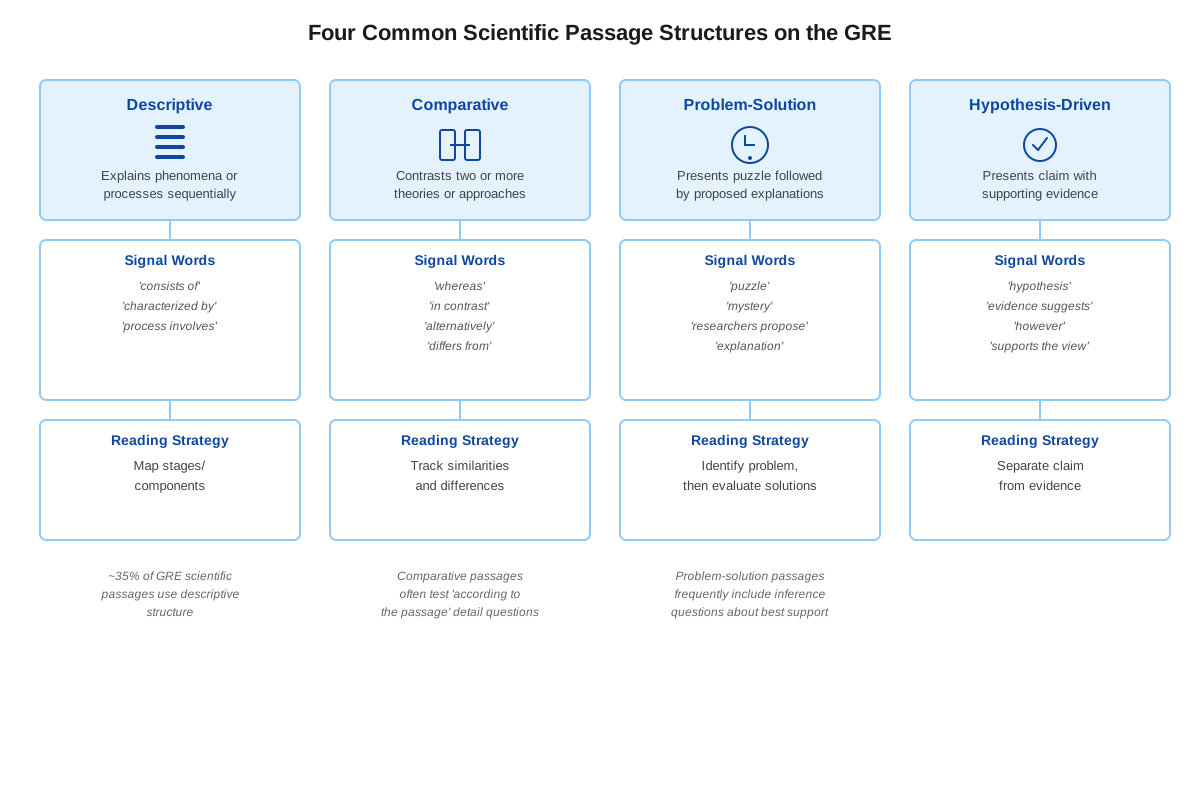
- [ ] Distinguish between different types of scientific passage structures (descriptive, comparative, problem-solution, hypothesis-driven)
- [ ] Extract main ideas from paragraphs containing dense technical terminology without getting lost in details
- [ ] Recognize the relationship between evidence and conclusions in scientific arguments
- [ ] Navigate complex sentence structures typical of scientific writing while maintaining comprehension speed
Prerequisites
- Basic reading comprehension skills: Ability to identify main ideas, supporting details, and author's purpose forms the foundation for tackling more complex scientific material
- Familiarity with GRE question types: Understanding the six standard Reading Comprehension question formats (main idea, detail, inference, function, vocabulary-in-context, and select-in-passage) enables focused practice on scientific content specifically
- Comfort with academic vocabulary: A working vocabulary of approximately 3,000-4,000 words allows students to focus on scientific terminology rather than struggling with general academic language
- Time management fundamentals: Basic pacing strategies for the Verbal section provide the framework for allocating appropriate time to scientific passages
Why This Topic Matters
Scientific passages hold particular significance in professional and academic contexts beyond the GRE itself. Graduate programs across disciplines require students to read and synthesize research literature, understand experimental methodologies, and evaluate scientific claims. The skills developed through mastering GRE scientific passages—extracting key information from technical texts, following complex logical chains, and distinguishing essential from peripheral details—transfer directly to success in graduate coursework and research activities.
From an exam statistics perspective, scientific passages appear in 2-3 of the 5-6 Reading Comprehension passages per Verbal section, accounting for approximately 8-12 questions per test. These passages typically range from 150-450 words and may be accompanied by 1-4 questions each. Notably, scientific passages generate higher error rates than other passage types, with average accuracy rates 10-15% lower than humanities passages among test-takers. This difficulty differential means that improving performance on scientific passages yields disproportionate score gains.
Scientific passages commonly appear in several recognizable formats on the GRE: explanations of natural phenomena (how volcanoes form, why certain species evolved specific traits), presentations of competing scientific theories (different models of planetary formation, alternative explanations for extinction events), descriptions of experimental findings (results from studies on animal behavior, discoveries in particle physics), and discussions of scientific processes or mechanisms (photosynthesis, plate tectonics, DNA replication). Recognizing these common frameworks helps students quickly orient themselves and anticipate the types of questions that will follow.
Core Concepts
Characteristics of Scientific Passages
Scientific passages on the GRE exhibit distinctive features that set them apart from other passage types. First, they employ technical terminology specific to scientific domains—words like "photosynthesis," "mitochondria," "tectonic," "electromagnetic," or "isotope" that may be unfamiliar to students without science backgrounds. However, the GRE never requires pre-existing knowledge of these terms; passages always provide sufficient context for comprehension. Second, scientific passages feature dense information presentation, packing multiple concepts, relationships, and details into relatively short texts. Third, they frequently use complex sentence structures with multiple clauses, parenthetical information, and qualifying phrases that mirror actual scientific writing.
The logical structure of scientific passages typically follows predictable patterns. Most passages move from general to specific, introducing a broad topic before narrowing to particular aspects, mechanisms, or examples. Many passages present a phenomenon-explanation structure, first describing what occurs and then explaining why or how it happens. Others follow a problem-solution framework, identifying a scientific puzzle or question before presenting research findings or theoretical solutions. Understanding these structural patterns enables faster comprehension and more accurate prediction of where specific information will appear.
Types of Scientific Content
Descriptive passages constitute the most straightforward scientific passage type. These texts explain how something works, describe the characteristics of a phenomenon, or outline the stages of a process. For example, a descriptive passage might explain how coral reefs form, describe the properties of different types of stars, or outline the stages of cellular division. Questions accompanying descriptive passages typically focus on details, sequence, and the relationships between components of the system being described.
Comparative passages present two or more theories, models, or approaches to understanding a scientific phenomenon. These passages often begin by introducing a scientific question or observation, then present competing explanations. For instance, a passage might discuss different theories about what caused the extinction of dinosaurs, alternative models for how the moon formed, or competing hypotheses about the function of a particular brain region. Questions on comparative passages frequently ask students to distinguish between the theories, identify evidence supporting each, or recognize points of agreement and disagreement.
Hypothesis-driven passages describe scientific research, presenting a hypothesis, the methodology used to test it, the results obtained, and the conclusions drawn. These passages mirror the structure of scientific papers and require students to distinguish between different elements of the research process. A typical hypothesis-driven passage might describe an experiment testing whether a particular gene influences behavior, a study investigating the effects of temperature on chemical reactions, or research examining the relationship between two astronomical phenomena. Questions often focus on the purpose of the research, the interpretation of results, or the implications of findings.
Key Reading Strategies
The active reading approach proves most effective for scientific passages. Rather than attempting to memorize details, successful test-takers focus on understanding the passage structure and the relationships between ideas. This involves identifying the main point of each paragraph, noting how paragraphs connect to each other, and recognizing the overall purpose of the passage. Students should ask themselves: "What is this paragraph doing? Is it introducing a problem, presenting evidence, explaining a mechanism, or offering a conclusion?"
Terminology management represents a critical skill for scientific passages. When encountering unfamiliar scientific terms, students should note their general category and function rather than worrying about precise definitions. For example, if a passage mentions "chloroplasts" and explains they are "structures within plant cells where photosynthesis occurs," students need only remember "chloroplasts = where photosynthesis happens in plants" rather than attempting to memorize a detailed definition. The passage provides all necessary context, and questions never require outside scientific knowledge.
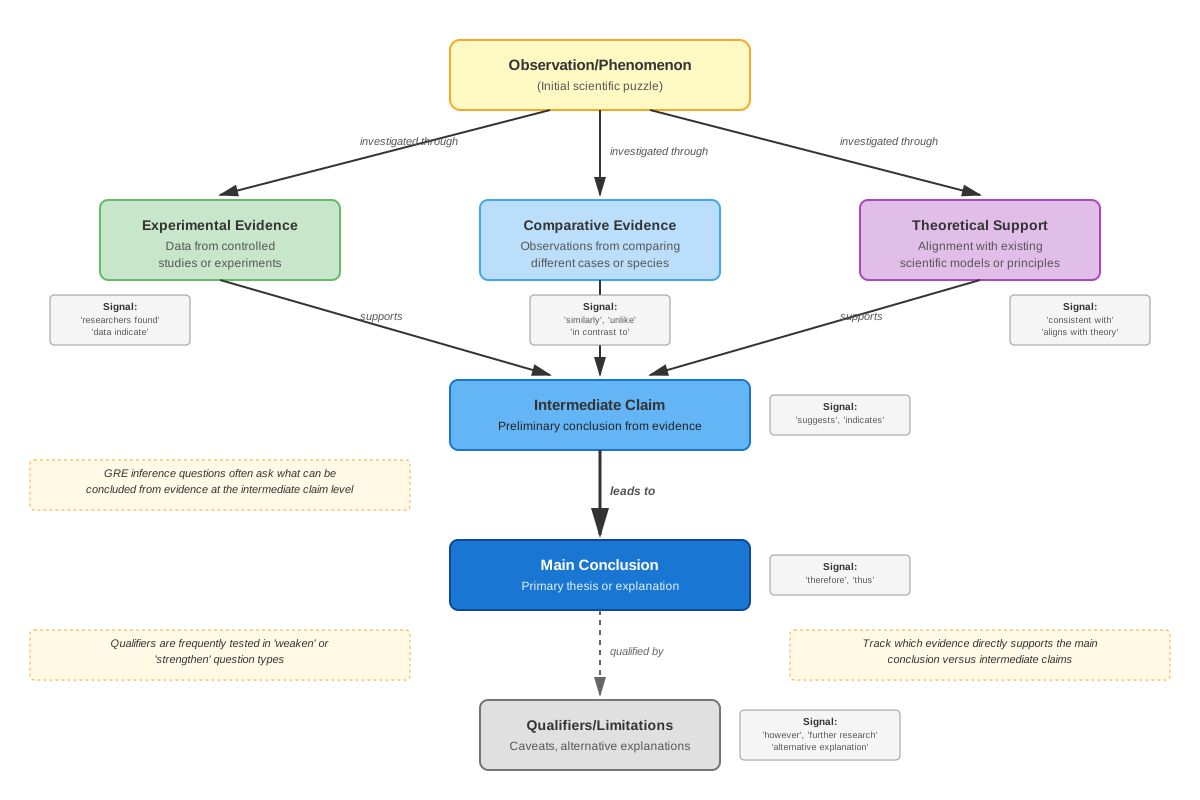
The evidence-conclusion distinction appears frequently in scientific passages and generates many questions. Students must recognize when the passage presents factual observations or experimental results (evidence) versus when it presents interpretations, theories, or explanations (conclusions). This distinction often appears in questions asking what the passage "suggests," what can be "inferred," or what "supports" a particular claim. Careful readers note signal words like "suggests," "indicates," "may explain," "appears to," and "could account for" that mark conclusions rather than established facts.
Common Question Types for Scientific Passages
| Question Type | Frequency | Key Strategy |
|---|---|---|
| Main Idea | High | Focus on the passage's overall purpose and the author's primary point |
| Detail/Retrieval | Very High | Return to the passage to locate specific information; avoid relying on memory |
| Inference | High | Look for what must be true based on stated information; avoid extreme conclusions |
| Function | Medium | Consider what role a paragraph, sentence, or detail plays in the passage structure |
| Vocabulary-in-Context | Medium | Use surrounding context; the correct answer fits the passage's meaning |
| Select-in-Passage | Low | Identify the sentence that performs a specific function or contains particular information |
Detail questions on scientific passages require precise reading and careful attention to qualifiers. The GRE often includes answer choices that distort passage information through subtle changes—replacing "may" with "will," changing "some" to "all," or reversing cause and effect. Students must return to the relevant passage section and compare answer choices word-by-word against the text rather than relying on general impressions or memory.
Inference questions test the ability to draw logical conclusions from stated information without going beyond what the passage supports. In scientific passages, valid inferences often involve recognizing implications of described mechanisms, extending patterns to similar situations, or combining information from different parts of the passage. Invalid inferences typically involve extreme statements, assumptions about unstated information, or conclusions that require outside knowledge.
Concept Relationships
The core concepts within scientific passages form an interconnected system. Passage structure (descriptive, comparative, hypothesis-driven) determines the types of information presented and influences the question types that appear. For example, comparative passages naturally generate questions about differences between theories, while hypothesis-driven passages frequently include questions about the purpose or implications of research. Understanding passage structure → enables prediction of question types → improves time efficiency and accuracy.
Terminology management connects directly to active reading strategies. Rather than getting bogged down in unfamiliar terms, effective readers maintain focus on relationships between concepts, using context to understand how terms function within the passage's logical framework. This relationship can be mapped as: encounter unfamiliar term → identify its category and function → note its relationship to other concepts → continue reading without interruption.
The evidence-conclusion distinction underlies success with multiple question types. Detail questions often test whether students can identify what the passage states as fact (evidence), while inference questions require drawing conclusions beyond what's explicitly stated but supported by the evidence. Function questions frequently ask students to identify whether a particular sentence or paragraph presents evidence, draws conclusions, or performs another structural role. Mastering this distinction → improves performance across question types → increases overall passage accuracy.
Scientific passages connect to broader GRE Verbal Reasoning skills through their emphasis on logical relationships and argument structure. The ability to follow causal chains, distinguish between hypotheses and supporting evidence, and recognize the purpose of different passage components transfers directly to Text Completion and Sentence Equivalence questions that test logical reasoning. Additionally, the vocabulary encountered in scientific passages—both technical terms and academic language—reinforces the word knowledge essential for all Verbal question types.
High-Yield Facts
⭐ Scientific passages account for approximately 30-40% of Reading Comprehension passages on the GRE, making them the most frequently tested passage type alongside social science passages.
⭐ The GRE never requires pre-existing scientific knowledge; all necessary information appears within the passage itself.
⭐ Scientific passages typically follow one of three structures: descriptive (explaining how something works), comparative (contrasting theories or approaches), or hypothesis-driven (presenting research findings).
⭐ Detail questions on scientific passages are the most common question type and require returning to the passage rather than relying on memory.
⭐ Technical terminology in scientific passages always includes sufficient context for comprehension; students should focus on the term's function and relationships rather than memorizing definitions.
- Scientific passages average 150-450 words in length, with longer passages typically accompanied by more questions.
- The most common error on scientific passages involves selecting answer choices that distort passage information through subtle changes in qualifiers, scope, or degree.
- Comparative scientific passages often present an older, established theory before introducing a newer or alternative explanation.
- Questions following scientific passages frequently test the distinction between what the passage states directly (evidence) and what it suggests or implies (conclusions).
- Hypothesis-driven passages typically follow the structure: background/question → hypothesis → methodology → results → interpretation/implications.
- Signal words like "however," "although," "surprisingly," and "in contrast" often mark important transitions or contradictions in scientific passages that generate questions.
Quick check — test yourself on Scientific passages so far.
Try Flashcards →Common Misconceptions
Misconception: Students need a strong science background to succeed with scientific passages. → Correction: The GRE explicitly designs scientific passages to be comprehensible without specialized knowledge. All necessary information appears in the passage, and questions never require outside scientific facts. Students with humanities backgrounds can achieve equally high scores by applying systematic reading strategies.
Misconception: Every detail in a scientific passage must be understood and remembered. → Correction: Successful test-takers focus on understanding the passage's structure and main ideas rather than memorizing details. The key is knowing where information appears so it can be located quickly when answering questions. Attempting to absorb every detail wastes time and increases cognitive load.
Misconception: Unfamiliar scientific terminology makes passages impossible to understand. → Correction: Scientific terms in GRE passages always appear with sufficient context to understand their role and function. Students should note the general category of unfamiliar terms (a type of cell, a chemical process, a geological formation) and their relationships to other concepts rather than worrying about precise definitions.
Misconception: The correct answer to inference questions can be any logical conclusion drawn from the passage. → Correction: Valid inferences must be directly supported by passage information without requiring outside knowledge or extreme logical leaps. The GRE tests conservative inferences—conclusions that must be true or are strongly suggested by stated information, not merely possible interpretations.
Misconception: Scientific passages always present objective, unbiased information. → Correction: While scientific passages typically maintain a more neutral tone than argumentative passages, they often include the author's perspective, particularly when presenting competing theories or evaluating research findings. Students must recognize when the passage shifts from presenting facts to offering interpretations or assessments.
Misconception: Reading scientific passages quickly is impossible due to their complexity. → Correction: With practice and strategic approaches, students can maintain good reading speed even on dense scientific material. The key is adjusting reading speed based on passage sections—moving quickly through background information and examples while slowing down for main claims, transitions, and complex mechanisms.
Worked Examples
Example 1: Descriptive Scientific Passage
Passage: "Bioluminescence, the production and emission of light by living organisms, occurs through a chemical reaction involving a light-emitting molecule called luciferin and an enzyme called luciferase. When luciferin reacts with oxygen in the presence of luciferase, the reaction produces light with minimal heat generation, making it far more efficient than incandescent light bulbs. This phenomenon appears in various marine organisms, including certain species of jellyfish, fish, and bacteria. In deep-sea environments where sunlight cannot penetrate, bioluminescence serves multiple functions: attracting prey, deterring predators, and facilitating communication between members of the same species. The anglerfish, for example, uses a bioluminescent lure extending from its head to attract smaller fish in the darkness of the deep ocean."
Question: According to the passage, which of the following is true about bioluminescence?
A) It requires sunlight to initiate the chemical reaction
B) It produces more heat than incandescent light bulbs
C) It involves a reaction between luciferin and oxygen
D) It appears only in deep-sea fish species
E) It serves primarily to facilitate communication
Analysis: This question tests detail retrieval from a descriptive scientific passage. The systematic approach involves:
- Identify the question type: "According to the passage" signals a detail question requiring information stated directly in the text.
- Return to the passage: Rather than relying on memory, locate the relevant information about bioluminescence.
- Evaluate each answer choice against passage information:
- (A) Contradicts the passage—bioluminescence occurs in deep-sea environments "where sunlight cannot penetrate"
- (B) Directly contradicts the passage statement that bioluminescence produces "minimal heat generation" and is "far more efficient than incandescent light bulbs"
- (C) Matches the passage: "When luciferin reacts with oxygen in the presence of luciferase, the reaction produces light"
- (D) Too narrow—the passage states bioluminescence "appears in various marine organisms, including certain species of jellyfish, fish, and bacteria"
- (E) Too narrow—the passage lists three functions: "attracting prey, deterring predators, and facilitating communication"
- Select the answer: (C) is correct because it accurately reflects stated passage information without distortion.
Key Takeaway: Detail questions on scientific passages require careful comparison between answer choices and passage text, watching for subtle distortions in scope, degree, or qualifiers.
Example 2: Comparative Scientific Passage
Passage: "Two competing theories attempt to explain the formation of Earth's moon. The fission theory proposes that the moon split off from Earth's surface due to rapid rotation in the planet's early history, leaving the Pacific Ocean basin as evidence of the separation. However, this theory has fallen out of favor because calculations show Earth never rotated fast enough for such separation to occur. The giant impact hypothesis, now widely accepted, suggests that approximately 4.5 billion years ago, a Mars-sized object collided with Earth, ejecting debris that eventually coalesced to form the moon. This theory better explains the moon's composition, which closely resembles Earth's mantle but lacks a substantial iron core, consistent with material ejected from Earth's outer layers during a massive impact."
Question: The passage suggests which of the following about the fission theory?
A) It has been definitively proven incorrect through recent experiments
B) It provides a better explanation for the moon's composition than the giant impact hypothesis
C) It is undermined by evidence regarding Earth's rotational speed
D) It is currently the most widely accepted explanation for lunar formation
E) It explains why the moon lacks a substantial iron core
Analysis: This inference question requires understanding the relationship between theories and evidence in a comparative passage.
- Identify the question type: "The passage suggests" indicates an inference question requiring a conclusion supported by but not explicitly stated in the passage.
- Locate relevant information: The passage discusses the fission theory in the first half, noting it "has fallen out of favor because calculations show Earth never rotated fast enough for such separation to occur."
- Evaluate answer choices:
- (A) Too strong—the passage says the theory "has fallen out of favor," not that it's been "definitively proven incorrect"
- (B) Contradicts the passage—the giant impact hypothesis "better explains the moon's composition"
- (C) Matches the passage logic—the theory is undermined because "calculations show Earth never rotated fast enough"
- (D) Contradicts the passage—the giant impact hypothesis is "now widely accepted"
- (E) Misattributes information—the passage connects the lack of iron core to the giant impact hypothesis, not the fission theory
- Select the answer: (C) correctly captures the inference that evidence about rotational speed undermines the fission theory.
Key Takeaway: Inference questions on comparative scientific passages often test understanding of how evidence supports or undermines different theories. The correct answer must be supported by passage information without requiring extreme logical leaps.
Exam Strategy
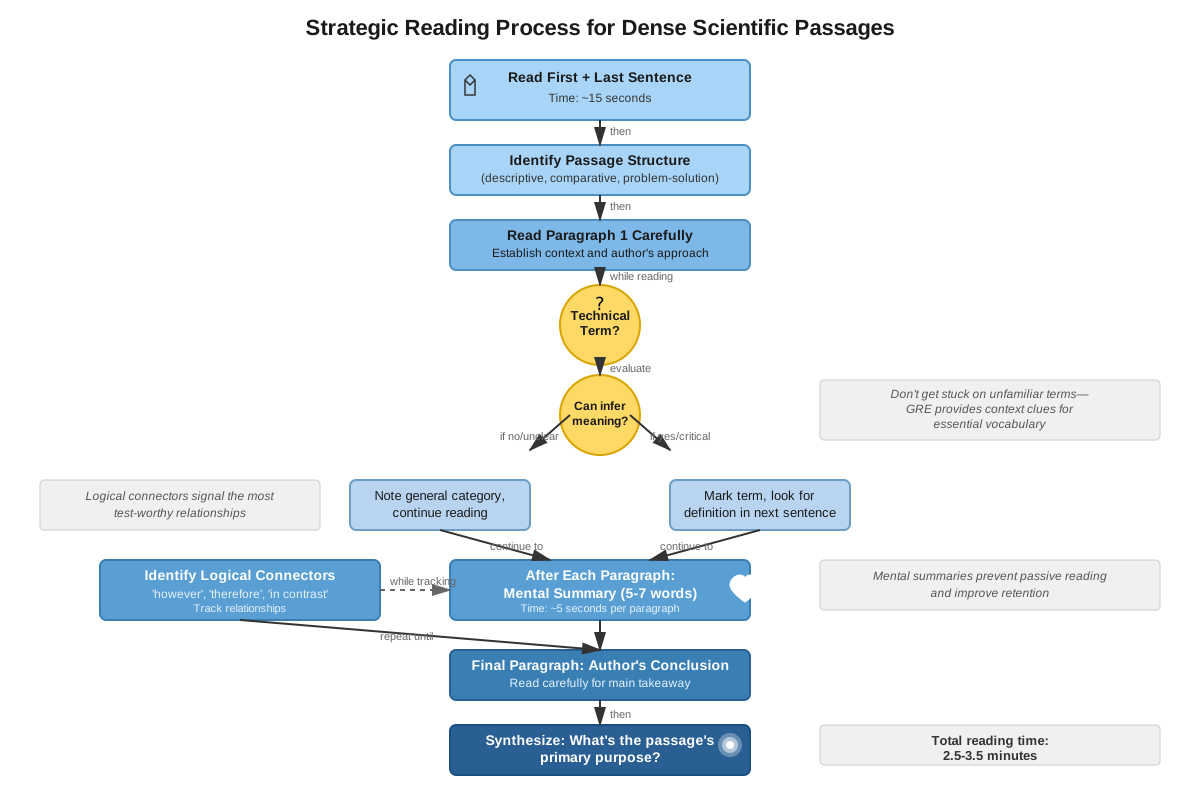
When approaching scientific passages on the GRE, implement a three-phase strategy: preview, active reading, and strategic question-answering. During the preview phase (15-20 seconds), quickly scan the passage to identify its type (descriptive, comparative, hypothesis-driven) and general topic. Note the number of paragraphs and any obvious structural markers like "however," "in contrast," or "recent research suggests." This preview creates a mental framework for organizing information during reading.
The active reading phase (2-3 minutes for a medium-length passage) focuses on understanding structure and relationships rather than memorizing details. Read at a steady pace, slowing down for main claims and transitions while moving more quickly through examples and supporting details. After each paragraph, mentally summarize its main point in 5-7 words. Note the purpose of each paragraph: Does it introduce a problem? Present evidence? Explain a mechanism? Offer a conclusion? Mark or mentally note the location of key information—where theories are introduced, where evidence appears, where the author's perspective emerges.
Trigger words and phrases signal important information in scientific passages:
- Contrast markers: "however," "although," "in contrast," "surprisingly," "unexpectedly" → often mark important shifts or contradictions that generate questions
- Causation indicators: "because," "therefore," "as a result," "consequently," "leads to" → signal cause-effect relationships frequently tested
- Qualification language: "may," "suggests," "appears to," "could explain," "might indicate" → distinguish conclusions from established facts
- Emphasis markers: "importantly," "significantly," "notably," "particularly" → highlight information the author considers crucial
- Evidence introduction: "research shows," "studies indicate," "experiments demonstrate," "observations reveal" → mark the presentation of supporting evidence
For process-of-elimination, apply these scientific passage-specific strategies:
- Eliminate answer choices with scope errors: Watch for options that are too broad (claiming something applies to all cases when the passage discusses only some) or too narrow (limiting a general claim to specific examples)
- Eliminate distortions of passage information: The GRE frequently includes answers that twist passage content by changing qualifiers ("may" to "will"), reversing relationships (cause to effect), or substituting similar but incorrect terms
- Eliminate answers requiring outside knowledge: If an answer choice seems to require scientific information not provided in the passage, it's incorrect
- Eliminate extreme statements: Answers using absolute language ("always," "never," "impossible," "only") are usually wrong unless the passage uses equally strong language
Time allocation for scientific passages should follow this guideline: spend approximately 3 minutes reading a medium-length passage (250-350 words) and 1 minute per question. If a passage seems particularly dense or difficult, don't get stuck—mark challenging questions and return to them after completing easier items. Remember that all questions carry equal weight; spending 4 minutes on one difficult scientific passage question while rushing through three easier questions on other passages represents poor strategy.
Exam Tip: If you encounter a scientific passage on an unfamiliar topic (quantum physics, molecular biology, geological processes), don't panic. The passage contains all necessary information, and your lack of background knowledge doesn't disadvantage you. In fact, students with science backgrounds sometimes struggle because they import outside knowledge instead of relying solely on passage information.
Memory Techniques
The STRUCTURE mnemonic helps remember the three main scientific passage types:
- System description (Descriptive passages explaining how something works)
- Theories compared (Comparative passages contrasting explanations)
- Research presented (Hypothesis-driven passages describing studies)
- Understand relationships (Focus on connections between concepts)
- Context for terminology (Use surrounding text to understand unfamiliar terms)
- Transitions mark importance (Note contrast and causation signals)
- Underline main claims (Identify key points in each paragraph)
- Return to passage (Don't rely on memory for detail questions)
- Evidence vs. conclusions (Distinguish facts from interpretations)
The SCIENCE approach provides a systematic reading strategy:
- Scan the passage structure first (preview)
- Categorize the passage type (descriptive, comparative, hypothesis-driven)
- Identify the main point of each paragraph
- Examine transitions and contrast markers
- Note where key information appears (don't memorize details)
- Connect paragraphs to understand overall structure
- Evaluate the author's purpose and perspective
Visualization strategy: For passages describing processes or mechanisms, create a simple mental flowchart or diagram. For example, if a passage explains how photosynthesis works, visualize: sunlight → chloroplasts → chemical reaction → glucose production. This visual representation aids comprehension and retention better than attempting to remember verbal descriptions.
The "Function First" technique: When reading each paragraph, immediately identify its function before worrying about details. Ask: "Is this paragraph introducing a problem, presenting a theory, describing evidence, explaining a mechanism, or drawing a conclusion?" Knowing the function helps you understand how the paragraph fits into the passage structure and where to return when answering questions.
Summary
Scientific passages represent a high-frequency, high-impact component of GRE Verbal Reasoning, appearing in approximately one-third of Reading Comprehension passages. These passages present content from natural sciences through three primary structures: descriptive passages explaining phenomena or processes, comparative passages contrasting theories or approaches, and hypothesis-driven passages describing research findings. Success requires not scientific knowledge but rather systematic reading strategies that emphasize understanding passage structure, managing technical terminology through context, distinguishing evidence from conclusions, and applying careful process-of-elimination techniques. The most common errors involve distorted details, scope problems, and importing outside knowledge rather than relying solely on passage information. Students who master scientific passages through active reading, strategic question-answering, and consistent practice gain significant competitive advantages, as these passages generate higher error rates than other passage types yet appear frequently enough to substantially impact overall Verbal scores.
Key Takeaways
- Scientific passages test reading comprehension and logical reasoning, never pre-existing scientific knowledge—all necessary information appears within the passage
- The three main passage structures (descriptive, comparative, hypothesis-driven) predict the types of questions that will follow and guide reading strategy
- Active reading focused on passage structure and relationships between ideas proves more effective than attempting to memorize details
- Technical terminology should be understood through context and function rather than precise definition; the passage always provides sufficient information
- Detail questions require returning to the passage and carefully comparing answer choices against stated information, watching for subtle distortions
- The distinction between evidence (facts, observations, data) and conclusions (interpretations, theories, implications) underlies many question types
- Strategic time allocation—approximately 3 minutes reading plus 1 minute per question—prevents getting stuck on difficult items while maximizing overall accuracy
Related Topics
Argument Structure in Reading Comprehension: Understanding how authors construct arguments, present evidence, and draw conclusions builds directly on skills developed through scientific passages, particularly the evidence-conclusion distinction. Mastering scientific passages provides excellent preparation for analyzing argumentative passages.
Vocabulary in Context: Scientific passages frequently test the ability to determine word meaning from surrounding context, a skill that transfers to all passage types and strengthens performance on Sentence Equivalence questions.
Inference Questions Across Passage Types: The conservative inference skills developed through scientific passages—drawing conclusions directly supported by stated information without extreme logical leaps—apply equally to humanities and social science passages.
Text Completion with Scientific Content: Some Text Completion questions present scientific scenarios requiring logical reasoning about processes, causes, and effects. The analytical skills developed through scientific passages enhance performance on these items.
Practice CTA
Now that you've mastered the core concepts and strategies for scientific passages, it's time to apply your knowledge through targeted practice. Complete the practice questions associated with this topic, focusing on implementing the systematic approaches outlined in this guide. Pay particular attention to identifying passage structure, managing technical terminology, and distinguishing evidence from conclusions. Review the flashcards to reinforce high-yield facts and common question patterns. Remember: consistent, strategic practice with scientific passages yields substantial score improvements because these passages generate higher error rates among test-takers. Your systematic approach gives you a competitive advantage—use it!
Sign up free to keep reading
Create a free AnvayaPrep account to finish this GRE guide on Scientific passages — plus flashcards and practice questions.