Overview
The author versus critic distinction is one of the most frequently tested concepts in GRE Reading Comprehension passages. This topic requires test-takers to differentiate between the views, opinions, and arguments presented by the author of a passage and those belonging to other individuals, scholars, or critics mentioned within the text. Mastering this skill is essential because approximately 30-40% of GRE Reading Comprehension questions require students to identify whose perspective is being represented in a particular statement or claim.
Understanding the GRE author versus critic framework goes beyond simple reading comprehension—it demands analytical precision and the ability to track multiple viewpoints simultaneously. The GRE deliberately constructs passages where authors discuss, critique, evaluate, or present alternative theories and perspectives. Test-takers must navigate these layered arguments while maintaining clarity about attribution. A single passage might contain the author's thesis, a traditional view the author challenges, supporting evidence from various researchers, and counterarguments from critics—all interwoven in complex prose.
This topic serves as a foundational skill for all Reading Comprehension question types, particularly inference questions, author's purpose questions, and function questions. The ability to distinguish between what the author believes versus what others believe directly impacts performance on questions asking about the passage's main idea, the author's tone, the purpose of citing specific evidence, and the logical structure of arguments. Without mastery of author versus critic distinctions, students risk misattributing claims and selecting answer choices that contradict the passage's actual argumentative structure.
Learning Objectives
- [ ] Identify when Author versus critic is being tested in GRE Reading Comprehension questions
- [ ] Explain the core rule or strategy behind Author versus critic distinctions
- [ ] Apply Author versus critic analysis to GRE-style questions accurately
- [ ] Recognize linguistic markers and signal phrases that indicate shifts in perspective
- [ ] Distinguish between direct quotations, paraphrased views, and the author's own position
- [ ] Evaluate answer choices by correctly attributing claims to their sources
- [ ] Analyze complex passages containing multiple viewpoints and nested arguments
Prerequisites
- Basic reading comprehension skills: The ability to understand college-level prose is necessary before attempting to distinguish between multiple perspectives within that prose
- Understanding of argument structure: Recognizing claims, evidence, and conclusions helps identify when the author is building their own argument versus presenting others' views
- Familiarity with academic writing conventions: Knowledge of how scholarly texts cite, discuss, and critique other work provides context for recognizing perspective shifts
- Vocabulary at GRE level: Understanding transition words, attribution verbs, and evaluative language is essential for tracking viewpoint changes
Why This Topic Matters
The author versus critic distinction appears in virtually every GRE Reading Comprehension section, making it one of the highest-yield topics for score improvement. Research on GRE question patterns reveals that 3-5 questions per Verbal Reasoning section directly test this skill, while many additional questions require it as a prerequisite for correct analysis. Questions explicitly testing this concept often ask: "The author mentions X in order to...", "According to the passage, critics believe...", or "The author's attitude toward the theory can best be described as..."
In real-world applications, the ability to distinguish between an author's position and the views they discuss is fundamental to academic research, professional analysis, and critical thinking. Graduate students must constantly evaluate sources, understand scholarly debates, and position their own arguments within existing literature—precisely the skills the GRE assesses through author versus critic questions.
GRE passages commonly present this distinction in several formats: scientific passages where researchers debate theories, humanities passages where the author critiques traditional interpretations, social science passages presenting competing explanations for phenomena, and historical passages where the author evaluates different scholarly perspectives on events. The test-makers deliberately construct passages where the author's view is subtle, requiring careful attention to evaluative language, logical structure, and rhetorical purpose rather than explicit statements like "I believe" or "In my opinion."
Core Concepts
The Fundamental Distinction
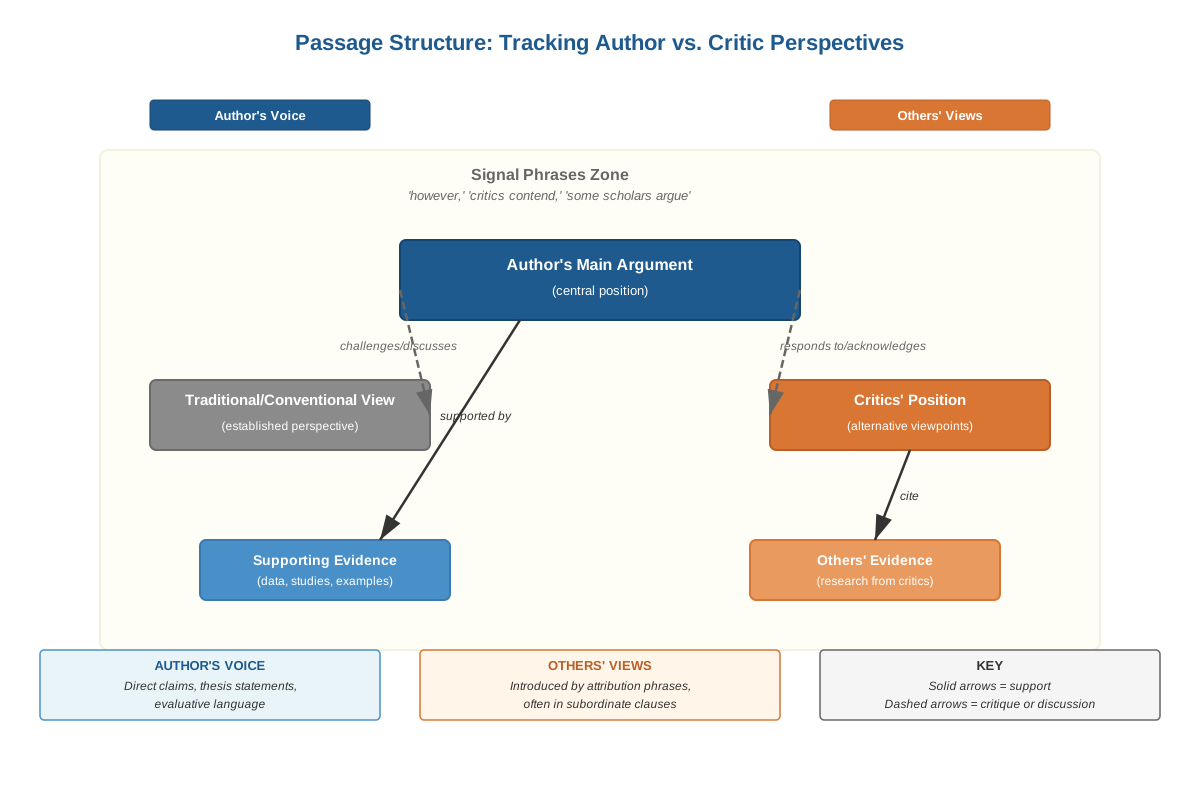
The author versus critic framework centers on a deceptively simple principle: in any GRE passage, multiple perspectives may be present, but only one belongs to the passage's author. The author is the person who wrote the passage itself—the voice organizing the argument, selecting evidence, and guiding the reader through the text. Critics, researchers, scholars, traditional views, or alternative theories represent other voices that the author discusses, presents, evaluates, or challenges.
This distinction becomes complex because authors rarely state their positions explicitly. Instead, they reveal their views through:
- Selection and emphasis: What information the author chooses to include and how much space they devote to it
- Evaluative language: Adjectives, adverbs, and verbs that convey judgment (e.g., "merely," "unfortunately," "convincingly demonstrates")
- Logical structure: Whether the author presents a view to support it, refute it, or provide context
- Contrast and concession: How the author positions their argument relative to other perspectives
Signal Phrases and Attribution Markers
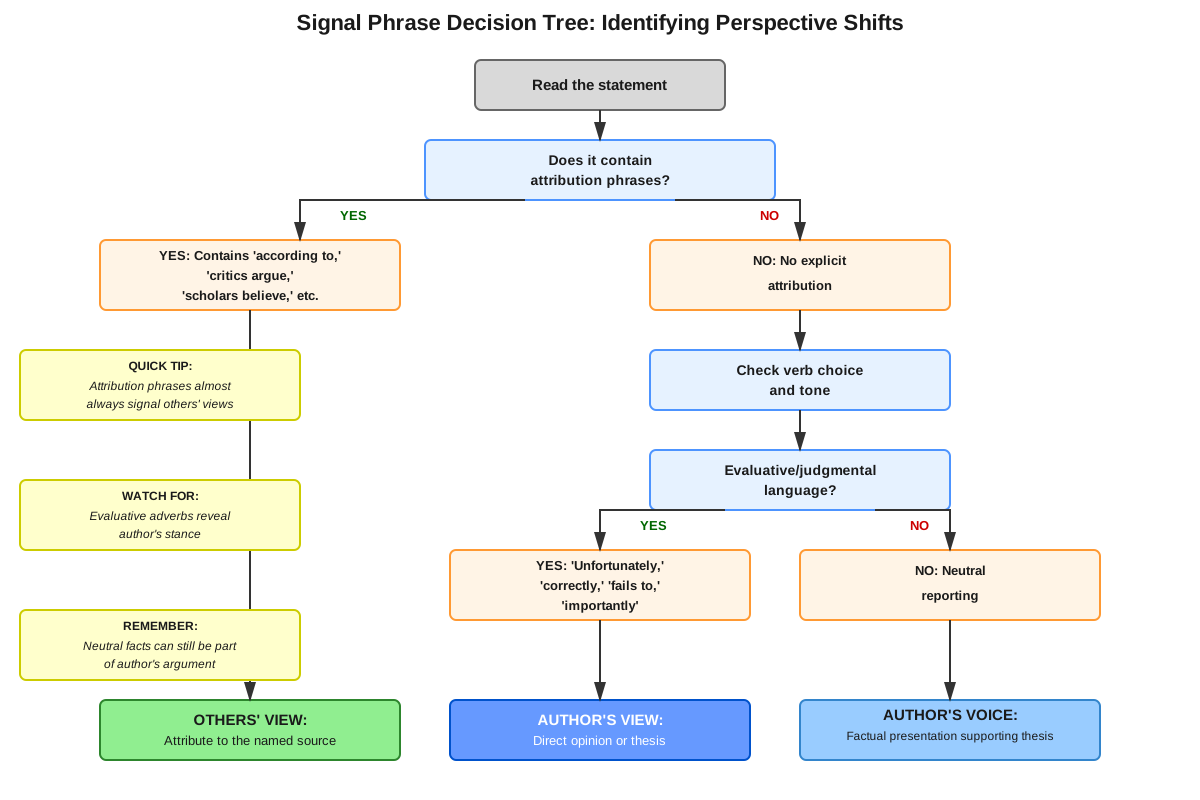
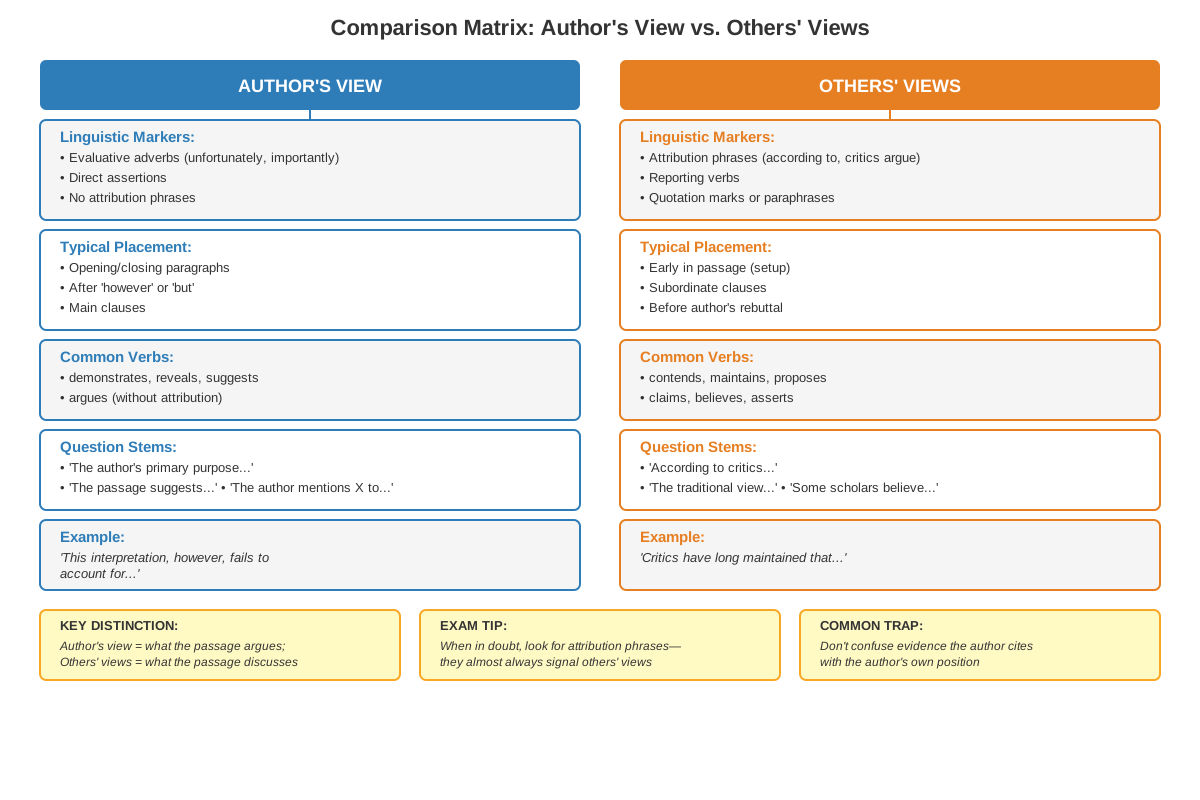
Recognizing when the author shifts from presenting their own view to discussing others' perspectives requires attention to attribution markers—linguistic signals that indicate whose voice is speaking. These markers fall into several categories:
| Attribution Type | Example Phrases | Function |
|---|---|---|
| Direct attribution | "Smith argues that...", "According to the study...", "Critics contend..." | Explicitly assigns a claim to someone other than the author |
| Reporting verbs | "suggests," "proposes," "maintains," "asserts," "claims" | Indicates the author is presenting someone else's position |
| Distancing language | "supposedly," "allegedly," "purportedly," "the so-called" | Signals author skepticism toward a view |
| Agreement markers | "indeed," "correctly notes," "as X rightly observes" | Shows author endorsement of another's view |
| Disagreement markers | "however," "unfortunately," "fails to consider," "overlooks" | Indicates author critique of a presented view |
The Author's Implicit Position
The most challenging aspect of author versus critic analysis involves identifying the author's position when it's never stated directly. GRE passages frequently present the author's view through:
- Structural positioning: The author's thesis often appears at the end of the first paragraph or beginning of the second, after presenting background or alternative views
- Sustained argument: Claims the author develops with detailed evidence and reasoning, rather than briefly mentioning
- Evaluative framing: How the author introduces and concludes discussions of other perspectives
- Rhetorical questions: Questions the author poses often signal their own position through implied answers
Types of "Critics" in GRE Passages
The term "critic" broadly encompasses any perspective other than the author's. GRE passages include various types:
- Traditional or conventional views: "Traditionally, scholars believed..." or "The standard interpretation holds..."
- Specific researchers or theorists: Named individuals whose work the author discusses
- Schools of thought: "Behaviorists argue..." or "Postmodern critics suggest..."
- Hypothetical objections: "One might object that..." or "Skeptics could argue..."
- Popular opinion: "It is commonly assumed..." or "Many believe..."
Each type serves a rhetorical purpose in the author's argument. The author might present traditional views to challenge them, cite specific researchers to support their thesis, or acknowledge objections to demonstrate thoroughness.
Nested Perspectives and Complex Attribution
Advanced GRE passages contain nested perspectives—situations where the author discusses one scholar's interpretation of another scholar's work, or where multiple layers of attribution exist. For example: "Johnson argues that Smith's interpretation of the data overlooks the role of economic factors." Here, three perspectives exist: the author's (who selected this quotation and framed it), Johnson's (who critiques Smith), and Smith's (whose interpretation is being critiqued).
Tracking these nested perspectives requires:
- Identifying the outermost frame (the author's purpose in including this information)
- Recognizing the immediate attribution (Johnson's argument)
- Understanding the embedded perspective (Smith's interpretation)
- Determining the author's stance toward each level
The Author's Rhetorical Purpose
Understanding why the author includes others' perspectives is crucial for answering function questions and inference questions. Authors cite critics or alternative views to:
- Establish context: Showing the scholarly conversation their argument enters
- Create contrast: Highlighting how their view differs from existing perspectives
- Provide support: Using others' research to bolster their claims
- Acknowledge complexity: Demonstrating awareness of counterarguments
- Build credibility: Showing familiarity with the field's debates
- Structure the argument: Using others' views as stepping stones to their conclusion
Concept Relationships
The author versus critic distinction connects intimately with several other Reading Comprehension skills. Argument structure analysis provides the framework for understanding how authors position their claims relative to others' views—the author's thesis often emerges in contrast to or building upon critics' perspectives. Tone and attitude questions depend entirely on distinguishing the author's evaluative stance from neutral presentation of others' views.
The relationship flows as follows: Basic comprehension → Identifying multiple perspectives → Attributing claims correctly → Understanding rhetorical purpose → Inferring the author's implicit position → Answering complex inference and function questions
This topic also connects to logical reasoning skills tested in the Verbal section. Just as Argument Analysis questions require identifying an argument's conclusion versus its premises, author versus critic questions require distinguishing the author's conclusion from the evidence or alternative views they present. The skill of tracking perspective shifts in Reading Comprehension directly supports the ability to analyze argument structure in shorter passages.
Furthermore, mastery of author versus critic distinctions enhances performance on primary purpose questions (which ask about the author's main goal), organization questions (which require understanding how the author structures their discussion of multiple views), and strengthen/weaken questions (which depend on correctly identifying what position needs support or challenge).
Quick check — test yourself on Author versus critic so far.
Try Flashcards →High-Yield Facts
⭐ The author is the person who wrote the passage itself, not any researcher, critic, or theorist mentioned within the passage
⭐ Attribution markers like "according to," "suggests," and "argues" signal that a claim belongs to someone other than the author
⭐ The author's position is often revealed through evaluative language, structural emphasis, and logical development rather than explicit statements
⭐ When the author presents a view without attribution markers, it typically represents the author's own position or accepted fact
⭐ Phrases like "however," "unfortunately," and "fails to consider" signal author disagreement with a presented view
- The author's thesis frequently appears after presenting background, context, or alternative perspectives
- Direct quotations always represent someone other than the author's voice (unless the author is quoting themselves from previous work)
- The amount of space and detail the author devotes to a perspective indicates its importance to their argument
- "Traditional," "conventional," and "standard" views are almost always presented for the author to challenge or complicate
- The author's tone toward different perspectives (neutral, critical, supportive) reveals their argumentative stance
- Questions asking "according to the passage" may refer to either the author's view or others' views—careful attribution is essential
- The author may agree with some aspects of a critic's view while disagreeing with others—positions are not always binary
- Rhetorical questions in GRE passages typically signal the author's own position through their implied answers
Common Misconceptions
Misconception: The author agrees with every view presented in the passage → Correction: Authors frequently present views they disagree with, plan to challenge, or consider incomplete. Presentation does not equal endorsement. The author's actual position must be determined through evaluative language, logical structure, and rhetorical purpose.
Misconception: If a view is presented in detail, it must be the author's position → Correction: Authors often present opposing views or traditional perspectives in detail specifically to critique them thoroughly. The amount of space devoted to a view indicates its importance to the argument, not necessarily the author's agreement. Look for evaluative language and what the author does with the view after presenting it.
Misconception: The author's view always appears in the first paragraph → Correction: While authors often state their thesis early, many GRE passages use a "problem-solution" or "traditional view-new perspective" structure where the author's position emerges after presenting background or alternative views. The author's thesis may appear anywhere in the passage.
Misconception: Attribution markers always indicate disagreement → Correction: Phrases like "according to" and "suggests" simply indicate that a claim belongs to someone other than the author. The author may strongly agree with, partially agree with, or completely disagree with attributed claims. Separate attribution from evaluation.
Misconception: If the passage doesn't explicitly say "I believe" or "in my opinion," the author hasn't stated their position → Correction: Academic writing rarely uses first-person explicit statements. The author's position emerges through argument structure, sustained development of claims with evidence, evaluative language, and the logical progression of the passage. Learning to recognize these implicit markers is essential for GRE success.
Worked Examples
Example 1: Scientific Passage with Multiple Perspectives
Passage excerpt: "For decades, researchers attributed the decline of coral reefs primarily to rising ocean temperatures. However, recent studies by Martinez and colleagues suggest that ocean acidification plays an equally significant role. While this new research provides valuable data on pH levels, it overlooks the complex interactions between temperature and acidity. A more comprehensive understanding requires examining how these factors work synergistically to damage coral ecosystems."
Question: The author's attitude toward the research by Martinez and colleagues can best be described as:
Analysis:
- Identify perspectives: Traditional researchers (attributed decline to temperature), Martinez and colleagues (emphasize acidification), and the author
- Locate attribution markers: "researchers attributed" (traditional view), "studies by Martinez and colleagues suggest" (Martinez's view)
- Find evaluative language: "valuable data" (positive), "overlooks" (critical), "more comprehensive understanding requires" (author's position)
- Determine author's stance: The author acknowledges Martinez's contribution ("valuable data") but critiques the research for being incomplete ("overlooks"). The author's own position appears in the final sentence—both factors must be examined together
Answer approach: The correct answer will reflect "appreciative but critical" or "acknowledging value while noting limitations." Wrong answers might suggest the author completely agrees (missing the critique) or completely disagrees (missing the acknowledgment of "valuable data").
Example 2: Humanities Passage with Nested Perspectives
Passage excerpt: "Literary critic Thompson argues that Morrison's novel challenges Baldwin's assertion that protest fiction cannot achieve aesthetic excellence. Thompson contends that Morrison successfully integrates social critique with literary artistry. Yet Thompson's analysis, while insightful regarding Morrison's technique, underestimates the fundamental differences between Morrison's and Baldwin's literary contexts and objectives."
Question: Which of the following statements about Baldwin's assertion is supported by the passage?
Analysis:
- Identify the three perspectives: Baldwin (protest fiction cannot achieve aesthetic excellence), Thompson (Morrison proves Baldwin wrong), and the author (Thompson's analysis has limitations)
- Track nested attribution: The author discusses Thompson's interpretation of Baldwin's claim
- Determine what the author actually says about Baldwin: The author never directly evaluates Baldwin's assertion—only Thompson's interpretation of it. The author critiques Thompson's analysis for ignoring contextual differences
- Recognize what's NOT stated: The author doesn't say whether Baldwin was right or wrong, only that Thompson's comparison is flawed
Answer approach: Correct answers will be limited to what's explicitly stated about Baldwin's assertion (that it concerns protest fiction and aesthetic excellence) or what Thompson claims about it. Wrong answers might attribute the author's critique of Thompson to Baldwin himself, or claim the author endorses or rejects Baldwin's view when the author only discusses Thompson's interpretation.
Exam Strategy
When approaching GRE Reading Comprehension questions testing author versus critic distinctions, implement this systematic process:
Step 1: Active Reading with Perspective Tracking
As you read the passage initially, mark or mentally note:
- Attribution markers (underline or note "according to," "suggests," etc.)
- Evaluative language (circle words like "unfortunately," "correctly," "merely")
- Transition words indicating contrast ("however," "yet," "although")
- The point where the author's thesis seems to emerge
Step 2: Question Stem Analysis
Identify trigger words and phrases that signal author versus critic questions:
- "The author mentions X in order to..." (asking about author's rhetorical purpose)
- "According to the passage, critics/researchers believe..." (asking for attributed view)
- "The author's attitude toward X can best be described as..." (asking for author's evaluation)
- "The passage suggests that the author would agree with..." (asking for author's position)
- "Which of the following is presented as evidence for the author's claim?" (requires distinguishing author's claim from others')
Step 3: Return to the Passage
Never rely on memory for attribution. Return to the relevant section and:
- Identify whose perspective the question asks about
- Check for attribution markers in that section
- Read 1-2 sentences before and after for context
- Verify whether evaluative language indicates the author's stance
Step 4: Eliminate Answer Choices
Use these elimination strategies:
- Eliminate choices that attribute claims to the wrong source
- Eliminate choices that confuse presentation with endorsement
- Eliminate extreme characterizations of the author's tone unless strongly supported
- Eliminate choices that ignore qualifying language ("some," "may," "suggests")
Time Allocation: Spend 15-20 seconds identifying the question type, 30-40 seconds locating and re-reading the relevant passage section, and 30-40 seconds evaluating answer choices. Author versus critic questions reward careful verification over speed.
Exam Tip: If a question asks about "the passage" without specifying the author, it may be asking about any claim made in the passage, including those attributed to others. If it asks about "the author," it specifically wants the author's own position.
Memory Techniques
MAPS Mnemonic for Identifying the Author's Position:
- Markers: Look for evaluative language and tone
- Argument: Identify what claim receives sustained development
- Positioning: Note where the claim appears structurally
- Support: Check what evidence the author provides (vs. just mentions)
The Attribution Acronym "SCAN":
- Signal phrases: "according to," "suggests," "argues"
- Contrast words: "however," "yet," "although" (often precede author's view)
- Adjectives: Evaluative words reveal author's stance
- Nesting: Track layers of attribution in complex passages
Visualization Strategy: Picture the passage as a conversation at a conference. The author is the moderator who introduces speakers (critics, researchers), summarizes their views, and occasionally offers their own commentary. When you read "Smith argues," visualize the author gesturing to Smith to speak. When you read "however" or evaluative language, visualize the author stepping forward to offer their own perspective.
The "Quote Test": When uncertain whether a claim represents the author's view, ask: "Could this sentence appear in quotation marks attributed to someone else?" If yes, look for attribution markers. If the claim appears without attribution and isn't common knowledge, it likely represents the author's position.
Summary
The author versus critic distinction is a foundational skill for GRE Reading Comprehension success, requiring test-takers to differentiate between the passage author's perspective and the various other viewpoints presented within the text. Mastery involves recognizing attribution markers that signal perspective shifts, identifying evaluative language that reveals the author's stance, understanding the rhetorical purposes for including others' views, and tracking complex nested perspectives where multiple layers of attribution exist. The author's position often emerges implicitly through structural emphasis, sustained argument development, and evaluative framing rather than explicit first-person statements. Success on these questions demands careful attention to linguistic signals, verification through passage review rather than memory, and systematic elimination of answer choices that misattribute claims. This skill appears in 30-40% of Reading Comprehension questions and serves as a prerequisite for correctly answering inference, function, and primary purpose questions.
Key Takeaways
- The author is the passage writer; all other perspectives (critics, researchers, traditional views) represent voices the author discusses but may not endorse
- Attribution markers like "according to," "suggests," and "argues" explicitly signal non-author perspectives
- The author's position emerges through evaluative language, structural emphasis, sustained development, and logical progression
- Presentation of a view does not equal author endorsement—authors frequently present views they plan to challenge
- Always return to the passage to verify attribution rather than relying on memory
- Evaluative language (adjectives, adverbs, contrast words) reveals the author's stance toward presented views
- Questions asking about "the author" require identifying the author's own position, while questions about "the passage" may refer to any claim made, including attributed ones
Related Topics
Tone and Attitude Questions: Building on author versus critic distinctions, these questions require identifying the author's emotional or evaluative stance toward subjects, arguments, or other perspectives. Mastering attribution enables accurate tone assessment.
Primary Purpose and Main Idea Questions: These questions require synthesizing the author's overall argument, which depends on distinguishing the author's thesis from background information, alternative views, and supporting evidence they present.
Function Questions: Questions asking why the author includes specific information or how a paragraph functions within the passage require understanding whether the author presents information to support their view, provide contrast, acknowledge objections, or establish context.
Inference Questions: Many inference questions require determining what the author would likely agree with based on their stated or implied positions, which depends on accurately identifying those positions versus others' views.
Argument Structure Analysis: Understanding how authors construct arguments by positioning their claims relative to existing scholarship, counterarguments, and supporting evidence directly applies author versus critic skills to logical analysis.
Practice CTA
Now that you've mastered the conceptual framework for distinguishing between author and critic perspectives, it's time to apply these skills to authentic GRE-style passages. The practice questions and flashcards will challenge you to identify attribution markers, track multiple perspectives, and correctly answer questions requiring precise attribution. Remember: this skill improves dramatically with deliberate practice. Each passage you analyze strengthens your ability to recognize perspective shifts and evaluative language automatically. Approach the practice materials with the strategies you've learned, and you'll see measurable improvement in your Reading Comprehension accuracy and confidence.
Sign up free to keep reading
Create a free AnvayaPrep account to finish this GRE guide on Author versus critic — plus flashcards and practice questions.