Overview
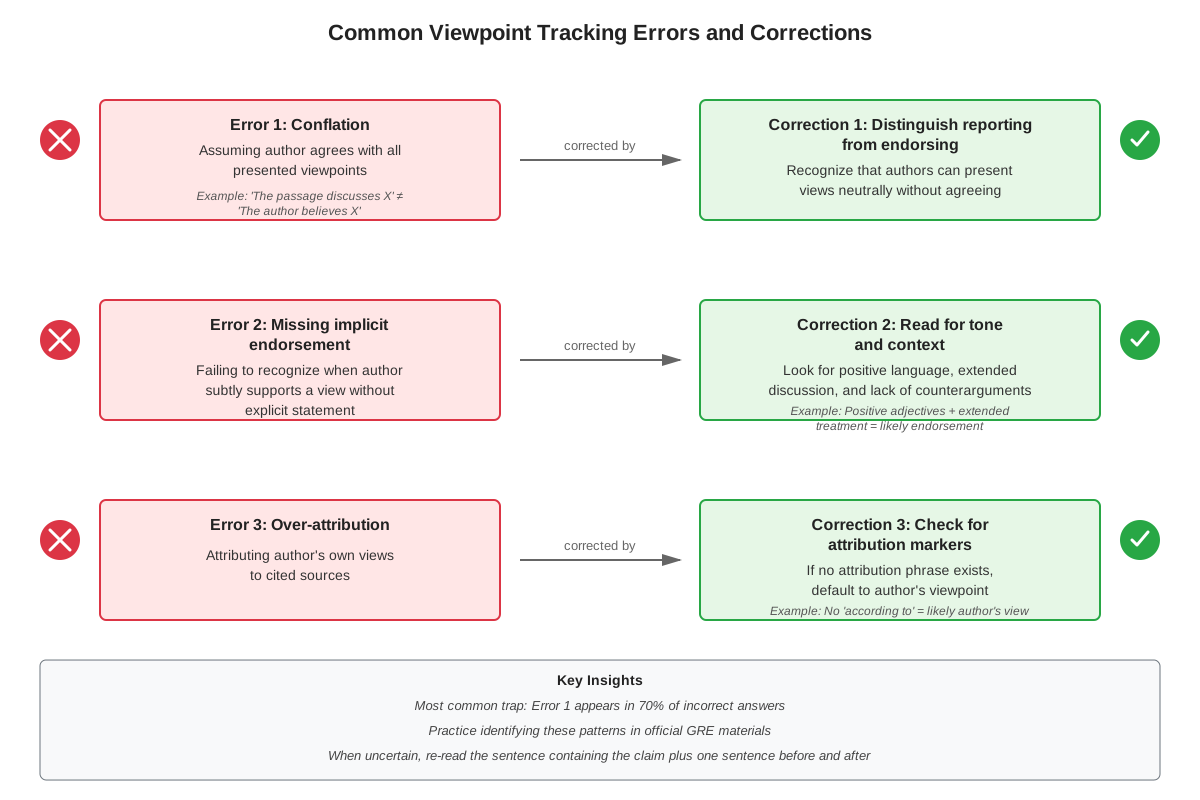
Viewpoint tracking is one of the most critical yet frequently overlooked skills in GRE Reading Comprehension. This technique involves identifying, distinguishing, and following the various perspectives, opinions, and attitudes presented throughout a passage—whether they belong to the author, researchers, critics, historical figures, or theoretical schools of thought. Mastering viewpoint tracking enables test-takers to navigate complex passages where multiple voices intersect, contradict, or build upon one another. Without this skill, students often conflate different perspectives, leading to incorrect answers on questions that specifically test the ability to distinguish "what the author believes" from "what the author reports others believe."
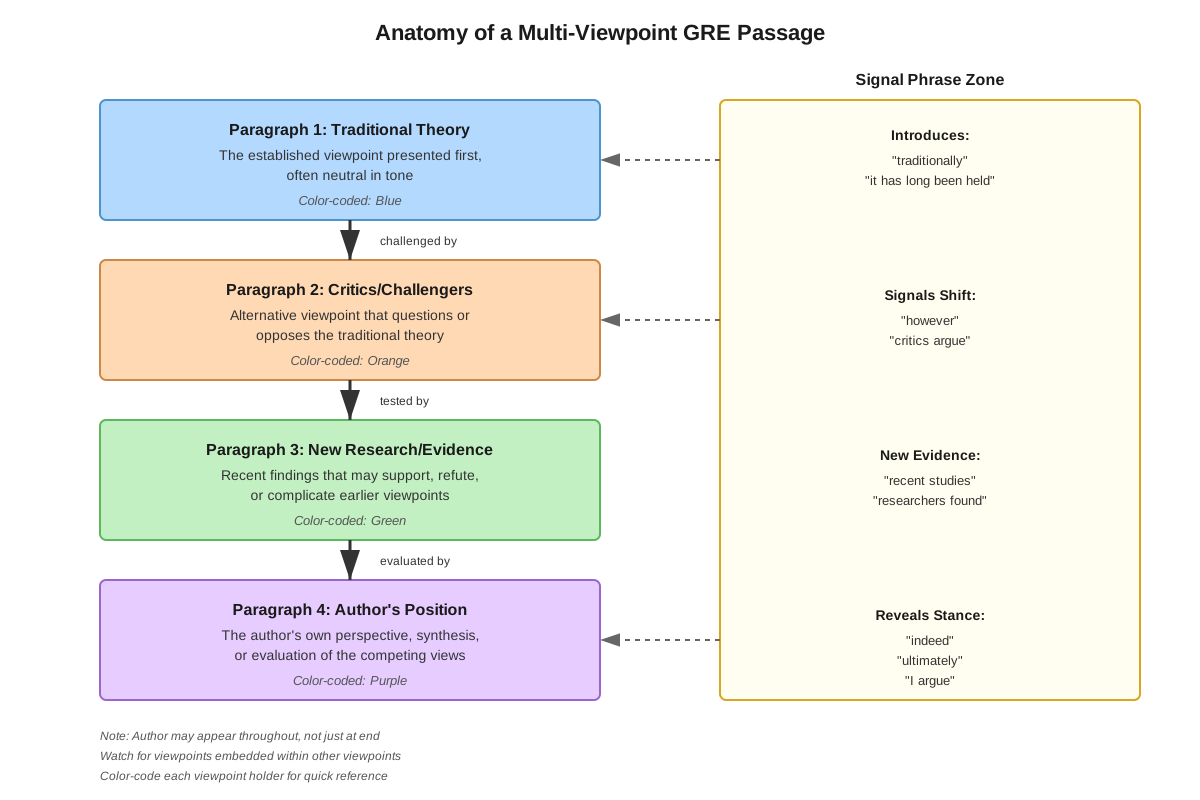
The GRE deliberately constructs passages with layered viewpoints to assess sophisticated reading comprehension. A typical passage might present a traditional theory, introduce critics who challenge it, describe new research that partially supports the critics, and then conclude with the author's own nuanced position. Questions will then ask test-takers to identify which viewpoint holds a specific belief or to determine the author's attitude toward a particular claim. GRE viewpoint tracking becomes essential because the test-makers know that conflating these perspectives is one of the most common errors among test-takers, making it a reliable discriminator between average and high-scoring students.
Within the broader context of Verbal Reasoning, viewpoint tracking serves as a foundational skill that supports multiple question types. It directly enables success on author's attitude questions, inference questions, and function questions (which ask why the author mentions a particular detail). Moreover, it enhances performance on primary purpose questions by helping students understand whether the author is advocating, critiquing, synthesizing, or merely reporting. This skill integrates closely with other Reading Comprehension strategies such as passage mapping, identifying logical structure, and recognizing rhetorical devices—all of which work together to build a complete understanding of complex academic texts.
Learning Objectives
- [ ] Identify when Viewpoint tracking is being tested in GRE Reading Comprehension questions
- [ ] Explain the core rule or strategy behind Viewpoint tracking
- [ ] Apply Viewpoint tracking to GRE-style questions accurately
- [ ] Distinguish between the author's viewpoint and the viewpoints of other parties mentioned in a passage
- [ ] Recognize linguistic markers and signal phrases that indicate shifts in perspective
- [ ] Evaluate answer choices by matching them to the correct viewpoint holder
- [ ] Construct a mental or written map of multiple viewpoints within a single passage
Prerequisites
- Basic reading comprehension skills: Understanding main ideas, supporting details, and paragraph structure is necessary before tracking multiple perspectives within those structures
- Familiarity with academic writing conventions: Recognizing how scholarly texts present and cite different sources helps identify when new viewpoints are being introduced
- Understanding of passage structure: Knowing how GRE passages are organized (introduction, body, conclusion) provides the framework within which viewpoints are distributed
- Ability to identify tone and attitude: Recognizing whether language is positive, negative, or neutral helps distinguish between mere reporting and actual endorsement
Why This Topic Matters
Viewpoint tracking appears in approximately 60-70% of GRE Reading Comprehension passages, making it one of the highest-yield skills for the Verbal Reasoning section. The Educational Testing Service (ETS) specifically designs passages with multiple perspectives because this structure mirrors the complexity of academic discourse that graduate students will encounter. Questions explicitly testing viewpoint tracking typically appear 2-3 times per Verbal section, but the skill implicitly supports correct answers on many additional questions.
In real-world academic contexts, the ability to track viewpoints is essential for literature reviews, understanding scholarly debates, and synthesizing research from multiple sources. Graduate students must constantly distinguish between what different researchers claim, what evidence supports various positions, and where their own analysis fits within existing conversations. The GRE tests this skill because it predicts success in graduate-level reading and writing.
Common manifestations of viewpoint tracking on the GRE include passages about scientific controversies (where researchers disagree), historical interpretations (where different historians offer competing explanations), literary criticism (where various critics analyze a work differently), and social science debates (where theoretical schools clash). The test frequently presents passages where the author remains neutral while reporting others' views, or where the author initially presents a common belief before challenging it with new evidence. Questions might ask: "The author mentions X primarily in order to..." or "According to the passage, which of the following would the critics mentioned in line 15 most likely agree with?" or "The author's attitude toward the theory described in the second paragraph can best be described as..."
Core Concepts
Definition and Fundamental Principle
Viewpoint tracking is the systematic process of identifying who holds each opinion, belief, claim, or attitude presented in a passage, and maintaining clear mental distinctions between these different perspectives throughout the reading process. The fundamental principle underlying this skill is that attribution matters as much as content—knowing what is claimed is incomplete without knowing who claims it.
In GRE passages, viewpoints typically fall into several categories:
| Viewpoint Type | Description | Common Indicators |
|---|---|---|
| Author's explicit view | The writer's stated opinion or argument | "I argue," "This essay demonstrates," "Clearly," "Indeed" |
| Author's implicit view | The writer's attitude revealed through word choice and emphasis | Positive/negative adjectives, qualifying language, rhetorical questions |
| Traditional/conventional view | Widely held beliefs or established theories | "Traditionally," "It has long been believed," "Conventional wisdom" |
| Specific researchers/critics | Named individuals or groups with particular positions | "Smith argues," "According to Jones," "Critics contend" |
| Hypothetical or conditional views | Positions presented for consideration without endorsement | "One might argue," "It could be claimed," "Suppose that" |
Linguistic Markers of Viewpoint Shifts
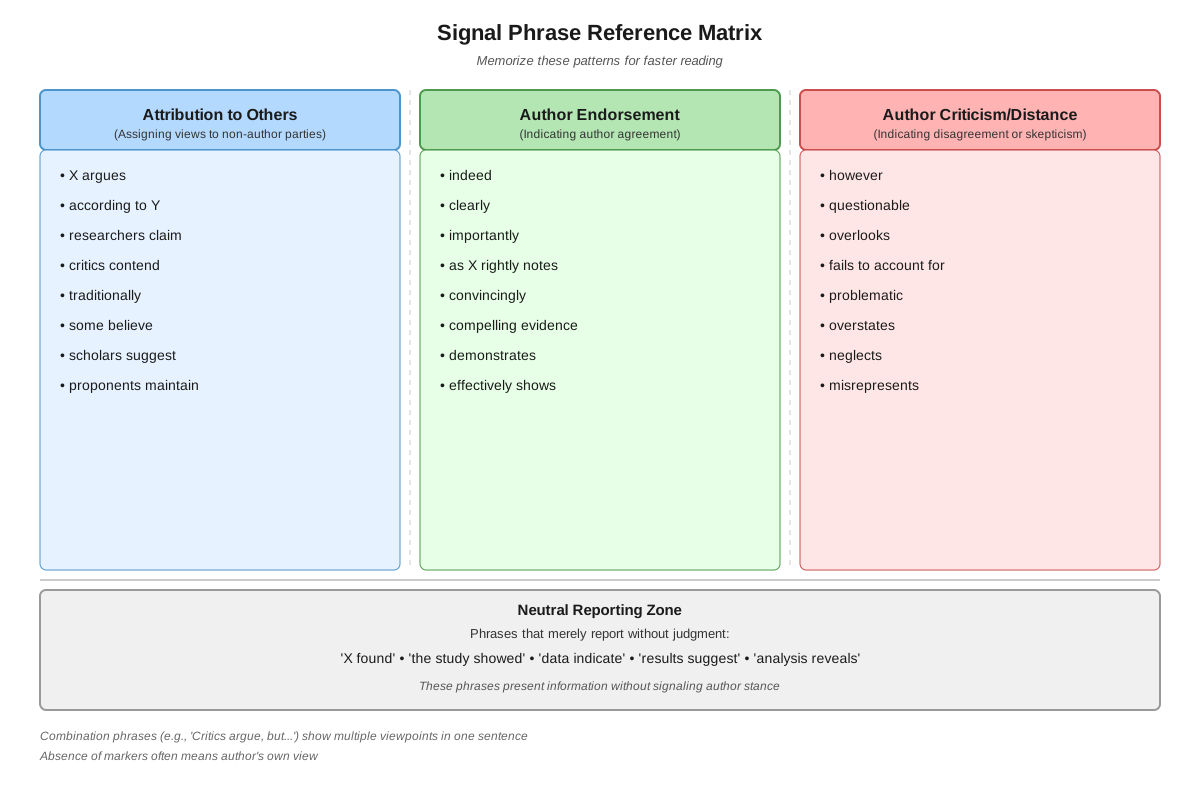
Successful viewpoint tracking depends on recognizing signal phrases and attribution markers that indicate when the passage shifts from one perspective to another. These linguistic cues function as road signs, alerting careful readers to changes in who is speaking or being represented.
Direct attribution markers explicitly name the holder of a viewpoint:
- According to [person/group]...
- [Name] argues/claims/suggests/maintains that...
- In [Name]'s view...
- Proponents/critics/supporters believe...
- Research by [Name] indicates...
Indirect attribution markers signal viewpoint shifts without naming specific holders:
- Some scholars argue...
- It has been suggested that...
- One interpretation holds that...
- A competing theory proposes...
- Recent studies indicate...
Contrast markers often signal that the author is about to present an opposing viewpoint or their own disagreement:
- However, this view overlooks...
- Yet critics point out...
- Nevertheless, evidence suggests...
- Despite this claim...
- In contrast to this position...
Endorsement and distancing language reveals the author's attitude toward viewpoints they present:
- Endorsement: "convincingly demonstrates," "compelling evidence," "rightfully notes," "important insight"
- Distancing: "merely claims," "assumes without evidence," "overlooks," "fails to consider," "simplistic view"
The Author's Multiple Roles
A sophisticated understanding of viewpoint tracking recognizes that the author can occupy different roles within a single passage, and these roles must be distinguished:
- Author as reporter: Neutrally presenting others' views without endorsement or criticism
- Author as critic: Evaluating and challenging positions held by others
- Author as advocate: Arguing for a particular position or interpretation
- Author as synthesizer: Combining elements from multiple viewpoints into a new perspective
Many GRE passages deliberately move through these roles sequentially. A typical structure might be:
- Paragraph 1: Author as reporter (presenting traditional view)
- Paragraph 2: Author as reporter (presenting challenges to traditional view)
- Paragraph 3: Author as critic (identifying weaknesses in both positions)
- Paragraph 4: Author as advocate (proposing a nuanced synthesis)
Tracking Viewpoints in Complex Passages
When passages contain three or more distinct viewpoints, systematic tracking becomes essential. Effective strategies include:
Mental mapping: Creating a mental organization chart of who believes what. For example:
- Traditional historians → believe economic factors caused the revolution
- Revisionist historians → argue cultural factors were primary
- Author → suggests both factors interacted in complex ways
Annotation while reading: Marking passages with abbreviations:
- "A" for author's view
- "T" for traditional/conventional view
- "C" for critics
- "R" for researchers/specific named parties
Temporal tracking: Noting when viewpoints emerged chronologically:
- Earlier scholars believed X
- Recent research suggests Y
- The author now proposes Z
Distinguishing Reporting from Endorsement
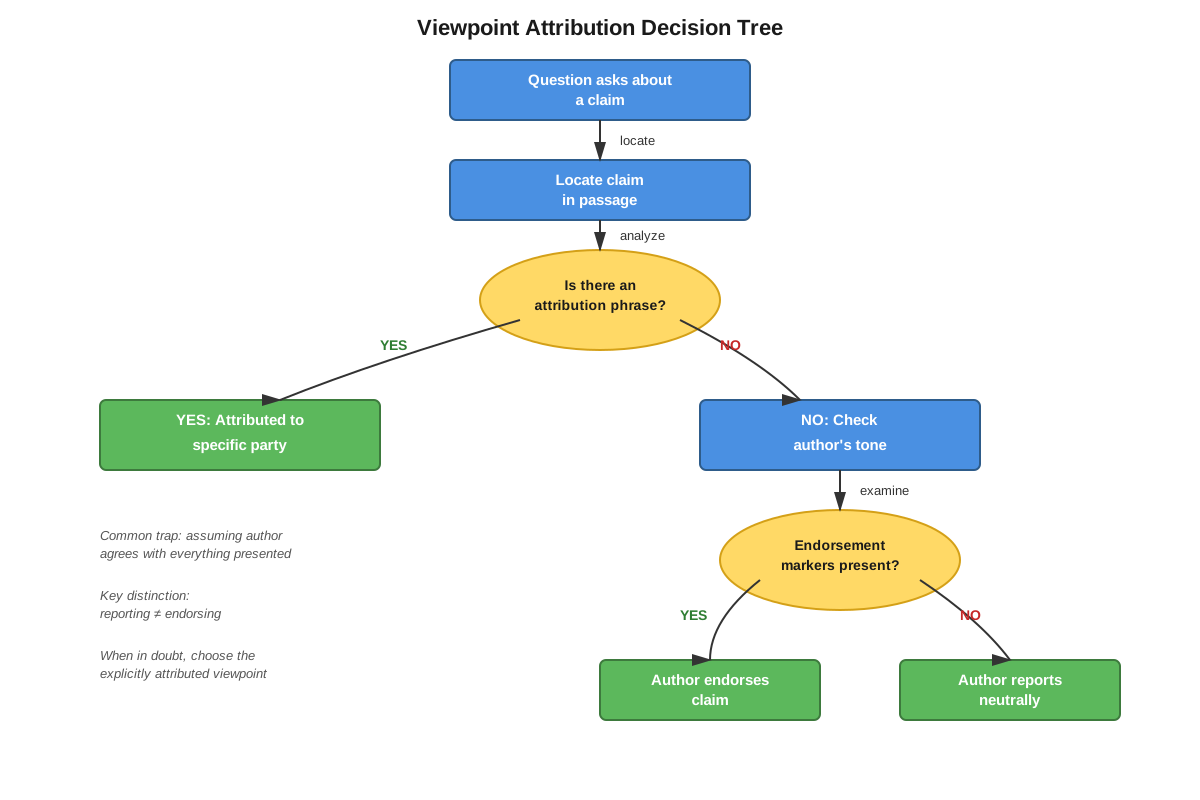
Perhaps the most critical distinction in viewpoint tracking is recognizing when the author reports a view versus endorses it. The GRE exploits confusion on this point more than any other aspect of viewpoint tracking.
Consider these two sentences:
- "Many economists believe that inflation is primarily caused by monetary policy."
- "Inflation is primarily caused by monetary policy, as economists have convincingly demonstrated."
In sentence 1, the author merely reports what economists believe—the author may or may not agree. In sentence 2, the author endorses this view through the word "convincingly." Test-takers who miss this distinction will incorrectly answer questions about the author's position.
Key principle: Unless the author explicitly endorses a reported view through evaluative language or by building arguments upon it, assume the author is neutral toward that view.
Concept Relationships
Viewpoint tracking connects intimately with several other Reading Comprehension skills, forming an integrated approach to passage analysis. The relationship can be mapped as follows:
Passage Structure Analysis → Viewpoint Tracking → Question Answering
Understanding overall passage structure (introduction of topic, presentation of viewpoints, author's position) provides the framework within which viewpoint tracking operates. Once viewpoints are tracked, this information directly enables accurate answering of specific question types.
Tone and Attitude Recognition ↔ Viewpoint Tracking
These skills reinforce each other bidirectionally. Recognizing tone (skeptical, enthusiastic, neutral) helps identify whose viewpoint is being presented, while tracking viewpoints helps determine the author's tone toward each position.
Logical Structure → Viewpoint Tracking → Inference Questions
Understanding how arguments are constructed (premises, conclusions, evidence) helps identify when the author is presenting someone else's argument versus their own. This distinction then enables accurate inferences about what each party would likely believe about related issues.
Detail Recognition → Viewpoint Attribution → Function Questions
Identifying specific details in the passage is the first step; attributing those details to the correct viewpoint holder is the second step; understanding why the author included that detail (to support, refute, or illustrate a viewpoint) is the third step that answers function questions.
Within viewpoint tracking itself, concepts build hierarchically:
- Recognize that multiple viewpoints exist (foundational awareness)
- Identify linguistic markers of viewpoint shifts (technical skill)
- Distinguish author's view from others' views (critical discrimination)
- Understand the author's attitude toward each view (evaluative analysis)
- Apply this understanding to answer questions accurately (practical application)
High-Yield Facts
⭐ The author can present a viewpoint without endorsing it—mere reporting does not equal agreement
⭐ Questions asking "according to the passage" require finding explicitly stated information, while "the author believes" questions require identifying the author's specific viewpoint
⭐ Contrast words (however, yet, nevertheless, although) often signal that the author is about to present their own view after reporting others' views
⭐ When the author uses qualifying language ("may," "might," "could," "possibly"), they are typically distancing themselves from a claim
⭐ The phrase "it has been argued/suggested/claimed" almost always introduces a view the author will later critique or complicate
- Positive evaluative language ("compelling," "convincing," "important") indicates author endorsement
- Negative evaluative language ("overlooks," "fails to consider," "simplistic") indicates author criticism
- The author's viewpoint most commonly appears in the final paragraph of GRE passages
- When multiple researchers are cited, the author typically favors the most recently mentioned position
- Questions containing "would most likely agree" require extrapolating from stated viewpoints to unstated implications
- The traditional/conventional view is almost always presented before challenges to it
- Authors rarely remain completely neutral throughout an entire passage—look for subtle indicators of preference
- Rhetorical questions in GRE passages typically signal the author's own position
- When the author presents both strengths and weaknesses of a view, they are usually positioning themselves for a nuanced middle position
- The word "merely" is a strong distancing marker indicating the author finds a claim insufficient
Quick check — test yourself on Viewpoint tracking so far.
Try Flashcards →Common Misconceptions
Misconception: If the author mentions a fact or claim, the author must believe it is true.
Correction: Authors frequently present claims made by others for the purpose of later refuting them or showing their limitations. Always check whether the author endorses the claim through evaluative language or logical structure.
Misconception: The author's viewpoint is always explicitly stated with phrases like "I believe" or "this essay argues."
Correction: While some passages include explicit thesis statements, many GRE passages reveal the author's position through subtle cues like word choice, emphasis, and the logical progression of the argument. The author's view must often be inferred from how they treat different positions.
Misconception: If critics or researchers are mentioned, their view must be wrong or the author wouldn't mention them.
Correction: Authors mention other viewpoints for many reasons: to build upon them, to show the evolution of thought, to synthesize multiple perspectives, or simply to provide context. Mention does not imply disagreement.
Misconception: The longest or most detailed viewpoint in the passage is the author's viewpoint.
Correction: Authors often spend considerable space explaining views they will ultimately critique. Length of presentation does not indicate endorsement—look instead for evaluative language and logical positioning.
Misconception: All viewpoints in a passage are equally important for answering questions.
Correction: While all viewpoints should be tracked, the author's viewpoint is disproportionately tested. Questions about the author's attitude, purpose, and position are more common than questions about other parties' views.
Misconception: If the author presents evidence for a claim, the author endorses that claim.
Correction: Authors often present the evidence that others use to support their claims, even when the author questions the interpretation of that evidence. Presenting evidence is part of fairly representing a viewpoint before critiquing it.
Misconception: Viewpoint tracking is only necessary for passages explicitly about debates or controversies.
Correction: Even passages that seem to present straightforward information often contain subtle viewpoint distinctions—between what is generally accepted, what recent research suggests, and what the author concludes. Viewpoint tracking applies to all passage types.
Worked Examples
Example 1: Scientific Controversy Passage
Passage excerpt:
"For decades, paleontologists attributed the extinction of large mammals at the end of the Pleistocene epoch to climate change resulting from glacial retreat. This view seemed to be supported by the correlation between rising temperatures and species disappearance. However, recent archaeological evidence has led some researchers to propose that human hunting was the primary cause. Martin (1984) argues that the temporal coincidence between human arrival in various regions and megafaunal extinctions is too striking to be accidental. Yet this hypothesis faces significant challenges. The archaeological record contains relatively few kill sites, and computer models suggest that the human populations of the time were too small to have hunted these species to extinction. A more nuanced view recognizes that climate change and human activity likely interacted in complex ways, with environmental stress making populations vulnerable to even modest hunting pressure."
Question: The author's attitude toward Martin's hypothesis can best be described as:
(A) Unqualified acceptance
(B) Tentative endorsement with reservations
(C) Neutral presentation without evaluation
(D) Respectful skepticism
(E) Complete rejection
Worked Solution:
Step 1: Identify Martin's viewpoint
Martin argues that human hunting was the primary cause of extinctions, based on temporal coincidence.
Step 2: Locate the author's response to Martin
The author presents Martin's view, then immediately follows with "Yet this hypothesis faces significant challenges."
Step 3: Analyze the author's language
- "Yet" signals contrast/criticism
- "faces significant challenges" is negative evaluation
- The author then provides specific problems: few kill sites, population models suggest impossibility
- The author concludes with "a more nuanced view" that differs from Martin's single-cause explanation
Step 4: Evaluate answer choices
- (A) Incorrect—author clearly raises objections
- (B) Incorrect—no endorsement is present, even tentative
- (C) Incorrect—author evaluates rather than merely presenting
- (D) CORRECT—author treats Martin's work seriously (mentions it, engages with the argument) but raises substantial objections, indicating skepticism while remaining respectful
- (E) Incorrect—author doesn't completely reject; instead proposes that hunting may have played a role in combination with climate
Key viewpoint tracking insight: The author moves through three viewpoints: (1) traditional climate-only view, (2) Martin's hunting-only view, (3) author's own interactive view. The question specifically asks about the author's attitude toward viewpoint #2, requiring careful distinction between presenting Martin's argument and evaluating it.
Example 2: Literary Criticism Passage
Passage excerpt:
"Critics have long praised Jane Austen's novels for their social realism and psychological insight. According to this traditional interpretation, Austen's genius lies in her faithful representation of the manners and morals of Regency England. More recently, however, feminist scholars have argued that this reading underestimates Austen's subversive intent. Gilbert and Gubar contend that beneath the surface propriety, Austen's novels contain a sustained critique of patriarchal institutions. While this revisionist approach has illuminated previously overlooked dimensions of Austen's work, it sometimes risks overstating the radicalism of an author who, after all, worked within and largely accepted the social conventions of her time. The most productive approach may be to recognize that Austen was simultaneously a keen observer of her society and a subtle questioner of some of its assumptions—neither the simple realist of traditional criticism nor the proto-feminist revolutionary of revisionist readings."
Question 1: Which of the following best describes the author's view of the feminist interpretation of Austen?
(A) It is entirely without merit
(B) It has contributed valuable insights but has limitations
(C) It is more accurate than the traditional interpretation
(D) It should replace the traditional interpretation
(E) It is based on misreadings of Austen's texts
Question 2: The author would most likely agree with which of the following statements?
(A) Traditional critics correctly understood Austen's primary intentions
(B) Feminist scholars have definitively proven Austen's radicalism
(C) Austen's work contains both realistic observation and subtle critique
(D) Social realism and subversive intent are mutually exclusive
(E) The debate between traditional and feminist critics cannot be resolved
Worked Solutions:
Question 1:
Step 1: Locate the author's explicit evaluation of feminist interpretation
"While this revisionist approach has illuminated previously overlooked dimensions of Austen's work, it sometimes risks overstating the radicalism..."
Step 2: Analyze the structure
- "While" introduces a concession (acknowledging positive contribution)
- "illuminated previously overlooked dimensions" = positive evaluation
- "however" and "risks overstating" = criticism/limitation
Step 3: Match to answer choices
- (A) Incorrect—author acknowledges contributions
- (B) CORRECT—perfectly matches the "illuminated dimensions" (valuable insights) + "risks overstating" (limitations) structure
- (C) Incorrect—author doesn't rank one as more accurate
- (D) Incorrect—author proposes synthesis, not replacement
- (E) Incorrect—author doesn't suggest misreading, only overstatement
Question 2:
Step 1: Identify the author's own position (final sentence)
"The most productive approach may be to recognize that Austen was simultaneously a keen observer of her society and a subtle questioner of some of its assumptions"
Step 2: Translate this position
- "keen observer" = realistic observation
- "subtle questioner" = critique
- "simultaneously" = both at once
Step 3: Match to answer choices
- (A) Incorrect—author finds traditional view incomplete
- (B) Incorrect—author questions the extent of radicalism
- (C) CORRECT—directly restates the author's synthesis
- (D) Incorrect—author argues they coexist
- (E) Incorrect—author proposes a resolution (synthesis)
Key viewpoint tracking insight: This passage contains three distinct viewpoints (traditional critics, feminist scholars, author's synthesis), and the questions test the ability to distinguish the author's evaluation of each viewpoint from the viewpoints themselves. The author's position is neither of the first two but a third option that incorporates elements of both.
Exam Strategy
Approaching Viewpoint Tracking Questions
Step 1: Pre-reading awareness
Before reading the passage, quickly scan for names, dates, and phrases like "critics argue" or "according to." This preview alerts you that multiple viewpoints will appear.
Step 2: Active annotation
As you read, mark viewpoint shifts with simple notation:
- Underline or bracket different viewpoints
- Note "Trad" for traditional views, "Crit" for critics, "Auth" for author's view
- Circle contrast words that signal viewpoint shifts
Step 3: Identify the author's position
Actively ask while reading: "What does the author actually think?" Look for:
- Evaluative language (positive or negative)
- The final paragraph (often contains author's conclusion)
- Contrast markers followed by the author's own claims
Step 4: Question analysis
When you encounter a question, identify whose viewpoint it asks about:
- "According to the passage" = any viewpoint explicitly stated
- "The author suggests/believes/argues" = specifically the author's view
- "The critics mentioned in line X would most likely" = specific other viewpoint
Trigger Words and Phrases
High-priority triggers indicating viewpoint shifts:
- According to
- However/Nevertheless/Yet (often precedes author's view)
- Some scholars/critics/researchers
- Traditionally/Conventionally
- Recent studies/evidence
- [Name] argues/claims/contends
Endorsement indicators (author agrees):
- Convincingly demonstrates
- Important insight
- Correctly notes
- Compelling evidence
- Indeed/Clearly (when following a claim)
Distancing indicators (author disagrees or questions):
- Merely claims
- Overlooks/Ignores
- Fails to consider
- Assumes without evidence
- Simplistic/Reductive
- Questionable/Problematic
Process of Elimination Tips
When answer choices present different viewpoints:
- Eliminate answers that attribute views to the wrong party
- If the question asks about the author's view, eliminate choices that describe what critics or researchers believe
- Eliminate extreme positions when the author takes a nuanced stance
- If the author synthesizes multiple views, eliminate answers suggesting complete acceptance or rejection of any single view
- Eliminate answers that confuse reporting with endorsement
- If the author merely mentions a view without evaluative language, eliminate answers suggesting the author endorses it
- Check answer choices against specific textual evidence
- For each remaining answer, locate the exact sentence that would support it and verify the viewpoint holder
Time Allocation
- Initial reading with viewpoint tracking: 3-4 minutes for a typical passage
- Don't skip this investment—it saves time on questions
- Per question involving viewpoints: 45-60 seconds
- 15 seconds: Identify whose viewpoint the question asks about
- 20 seconds: Locate relevant passage section
- 20 seconds: Eliminate wrong answers and confirm correct answer
Exam Tip: If you're unsure whose viewpoint a question asks about, reread the question stem carefully. The difference between "according to the passage" and "the author suggests" is often the difference between a correct and incorrect answer.
Memory Techniques
The TRACK Acronym
Tag each viewpoint as you read (author, critics, traditional, researchers)
Recognize signal words that indicate viewpoint shifts
Attribute claims to the correct holder before answering questions
Contrast markers often precede the author's own position
Keep the author's view separate from reported views
The Reporter vs. Advocate Visualization
Visualize the author as wearing two different hats:
- Reporter hat (neutral): "Some people say X, others say Y"
- Advocate hat (evaluative): "X is more convincing because..."
When reading, mentally note which hat the author is wearing in each paragraph. This prevents conflating reported views with endorsed views.
The Three-Column Mental Table
As you read complex passages, mentally organize information into three columns:
| Traditional/Old View | Critics/New View | Author's View |
|---|---|---|
| What was believed | What challenges it | What author concludes |
This structure works for approximately 70% of GRE passages that present viewpoint contrasts.
The "However" Rule
Mnemonic: "However = Here's what I (the author) really think"
When you see "however," "yet," or "nevertheless" after the author has been reporting others' views, the author's own position typically follows. Mark these moments with special attention.
The Quotation Mark Principle
Even when actual quotation marks don't appear, mentally place them around views the author reports but doesn't endorse:
- Some scholars believe "economic factors were primary"
- Critics argue "the traditional view is outdated"
This mental punctuation helps maintain the distinction between reporting and endorsing.
Summary
Viewpoint tracking is the essential skill of identifying and distinguishing between the multiple perspectives presented in GRE Reading Comprehension passages—including the author's view, traditional or conventional views, critics' positions, and researchers' claims. Success requires recognizing linguistic markers that signal viewpoint shifts (such as "according to," "however," and attribution phrases), understanding the critical distinction between reporting a view and endorsing it, and maintaining clear mental separation between different perspectives throughout the passage. The author can occupy multiple roles (reporter, critic, advocate, synthesizer), and these roles must be distinguished to answer questions accurately. Most GRE passages deliberately layer multiple viewpoints to test whether readers can attribute claims to the correct holders, making viewpoint tracking one of the highest-yield skills for the Verbal Reasoning section. Mastery involves both technical recognition of signal words and deeper comprehension of how authors position themselves relative to the views they present, ultimately enabling accurate answers to questions about who believes what and why the author includes particular perspectives.
Key Takeaways
- Attribution is as important as content—always track who holds each viewpoint, not just what the viewpoint is
- The author can present views without endorsing them—reporting ≠ agreement
- Contrast markers (however, yet, nevertheless) typically signal the author's own position after presenting others' views
- Evaluative language reveals the author's attitude—words like "convincingly," "overlooks," and "merely" indicate endorsement or criticism
- The author's viewpoint is disproportionately tested—prioritize identifying what the author actually believes versus what they report
- Questions asking "according to the passage" differ fundamentally from "the author believes"—the former includes any stated view, the latter requires the author's specific position
- Systematic annotation during reading saves time on questions—mark viewpoint shifts as you read rather than searching later
Related Topics
Passage Structure and Organization: Understanding how GRE passages are structured (problem-solution, chronological, compare-contrast) provides the framework within which viewpoints are distributed and helps predict where the author's position will appear.
Tone and Attitude Recognition: Identifying whether language is positive, negative, skeptical, or enthusiastic works hand-in-hand with viewpoint tracking to determine not just who holds a view but how the author feels about it.
Inference Questions: Once viewpoints are accurately tracked, inference questions become more manageable because you can extrapolate what each party would likely believe about related issues based on their stated positions.
Function Questions: Understanding why the author mentions particular details or viewpoints (to support, refute, illustrate, or complicate) builds directly on viewpoint tracking skills.
Primary Purpose Questions: Determining whether the author's primary purpose is to advocate, critique, synthesize, or report requires first identifying the author's viewpoint and how it relates to other presented views.
Mastering viewpoint tracking creates a foundation for these related skills and significantly improves overall Reading Comprehension performance.
Practice CTA
Now that you understand the principles and strategies of viewpoint tracking, it's time to apply these skills to actual GRE-style passages. The practice questions and flashcards will reinforce your ability to identify viewpoint shifts, distinguish the author's position from reported views, and accurately answer questions that test this critical skill. Remember: viewpoint tracking is not just about reading carefully—it's about reading strategically, with constant awareness of who is saying what. Each practice passage you complete with focused attention to viewpoints strengthens the neural pathways that will serve you on test day. Approach the practice materials with confidence, knowing that viewpoint tracking is a learnable skill that dramatically improves with deliberate practice.
Sign up free to keep reading
Create a free AnvayaPrep account to finish this GRE guide on Viewpoint tracking — plus flashcards and practice questions.