Overview
Ambiguous words represent one of the most subtle yet frequently tested elements of GRE Verbal Reasoning. These are words that possess multiple distinct meanings depending on context, and the GRE deliberately exploits this multiplicity to assess a test-taker's vocabulary depth and contextual reasoning skills. Unlike simple vocabulary questions that test whether you know a word's primary definition, ambiguous word questions evaluate whether you can recognize secondary, tertiary, or specialized meanings that may differ dramatically from the common usage you encounter in everyday speech.
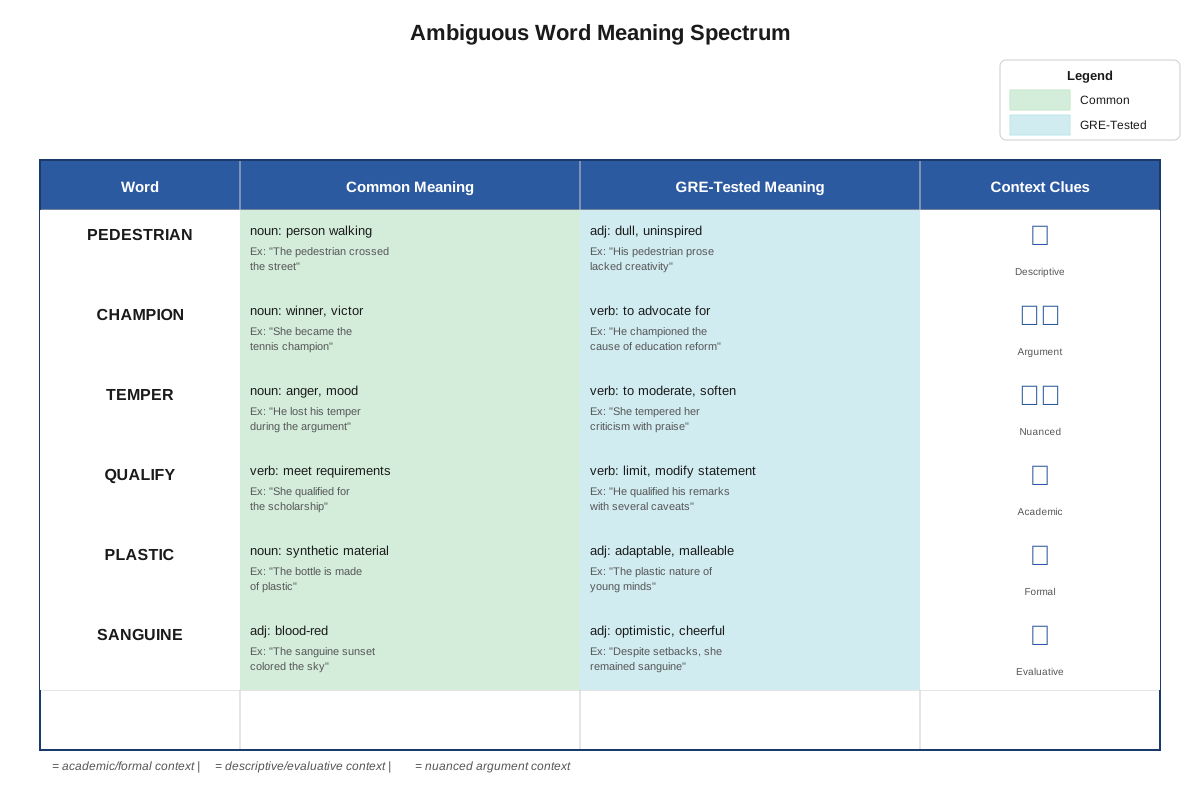
The challenge of GRE ambiguous words lies not in their obscurity but in their familiarity. Words like "pedestrian," "champion," "temper," and "qualify" appear innocuous because test-takers know their common meanings. However, the GRE consistently tests less common definitions: "pedestrian" as dull or uninspired, "champion" as a verb meaning to advocate for, "temper" as a verb meaning to moderate or soften, and "qualify" meaning to limit or modify a statement. This testing approach rewards students who have developed nuanced vocabulary knowledge rather than surface-level recognition.
Within the broader Verbal Reasoning framework, ambiguous words connect directly to reading comprehension, text completion, and sentence equivalence questions. They test the same fundamental skill: deriving meaning from context. Mastering ambiguous words strengthens your ability to parse complex academic prose, recognize authorial intent, and eliminate trap answers that exploit common but contextually inappropriate word meanings. This topic serves as a bridge between pure vocabulary knowledge and applied reading comprehension, making it essential for achieving a competitive Verbal Reasoning score.
Learning Objectives
- [ ] Identify when Ambiguous words is being tested
- [ ] Explain the core rule or strategy behind Ambiguous words
- [ ] Apply Ambiguous words to GRE-style questions accurately
- [ ] Distinguish between primary and secondary meanings of high-frequency ambiguous words
- [ ] Use contextual clues to determine which meaning of an ambiguous word is intended
- [ ] Recognize common trap answers that exploit the wrong meaning of ambiguous words
- [ ] Build a systematic approach to learning and retaining multiple meanings of single words
Prerequisites
- Basic vocabulary foundation: Understanding of approximately 1,000-1,500 common English words provides the baseline from which ambiguous meanings can be learned
- Contextual reading skills: Ability to use surrounding text to infer meaning is essential because ambiguous words require context-dependent interpretation
- Parts of speech recognition: Knowing whether a word functions as a noun, verb, adjective, or adverb helps identify which meaning applies in a given sentence
- Synonym and antonym relationships: Understanding word relationships aids in recognizing when an ambiguous word is being used in an unexpected way
Why This Topic Matters
Ambiguous words appear with remarkable frequency across all GRE Verbal Reasoning question types. Research on GRE question patterns indicates that approximately 15-20% of Text Completion and Sentence Equivalence questions feature at least one answer choice that is an ambiguous word used in its less common sense. Reading Comprehension passages routinely employ ambiguous words in their sophisticated academic prose, and understanding these nuanced meanings often proves critical for answering inference and vocabulary-in-context questions correctly.
In real-world applications, the ability to recognize and interpret ambiguous words reflects genuine academic literacy. Graduate-level coursework across disciplines—from scientific literature to humanities scholarship—employs precise vocabulary where common words carry specialized meanings. A biology paper might describe an organism's "plastic" response to environmental stress (meaning adaptable, not synthetic), while a philosophy text might discuss how one theory "informs" another (meaning shapes or influences, not merely provides information to).
The GRE specifically tests ambiguous words because they efficiently distinguish between test-takers with superficial vocabulary knowledge and those with deep, contextual understanding. A student who has merely memorized flashcards showing one definition per word will struggle, while a student who has encountered words in varied contexts and learned multiple meanings will excel. This testing approach aligns with the exam's goal of predicting graduate school success, where nuanced reading comprehension proves essential.
Core Concepts
What Makes a Word Ambiguous
An ambiguous word is a single lexical item that possesses two or more distinct, established meanings that are not merely shades of the same concept but represent genuinely different ideas. The term "ambiguous" in this context does not mean vague or unclear; rather, it describes words with multiple clear meanings that require context to disambiguate. For example, "bank" can mean a financial institution or the edge of a river—two completely unrelated concepts that share the same spelling and pronunciation.
The GRE focuses on a specific subset of ambiguous words: those where one meaning is common in everyday usage while another meaning is more formal, academic, or archaic. This creates a natural trap for test-takers who rely on their most familiar understanding of a word without considering alternative meanings.
Categories of Ambiguous Words
Ambiguous words on the GRE typically fall into several recognizable patterns:
Common-to-Formal Shifts: Words like "pedestrian" (walker vs. dull/ordinary), "provincial" (relating to a province vs. narrow-minded), and "plastic" (synthetic material vs. malleable/adaptable) where the everyday meaning differs from the academic or formal meaning.
Part-of-Speech Shifts: Words that change meaning when used as different parts of speech, such as "champion" (noun: winner; verb: to advocate for), "table" (noun: furniture; verb: to postpone discussion), and "tender" (adjective: soft; verb: to offer formally).
Intensity or Degree Variations: Words like "qualify" (to become eligible vs. to limit or modify), "temper" (anger vs. to moderate), and "sanction" (to approve vs. to penalize) where meanings can be opposite or significantly different in intensity.
Technical vs. Common Usage: Words like "discriminate" (to treat unfairly vs. to distinguish between), "precipitate" (to cause suddenly vs. to condense from vapor), and "compound" (to make worse vs. to combine elements) where specialized or technical meanings differ from everyday usage.
How the GRE Tests Ambiguous Words
The exam employs several sophisticated testing mechanisms:
| Testing Method | Description | Example Context |
|---|---|---|
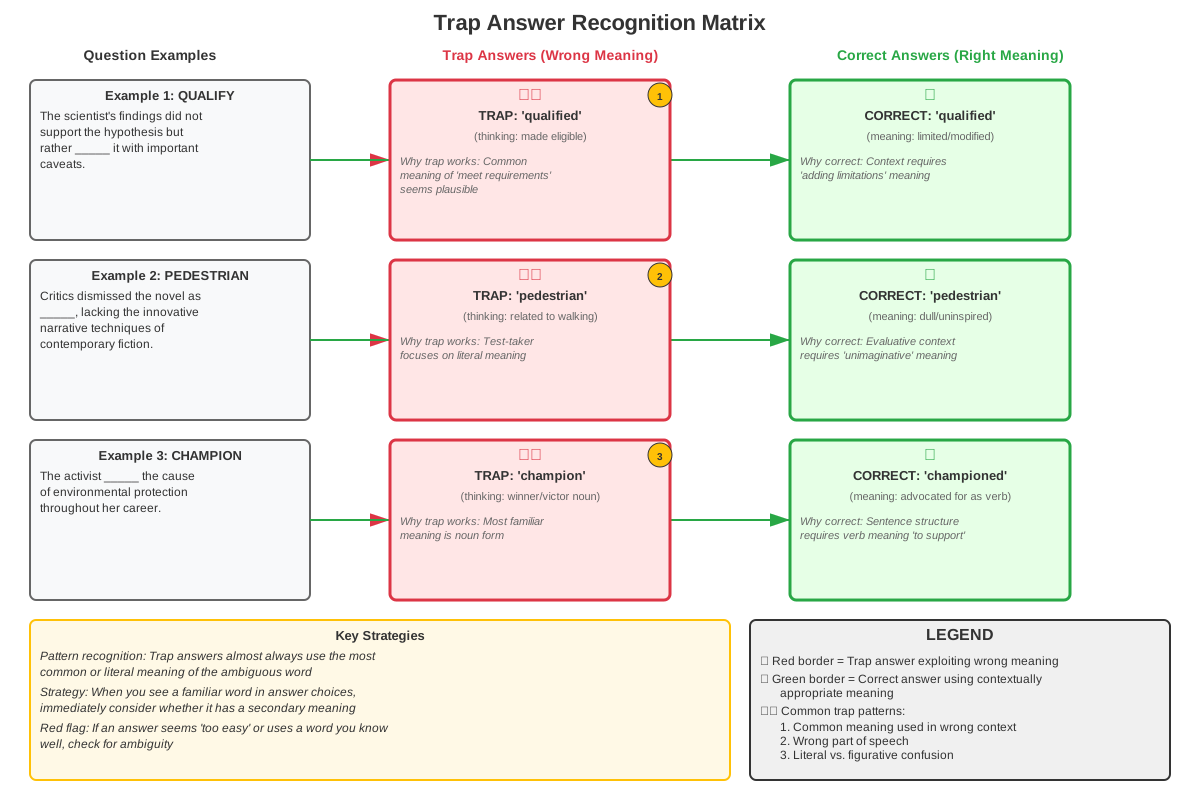
| Trap Answer Choices | Correct answer uses uncommon meaning; wrong answers use common meaning | "The critic found the film _____ despite its popular appeal" with "pedestrian" as correct answer |
| Context Reversal | Sentence context contradicts the expected meaning | "Rather than champion the cause, she _____ it" where "champion" means advocate, not winner |
| Synonym Pairs | Sentence Equivalence requiring two words with the same uncommon meaning | Both "temper" and "moderate" meaning to soften or reduce |
| Vocabulary in Context | Reading Comprehension asking what a word means in a specific passage | "Plastic" in a biology passage meaning adaptable |
Recognition Strategies
Identifying when ambiguous words are being tested requires attention to several signals:
Contextual Mismatch: When your first interpretation of a word doesn't fit logically with the sentence structure or meaning, consider alternative definitions. If a sentence states "The scientist's plastic approach allowed adaptation," the common meaning of plastic (synthetic material) creates nonsense, signaling the need for the alternative meaning (flexible/adaptable).
Formal Register: Academic or formal writing contexts increase the likelihood that ambiguous words appear in their less common meanings. Passages discussing scholarly topics, scientific research, or literary criticism frequently employ words in their specialized senses.
Grammatical Function: Pay attention to whether a word you recognize as a noun is being used as a verb, or vice versa. This part-of-speech shift often accompanies a meaning shift.
Elimination Failure: When you cannot eliminate enough answer choices using your initial understanding of words, reconsider whether any choices might have alternative meanings you haven't considered.
Concept Relationships
The mastery of ambiguous words builds directly upon foundational vocabulary knowledge while simultaneously enhancing reading comprehension skills. The relationship flows as follows:
Basic Vocabulary → Ambiguous Words → Contextual Reading → Advanced Comprehension
Basic vocabulary provides the initial word recognition, but ambiguous words require moving beyond single-definition memorization to multiple-meaning awareness. This awareness then strengthens contextual reading ability because students learn to use surrounding text as evidence for meaning selection. Finally, advanced comprehension emerges when readers can fluidly navigate texts that employ sophisticated vocabulary with precision.
Within the topic itself, the categories of ambiguous words interconnect. Common-to-formal shifts often overlap with part-of-speech shifts (e.g., "champion" shifts both meaning and function). Technical versus common usage frequently involves intensity variations (e.g., "discriminate" shifts from negative to neutral). Understanding these overlapping patterns helps students recognize ambiguous words more quickly during the exam.
Ambiguous words also connect to other Verbal Reasoning topics: they appear as answer choices in Text Completion questions, they form synonym pairs in Sentence Equivalence questions, and they require careful interpretation in Reading Comprehension passages. The skill of recognizing multiple meanings transfers directly to understanding figurative language, identifying authorial tone, and making valid inferences from complex texts.
High-Yield Facts
⭐ The GRE tests approximately 150-200 high-frequency ambiguous words repeatedly across multiple exam administrations
⭐ When an answer choice seems too simple or obvious, check whether the word has an alternative meaning that fits better
⭐ Ambiguous words in Sentence Equivalence questions almost always require selecting the less common meaning
⭐ Words that function as both nouns and verbs are prime candidates for ambiguous word testing
⭐ Context clues in the same sentence or adjacent sentences nearly always indicate which meaning applies
- Approximately 60% of ambiguous word questions can be solved by recognizing part-of-speech shifts
- The most commonly tested ambiguous words include: pedestrian, champion, qualify, temper, sanction, table, discriminate, plastic, provincial, and pedestrian
- Wrong answer choices frequently use the common meaning of an ambiguous word when the uncommon meaning is correct
- Reading academic journals and sophisticated literature naturally builds familiarity with uncommon word meanings
- Many ambiguous words derive their multiple meanings from different etymological roots that converged in spelling
- The GRE rarely tests extremely obscure meanings; secondary meanings are typically found in standard dictionaries
- Ambiguous words appear more frequently in medium and hard difficulty questions than in easy questions
- Recognizing ambiguous words can eliminate 1-2 wrong answers immediately, improving guessing odds significantly
Quick check — test yourself on Ambiguous words so far.
Try Flashcards →Common Misconceptions
Misconception: Ambiguous words are rare, obscure vocabulary items that require specialized study. → Correction: Ambiguous words are typically common words that test-takers already know in one sense; the challenge lies in recognizing alternative meanings of familiar words, not learning entirely new vocabulary.
Misconception: If you know one meaning of a word, you can use context to figure out any other meaning during the test. → Correction: While context helps confirm which meaning applies, you must already know the alternative meanings to recognize them. Context reveals which definition fits but doesn't teach you new definitions in real-time.
Misconception: The most common meaning of a word is usually correct on the GRE. → Correction: The GRE deliberately tests less common meanings to distinguish sophisticated vocabulary knowledge from basic familiarity. When a word seems too easy or obvious, the less common meaning is often correct.
Misconception: Ambiguous words only appear in vocabulary-focused questions like Text Completion. → Correction: Ambiguous words appear across all Verbal Reasoning question types, including Reading Comprehension passages where understanding the precise meaning affects passage interpretation and inference questions.
Misconception: Learning ambiguous words requires memorizing long lists of definitions for every word. → Correction: Effective learning focuses on the 150-200 high-frequency ambiguous words that appear repeatedly on the GRE, with emphasis on understanding how context signals which meaning applies rather than rote memorization.
Misconception: If a word has multiple meanings, all meanings are equally likely to appear on the GRE. → Correction: The GRE specifically targets meaning pairs where one is common and one is formal/academic, creating a predictable pattern that students can learn to recognize.
Worked Examples
Example 1: Text Completion with "Pedestrian"
Question: Despite the novelist's reputation for innovative storytelling, critics found her latest work surprisingly _____, lacking the creative spark that characterized her earlier novels.
(A) provocative
(B) pedestrian
(C) sophisticated
(D) controversial
(E) ambitious
Solution Process:
Step 1: Analyze the sentence structure. The word "Despite" signals a contrast between the novelist's reputation (innovative) and the critics' assessment of the latest work.
Step 2: The blank must describe something negative that contrasts with "innovative storytelling" and aligns with "lacking the creative spark."
Step 3: Evaluate each choice:
- (A) provocative: This is positive and doesn't contrast with innovative
- (B) pedestrian: Common meaning is "walker," which makes no sense here
- (C) sophisticated: This is positive, not a contrast
- (D) controversial: This doesn't necessarily mean lacking creativity
- (E) ambitious: This is positive, not a contrast
Step 4: Reconsider (B) "pedestrian" for alternative meanings. The less common meaning is "dull, ordinary, uninspired"—precisely the contrast needed.
Step 5: Verify with context: "pedestrian" (dull) contrasts with "innovative" and aligns with "lacking creative spark."
Answer: (B) pedestrian
Connection to Learning Objectives: This example demonstrates identifying when ambiguous words are tested (the obvious meaning doesn't fit) and applying contextual reasoning to select the correct meaning.
Example 2: Sentence Equivalence with "Qualify"
Question: The researcher's findings initially appeared to support the hypothesis completely, but further analysis _____ the conclusions, revealing several important limitations.
Select two answer choices that produce sentences with the same meaning:
(A) strengthened
(B) qualified
(C) undermined
(D) tempered
(E) validated
(F) endorsed
Solution Process:
Step 1: Identify the sentence logic. "Initially appeared to support completely" followed by "but" signals a reversal or modification.
Step 2: The phrase "revealing several important limitations" indicates the conclusions were modified or restricted, not completely undermined.
Step 3: Evaluate choices:
- (A) strengthened: Opposite of what "but" signals
- (B) qualified: Common meaning is "became eligible," which doesn't fit; less common meaning is "limited or modified"
- (C) undermined: Too strong; suggests complete invalidation rather than limitation
- (D) tempered: Common meaning is "anger," which doesn't fit; less common meaning is "moderated or softened"
- (E) validated: Opposite of what "but" signals
- (F) endorsed: Opposite of what "but" signals
Step 4: Both (B) "qualified" (limited/modified) and (D) "tempered" (moderated/softened) convey the same idea of partial modification rather than complete rejection.
Step 5: Verify that both create equivalent meanings: "qualified the conclusions" = "tempered the conclusions" = made them less absolute by revealing limitations.
Answer: (B) and (D)
Connection to Learning Objectives: This example shows how ambiguous words appear in pairs for Sentence Equivalence and how recognizing less common meanings is essential for identifying synonyms.
Exam Strategy
Systematic Approach to Ambiguous Word Questions
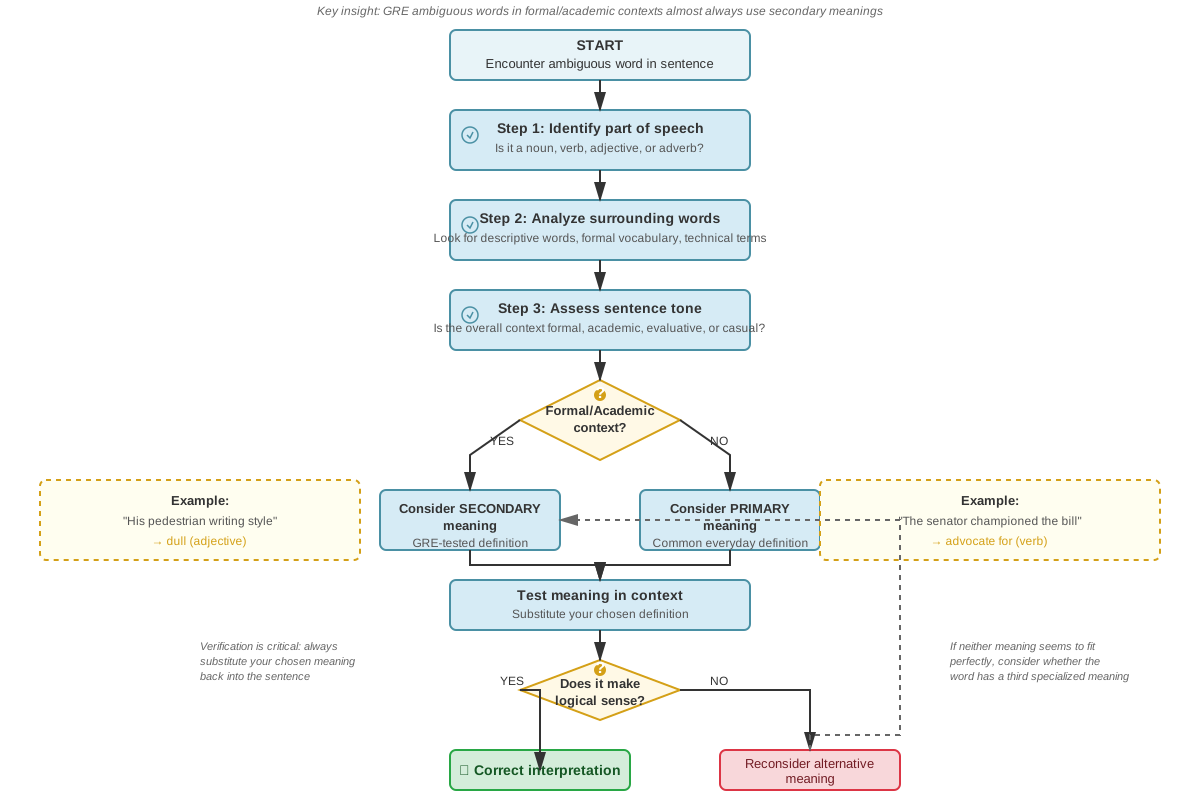
When encountering potential ambiguous words on the GRE, employ this four-step process:
- Initial Assessment: Read the sentence with your first understanding of all words. If the meaning flows logically and grammatically, proceed with that interpretation.
- Mismatch Detection: If the sentence doesn't make sense, if an answer seems too obvious, or if you cannot eliminate enough choices, flag potential ambiguous words—especially common words in formal contexts.
- Alternative Meaning Check: For flagged words, mentally review alternative meanings, particularly checking if the word is being used as a different part of speech than you initially assumed.
- Context Verification: Confirm your alternative meaning by checking that it creates logical coherence with surrounding words and phrases.
Trigger Words and Phrases
Certain contextual elements signal high probability of ambiguous word testing:
- Contrast words: "despite," "although," "however," "but," "rather than" often precede sentences where common meanings would create logical contradictions
- Formal academic language: Passages discussing research, theory, or scholarly analysis increase likelihood of formal word meanings
- Unexpected simplicity: When an answer choice seems too easy for a medium or hard question, consider alternative meanings
- Part-of-speech ambiguity: When a word you know as a noun appears where a verb should be (or vice versa), check for meaning shifts
Process of Elimination Tips
Use these specific strategies for ambiguous word questions:
Eliminate based on context first: Before considering alternative meanings, eliminate choices that clearly contradict the sentence logic regardless of vocabulary nuances.
Check for trap answers: If one answer uses a word's common meaning and another uses the same word's uncommon meaning, the uncommon meaning is usually correct.
Look for synonym pairs: In Sentence Equivalence, if you identify one ambiguous word in its less common meaning, search for another choice that means the same thing in that sense.
Trust grammatical function: If a word must function as a verb based on sentence structure, eliminate interpretations where it functions as a noun.
Time Allocation
Ambiguous word recognition should add minimal time to your question-solving process. Spend approximately:
- 5-10 seconds on initial reading and assessment
- 5-10 seconds on alternative meaning consideration if needed
- 5 seconds on context verification
If you cannot identify an alternative meaning within 20 seconds, make your best guess and move forward. Spending excessive time on a single ambiguous word question yields diminishing returns.
Memory Techniques
The "Common vs. Formal" Mnemonic
Create mental associations between common and formal meanings using vivid imagery:
- PEDESTRIAN: Picture a boring person walking (pedestrian = walker) in gray, dull clothing (pedestrian = dull)
- CHAMPION: Visualize a trophy winner (champion = victor) holding a megaphone to advocate (champion = support) for a cause
- PLASTIC: Imagine a plastic bottle that bends easily (plastic = flexible/adaptable) rather than breaking
- QUALIFY: Picture someone qualifying for a race but then adding asterisks and footnotes (qualify = limit/modify) to their achievement
The "Part-of-Speech Shift" Acronym
TABLE-CHAMPION-SANCTION (TCS) reminds you of three high-frequency words that shift meaning with part of speech:
- Table: noun (furniture) vs. verb (postpone)
- Champion: noun (winner) vs. verb (advocate)
- Sanction: noun/verb (approve) vs. noun/verb (penalize)
Visualization Strategy
For each ambiguous word you learn, create a mental "split screen" image:
Left side: Common meaning with everyday context
Right side: Formal meaning with academic context
For "temper": Left shows an angry face (temper = anger); Right shows a blacksmith tempering steel by cooling it (temper = moderate/strengthen through modification)
The "Context Clue" Framework
Remember SCAN when you suspect an ambiguous word:
- Sentence structure: Does grammar suggest a different part of speech?
- Contrast words: Do "but," "despite," etc. signal unexpected meanings?
- Academic register: Is the passage formal enough for specialized meanings?
- Nonsense check: Does your first interpretation create logical nonsense?
Summary
Ambiguous words represent a critical testing mechanism on the GRE Verbal Reasoning section, appearing in approximately 15-20% of questions across all question types. These are familiar words with multiple distinct meanings, where the GRE deliberately tests less common, formal, or academic definitions to assess vocabulary depth rather than breadth. Success requires moving beyond single-definition memorization to develop awareness of secondary meanings, particularly for the 150-200 high-frequency ambiguous words that appear repeatedly on the exam. The key strategy involves recognizing contextual signals—contrast words, formal register, grammatical function, and logical coherence—that indicate when a less common meaning applies. Mastering ambiguous words strengthens overall reading comprehension by training students to derive precise meaning from context, a skill essential for graduate-level academic work. The most commonly tested patterns include common-to-formal shifts (pedestrian, provincial), part-of-speech shifts (champion, table), and technical versus common usage (discriminate, precipitate). By systematically learning these patterns and applying context-based verification strategies, test-takers can transform ambiguous words from a source of confusion into an opportunity for confident, accurate answering.
Key Takeaways
- Ambiguous words are common words with multiple meanings, not obscure vocabulary; the challenge lies in recognizing less familiar definitions of words you already know
- Context clues in the sentence always indicate which meaning applies; contrast words, formal register, and grammatical function serve as reliable signals
- The GRE tests approximately 150-200 high-frequency ambiguous words repeatedly; focused study of these words yields high returns
- When an answer seems too obvious or simple, check for alternative meanings; the exam deliberately creates traps using common definitions when uncommon ones are correct
- Part-of-speech shifts often accompany meaning shifts; recognizing whether a word functions as a noun, verb, or adjective helps identify the intended meaning
- Ambiguous words appear across all Verbal Reasoning question types, making this skill essential for comprehensive exam performance
- Systematic practice with context-based meaning selection builds the automatic recognition needed for efficient test-day performance
Related Topics
Vocabulary in Context (Reading Comprehension): Understanding ambiguous words directly enhances the ability to answer vocabulary-in-context questions in reading passages, where determining precise word meaning from surrounding text is essential.
Connotation and Tone: Mastering ambiguous words builds awareness of how word choice affects meaning nuance, which connects to identifying authorial tone and understanding subtle distinctions in passage arguments.
Sentence Equivalence Strategy: Since ambiguous words frequently appear as synonym pairs in Sentence Equivalence questions, this topic enables more sophisticated answer selection and elimination strategies.
Etymology and Word Roots: Studying how ambiguous words developed multiple meanings through historical language evolution provides deeper understanding and better retention of alternative definitions.
Advanced Text Completion: Higher-difficulty Text Completion questions increasingly rely on ambiguous words in answer choices, making this topic essential for achieving top Verbal Reasoning scores.
Practice CTA
Now that you understand the patterns, strategies, and high-frequency ambiguous words tested on the GRE, it's time to apply this knowledge through deliberate practice. Attempt the practice questions associated with this topic, focusing on identifying contextual signals and considering alternative meanings before selecting answers. Use the flashcards to build automatic recognition of the 150-200 most commonly tested ambiguous words and their multiple meanings. Remember that mastery comes through repeated exposure in varied contexts—each practice question strengthens your ability to recognize these patterns quickly and accurately on test day. Your investment in understanding ambiguous words will pay dividends across all Verbal Reasoning question types, bringing you closer to your target score.
Sign up free to keep reading
Create a free AnvayaPrep account to finish this GRE guide on Ambiguous words — plus flashcards and practice questions.