Overview
Multiple-meaning words represent one of the most subtle yet frequently tested elements of GRE Verbal Reasoning. These are words that possess two or more distinct definitions, often with dramatically different meanings depending on context. Unlike simple vocabulary questions that test whether a student knows a single definition, GRE multiple-meaning words assess the ability to recognize which meaning applies in a specific context and to navigate the cognitive flexibility required when familiar words appear in unfamiliar ways. The GRE deliberately exploits these words because they reveal a test-taker's depth of vocabulary knowledge and reading comprehension sophistication.
The challenge with multiple-meaning words extends beyond mere memorization. A student might confidently know that "pedestrian" means someone who walks, yet fail to recognize it as an adjective meaning "dull" or "commonplace" in a Text Completion question. Similarly, "champion" functions as both a noun (a winner) and a verb (to advocate for), and the GRE frequently tests the less common usage. This topic demands active engagement with words across different parts of speech and semantic domains, requiring students to maintain mental flexibility and resist the temptation to default to the most familiar definition.
Within the broader landscape of Verbal Reasoning, multiple-meaning words intersect with vocabulary mastery, contextual analysis, and critical reading skills. They appear across all question types—Text Completion, Sentence Equivalence, and Reading Comprehension—making them a high-yield study focus. Mastering this topic strengthens overall verbal performance by training students to question their initial interpretations, consider alternative meanings, and use context clues to disambiguate word usage. This skill set directly supports the analytical thinking that defines success on the GRE.
Learning Objectives
- [ ] Identify when Multiple-meaning words is being tested
- [ ] Explain the core rule or strategy behind Multiple-meaning words
- [ ] Apply Multiple-meaning words to GRE-style questions accurately
- [ ] Distinguish between primary and secondary meanings of high-frequency GRE words
- [ ] Recognize part-of-speech shifts that signal alternative word meanings
- [ ] Develop systematic strategies for using context to determine correct word meanings
- [ ] Build a personal reference list of 50+ multiple-meaning words commonly tested on the GRE
Prerequisites
- Basic vocabulary foundation: Understanding of approximately 3,000-5,000 common English words provides the baseline from which to recognize when familiar words are being used in unfamiliar ways
- Parts of speech recognition: Ability to identify nouns, verbs, adjectives, and adverbs enables detection of meaning shifts that occur when words function in different grammatical roles
- Context clue strategies: Familiarity with using surrounding text to infer meaning supports the disambiguation process essential for multiple-meaning words
- Sentence structure analysis: Understanding of how clauses and phrases relate helps determine which meaning of a word fits the logical flow of a sentence
Why This Topic Matters
Multiple-meaning words appear with remarkable frequency on the GRE, showing up in approximately 30-40% of Text Completion and Sentence Equivalence questions. The test designers favor these words precisely because they separate superficial vocabulary knowledge from deep, nuanced understanding. In Reading Comprehension passages, authors deliberately employ less common meanings of familiar words to create sophisticated prose, and comprehension questions often hinge on whether students correctly interpreted these usage choices.
Beyond exam performance, mastery of multiple-meaning words reflects genuine verbal sophistication valued in graduate-level academic work. Graduate students must navigate dense scholarly texts where authors assume readers recognize specialized or archaic meanings of common words. A philosophy text might use "nice" in its original sense of "precise" or "subtle," while a scientific paper might employ "appreciate" to mean "increase in value" rather than "be grateful for." The ability to recognize and adapt to these shifts represents a fundamental academic literacy skill.
On the GRE specifically, multiple-meaning words appear in several predictable patterns. Text Completion questions frequently present sentences where the blank requires a word's secondary meaning, with the primary meaning serving as a trap answer. Sentence Equivalence questions may pair two words that share a less common meaning, testing whether students can move beyond surface-level synonymy. Reading Comprehension questions occasionally ask about the meaning of a word "as used in line X," specifically targeting instances where the author employs an unexpected definition. Recognizing these patterns transforms multiple-meaning words from a source of confusion into a strategic advantage.
Core Concepts
Definition and Scope of Multiple-Meaning Words
Multiple-meaning words, also called polysemous words or homonyms (though technically distinct), are lexical items with two or more established definitions in standard English dictionaries. These meanings may be related through metaphorical extension (like "grasp" meaning both "to hold physically" and "to understand mentally") or may be entirely unrelated through historical accident (like "bank" meaning both "financial institution" and "river edge"). The GRE focuses primarily on words where one meaning is common in everyday usage while another is more formal, academic, or archaic.
The scope of this topic includes three primary categories:
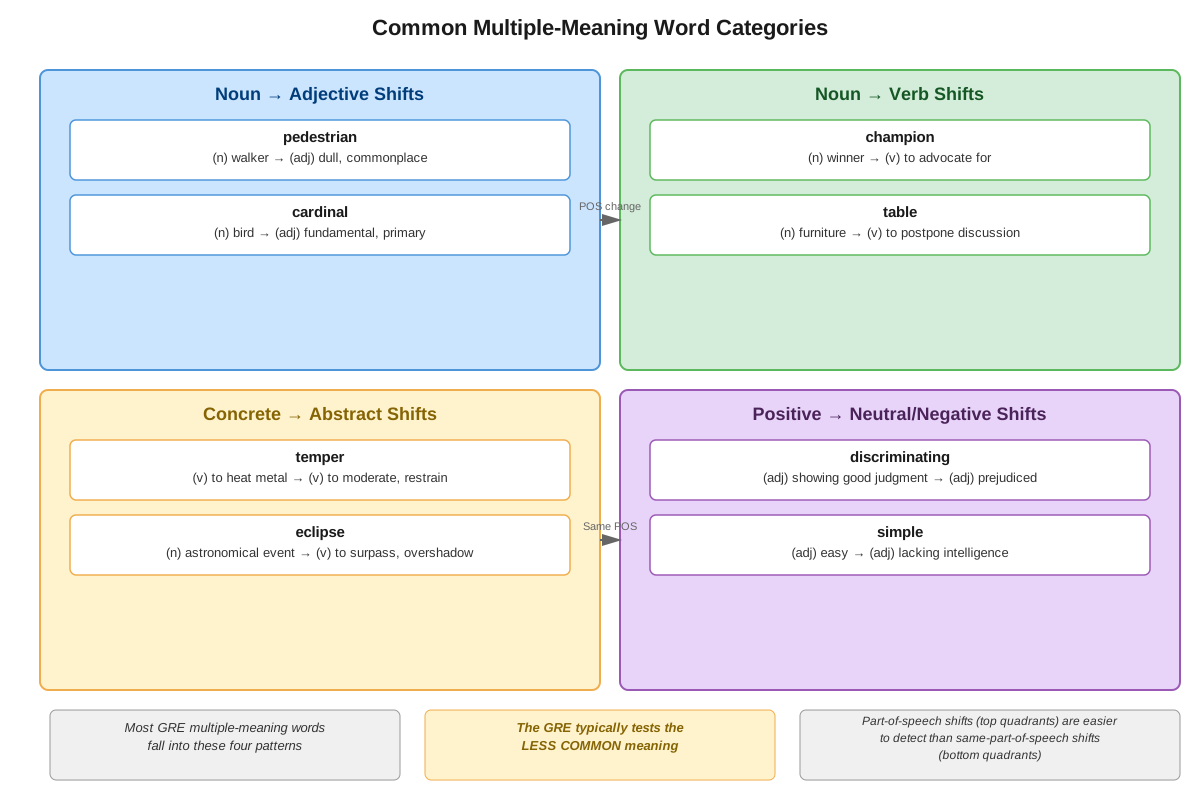
- Part-of-speech shifts: Words that change meaning when functioning as different parts of speech (e.g., "champion" as noun vs. verb)
- Register variations: Words with informal and formal meanings (e.g., "pedestrian" as literal walker vs. metaphorical dullness)
- Domain-specific meanings: Words with general meanings and specialized academic/technical meanings (e.g., "plastic" as material vs. adjective meaning "malleable")
Recognition Strategies
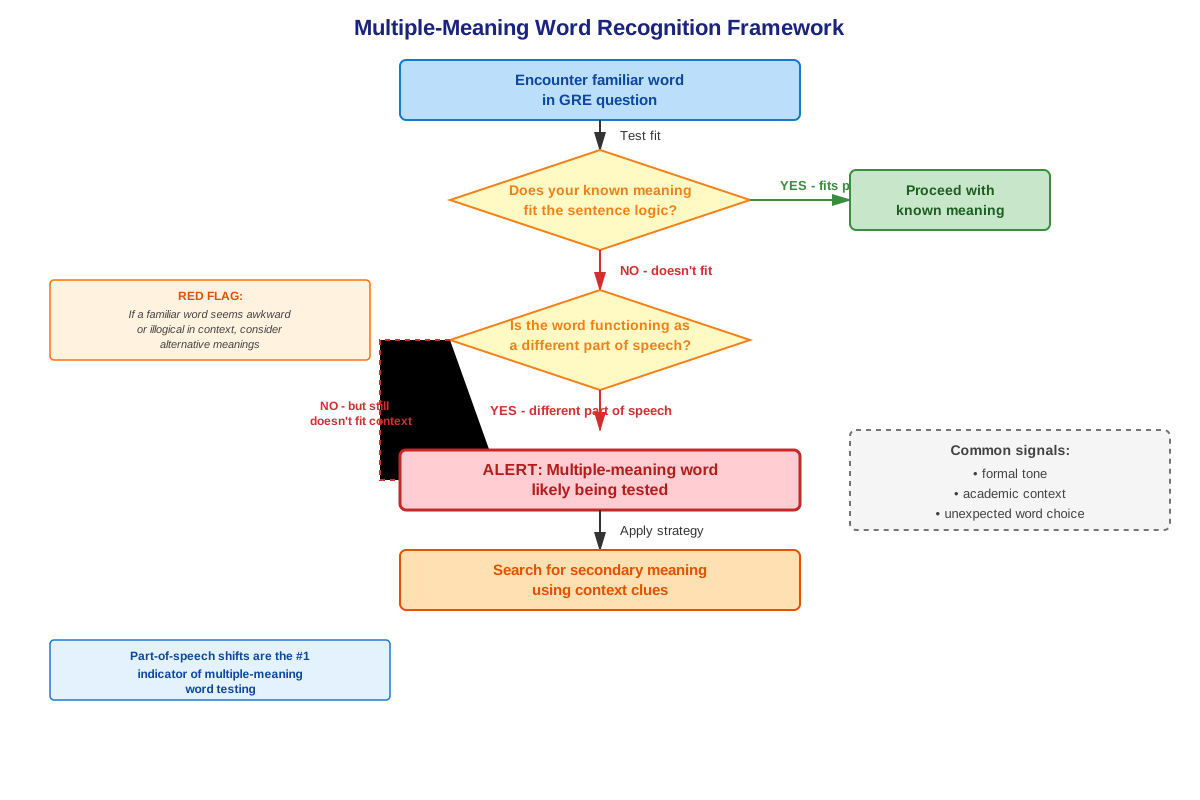
Identifying when the GRE is testing multiple-meaning words requires attention to specific textual signals. The most reliable indicator is cognitive dissonance—when a sentence feels awkward or nonsensical using a word's most common meaning. If inserting the familiar definition creates a logical contradiction or grammatical error, the question almost certainly tests an alternative meaning.
Grammatical function provides another crucial clue. When a word that typically functions as one part of speech appears in a different grammatical role, the GRE is likely testing the less familiar usage. For example, if "table" appears as a verb ("The committee decided to table the motion"), the sentence tests knowledge of "table" meaning "to postpone" rather than the noun meaning "furniture."
Formal or academic context signals potential multiple-meaning word testing. When passages employ elevated diction or discuss scholarly topics, familiar words often carry specialized meanings. A sentence about "the plastic nature of neural connections" uses "plastic" in its academic sense of "capable of change," not as the common noun for synthetic material.
High-Frequency GRE Multiple-Meaning Words
The following table presents commonly tested multiple-meaning words, organized by their primary (familiar) and secondary (GRE-tested) meanings:
| Word | Primary Meaning | Secondary/GRE Meaning | Part of Speech Shift |
|---|---|---|---|
| Champion | Winner, victor | To advocate for, support | Noun → Verb |
| Pedestrian | Person walking | Dull, commonplace, unimaginative | Noun → Adjective |
| Plastic | Synthetic material | Malleable, capable of being shaped | Noun → Adjective |
| Table | Furniture | To postpone, remove from consideration | Noun → Verb |
| Pedestrian | Walker | Ordinary, lacking inspiration | Noun → Adjective |
| Qualify | To meet requirements | To limit, modify, or restrict | Verb (different meanings) |
| Discriminating | Showing prejudice | Having refined taste, perceptive | Adjective (different connotations) |
| Pedestrian | One who walks | Prosaic, uninspired | Noun → Adjective |
| Appropriate | Suitable, proper | To take for one's own use | Adjective → Verb |
| Sanction | To approve officially | A penalty or punishment | Verb/Noun (opposite meanings) |
| Husband | Male spouse | To manage resources carefully | Noun → Verb |
| Tender | Soft, gentle | To offer formally | Adjective → Verb |
| Intimate | Close, personal | To hint or suggest indirectly | Adjective → Verb |
| Pedestrian | Walker | Lacking imagination | Noun → Adjective |
| Founder | Creator, establisher | To fail completely, sink | Noun → Verb |
Context-Based Disambiguation
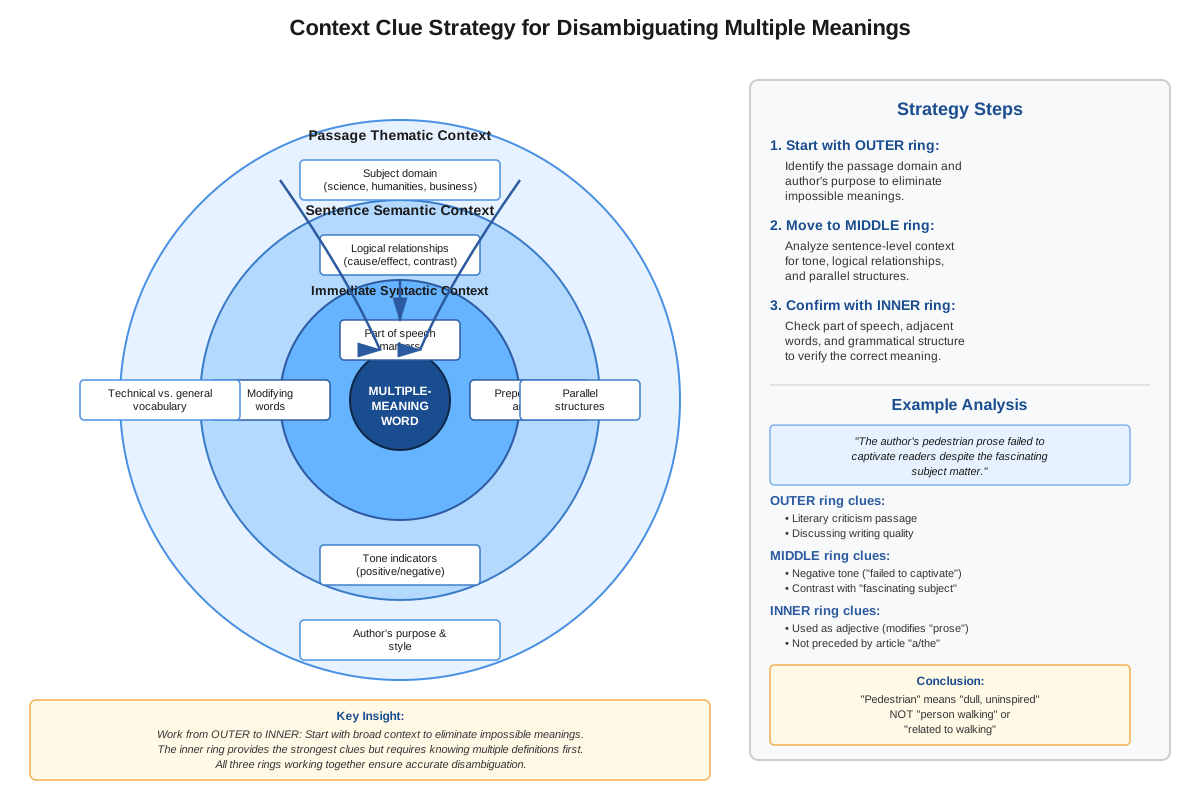
Successfully navigating multiple-meaning words requires systematic use of context clues. The semantic field of surrounding words provides the strongest evidence for intended meaning. If a sentence discusses art, literature, or creativity, "pedestrian" likely means "unimaginative." If the sentence discusses urban planning or transportation, it probably means "walker."
Syntactic structure offers additional disambiguation power. The grammatical relationships between words constrain possible meanings. In "The senator championed the bill," the direct object "the bill" indicates "championed" must be a transitive verb meaning "advocated for," not the noun "winner."
Logical coherence serves as the ultimate test. The correct meaning must create a sentence that makes logical sense within its broader context. Students should mentally substitute each possible meaning and evaluate which produces a coherent, meaningful statement. This process, while time-consuming initially, becomes rapid with practice.
The Role of Etymology and Word Families
Understanding word origins illuminates why multiple meanings exist and helps predict secondary definitions. Many multiple-meaning words developed their various senses through metaphorical extension. "Grasp" originally meant only physical holding, but the metaphor of "holding an idea in your mind" created the intellectual meaning. Recognizing these patterns helps students intuit less familiar meanings.
Word families provide another predictive tool. If "discrimination" can mean both "prejudice" and "refined perception," then "discriminating" likely carries both negative and positive connotations depending on context. Building awareness of how related words share semantic ranges improves recognition of multiple meanings across vocabulary sets.
Concept Relationships
The concepts within multiple-meaning words form an interconnected system. Recognition strategies depend on understanding part-of-speech shifts and semantic fields, which in turn enable effective context-based disambiguation. The process flows: Recognition (identifying that a multiple-meaning word is being tested) → Analysis (determining which grammatical and semantic clues apply) → Disambiguation (selecting the contextually appropriate meaning) → Verification (confirming logical coherence).
This topic connects directly to prerequisite knowledge of parts of speech and context clues, building upon these foundations to address more sophisticated vocabulary challenges. It also relates to vocabulary building strategies by emphasizing depth over breadth—knowing multiple meanings of 500 words proves more valuable than knowing single meanings of 1,000 words.
The relationship to Text Completion and Sentence Equivalence strategies is particularly strong. These question types frequently exploit multiple-meaning words by presenting contexts that require secondary definitions. Mastering this topic directly improves performance on these high-value question types.
Relationship Map:
Context Clues (prerequisite) → Recognition of Multiple-Meaning Words → Part-of-Speech Analysis → Semantic Field Analysis → Context-Based Disambiguation → Successful Text Completion/Sentence Equivalence → Improved Reading Comprehension
High-Yield Facts
⭐ Approximately 30-40% of GRE Text Completion questions involve words with multiple meanings, making this one of the highest-yield vocabulary topics.
⭐ When a familiar word appears in an unexpected grammatical role (especially noun-to-verb or adjective-to-verb shifts), the GRE is almost always testing the less common meaning.
⭐ The word "sanction" uniquely possesses opposite meanings: both "to approve" and "to penalize," making it a frequent GRE trap.
⭐ Part-of-speech shifts account for approximately 60% of multiple-meaning word questions, making grammatical analysis the most important recognition strategy.
⭐ Words ending in -ate (appropriate, intimate, advocate) frequently function as both adjectives and verbs with distinct meanings, representing a high-frequency pattern.
- Multiple-meaning words appear across all three Verbal Reasoning question types: Text Completion, Sentence Equivalence, and Reading Comprehension.
- The GRE favors words where the secondary meaning is more formal or academic than the primary meaning, reflecting graduate-level vocabulary expectations.
- Approximately 75% of multiple-meaning word questions can be solved correctly by carefully analyzing the grammatical structure and semantic field of the sentence.
- Words with Latin or Greek roots often carry specialized academic meanings distinct from their common usage (e.g., "plastic" from Greek "plastikos" meaning "capable of being shaped").
- The most commonly tested multiple-meaning words include: champion, pedestrian, plastic, qualify, discriminating, appropriate, sanction, husband, tender, intimate, and founder.
- Reading Comprehension questions that ask "as used in line X, the word Y most nearly means" almost always target multiple-meaning words.
- Sentence Equivalence questions frequently pair two words that share a less common meaning, requiring recognition of secondary definitions to identify true synonyms.
Quick check — test yourself on Multiple-meaning words so far.
Try Flashcards →Common Misconceptions
Misconception: Multiple-meaning words are rare vocabulary items that require memorizing obscure definitions.
Correction: Multiple-meaning words are typically familiar, everyday words used in unexpected ways. The challenge lies not in learning new vocabulary but in recognizing alternative meanings of known words. Success depends on flexibility and context analysis rather than memorization.
Misconception: The most common meaning of a word is usually correct on the GRE.
Correction: The GRE deliberately tests less common meanings precisely because they're unexpected. When a familiar word appears in a Text Completion or Sentence Equivalence question, the less common meaning is often correct. Students should actively question their first instinct and consider alternative definitions.
Misconception: If a word doesn't make sense in context, it must be a vocabulary word the student doesn't know.
Correction: Cognitive dissonance—when a sentence feels wrong using a familiar definition—is actually the primary signal that a multiple-meaning word is being tested. This confusion should prompt students to consider alternative meanings rather than assume ignorance.
Misconception: Multiple-meaning words always have related meanings connected by metaphor or extension.
Correction: While many multiple-meaning words developed related senses through metaphorical extension, some possess entirely unrelated meanings due to historical accident (homonyms). "Bank" (financial institution vs. river edge) and "sanction" (approve vs. penalize) exemplify unrelated meanings that must be learned independently.
Misconception: Part-of-speech shifts always signal multiple-meaning words.
Correction: While part-of-speech shifts frequently indicate multiple meanings (especially on the GRE), not all grammatical flexibility creates semantic change. Words like "fast" maintain similar core meanings across adjective ("a fast car") and adverb ("run fast") uses. The key is whether the meaning fundamentally changes, not merely the grammatical function.
Misconception: Once you learn both meanings of a multiple-meaning word, you'll always recognize which applies.
Correction: Recognition requires active engagement with context every time. Even familiar multiple-meaning words can be misinterpreted without careful analysis of grammatical structure and semantic field. Successful students develop systematic disambiguation habits rather than relying on passive recognition.
Worked Examples
Example 1: Text Completion with Part-of-Speech Shift
Question: The committee decided to __________ the proposal until more data could be gathered, recognizing that premature action might prove counterproductive.
(A) champion
(B) table
(C) appropriate
(D) intimate
(E) founder
Solution Process:
Step 1 - Analyze context: The sentence discusses postponing action on a proposal. The phrase "until more data could be gathered" indicates delay or postponement.
Step 2 - Identify grammatical requirements: The blank requires a verb (following "to"). The direct object is "the proposal."
Step 3 - Evaluate each option:
- (A) "champion" as a verb means "to advocate for" or "support"—opposite of postponing
- (B) "table" as a verb means "to postpone" or "set aside"—matches context perfectly
- (C) "appropriate" as a verb means "to take for one's own use"—doesn't fit postponement context
- (D) "intimate" as a verb means "to hint or suggest"—doesn't fit postponement context
- (E) "founder" as a verb means "to fail or sink"—too negative and doesn't mean postpone
Step 4 - Verify with substitution: "The committee decided to table the proposal until more data could be gathered" creates perfect logical coherence.
Answer: (B) table
Learning Objective Connection: This example demonstrates identifying when multiple-meaning words are tested (the familiar noun "table" appears as a verb) and applying context-based disambiguation to select the correct meaning.
Example 2: Sentence Equivalence with Register Variation
Question: Despite the author's reputation for brilliance, critics found her latest novel disappointingly __________, lacking the innovative narrative techniques that characterized her earlier work.
Select two answer choices that, when used to complete the sentence, fit the meaning of the sentence as a whole and produce completed sentences that are alike in meaning.
(A) pedestrian
(B) ambulatory
(C) prosaic
(D) peripatetic
(E) innovative
(F) inspired
Solution Process:
Step 1 - Analyze context: The sentence contrasts the author's reputation with critics' disappointment. The blank describes something negative about the novel, specifically lacking innovation.
Step 2 - Identify semantic requirements: The blank needs a word meaning "unimaginative," "ordinary," or "lacking innovation" (opposite of "innovative narrative techniques").
Step 3 - Evaluate each option:
- (A) "pedestrian" as an adjective means "dull, commonplace, unimaginative"—perfect match
- (B) "ambulatory" means "able to walk" or "relating to walking"—doesn't fit context
- (C) "prosaic" means "lacking imagination, dull, ordinary"—perfect match and synonym to (A)
- (D) "peripatetic" means "traveling from place to place"—doesn't fit context
- (E) "innovative" is the opposite of what's needed (the novel lacks innovation)
- (F) "inspired" is the opposite of what's needed
Step 4 - Verify synonymy: Both "pedestrian" and "prosaic" mean "unimaginative and dull," creating equivalent sentences.
Step 5 - Recognize the trap: Option (B) "ambulatory" and (D) "peripatetic" relate to walking/traveling, which might seem connected to "pedestrian," but only if using the noun meaning "walker" rather than the adjective meaning "dull." This is a deliberate trap exploiting multiple meanings.
Answer: (A) pedestrian and (C) prosaic
Learning Objective Connection: This example shows how the GRE tests secondary meanings (pedestrian as "dull" rather than "walker") and creates traps using primary meanings (ambulatory/peripatetic relating to walking). Success requires recognizing which meaning fits the context and avoiding superficial word associations.
Exam Strategy
Systematic Approach to Multiple-Meaning Word Questions
When encountering a familiar word in an unexpected context, deploy this four-step process:
- Pause and question: Resist the impulse to use the first definition that comes to mind. Ask: "Does this meaning create logical coherence?"
- Analyze grammar: Identify the word's part of speech in the sentence. If it differs from the most common usage, a secondary meaning is likely being tested.
- Map the semantic field: Examine surrounding words for clues about topic, tone, and meaning. Academic contexts favor formal definitions; creative contexts favor metaphorical meanings.
- Test alternatives: Mentally substitute different meanings and evaluate which produces the most logical, coherent sentence.
Trigger Words and Phrases
Certain phrases signal that multiple-meaning words are being tested:
- "As used in line X": Reading Comprehension questions with this phrase almost always target multiple-meaning words
- Formal or academic vocabulary surrounding a common word: Elevated diction suggests the common word carries a specialized meaning
- Grammatical structures that seem awkward: When a familiar word appears in an unusual grammatical role, secondary meanings are likely
- Logical contradictions using primary meanings: If the obvious definition creates nonsense, alternative meanings must be considered
Process of Elimination Tips
For Text Completion questions:
- Eliminate answers that use the most common meaning if that meaning creates logical problems
- Favor answers where familiar words function in unexpected grammatical roles
- Be suspicious of answers that seem "too easy" when they use everyday words
For Sentence Equivalence questions:
- Identify which meaning of a multiple-meaning word fits the context before seeking its synonym
- Eliminate trap answers that relate to the wrong meaning (like "ambulatory" relating to "pedestrian" as walker)
- Remember that true synonyms must match the specific meaning required by context, not just share a general semantic relationship
Time Allocation
Multiple-meaning word questions often consume extra time because they require overcoming initial instincts. Budget 15-20 seconds for the recognition and analysis phase, even though this feels counterintuitive. This investment prevents the more costly error of confidently selecting a wrong answer based on the primary meaning. With practice, recognition becomes faster, but initially, deliberate analysis is essential.
Memory Techniques
The "Part-of-Speech Flip" Mnemonic
Remember the acronym CHAPTAIN for high-frequency words that shift from noun to verb with meaning changes:
- Champion (winner → advocate for)
- Husband (spouse → manage carefully)
- Appropriate (suitable → take for one's use)
- Plastic (material → malleable)
- Table (furniture → postpone)
- Advocate (supporter → speak in favor of)
- Intimate (close friend → hint at)
- Nurture (care → foster growth)
Visualization Strategy: The "Two-Face" Technique
For each multiple-meaning word, visualize a two-faced coin. One side shows the common meaning (often concrete or literal), the other shows the GRE meaning (often abstract or formal). When encountering the word, mentally "flip the coin" to consider both sides. This physical metaphor reinforces the habit of considering alternatives.
The "Context Crown" Method
Imagine context clues as a crown surrounding the multiple-meaning word. Each jewel in the crown represents a different type of clue:
- Ruby = grammatical structure (part of speech)
- Sapphire = semantic field (surrounding vocabulary)
- Emerald = logical coherence (does it make sense?)
- Diamond = tone and register (formal vs. informal)
When analyzing a sentence, "collect all four jewels" before selecting a meaning.
Acronym for Disambiguation Process
Use GAVEL to remember the systematic approach:
- Grammar: What part of speech is the word?
- Analyze: What does the context suggest?
- Verify: Does this meaning create coherence?
- Eliminate: Remove meanings that don't fit
- Logic: Confirm the sentence makes sense
Summary
Multiple-meaning words represent a critical GRE Verbal Reasoning topic, appearing in 30-40% of Text Completion and Sentence Equivalence questions and frequently in Reading Comprehension passages. These are familiar words used in unexpected ways, testing depth of vocabulary knowledge rather than breadth. Success requires recognizing when multiple meanings are being tested (primarily through grammatical analysis and cognitive dissonance), systematically analyzing context to determine which meaning applies, and resisting the impulse to default to the most common definition. The highest-yield strategy involves identifying part-of-speech shifts, which account for approximately 60% of multiple-meaning word questions. Key high-frequency words include champion, pedestrian, plastic, table, qualify, discriminating, appropriate, sanction, husband, tender, intimate, and founder. Mastery demands active engagement with context every time these words appear, using grammatical structure, semantic fields, and logical coherence to disambiguate meanings. This skill directly improves performance across all Verbal Reasoning question types and reflects the sophisticated vocabulary knowledge expected at the graduate level.
Key Takeaways
- Multiple-meaning words are familiar words used in unexpected ways, not obscure vocabulary requiring memorization of rare definitions
- Part-of-speech shifts signal approximately 60% of multiple-meaning word questions, making grammatical analysis the most powerful recognition strategy
- Cognitive dissonance—when a sentence feels wrong using the common meaning—is the primary indicator that a secondary definition is being tested
- Context-based disambiguation using grammatical structure, semantic field, and logical coherence is more reliable than trying to memorize all possible meanings
- The GRE deliberately favors less common, more formal or academic meanings over everyday definitions, making "too easy" answers suspicious
- Systematic application of the GAVEL process (Grammar, Analyze, Verify, Eliminate, Logic) prevents costly errors from defaulting to primary meanings
- High-frequency words like champion, pedestrian, table, and sanction appear repeatedly, making focused study of these terms particularly high-yield
Related Topics
Contextual Vocabulary: Building on multiple-meaning words, this topic explores how to infer meanings of completely unfamiliar words from context, using similar analytical strategies but applied to unknown rather than partially-known vocabulary.
Sentence Equivalence Strategy: Mastering multiple-meaning words directly enhances Sentence Equivalence performance, as these questions frequently test whether students can identify true synonyms by matching specific meanings rather than general semantic relationships.
Text Completion Advanced Techniques: Understanding multiple-meaning words enables more sophisticated Text Completion strategies, particularly for two-blank and three-blank questions where word meanings must be coordinated across multiple contexts.
Reading Comprehension Vocabulary-in-Context Questions: These questions explicitly test multiple-meaning words by asking what a word "means as used in line X," making this topic essential preparation for this question type.
Etymology and Word Roots: Studying word origins illuminates why multiple meanings exist and helps predict secondary definitions through understanding of metaphorical extension and semantic development.
Practice CTA
Now that you've mastered the core concepts of multiple-meaning words, it's time to cement your understanding through active practice. Attempt the practice questions designed specifically for this topic, focusing on applying the GAVEL process systematically to each question. Use the flashcards to build rapid recognition of high-frequency multiple-meaning words and their various definitions. Remember: recognizing these words on the GRE isn't about memorizing lists—it's about developing the analytical habits that allow you to navigate unexpected word usage with confidence. Each practice question you complete strengthens these habits and moves you closer to your target score. You've built the foundation; now apply it!
Sign up free to keep reading
Create a free AnvayaPrep account to finish this GRE guide on Multiple-meaning words — plus flashcards and practice questions.