Overview
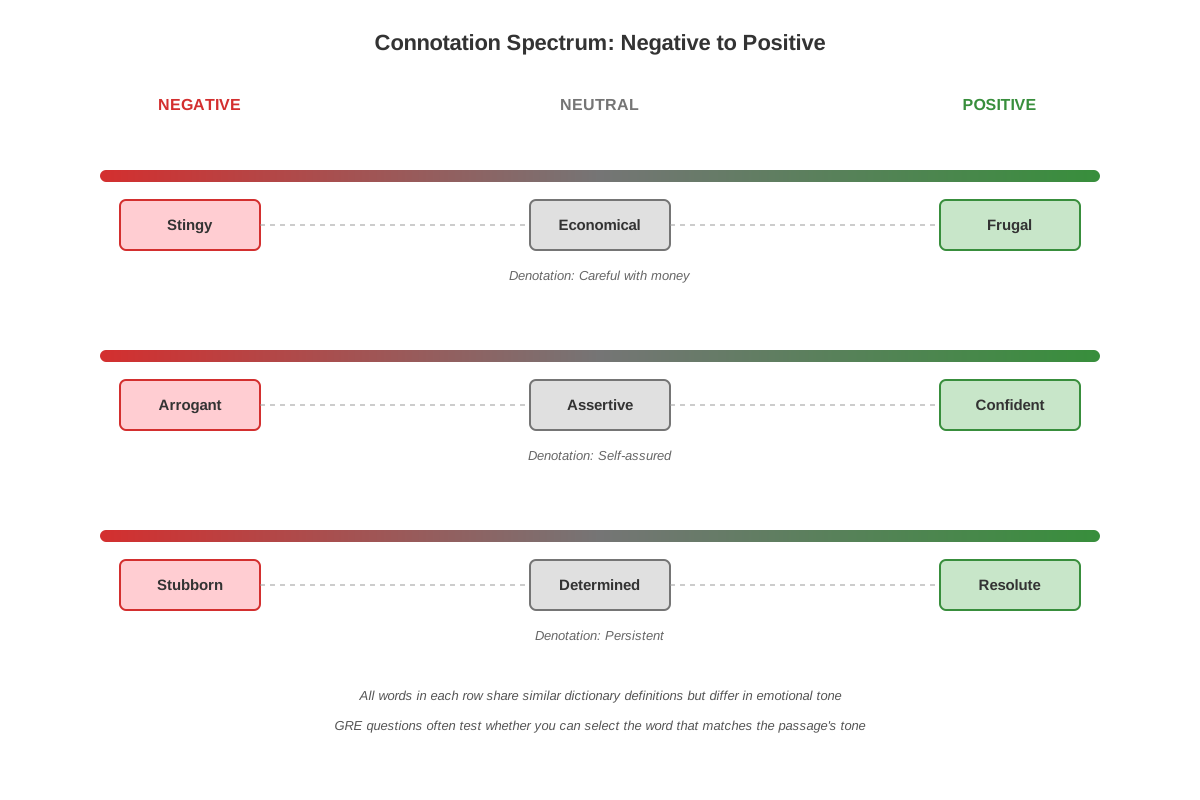
Negative connotation is a critical concept in GRE Verbal Reasoning that tests a student's ability to recognize the emotional tone, implied judgment, or subtle attitude embedded within word choices. While two words may share similar dictionary definitions (denotations), they often carry vastly different emotional associations that can completely alter the meaning of a sentence. Understanding negative connotation allows test-takers to distinguish between words like "frugal" and "stingy," or "confident" and "arrogant"—pairs that describe similar behaviors but convey opposite judgments about them.
On the GRE, gre negative connotation questions appear across multiple question types, including Text Completion, Sentence Equivalence, and Reading Comprehension. The exam frequently tests whether students can identify words that match the emotional tone of a passage, select synonyms that preserve negative undertones, or recognize when an author is expressing criticism versus neutrality. Mastery of this concept directly impacts scoring because connotation errors lead to selecting answers that are technically "close" but fundamentally wrong in tone—a trap the GRE deliberately sets for unprepared test-takers.
This topic connects intimately with broader Verbal Reasoning skills including context clues, author's tone and attitude, word precision, and vocabulary relationships. Students who master negative connotation develop a sophisticated understanding of how language operates beyond literal meaning, enabling them to decode subtle authorial intent and select answers that capture both semantic meaning and emotional coloring. This dual awareness—of what words mean and how they feel—separates high scorers from average performers on the GRE Verbal section.
Learning Objectives
- [ ] Identify when Negative connotation is being tested in GRE questions
- [ ] Explain the core rule or strategy behind Negative connotation
- [ ] Apply Negative connotation to GRE-style questions accurately
- [ ] Distinguish between words with similar denotations but different connotations
- [ ] Analyze passage context to determine whether negative, positive, or neutral connotation is required
- [ ] Evaluate answer choices by matching both semantic meaning and emotional tone to passage requirements
Prerequisites
- Basic vocabulary knowledge: Understanding word definitions (denotations) provides the foundation for recognizing how connotations diverge from literal meanings
- Context clue recognition: The ability to extract meaning from surrounding text is essential because connotation must match the passage's overall tone
- Synonym and antonym relationships: Recognizing word relationships helps identify when two similar words differ primarily in their emotional coloring
- Reading comprehension fundamentals: Understanding main ideas and author's purpose enables accurate assessment of whether negative tone is appropriate
Why This Topic Matters
Negative connotation appears in approximately 15-20% of GRE Verbal Reasoning questions, making it one of the highest-yield concepts for score improvement. This topic directly impacts performance on Text Completion (where tone matching is essential), Sentence Equivalence (where both answer choices must share connotation, not just denotation), and Reading Comprehension (where understanding an author's critical stance depends on recognizing negative word choices).
In real-world applications, connotation awareness is fundamental to effective communication, persuasive writing, critical reading of media and academic texts, and professional correspondence. The ability to detect subtle bias, implied criticism, or emotional manipulation through word choice is a cornerstone of advanced literacy and critical thinking.
On the GRE specifically, connotation questions appear in several predictable patterns: passages describing failed policies or flawed theories that require negatively-toned vocabulary; character descriptions where the author's judgment (admiring versus critical) must be inferred; and scientific or historical passages where the author's stance toward competing theories becomes clear through word choice. The exam particularly favors testing connotation in adjectives and verbs, where emotional coloring is most pronounced. Students who miss connotation distinctions typically select answers that are "close enough" in meaning but fail to capture the passage's critical or disapproving tone, resulting in incorrect answers despite strong vocabulary knowledge.
Core Concepts
Defining Connotation Versus Denotation
Denotation refers to the literal, dictionary definition of a word—its objective, neutral meaning. Connotation, by contrast, encompasses the emotional associations, cultural implications, and subjective feelings that a word evokes beyond its literal definition. While "house" and "home" both denote a dwelling structure, "home" carries positive connotations of warmth, belonging, and emotional connection that "house" lacks.
Negative connotation specifically refers to words that carry unfavorable, critical, disapproving, or unpleasant associations. These words suggest something undesirable, problematic, or worthy of criticism. For example, "odor" has negative connotation (suggesting something unpleasant), while "scent" is neutral to positive, and "fragrance" is decidedly positive—yet all three denote a smell.
The Spectrum of Connotation
Connotation exists on a spectrum rather than in discrete categories:
| Negative | Neutral | Positive |
|---|---|---|
| stench | smell | aroma |
| cheap | inexpensive | economical |
| stubborn | determined | resolute |
| nosy | curious | inquisitive |
| mob | crowd | gathering |
| scheme | plan | strategy |
Understanding this spectrum is crucial for GRE success because the exam tests whether students can identify the precise degree of negativity required by context. A passage criticizing a politician's behavior might require "obstinate" (strongly negative) rather than "firm" (neutral to positive), even though both suggest unwillingness to change position.
Context Determines Connotation Requirements
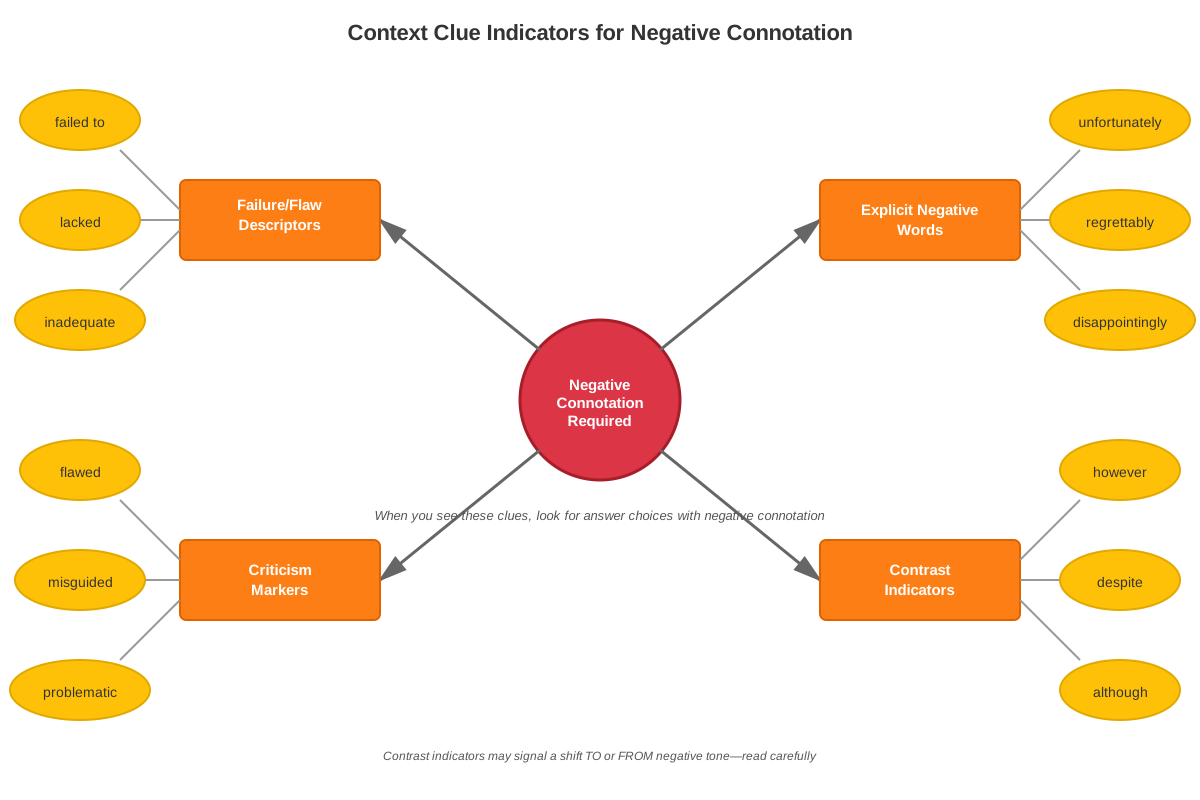
The surrounding text provides critical clues about whether negative connotation is appropriate. Key indicators include:
Negative context markers:
- Criticism or disapproval expressed elsewhere in the passage
- Words like "unfortunately," "regrettably," "problematically"
- Descriptions of failures, flaws, or negative outcomes
- Contrasts with positive alternatives
- Author's argumentative stance against an idea
Positive context markers:
- Praise, admiration, or approval
- Words like "fortunately," "admirably," "successfully"
- Descriptions of achievements or beneficial outcomes
- Supportive tone toward the subject
Neutral context markers:
- Objective, factual reporting
- Balanced presentation of multiple perspectives
- Academic or scientific description without judgment
Common Word Pairs with Connotation Differences
The GRE frequently tests specific word pairs where connotation is the primary distinction:
Describing people's traits:
- Confident (positive) vs. arrogant (negative)
- Frugal (positive) vs. cheap/stingy (negative)
- Youthful (positive) vs. immature/childish (negative)
- Assertive (positive) vs. pushy/aggressive (negative)
- Unique (positive) vs. odd/bizarre (negative)
- Selective (neutral/positive) vs. picky (negative)
Describing actions or behaviors:
- Persuade (neutral) vs. manipulate (negative)
- Discuss (neutral) vs. argue/quarrel (negative)
- Examine (neutral) vs. scrutinize (slightly negative) vs. nitpick (negative)
- Simplify (positive) vs. oversimplify (negative)
- Decorate (neutral) vs. embellish (can be negative, suggesting excess)
Describing ideas or things:
- Unusual (neutral) vs. strange/weird (negative)
- Old (neutral) vs. antiquated/obsolete (negative)
- Thin (neutral) vs. scrawny/emaciated (negative)
- Talkative (neutral) vs. garrulous/loquacious (negative)
Intensity and Degree in Negative Connotation
Negative connotation varies in intensity, and the GRE tests whether students can match the appropriate degree of negativity:
Mild negativity: problematic, questionable, debatable, imperfect, flawed
Moderate negativity: misguided, erroneous, detrimental, harmful, inadequate
Strong negativity: disastrous, catastrophic, abhorrent, egregious, pernicious
A passage describing a "somewhat flawed" theory requires mild negative connotation, while one describing a "completely discredited" theory demands strong negative vocabulary.
Recognizing Negative Connotation in Verbs
Verbs carry particularly important connotational weight on the GRE:
- Neutral: said, walked, took, made
- Negative: claimed (suggests doubt), trudged (suggests difficulty), seized (suggests force), fabricated (suggests dishonesty)
The choice between "The politician said the policy would work" versus "The politician claimed the policy would work" dramatically changes the sentence's meaning through connotation alone—the second implies skepticism about the politician's statement.
Concept Relationships
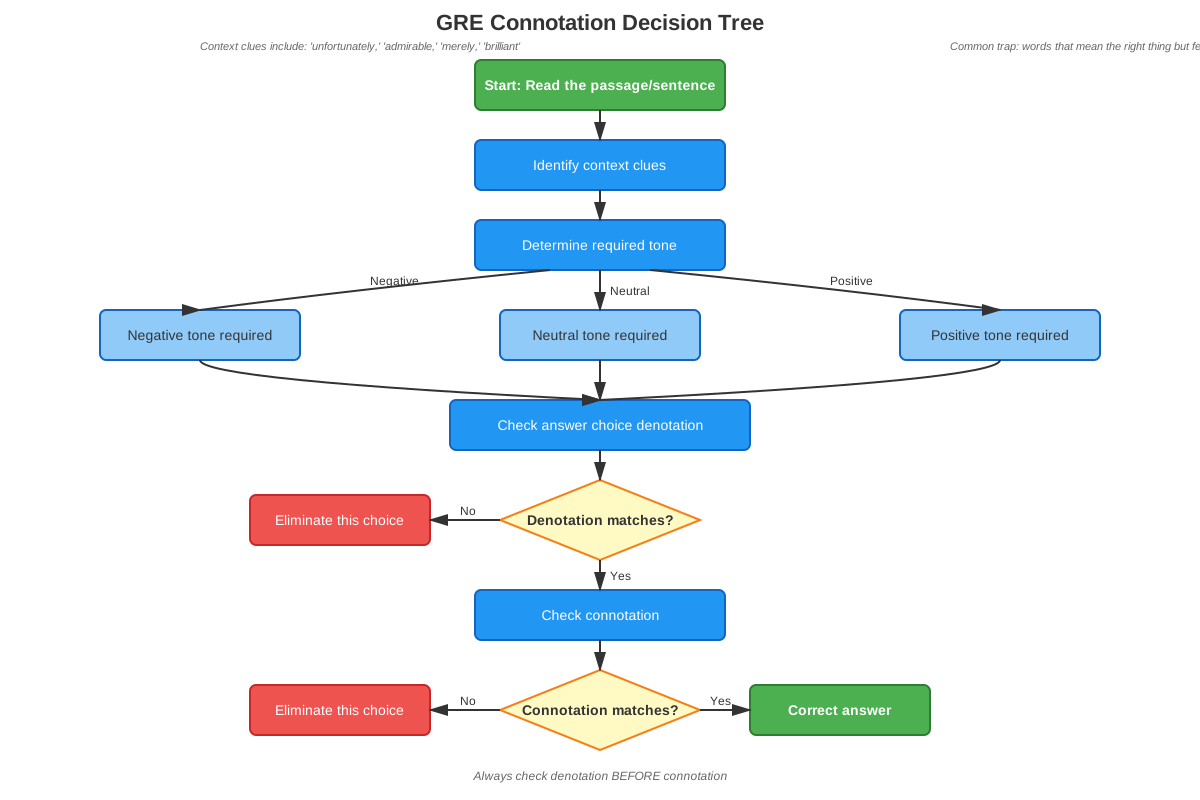
Negative connotation connects directly to context clues because the surrounding text determines whether negative tone is appropriate. Students must first identify context markers (criticism, failure, disapproval) before selecting negatively-connotated vocabulary.
This topic builds upon synonym relationships but adds a critical layer: true synonyms for GRE purposes must match both denotation AND connotation. "Stubborn" and "resolute" are not GRE synonyms despite similar meanings because their connotations differ fundamentally.
The relationship flow operates as follows:
Context Analysis → Tone Identification → Connotation Requirement → Word Selection
For example: Passage criticizes a theory (context) → Author disapproves (tone) → Negative connotation needed (requirement) → Select "dubious" not "uncertain" (word choice)
Negative connotation also connects to author's purpose and tone in Reading Comprehension. Recognizing an author's critical stance requires identifying accumulated negative connotation across multiple word choices. A single negatively-connotated word might be coincidental, but consistent negative vocabulary reveals authorial attitude.
Finally, this concept relates to precision in vocabulary, a core GRE skill. The exam rewards students who understand that vocabulary mastery means knowing not just what words mean, but how they feel and when they're appropriate.
High-Yield Facts
⭐ Negative connotation refers to unfavorable emotional associations a word carries beyond its literal definition
⭐ The GRE tests connotation in Text Completion, Sentence Equivalence, and Reading Comprehension questions
⭐ Context clues in the passage determine whether negative, positive, or neutral connotation is required
⭐ Words with similar denotations can have opposite connotations (e.g., "confident" vs. "arrogant")
⭐ In Sentence Equivalence, both correct answers must match in connotation, not just meaning
- Verbs and adjectives most frequently carry connotational weight on the GRE
- Negative connotation exists on a spectrum from mildly unfavorable to strongly critical
- Words like "claim," "assert," and "allege" carry more negative connotation than neutral "say" or "state"
- The intensity of negative connotation must match the passage's degree of criticism
- Recognizing accumulated negative vocabulary across a passage reveals author's critical stance
- Common GRE trap answers have correct denotation but wrong connotation
- Prefixes like "over-" (overconfident, oversimplify) often add negative connotation to neutral root words
Quick check — test yourself on Negative connotation so far.
Try Flashcards →Common Misconceptions
Misconception: If two words have similar dictionary definitions, they're interchangeable on the GRE.
Correction: The GRE specifically tests connotation differences between near-synonyms. "Childlike" (positive: innocent, wonder-filled) and "childish" (negative: immature, petulant) have similar denotations but opposite connotations, making them non-interchangeable.
Misconception: Negative connotation only matters in Reading Comprehension questions about author's tone.
Correction: Negative connotation is equally critical in Text Completion and Sentence Equivalence, where selecting words that match the passage's emotional tone is essential for correct answers.
Misconception: Formal or sophisticated vocabulary automatically has neutral connotation.
Correction: Many advanced GRE words carry strong negative connotation (e.g., "obsequious," "mendacious," "pernicious"). Vocabulary level and connotation are independent properties.
Misconception: If a passage doesn't explicitly state criticism, negative connotation isn't needed.
Correction: Authors often express disapproval exclusively through word choice rather than explicit statements. Recognizing subtle negative connotation is key to identifying implicit criticism.
Misconception: In Sentence Equivalence, the two correct answers must be perfect synonyms.
Correction: The correct pair must produce sentences with equivalent meaning AND tone. Words with similar denotations but different connotations (one negative, one neutral) cannot both be correct.
Misconception: Connotation is subjective and varies too much to test reliably.
Correction: While connotation has cultural dimensions, the GRE tests widely-agreed-upon connotations in standard academic English. Words like "stingy," "arrogant," and "manipulate" have consistently negative connotation across contexts.
Worked Examples
Example 1: Text Completion
Question: The critic's review was hardly ___________; she described the performance as technically adequate but emotionally hollow, and suggested that the director had __________ the original playwright's intentions.
Blank (i): laudatory, analytical, measured
Blank (ii): honored, distorted, interpreted
Solution Process:
Step 1: Analyze context for Blank (i). The word "hardly" creates a negative construction. The subsequent description ("technically adequate but emotionally hollow") is clearly critical, not praising. We need a positive word that "hardly" will negate, or we need to recognize that the review itself is critical.
Step 2: Evaluate options for Blank (i):
- "Laudatory" means praising—"hardly laudatory" fits perfectly with a critical review
- "Analytical" is neutral—"hardly analytical" doesn't match (the review IS analytical)
- "Measured" means balanced/restrained—"hardly measured" suggests extreme, which doesn't fit
Answer for Blank (i): laudatory
Step 3: Analyze context for Blank (ii). The critic is negative about the performance, suggesting the director did something wrong to the playwright's intentions. We need negative connotation.
Step 4: Evaluate options for Blank (ii):
- "Honored" is positive—contradicts the critical tone
- "Distorted" is negative—suggests harmful alteration, matches critical tone
- "Interpreted" is neutral—doesn't convey the criticism implied
Answer for Blank (ii): distorted
Key Takeaway: The negative tone established by "technically adequate but emotionally hollow" requires negatively-connotated vocabulary. "Distorted" captures both the meaning (changed) and the negative judgment (changed for the worse) that context demands.
Example 2: Sentence Equivalence
Question: The politician's opponents characterized his budget proposal as __________, arguing that it prioritized short-term popularity over long-term fiscal responsibility.
- pragmatic
- opportunistic
- shrewd
- expedient
- calculated
- cynical
Solution Process:
Step 1: Identify context clues. "Opponents characterized" signals criticism. "Prioritized short-term popularity over long-term fiscal responsibility" is clearly negative—suggesting the politician is acting for selfish political gain rather than good policy.
Step 2: Determine connotation requirement. We need words with NEGATIVE connotation that mean "focused on immediate advantage."
Step 3: Evaluate each option:
- "Pragmatic" (neutral to positive): means practical, realistic—doesn't convey criticism
- "Opportunistic" (negative): means exploiting circumstances for selfish gain—matches!
- "Shrewd" (neutral to positive): means clever, astute—suggests admiration, not criticism
- "Expedient" (negative): means convenient/advantageous but possibly unprincipled—matches!
- "Calculated" (neutral to slightly negative): means carefully planned—doesn't strongly convey the selfishness implied
- "Cynical" (negative): means distrustful/contemptuous—wrong meaning (describes attitude, not behavior)
Answers: opportunistic and expedient
Key Takeaway: Both correct answers must share negative connotation. "Shrewd" and "pragmatic" have similar meanings to the correct answers but lack the critical tone that "opponents characterized" requires. This is a classic GRE trap—offering near-synonyms with wrong connotation.
Exam Strategy
Identifying When Connotation Is Being Tested
Watch for these trigger patterns:
Exam Tip: If answer choices contain words with similar meanings but you're struggling to choose, connotation is likely the deciding factor.
Key triggers:
- Questions where multiple answers seem semantically correct
- Passages with clear authorial stance (critical, admiring, skeptical)
- Sentence Equivalence questions where several pairs seem possible
- Words describing people's character traits or behaviors
- Passages discussing failures, flaws, controversies, or criticism
Step-by-Step Approach
- Read for tone first: Before looking at answer choices, determine whether the passage is positive, negative, or neutral toward its subject
- Identify tone markers: Circle words like "unfortunately," "merely," "however," "impressive," "successful" that signal attitude
- Eliminate connotation mismatches: Cross out any answer that has the wrong emotional tone, even if the meaning seems close
- Check intensity: Ensure your answer matches the degree of positivity/negativity in the passage
- For Sentence Equivalence: Verify that both selected answers share connotation, not just denotation
Process of Elimination Tips
- Eliminate neutral words when context is clearly positive or negative: If a passage criticizes something, neutral vocabulary is almost always wrong
- Watch for "over-" prefix: Words like "overconfident," "oversimplify," "overstate" add negative connotation to otherwise neutral roots
- Test substitution: Mentally replace the blank with each option and assess whether the sentence's tone remains consistent
- Beware of positive-sounding words in negative contexts: The GRE loves trap answers that sound good but contradict the passage's critical tone
Time Allocation
Connotation analysis should take 10-15 seconds once you've read the passage. If you're spending longer, you may be overthinking—trust your instinctive sense of whether a word "feels" right for the context. Native and advanced English speakers have strong intuitions about connotation that should be leveraged rather than second-guessed.
Memory Techniques
The "Feeling Test" Mnemonic
When evaluating words, ask: "How would I FEEL if someone described ME this way?"
- Would you be pleased if called "frugal"? Probably yes → positive/neutral
- Would you be pleased if called "cheap"? Probably no → negative
This emotional test quickly reveals connotation.
The "Synonym Spectrum" Visualization
For any concept, visualize a horizontal line with negative on the left, neutral in the middle, positive on the right:
NEGATIVE ←——— NEUTRAL ———→ POSITIVE
stingy ←——— thrifty ———→ economical
arrogant ←——— confident ———→ self-assured
When you encounter a word, mentally place it on this spectrum.
The "Context Color-Coding" Technique
As you read passages, mentally color-code:
- Red for negative context markers (criticism, failure, problems)
- Green for positive context markers (success, praise, benefits)
- Gray for neutral, objective description
Your answer should match the dominant color.
Acronym: TONE
Tone markers in passage (identify first)
Opposite connotations (eliminate immediately)
Neutral words (usually wrong in strongly-toned passages)
Emotional consistency (verify your answer maintains it)
Summary
Negative connotation represents the unfavorable emotional associations and implied judgments that words carry beyond their literal definitions. On the GRE Verbal Reasoning section, this concept appears across Text Completion, Sentence Equivalence, and Reading Comprehension questions, testing whether students can match vocabulary to the emotional tone established by passage context. Mastery requires distinguishing between words with similar denotations but different connotations (such as "confident" versus "arrogant"), analyzing context clues to determine whether negative tone is appropriate, and selecting answers that preserve both semantic meaning and emotional coloring. The exam specifically targets this skill by offering trap answers that are technically correct in meaning but wrong in tone—a distinction that separates high scorers from average performers. Success depends on reading passages for authorial attitude, identifying tone markers, and systematically eliminating answers with connotation mismatches before considering other factors.
Key Takeaways
- Negative connotation refers to unfavorable emotional associations beyond literal meaning, and the GRE tests this concept extensively across question types
- Context clues determine whether negative, positive, or neutral connotation is required—always analyze tone before selecting answers
- Words with similar denotations can have opposite connotations, making them non-interchangeable on the GRE (e.g., "stubborn" vs. "resolute")
- In Sentence Equivalence, both correct answers must match in connotation, not just meaning—this is a high-yield trap pattern
- Verbs and adjectives most frequently carry connotational weight; pay special attention to words describing traits, actions, and attitudes
- The intensity of negative connotation must match the passage's degree of criticism—mild, moderate, or strong negativity
- Eliminate answers with wrong emotional tone first, even if the meaning seems close—connotation mismatches are always incorrect
Related Topics
Positive Connotation: The complementary concept examining favorable emotional associations; mastering negative connotation naturally prepares students for recognizing positive connotation patterns.
Author's Tone and Attitude: Understanding how accumulated word choices reveal authorial stance; negative connotation is a primary tool authors use to express criticism.
Context Clues and Inference: The foundational skill for determining what tone is appropriate; connotation mastery depends on strong context analysis.
Precision in Vocabulary: The broader principle that word choice must be exact in both meaning and tone; connotation represents a specific application of this principle.
Sentence Equivalence Strategy: Advanced techniques for finding answer pairs that match in all dimensions, including connotation—a critical application of this topic.
Practice CTA
Now that you understand negative connotation and its critical role in GRE Verbal Reasoning, it's time to apply these concepts to real practice questions. Work through the accompanying practice set, paying special attention to identifying tone markers and eliminating connotation mismatches. Review the flashcards to internalize common word pairs with connotation differences—this pattern recognition will become automatic with practice. Remember: every question you practice strengthens your intuitive sense of how words feel, not just what they mean. This intuition is what separates good scores from great scores. You've built the foundation—now build the skill through deliberate practice!
Sign up free to keep reading
Create a free AnvayaPrep account to finish this GRE guide on Negative connotation — plus flashcards and practice questions.