Overview
Prefixes are foundational building blocks of English vocabulary that appear at the beginning of words to modify or completely change their meaning. On the GRE Verbal Reasoning section, understanding prefixes is not merely helpful—it is essential for decoding unfamiliar words, eliminating incorrect answer choices, and maximizing performance on Text Completion, Sentence Equivalence, and Reading Comprehension questions. When encountering a challenging vocabulary word like "intransigent" or "circumlocution," recognizing the prefix can unlock the word's meaning even without prior exposure to the complete term.
The GRE deliberately tests sophisticated vocabulary that most test-takers have not memorized, making prefix knowledge a critical compensatory strategy. Rather than attempting to memorize tens of thousands of individual words, students who master gre prefixes can decode word meanings systematically and efficiently. This approach transforms vocabulary from a memorization challenge into a logical puzzle-solving exercise, aligning perfectly with the analytical skills the GRE aims to measure.
Prefix mastery connects directly to broader Verbal Reasoning competencies including context clue analysis, semantic relationships, and precise word choice discrimination. When combined with root word knowledge and suffix understanding, prefix recognition enables students to break down complex academic vocabulary into manageable components, dramatically expanding effective vocabulary range without proportional study time investment. This topic serves as a force multiplier for all vocabulary-dependent GRE tasks.
Learning Objectives
- [ ] Identify when Prefixes is being tested
- [ ] Explain the core rule or strategy behind Prefixes
- [ ] Apply Prefixes to GRE-style questions accurately
- [ ] Recognize and define the 30 most high-yield GRE prefixes
- [ ] Combine prefix knowledge with context clues to decode unfamiliar words
- [ ] Distinguish between words with similar prefixes but different meanings
- [ ] Analyze how prefix changes affect word connotation and usage
Prerequisites
- Basic English vocabulary foundation: Understanding common words enables recognition of how prefixes modify familiar terms
- Parts of speech knowledge: Identifying whether a word functions as a noun, verb, or adjective helps predict how prefixes will alter meaning
- Root word familiarity: Prefixes attach to roots, so recognizing common Latin and Greek roots enhances decoding ability
- Context clue strategies: Prefix knowledge works synergistically with surrounding textual information to determine word meaning
Why This Topic Matters
Prefix knowledge represents one of the highest-yield study investments for GRE preparation. Research on GRE vocabulary patterns reveals that approximately 60-70% of challenging GRE words contain identifiable prefixes, roots, or suffixes. Rather than memorizing 3,000+ individual vocabulary words, students who master the 30-40 most common prefixes can decode hundreds of words systematically.
On the GRE Verbal Reasoning section, prefix-based vocabulary appears across all question types. Text Completion questions frequently feature answer choices distinguished by prefix variations (e.g., "prescient" vs. "omniscient" vs. "nescient"). Sentence Equivalence questions often require selecting two words with similar prefix-derived meanings. Reading Comprehension passages in scientific, historical, and philosophical domains employ technical vocabulary heavily dependent on prefix understanding.
Real-world applications extend beyond test performance. Academic reading, professional communication, and intellectual discourse all rely on Latinate and Greek-derived vocabulary constructed through prefix-root-suffix combinations. Medical terminology, legal language, scientific nomenclature, and scholarly writing all follow these morphological patterns. Mastering prefixes develops transferable analytical skills applicable to lifelong learning and professional advancement.
The GRE specifically targets prefix knowledge because it measures the ability to reason through unfamiliar material—a core graduate school competency. Test designers intentionally include low-frequency vocabulary to assess whether students can apply systematic analysis rather than relying solely on memorization. This makes prefix mastery not just helpful but strategically essential for competitive scoring.
Core Concepts
Understanding Prefix Function
A prefix is a morpheme (meaningful unit) attached to the beginning of a root word or base word that modifies its meaning. Unlike suffixes, which often change a word's part of speech, prefixes typically alter semantic content while maintaining grammatical function. For example, "happy" (adjective) becomes "unhappy" (still an adjective), but the meaning reverses from positive to negative.
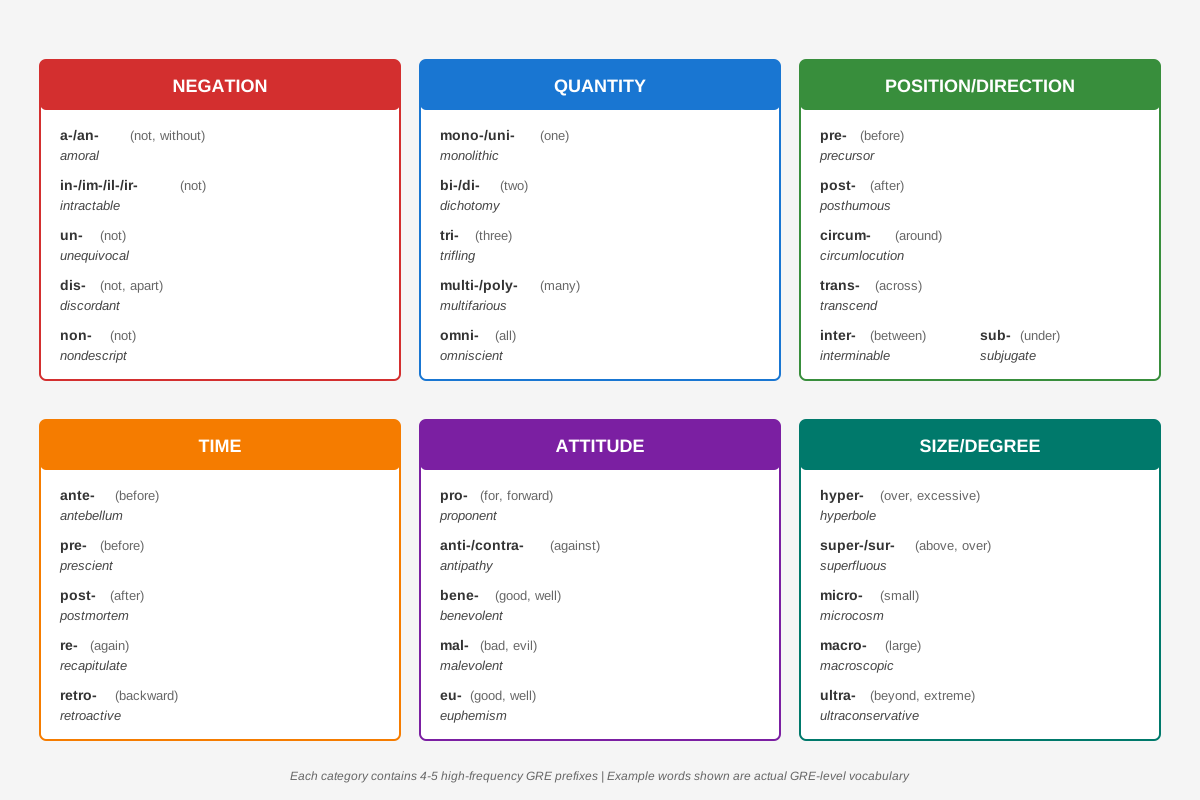
Prefixes operate through several mechanisms: negation (un-, in-, non-), quantity (mono-, bi-, poly-), time (pre-, post-, ante-), direction (pro-, retro-, circum-), and degree (hyper-, hypo-, super-). Understanding these categorical functions enables systematic prediction of word meanings even when encountering completely unfamiliar terms.
High-Yield Negative and Opposing Prefixes
| Prefix | Meaning | Example | GRE Context |
|---|---|---|---|
| a-/an- | without, not | amoral, anarchy | Frequently in philosophical and ethical vocabulary |
| anti- | against, opposite | antipathy, antithesis | Common in argument-based passages |
| contra- | against, opposite | contradict, contravene | Legal and logical reasoning contexts |
| de- | reverse, remove | debunk, demystify | Academic discourse and criticism |
| dis- | not, opposite of | disparage, dissonance | Extremely common across all question types |
| in-/im-/il-/ir- | not | ineffable, immutable, illicit, irrevocable | Highest-frequency negative prefix on GRE |
| mal- | bad, wrong | malevolent, maladroit | Character description and critique |
| mis- | wrong, badly | misconstrue, misnomer | Reasoning and interpretation contexts |
| non- | not | nondescript, nonplussed | Straightforward negation |
| un- | not, reverse | unequivocal, unprecedented | Universal application |
The in- prefix family (in-, im-, il-, ir-) follows phonetic assimilation rules: "im-" before b, m, p (immutable, imbalance); "il-" before l (illicit, illogical); "ir-" before r (irrevocable, irresolute). This pattern aids spelling recognition and pronunciation.
Quantity and Number Prefixes
| Prefix | Meaning | Example | GRE Application |
|---|---|---|---|
| mono-/uni- | one, single | monolithic, unilateral | Describing singular perspectives or approaches |
| bi-/di- | two | bifurcate, dichotomy | Discussing divisions or dual aspects |
| tri- | three | tripartite, trilogy | Less common but appears in structural descriptions |
| multi-/poly- | many | multifarious, polyglot | Describing complexity or variety |
| semi-/hemi- | half, partial | seminal, hemisphere | Partial qualities or incomplete states |
| omni- | all | omniscient, omnipresent | Absolute or universal characteristics |
These prefixes frequently appear in Reading Comprehension passages discussing classification systems, analytical frameworks, or comparative structures.
Time and Sequence Prefixes
| Prefix | Meaning | Example | GRE Context |
|---|---|---|---|
| ante-/pre- | before | antecedent, precursor | Historical and causal relationships |
| post- | after | posthumous, postulate | Temporal sequences and consequences |
| pro- | forward, before | prognosis, proactive | Future orientation and prediction |
| retro- | backward | retrospective, retrograde | Historical analysis and regression |
| re- | again, back | recapitulate, renounce | Repetition or reversal |
Understanding temporal prefixes proves particularly valuable in Reading Comprehension questions about historical development, scientific processes, or argumentative structure.
Spatial and Directional Prefixes
| Prefix | Meaning | Example | GRE Application |
|---|---|---|---|
| circum- | around | circumscribe, circumvent | Describing boundaries or avoidance |
| ex-/e- | out, from | extricate, egress | Removal or departure |
| inter- | between, among | intersperse, intermediary | Relationships and connections |
| intra- | within | intramural, introspective | Internal processes or boundaries |
| sub- | under, below | subliminal, subjugate | Hierarchy or hidden qualities |
| super-/sur- | above, beyond | superfluous, surmount | Excess or transcendence |
| trans- | across, beyond | transcend, transgress | Crossing boundaries or transformation |
These directional prefixes commonly appear in abstract and metaphorical contexts on the GRE, requiring students to recognize both literal and figurative applications.
Degree and Intensity Prefixes
| Prefix | Meaning | Example | GRE Context |
|---|---|---|---|
| hyper- | excessive, above | hyperbole, hyperactive | Exaggeration or extremity |
| hypo- | under, below | hypothetical, hypocritical | Deficiency or subordination |
| ultra- | beyond, extreme | ultraconservative, ultramundane | Extreme positions or qualities |
| arch- | chief, extreme | archetype, archenemy | Primary or quintessential examples |
Degree prefixes help distinguish between similar answer choices by indicating intensity differences.
Relational and Social Prefixes
| Prefix | Meaning | Example | GRE Application |
|---|---|---|---|
| co-/com-/con- | with, together | coalesce, commiserate, concord | Cooperation and agreement |
| syn-/sym- | together, same | synthesis, symbiotic | Unity and combination |
| auto- | self | autonomous, autocratic | Self-direction or independence |
| hetero- | different | heterogeneous, heterodox | Diversity and difference |
| homo- | same | homogeneous, homonym | Similarity and uniformity |
These prefixes frequently appear in social science passages and questions about group dynamics or comparative analysis.
Concept Relationships
Prefix knowledge forms the foundation of a hierarchical vocabulary decoding system. At the base level, individual prefix recognition enables basic word meaning approximation. This connects upward to prefix-root combination analysis, where understanding both components yields precise definitions. For example, recognizing "bene-" (good) + "volent" (wishing) produces "benevolent" (wishing good, kindly).
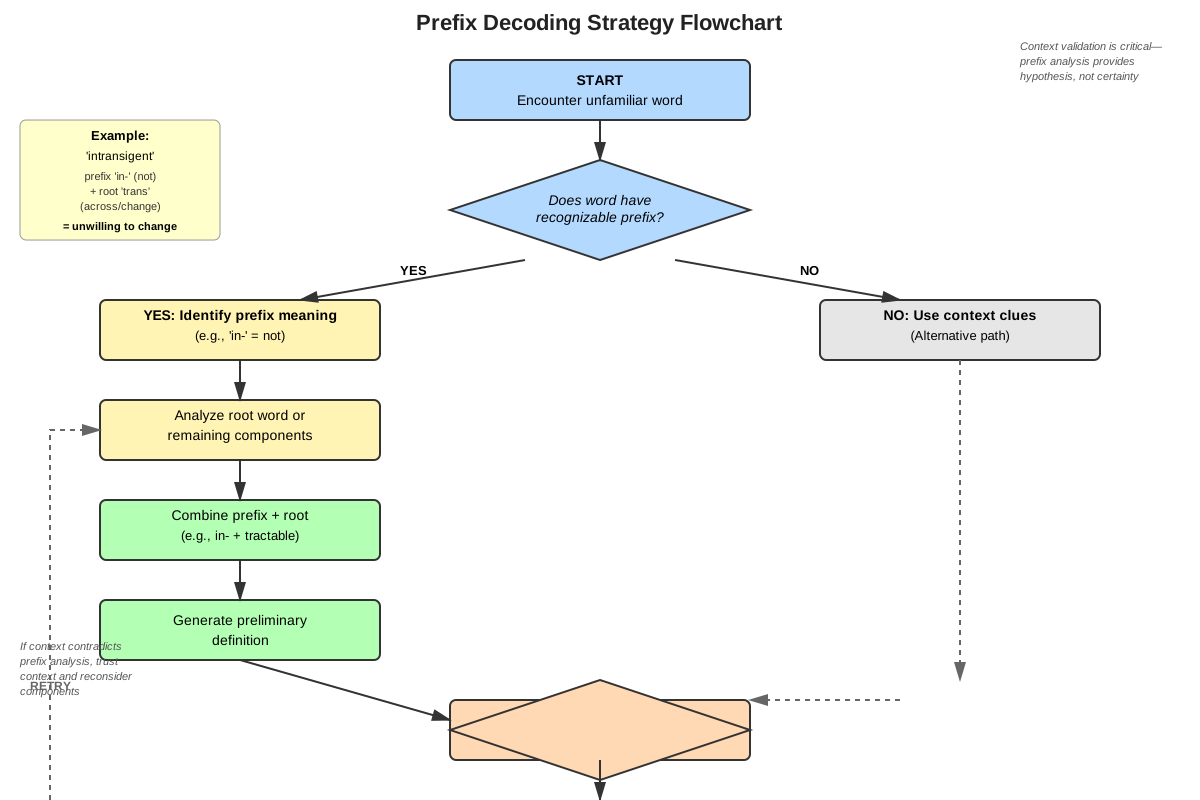
The relationship flows: Prefix Recognition → Root Identification → Suffix Analysis → Complete Word Meaning. Each component provides partial information that combines synergistically. When one element remains unknown, the others compensate, making the system robust against knowledge gaps.
Prefix mastery connects laterally to context clue analysis. When a sentence provides semantic hints about a word's meaning, prefix knowledge either confirms the contextual hypothesis or reveals contradictions that prompt reconsideration. This bidirectional verification improves accuracy significantly.
The concept also relates to word family recognition. Words sharing prefixes often appear in semantic clusters: "circumvent," "circumscribe," "circumlocution," and "circumspect" all involve the concept of "around" but apply it differently. Recognizing these families accelerates vocabulary acquisition through pattern recognition rather than isolated memorization.
Finally, prefix understanding connects to etymology and language history. Most GRE prefixes derive from Latin or Greek, reflecting the academic vocabulary's classical origins. This historical awareness helps predict spelling patterns, pronunciation, and semantic evolution, creating a richer, more durable knowledge framework.
Quick check — test yourself on Prefixes so far.
Try Flashcards →High-Yield Facts
⭐ The prefix "in-" (and variants im-, il-, ir-) is the single most common negative prefix on the GRE, appearing in words like ineffable, immutable, illicit, and irrevocable.
⭐ Approximately 60-70% of challenging GRE vocabulary words contain identifiable prefixes, making prefix knowledge one of the highest-yield study investments.
⭐ The prefix "circum-" always relates to "around" or "surrounding", helping decode circumvent (go around), circumscribe (draw around/limit), and circumlocution (talking around).
⭐ "Pre-" and "pro-" both can mean "before," but "pre-" emphasizes temporal precedence while "pro-" emphasizes forward motion or advocacy, distinguishing words like "precursor" from "proponent."
⭐ The prefix "sub-" can mean both "under" (subordinate) and "secretly/slightly" (subtle, subversive), requiring context to determine precise meaning.
- "Dis-" and "de-" prefixes often indicate reversal or removal rather than simple negation, as in "dismantle" or "debunk."
- "Bene-" (good) and "mal-" (bad) create clear antonym pairs: benevolent/malevolent, benefactor/malefactor, beneficial/malicious.
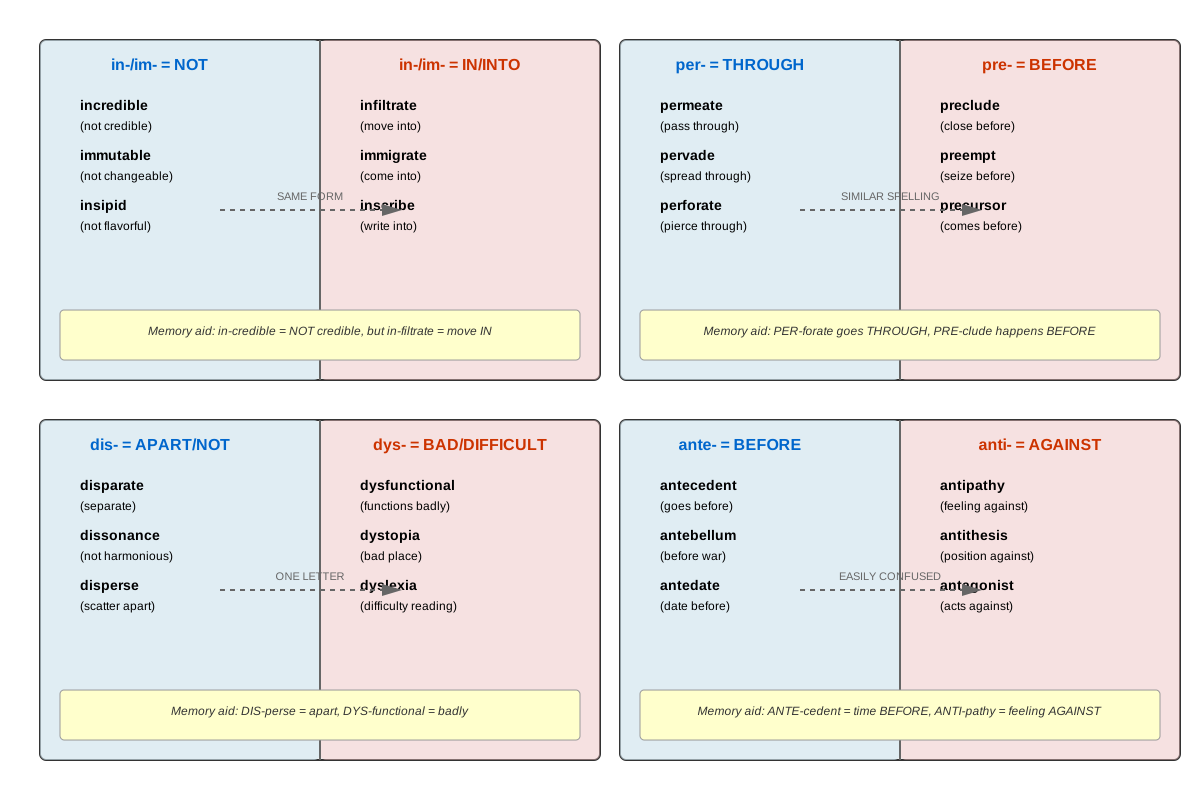
- "Ante-" (before) and "anti-" (against) are frequently confused but have completely different meanings: antecedent (coming before) vs. antipathy (feeling against).
- The prefix "a-/an-" specifically means "without" and appears in philosophical vocabulary: amoral (without morals), apathy (without feeling), anarchy (without rulers).
- "Trans-" indicates crossing boundaries or transformation, appearing in transcend, transgress, transient, and transparent.
- "Inter-" (between) and "intra-" (within) are commonly tested opposites: international vs. intramural, interpersonal vs. intrapersonal.
- "Retro-" always indicates backward direction or past orientation: retrospective, retrograde, retroactive.
Common Misconceptions
Misconception: All words beginning with "in-" are negative.
Correction: While "in-" often means "not" (ineffable, inept), it can also mean "in" or "into" (infiltrate, inaugurate, incarcerate). Context and the root word determine which meaning applies.
Misconception: "Nonplussed" means "unfazed" or "unimpressed" because "non-" means "not."
Correction: "Nonplussed" actually means "bewildered" or "at a loss," derived from Latin "non plus" (no more/further). This represents a common GRE trap where prefix logic misleads.
Misconception: Prefixes always attach to complete, recognizable English words.
Correction: Prefixes often attach to Latin or Greek roots that don't function as standalone English words. "Ineffable" combines "in-" (not) with "effable" (speakable), but "effable" isn't used independently in modern English.
Misconception: "Inflammable" means "not flammable" because "in-" is a negative prefix.
Correction: "Inflammable" actually means "easily set on fire," where "in-" derives from "into" rather than negation. This demonstrates why prefix knowledge must combine with root understanding.
Misconception: All "anti-" words indicate opposition or hostility.
Correction: While "anti-" generally means "against," words like "anticipate" use "anti-" in its alternative meaning of "before" (from Latin "ante"), meaning "to take before" or "expect."
Misconception: Knowing the prefix always provides the complete word meaning.
Correction: Prefixes provide directional clues but must combine with root and suffix knowledge plus context for precise meaning. "Circumspect" (looking around) means "cautious," not literally "looking around."
Misconception: "Bi-" and "semi-" are interchangeable for "two" or "half."
Correction: "Bi-" means "two" (bilateral, bifurcate), while "semi-" means "half" or "partial" (semicircle, semifinal). "Biannual" (twice yearly) differs from "semiannual" (every half year), though they coincidentally mean the same thing.
Worked Examples
Example 1: Text Completion with Prefix Analysis
Question: The scientist's hypothesis was so __________ that even her most supportive colleagues found it impossible to verify through experimentation.
(A) empirical
(B) ineffable
(C) pragmatic
(D) substantiated
(E) unfalsifiable
Solution Process:
Step 1: Analyze the sentence structure and logic. The blank describes a hypothesis that "even supportive colleagues found impossible to verify." This suggests something that cannot be tested or proven.
Step 2: Apply prefix knowledge to eliminate choices:
- (A) empirical: "em-" (variant of "en-") means "in/into"; empirical relates to observation and evidence—opposite of what we need
- (B) ineffable: "in-" (not) + root relating to speaking/expressing; means "inexpressible"—doesn't fit verification context
- (C) pragmatic: "prag-" relates to practice/action; means practical—opposite of untestable
- (D) substantiated: "sub-" (under/supporting) + root for standing; means proven—directly opposite of needed meaning
- (E) unfalsifiable: "un-" (not) + "fals-" (false) + "-ifiable" (able to be made); means cannot be proven false
Step 3: Recognize that "unfalsifiable" perfectly captures a hypothesis that cannot be tested or disproven, which matches the context of being "impossible to verify."
Answer: (E) unfalsifiable
Connection to Learning Objectives: This example demonstrates identifying when prefixes are tested (distinguishing between similar-sounding academic terms), explaining the strategy (systematic elimination using prefix meanings), and applying knowledge accurately to select the correct answer.
Example 2: Sentence Equivalence with Prefix Discrimination
Question: The politician's speech was criticized for its __________ nature, as he spoke at length without directly addressing the central question.
Select TWO answer choices:
(A) circumlocutory
(B) laconic
(C) periphrastic
(D) succinct
(E) verbose
(F) terse
Solution Process:
Step 1: Identify the key context: "spoke at length without directly addressing the central question" indicates indirect, wordy communication.
Step 2: Apply prefix and root analysis:
- (A) circumlocutory: "circum-" (around) + "locut-" (speaking); literally "speaking around"—perfect match
- (B) laconic: No helpful prefix; means brief/concise—opposite of needed meaning
- (C) periphrastic: "peri-" (around) + "phras-" (speaking); literally "speaking around"—perfect match
- (D) succinct: "suc-" (variant of "sub-," under/up to) + "cinct" (girded/bound); means brief—opposite
- (E) verbose: "verb-" (word) + "-ose" (full of); means wordy but doesn't capture the "indirect" aspect as precisely
- (F) terse: No helpful prefix; means brief—opposite
Step 3: Recognize that both "circumlocutory" and "periphrastic" use prefixes meaning "around" combined with roots meaning "speaking," making them precise synonyms for indirect, roundabout speech.
Answer: (A) and (C)
Connection to Learning Objectives: This example shows how prefix knowledge enables precise discrimination between near-synonyms (verbose vs. circumlocutory) and identification of true equivalents through morphological analysis rather than vague semantic similarity.
Exam Strategy
Recognition Triggers
When encountering unfamiliar vocabulary on the GRE, immediately scan for recognizable prefixes. Words beginning with common prefixes like "in-," "un-," "dis-," "pre-," "trans-," or "circum-" offer immediate decoding opportunities. Even partial understanding provides elimination power in multiple-choice contexts.
Systematic Approach
- Identify the prefix and recall its core meaning
- Isolate the root (even if unfamiliar, note its spelling and sound)
- Consider the suffix for part of speech and additional meaning clues
- Synthesize components into a working definition
- Test against context to confirm or refine understanding
- Eliminate impossible answers based on prefix meaning alone
Process of Elimination Power
Even when uncertain about complete word meaning, prefix knowledge enables confident elimination. If a sentence requires a negative concept and one answer choice begins with "in-" while others lack negative prefixes, the "in-" word becomes more probable. This probabilistic reasoning improves guessing accuracy significantly.
Time Management
Prefix analysis should take 5-10 seconds per word maximum. If prefix recognition doesn't yield immediate insight, proceed to context clues rather than dwelling on morphological analysis. The strategy works best when automatic, suggesting the value of prefix memorization to automaticity.
Common Trap Awareness
GRE test designers deliberately include words where prefix logic misleads (like "nonplussed" or "inflammable"). When prefix-based prediction contradicts context strongly, trust context and flag the word as an exception. These exceptions are rare enough that prefix logic remains highly reliable overall.
Answer Choice Comparison
When multiple answer choices share the same prefix, focus on root and suffix differences. Conversely, when answer choices have different prefixes but similar roots, the prefix becomes the primary discriminator. This comparative analysis often reveals the question's true focus.
Memory Techniques
Prefix Grouping Mnemonic
Negative Prefixes: "Uncle Don Is Not Able" = Un-, Dis-, In-, Non-, A-
Quantity Prefixes: "Many People Buy Two Umbrellas" = Multi-/Poly-, Bi-, Tri-, Uni-/Mono-
Time Prefixes: "Please Post Real Records" = Pre-, Post-, Re-, Retro-
Visualization Strategy
For spatial prefixes, create mental images:
- Circum-: Visualize walking around a circular track
- Trans-: Picture crossing across a bridge
- Inter-: Imagine standing between two people
- Intra-: Envision being within a building
- Sub-: See yourself under water
- Super-: Picture flying above clouds
Etymology Anchors
Connect prefixes to familiar words:
- Bene- = Benefit (good)
- Mal- = Malfunction (bad)
- Ante- = Antebellum (before the war)
- Post- = Postscript (written after)
- Circum- = Circumference (distance around)
Opposite Pairs
Memorize antonym pairs to reinforce meanings:
- Pro- (forward) vs. Retro- (backward)
- Hyper- (excessive) vs. Hypo- (deficient)
- Inter- (between) vs. Intra- (within)
- Bene- (good) vs. Mal- (bad)
- Ante- (before) vs. Post- (after)
Sentence Anchors
Create memorable sentences using multiple words with the same prefix:
- "The ineffable, inexorable, inimitable force proved invincible"
- "Circumspect travelers circumvent obstacles by circumnavigating dangerous areas"
- "Transient visitors transgress boundaries while transcending expectations"
Summary
Prefix mastery represents a foundational GRE Verbal Reasoning competency that enables systematic vocabulary decoding across all question types. By understanding the 30-40 highest-yield prefixes—particularly negative prefixes (in-, un-, dis-), temporal prefixes (pre-, post-, retro-), and spatial prefixes (circum-, trans-, inter-)—students can decode hundreds of unfamiliar words through morphological analysis rather than rote memorization. The strategy works because approximately 60-70% of challenging GRE vocabulary contains identifiable prefixes that provide directional meaning clues. Effective application requires recognizing when prefix knowledge is being tested, systematically breaking words into prefix-root-suffix components, and combining morphological analysis with context clues for verification. Common pitfalls include overgeneralizing prefix meanings without considering roots and failing to recognize exceptions where prefix logic misleads. Success demands both memorization of core prefix meanings and practiced application through repeated exposure to GRE-level vocabulary in context, developing the automaticity necessary for efficient test-day performance.
Key Takeaways
- Prefixes modify word meaning systematically, making them more valuable than individual word memorization for GRE preparation
- The "in-" prefix family (in-, im-, il-, ir-) is the highest-yield negative prefix, appearing in countless GRE vocabulary words
- Spatial prefixes (circum-, trans-, inter-, intra-, sub-, super-) frequently appear in abstract and metaphorical contexts, requiring recognition of both literal and figurative applications
- Prefix knowledge enables powerful process-of-elimination strategies even when complete word meaning remains uncertain
- Approximately 60-70% of challenging GRE words contain identifiable prefixes, making this a high-return study investment
- Combining prefix analysis with context clues and root knowledge creates a robust vocabulary decoding system that compensates for knowledge gaps
- Automatic prefix recognition requires deliberate memorization and repeated practice with GRE-level vocabulary in authentic contexts
Related Topics
Root Words and Etymology: Understanding Greek and Latin roots that combine with prefixes to form complete words; mastering roots exponentially increases vocabulary decoding power when combined with prefix knowledge.
Suffixes and Word Formation: Learning how suffixes modify part of speech and meaning; completing the prefix-root-suffix analysis system for comprehensive morphological decoding.
Context Clues and Inference: Developing strategies for determining word meaning from surrounding text; works synergistically with prefix knowledge for maximum accuracy.
Synonym and Antonym Recognition: Building semantic relationship awareness; prefix knowledge helps identify word families and opposition patterns essential for Sentence Equivalence questions.
Academic Vocabulary Development: Expanding exposure to sophisticated vocabulary in context; provides authentic practice applying prefix knowledge to real GRE-level passages.
Practice CTA
Now that you understand the systematic power of prefix analysis, it's time to cement this knowledge through active practice. Attempt the practice questions to apply prefix decoding strategies to authentic GRE-style problems, and use the flashcards to build automatic recognition of high-yield prefixes. Remember: prefix mastery isn't about memorizing definitions—it's about developing the analytical reflex to break unfamiliar words into meaningful components. Every practice question strengthens this reflex, transforming vocabulary from your weakness into your competitive advantage. Start practicing now to experience how prefix knowledge unlocks hundreds of words you've never formally studied!
Sign up free to keep reading
Create a free AnvayaPrep account to finish this GRE guide on Prefixes — plus flashcards and practice questions.