Overview
Academic vocabulary represents a critical component of GRE Verbal Reasoning success, encompassing the sophisticated, formal words commonly used in scholarly writing, research publications, and intellectual discourse. Unlike everyday conversational language, these words appear frequently in graduate-level texts across disciplines—from scientific journals to humanities essays—and form the backbone of the GRE's vocabulary testing strategy. The exam consistently evaluates whether test-takers can comprehend and use these elevated terms appropriately, as they signal readiness for graduate-level academic work.
The GRE tests GRE academic vocabulary through multiple question types: Text Completion questions require selecting words that fit logically into scholarly passages, Sentence Equivalence questions demand identifying synonymous academic terms, and Reading Comprehension passages are saturated with sophisticated vocabulary that students must understand to answer questions accurately. Mastering this vocabulary isn't about memorizing obscure words; it's about developing familiarity with the precise, nuanced language that academics use to express complex ideas efficiently.
Academic vocabulary connects intimately with other Verbal Reasoning skills, particularly context clue analysis, word relationship recognition, and reading comprehension. Understanding these words enables students to decode complex sentence structures, grasp subtle distinctions between similar concepts, and navigate the dense prose typical of GRE passages. This vocabulary knowledge serves as the foundation upon which all other verbal skills build—without it, even strong analytical abilities cannot compensate for fundamental comprehension gaps.
Learning Objectives
- [ ] Identify when Academic vocabulary is being tested
- [ ] Explain the core rule or strategy behind Academic vocabulary
- [ ] Apply Academic vocabulary to GRE-style questions accurately
- [ ] Distinguish between academic vocabulary and common synonyms based on register and connotation
- [ ] Recognize word families and root patterns to decode unfamiliar academic terms
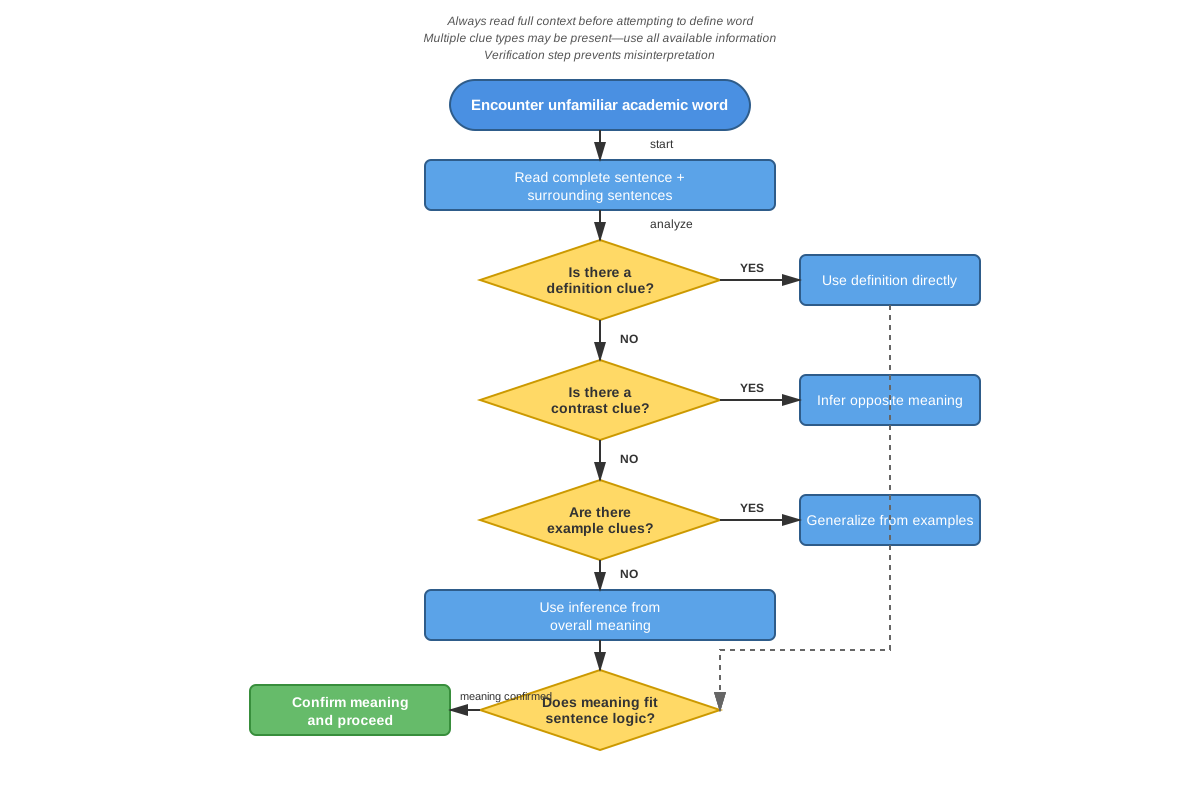
- [ ] Evaluate context clues to determine precise meanings of academic vocabulary in complex sentences
- [ ] Construct effective study strategies for long-term retention of academic vocabulary
Prerequisites
- Basic vocabulary foundation: Understanding common English words and their meanings provides the baseline from which academic vocabulary extends, allowing students to recognize when a word represents elevated diction.
- Reading comprehension skills: The ability to extract meaning from sentences and paragraphs is essential because academic vocabulary rarely appears in isolation—context determines precise usage.
- Familiarity with parts of speech: Recognizing whether a word functions as a noun, verb, adjective, or adverb helps predict its role in sentences and narrow down meaning possibilities.
- Basic knowledge of prefixes, suffixes, and roots: Understanding word components enables students to break down unfamiliar academic terms into recognizable parts.
Why This Topic Matters
Academic vocabulary proficiency directly correlates with GRE Verbal Reasoning scores because approximately 40-50% of verbal questions explicitly test vocabulary knowledge through Text Completion and Sentence Equivalence questions. Additionally, Reading Comprehension passages—which constitute the remaining verbal questions—are deliberately written using sophisticated academic language, making vocabulary knowledge essential even when it's not the primary skill being assessed. Students who struggle with academic vocabulary find themselves guessing on multiple questions per section, severely limiting their score potential.
Beyond the exam itself, academic vocabulary mastery signals genuine readiness for graduate education. Graduate programs across all disciplines require students to read research papers, scholarly articles, and theoretical texts that employ this elevated language as standard communication. Professors expect incoming graduate students to understand terms like "paradigm," "empirical," "ubiquitous," and "mitigate" without explanation. The GRE's emphasis on academic vocabulary reflects this real-world necessity.
In exam passages, academic vocabulary appears in several predictable patterns: scientific passages use terms like "catalyst," "anomaly," and "hypothesis"; humanities passages employ words like "aesthetic," "juxtapose," and "rhetoric"; social science texts feature "demographic," "correlation," and "methodology." The exam deliberately selects passages from diverse academic fields to ensure that no single disciplinary vocabulary gives certain students unfair advantages, making broad academic vocabulary knowledge essential for all test-takers.
Core Concepts
Defining Academic Vocabulary
Academic vocabulary consists of words that appear frequently in scholarly writing across multiple disciplines but rarely in casual conversation. These words occupy a middle ground between everyday language and highly specialized technical jargon. For example, "demonstrate" is academic vocabulary (more formal than "show"), while "spectrophotometry" is technical jargon (specific to chemistry). The GRE focuses on academic vocabulary because it represents language that all graduate students must understand, regardless of their specific field.
Academic vocabulary typically exhibits several characteristics: it tends to be Latinate rather than Anglo-Saxon in origin (compare "commence" to "start"), it often carries more precise or nuanced meanings than common synonyms, and it maintains a formal register appropriate for professional and scholarly contexts. Words like "facilitate," "comprehensive," "subsequent," and "inherent" exemplify this category—they're not obscure, but they're distinctly more formal than everyday alternatives.
Register and Formality Levels
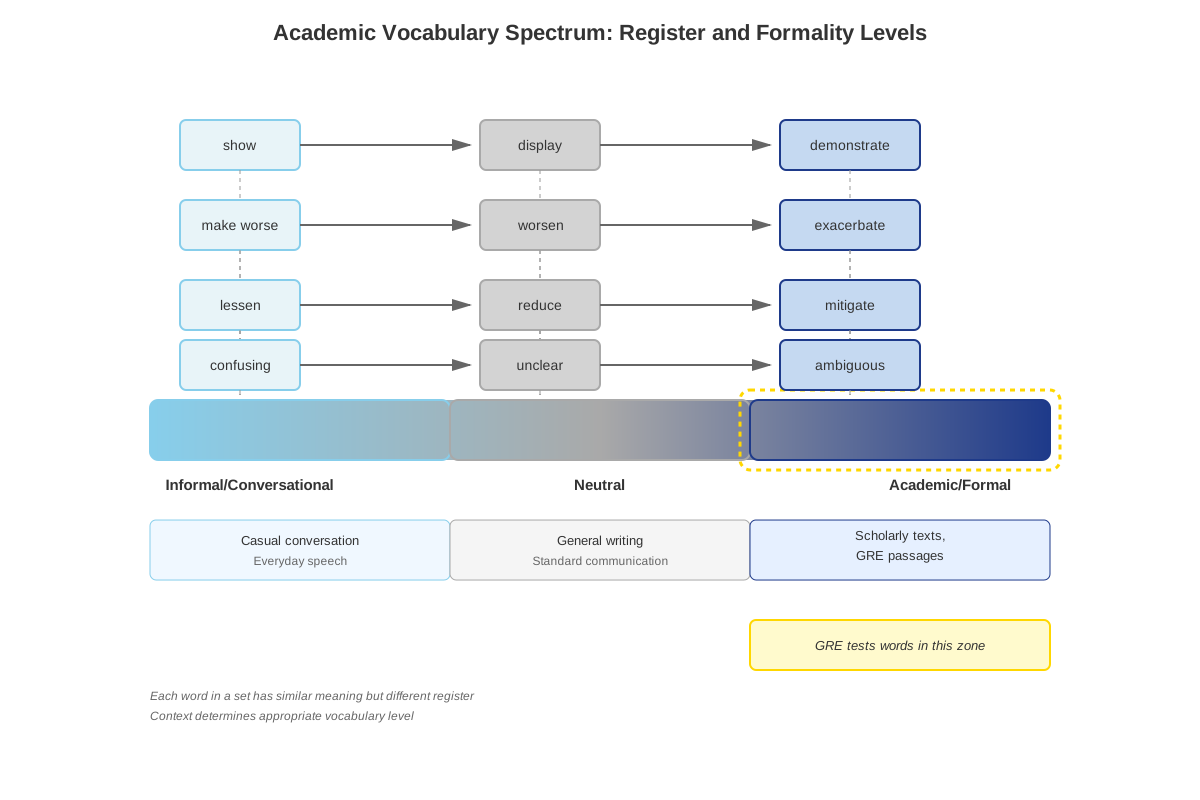
Understanding register—the level of formality appropriate to a context—is crucial for GRE success. Academic vocabulary represents a formal register, and the exam frequently tests whether students can distinguish between words of similar meaning but different formality levels. Consider these progressions from informal to formal:
| Informal | Neutral | Academic/Formal |
|---|---|---|
| get rid of | remove | eliminate |
| make up | create | fabricate |
| speed up | quicken | accelerate |
| make worse | worsen | exacerbate |
| show | display | demonstrate |
The GRE expects test-takers to select words matching the formal, academic register of the passage. A sentence discussing scientific research would use "demonstrate" rather than "show," even though both convey similar meanings. This sensitivity to register distinguishes strong verbal performers from weaker ones.
Word Families and Morphological Patterns
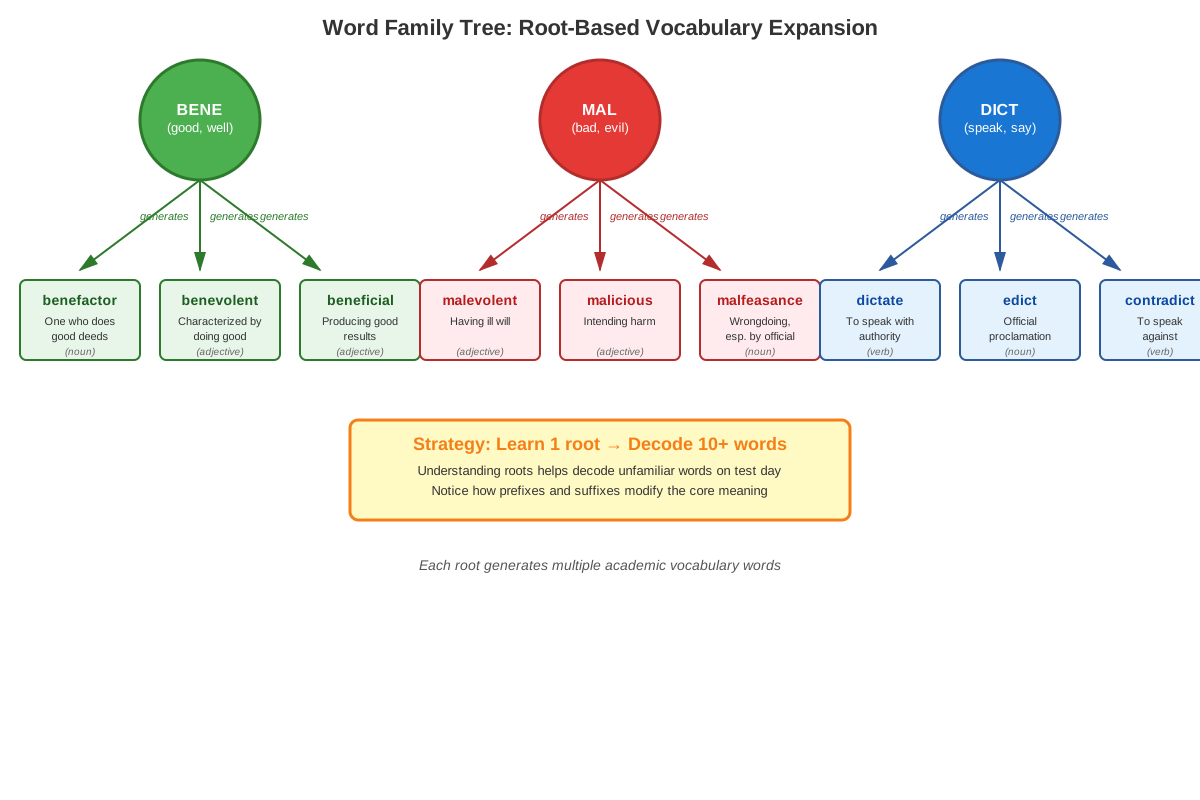
Academic vocabulary often appears in word families—groups of related words sharing a common root but functioning as different parts of speech. Recognizing these patterns enables students to leverage knowledge of one word to understand several others:
- Analyze (verb) → analysis (noun) → analytical (adjective) → analytically (adverb)
- Synthesize (verb) → synthesis (noun) → synthetic (adjective)
- Emphasize (verb) → emphasis (noun) → emphatic (adjective)
Understanding morphological patterns—how prefixes, roots, and suffixes combine—unlocks hundreds of academic words. Common academic prefixes include:
- Pre- (before): precede, prerequisite, preempt
- Post- (after): posthumous, posterior, postulate
- Circum- (around): circumvent, circumscribe, circumstantial
- Sub- (under): subordinate, subvert, subtle
- Super-/Sur- (above): superfluous, surpass, surmount
Common academic roots include:
- -ced-/-ceed-/-cess- (go): precede, proceed, succession
- -duc-/-duct- (lead): conducive, deductive, induce
- -fac-/-fic-/-fect- (make/do): facilitate, proficient, effect
- -scrib-/-script- (write): prescribe, manuscript, inscription
Connotation and Precision
Academic vocabulary demands attention to connotation—the emotional or evaluative associations a word carries beyond its literal definition. The GRE frequently presents answer choices with similar denotations (dictionary definitions) but different connotations. Consider:
- Frugal (positive: wisely economical) vs. miserly (negative: stingily cheap)
- Confident (positive: self-assured) vs. arrogant (negative: excessively proud)
- Meticulous (positive: carefully thorough) vs. pedantic (negative: overly concerned with details)
Academic writing values precision, so the GRE tests whether students can select words that capture exact shades of meaning. A scientist who carefully checks results is "meticulous," not "pedantic." A theory that applies broadly is "comprehensive," not merely "big." This precision distinguishes academic vocabulary from looser conversational language.
Context-Dependent Meanings
Many academic words carry different meanings across disciplines, and the GRE tests whether students can determine the appropriate meaning from context. Consider "significant":
- In statistics: "The results were statistically significant" (unlikely due to chance)
- In general academic use: "The discovery had significant implications" (important, meaningful)
Similarly, "theory" means something different in scientific contexts (well-supported explanation) versus casual usage (speculation). The exam expects students to recognize these context-dependent meanings and select answers accordingly.
High-Frequency Academic Word Categories
Certain categories of academic vocabulary appear with exceptional frequency on the GRE:
1. Words describing arguments and reasoning: substantiate, corroborate, refute, undermine, bolster, validate, contradict, reconcile
2. Words describing change and causation: precipitate, catalyst, mitigate, exacerbate, ameliorate, engender, forestall, impede
3. Words describing abundance and scarcity: copious, profuse, sparse, paucity, plethora, dearth, abundant, meager
4. Words describing attitudes and dispositions: ambivalent, indifferent, zealous, apathetic, fervent, reticent, candid, circumspect
5. Words describing complexity and clarity: convoluted, lucid, opaque, transparent, nuanced, unequivocal, ambiguous, explicit
Concept Relationships
Academic vocabulary knowledge forms the foundation for all other Verbal Reasoning skills. Without understanding the words in a passage, students cannot comprehend the author's argument (Reading Comprehension), cannot select appropriate words to complete sentences (Text Completion), and cannot identify synonymous terms (Sentence Equivalence). This foundational relationship means that vocabulary deficits create cascading problems across all verbal question types.
Within the topic itself, concepts connect hierarchically: understanding register and formality enables students to distinguish between similar words → recognizing word families and morphological patterns allows students to decode unfamiliar terms → appreciating connotation and precision helps students select the most accurate answer → recognizing context-dependent meanings prevents misapplication of known vocabulary.
The relationship map flows as follows:
Basic vocabulary knowledge → Academic vocabulary recognition → Register awareness → Morphological analysis → Connotation sensitivity → Context-based meaning determination → Accurate answer selection
This progression also connects to prerequisite topics: parts of speech knowledge enables recognition of word families, reading comprehension skills facilitate context-based meaning determination, and root/prefix/suffix familiarity supports morphological analysis. Together, these interconnected skills create comprehensive vocabulary mastery.
High-Yield Facts
⭐ Academic vocabulary appears in approximately 40-50% of GRE Verbal questions directly and influences comprehension in nearly 100% of questions.
⭐ The GRE tests approximately 1,000-1,500 high-frequency academic words repeatedly across multiple exams.
⭐ Words with similar meanings but different connotations (positive vs. negative) appear frequently as trap answers.
⭐ Understanding common Latin and Greek roots enables students to decode 60-70% of unfamiliar academic vocabulary.
⭐ Academic vocabulary maintains a formal register; informal synonyms are almost never correct answers in Text Completion or Sentence Equivalence questions.
- Academic vocabulary differs from technical jargon by being discipline-neutral and broadly applicable across fields.
- The GRE favors words that appear in academic journals, research papers, and scholarly books rather than specialized technical terms.
- Word families allow one learned word to unlock 3-5 related terms across different parts of speech.
- Context clues in GRE sentences almost always provide sufficient information to determine the correct academic vocabulary word, even if the word is unfamiliar.
- Academic vocabulary words often have multiple meanings; the GRE tests whether students can identify the contextually appropriate definition.
- Prefixes like "bene-" (good), "mal-" (bad), "eu-" (good), and "dys-" (bad) immediately signal positive or negative connotations.
- The GRE rarely tests archaic or obsolete vocabulary; nearly all tested words appear in contemporary academic writing.
Quick check — test yourself on Academic vocabulary so far.
Try Flashcards →Common Misconceptions
Misconception: Academic vocabulary consists of the most obscure, rarely-used words possible. → Correction: The GRE focuses on high-frequency academic words that appear regularly in scholarly writing across disciplines. Words like "ubiquitous," "paradigm," and "empirical" are common in graduate-level texts, not obscure.
Misconception: Memorizing dictionary definitions is sufficient for GRE vocabulary success. → Correction: Understanding connotation, register, and contextual usage is equally important. Knowing that "frugal" means "economical" isn't enough; students must recognize it carries a positive connotation unlike "cheap" or "miserly."
Misconception: If two words have similar meanings, they're interchangeable on the GRE. → Correction: The GRE tests precise word choice. "Mitigate" (make less severe) and "eliminate" (remove completely) both involve reduction, but they're not synonymous and cannot be used interchangeably.
Misconception: Academic vocabulary is discipline-specific, so students should focus only on vocabulary from their intended field of study. → Correction: The GRE deliberately tests cross-disciplinary academic vocabulary that all graduate students need. Passages span sciences, humanities, and social sciences, requiring broad vocabulary knowledge.
Misconception: Native English speakers don't need to study academic vocabulary because they already know these words. → Correction: Academic vocabulary differs significantly from conversational English. Many native speakers have passive recognition of these words but lack the precise understanding needed for GRE-level usage.
Misconception: Learning vocabulary in isolation (flashcards only) is the most efficient study method. → Correction: While flashcards help, encountering words in context through reading academic texts reinforces understanding of usage, connotation, and register more effectively than isolated memorization.
Misconception: If a word has multiple meanings, the GRE question will be ambiguous. → Correction: The GRE always provides sufficient context to determine which meaning applies. Students must read carefully and use context clues rather than assuming the first definition they know is correct.
Worked Examples
Example 1: Text Completion with Academic Vocabulary
Question: The researcher's methodology was _________; she left no variable unexamined and documented every procedural step with painstaking thoroughness.
(A) haphazard
(B) meticulous
(C) innovative
(D) superficial
(E) expedient
Solution Process:
Step 1: Identify context clues. The sentence describes someone who "left no variable unexamined" and "documented every procedural step with painstaking thoroughness." These phrases indicate extreme carefulness and attention to detail.
Step 2: Predict a word before looking at choices. The blank needs a word meaning "extremely careful and thorough." Possible predictions: careful, thorough, detailed, precise.
Step 3: Evaluate each choice against the context:
- (A) haphazard means random or lacking organization—opposite of what the context describes. Eliminate.
- (B) meticulous means showing great attention to detail, extremely careful—perfect match for the context.
- (C) innovative means introducing new ideas—doesn't address the thoroughness described. Eliminate.
- (D) superficial means lacking depth—opposite of the described behavior. Eliminate.
- (E) expedient means convenient or practical—doesn't capture the thoroughness. Eliminate.
Step 4: Verify the answer. "The researcher's methodology was meticulous" perfectly captures the extreme carefulness described in the rest of the sentence.
Answer: (B) meticulous
Connection to Learning Objectives: This example demonstrates identifying when academic vocabulary is tested (recognizing that the blank requires a formal, precise term), applying the core strategy (using context clues to predict meaning before evaluating choices), and applying academic vocabulary accurately (selecting the word with the appropriate connotation and register).
Example 2: Sentence Equivalence with Connotation Awareness
Question: The politician's speech was so _________ that audience members from opposing parties found themselves agreeing with her proposals.
Select two answer choices that, when used to complete the sentence, fit the meaning of the sentence as a whole and produce completed sentences that are alike in meaning.
(A) persuasive
(B) verbose
(C) compelling
(D) contentious
(E) eloquent
(F) dogmatic
Solution Process:
Step 1: Analyze the context. The speech caused people who normally disagree to agree with the proposals. This indicates the speech was highly effective and convincing.
Step 2: Predict synonymous words. The blank needs words meaning "convincing" or "effective at persuading." The words must be synonymous with each other.
Step 3: Evaluate each choice:
- (A) persuasive means effective at convincing others—fits the context perfectly.
- (B) verbose means using too many words—doesn't explain why people agreed. Eliminate.
- (C) compelling means powerfully convincing—fits the context and is synonymous with persuasive.
- (D) contentious means causing disagreement—opposite of what the context describes. Eliminate.
- (E) eloquent means fluent and articulate—describes speaking style but doesn't necessarily mean convincing. Close, but not synonymous with persuasive/compelling.
- (F) dogmatic means asserting opinions as facts without evidence—would likely cause disagreement, not agreement. Eliminate.
Step 4: Verify the pair. "Persuasive" and "compelling" are near-synonyms both meaning "convincing and effective," and both fit the context of causing agreement.
Answer: (A) persuasive and (C) compelling
Connection to Learning Objectives: This example shows identifying when academic vocabulary is tested (recognizing the need for formal synonyms), explaining the core strategy (finding two words that are synonymous and fit the context), and applying vocabulary accurately (distinguishing between similar words like "eloquent" and "persuasive" based on precise meaning).
Exam Strategy
Approaching Academic Vocabulary Questions
Step 1: Read for context first. Never look at answer choices before reading the entire sentence or passage. Context clues almost always indicate the type of word needed (positive/negative, degree of intensity, specific meaning).
Step 2: Make a prediction. Before examining answer choices, predict what type of word fits the blank. This prediction doesn't need to be sophisticated—"something positive about being careful" is sufficient. This prevents answer choices from biasing your thinking.
Step 3: Eliminate based on register. Remove any answer choices that are too informal for academic writing. If the passage discusses scientific research, eliminate conversational words like "get rid of" in favor of academic terms like "eliminate."
Step 4: Eliminate based on connotation. If context indicates a positive situation, eliminate words with negative connotations, and vice versa. Pay special attention to words that seem similar but carry different emotional weight.
Step 5: Check for precision. Among remaining choices, select the word that most precisely matches the context. The GRE rewards exactness—"mitigate" (reduce severity) is more precise than "change" (alter in any way) when discussing reducing negative effects.
Trigger Words and Phrases
Watch for these context clues that signal specific vocabulary needs:
- Contrast indicators ("however," "although," "despite"): The blank will contrast with another part of the sentence, often requiring a word with opposite connotation.
- Support indicators ("furthermore," "indeed," "because"): The blank will reinforce or explain another part of the sentence.
- Degree modifiers ("extremely," "somewhat," "barely"): These indicate the intensity of the word needed.
- Comparison structures ("more than," "less than," "as...as"): These signal relative relationships.
Time Allocation
Spend approximately 1-1.5 minutes per Text Completion or Sentence Equivalence question. If you don't know a vocabulary word, use the following process-of-elimination strategy:
- Eliminate words you know are wrong (15 seconds)
- Use root/prefix/suffix analysis on unfamiliar words (15 seconds)
- Make an educated guess from remaining choices (5 seconds)
- Move on—don't waste time agonizing over unknown words
For Reading Comprehension passages with challenging vocabulary, don't stop to analyze every difficult word. Focus on understanding the overall argument; specific vocabulary questions will direct you back to relevant sections.
Memory Techniques
Root-Based Mnemonics
Create mental connections between roots and their meanings:
- -bene- (good): Remember "benefit" = good result. Apply to: benevolent, benign, benefactor
- -mal- (bad): Remember "malfunction" = bad function. Apply to: malicious, malady, malevolent
- -cred- (believe): Remember "credit" = belief in repayment. Apply to: credible, incredulous, credulity
Connotation Visualization
For words with similar meanings but different connotations, create vivid mental images:
- Frugal (positive): Visualize a wise person carefully budgeting for important goals
- Miserly (negative): Visualize Scrooge hoarding money and refusing to help others
- Economical (neutral): Visualize a simple price comparison chart
Word Family Trees
Draw mental "family trees" connecting related words:
                    ANALYZE (verb)
                        |
        +---------------+---------------+
        |               |               |
    ANALYSIS        ANALYTICAL      ANALYTICALLY
     (noun)         (adjective)       (adverb)
Acronym for Question Approach
PRICE strategy for vocabulary questions:
- Predict before looking at choices
- Register check (formal vs. informal)
- Intensity match (degree of strength)
- Connotation awareness (positive/negative)
- Eliminate and verify
Contextual Sentence Creation
For each new academic word, create a memorable sentence using vivid imagery:
- Ubiquitous: "Smartphones are ubiquitous—I see them everywhere, even at my grandmother's house."
- Ephemeral: "Morning dew is ephemeral, disappearing as soon as the sun rises."
- Pragmatic: "My pragmatic friend always chooses the most practical solution, not the most exciting one."
Summary
Academic vocabulary mastery is essential for GRE Verbal Reasoning success, as these sophisticated, formal words appear throughout Text Completion, Sentence Equivalence, and Reading Comprehension questions. Unlike everyday conversational language, academic vocabulary represents the precise, nuanced terminology used in scholarly writing across disciplines. Success requires understanding not just definitions but also register (formality level), connotation (positive/negative associations), and context-dependent meanings. The most effective approach combines morphological analysis (breaking words into roots, prefixes, and suffixes) with contextual reading strategies. Students should focus on high-frequency academic words that appear across multiple disciplines rather than specialized jargon. By recognizing word families, understanding subtle distinctions between similar terms, and consistently applying systematic elimination strategies, test-takers can accurately answer vocabulary questions even when encountering unfamiliar words. The key is developing sensitivity to the precise, formal language that characterizes academic discourse.
Key Takeaways
- Academic vocabulary consists of formal, discipline-neutral words that appear frequently in scholarly writing across all fields, not obscure or archaic terms.
- Understanding connotation, register, and precise meaning distinctions is as important as knowing basic definitions for GRE success.
- Morphological analysis—breaking words into roots, prefixes, and suffixes—enables students to decode 60-70% of unfamiliar academic vocabulary.
- Context clues in GRE sentences always provide sufficient information to determine the correct answer; systematic reading and prediction before examining choices improves accuracy.
- The GRE tests approximately 1,000-1,500 high-frequency academic words repeatedly; focused study of these words yields high returns.
- Word families allow efficient learning—mastering one word unlocks 3-5 related terms across different parts of speech.
- Eliminating answers based on register (formality), connotation (positive/negative), and precision (exact vs. approximate meaning) is more effective than relying solely on recognition.
Related Topics
Context Clues and Inference: Building on academic vocabulary knowledge, this topic teaches systematic strategies for determining word meanings from surrounding text, even when the specific word is unfamiliar. Mastering academic vocabulary provides the foundation for recognizing when inference is necessary.
Sentence Equivalence Strategies: This topic applies academic vocabulary knowledge specifically to questions requiring identification of synonymous terms. Strong vocabulary knowledge makes synonym recognition more efficient and accurate.
Text Completion Multi-Blank Questions: Advanced application of academic vocabulary to complex sentences with multiple blanks, requiring understanding of how words relate to each other within sophisticated sentence structures.
Reading Comprehension in Scientific Passages: Academic vocabulary from scientific contexts (hypothesis, empirical, anomaly, catalyst) appears frequently in these passages. Vocabulary mastery enables faster, more accurate comprehension.
Word Roots, Prefixes, and Suffixes: Deeper exploration of morphological analysis techniques that support academic vocabulary acquisition and enable decoding of unfamiliar terms during the exam.
Practice CTA
Now that you've mastered the core concepts of academic vocabulary, it's time to apply this knowledge through targeted practice. Complete the practice questions to test your ability to identify, analyze, and apply academic vocabulary in GRE-style contexts. Use the flashcards to reinforce high-frequency academic words and their precise meanings, connotations, and usage patterns. Remember: vocabulary mastery develops through repeated exposure and application, not passive review. Each practice question you complete strengthens your ability to recognize patterns and make accurate selections under timed conditions. Your investment in vocabulary study now will pay dividends across every section of the GRE Verbal Reasoning test. Start practicing today!
Sign up free to keep reading
Create a free AnvayaPrep account to finish this GRE guide on Academic vocabulary — plus flashcards and practice questions.