Overview
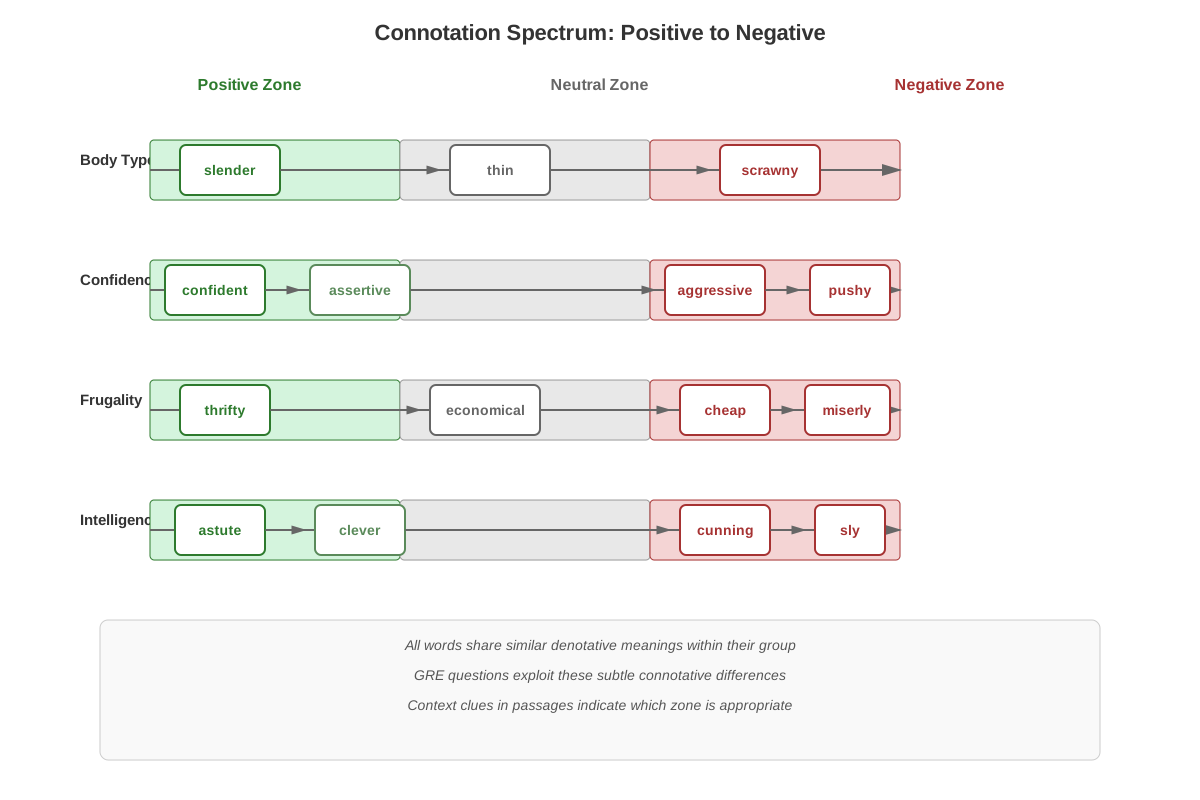
Understanding positive connotation is fundamental to success on the GRE Verbal Reasoning section. Connotation refers to the emotional, cultural, or associative meaning that a word carries beyond its literal dictionary definition (denotation). A positive connotation indicates that a word evokes favorable, pleasant, or desirable associations in the reader's mind. For example, while "slender" and "scrawny" both describe a thin physique, "slender" carries positive associations of elegance and grace, whereas "scrawny" suggests unhealthy weakness.
The GRE consistently tests students' ability to recognize subtle differences in connotation across vocabulary questions, text completion items, and sentence equivalence problems. Test-makers deliberately include answer choices with similar denotative meanings but vastly different connotative values. A student who selects a word based solely on its dictionary definition without considering its emotional tone will frequently choose incorrect answers. Mastering gre positive connotation recognition enables test-takers to eliminate trap answers and select words that match both the logical meaning and emotional tone of a passage.
This topic sits at the intersection of vocabulary knowledge, contextual analysis, and tone recognition within the Verbal Reasoning framework. Understanding positive connotation connects directly to broader skills in identifying author attitude, analyzing rhetorical choices, and interpreting nuanced language in reading comprehension passages. Students who excel at recognizing connotation demonstrate sophisticated reading skills that extend beyond surface-level comprehension to capture the subtle emotional layers that distinguish advanced writing.
Learning Objectives
- [ ] Identify when Positive connotation is being tested in GRE questions
- [ ] Explain the core rule or strategy behind Positive connotation
- [ ] Apply Positive connotation to GRE-style questions accurately
- [ ] Distinguish between words with similar denotations but different connotative values
- [ ] Analyze passage context to determine whether positive, negative, or neutral connotation is required
- [ ] Evaluate answer choices by comparing their connotative intensity and emotional direction
Prerequisites
- Basic vocabulary knowledge: Understanding dictionary definitions provides the foundation upon which connotative meanings are built; students must know what words mean literally before analyzing their emotional associations.
- Reading comprehension skills: The ability to extract main ideas and understand context is essential because connotation depends heavily on surrounding textual clues.
- Understanding of tone and mood: Recognizing whether a passage is optimistic, critical, neutral, or celebratory helps determine which connotative values are appropriate.
Why This Topic Matters
In professional and academic contexts, word choice communicates not just information but also attitude, bias, and perspective. Writers select words with specific connotations to persuade, inspire, criticize, or inform their audiences. Understanding these nuances enables readers to detect subtle arguments, identify author bias, and interpret sophisticated texts accurately—skills essential for graduate-level academic work.
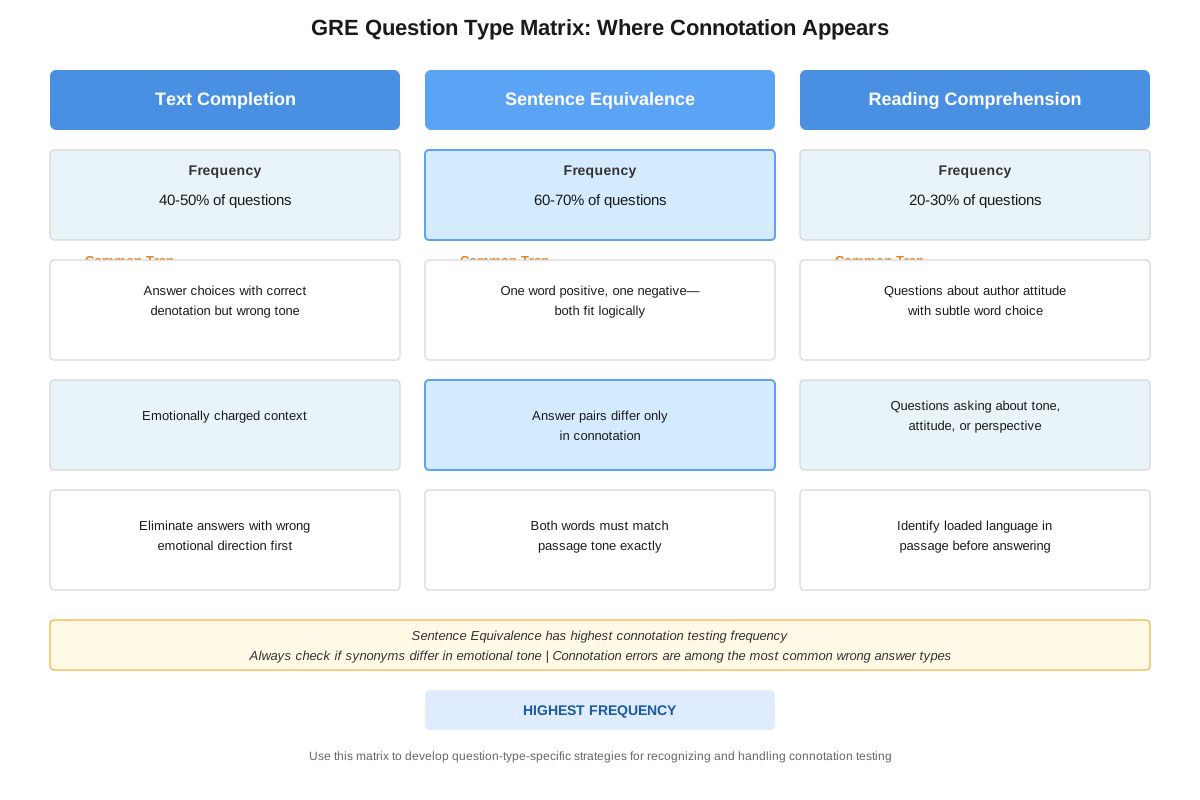
On the GRE specifically, connotation appears in approximately 30-40% of Verbal Reasoning questions across multiple question types. Text Completion questions frequently include answer choices that are semantically similar but connotatively distinct. Sentence Equivalence questions require selecting two words that produce sentences with equivalent meaning and tone, making connotation recognition essential. Reading Comprehension questions about author attitude, tone, or purpose depend on recognizing the connotative values of key words in passages.
The GRE tests positive connotation through several common patterns: questions asking students to complete sentences describing achievements, innovations, or admirable qualities; passages discussing successful individuals, beneficial developments, or praiseworthy actions; and vocabulary questions where the correct answer must match an approving or optimistic tone established in the sentence. Recognizing these patterns helps students anticipate when connotation analysis will be critical.
Core Concepts
Defining Positive Connotation
Positive connotation refers to the favorable emotional associations, pleasant imagery, or desirable qualities that a word evokes beyond its literal meaning. These associations develop through cultural usage, personal experience, and contextual patterns in language. Words with positive connotations make readers feel good, suggest approval, or imply beneficial qualities.
Consider the word "home" versus "house." Both refer to a dwelling, but "home" carries positive connotations of warmth, family, belonging, and comfort, while "house" is more neutral, referring simply to a physical structure. Similarly, "aroma" suggests a pleasant smell (positive), while "odor" often implies something unpleasant (negative), even though both denote a smell.
The Connotation Spectrum
Words exist along a spectrum from strongly negative to strongly positive, with neutral terms in the middle. Understanding this spectrum helps test-takers select words with appropriate intensity:
| Negative Connotation | Neutral | Positive Connotation |
|---|---|---|
| stubborn | determined | resolute |
| cheap | inexpensive | economical |
| pushy | assertive | confident |
| old | aged | vintage |
| childish | youthful | childlike |
The GRE exploits this spectrum by offering answer choices at different points along it. A passage describing someone favorably requires a word from the positive end, even if a neutral or negative synonym has the correct denotation.
Context as the Determining Factor
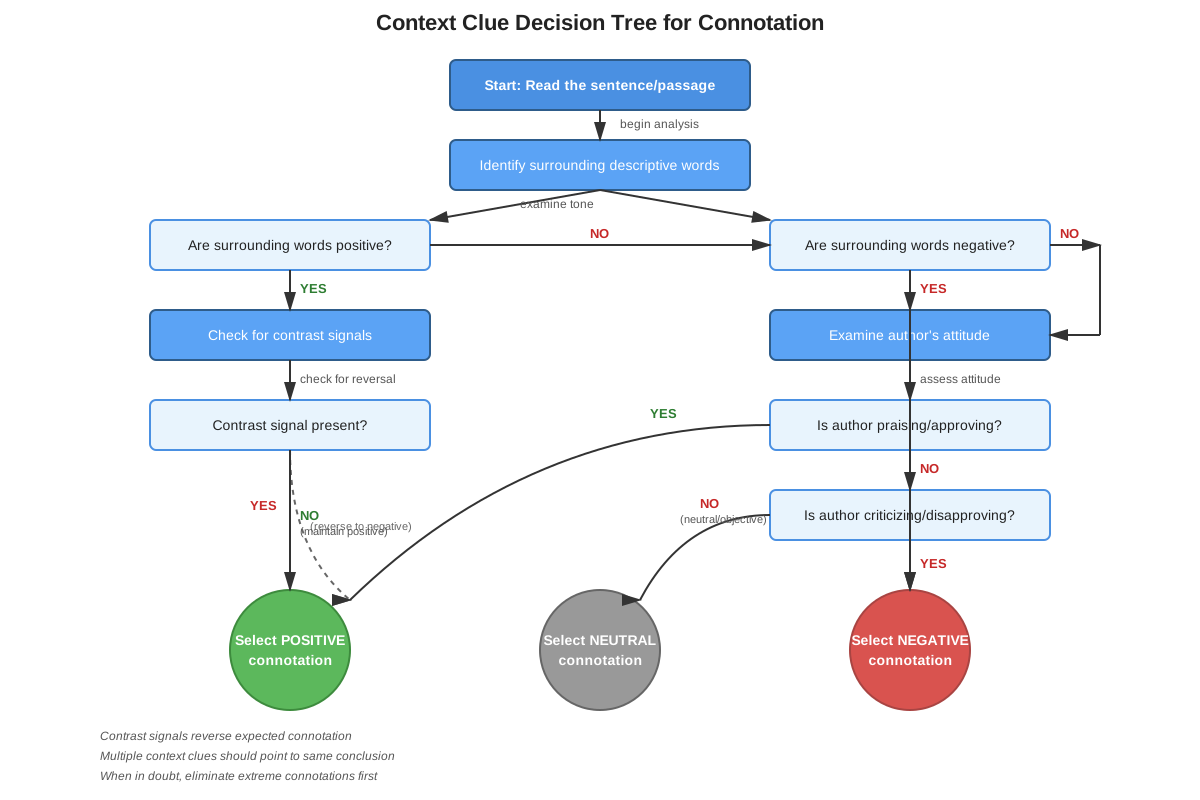
Context provides the critical clues for determining which connotation is appropriate. Several contextual elements signal whether positive connotation is required:
Descriptive modifiers: Adjectives and adverbs surrounding a blank often indicate tone. Phrases like "admirably," "fortunately," "impressive," or "beneficial" signal that positive connotation is needed.
Subject matter: Sentences describing achievements, solutions, improvements, or praiseworthy individuals typically require positively connotated words.
Contrast indicators: Words like "although," "despite," "however," and "while" often signal that the blank requires a word with connotation opposite to another part of the sentence.
Parallel structure: When sentences contain lists or parallel constructions, the connotation should remain consistent across elements unless contrast is explicitly indicated.
Intensity Matching
Beyond simply being positive, words vary in the intensity of their positive connotation. "Good" is mildly positive, "excellent" is strongly positive, and "transcendent" is extremely positive. The GRE tests whether students can match intensity to context:
- Mild positive: pleasant, nice, adequate, satisfactory, decent
- Moderate positive: good, beneficial, helpful, favorable, commendable
- Strong positive: excellent, outstanding, exemplary, remarkable, exceptional
- Extreme positive: sublime, transcendent, unparalleled, magnificent, superlative
Selecting a word with excessive intensity for a mild context (or insufficient intensity for an emphatic context) results in an incorrect answer, even if the connotation direction is correct.
Cultural and Domain-Specific Connotations
Some words carry positive connotations in specific contexts but neutral or negative connotations elsewhere. "Aggressive" has negative connotations in social contexts but can be positive in business contexts ("aggressive marketing strategy"). "Clinical" is positive in medical contexts (suggesting precision and professionalism) but negative when describing personal interactions (suggesting coldness).
The GRE typically uses words with broadly recognized connotations rather than highly context-dependent ones, but awareness of this variability helps students avoid overgeneralizing.
Connotation Versus Denotation
The distinction between denotation (literal dictionary meaning) and connotation (emotional associations) is central to GRE success. Many incorrect answer choices have correct denotations but wrong connotations. For example:
- Denotation: Both "frugal" and "stingy" mean "unwilling to spend money"
- Connotation: "Frugal" is positive (suggesting wise financial management), while "stingy" is negative (suggesting selfishness)
Students must train themselves to evaluate both dimensions when analyzing answer choices.
Concept Relationships
Positive connotation connects intimately with several other verbal reasoning concepts. Understanding tone (the author's attitude toward the subject) requires recognizing connotation, as tone is largely conveyed through word choice. An author using positively connotated words reveals approval or admiration, while negatively connotated words suggest criticism or disapproval.
Context clues provide the evidence needed to determine appropriate connotation. Students must identify these clues before evaluating answer choices. The relationship flows: Context clues → Determine required tone → Select appropriate connotation → Evaluate answer choices.
Vocabulary knowledge forms the foundation: students cannot recognize positive connotation in unfamiliar words. However, connotation analysis can sometimes help deduce word meanings. If context clearly requires positive connotation and only one answer choice "sounds" positive, that provides a clue even without knowing the precise definition.
Sentence equivalence questions explicitly test connotation by requiring two words that create equivalent meaning and tone. Students must match both denotation and connotation across their two selections.
The relationship map: Vocabulary knowledge → Enables connotation recognition → Informed by context clues → Determines appropriate tone → Guides answer selection → Ensures sentence equivalence (when applicable).
High-Yield Facts
- ⭐ Positive connotation refers to favorable emotional associations beyond literal meaning, not just "happy" words
- ⭐ Context clues (descriptive modifiers, subject matter, contrast indicators) determine which connotation is appropriate
- ⭐ Words with identical denotations can have opposite connotations (e.g., "slender" vs. "scrawny")
- ⭐ Intensity matching is critical—the strength of positive connotation must fit the context
- ⭐ Sentence Equivalence questions require matching both denotation AND connotation in both answer choices
- Connotation exists on a spectrum from strongly negative through neutral to strongly positive
- The GRE frequently uses connotation to create trap answers with correct denotations but wrong tone
- Approximately 30-40% of Verbal Reasoning questions involve connotation analysis
- Cultural context can shift connotation, but the GRE uses broadly recognized associations
- Reading the entire sentence before evaluating answer choices prevents connotation mismatches
- Parallel structure in sentences typically requires consistent connotation across elements
- Author attitude questions in Reading Comprehension depend heavily on recognizing connotation in key words
Quick check — test yourself on Positive connotation so far.
Try Flashcards →Common Misconceptions
Misconception: Positive connotation simply means "happy" or "cheerful" words.
Correction: Positive connotation encompasses any favorable association—words suggesting competence, wisdom, beauty, strength, or value all carry positive connotation without necessarily implying happiness. "Formidable" and "austere" can be positive in appropriate contexts despite not being cheerful.
Misconception: If a word's dictionary definition fits the sentence, it's the correct answer.
Correction: The GRE deliberately includes answer choices with correct denotations but inappropriate connotations. Students must evaluate both dimensions. A word can be definitionally correct but tonally wrong.
Misconception: Connotation is subjective and varies too much between individuals to be tested reliably.
Correction: While personal associations exist, words have broadly recognized cultural connotations that are consistent across educated English speakers. The GRE tests these shared associations, not idiosyncratic personal reactions.
Misconception: Neutral words are always safer choices than strongly connotated words.
Correction: When context clearly establishes a positive or negative tone, neutral words are incorrect because they fail to match the required emotional direction. The correct answer matches the context's connotative requirements.
Misconception: Formal or sophisticated vocabulary automatically carries positive connotation.
Correction: Vocabulary level is independent of connotation. Sophisticated words can be negative ("execrable," "mendacious"), neutral ("ubiquitous," "temporal"), or positive ("exemplary," "laudable"). Students must learn each word's specific connotative value.
Misconception: In Sentence Equivalence, any two synonyms will work as long as they have similar meanings.
Correction: The two correct answers must match in both denotation and connotation. Two words might be synonyms but carry different connotative values, making them incorrect as a pair even though each might work individually in other contexts.
Worked Examples
Example 1: Text Completion
Question: The scientist's approach to research was remarkably \_\_\_\_\_; she pursued even the most challenging problems with unwavering dedication and enthusiasm.
(A) obstinate
(B) tenacious
(C) stubborn
(D) persistent
(E) dogged
Solution:
Step 1: Analyze context for tone
The sentence describes the scientist positively ("remarkably," "unwavering dedication and enthusiasm"). The blank requires a word with positive connotation.
Step 2: Evaluate denotations
All five words share similar denotations—they all mean "refusing to give up" or "continuing despite difficulty."
Step 3: Evaluate connotations
- (A) "obstinate" = negative (suggests unreasonable refusal to change)
- (B) "tenacious" = positive (suggests admirable persistence)
- (C) "stubborn" = negative (suggests inflexibility and unreasonableness)
- (D) "persistent" = neutral to slightly positive (factual description)
- (E) "dogged" = neutral to slightly negative (suggests plodding determination)
Step 4: Match intensity
The word "remarkably" suggests the quality is notably positive, requiring a strongly positive word rather than merely neutral.
Answer: (B) tenacious
This example demonstrates how the GRE uses synonyms with different connotations as trap answers. Students focusing only on denotation might select any of these options, but only "tenacious" matches both the meaning and the positive tone established by context.
Example 2: Sentence Equivalence
Question: The chef's \_\_\_\_\_ use of spices transformed ordinary ingredients into memorable culinary experiences.
Select two answer choices that, when used to complete the sentence, fit the meaning of the sentence as a whole and produce completed sentences that are alike in meaning.
(A) excessive
(B) skillful
(C) liberal
(D) adept
(E) profuse
(F) lavish
Solution:
Step 1: Analyze context
The sentence describes a positive outcome ("transformed," "memorable culinary experiences"), indicating that the chef's spice use was good, not problematic.
Step 2: Identify required connotation
Positive connotation is required to match the favorable outcome.
Step 3: Evaluate each choice
- (A) "excessive" = negative (too much, overdone)
- (B) "skillful" = positive (demonstrating expertise)
- (C) "liberal" = neutral to slightly negative in this context (generous but possibly too much)
- (D) "adept" = positive (demonstrating expertise)
- (E) "profuse" = neutral to negative (abundant, possibly excessive)
- (F) "lavish" = neutral to slightly negative in this context (very generous, possibly wasteful)
Step 4: Match meaning and connotation
Both (B) "skillful" and (D) "adept" are positive words suggesting expertise and competence. They create sentences with equivalent meaning and tone.
Answer: (B) and (D)
This example shows how Sentence Equivalence questions require matching both denotation and connotation. Options (C), (E), and (F) all suggest generous use of spices (similar denotation to each other) but lack the clearly positive connotation needed to match the favorable outcome described.
Exam Strategy
When approaching GRE questions involving connotation, follow this systematic process:
Step 1: Read the entire sentence or passage before looking at answer choices. This prevents premature commitment to an answer and ensures full understanding of context.
Step 2: Identify tone indicators in the context. Look for:
- Descriptive adjectives and adverbs
- Words indicating success, failure, improvement, or decline
- Contrast words (however, although, despite)
- Parallel structures suggesting consistent tone
Step 3: Determine the required connotation direction and intensity. Decide whether the blank needs positive, negative, or neutral connotation, and how strong that connotation should be.
Step 4: Evaluate answer choices for both denotation and connotation. Eliminate choices with wrong meanings first, then eliminate choices with correct meanings but inappropriate connotations.
Step 5: For Sentence Equivalence, verify that both selected answers match in connotation, not just denotation.
Exam Tip: When stuck between two answers with similar meanings, read each aloud in the sentence. The one that "sounds right" often has the appropriate connotation, as native speakers have intuitive sense of connotative appropriateness.
Trigger words for positive connotation:
- "fortunately," "admirably," "commendably," "impressively"
- "success," "achievement," "improvement," "innovation"
- "praised," "celebrated," "renowned," "esteemed"
- "beneficial," "valuable," "worthwhile," "productive"
Time allocation: Spend 10-15 seconds identifying context and tone before evaluating answer choices. This upfront investment prevents wasting time on choices with wrong connotations.
Process of elimination: First eliminate answers with incorrect denotations (wrong meaning), then eliminate answers with incorrect connotations (wrong tone). This two-stage process is more efficient than trying to find the "perfect" answer immediately.
Memory Techniques
The "Feeling Test" Mnemonic: When uncertain about connotation, ask "How would I feel if someone described ME with this word?" If you'd be pleased, it's positive; if offended, it's negative; if indifferent, it's neutral.
The Synonym Spectrum: Create mental lists of synonyms arranged from negative to positive:
- Negative → Neutral → Positive
- Stubborn → Determined → Resolute
- Cheap → Inexpensive → Economical
- Old → Aged → Vintage
The "Context Clue Hunt": Use the acronym DAMP to remember what to look for:
- Descriptive words (adjectives/adverbs)
- Attitude indicators (praise/criticism words)
- Modifiers (words that intensify or diminish)
- Parallel structures (consistent tone across elements)
Visualization Strategy: Picture the word being used in different contexts. "Aggressive" at a business meeting (positive: "aggressive growth strategy") versus at a family dinner (negative: "aggressive behavior"). This mental flexibility helps recognize context-dependent connotations.
The Intensity Scale: Visualize a thermometer with neutral at the middle, mild positive/negative near the middle, and extreme positive/negative at the ends. Place words along this scale to remember their intensity.
Summary
Positive connotation represents the favorable emotional associations and pleasant imagery that words evoke beyond their literal dictionary definitions. Success on the GRE Verbal Reasoning section requires recognizing that words with similar denotations can have vastly different connotations, and that context determines which connotation is appropriate. Students must analyze contextual clues—including descriptive modifiers, subject matter, contrast indicators, and parallel structures—to determine whether positive, negative, or neutral connotation is required. Beyond direction, intensity matching is critical; the strength of positive connotation must fit the context's requirements. The GRE systematically tests connotation through Text Completion, Sentence Equivalence, and Reading Comprehension questions, frequently using trap answers with correct denotations but inappropriate connotations. Mastering positive connotation requires building vocabulary knowledge, developing sensitivity to tone, and practicing systematic evaluation of both meaning and emotional associations in answer choices.
Key Takeaways
- Positive connotation refers to favorable emotional associations beyond literal meaning, tested in 30-40% of Verbal Reasoning questions
- Context clues (descriptive words, subject matter, contrast indicators) determine which connotation is appropriate
- Words with identical denotations can have opposite connotations, making connotation analysis essential for eliminating trap answers
- Both direction (positive/negative/neutral) and intensity (mild/moderate/strong) must match context requirements
- Sentence Equivalence questions require matching connotation and denotation in both selected answers
- Systematic evaluation—read context, identify tone, determine required connotation, evaluate choices—prevents errors
- The GRE uses broadly recognized cultural connotations, not idiosyncratic personal associations
Related Topics
Negative Connotation: Understanding unfavorable emotional associations completes the connotation spectrum and enables students to recognize when context requires words with negative tone. Mastering positive connotation provides the foundation for analyzing its opposite.
Neutral Tone and Objectivity: Some passages and sentences require neutral, unbiased language. Recognizing when to avoid connotated words is as important as knowing when to use them.
Author Attitude and Tone: Reading Comprehension questions frequently ask about author attitude, which is revealed primarily through connotation in word choice. Connotation analysis is the primary tool for answering these questions.
Rhetorical Strategies: Understanding how writers use connotation to persuade, inspire, or criticize connects to broader analysis of rhetorical techniques in passages.
Advanced Vocabulary Building: As vocabulary expands, students can make finer distinctions between words with similar meanings but different connotative values, improving accuracy on difficult questions.
Practice CTA
Now that you understand the principles of positive connotation, apply this knowledge to practice questions and flashcards. Focus on identifying context clues before evaluating answer choices, and consciously distinguish between denotation and connotation in each question. Regular practice with immediate feedback will develop the intuitive sense of connotative appropriateness that characterizes high-scoring test-takers. Remember: every question is an opportunity to refine your sensitivity to the subtle emotional dimensions of language that distinguish good writing from great writing—and correct answers from incorrect ones.
Sign up free to keep reading
Create a free AnvayaPrep account to finish this GRE guide on Positive connotation — plus flashcards and practice questions.