Overview
Understanding word roots is one of the most powerful strategies for conquering GRE Verbal Reasoning, particularly when facing unfamiliar vocabulary in Text Completion and Reading Comprehension questions. GRE word roots are the foundational building blocks of English words—typically derived from Latin and Greek—that carry core meanings and allow test-takers to decode the definitions of thousands of words they may never have encountered before. Rather than memorizing isolated vocabulary lists, mastering common roots, prefixes, and suffixes enables students to break down complex words into recognizable components and infer meaning through logical analysis.
The GRE frequently tests vocabulary that extends beyond everyday usage, presenting words that even well-read students may not recognize. However, the exam rarely uses completely obscure terminology; instead, it favors sophisticated academic vocabulary built from predictable root patterns. By learning approximately 50-100 high-frequency roots and understanding how they combine with common prefixes and suffixes, test-takers can dramatically expand their effective vocabulary from thousands of memorized words to tens of thousands of decodable terms. This approach is not only more efficient but also more reliable under test pressure, as it provides a systematic method for approaching unknown words rather than relying on rote recall.
Within the broader context of Verbal Reasoning, word roots serve as the foundation for understanding vocabulary and word relationships. They connect directly to analogy-style thinking (understanding how words relate to each other), context clue analysis (using surrounding text to confirm root-based inferences), and semantic precision (distinguishing between closely related terms). Mastery of word roots enhances performance across all Verbal question types, from selecting the precise word to complete a sentence to understanding nuanced arguments in complex passages.
Learning Objectives
- [ ] Identify when Word roots is being tested
- [ ] Explain the core rule or strategy behind Word roots
- [ ] Apply Word roots to GRE-style questions accurately
- [ ] Deconstruct unfamiliar words into component parts (prefix + root + suffix)
- [ ] Recognize at least 50 high-frequency roots and their meanings
- [ ] Combine knowledge of multiple roots to infer meanings of compound words
- [ ] Distinguish between words with similar roots but different meanings based on prefixes or suffixes
Prerequisites
- Basic English grammar and parts of speech: Understanding whether a word functions as a noun, verb, adjective, or adverb helps determine which suffix meanings apply and how roots combine.
- Familiarity with common prefixes and suffixes: Roots rarely appear in isolation; knowing that "un-" means "not" or "-tion" indicates a noun form is essential for complete word analysis.
- Context clue strategies: Root analysis works best when combined with the ability to use surrounding sentence structure and meaning to confirm or refine initial inferences.
- Basic Latin and Greek awareness: Recognizing that English academic vocabulary draws heavily from classical languages helps students understand why certain letter combinations and patterns recur.
Why This Topic Matters
In real-world academic and professional contexts, the ability to decode unfamiliar terminology is invaluable. Graduate-level coursework, research papers, legal documents, and technical writing all employ specialized vocabulary built from the same root patterns tested on the GRE. Students who master root analysis develop transferable skills that extend far beyond test preparation, enabling them to engage confidently with sophisticated texts across disciplines.
On the GRE specifically, word roots appear in approximately 60-70% of vocabulary-based questions. Text Completion questions frequently feature answer choices where multiple options seem plausible, but only one aligns with the precise meaning suggested by root analysis. Sentence Equivalence questions require identifying two words that create equivalent meanings, and roots often reveal subtle distinctions between near-synonyms. Reading Comprehension passages contain dense academic prose with specialized terminology that becomes accessible when students can break down unfamiliar words into recognizable components.
The exam particularly favors certain categories of roots: those related to speaking and communication (dict, loqu, voc), thinking and knowledge (cogn, sci, soph), movement and change (vert, mut, gress), and emotional or moral qualities (bene, mal, path). Questions may test roots directly by presenting an unfamiliar word in context, or indirectly by requiring students to distinguish between words that share roots but differ in prefixes or connotations. Understanding roots transforms vocabulary from a memorization challenge into a logical puzzle that rewards analytical thinking.
Core Concepts
What Are Word Roots?
A word root is the core morpheme (smallest unit of meaning) that carries the primary semantic content of a word. Unlike prefixes (which modify meaning and appear at the beginning) and suffixes (which often indicate grammatical function and appear at the end), roots provide the fundamental concept around which a word is built. Most academic English vocabulary derives from Latin and Greek roots, which combine in predictable patterns to create complex terms.
For example, the root "dict" means "to say or speak." This single root appears in dozens of English words: predict (to say beforehand), contradict (to speak against), dictate (to say with authority), dictionary (a book of words/sayings), and benediction (a good saying or blessing). By recognizing "dict" and understanding the prefixes and suffixes that accompany it, students can decode unfamiliar words like "malediction" (bad speaking; a curse) or "valediction" (a farewell saying) even if they've never encountered these terms before.
Categories of High-Frequency Roots
GRE word roots fall into several thematic categories that reflect the exam's focus on academic discourse:
| Category | Common Roots | Core Meaning | Example Words |
|---|---|---|---|
| Communication | dict, loqu/locut, voc/vok, claim/clam | speaking, calling | eloquent, advocate, proclaim, diction |
| Thinking/Knowledge | cogn, sci, soph, log | knowing, wisdom, reason | recognize, omniscient, philosophy, logic |
| Movement | vert/vers, gress/grad, ced/cess, duc/duct | turning, stepping, going, leading | convert, digress, proceed, conduct |
| Feeling/Emotion | path/pass, sent/sens, cord | feeling, sensing, heart | apathy, sentiment, discord |
| Good/Bad | bene, mal, eu, dys | good, bad, well, ill | benefit, malevolent, euphoria, dysfunctional |
| Size/Quantity | magn, min/micro, multi, omni | large, small, many, all | magnify, minimize, multitude, omnipresent |
| Life/Death | viv/vit, mort, bio | living, death, life | vivacious, mortal, biology |
| Time | chron, temp, ann/enn | time, time, year | chronological, temporary, annual |
How Roots Combine with Affixes
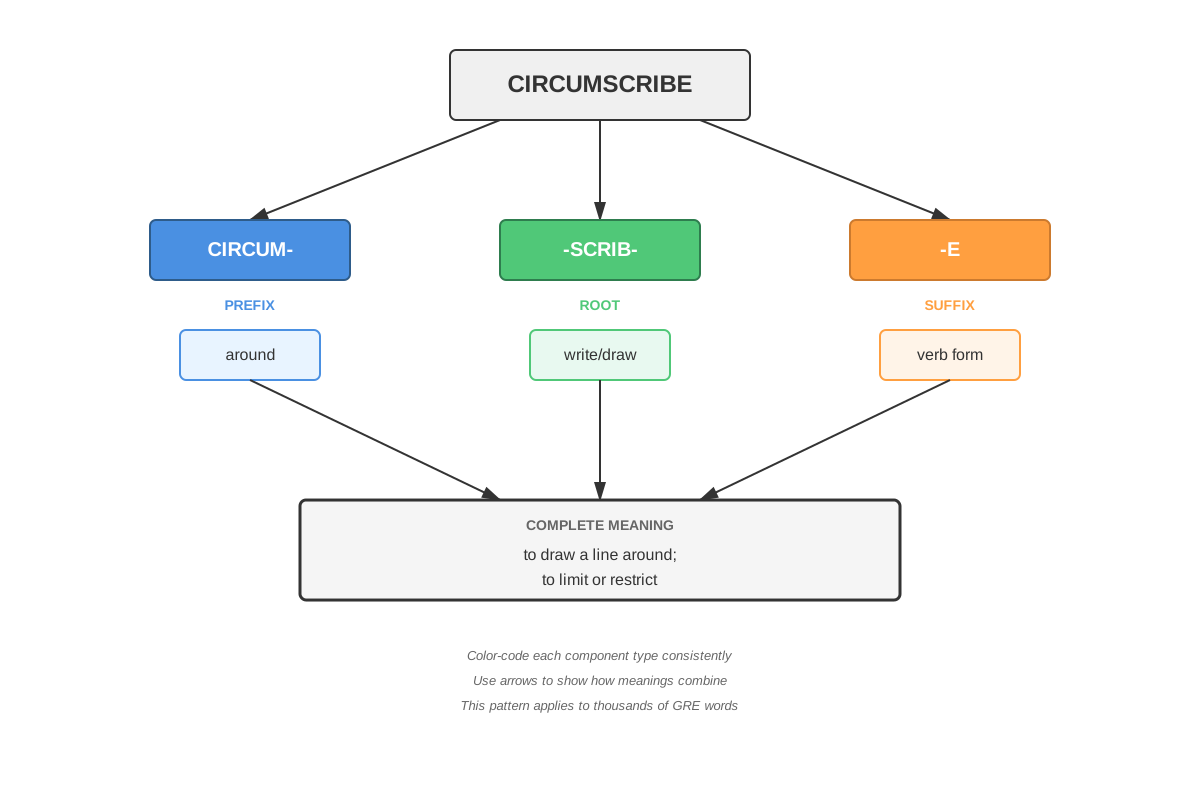
Understanding roots requires recognizing how they interact with prefixes and suffixes to create complete words. The formula typically follows this pattern:
Prefix + Root + Suffix = Complete Word
Consider the word "intractable":
- in- (prefix meaning "not")
- tract (root meaning "to pull or draw")
- -able (suffix meaning "capable of being")
- Combined meaning: "not capable of being pulled/drawn" → stubborn, unmanageable
This systematic approach allows students to tackle even the most intimidating vocabulary. The word "circumlocution" breaks down as:
- circum- (prefix meaning "around")
- locut (root meaning "to speak")
- -ion (suffix indicating a noun)
- Combined meaning: "speaking around" → indirect or evasive speech
Root Variations and Spelling Changes
Many roots appear in multiple forms due to linguistic evolution and the influence of different languages. Recognizing these variations is crucial for comprehensive root mastery:
- ced/cess/ceed: all mean "to go" (precede, process, exceed)
- duc/duct: both mean "to lead" (induce, conduct)
- spec/spect/spic: all mean "to look" (inspect, spectacle, conspicuous)
- scrib/script: both mean "to write" (describe, manuscript)
Additionally, roots often undergo spelling changes when combined with certain prefixes due to assimilation (where sounds blend for easier pronunciation):
- ad- (to) + similate becomes "assimilate" (not "adsimilate")
- in- (not) + legible becomes "illegible" (not "inlegible")
- con- (with) + respond becomes "correspond" (not "conrespond")
Context-Dependent Root Meanings
While roots provide reliable semantic clues, context remains essential because some roots carry multiple related meanings or have evolved different connotations. The root "port" primarily means "to carry," appearing in transport (carry across), export (carry out), and portable (able to be carried). However, it also appears in "report" (carry back information) and "deportment" (how one carries oneself; behavior), where the meaning extends metaphorically.
Similarly, "tract" means "to pull or draw," but this manifests differently across words:
- attract: pull toward
- detract: pull away from
- protract: pull forward/extend in time
- abstract: pulled away from concrete reality
- tractable: able to be pulled/managed
Successful root analysis combines knowledge of the root's core meaning with attention to how prefixes modify that meaning and how context confirms or refines the interpretation.
Building a Root Vocabulary System
The most effective approach to mastering GRE word roots involves learning roots in families rather than isolation. Start with the highest-frequency roots that appear in the most words, then expand to related roots and variations. For each root, learn:
- The core meaning(s)
- The language of origin (Latin or Greek)
- At least 3-5 common words containing the root
- Common prefixes that combine with the root
- Any spelling variations
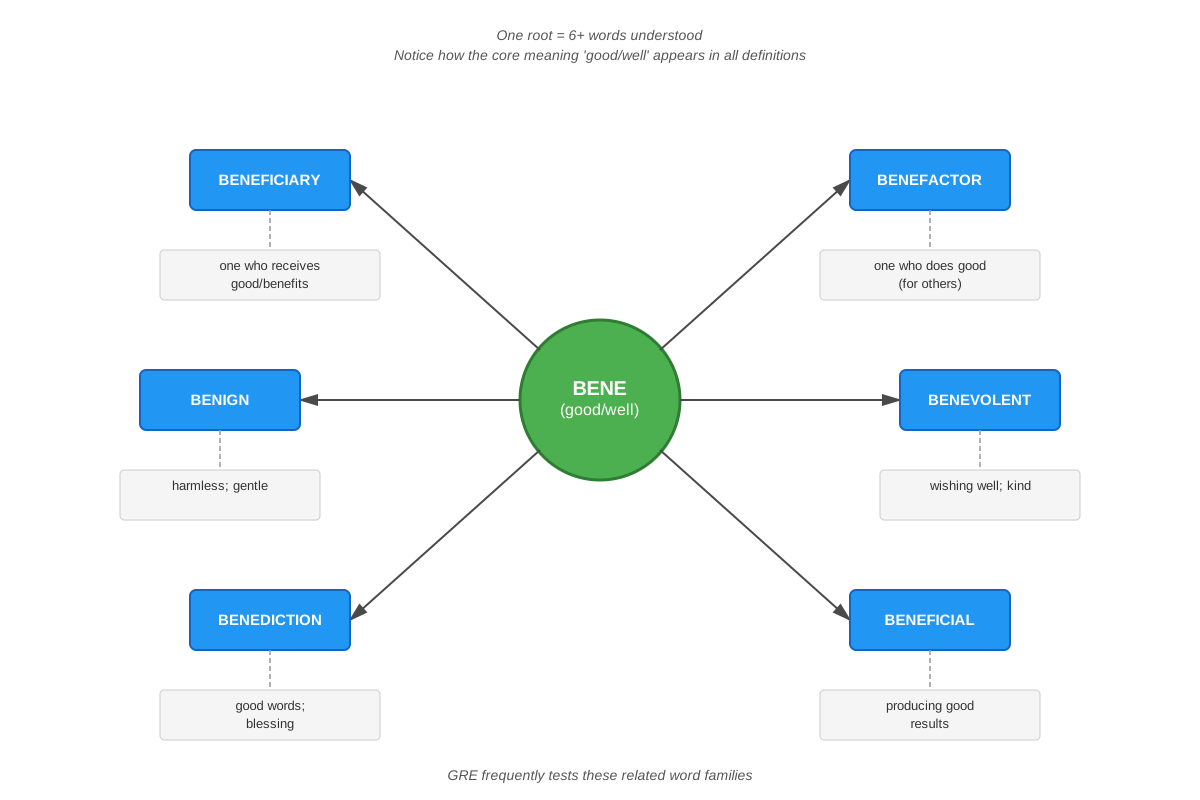
For example, studying the root "bene" (good, well):
- Origin: Latin
- Common words: benefit, benevolent, benefactor, benediction, benign
- Common combinations: bene + fit (do), bene + vol (wish), bene + fact (do/make)
- Related roots: mal (bad), as in malevolent vs. benevolent
Concept Relationships
Word roots function as the central node in a network of vocabulary-building strategies. The relationship flows as follows:
Root Knowledge → Word Deconstruction → Meaning Inference → Context Confirmation → Precise Understanding
Roots connect directly to prefix and suffix knowledge, as these three components work together to create complete words. A student cannot effectively use root analysis without understanding how "pre-" (before) or "post-" (after) modifies the root's temporal meaning, or how "-ous" (full of) versus "-less" (without) creates opposite adjectives from the same root.
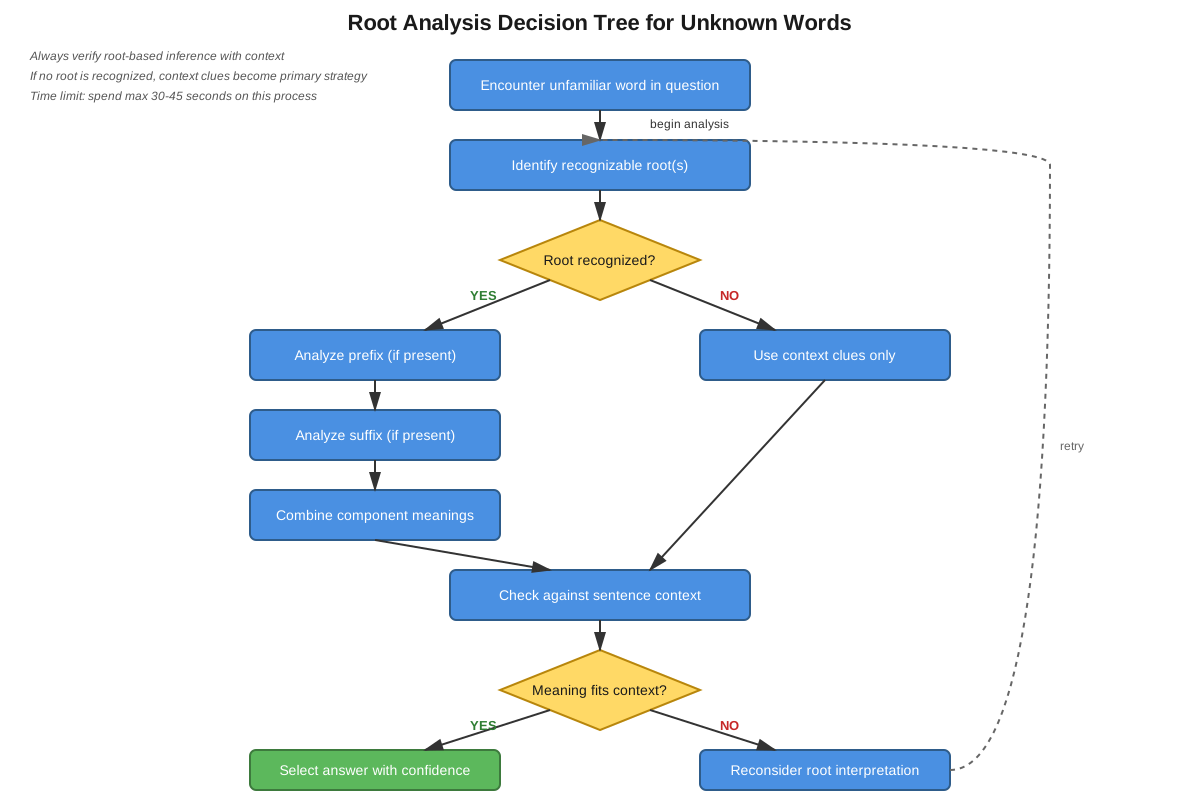
Root mastery also enhances context clue analysis. When encountering an unfamiliar word in a sentence, students can use root analysis to generate a hypothesis about meaning, then verify that hypothesis against the surrounding context. This two-step process is more reliable than either strategy alone: roots provide the semantic foundation, while context confirms and refines the interpretation.
Furthermore, understanding roots illuminates word relationships and analogies. Many GRE vocabulary questions test the ability to recognize relationships between words, and roots often reveal these connections. Words sharing a root typically share semantic territory (dictate, predict, contradict all involve speaking), while words with opposite roots create antonym pairs (benevolent/malevolent, progress/regress).
The progression from root knowledge to vocabulary mastery follows this path: Individual Root Learning → Root Family Recognition → Multi-Root Word Analysis → Contextual Application → Automatic Recognition. As students internalize common roots, the deconstruction process becomes increasingly automatic, allowing rapid vocabulary processing under timed test conditions.
Quick check — test yourself on Word roots so far.
Try Flashcards →High-Yield Facts
⭐ The 50 most common roots account for over 60% of GRE vocabulary questions, making focused root study highly efficient.
⭐ Latin roots typically combine with Latin prefixes, and Greek roots with Greek prefixes, though exceptions exist; recognizing this pattern aids in word deconstruction.
⭐ Roots related to speaking (dict, loqu, voc) and thinking (cogn, sci, log) appear most frequently on the GRE, reflecting the exam's focus on academic communication.
⭐ When multiple answer choices seem plausible, root analysis often reveals subtle distinctions that eliminate incorrect options.
⭐ Roots can function as standalone words (port, tract, duct) or only appear in combination with affixes (cogn, dict, vert).
- The root "path" (feeling) appears in sympathy (feeling with), apathy (without feeling), empathy (feeling into), and antipathy (feeling against), demonstrating how prefixes create a family of related terms.
- Roots ending in consonants typically require connecting vowels (usually "i" or "o") when combining with suffixes: "dict" + "ion" becomes "diction," not "dicttion."
- Many seemingly unrelated words share roots: "vocal," "advocate," "revoke," and "equivocate" all contain "voc/vok" (to call).
- The root "spec/spect" (to look) generates over 50 common English words, including inspect, respect, spectacle, perspective, and introspection.
- Greek roots often appear in scientific and technical terminology (bio, geo, therm, chron), while Latin roots dominate legal, political, and general academic vocabulary.
- Recognizing root "vert/vers" (to turn) unlocks words like convert, revert, diverse, versatile, controversy, and inadvertent—all involving turning or changing direction.
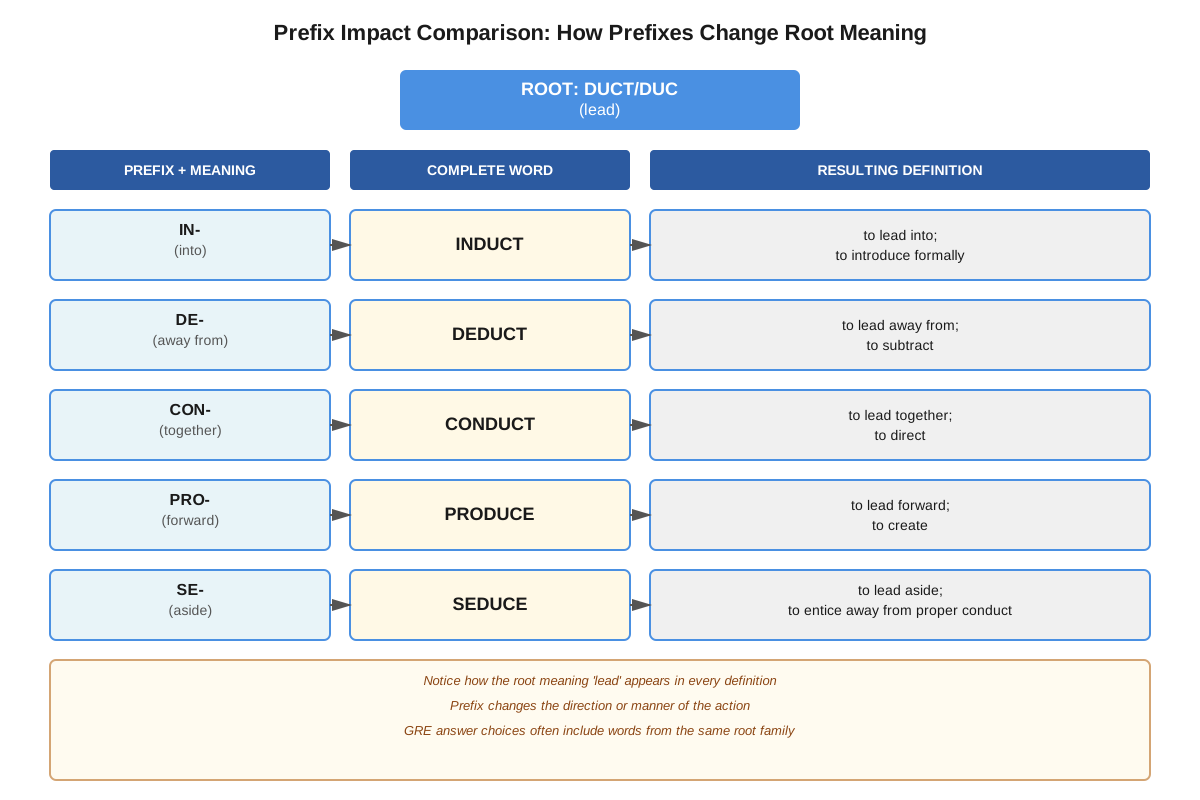
- The roots "duc/duct" (to lead) appear in conduct, deduce, induce, produce, reduce, seduce, and aqueduct, with prefixes indicating the direction or manner of leading.
Common Misconceptions
Misconception: All words can be decoded through root analysis alone.
Correction: While roots provide powerful clues, some English words have evolved meanings that diverge from their etymological origins, and some common words derive from Old English or other sources without clear Latin/Greek roots. Root analysis works best when combined with context clues and general vocabulary knowledge.
Misconception: A root always means exactly the same thing in every word.
Correction: Roots carry core semantic content, but their precise meaning often shifts based on prefixes, suffixes, and metaphorical extension. The root "tract" (pull) has a literal meaning in "tractor" but a metaphorical one in "abstract" (pulled away from concrete reality).
Misconception: Learning roots is just memorization, no different from memorizing whole words.
Correction: Root learning is exponentially more efficient because each root unlocks dozens of words. Learning the root "bene" (good) provides access to benefit, benevolent, benefactor, beneficiary, benign, and many others—far more efficient than memorizing each word individually.
Misconception: Greek and Latin roots can be mixed freely in any combination.
Correction: While hybrid words exist, classical word formation typically keeps Greek roots with Greek affixes and Latin roots with Latin affixes. "Television" (Greek "tele" + Latin "vision") is a modern hybrid, but traditional academic vocabulary follows language-consistent patterns.
Misconception: If you know the root, you can ignore the context.
Correction: Root analysis and context work synergistically. Context confirms root-based inferences and helps distinguish between multiple possible meanings when roots have semantic range. Always verify root-based hypotheses against sentence meaning.
Misconception: Prefixes and suffixes are less important than roots.
Correction: All three components are essential. Prefixes often completely reverse or redirect root meaning (pro- vs. re- vs. de-), and suffixes determine part of speech and grammatical function. "Produce" (verb) and "production" (noun) share a root but function differently in sentences.
Worked Examples
Example 1: Text Completion with Root Analysis
Question: The professor's lecture style was notably ________; rather than speaking clearly and directly, he tended to wander through tangential anecdotes and obscure references.
(A) perspicacious
(B) circumlocutory
(C) laconic
(D) didactic
(E) mellifluous
Solution Process:
First, analyze the context: The sentence contrasts the professor's actual style with "speaking clearly and directly," and describes "wandering through tangential anecdotes." We need a word meaning indirect or roundabout speech.
Now apply root analysis to each option:
(A) perspicacious:
- per- (through) + spic (to see) + -acious (full of)
- Meaning: "seeing through clearly" → having keen insight
- Doesn't match; this describes clarity, not indirectness
(B) circumlocutory:
- circum- (around) + locut (to speak) + -ory (characterized by)
- Meaning: "characterized by speaking around" → indirect, evasive speech
- Perfect match for the context!
(C) laconic:
- From Laconia (Sparta), known for brief speech
- Meaning: using few words, concise
- Opposite of what we need
(D) didactic:
- di- (thoroughly) + dact (to teach) + -ic (relating to)
- Meaning: instructive, preachy
- Doesn't address directness vs. indirectness
(E) mellifluous:
- melli (honey) + flu (to flow) + -ous (full of)
- Meaning: sweet-flowing, pleasant-sounding
- Describes sound quality, not communication style
Answer: (B) circumlocutory
The root analysis reveals that only "circumlocutory" contains roots meaning "speaking around," which perfectly matches the context clue about wandering through tangents rather than speaking directly.
Example 2: Sentence Equivalence with Multiple Roots
Question: Despite the diplomat's efforts to appear neutral, her ________ remarks revealed a clear preference for one side of the conflict.
Select two answer choices that produce sentences with equivalent meanings:
(A) equivocal
(B) tendentious
(C) ambiguous
(D) partisan
(E) impartial
(F) biased
Solution Process:
Context analysis: "Despite" signals contrast. She tries to appear neutral, but her remarks reveal the opposite—a preference for one side. We need two words meaning "showing bias" or "favoring one side."
Root analysis:
(A) equivocal:
- equi- (equal) + voc (to call/speak) + -al (relating to)
- Meaning: "calling things equal" → ambiguous, unclear
- This suggests neutrality/ambiguity, opposite of what we need
(B) tendentious:
- tend (to stretch toward) + -ious (full of)
- Meaning: stretching toward a particular viewpoint → biased
- Matches our need!
(C) ambiguous:
- ambi- (both) + ag (to drive) + -ous (full of)
- Meaning: "driven both ways" → unclear, having multiple meanings
- Suggests neutrality, not bias
(D) partisan:
- part (part/side) + -isan (supporter of)
- Meaning: supporting one side → biased
- Matches our need!
(E) impartial:
- im- (not) + part (side) + -ial (relating to)
- Meaning: "not taking a side" → neutral
- Opposite of what we need
(F) biased:
- bi (toward) + -ased (leaning)
- Meaning: leaning toward one side → prejudiced
- Matches our need!
Answers: (D) partisan and (F) biased
While (B) tendentious also works semantically, the question asks for two answers that create equivalent meanings. "Partisan" and "biased" are the closest synonyms. Root analysis helps eliminate the trap answers (A, C, E) that suggest neutrality or ambiguity rather than clear bias.
Exam Strategy
When approaching GRE questions involving unfamiliar vocabulary, implement this systematic root analysis process:
Step 1: Identify the unknown word and isolate its components. Visually break the word into prefix-root-suffix segments. Look for familiar letter patterns that signal common roots.
Step 2: Analyze each component separately. Start with the root (usually the middle portion), then consider how the prefix modifies the root meaning, and finally how the suffix affects part of speech or adds nuance.
Step 3: Synthesize a working definition. Combine the component meanings into a rough definition. This doesn't need to be perfect—a general semantic direction is often sufficient.
Step 4: Test against context. Check whether your root-based hypothesis makes sense in the sentence. Context should confirm or refine your inference.
Step 5: Eliminate answer choices. Use your understanding to eliminate options that clearly don't fit, even if you're not 100% certain of the correct answer.
Exam Tip: When you encounter a word with multiple roots (like "benevolent" = bene + vol + ent), analyze each root separately, then combine their meanings. "Good" + "wishing" + "characterized by" = "characterized by wishing good" = kind, generous.
Trigger words and phrases to watch for:
- Questions asking about "the meaning of [word] in line X" directly test vocabulary and root knowledge
- Phrases like "most nearly means" or "closest in meaning to" signal vocabulary-focused questions
- Text Completion blanks preceded by descriptive context clues that define the missing word through roots
- Sentence Equivalence questions where answer choices share roots but differ in prefixes (progress/regress, attract/detract)
Process-of-elimination strategies:
- Eliminate words whose roots clearly contradict the context (if context suggests "bad," eliminate words with "bene" or "eu")
- Eliminate words where the prefix creates the wrong directional meaning (if context suggests "forward," eliminate words with "re-" meaning "back")
- Watch for trap answers that share roots with the correct answer but have different prefixes that reverse meaning
- Be cautious of familiar-looking words that might be misinterpreted; verify through root analysis
Time allocation advice:
Root analysis should take 10-15 seconds per word maximum. If you cannot quickly identify familiar roots, make your best guess based on context and move on. The goal is to use roots as a rapid decoding tool, not to conduct lengthy etymological research during the exam. Practice root analysis during preparation until the process becomes automatic, allowing you to recognize common roots instantly under test conditions.
Memory Techniques
Mnemonic for high-frequency "speaking" roots:
"DLV Speaks" = Dict, Loqu, Voc all mean "to speak"
Visualization for movement roots:
Picture a VERTical line turning (vert = turn), GRADual steps going forward (grad/gress = step), and a DUCk leading ducklings (duc/duct = lead). These mental images connect abstract roots to concrete actions.
Acronym for good/bad roots:
"BMED" = Bene (good), Mal (bad), Eu (good), Dys (bad)
Remember: "Be Med" (be medical/healthy) uses the good roots, while the harsh-sounding ones are bad.
Root family clustering:
Group roots by theme and create memorable sentences:
- Thinking roots: "Cognac makes you think you're a scientist with sophistication and logic"
- Feeling roots: "Pathetic people lack sense and cordiality"
Prefix-root pairing practice:
Create flashcards that combine high-frequency prefixes with high-frequency roots:
- pro- (forward) + gress (step) = progress
- re- (back) + gress (step) = regress
- con- (together) + gress (step) = congress
This systematic pairing helps internalize how components combine and makes pattern recognition automatic.
Story-based memory for root families:
For the root "port" (carry), create a narrative: "The porter transported imported goods that were portable, then wrote a report about deportment standards." Each word in the story contains "port" with different prefixes, reinforcing the root meaning through context.
Summary
Mastering word roots represents one of the highest-yield strategies for GRE Verbal Reasoning success, transforming vocabulary from a memorization challenge into a logical decoding process. By learning 50-100 high-frequency Latin and Greek roots and understanding how they combine with common prefixes and suffixes, test-takers can access tens of thousands of words rather than memorizing each term individually. The systematic approach—breaking unfamiliar words into component parts, analyzing each element's meaning, synthesizing a working definition, and confirming against context—provides a reliable method for handling even the most sophisticated academic vocabulary. Roots related to communication (dict, loqu, voc), cognition (cogn, sci, log), and movement (vert, gress, duc) appear most frequently on the GRE, making them priority learning targets. Success requires not just passive recognition but active application: consistently practicing root analysis on GRE-style questions until the deconstruction process becomes automatic, allowing rapid vocabulary processing under timed conditions while maintaining accuracy through context confirmation.
Key Takeaways
- Word roots are the foundational building blocks of academic vocabulary, with 50-100 high-frequency roots unlocking access to thousands of GRE words
- Systematic deconstruction (prefix + root + suffix analysis) provides a reliable method for inferring meanings of unfamiliar words
- Root analysis works synergistically with context clues—use roots to generate hypotheses, then verify against sentence meaning
- Communication, cognition, and movement roots (dict/loqu/voc, cogn/sci/log, vert/gress/duc) appear most frequently on the GRE
- Recognize root variations and spelling changes (ced/cess/ceed, duc/duct, spec/spect/spic) to maximize pattern recognition
- Practice until root recognition becomes automatic—the goal is rapid decoding under test conditions, not lengthy analysis
- Combine root knowledge with strategic elimination to narrow answer choices even when perfect certainty isn't possible
Related Topics
Prefixes and Suffixes: While this guide focuses on roots, comprehensive vocabulary mastery requires equal attention to the affixes that modify root meanings and indicate grammatical function. Understanding how prefixes like "pre-," "post-," "anti-," and "pro-" alter temporal, spatial, or oppositional relationships is essential for complete word analysis.
Context Clues and Inference: Root analysis provides semantic hypotheses that must be confirmed through contextual evidence. Developing skills in identifying definition clues, contrast clues, and example clues enhances the accuracy of root-based inferences.
Vocabulary in Context: Advanced application of root knowledge involves understanding how word meanings shift based on context, connotation, and register. This includes distinguishing between denotative (dictionary) and connotative (emotional/cultural) meanings.
Etymology and Word History: Deeper study of how English vocabulary evolved from Latin, Greek, French, and Germanic sources provides insight into why certain roots combine in specific patterns and how meanings have shifted over time.
Practice CTA
Now that you understand the systematic approach to word root analysis, it's time to put these strategies into action. Attempt the practice questions and flashcards designed specifically for this topic, focusing on breaking down unfamiliar words into their component parts before checking definitions. Remember: every unfamiliar word you encounter is an opportunity to strengthen your root recognition skills. The more you practice active deconstruction, the more automatic the process becomes, transforming vocabulary from your greatest challenge into your strongest asset on test day. Start building your root vocabulary today—your future GRE score will thank you!
Sign up free to keep reading
Create a free AnvayaPrep account to finish this GRE guide on Word roots — plus flashcards and practice questions.