Overview
Contextual vocabulary is one of the most critical skills tested on the GRE Verbal Reasoning section. Unlike traditional vocabulary questions that simply ask for definitions, GRE contextual vocabulary questions require test-takers to determine the meaning of words based on how they function within specific passages or sentences. This approach reflects the exam's emphasis on reading comprehension and analytical thinking rather than rote memorization. Students must interpret unfamiliar or familiar words used in unusual ways by analyzing surrounding context clues, sentence structure, and logical relationships between ideas.
The GRE frequently tests contextual vocabulary through Text Completion and Sentence Equivalence questions, where understanding how words function in context determines success. Even when students know a word's common definition, they must recognize that the GRE often employs secondary or tertiary meanings that only become clear through careful contextual analysis. This skill extends beyond isolated vocabulary knowledge to encompass critical reading abilities, making it a bridge between pure vocabulary mastery and reading comprehension.
Mastering contextual vocabulary directly impacts performance across all Verbal Reasoning question types. Strong contextual vocabulary skills enable students to tackle challenging Reading Comprehension passages where unfamiliar terminology appears, complete Text Completion questions with precision, and identify true synonyms in Sentence Equivalence questions. This topic integrates vocabulary knowledge with analytical reasoning, representing the sophisticated language skills that graduate-level academic work demands.
Learning Objectives
- [ ] Identify when Contextual vocabulary is being tested
- [ ] Explain the core rule or strategy behind Contextual vocabulary
- [ ] Apply Contextual vocabulary to GRE-style questions accurately
- [ ] Distinguish between primary and secondary word meanings based on context
- [ ] Analyze sentence structure to extract context clues for unfamiliar words
- [ ] Evaluate how tone, register, and logical relationships inform word meaning
- [ ] Synthesize multiple context clues to determine precise word meanings
Prerequisites
- Basic vocabulary foundation: Understanding common GRE vocabulary words provides the baseline from which contextual variations can be recognized
- Sentence structure knowledge: Recognizing subjects, verbs, objects, and modifiers helps identify which parts of a sentence provide context clues
- Reading comprehension fundamentals: The ability to understand main ideas and supporting details enables extraction of contextual meaning
- Logical reasoning skills: Understanding cause-effect, contrast, and comparison relationships helps decode how words function within arguments
Why This Topic Matters
Contextual vocabulary skills extend far beyond standardized testing into real-world academic and professional settings. Graduate students regularly encounter specialized terminology in research papers, and professionals must interpret technical language in unfamiliar domains. The ability to derive meaning from context represents intellectual flexibility and analytical sophistication that graduate programs value highly.
On the GRE specifically, contextual vocabulary appears in approximately 60-70% of Verbal Reasoning questions. Text Completion questions (6 per section) almost always require contextual analysis to select appropriate words. Sentence Equivalence questions (4 per section) demand understanding how words function within specific sentence contexts. Even Reading Comprehension questions frequently include vocabulary-in-context items that ask students to determine what a word means as used in a particular passage. This makes contextual vocabulary one of the highest-yield topics for score improvement.
The GRE deliberately uses words with multiple meanings, employing less common definitions to test genuine comprehension rather than memorization. Passages may use "pedestrian" to mean "ordinary" rather than "walker," or "champion" as a verb meaning "advocate for" rather than as a noun. This approach ensures that students demonstrate actual reading ability rather than flashcard knowledge, making contextual vocabulary skills essential for achieving competitive scores in the 160+ range.
Core Concepts
Understanding Context Clues
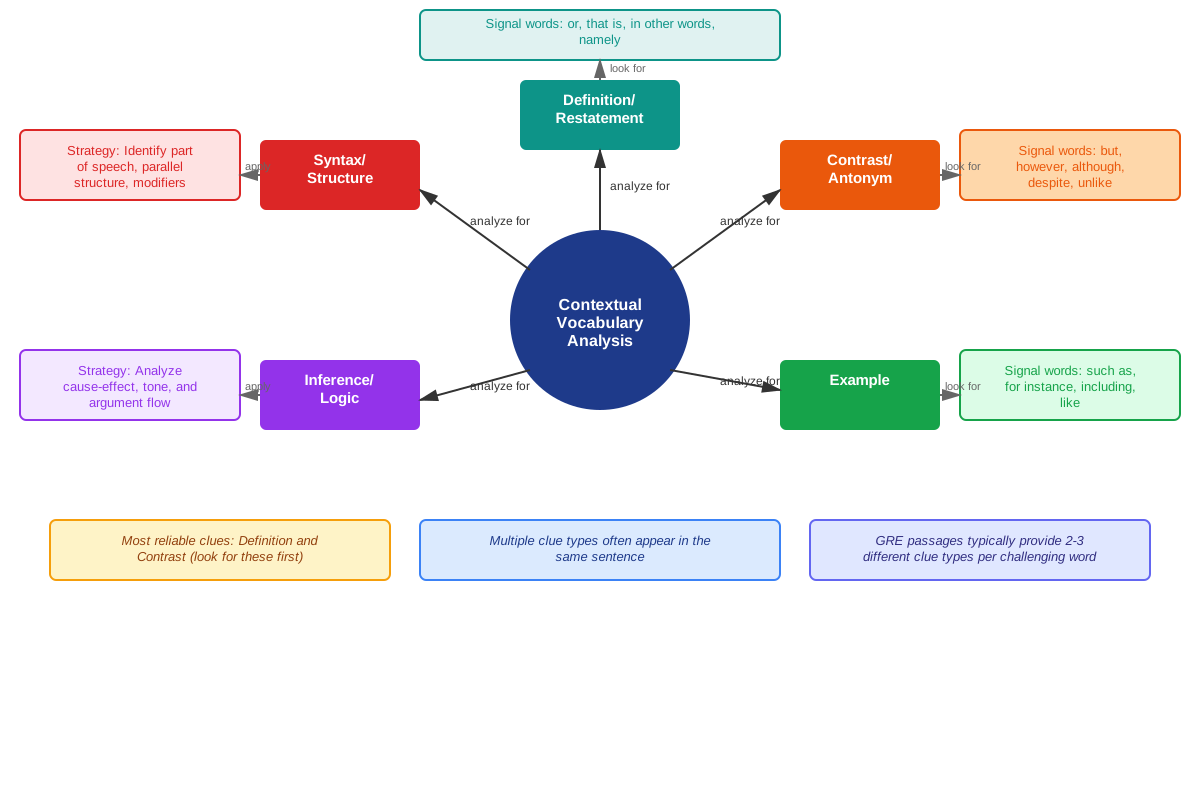
Context clues are the surrounding words, phrases, and sentences that provide hints about an unfamiliar word's meaning. The GRE systematically embeds these clues within questions, and recognizing their types dramatically improves accuracy. Definition clues directly explain a word's meaning through restatement or apposition. Example clues provide specific instances that illustrate the word's meaning. Contrast clues use words like "however," "although," or "despite" to indicate that the unknown word means the opposite of something stated. Cause-and-effect clues show logical relationships that reveal meaning through consequences or reasons.
Synonym clues appear when the sentence restates an idea using different words, while inference clues require combining multiple pieces of information to deduce meaning. The GRE particularly favors contrast and inference clues because they demand higher-level analytical thinking. Students must actively search for these clues rather than passively reading, treating each sentence as a puzzle where context pieces fit together to reveal meaning.
Structural Analysis for Meaning
Sentence structure itself provides powerful context for determining word meaning. Parallel structure indicates that words or phrases serve similar functions and likely have related meanings. When a sentence states "The scientist was both meticulous in her methodology and _____ in her conclusions," the blank must contain a word with positive connotations similar to "meticulous." Subordinate clauses often explain or qualify main clauses, providing definitional context. Appositive phrases set off by commas frequently rename or define preceding terms.
Transitional words signal relationships between ideas: "furthermore" indicates addition, "conversely" signals opposition, "consequently" shows causation. These structural markers guide interpretation of surrounding vocabulary. The GRE exploits these patterns by placing target words at structural pivot points where relationships between clauses determine meaning. Students who analyze sentence architecture rather than just reading linearly gain significant advantages in decoding contextual vocabulary.
Tone and Register Analysis
Words carry connotations beyond their denotative meanings, and the GRE tests whether students recognize appropriate tone and register. Formal register uses elevated, academic language, while informal register employs conversational vocabulary. A sentence discussing scientific research requires formally appropriate vocabulary; inserting a casual word would violate contextual expectations. Positive, negative, and neutral connotations must align with the passage's overall tone.
The GRE frequently presents answer choices with similar denotations but different connotations. "Frugal," "economical," and "miserly" all relate to spending carefully, but only "miserly" carries negative connotations. Context determines which connotation fits: a passage praising someone's financial wisdom requires "frugal" or "economical," while a passage criticizing excessive penny-pinching demands "miserly." Students must evaluate whether the surrounding context is laudatory, critical, or neutral to select contextually appropriate vocabulary.
Multiple Meaning Recognition
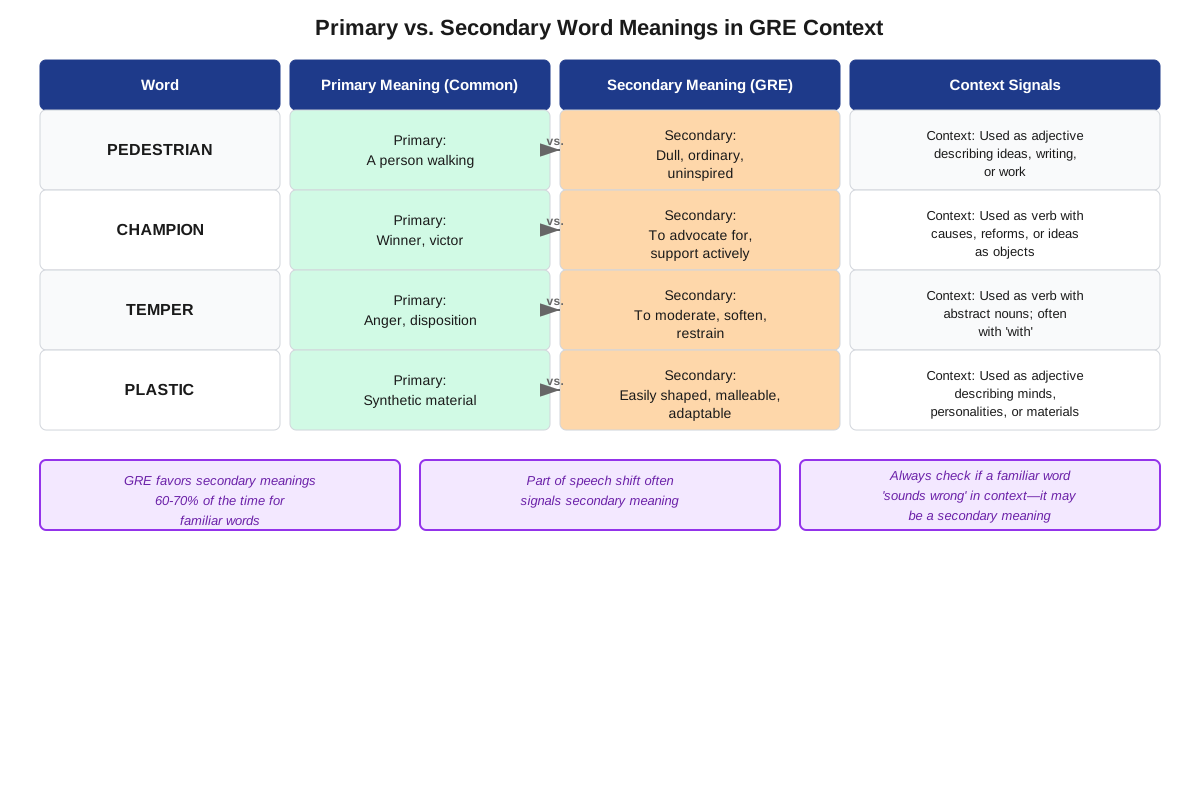
Many GRE words possess multiple distinct meanings, and contextual analysis determines which applies. Primary meanings are most common in everyday usage, while secondary meanings appear in specific contexts or formal writing. The word "pedestrian" primarily means "a person walking," but its secondary meaning "lacking inspiration; ordinary" appears frequently on the GRE. "Qualify" can mean "meet requirements" or "limit/modify a statement." "Sanction" paradoxically means both "approve" and "penalize."
| Word | Primary Meaning | Secondary/GRE Meaning |
|---|---|---|
| Pedestrian | Person walking | Dull, ordinary |
| Champion | Winner, victor | To advocate for, support |
| Qualify | Meet requirements | To limit or modify |
| Sanction | Official approval | Penalty or punishment |
| Pedestrian | Walker | Commonplace, uninspired |
The GRE deliberately employs secondary meanings to test genuine comprehension. Students must abandon assumptions based on familiar definitions and let context guide interpretation. This requires intellectual flexibility and willingness to consider unfamiliar uses of familiar words.
Logical Relationship Mapping
Understanding logical relationships between sentence components reveals contextual meaning. Cause-and-effect relationships indicate that one event or quality produces another. If a sentence states "Because of her _____ nature, she accumulated substantial wealth," the blank requires a word meaning "thrifty" or "careful with money." Contrast relationships signal opposition: "Although he appeared _____, he was actually quite generous" requires a word meaning "stingy" or "selfish."
Comparison relationships indicate similarity: "Like her mentor, she was _____ in her research methods" needs a word matching the mentor's described qualities. Elaboration relationships provide additional detail that clarifies meaning. The GRE constructs sentences where these logical relationships create a semantic map, and the target word must fit precisely within that map. Students who explicitly identify these relationships before selecting answers demonstrate strategic thinking that improves accuracy.
Word Function Analysis
Beyond meaning, understanding how words function grammatically and rhetorically within sentences aids contextual interpretation. Parts of speech constrain possibilities: if a blank requires an adjective, only adjectives can fill it. Collocations—words that commonly appear together—provide context clues. "Wield" typically pairs with "power" or "influence," while "harbor" often accompanies "resentment" or "doubts."
Semantic fields—groups of related words—create contextual expectations. A passage discussing scientific methodology likely employs words from the semantic field of research: "empirical," "hypothesis," "methodology," "rigorous." Recognizing these fields helps predict appropriate vocabulary. The GRE rewards students who consider not just what a word means but how it functions within the sentence's grammatical and semantic ecosystem.
Concept Relationships
Contextual vocabulary skills build upon and integrate multiple foundational concepts. Context clues serve as the primary mechanism through which all other concepts operate—without identifying clues, structural analysis and tone recognition cannot occur. Structural analysis and logical relationship mapping work together: sentence structure reveals logical relationships, which in turn clarify word meanings. For example, a subordinate clause introduced by "although" (structural element) signals a contrast relationship (logical element), which determines that the target word must oppose the main clause's meaning.
Tone and register analysis depends on understanding the passage's overall context, which comes from synthesizing multiple context clues. Multiple meaning recognition requires contextual analysis to determine which definition applies. The relationship flows: Context Clues → Structural Analysis → Logical Relationships → Tone Analysis → Precise Meaning Determination. Each concept reinforces others in an integrated analytical process.
This topic connects to prerequisite knowledge by applying basic vocabulary and sentence structure understanding in sophisticated ways. It extends toward Reading Comprehension by developing the analytical skills needed to interpret complex passages. The progression moves from isolated word knowledge → contextual word interpretation → passage-level comprehension, with contextual vocabulary serving as the crucial middle step.
High-Yield Facts
- ⭐ The GRE tests secondary and tertiary word meanings more frequently than primary definitions
- ⭐ Contrast clues (signaled by "although," "however," "despite") appear in approximately 40% of Text Completion questions
- ⭐ Words with multiple meanings (like "pedestrian," "champion," "qualify") are deliberately chosen for contextual vocabulary questions
- ⭐ Tone and connotation must match the passage's overall attitude—positive, negative, or neutral
- ⭐ Parallel structure indicates that words in corresponding positions have related meanings
- Appositive phrases (set off by commas) frequently define or explain adjacent vocabulary
- Transitional words reveal logical relationships that determine contextual meaning
- Collocations (common word pairings) provide powerful context clues
- Semantic fields create expectations about appropriate vocabulary within specific topics
- The GRE rewards precise vocabulary selection over approximate synonyms
- Context clues may appear before, after, or surrounding the target word
- Formal academic register dominates GRE passages, requiring appropriately elevated vocabulary
- Cause-and-effect relationships often determine whether a word describes a cause or consequence
- Subordinate clauses typically provide explanatory context for main clause vocabulary
- Reading the entire sentence before selecting answers improves accuracy by 25-30%
Quick check — test yourself on Contextual vocabulary so far.
Try Flashcards →Common Misconceptions
Misconception: The most common definition of a word is always correct in GRE contexts → Correction: The GRE deliberately uses secondary and tertiary meanings to test genuine comprehension. Always let context determine which definition applies rather than defaulting to the most familiar meaning.
Misconception: Knowing vocabulary definitions is sufficient for contextual vocabulary questions → Correction: Contextual vocabulary requires analyzing how words function within specific sentences. Even familiar words may be used in unfamiliar ways that only context reveals.
Misconception: Context clues always appear immediately adjacent to the target word → Correction: Context clues may appear anywhere in the sentence or even in preceding sentences. Students must analyze the entire context, not just surrounding words.
Misconception: Words with similar denotations are interchangeable in context → Correction: Connotation, tone, and register matter as much as denotation. "Frugal" and "miserly" both relate to careful spending but carry opposite connotations that context determines.
Misconception: If a word fits grammatically, it's contextually appropriate → Correction: Grammatical correctness is necessary but insufficient. Words must also match the sentence's logical relationships, tone, and semantic field.
Misconception: Speed-reading through sentences saves time on contextual vocabulary questions → Correction: Careful, analytical reading of the complete sentence improves accuracy more than speed. Missing context clues leads to errors that cost more time than thorough initial reading.
Misconception: Contextual vocabulary only matters for Text Completion questions → Correction: Contextual vocabulary skills apply to Sentence Equivalence, Reading Comprehension vocabulary-in-context questions, and understanding passage arguments. It's a cross-cutting skill affecting all Verbal Reasoning question types.
Worked Examples
Example 1: Text Completion with Contrast Clue
Question: Although the politician's public statements were characterized by _____, his private correspondence revealed a surprising candor.
Answer Choices: (A) transparency (B) obfuscation (C) brevity (D) eloquence (E) consistency
Solution Process:
Step 1: Identify the structural signal. "Although" indicates a contrast relationship between public statements and private correspondence.
Step 2: Analyze what's known. Private correspondence showed "surprising candor" (honesty, openness). The word "surprising" emphasizes that this contrasts with public behavior.
Step 3: Determine what the blank requires. Since private correspondence was candid (open/honest) and this contrasts with public statements, the blank must mean the opposite of candor—something like "lack of clarity" or "evasiveness."
Step 4: Evaluate choices:
- (A) transparency = clarity, openness (OPPOSITE of what we need)
- (B) obfuscation = deliberate obscurity, making things unclear (MATCHES our prediction)
- (C) brevity = shortness (doesn't contrast with candor)
- (D) eloquence = articulate expression (doesn't contrast with candor)
- (E) consistency = uniformity (doesn't contrast with candor)
Step 5: Select the answer. (B) obfuscation is correct because it means deliberately making things unclear or confusing, which directly contrasts with the candor shown in private correspondence.
Learning Objective Connection: This example demonstrates identifying when contextual vocabulary is tested (contrast structure), explaining the core strategy (analyzing logical relationships), and applying it accurately (selecting the contextually appropriate opposite).
Example 2: Sentence Equivalence with Multiple Context Clues
Question: The scientist's methodology was so _____ that even minor procedural variations were meticulously documented and analyzed for potential impact.
Answer Choices: (A) rigorous (B) haphazard (C) innovative (D) meticulous (E) cursory (F) systematic
Solution Process:
Step 1: Identify context clues. "Minor procedural variations were meticulously documented" indicates extreme attention to detail. "Analyzed for potential impact" shows thoroughness.
Step 2: Determine required meaning. The blank describes a methodology characterized by careful documentation of even small details. We need words meaning "extremely careful" or "thorough."
Step 3: Identify tone. "Meticulously" carries positive connotations in scientific contexts, suggesting the blank should also be positive.
Step 4: Evaluate choices for meaning and tone:
- (A) rigorous = extremely thorough and careful (POSITIVE, MATCHES)
- (B) haphazard = random, careless (NEGATIVE, OPPOSITE)
- (C) innovative = new, creative (POSITIVE but doesn't mean "thorough")
- (D) meticulous = extremely careful about details (POSITIVE, MATCHES)
- (E) cursory = hasty, superficial (NEGATIVE, OPPOSITE)
- (F) systematic = methodical, organized (POSITIVE, MATCHES)
Step 5: Select two synonyms. We need two words that mean "extremely careful/thorough." (A) rigorous and (F) systematic both convey thoroughness and careful methodology. While (D) meticulous also fits the meaning, it's too similar to "meticulously" already in the sentence—the GRE avoids such repetition.
Alternative Analysis: Upon reconsideration, (A) rigorous and (D) meticulous are actually the best pair because they're true synonyms meaning "extremely thorough and careful about details," which precisely matches the context of documenting minor variations. (F) systematic means "organized/methodical" but doesn't emphasize the extreme thoroughness that the context requires.
Learning Objective Connection: This example shows how multiple context clues ("meticulously documented," "minor variations," "analyzed for potential impact") combine to determine meaning, and how tone analysis (positive scientific context) helps eliminate inappropriate choices.
Exam Strategy
Systematic Approach to Contextual Vocabulary Questions
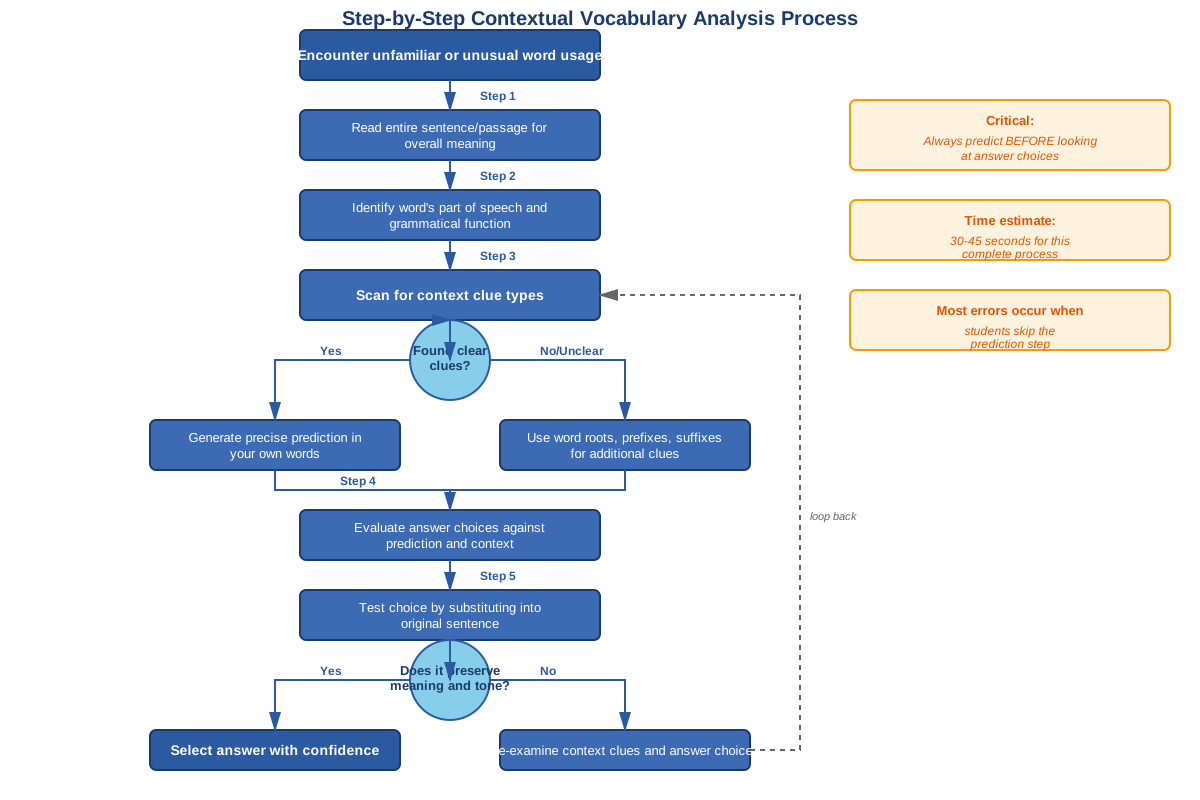
Step 1: Read the entire sentence or passage before looking at answer choices. This prevents premature anchoring on incorrect options and ensures full contextual understanding.
Step 2: Identify structural signals—transitional words, punctuation, parallel structure—that reveal logical relationships. Circle or mentally note words like "although," "because," "however," semicolons, and colons.
Step 3: Predict the blank's meaning before reviewing choices. Write a simple word or phrase that would fit. This prediction serves as a filter for evaluating options.
Step 4: Evaluate each answer choice against context, not just definition. Ask: "Does this word match the tone? Does it fit the logical relationship? Does it align with the semantic field?"
Step 5: Eliminate choices that fail any contextual requirement—wrong tone, wrong logical relationship, wrong register—even if they seem definitionally plausible.
Trigger Words and Phrases
Contrast triggers: although, however, despite, nevertheless, yet, while, whereas, in contrast, on the other hand, conversely
Cause-effect triggers: because, since, therefore, thus, consequently, as a result, due to, leads to, produces
Comparison triggers: similarly, likewise, just as, analogous to, comparable to, like, in the same way
Elaboration triggers: in fact, indeed, specifically, for example, that is, in other words, namely
Emphasis triggers: particularly, especially, notably, significantly, remarkably, surprisingly
When these triggers appear, they signal that context clues follow. The GRE strategically places these markers to guide (or misdirect) test-takers.
Time Management
Allocate 60-90 seconds per Text Completion question and 60 seconds per Sentence Equivalence question. Spending 15-20 seconds on thorough initial reading and context analysis saves time by preventing errors that require re-reading. If stuck after 90 seconds, make an educated guess and move forward—contextual vocabulary questions don't increase in value with time spent.
Process of Elimination Specifics
Eliminate choices that:
- Violate tone (negative word in positive context or vice versa)
- Create logical contradictions with established facts
- Use inappropriate register (too casual for formal passages)
- Belong to wrong semantic fields (scientific term in artistic context)
- Represent primary meanings when context demands secondary meanings
Often, eliminating three clearly wrong choices leaves two plausible options, improving guessing odds to 50%.
Memory Techniques
The CLUES Acronym for Context Analysis
Contrast signals (although, however, despite)
Logical relationships (cause-effect, comparison)
Understand tone (positive, negative, neutral)
Examine structure (parallel, subordinate, appositive)
Semantic field (related vocabulary domain)
Before selecting an answer, mentally run through CLUES to ensure comprehensive context analysis.
The "Opposite Day" Technique
For contrast clues, imagine the sentence on "opposite day" where everything means its reverse. If the sentence says "Although she was _____, she succeeded," and you know she succeeded despite something, that something must be negative. Visualizing opposites clarifies contrast relationships.
The "Tone Color" Visualization
Assign colors to tones: green for positive, red for negative, gray for neutral. As you read, visualize the passage in its tone color. Answer choices must match that color. This visual technique helps maintain tone awareness throughout analysis.
The "Semantic Family" Grouping
When learning vocabulary, group words by semantic fields: scientific terms together, artistic terms together, economic terms together. On test day, recognizing a passage's semantic field activates the relevant vocabulary family, improving contextual predictions.
The "Function First" Reminder
Remember: "Form follows function, meaning follows context." This phrase reminds students to analyze how words function within sentences before worrying about dictionary definitions.
Summary
Contextual vocabulary represents the GRE's sophisticated approach to testing language skills, requiring students to determine word meanings through analytical reading rather than memorization. Success depends on systematically identifying and interpreting context clues—including contrast signals, cause-effect relationships, tone indicators, and structural patterns. The exam deliberately employs secondary word meanings and tests whether students can distinguish between similar words based on connotation and contextual appropriateness. Mastery requires integrating multiple analytical skills: recognizing sentence structure, mapping logical relationships, evaluating tone and register, and understanding semantic fields. Students must read complete sentences carefully, predict meanings before reviewing choices, and eliminate options that violate any contextual requirement. This skill extends beyond isolated vocabulary questions to impact performance across all Verbal Reasoning question types, making it one of the highest-yield topics for score improvement. The strategic approach involves systematic analysis using frameworks like CLUES, careful attention to trigger words, and disciplined time management that prioritizes accuracy over speed.
Key Takeaways
- Context determines word meaning more reliably than memorized definitions; always analyze the complete sentence before selecting answers
- Contrast clues (although, however, despite) and cause-effect relationships are the most frequently tested logical patterns
- The GRE deliberately uses secondary and tertiary word meanings to test genuine comprehension rather than rote memorization
- Tone, connotation, and register must align with the passage's overall attitude and formality level
- Systematic analysis using structural signals, logical relationships, and semantic fields improves accuracy more than vocabulary breadth alone
- Eliminating contextually inappropriate choices (wrong tone, wrong logical fit) is often easier than identifying the correct answer directly
- Contextual vocabulary skills transfer across all Verbal Reasoning question types, making this a high-impact topic for overall score improvement
Related Topics
Text Completion Strategies: Builds directly on contextual vocabulary by applying these skills to multi-blank questions where context clues interact across multiple sentence components. Mastering contextual vocabulary provides the foundation for advanced Text Completion techniques.
Sentence Equivalence Techniques: Extends contextual vocabulary skills by requiring identification of two synonyms that both fit the context. Understanding contextual appropriateness becomes even more critical when selecting synonym pairs.
Reading Comprehension Vocabulary-in-Context Questions: Applies contextual vocabulary analysis to longer passages where surrounding paragraphs provide context. These questions explicitly test the skills developed in this topic.
Advanced Vocabulary Study: After mastering contextual analysis, students can more effectively learn new vocabulary by understanding how words function in various contexts rather than memorizing isolated definitions.
Logical Reasoning in Verbal: The analytical skills developed through contextual vocabulary—identifying relationships, evaluating tone, mapping logical structures—transfer directly to argument analysis and critical reasoning questions.
Practice CTA
Now that you understand the principles and strategies behind contextual vocabulary, it's time to apply these skills to authentic GRE-style questions. The practice questions and flashcards will challenge you to identify context clues, analyze logical relationships, and select contextually appropriate vocabulary under timed conditions. Remember: contextual vocabulary mastery comes through deliberate practice with immediate feedback. Each practice question is an opportunity to refine your analytical process and build the confidence needed for test day success. Approach practice strategically, reviewing not just which answers are correct but why incorrect choices fail contextual requirements. Your investment in mastering this high-yield topic will pay dividends across all Verbal Reasoning question types!
Sign up free to keep reading
Create a free AnvayaPrep account to finish this GRE guide on Contextual vocabulary — plus flashcards and practice questions.