Overview
Formal register refers to the level of language formality used in written and spoken communication, particularly the sophisticated, elevated vocabulary and grammatical structures characteristic of academic and professional discourse. On the GRE Verbal Reasoning section, understanding formal register is crucial because the exam consistently employs high-level academic language across all question types—Text Completion, Sentence Equivalence, and Reading Comprehension. The test-makers deliberately select words and phrases that reflect the language used in graduate-level academic writing, and students who can recognize and interpret this formal register gain a significant advantage.
The GRE's commitment to GRE formal register extends beyond simply using difficult vocabulary. It encompasses the entire tone, structure, and stylistic choices that characterize scholarly writing. This includes complex sentence structures, precise technical terminology, nuanced distinctions between near-synonyms, and the avoidance of colloquialisms or casual expressions. When students encounter passages about art history, scientific research, or philosophical arguments, they must navigate not only the content but also the formal linguistic framework in which that content is presented.
Mastering formal register connects directly to other essential Verbal Reasoning skills, including vocabulary development, context clue analysis, and reading comprehension strategies. The ability to recognize formal language patterns helps students decode unfamiliar words through structural analysis, identify the author's tone and purpose, and select appropriate answer choices that match the sophistication level of the passage. This topic serves as a foundational element that enhances performance across all verbal question types, making it one of the highest-yield areas for focused study.
Learning Objectives
- [ ] Identify when Formal register is being tested in GRE questions
- [ ] Explain the core rule or strategy behind Formal register
- [ ] Apply Formal register to GRE-style questions accurately
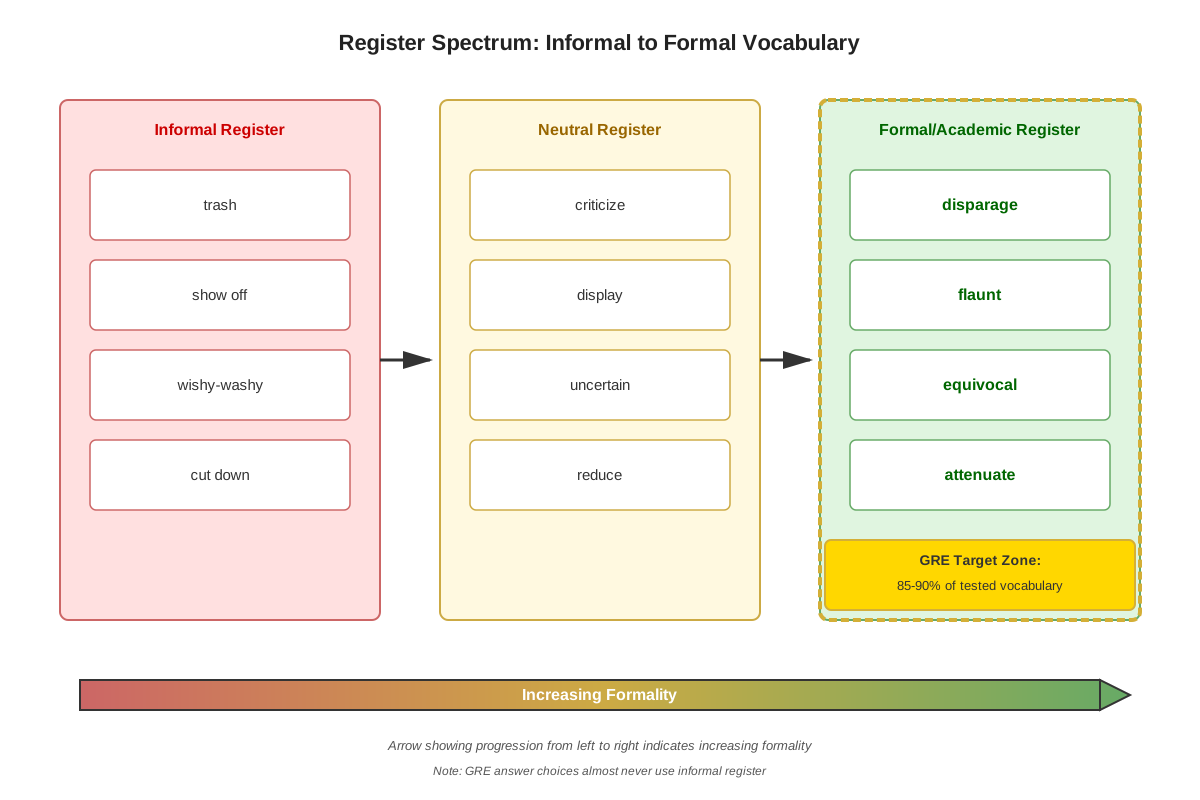
- [ ] Distinguish between formal, neutral, and informal register in vocabulary choices
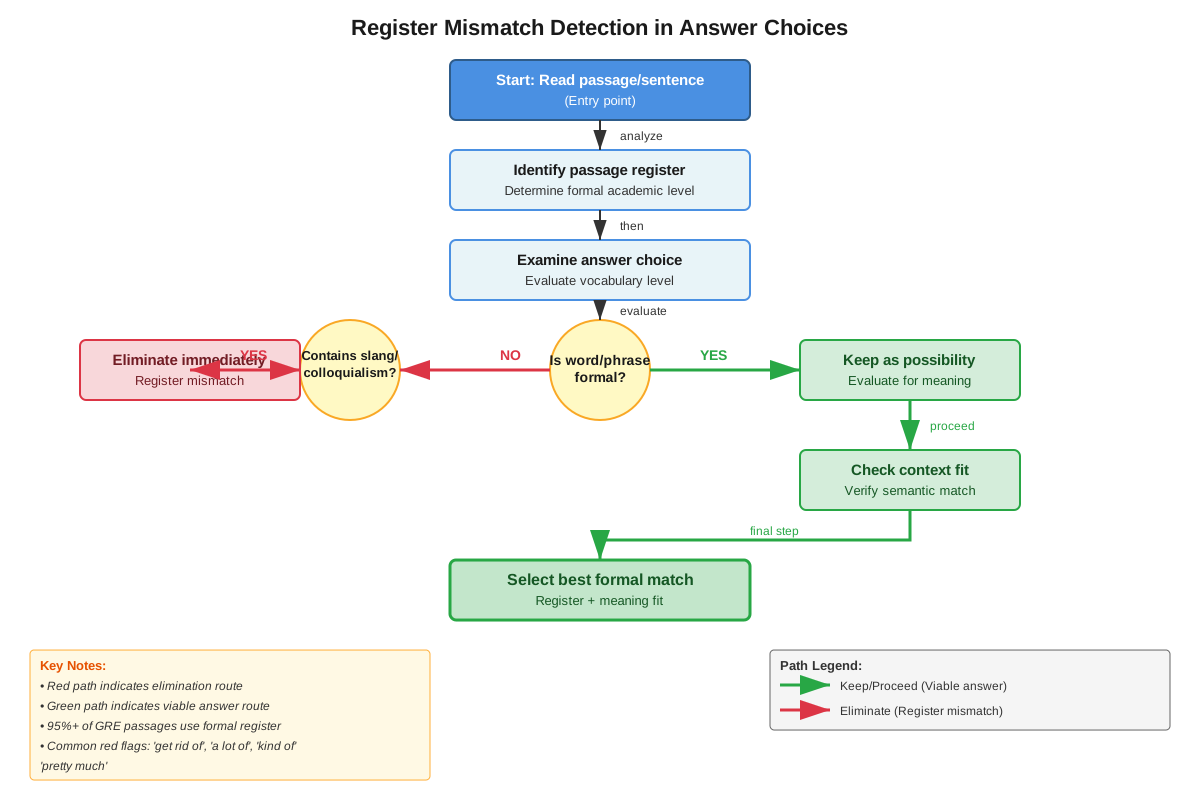
- [ ] Recognize register mismatches that signal incorrect answer choices
- [ ] Evaluate answer options based on their appropriateness to academic contexts
- [ ] Analyze how formal register affects tone and meaning in reading passages
Prerequisites
- Basic vocabulary knowledge: Understanding common words and their definitions provides the foundation for recognizing more sophisticated formal alternatives
- Sentence structure comprehension: Familiarity with complex sentences helps students parse the elaborate constructions typical of formal register
- Context clue skills: The ability to infer meaning from surrounding text is essential when encountering unfamiliar formal vocabulary
- Synonym and antonym relationships: Recognizing word relationships enables students to identify formal equivalents of more common terms
Why This Topic Matters
Understanding formal register has profound real-world significance beyond test preparation. Graduate programs require students to read dense academic texts, write scholarly papers, and communicate professionally with faculty and peers. The language patterns tested on the GRE directly mirror those encountered in graduate coursework across disciplines—from scientific journals to literary criticism to policy analysis. Professionals in law, medicine, academia, and business regularly employ formal register in reports, presentations, and correspondence, making this skill essential for career success.
On the GRE specifically, formal register appears with remarkable consistency. Approximately 85-90% of all vocabulary tested falls within the formal or academic register, making it one of the most pervasive features of the exam. Text Completion questions frequently require students to select words that match the formal tone of the passage, while Sentence Equivalence questions demand recognition of formal synonyms. Reading Comprehension passages are invariably written in formal academic prose, and students must interpret this language accurately to answer inference and detail questions correctly.
Common manifestations of formal register testing include: passages that use elevated vocabulary when simpler alternatives exist (e.g., "ameliorate" instead of "improve"), questions that require distinguishing between formal synonyms with subtle connotation differences (e.g., "reticent" vs. "taciturn"), and answer choices that include informal or colloquial options as distractors. The GRE also tests register awareness by including words that are technically correct but stylistically inappropriate for academic writing, forcing students to consider not just meaning but also appropriateness.
Core Concepts
Defining Formal Register
Formal register represents the highest level of linguistic formality in English, characterized by sophisticated vocabulary, complex grammatical structures, objective tone, and adherence to standard conventions of academic and professional writing. Unlike informal or casual register, which permits contractions, slang, colloquialisms, and personal expressions, formal register maintains distance, precision, and elevated diction. The GRE exclusively employs formal register in its passages and expects test-takers to recognize and work within this linguistic framework.
The spectrum of register includes several levels:
| Register Level | Characteristics | Example |
|---|---|---|
| Frozen | Ceremonial, unchanging language | Legal documents, religious texts |
| Formal | Academic, professional, impersonal | GRE passages, scholarly articles |
| Consultative | Professional but conversational | Business meetings, interviews |
| Casual | Relaxed, personal | Conversations with friends |
| Intimate | Private, abbreviated | Communication between close relations |
The GRE operates almost exclusively in the formal register, occasionally touching on frozen register for specialized terminology. Understanding this positioning helps students calibrate their expectations and recognize when answer choices deviate inappropriately from the expected formality level.
Characteristics of GRE Formal Register
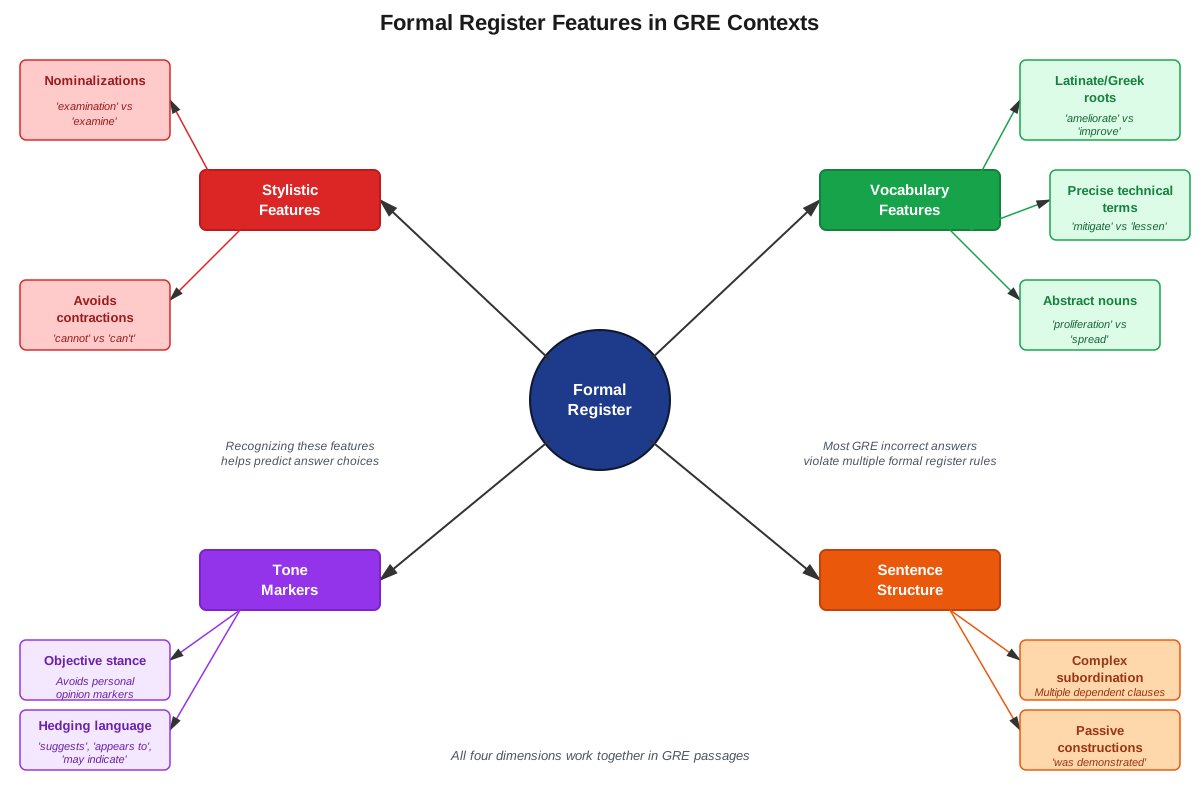
Several distinctive features mark formal register as it appears on the GRE:
Lexical sophistication: The exam favors polysyllabic words of Latin or Greek origin over simpler Anglo-Saxon alternatives. Where everyday speech might use "show," formal register employs "demonstrate," "manifest," or "evince." This preference extends to all content areas, creating a consistently elevated vocabulary baseline.
Syntactic complexity: Formal register utilizes subordinate clauses, participial phrases, and embedded structures that create longer, more intricate sentences. A simple statement like "The theory was wrong, so scientists rejected it" becomes "Given the theory's fundamental inconsistencies with empirical observations, the scientific community deemed it untenable."
Nominalization: Formal writing converts verbs and adjectives into nouns, creating a more abstract, academic tone. "The economy grew rapidly" becomes "The economy experienced rapid growth" or "Rapid economic expansion occurred."
Impersonal constructions: Formal register avoids first and second person, preferring third person and passive voice. Rather than "You can see that the results vary," formal writing states "The results demonstrate considerable variation" or "It is evident that the results vary."
Precise technical terminology: Academic formal register employs discipline-specific vocabulary with exact meanings. In scientific passages, "catalyst" has a specific chemical meaning; in literary criticism, "trope" refers to a particular rhetorical device.
Register Matching in Answer Selection
One of the most powerful strategies for GRE success involves register matching—ensuring that selected answers align with the formality level of the passage or question stem. This principle operates across all question types:
In Text Completion, the correct answer must match not only the logical meaning but also the stylistic register of the surrounding text. If a passage discusses "the philosopher's propensity to engage in abstruse speculation," an answer choice using casual language like "weird thinking" would be incorrect even if semantically close, because it violates register expectations.
For Sentence Equivalence, both correct answers must occupy the same register level while producing equivalent meanings. The question might provide a formal sentence requiring two formal synonyms; including one formal and one casual option as correct answers would violate the equivalence requirement.
In Reading Comprehension, answer choices often include register mismatches as distractors. A passage written in formal academic prose might discuss a scientist's careful methodology, and an incorrect answer choice might describe the scientist as "really into details" rather than "meticulous" or "scrupulous."
Formal Vocabulary Patterns
The GRE draws formal vocabulary from predictable semantic fields and word formation patterns:
Latin-derived abstract nouns: Words ending in -tion, -ity, -ence, -ance (e.g., "perspicacity," "munificence," "temerity") appear frequently and carry formal register markers.
Greek-derived technical terms: Particularly in scientific and philosophical contexts, Greek roots provide formal vocabulary (e.g., "paradigm," "synthesis," "empirical").
Formal verbs of attribution: Academic writing uses specific verbs to describe intellectual activities: "posit," "contend," "elucidate," "corroborate," "refute," rather than simpler alternatives like "say" or "prove."
Evaluative adjectives: Formal register employs precise adjectives that convey nuanced judgments: "judicious," "sagacious," "perspicacious," "astute" rather than simply "smart" or "wise."
Register and Tone
Formal register directly influences tone—the author's attitude toward the subject matter. The GRE frequently tests whether students can identify tone accurately, and register provides crucial clues:
Objective/neutral tone: Most GRE passages maintain scholarly objectivity through formal register, avoiding emotional language or personal opinion markers.
Critical tone: When authors critique ideas, they use formal language that maintains academic decorum: "The hypothesis proves untenable" rather than "The hypothesis is obviously wrong."
Laudatory tone: Praise in formal register remains measured and specific: "The researcher's methodology demonstrates remarkable rigor" rather than "The researcher did a great job."
Understanding that formal register constrains emotional expression helps students avoid answer choices that overstate or mischaracterize the author's tone.
Concept Relationships
The concepts within formal register form an interconnected system where each element reinforces the others. Lexical sophistication (elevated vocabulary) combines with syntactic complexity (elaborate sentence structures) to create the overall impression of formality. These features work together with nominalization and impersonal constructions to establish the objective, academic tone characteristic of GRE passages.
The relationship flows as follows: Formal register → Elevated vocabulary + Complex syntax → Academic tone → Precise meaning → Appropriate answer selection. Each step depends on the previous one, creating a chain of understanding that guides test-takers toward correct answers.
Formal register connects to prerequisite topics by building on basic vocabulary knowledge and extending it into more sophisticated territory. Context clue skills become more critical when formal vocabulary appears, as students must use surrounding formal language to decode unfamiliar terms. Synonym relationships expand to include formal equivalents, requiring students to recognize that "ameliorate," "enhance," and "improve" occupy different register levels while sharing core meaning.
This topic also relates to broader Verbal Reasoning skills: Reading Comprehension requires interpreting formal prose accurately; Text Completion demands selecting words that match passage register; Sentence Equivalence tests recognition of formal synonyms. Formal register thus serves as a unifying thread connecting all verbal question types.
High-Yield Facts
⭐ The GRE uses formal/academic register in approximately 85-90% of all verbal content, making register awareness essential for success
⭐ Register mismatches in answer choices serve as powerful elimination signals—casual or colloquial options are almost always incorrect
⭐ Latin and Greek-derived vocabulary dominates GRE formal register, particularly words ending in -tion, -ity, -ence, -ous, and -ive
⭐ Formal register avoids contractions, colloquialisms, slang, and first/second person pronouns in favor of impersonal constructions
⭐ When two answer choices have similar meanings but different register levels, the more formal option is typically correct
- Nominalization (converting verbs to nouns) is a hallmark of formal academic writing on the GRE
- Formal register maintains emotional distance and objectivity, avoiding hyperbolic or overly casual language
- Technical terminology specific to academic disciplines appears regularly and must be interpreted within formal contexts
- Passive voice and impersonal constructions ("It is evident that..." rather than "You can see that...") characterize formal register
- Formal synonyms often carry subtle connotation differences that affect appropriateness in specific contexts
- The GRE rewards students who can distinguish between formal synonyms (e.g., "reticent" vs. "taciturn" vs. "laconic")
- Answer choices that use informal intensifiers ("really," "very," "totally") or casual phrasing signal incorrect options
Quick check — test yourself on Formal register so far.
Try Flashcards →Common Misconceptions
Misconception: Formal register simply means using big words.
Correction: Formal register encompasses vocabulary, syntax, tone, and structural choices. Using sophisticated vocabulary with casual grammar or inappropriate context still violates formal register expectations. The entire linguistic package must align with academic conventions.
Misconception: The most difficult or obscure word is always the correct answer in formal contexts.
Correction: While formal register favors elevated vocabulary, correctness depends on precise meaning and appropriateness, not maximum difficulty. An extremely obscure word that doesn't fit the context is wrong, even if it's more challenging than the correct answer.
Misconception: Formal register and technical jargon are the same thing.
Correction: Formal register is a style of language use applicable across all subjects, while technical jargon consists of specialized terminology within specific fields. A passage can be formal without being technical, and technical terms can appear in less formal contexts.
Misconception: If an answer choice means roughly the same thing as the passage, register doesn't matter.
Correction: Register matching is a critical selection criterion on the GRE. An answer that captures the general meaning but violates register expectations is incorrect. The test specifically includes such options as distractors.
Misconception: Formal register means avoiding all simple words.
Correction: Formal register uses simple words when they're the most precise choice. Articles, prepositions, and common verbs appear in formal writing. The key is avoiding casual expressions and maintaining overall sophistication, not eliminating every simple word.
Misconception: Passive voice is always wrong in formal writing.
Correction: While some writing guides discourage passive voice, formal academic register frequently employs it to maintain impersonal tone and emphasize actions over actors. The GRE passages regularly use passive constructions appropriately.
Misconception: Formal register sounds unnatural, so the most awkward-sounding answer must be correct.
Correction: Formal register should be sophisticated but clear. Genuinely awkward or ungrammatical constructions are incorrect regardless of vocabulary level. Formal doesn't mean convoluted or unclear.
Worked Examples
Example 1: Text Completion with Register Matching
Question: The historian's analysis of the economic crisis was notably ________; rather than offering simplistic explanations, she acknowledged the multifaceted nature of the collapse.
(A) reductive
(B) nuanced
(C) sketchy
(D) detailed
(E) comprehensive
Solution Process:
Step 1: Analyze the passage register. The language is formal academic: "notably," "simplistic explanations," "acknowledged," "multifaceted nature." This establishes that the answer must match this formality level.
Step 2: Examine the logical relationship. The semicolon introduces an explanation, and "rather than" signals contrast. The historian did NOT offer simplistic explanations but DID acknowledge complexity. The blank should describe an approach that recognizes multiple factors.
Step 3: Evaluate each option for both meaning and register:
(A) "reductive" - Formal register, but means oversimplifying, which contradicts the passage
(B) "nuanced" - Formal register, means showing subtle distinctions and complexity, fits perfectly
(C) "sketchy" - Informal/casual register ("sketchy" suggests incomplete or suspicious in casual usage), eliminates immediately
(D) "detailed" - Neutral register, somewhat appropriate but less precise than "nuanced"
(E) "comprehensive" - Formal register, means thorough but doesn't specifically capture the recognition of complexity
Step 4: Select the answer that matches both meaning and register. (B) nuanced is correct because it precisely captures the recognition of complexity in appropriately formal vocabulary.
Key Takeaway: Option (C) can be eliminated immediately based on register mismatch, even without fully analyzing meaning. Option (D), while not wrong in register, lacks the precision of (B), demonstrating that among formal options, the most precise wins.
Example 2: Sentence Equivalence with Register Awareness
Question: Despite the committee's efforts to maintain decorum, the proceedings became increasingly ________ as members openly challenged each other's credentials.
Select two answer choices that produce sentences with equivalent meaning:
(A) contentious
(B) rowdy
(C) acrimonious
(D) loud
(E) disputatious
(F) chaotic
Solution Process:
Step 1: Identify passage register. "Maintain decorum," "proceedings," "openly challenged each other's credentials" - clearly formal academic register describing a professional meeting.
Step 2: Determine the logical meaning needed. "Despite" signals contrast with "maintain decorum," so the blank describes a breakdown of civility. "Openly challenged each other's credentials" suggests argumentative behavior.
Step 3: Evaluate each option for register and meaning:
(A) "contentious" - Formal, means involving heated disagreement, fits meaning ✓
(B) "rowdy" - Informal/casual, means noisy and disorderly (used for parties, crowds), register mismatch ✗
(C) "acrimonious" - Formal, means bitter and angry in tone, fits meaning ✓
(D) "loud" - Neutral/casual, too simple for the formal context, register mismatch ✗
(E) "disputatious" - Formal, means inclined to argue, fits meaning ✓
(F) "chaotic" - Neutral, means disorganized, doesn't specifically capture argumentative nature ✗
Step 4: Identify the pair that matches both register and meaning. The three formal options (A, C, E) all fit the register. Now determine which two are most equivalent:
- "Contentious" and "disputatious" both emphasize the argumentative nature
- "Acrimonious" adds the element of bitterness and anger
- While all three could work individually, "contentious" and "disputatious" are closer synonyms
Answer: (A) and (E) - Both maintain formal register and specifically describe argumentative behavior without adding the emotional intensity of "acrimonious."
Key Takeaway: Options (B) and (D) can be eliminated immediately based on register, cutting the choices in half. Among remaining formal options, selecting the closest synonyms requires understanding subtle connotation differences within formal vocabulary.
Exam Strategy
Approaching Register-Based Questions
When encountering any GRE Verbal question, implement this systematic approach:
- Establish the passage register immediately by noting vocabulary level, sentence complexity, and tone in the first few words
- Eliminate register mismatches first before analyzing meaning in detail—this often removes 2-3 options quickly
- Among remaining formal options, select based on precise meaning and contextual appropriateness
- Trust register consistency—the GRE maintains formal register throughout passages and expects answers to match
Trigger Words and Phrases
Watch for these signals that formal register is being tested:
In question stems: "The author's tone can best be described as..." (requires understanding formal tone markers), "Which of the following would best complete the passage?" (demands register matching)
In passages: Presence of Latin/Greek-derived vocabulary, complex sentence structures with multiple clauses, impersonal constructions, technical terminology, and absence of contractions or casual expressions
In answer choices: Options that include colloquialisms ("kind of," "sort of," "really"), casual vocabulary ("weird," "sketchy," "cool"), or overly simple language when other options are sophisticated
Process of Elimination Tips
Immediate elimination criteria:
- Any answer choice using contractions (can't, won't, shouldn't)
- Colloquial expressions or slang
- First or second person pronouns when the passage uses third person
- Casual intensifiers (really, very, totally, super)
- Vocabulary that's too simple when other options are sophisticated
Secondary elimination criteria:
- Formal vocabulary used incorrectly or in wrong context
- Register level that's inconsistent with passage tone
- Technical jargon in non-technical contexts
- Overly emotional language when passage is objective
Time Allocation Advice
Exam Tip: Spend 5-10 seconds establishing passage register before reading answer choices. This upfront investment saves time by enabling rapid elimination of register mismatches, often reducing five options to two or three within seconds.
For Text Completion and Sentence Equivalence, register analysis should take approximately 20-30% of your total time on the question. For Reading Comprehension, register awareness operates continuously as you read, requiring no separate time allocation but enhancing comprehension speed.
Memory Techniques
The FORMAL Acronym
Remember key features of GRE formal register:
Fancy vocabulary (Latin/Greek-derived, polysyllabic)
Objective tone (impersonal, unemotional)
Refined syntax (complex, subordinate clauses)
Measured language (precise, avoiding hyperbole)
Academic conventions (nominalization, passive voice)
Lacking casual elements (no contractions, slang, colloquialisms)
Visualization Strategy
Picture formal register as a formal dinner party versus casual register as a backyard barbecue. At the formal dinner, guests wear suits and gowns (sophisticated vocabulary), use proper place settings (complex syntax), speak politely and impersonally (objective tone), and follow etiquette rules (academic conventions). At the barbecue, people wear casual clothes (simple vocabulary), eat with their hands (simple syntax), speak personally and emotionally (subjective tone), and relax rules (casual conventions). The GRE is always the formal dinner party.
Register Level Ladder
Visualize register levels as a ladder where the GRE operates on the top rungs:
FROZEN (top rung) - Legal/ceremonial language
FORMAL (GRE level) - Academic/professional language
CONSULTATIVE - Business conversation
CASUAL - Friendly conversation
INTIMATE (bottom rung) - Private communication
When evaluating answer choices, mentally place each option on this ladder. Correct answers cluster at the FORMAL level; incorrect answers often drop to CASUAL or below.
The "Would a Professor Write This?" Test
When uncertain about register appropriateness, ask: "Would a professor write this in a scholarly journal article?" If the answer is no due to casual language, contractions, or overly simple vocabulary, eliminate that option.
Summary
Formal register represents the sophisticated, elevated language characteristic of academic and professional discourse, and mastering it is essential for GRE Verbal Reasoning success. The exam consistently employs formal vocabulary, complex syntax, impersonal constructions, and objective tone across all question types, expecting test-takers to recognize and work within this linguistic framework. Understanding formal register enables students to eliminate incorrect answer choices rapidly by identifying register mismatches—casual or colloquial options that violate the academic tone of GRE passages. The key to success lies in recognizing that formal register encompasses not just difficult vocabulary but an entire system of linguistic choices including Latin/Greek-derived words, nominalization, passive voice, and precise technical terminology. Students must develop the ability to match answer choices to passage register while simultaneously evaluating meaning, using register awareness as a powerful first-pass elimination tool. By internalizing the characteristics of GRE formal register and practicing register-based analysis, test-takers gain a significant strategic advantage that improves performance across Text Completion, Sentence Equivalence, and Reading Comprehension questions.
Key Takeaways
- Formal register dominates 85-90% of GRE Verbal content, making register awareness one of the highest-yield study areas for score improvement
- Register mismatches provide immediate elimination signals—casual vocabulary, contractions, and colloquialisms in answer choices are almost always incorrect
- Latin and Greek-derived vocabulary forms the backbone of GRE formal register, particularly abstract nouns and precise technical terms
- Register matching must occur alongside meaning analysis—both criteria must be satisfied for an answer to be correct
- Formal register maintains objectivity and emotional distance through impersonal constructions, avoiding first/second person and hyperbolic language
- Among multiple formal options, select the most precise rather than simply the most difficult or obscure
- Systematic register analysis saves time by enabling rapid elimination before detailed meaning evaluation
Related Topics
Vocabulary in Context: Building on formal register understanding, this topic explores how to decode unfamiliar formal vocabulary using context clues within academic passages, enabling students to handle even unknown words confidently.
Tone and Attitude Recognition: Formal register directly influences authorial tone; mastering register provides the foundation for accurately identifying whether an author is critical, supportive, neutral, or ambivalent toward their subject matter.
Sentence Equivalence Strategies: This topic extends register awareness into the specific challenge of identifying formal synonyms that produce equivalent meanings while maintaining appropriate academic register.
Reading Comprehension for Dense Academic Prose: Understanding formal register is prerequisite to efficiently processing the complex, formal passages that appear in GRE Reading Comprehension, particularly in humanities and social science topics.
Practice CTA
Now that you've mastered the fundamentals of formal register, it's time to apply this knowledge to authentic GRE-style questions. The practice questions and flashcards have been specifically designed to reinforce register recognition and matching skills, giving you the opportunity to internalize these patterns until register analysis becomes automatic. Remember that formal register awareness is a skill that improves dramatically with focused practice—each question you analyze strengthens your ability to recognize register mismatches instantly and select appropriately formal answers confidently. Approach the practice materials with the systematic strategies you've learned, and you'll see measurable improvement in your verbal reasoning performance. Your investment in mastering this high-yield topic will pay dividends across every section of the GRE Verbal Reasoning test!
Sign up free to keep reading
Create a free AnvayaPrep account to finish this GRE guide on Formal register — plus flashcards and practice questions.