Overview
Application questions represent one of the most sophisticated and challenging question types in GRE Reading Comprehension. Unlike questions that simply ask students to recall information stated directly in the passage or make straightforward inferences, application questions require test-takers to take principles, arguments, or information from the passage and apply them to entirely new contexts, scenarios, or situations that were never mentioned in the original text. This cognitive leap—from understanding what the passage says to predicting how those ideas would function in novel circumstances—tests deeper comprehension and analytical reasoning skills.
These questions are essential for the GRE because they assess whether students truly understand the underlying logic, methodology, or principles discussed in a passage, rather than merely memorizing surface-level details. GRE application questions typically appear 1-3 times per Verbal Reasoning section and are considered medium-to-high difficulty questions that can significantly impact your score. They often begin with phrases like "Which of the following scenarios..." or "The author's argument would be most strengthened by..." or "Based on the passage, which situation would most closely parallel..."
Application questions connect intimately with other Reading Comprehension question types, particularly inference questions and logical reasoning questions. While inference questions ask you to read between the lines of what's stated, application questions demand that you extend the passage's logic outward into hypothetical territory. Mastering this question type demonstrates the kind of flexible, transferable thinking that graduate programs value—the ability to take theoretical knowledge and apply it to practical, real-world situations.
Learning Objectives
- [ ] Identify when Application questions is being tested
- [ ] Explain the core rule or strategy behind Application questions
- [ ] Apply Application questions to GRE-style questions accurately
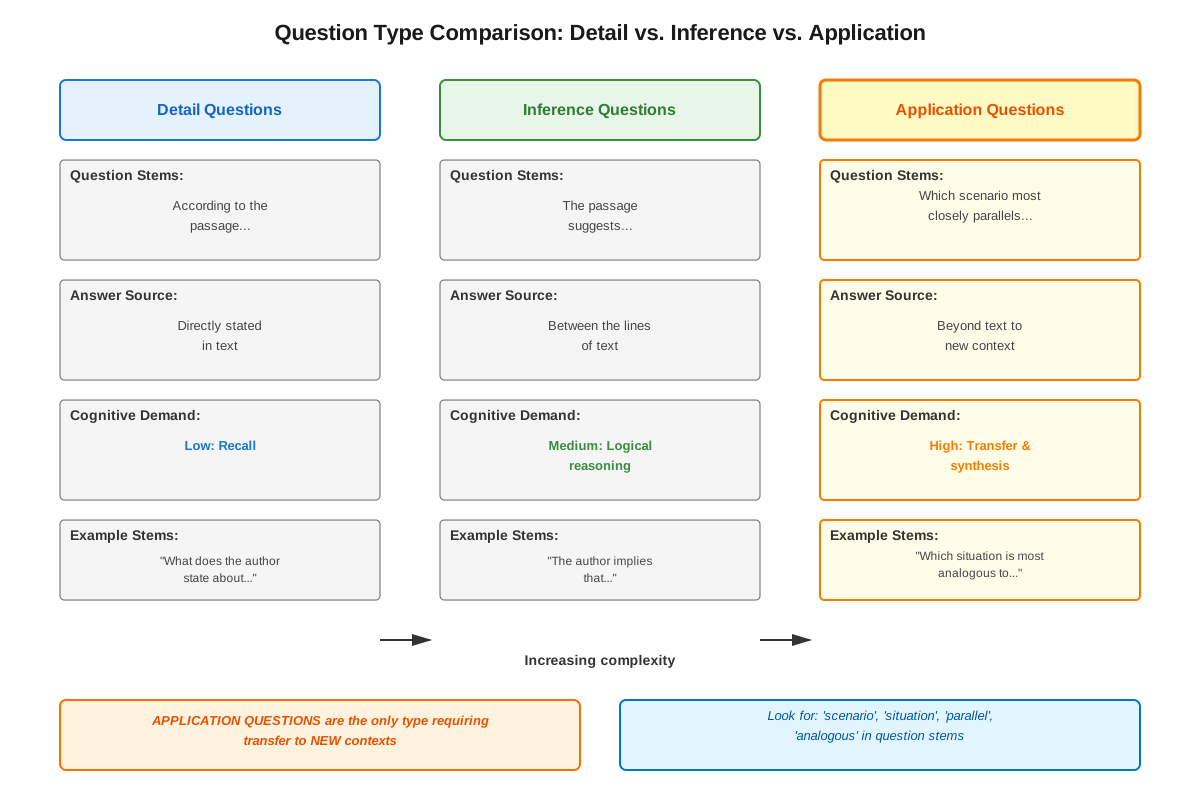
- [ ] Distinguish application questions from inference and detail questions based on question stems
- [ ] Evaluate answer choices by determining which scenarios best match the passage's underlying principles
- [ ] Recognize common trap answers that superficially resemble passage content without matching its logic
Prerequisites
- Basic Reading Comprehension skills: Understanding main ideas, supporting details, and passage structure is necessary because application questions build upon accurate comprehension of the source material.
- Inference-making ability: Since application questions extend beyond what's explicitly stated, students must be comfortable drawing logical conclusions from textual evidence.
- Argument analysis fundamentals: Recognizing premises, conclusions, and logical structures helps identify which principles from a passage can be transferred to new contexts.
- Vocabulary proficiency: Application questions often involve complex scenarios described with sophisticated vocabulary, requiring strong word knowledge to evaluate answer choices accurately.
Why This Topic Matters
Application questions appear with high frequency on the GRE, typically comprising 15-25% of all Reading Comprehension questions. According to ETS data, these questions effectively discriminate between mid-range and high-scoring test-takers, making them crucial for students aiming for scores above the 160 mark in Verbal Reasoning. Graduate programs value the cognitive skills these questions assess because academic success requires constantly applying theoretical frameworks to new research questions, case studies, and practical problems.
In real-world academic contexts, the ability to apply principles across domains is fundamental to critical thinking. Whether analyzing how an economic theory applies to emerging markets, how a biological mechanism might function in different species, or how a philosophical argument relates to contemporary ethical dilemmas, this transferable reasoning skill underlies advanced scholarship. On the GRE, application questions appear across all passage types—science, humanities, social sciences, and argumentative essays—making them universally important regardless of your intended field of study.
These questions commonly appear in several formats: asking which new scenario would be most analogous to one described in the passage; which evidence would most strengthen or weaken the author's argument; which situation would best exemplify a principle discussed; or how a method or approach described would function in a different context. The passages that spawn application questions often discuss theories, methodologies, historical patterns, or cause-and-effect relationships—any content with underlying principles that can be extrapolated.
Core Concepts
Defining Application Questions
Application questions ask test-takers to transfer information, principles, arguments, or methodologies from the passage to new, hypothetical situations not discussed in the original text. The defining characteristic is this cognitive extension: you must understand not just what the passage says, but how those ideas would operate in different circumstances. These questions test whether you've grasped the underlying logic rather than surface details.
The key distinction lies in the relationship between passage content and answer choices. While detail questions point to specific information stated in the passage, and inference questions ask you to draw conclusions from combined passage elements, application questions require you to recognize parallel structures, analogous situations, or matching principles in entirely new contexts. The correct answer will share the same logical structure, causal relationship, or methodological approach as something in the passage, even though the specific subject matter differs completely.
Question Stem Patterns
Application questions reveal themselves through distinctive question stems that signal the need to extend passage content outward:
- "Which of the following scenarios most closely parallels..."
- "The author's argument would be most strengthened/weakened by which of the following?"
- "Based on the passage, which situation would best exemplify..."
- "The method described in the passage could best be used to..."
- "Which of the following would the author most likely agree with?"
- "If the principle described were applied to [new context], the result would be..."
- "The passage suggests that which of the following situations would be most analogous to..."
These stems share a common feature: they explicitly or implicitly introduce new information not mentioned in the passage and ask you to evaluate it through the lens of passage content.
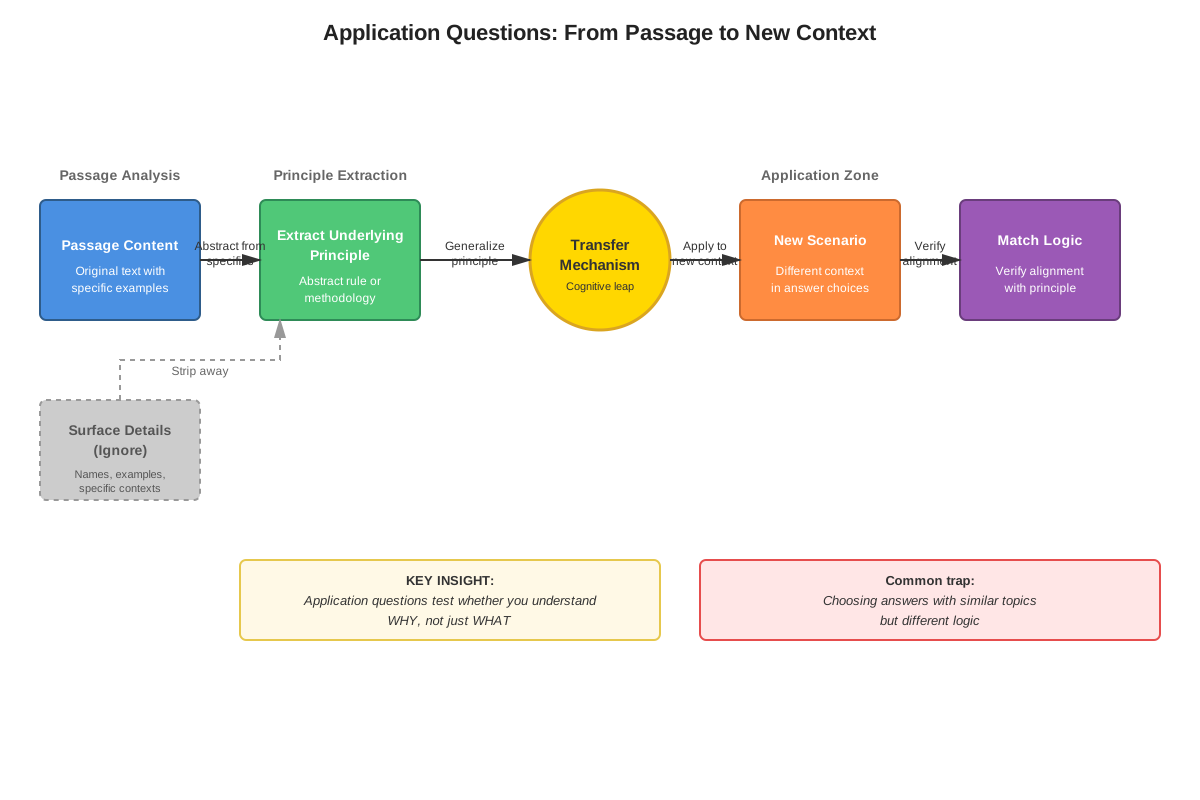
The Core Strategy: Abstraction and Pattern Matching
The fundamental approach to application questions involves a two-step process:
Step 1: Abstract the Principle
Read the relevant portion of the passage and identify the underlying principle, pattern, or logical structure—not the specific details. For example, if a passage discusses how introducing wolves to Yellowstone created a trophic cascade that restored vegetation, the abstract principle is: "Reintroducing a top predator can trigger cascading ecological effects that restore ecosystem balance." The specific details (wolves, Yellowstone, vegetation) are less important than this general pattern.
Step 2: Pattern Match to Answer Choices
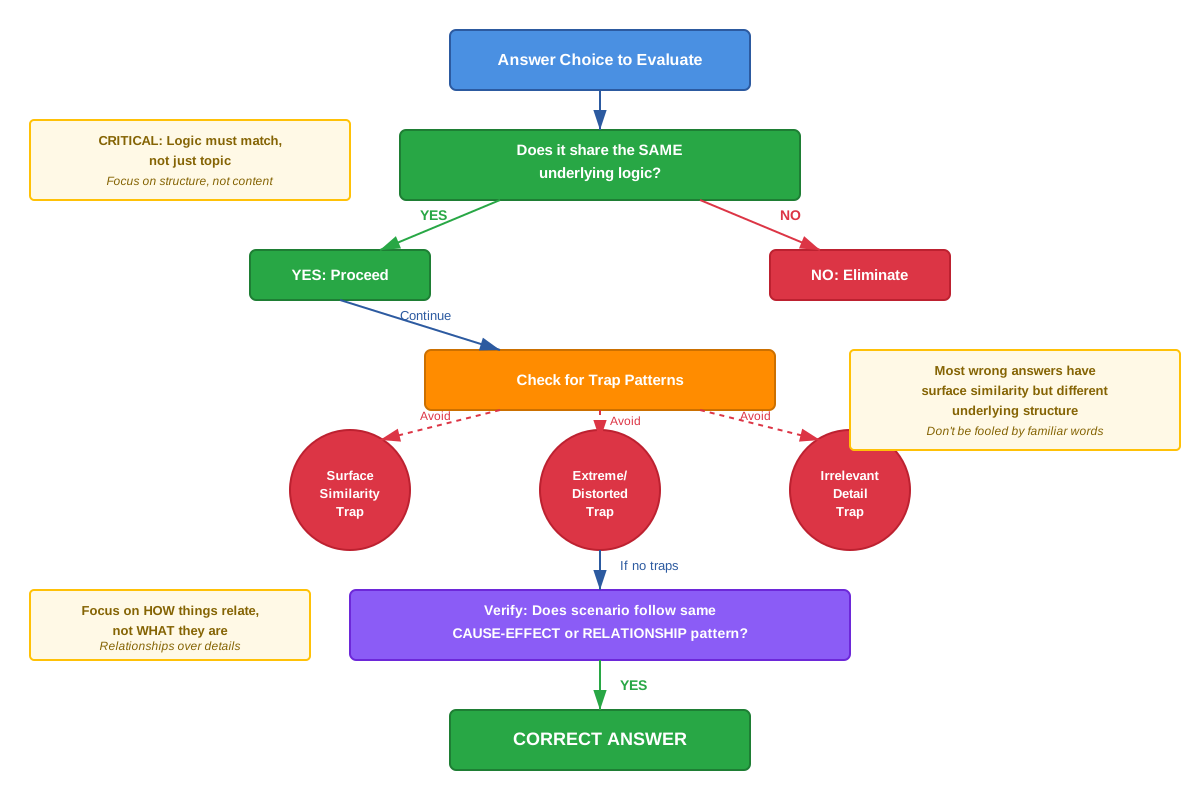
Evaluate each answer choice by determining which scenario best matches the abstract principle you identified. The correct answer will replicate the same logical structure, causal relationship, or methodological approach, even if the subject matter is completely different. In our example, the correct answer might describe reintroducing sea otters to kelp forests (different animals, different ecosystem) but showing the same pattern of top-predator reintroduction leading to cascading restoration effects.
Types of Application Questions
| Application Type | What It Tests | Example Question Stem |
|---|---|---|
| Analogous Scenarios | Recognizing parallel situations with matching logical structures | "Which scenario most closely parallels the situation described?" |
| Principle Extension | Applying a stated principle to new contexts | "Based on the principle in lines 15-20, which would be true?" |
| Argument Strengthening/Weakening | Identifying evidence that would support or undermine the author's claims | "Which finding would most strengthen the author's hypothesis?" |
| Methodological Application | Determining how a described method would function in different circumstances | "The technique described could best be used to..." |
| Predictive Application | Forecasting outcomes based on patterns or theories in the passage | "If the trend continued, which outcome would be most likely?" |
The Abstraction Ladder
Successful application requires operating at the right level of abstraction—not too specific (focusing on irrelevant details) and not too general (losing the distinctive logical structure). Consider this hierarchy:
Too Specific: "Wolves in Yellowstone ate elk, which allowed willows to grow"
Appropriate Abstraction: "Reintroducing a top predator reduces herbivore populations, enabling vegetation recovery"
Too General: "Animals affect their environment"
The middle level captures the essential causal structure while remaining flexible enough to recognize the pattern in different contexts. Practice identifying this "Goldilocks zone" of abstraction for each passage element.
Common Trap Answer Patterns
Application questions feature predictable wrong answer types:
Surface-Level Similarity Traps: These answers mention similar topics, vocabulary, or subject matter from the passage but don't match the underlying logical structure. If the passage discusses economic sanctions affecting authoritarian regimes, a trap answer might mention economic sanctions in a completely different context that doesn't match the causal pattern described.
Reversal Traps: These answers flip the causal relationship or logical structure. If the passage describes how X causes Y, the trap answer presents a scenario where Y causes X.
Scope Mismatches: These answers apply the principle too broadly or too narrowly, extending it beyond its logical boundaries or restricting it inappropriately.
Detail Fixation Traps: These answers correctly recall specific details from the passage but fail to apply the underlying principle to the new scenario presented in the question.
Concept Relationships
Application questions build directly upon fundamental reading comprehension skills, requiring first that students accurately understand passage content before extending it to new contexts. The relationship flows: Literal Comprehension → Inference → Application. Each level requires the previous one; you cannot apply principles you haven't first understood and internalized.
Within the application question category itself, the various types interconnect. Analogous scenario questions and principle extension questions both require the same abstraction skill but apply it differently—the former asks you to recognize matching patterns, while the latter asks you to predict outcomes. Argument strengthening/weakening questions combine application skills with logical reasoning, requiring you to both understand the argument's structure and evaluate which new evidence would affect it.
Application questions also connect forward to the Analytical Writing section, where you must apply critical reasoning to arguments and issues. The same cognitive skill—taking abstract principles and applying them to specific cases—underlies both question types. Additionally, these questions relate to Quantitative Reasoning's word problems, which require applying mathematical principles to real-world scenarios. The transferable skill of pattern recognition and principle application spans the entire GRE.
The relationship map: Passage Comprehension → Principle Abstraction → Pattern Recognition → Answer Evaluation → Correct Application. Each step depends on the previous one, and weakness at any stage will compromise your ability to answer these questions correctly.
High-Yield Facts
⭐ Application questions require identifying underlying principles or patterns, not recalling specific details from the passage.
⭐ The correct answer will match the logical structure or causal relationship from the passage, even if the subject matter is completely different.
⭐ Question stems containing "scenario," "parallel," "analogous," "strengthen," "weaken," or "exemplify" typically signal application questions.
⭐ Abstracting to the appropriate level—neither too specific nor too general—is the most critical skill for these questions.
⭐ Wrong answers often feature surface-level similarity to passage content without matching the underlying logic.
- Application questions typically comprise 15-25% of Reading Comprehension questions on the GRE.
- These questions appear across all passage types: science, humanities, social sciences, and argumentative texts.
- The two-step strategy (abstract the principle, then pattern match) should be applied systematically to every application question.
- Argument strengthening/weakening questions are a specific subtype of application questions that combine logical reasoning with principle application.
- Application questions are considered medium-to-high difficulty and effectively discriminate between mid-range and high-scoring test-takers.
- The correct answer to an application question is never explicitly stated in the passage but must be logically consistent with passage principles.
- Time investment in carefully abstracting the principle pays dividends in answer evaluation efficiency.
- Application questions test transferable reasoning skills valued in graduate-level academic work.
Quick check — test yourself on Application questions so far.
Try Flashcards →Common Misconceptions
Misconception: Application questions simply ask you to recall information from the passage in a different format.
Correction: Application questions require extending passage principles to entirely new contexts not mentioned in the text. They test understanding of underlying logic, not memory of details.
Misconception: The correct answer will use similar vocabulary or discuss similar topics as the passage.
Correction: Correct answers often involve completely different subject matter but share the same logical structure or causal pattern. Surface-level similarity is actually a common trap answer characteristic.
Misconception: You need extensive outside knowledge to answer application questions correctly.
Correction: All information needed to answer application questions comes from the passage itself. The challenge is recognizing how passage principles apply to new scenarios, not importing external knowledge.
Misconception: Application questions are just harder inference questions.
Correction: While both require going beyond what's explicitly stated, inference questions draw conclusions from passage information, while application questions extend passage principles to hypothetical new situations. The cognitive tasks differ fundamentally.
Misconception: If an answer choice mentions something that would strengthen the author's argument, it must be correct for a strengthening question.
Correction: The answer must not only strengthen the argument but do so in a way that's most relevant and direct. Multiple answers might provide some support, but only one provides the strongest or most appropriate support based on the passage's specific logic.
Misconception: Spending time abstracting the principle wastes valuable test time.
Correction: Failing to properly abstract the principle leads to confusion when evaluating answer choices, ultimately wasting more time. The upfront investment in abstraction makes answer evaluation much more efficient and accurate.
Worked Examples
Example 1: Biological Principle Application
Passage Excerpt:
"The peacock's elaborate tail plumage presents an evolutionary paradox. These ornate feathers require significant metabolic resources to produce and maintain, and their size and visibility make peacocks more vulnerable to predators. However, Zahavi's handicap principle resolves this paradox by proposing that these costly traits honestly signal genetic fitness to potential mates. Only genuinely healthy peacocks can afford the metabolic burden and predation risk of maintaining such extravagant displays, making the trait a reliable indicator of mate quality."
Question: Which of the following scenarios would best exemplify the principle described in the passage?
(A) A company requires expensive certifications for job applicants to ensure only serious candidates apply
(B) A bird species develops camouflage coloring that helps it avoid predators while foraging
(C) An athlete undergoes rigorous training that temporarily weakens them but ultimately improves performance
(D) A luxury car manufacturer uses expensive materials that only wealthy buyers can afford
(E) A plant species produces toxic compounds that deter herbivores despite the metabolic cost
Step 1: Abstract the Principle
The handicap principle states that costly, seemingly disadvantageous traits can serve as honest signals of quality precisely because only high-quality individuals can afford to bear those costs. The key elements are: (1) a costly trait, (2) that seems disadvantageous, (3) but honestly signals quality, (4) because only high-quality individuals can sustain the cost.
Step 2: Evaluate Each Answer
(A) Expensive certifications: This involves a cost (money, time) that filters applicants, and only serious/capable candidates would invest in them. This matches the pattern: costly signal → filters for quality → honest indicator. This is promising.
(B) Camouflage coloring: This is adaptive and reduces costs (predation risk) rather than imposing costs. It doesn't match the handicap principle's paradoxical cost structure. Eliminate.
(C) Rigorous training: While this involves temporary costs, the purpose is direct performance improvement, not signaling quality to others. The mechanism differs from the handicap principle. Eliminate.
(D) Expensive luxury materials: This involves cost, but it's about excluding poor buyers, not about the manufacturer honestly signaling their own quality through a costly trait they bear. The analogy is imperfect. Eliminate.
(E) Toxic compounds in plants: This is a defensive adaptation. While metabolically costly, it directly deters herbivores rather than serving as an honest signal of quality to potential mates or partners. Eliminate.
Correct Answer: (A)
The certification scenario best matches the handicap principle: the cost (expensive certifications) seems like a barrier but actually serves as an honest signal of candidate quality because only genuinely serious/capable applicants will bear that cost. The logical structure perfectly parallels the peacock example.
Example 2: Argument Strengthening Application
Passage Excerpt:
"Historian Maria Chen argues that the rapid industrialization of Japan during the Meiji Restoration (1868-1912) succeeded where other non-Western nations failed because Japan strategically borrowed Western technology while preserving core cultural institutions. Unlike colonized nations forced to adopt Western systems wholesale, Japan's government selectively imported industrial techniques and organizational models while maintaining traditional social hierarchies and values. This selective adaptation, Chen contends, provided social stability that enabled sustained economic transformation."
Question: Which of the following findings, if true, would most strengthen Chen's argument?
(A) Japan's literacy rates were higher than most Western nations during the Meiji period
(B) Other Asian nations that attempted rapid industrialization while maintaining traditional institutions also succeeded economically
(C) Nations that underwent forced Westernization during the same period experienced social upheaval that disrupted economic development
(D) Japan's traditional social hierarchies were actually modified significantly during the Meiji Restoration
(E) Western nations provided substantial financial assistance to Japan during its industrialization
Step 1: Abstract the Argument Structure
Chen's argument: Selective borrowing (technology) + preservation (culture/institutions) → social stability → successful industrialization. The causal claim is that this specific combination enabled success that others lacked. To strengthen this, we need evidence that: (1) confirms the causal mechanism worked as described, or (2) shows the alternative approach (forced wholesale adoption) produced the predicted negative outcome, or (3) demonstrates the pattern holds in other cases.
Step 2: Evaluate Each Answer
(A) High literacy rates: This might explain Japan's success but doesn't specifically support Chen's argument about selective borrowing + cultural preservation. It introduces an alternative explanation rather than strengthening her specific causal claim. Eliminate.
(B) Other nations with similar approach succeeded: This would strengthen the argument by showing the pattern holds across multiple cases. However, the answer says "other Asian nations," which is somewhat supportive but not as strong as evidence about the contrasting approach. Keep as possible.
(C) Forced Westernization caused upheaval and disrupted development: This directly supports Chen's implicit claim that wholesale adoption (the alternative approach) caused instability that prevented successful industrialization. This strengthens her argument by confirming the negative outcome of the contrasting approach. Strong candidate.
(D) Traditional hierarchies were modified: This actually weakens Chen's argument by suggesting Japan didn't preserve cultural institutions as fully as she claims. Eliminate.
(E) Western financial assistance: This provides an alternative explanation for Japan's success, potentially weakening rather than strengthening Chen's cultural-preservation argument. Eliminate.
Correct Answer: (C)
This answer most strengthens Chen's argument by providing evidence that the alternative approach (forced wholesale Westernization) produced exactly the negative outcome (social upheaval disrupting development) that her theory predicts. It confirms the causal mechanism by showing what happened when the key factor (selective adaptation preserving stability) was absent.
Exam Strategy
Systematic Approach
When you encounter an application question, follow this process:
- Identify the question type by reading the stem carefully. Look for trigger words like "scenario," "parallel," "analogous," "strengthen," "weaken," "exemplify," or "apply."
- Return to the passage and locate the relevant section. Don't rely on memory; reread the specific lines or paragraph that contain the principle, pattern, or argument you need to apply.
- Abstract deliberately by asking: "What's the underlying principle here? What's the logical structure or causal pattern?" Write it down in your scratch paper if helpful: "If X, then Y because Z."
- Predict before looking at answers when possible. If you've abstracted clearly, you may be able to anticipate what kind of scenario would match the pattern.
- Evaluate systematically by testing each answer choice against your abstracted principle. Ask: "Does this scenario have the same logical structure? Does it match the causal pattern? Or does it just sound similar on the surface?"
Trigger Words and Phrases
In Question Stems:
- "Which scenario..." → Analogous scenario question
- "Most closely parallels..." → Pattern matching required
- "Would strengthen/weaken..." → Argument application
- "Best exemplifies..." → Principle illustration
- "The author would most likely agree..." → Viewpoint extension
- "Could best be used to..." → Methodological application
- "If applied to..." → Direct principle transfer
In Answer Choices (Warning Signs):
- Exact vocabulary from passage → Possible surface-similarity trap
- Reversed causal relationships → Reversal trap
- Overly broad or narrow scope → Scope mismatch trap
Process of Elimination Tips
Eliminate answers that:
- Merely repeat passage details without applying them to the new scenario
- Reverse the causal direction or logical relationship from the passage
- Introduce scope changes that make the principle too broad or too narrow
- Focus on superficial similarities (same topic/vocabulary) without matching logical structure
- Require outside knowledge not provided in the passage
Keep answers that:
- Match the abstract pattern even if the subject matter differs completely
- Maintain the same causal relationships and logical structure
- Operate at the same level of specificity as the passage principle
- Directly address the specific aspect of the argument or principle asked about
Time Allocation
Application questions typically require more time than detail questions but shouldn't exceed 2 minutes per question. Allocate time as follows:
- 30 seconds: Read question stem and identify question type
- 30 seconds: Return to passage and reread relevant section
- 30 seconds: Abstract the principle or pattern
- 30 seconds: Evaluate answer choices and eliminate obvious wrong answers
If you're stuck between two answers after 2 minutes, make your best guess and move on. The abstraction step is worth the time investment—rushing through it leads to confusion that wastes more time during answer evaluation.
Memory Techniques
The "APPLE" Framework
Remember the application question approach with APPLE:
- Abstract the principle from the passage
- Pattern match to answer choices
- Predict what kind of scenario would fit
- Logical structure matters more than surface details
- Eliminate surface-similarity traps first
Visualization Strategy
Picture the passage principle as a template or mold. The specific details (wolves, Yellowstone, elk) are just one way to fill that mold. The correct answer is a different way to fill the same mold—different details, same shape. Wrong answers either use the wrong mold entirely or try to force details into a mold that doesn't fit.
The "Same Structure, Different Clothes" Mantra
When evaluating answers, repeat: "Same structure, different clothes." The correct answer wears different clothes (different subject matter, vocabulary, context) but has the same underlying structure (logical relationships, causal patterns, methodological approach) as the passage content.
Acronym for Trap Answers: "SSRD"
Remember common trap answer types with SSRD:
- Surface Similarity (same words, wrong logic)
- Scope mismatch (too broad or narrow)
- Reversal (flipped causal direction)
- Detail fixation (recalls facts but doesn't apply principle)
Summary
Application questions represent a sophisticated GRE Reading Comprehension question type that requires test-takers to extend passage principles, arguments, or patterns to entirely new contexts not mentioned in the original text. Success depends on a two-step process: first, abstracting the underlying principle or logical structure from the passage (moving beyond specific details to identify the general pattern), and second, pattern matching to evaluate which answer choice replicates that same structure in a different context. The correct answer will share the passage's logical relationships and causal patterns even when the subject matter differs completely, while wrong answers typically feature surface-level similarity without matching the underlying logic. These questions appear frequently on the GRE (15-25% of Reading Comprehension questions), test transferable reasoning skills valued in graduate education, and effectively discriminate between mid-range and high-scoring test-takers. Mastering application questions requires resisting the temptation to focus on superficial details and instead developing the ability to recognize abstract patterns across diverse contexts—a skill that extends beyond test-taking to academic and professional success.
Key Takeaways
- Application questions require extending passage principles to new contexts, not recalling details or making simple inferences
- The two-step strategy—abstract the principle, then pattern match—should be applied systematically to every application question
- Correct answers match the logical structure and causal patterns from the passage, even when subject matter differs completely
- Surface-level similarity (same vocabulary, similar topics) is the most common trap answer characteristic
- Question stems containing "scenario," "parallel," "strengthen," "weaken," or "exemplify" signal application questions
- Investing time in proper abstraction (identifying the underlying principle) makes answer evaluation more efficient and accurate
- These questions test transferable reasoning skills that are fundamental to graduate-level academic work
Related Topics
Inference Questions: While application questions extend principles to new contexts, inference questions draw conclusions from information within the passage itself. Mastering application questions builds upon strong inference skills and prepares you for the more complex cognitive task of principle transfer.
Argument Structure Questions: Understanding how arguments are constructed—identifying premises, conclusions, and logical relationships—directly supports success with application questions, particularly argument strengthening/weakening subtypes.
Logical Reasoning (Analytical Writing): The same principle-application skills tested in Reading Comprehension application questions underlie the Analyze an Argument essay task, where you must evaluate how evidence and examples relate to an argument's logical structure.
Function Questions: These ask why an author includes specific information, which requires understanding the logical role details play—a skill that complements the pattern recognition needed for application questions.
Practice CTA
Now that you've mastered the core concepts and strategies for application questions, it's time to put your knowledge into practice. Work through the practice questions systematically, applying the APPLE framework and two-step strategy to each one. Pay special attention to how you abstract principles and resist surface-similarity traps. The flashcards will help reinforce key concepts and common question patterns. Remember: application questions are highly learnable skills that improve dramatically with deliberate practice. Each question you work through strengthens your pattern recognition abilities and builds the transferable reasoning skills that will serve you throughout graduate school and beyond. You've got this!
Sign up free to keep reading
Create a free AnvayaPrep account to finish this GRE guide on Application questions — plus flashcards and practice questions.