Overview
Resolve discrepancy questions represent a sophisticated question type within GRE Reading Comprehension that tests a student's ability to identify logical tensions within a passage and determine which answer choice best explains or reconciles an apparent contradiction. These questions typically present two seemingly conflicting facts, observations, or outcomes, and ask the test-taker to select the option that makes both statements logically compatible. Unlike straightforward comprehension questions that test recall, resolve discrepancy questions assess critical reasoning skills by requiring students to understand the underlying logic of an argument and identify missing information that bridges an apparent gap.
This question type is essential for the GRE because it evaluates higher-order thinking skills that graduate programs value: the ability to synthesize information, recognize logical relationships, and think analytically about complex problems. GRE resolve discrepancy questions appear regularly in the Verbal Reasoning section, often embedded within longer reading passages or presented as standalone logical reasoning items. Students who master this question type demonstrate their capacity to move beyond surface-level reading and engage with the deeper logical structure of arguments—a skill that directly translates to graduate-level academic work.
Within the broader landscape of Verbal Reasoning, resolve discrepancy questions connect closely to other critical reasoning question types, including assumption questions, strengthen/weaken questions, and inference questions. All of these question types require students to understand argument structure and identify logical relationships between premises and conclusions. However, resolve discrepancy questions have a unique focus: they specifically target the ability to explain why two apparently contradictory pieces of information can both be true simultaneously. This makes them particularly valuable for assessing a student's logical flexibility and problem-solving capacity.
Learning Objectives
- [ ] Identify when Resolve discrepancy questions is being tested
- [ ] Explain the core rule or strategy behind Resolve discrepancy questions
- [ ] Apply Resolve discrepancy questions to GRE-style questions accurately
- [ ] Distinguish between genuine discrepancies and mere differences in information
- [ ] Evaluate answer choices systematically to determine which option addresses both sides of the apparent contradiction
- [ ] Recognize common wrong answer patterns in resolve discrepancy questions
- [ ] Construct mental models that explain how seemingly contradictory information can coexist
Prerequisites
- Basic argument structure recognition: Understanding premises, conclusions, and evidence is essential because resolve discrepancy questions require identifying the logical relationship between conflicting claims
- Reading comprehension fundamentals: The ability to extract main ideas and supporting details from passages provides the foundation for recognizing when information appears contradictory
- Logical reasoning basics: Familiarity with cause-and-effect relationships and conditional logic helps students understand how new information can reconcile apparent conflicts
- Critical thinking skills: The capacity to analyze information objectively and consider multiple perspectives enables students to evaluate which answer choice truly resolves the discrepancy
Why This Topic Matters
Resolve discrepancy questions appear with significant frequency on the GRE, typically comprising 10-15% of Reading Comprehension questions across both Verbal Reasoning sections. This translates to approximately 2-4 questions per exam, making them a high-yield topic that can meaningfully impact overall scores. The Educational Testing Service (ETS) values these questions because they assess skills directly applicable to graduate-level research and analysis: the ability to reconcile conflicting data, explain unexpected results, and synthesize information from multiple sources.
In real-world academic contexts, the skills tested by resolve discrepancy questions prove invaluable. Graduate students regularly encounter situations where research findings appear contradictory, where theoretical predictions don't match empirical observations, or where different methodologies yield conflicting results. The ability to identify explanatory factors that reconcile these apparent contradictions is fundamental to scientific thinking, literary analysis, historical interpretation, and virtually every other academic discipline. Professionals in fields ranging from law to medicine to business analytics constantly use this same reasoning process when evaluating conflicting evidence or explaining unexpected outcomes.
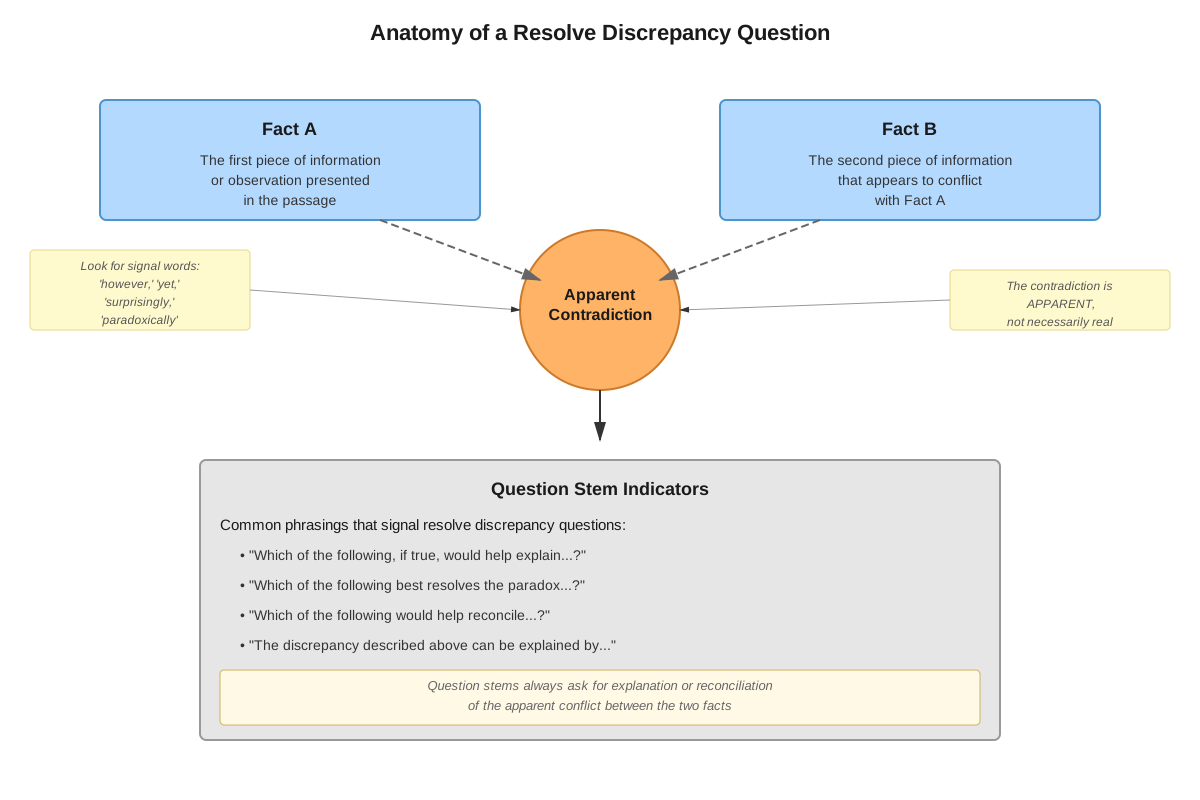
On the GRE, resolve discrepancy questions commonly appear in passages discussing scientific research (where experimental results seem to contradict predictions), social science topics (where demographic trends appear inconsistent), business scenarios (where market behaviors seem paradoxical), or historical analyses (where events seem to contradict established patterns). The questions are typically phrased with trigger words such as "explain," "resolve," "reconcile," "account for," or "which of the following, if true, would help explain." Recognizing these linguistic markers helps students quickly identify the question type and activate the appropriate problem-solving strategy.
Core Concepts
Understanding What Constitutes a Discrepancy
A discrepancy in GRE terms refers to an apparent contradiction, paradox, or unexpected outcome presented within a passage. The key word here is "apparent"—the contradiction is not necessarily real, but rather seems contradictory based on the information initially provided. For example, a passage might state that a company increased its advertising budget by 50% while simultaneously experiencing a 20% decline in sales. These two facts appear contradictory because increased advertising typically correlates with increased sales, yet both statements can be true if additional explanatory factors exist.
True discrepancies in GRE passages share several characteristics. First, they involve two or more pieces of information that seem logically incompatible based on common assumptions or stated expectations. Second, they create a puzzle that demands explanation—the reader naturally asks "how can both of these things be true?" Third, they can be resolved by introducing new information that provides context, identifies a confounding variable, or reveals a previously unstated mechanism. Understanding these characteristics helps students distinguish genuine resolve discrepancy questions from other question types that might superficially resemble them.
The Core Strategy: The Bridge Concept
The fundamental strategy for resolve discrepancy questions involves finding the "bridge" that connects two apparently contradictory pieces of information. This bridge is always a piece of information that makes both sides of the discrepancy logically compatible. The correct answer will typically introduce a new factor, provide additional context, identify a relevant distinction, or reveal a mechanism that explains why the seemingly contradictory facts can coexist.
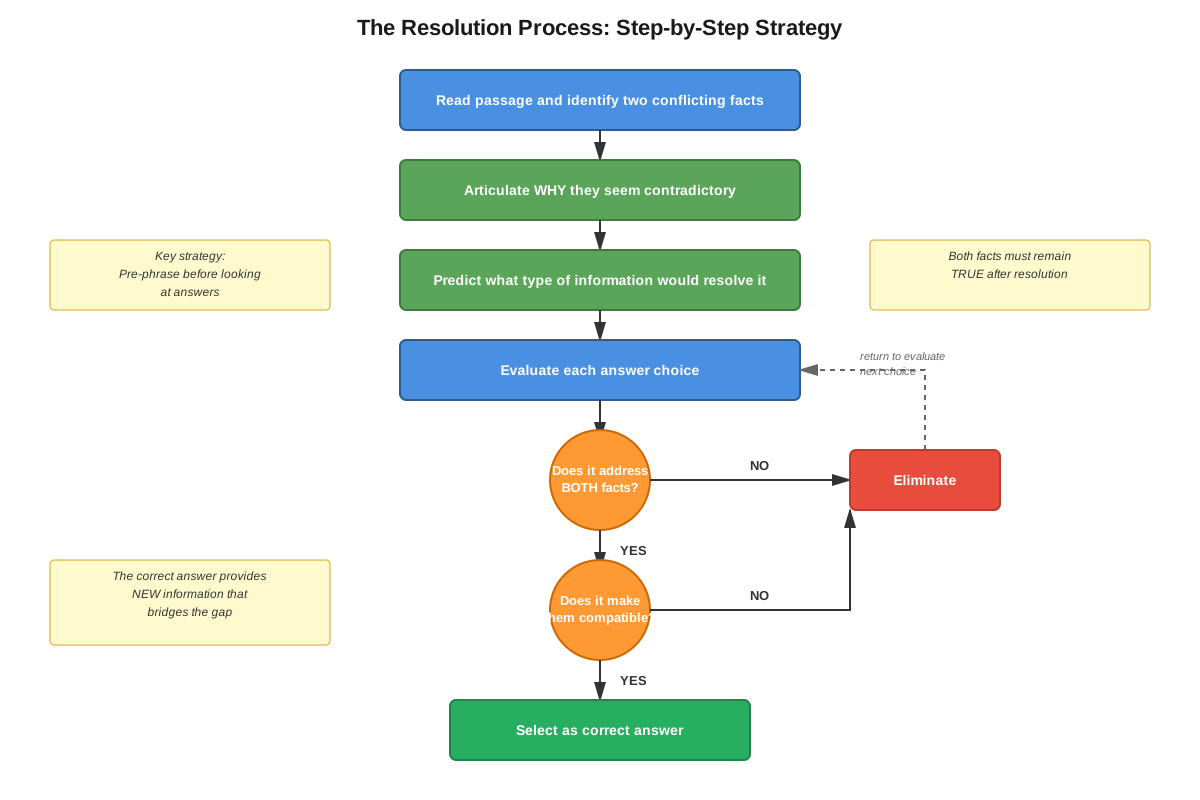
When approaching these questions, students should follow this systematic process:
- Identify the two sides of the discrepancy clearly: Articulate exactly what seems contradictory. Often, writing out "On one hand... but on the other hand..." helps crystallize the tension.
- Determine what assumption makes the information seem contradictory: Discrepancies only exist relative to certain assumptions. Identifying the implicit assumption reveals what needs to be addressed.
- Predict what type of information would resolve the tension: Before looking at answer choices, hypothesize what kind of explanation would make both facts compatible.
- Evaluate each answer choice against both sides: The correct answer must address BOTH parts of the discrepancy, not just one side.
- Eliminate answers that worsen the discrepancy or are irrelevant: Wrong answers often explain only one side, introduce new contradictions, or discuss tangential issues.
Types of Resolutions
Resolve discrepancy questions can be answered through several common resolution patterns:
Temporal distinctions: The discrepancy exists because the two pieces of information refer to different time periods. For example, sales might have increased in the short term but decreased in the long term.
Scope or category distinctions: The apparently contradictory information actually refers to different subgroups, categories, or contexts. A medication might be effective for one demographic while ineffective for another.
Confounding variables: An unmentioned third factor influences both sides of the discrepancy. Economic conditions might explain why increased advertising didn't boost sales.
Measurement or definition differences: What appears contradictory results from measuring different things or using different definitions. "Success" might be defined differently in two contexts.
Mechanism explanations: The resolution reveals a process or mechanism that explains the unexpected relationship. A drug might reduce symptoms while actually worsening the underlying condition through a specific biological pathway.
Distinguishing Correct from Incorrect Answers
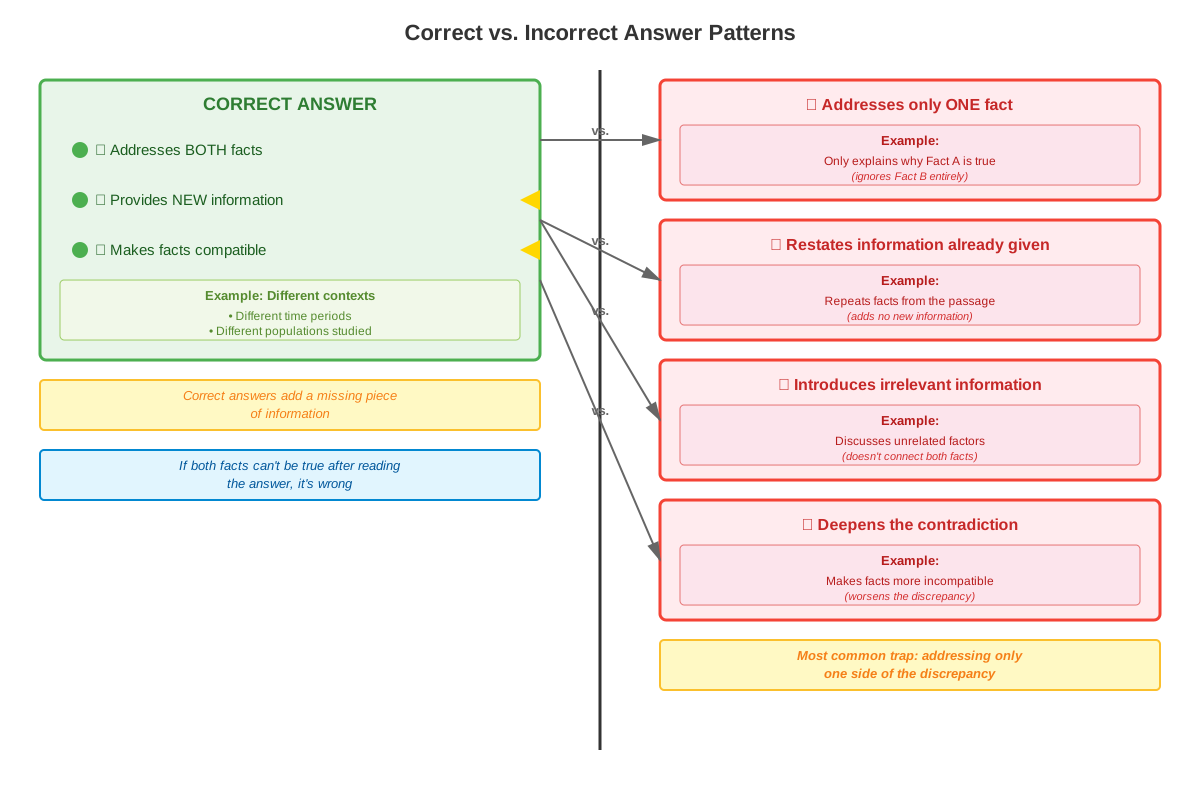
The correct answer to a resolve discrepancy question has a unique logical property: it makes the discrepancy disappear by showing how both sides can be true simultaneously. Incorrect answers typically fall into predictable categories:
| Wrong Answer Type | Characteristic | Why It's Wrong |
|---|---|---|
| One-sided explanation | Addresses only one part of the discrepancy | Doesn't show how both facts can coexist |
| Irrelevant information | Discusses related but tangential issues | Doesn't bridge the logical gap |
| Worsens the discrepancy | Makes the contradiction more severe | Moves in the wrong direction |
| Requires additional assumptions | Only works if you assume unstated facts | Correct answers are self-sufficient |
| Opposite resolution | Would resolve the opposite discrepancy | Tests whether you understood the tension |
The Role of Assumptions in Discrepancies
Every discrepancy rests on an underlying assumption that creates the appearance of contradiction. For instance, if a passage states that "despite increased rainfall, crop yields declined," the discrepancy exists only because we assume increased rainfall should improve crop yields. The correct answer might reveal that the rainfall came at the wrong time in the growing season, or that it was accompanied by decreased sunlight, or that it caused flooding. Each of these resolutions works by addressing the assumption that connects rainfall to crop yields.
Skilled test-takers explicitly identify these assumptions before evaluating answer choices. This practice transforms resolve discrepancy questions from confusing puzzles into systematic logical exercises. The assumption is always the "missing link" that, when properly understood, points directly toward the correct answer.
Concept Relationships
The concepts within resolve discrepancy questions form an interconnected logical framework. The identification of the discrepancy serves as the foundation, leading directly to assumption analysis—understanding what makes the information seem contradictory. This assumption analysis then guides the prediction of resolution types, which informs the systematic evaluation of answer choices. Each step builds on the previous one, creating a coherent problem-solving methodology.
Resolve discrepancy questions connect to prerequisite topics in important ways. Argument structure recognition provides the framework for identifying the two sides of a discrepancy, as each side typically functions as a premise or conclusion within a larger argument. Reading comprehension fundamentals enable students to extract the relevant information from passages without being distracted by supporting details. Logical reasoning basics supply the tools for understanding causal relationships and conditional logic that often underlie discrepancies.
Within the broader Verbal Reasoning section, resolve discrepancy questions relate closely to several other question types. Assumption questions ask what must be true for an argument to work; resolve discrepancy questions essentially ask what would make an apparent contradiction work. Strengthen questions ask what would make an argument more convincing; resolving a discrepancy within an argument strengthens it. Inference questions require drawing conclusions from stated information; resolve discrepancy questions require inferring what additional information would reconcile stated facts.
The relationship map flows as follows: Reading Comprehension Skills → Argument Structure Recognition → Discrepancy Identification → Assumption Analysis → Resolution Prediction → Answer Evaluation → Correct Answer Selection. Each arrow represents a logical dependency, and mastery of earlier steps directly improves performance on later steps.
High-Yield Facts
⭐ Resolve discrepancy questions always present two pieces of information that seem contradictory but are both stated as true in the passage
⭐ The correct answer must address BOTH sides of the discrepancy, not just explain one side
⭐ Common trigger phrases include "explain," "resolve," "reconcile," "account for," and "which of the following, if true"
⭐ Every discrepancy rests on an implicit assumption that creates the appearance of contradiction
⭐ The correct answer introduces new information that was not stated in the passage but makes both facts compatible
- Wrong answers often explain only one side of the discrepancy while ignoring the other
- Temporal distinctions (different time periods) and scope distinctions (different categories) are among the most common resolution types
- The correct answer should make you think "Oh, now I see why both things can be true"
- Resolve discrepancy questions test logical reasoning more than reading comprehension
- Predicting the type of resolution before reading answer choices significantly improves accuracy
- Answer choices that worsen the discrepancy or introduce new contradictions are always wrong
- The resolution doesn't need to be the only possible explanation, just a sufficient one
- These questions appear in approximately 10-15% of Reading Comprehension questions on the GRE
- Passages with discrepancies often discuss research findings, market trends, or historical events
- The discrepancy is usually stated explicitly, not hidden within complex prose
Quick check — test yourself on Resolve discrepancy questions so far.
Try Flashcards →Common Misconceptions
Misconception: The correct answer must completely eliminate all possible confusion or questions about the topic. → Correction: The correct answer only needs to show how both sides of the stated discrepancy can be true simultaneously; it doesn't need to explain every aspect of the situation or answer every possible question.
Misconception: If an answer choice explains one side of the discrepancy very well, it's probably correct. → Correction: One-sided explanations are among the most common wrong answers. The correct answer must address both sides of the apparent contradiction, showing how they can coexist.
Misconception: The correct answer will always introduce a completely new concept not mentioned anywhere in the passage. → Correction: While the correct answer does introduce new information, it often relates to concepts already present in the passage. The new information provides context or reveals a mechanism that connects existing ideas.
Misconception: Resolve discrepancy questions are asking for the most likely explanation in the real world. → Correction: These questions ask for an explanation that logically resolves the stated discrepancy, regardless of real-world probability. An answer that seems unlikely but perfectly resolves the logical tension is better than a realistic answer that doesn't address both sides.
Misconception: If you can think of a way that an answer choice might not fully resolve the discrepancy, you should eliminate it. → Correction: The correct answer needs to be sufficient to resolve the discrepancy, not necessary or perfect. If an answer choice makes both facts compatible, it's correct even if you can imagine edge cases or alternative explanations.
Misconception: The discrepancy must involve a direct logical contradiction where both statements cannot possibly be true. → Correction: GRE discrepancies are "apparent" contradictions—they seem inconsistent based on common assumptions or expectations, but they're not formal logical contradictions. Both statements are presented as true; the question asks what explains the unexpected relationship.
Misconception: Longer, more detailed answer choices are more likely to be correct because they provide more thorough explanations. → Correction: Answer length has no correlation with correctness. The correct answer might be concise and direct, while wrong answers might be verbose but irrelevant or one-sided.
Worked Examples
Example 1: Scientific Research Discrepancy
Passage: A recent study found that people who drink coffee regularly have lower rates of heart disease than those who don't drink coffee. However, the same study found that among people who already have heart disease, those who drink coffee have worse outcomes than those who abstain.
Question: Which of the following, if true, would best help to explain the apparently contradictory findings?
Answer Choices:
A) Coffee contains antioxidants that can protect against the initial development of heart disease but also contains caffeine that can exacerbate existing heart conditions
B) People who drink coffee regularly tend to exercise more frequently than those who don't drink coffee
C) The study included participants from multiple countries with different coffee-drinking traditions
D) Heart disease has multiple subtypes, some more severe than others
E) Coffee consumption has increased significantly over the past two decades
Solution Process:
Step 1 - Identify the discrepancy: On one hand, coffee drinkers have lower rates of heart disease (suggesting coffee is protective). On the other hand, among people with heart disease, coffee drinkers have worse outcomes (suggesting coffee is harmful).
Step 2 - Identify the assumption: The discrepancy exists because we assume that if coffee protects against heart disease, it should also help people who already have heart disease. We expect a substance to have consistent effects.
Step 3 - Predict the resolution: We need an explanation that shows how coffee can be protective in one context (preventing disease) but harmful in another context (existing disease). This likely involves different mechanisms or effects at different stages.
Step 4 - Evaluate answer choices:
- Choice A: This directly addresses both sides. Antioxidants explain the protective effect (lower rates), while caffeine's exacerbating effect explains worse outcomes for those with existing disease. This shows how coffee can have different effects depending on whether disease is present. This resolves the discrepancy.
- Choice B: This only addresses one side—it might explain why coffee drinkers have lower rates (they exercise more), but it doesn't explain why coffee drinkers with existing heart disease have worse outcomes. Incomplete resolution.
- Choice C: This provides context but doesn't explain the contradictory findings. Different traditions don't show how both findings can be true. Irrelevant.
- Choice D: This discusses heart disease subtypes but doesn't connect this to coffee consumption or explain the different effects. Doesn't bridge the gap.
- Choice E: This historical trend is completely irrelevant to explaining the relationship between coffee and heart disease outcomes. Off-topic.
Correct Answer: A
This example demonstrates the classic resolution pattern of revealing different mechanisms that operate in different contexts. The correct answer makes you think, "Ah, coffee has two different components with opposite effects, and which effect dominates depends on whether disease is already present."
Example 2: Economic Discrepancy
Passage: Despite implementing aggressive cost-cutting measures that reduced operating expenses by 30%, TechCorp's profit margins actually decreased during the same quarter. The company's revenue remained stable throughout this period.
Question: Which of the following best accounts for the unexpected decrease in profit margins?
Answer Choices:
A) TechCorp's competitors also reduced their operating expenses during the same period
B) The cost-cutting measures included eliminating the quality control department, leading to increased product returns and refund costs that exceeded the savings
C) TechCorp's CEO received criticism from shareholders for the cost-cutting approach
D) Operating expenses represent only one component of a company's total costs
E) Profit margins in the technology sector have been declining industry-wide
Solution Process:
Step 1 - Identify the discrepancy: Operating expenses decreased by 30% and revenue stayed stable, yet profit margins decreased. This seems contradictory because lower expenses with stable revenue should increase profit margins (profit margin = revenue minus costs, divided by revenue).
Step 2 - Identify the assumption: The discrepancy assumes that operating expenses are the only relevant costs. If reducing operating expenses somehow increased other costs, profit margins could decrease despite the expense reduction.
Step 3 - Predict the resolution: We need an explanation showing how the cost-cutting measures led to increased costs elsewhere, or how the 30% reduction in operating expenses was offset by increases in other areas.
Step 4 - Evaluate answer choices:
- Choice A: What competitors did doesn't explain TechCorp's internal financial relationship between expenses and profit margins. Irrelevant to the specific discrepancy.
- Choice B: This perfectly resolves the discrepancy. The cost-cutting (eliminating quality control) reduced operating expenses but created new costs (returns and refunds) that exceeded the savings. Both facts can now coexist: operating expenses went down, but total costs went up, decreasing profit margins. This resolves the discrepancy.
- Choice C: Shareholder criticism doesn't explain the financial relationship between expenses and profit margins. This is about perception, not accounting. Irrelevant.
- Choice D: While technically true, this doesn't explain the specific situation. It hints at the resolution but doesn't provide the mechanism showing how costs increased elsewhere. Too vague.
- Choice E: Industry-wide trends don't explain why TechCorp's specific cost-cutting measures failed to improve margins. This would explain declining margins without cost-cutting, but not with it. Doesn't address both sides.
Correct Answer: B
This example illustrates the "confounding variable" resolution pattern. The cost-cutting measures had an unintended consequence that offset their benefits. The correct answer reveals a hidden mechanism that explains why the expected outcome (improved margins) didn't occur.
Exam Strategy
When approaching GRE resolve discrepancy questions, begin by investing 15-20 seconds in clearly articulating the discrepancy before looking at answer choices. This upfront investment pays dividends by preventing confusion and misdirection. Literally ask yourself: "What seems contradictory here?" and "Why do these facts seem incompatible?" This mental clarity transforms a potentially confusing question into a systematic logical puzzle.
Trigger words and phrases that signal resolve discrepancy questions include: "explain," "resolve," "reconcile," "account for," "help to explain," "which of the following, if true," "best explains the apparent discrepancy," and "paradox." When you see these phrases, immediately shift into discrepancy-resolution mode. Recognize that you're not being asked to strengthen an argument, make an inference, or identify an assumption—you're being asked to bridge a logical gap.
Process of elimination is particularly powerful for these questions. Systematically eliminate answer choices that:
- Address only one side of the discrepancy (test each answer against both sides explicitly)
- Introduce information that worsens or complicates the discrepancy
- Discuss tangential topics that don't bridge the logical gap
- Require you to make additional assumptions to work
Exam Tip: After identifying what you think is the correct answer, perform the "both sides test"—explicitly verify that the answer addresses both parts of the discrepancy. This five-second check catches most errors.
Time allocation for resolve discrepancy questions should be approximately 1.5-2 minutes per question. These questions reward careful analysis more than speed. If you find yourself rushing and confused, slow down and re-articulate the discrepancy. Conversely, if you've clearly identified the discrepancy and predicted the resolution type, you can often identify the correct answer quickly and move on.
Common trap answers include those that explain one side beautifully while ignoring the other, and those that introduce real-world knowledge that seems relevant but doesn't logically resolve the stated discrepancy. Remember: the GRE tests logical reasoning, not real-world knowledge. An answer that seems unlikely in reality but perfectly resolves the logical tension is better than a realistic answer that doesn't address both sides.
When stuck between two answers, return to the discrepancy itself. Re-read the relevant sentences in the passage, re-articulate what seems contradictory, and then test each answer choice against your clear understanding of both sides. The correct answer will have an "aha" quality—it will make you see how both facts can coexist, while wrong answers will leave at least one side unexplained.
Memory Techniques
BRIDGE acronym for the systematic approach:
- Both sides: Identify both parts of the discrepancy clearly
- Reason: Determine what assumption makes them seem contradictory
- Imagine: Predict what type of information would resolve it
- Distinguish: Evaluate how each answer addresses the tension
- Gap: The correct answer fills the logical gap between both sides
- Eliminate: Remove one-sided and irrelevant answers
The "Two Hands" visualization: Imagine holding one side of the discrepancy in your left hand and the other side in your right hand. The correct answer is the bridge that connects your hands. As you evaluate each answer choice, visualize whether it actually connects both hands or just touches one.
The "Aha Test" mnemonic: The correct answer should make you say "Aha! Now I see how both can be true!" If an answer doesn't produce this reaction, it's probably wrong. This emotional/cognitive response is a reliable indicator because true resolutions create a sense of clarity and understanding.
TEMPO for resolution types:
- Temporal: Different time periods
- Explanatory mechanism: Reveals a process
- Measurement: Different definitions or metrics
- Population: Different subgroups or categories
- Outside factor: Confounding variable
The "Both Sides Test" reminder: Before selecting an answer, physically point to or touch both sides of the discrepancy on your scratch paper and verify that your chosen answer addresses each one. This kinesthetic reinforcement prevents the most common error.
Summary
Resolve discrepancy questions test the ability to identify and explain apparent contradictions within GRE passages by finding information that makes seemingly incompatible facts logically compatible. These questions require students to move beyond surface-level comprehension to analyze the logical structure of arguments, identify implicit assumptions that create the appearance of contradiction, and systematically evaluate which answer choice serves as the "bridge" connecting both sides of the discrepancy. The core strategy involves clearly articulating both sides of the tension, determining what assumption makes them seem contradictory, predicting the type of resolution needed, and then evaluating answer choices against both sides of the discrepancy. Common resolution patterns include temporal distinctions, scope differences, confounding variables, measurement variations, and mechanism explanations. Success on these questions requires recognizing that the correct answer must address both sides of the discrepancy simultaneously—one-sided explanations, regardless of how compelling, are always incorrect. By mastering the systematic approach and avoiding common traps like one-sided answers and irrelevant information, students can consistently identify correct answers and demonstrate the higher-order reasoning skills that the GRE values.
Key Takeaways
- Resolve discrepancy questions present two apparently contradictory facts that are both true; the correct answer explains how they can coexist
- The systematic approach—identify both sides, analyze assumptions, predict resolution type, evaluate answers—transforms these questions from puzzles into methodical exercises
- The correct answer MUST address both sides of the discrepancy; one-sided explanations are the most common wrong answer type
- Common resolution patterns include temporal distinctions, scope differences, confounding variables, and mechanism explanations
- Trigger phrases like "explain," "resolve," "reconcile," and "account for" signal these question types
- Every discrepancy rests on an implicit assumption; identifying this assumption points toward the correct answer
- The "both sides test"—explicitly verifying that your chosen answer addresses both parts of the discrepancy—prevents most errors
Related Topics
Assumption Questions: These questions ask what must be true for an argument to work, which closely relates to identifying the assumptions that create apparent discrepancies. Mastering resolve discrepancy questions strengthens assumption identification skills.
Strengthen and Weaken Questions: Understanding how to resolve discrepancies helps with strengthen questions because resolving internal contradictions strengthens arguments. The logical reasoning skills transfer directly.
Inference Questions: Both question types require drawing conclusions from stated information, though inference questions ask what must be true while resolve discrepancy questions ask what would explain an apparent contradiction.
Causal Reasoning: Many discrepancies involve unexpected causal relationships. Studying causal reasoning patterns enhances the ability to identify confounding variables and alternative explanations.
Argument Structure Analysis: Deep understanding of how premises support conclusions provides the foundation for recognizing when information seems contradictory and what would resolve the tension.
Practice CTA
Now that you've mastered the concepts and strategies for resolve discrepancy questions, it's time to apply this knowledge to actual GRE-style practice questions. The systematic approach you've learned—identifying both sides, analyzing assumptions, predicting resolutions, and evaluating answers—becomes automatic only through deliberate practice. Challenge yourself with the practice questions and flashcards, focusing not just on getting correct answers but on executing the process efficiently. Each practice question is an opportunity to refine your technique and build the confidence that leads to top scores. Remember: resolve discrepancy questions reward careful analysis and systematic thinking—skills you've now developed and are ready to demonstrate!
Sign up free to keep reading
Create a free AnvayaPrep account to finish this GRE guide on Resolve discrepancy questions — plus flashcards and practice questions.