Overview
GRE reading pacing represents one of the most critical yet frequently overlooked skills for achieving a competitive Verbal Reasoning score. Unlike content mastery alone, effective pacing determines whether test-takers can demonstrate their knowledge within the strict time constraints of the exam. The GRE Verbal Reasoning section allocates approximately 30 minutes for 20 questions across two sections, with Reading Comprehension passages consuming roughly 50-60% of that time. Students who fail to develop strategic pacing habits often find themselves rushing through final questions, making careless errors, or leaving questions unanswered—all of which significantly impact scores.
The challenge of gre reading pacing extends beyond simply reading faster. It requires a sophisticated understanding of when to invest time deeply analyzing passage details versus when to skim for main ideas, how to allocate seconds per question type, and which strategic shortcuts preserve accuracy while maximizing efficiency. Test-takers must balance thoroughness with speed, recognizing that the GRE rewards both comprehension and time management equally. A student who answers 18 questions correctly with strategic pacing will typically outscore one who answers 15 questions perfectly but runs out of time.
This topic integrates fundamentally with all other Verbal Reasoning concepts, serving as the operational framework through which content knowledge becomes actionable test performance. Strong pacing enables effective application of vocabulary strategies, critical reasoning skills, and passage analysis techniques. Without mastery of gre gre reading pacing, even students with exceptional verbal abilities may underperform, while those with strategic time management can maximize every point available within their skill level.
Learning Objectives
- [ ] Identify when GRE reading pacing is being tested
- [ ] Explain the core rule or strategy behind GRE reading pacing
- [ ] Apply GRE reading pacing to GRE-style questions accurately
- [ ] Calculate optimal time allocation for different passage lengths and question types
- [ ] Recognize warning signs of pacing problems during practice and actual test conditions
- [ ] Implement recovery strategies when falling behind the target pace
- [ ] Evaluate personal reading speed and adjust strategies accordingly
Prerequisites
- Basic reading comprehension skills: Understanding main ideas, supporting details, and author's purpose forms the foundation upon which pacing strategies build
- Familiarity with GRE question formats: Knowing the structure of Text Completion, Sentence Equivalence, and Reading Comprehension questions prevents time waste on format confusion
- Baseline typing/clicking proficiency: Computer-based test navigation must be automatic to avoid losing seconds on interface mechanics
- Ability to focus for 30-minute intervals: Sustained concentration enables consistent pacing without mental fatigue disruptions
Why This Topic Matters
Pacing directly determines score outcomes on the GRE Verbal Reasoning section more than any other single factor. Research on standardized testing consistently shows that students who complete all questions, even with slightly lower accuracy on individual items, score higher than those who achieve perfect accuracy on incomplete sections. The GRE's scoring algorithm penalizes unanswered questions severely, making strategic time management essential for competitive scores in the 160+ range.
On the actual exam, Reading Comprehension passages appear in sets of 1-6 questions per passage, with passage lengths varying from approximately 100 words (short) to 450 words (long). Statistical analysis of GRE performance data reveals that students typically encounter 10 Reading Comprehension questions per 20-question Verbal section, consuming 15-18 minutes of the 30-minute allocation. The remaining time must cover Text Completion and Sentence Equivalence questions, creating intense pressure that makes efficient reading non-negotiable.
Common manifestations of pacing challenges include: spending 4+ minutes on a single difficult passage, re-reading paragraphs multiple times without strategic purpose, getting trapped in detail-oriented questions that consume disproportionate time, and failing to recognize when to make an educated guess and move forward. These patterns appear consistently across test-taker populations and represent the primary difference between students who score in the 150s versus those who break into the 160s and 170s.
Core Concepts
The 1.5-Minute Rule
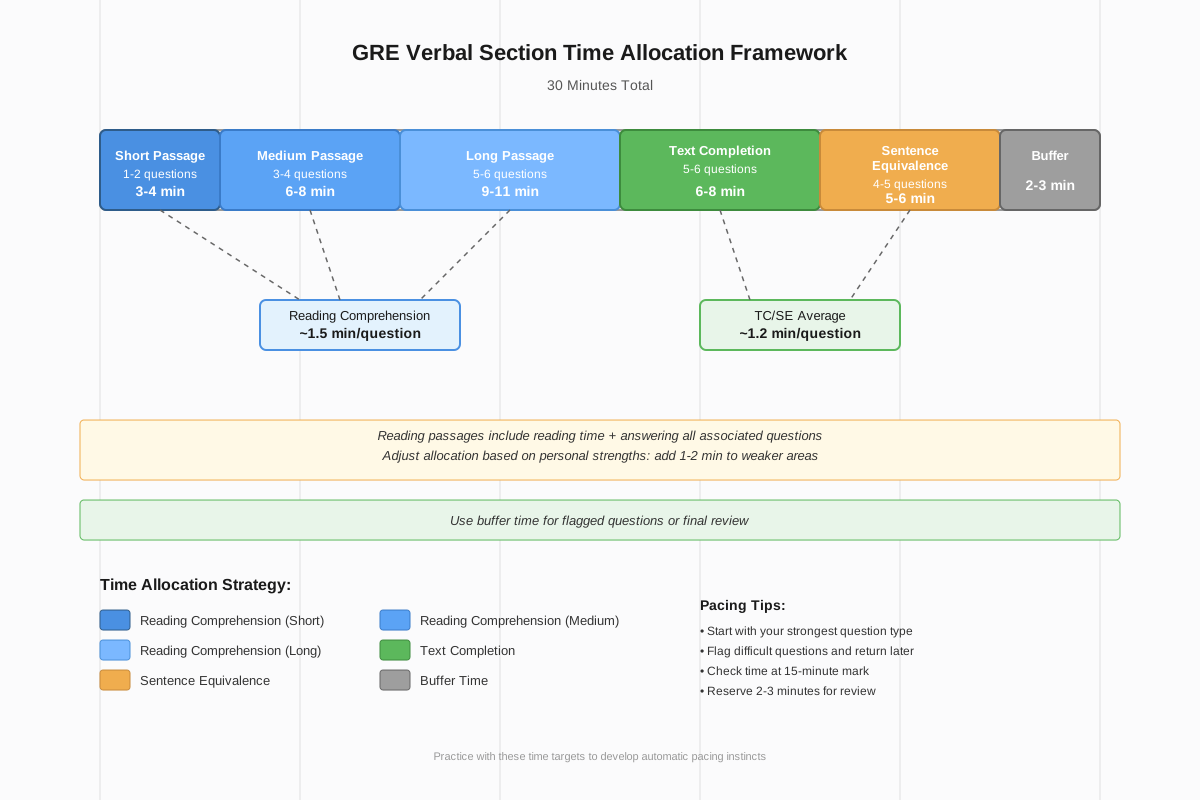
The foundational principle of GRE reading pacing centers on the 1.5-minute rule: each question should average approximately 1.5 minutes from start to finish, including passage reading time distributed across associated questions. This translates to 30 minutes ÷ 20 questions = 1.5 minutes per question. However, this average conceals important variations by question type and passage length.
For Reading Comprehension specifically, effective pacing requires front-loading time investment in passage reading (2-4 minutes depending on length) followed by rapid question answering (30-60 seconds per question). This approach contrasts with Text Completion and Sentence Equivalence questions, which typically require 45-90 seconds each without separate reading time.
Strategic Time Allocation by Passage Type
Different passage lengths demand different time investments to maintain optimal pacing:
| Passage Length | Reading Time | Questions | Time per Question | Total Time Budget |
|---|---|---|---|---|
| Short (100-150 words) | 1.5-2 minutes | 1-2 | 45-60 seconds | 2.5-4 minutes |
| Medium (200-300 words) | 2.5-3 minutes | 3-4 | 45-60 seconds | 5-7 minutes |
| Long (400-450 words) | 3.5-4 minutes | 5-6 | 45-60 seconds | 8-10 minutes |
These allocations assume average reading speed (250-300 words per minute) and must be adjusted based on individual baseline performance. Students who read significantly faster can invest additional seconds in question analysis, while slower readers must compensate through more aggressive skimming strategies.
Active Reading vs. Passive Reading
Active reading represents the cornerstone of efficient pacing. Rather than absorbing every word sequentially, active readers engage with text strategically, identifying structural elements that signal important information. This includes:
- Topic sentences that introduce paragraph main ideas (typically first or second sentence)
- Transition words that signal shifts in argument direction (however, moreover, nevertheless)
- Author's tone indicators that reveal perspective (unfortunately, clearly, supposedly)
- Structural markers that organize information (first, in contrast, finally)
Passive reading, by contrast, treats all text equally, resulting in 40-60% longer reading times without proportional comprehension gains. The GRE specifically designs passages to reward active reading by placing question-relevant information at structurally predictable locations.
The Two-Pass Strategy
Effective gre gre reading pacing often employs a two-pass approach:
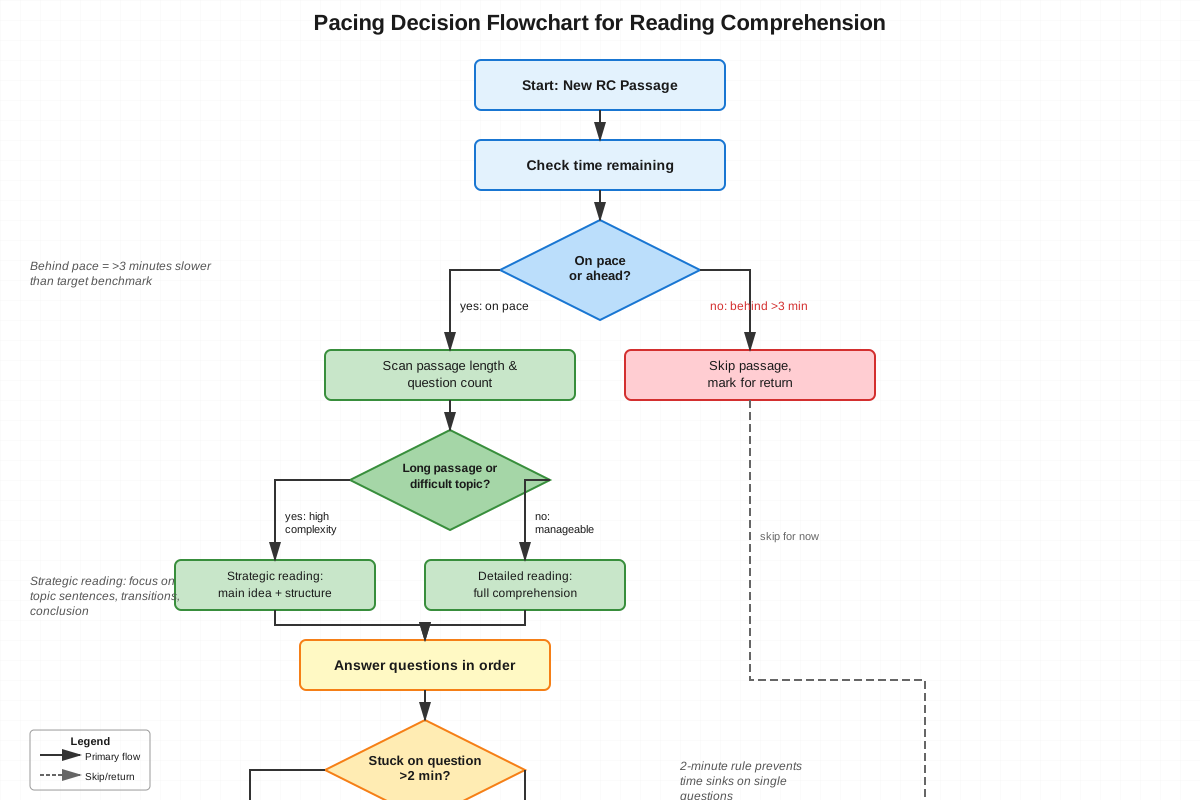
First Pass (Initial Reading): Invest 60-70% of allocated passage time reading for structure and main ideas. Focus on understanding the author's purpose, the passage's organizational pattern, and the location of key details without memorizing specifics. Create a mental map of where information resides.
Second Pass (Question-Driven): Return to specific passage sections as questions demand, using 30-40% of time for targeted re-reading. This approach prevents wasting time memorizing details that may never be tested while ensuring accurate answers to questions that do appear.
Recognizing Time Traps
Certain question types and passage characteristics consistently consume disproportionate time:
- Inference questions requiring synthesis of multiple passage elements
- EXCEPT/NOT questions demanding evaluation of all answer choices
- Detail questions about minor points requiring extensive passage searching
- Passages with unfamiliar technical vocabulary that slow reading speed
- Arguments with complex logical structures requiring careful tracking
Strategic pacing requires recognizing these traps early and implementing countermeasures: marking questions for review, making educated guesses based on partial information, or temporarily skipping to maintain forward momentum.
The 5-Minute Check-In Protocol
Maintaining pace requires regular time awareness. The 5-minute check-in protocol provides structure:
- At 5 minutes: Should have completed 3-4 questions
- At 10 minutes: Should have completed 6-7 questions
- At 15 minutes: Should have completed 10 questions (halfway point)
- At 20 minutes: Should have completed 13-14 questions
- At 25 minutes: Should have completed 17-18 questions
- Final 5 minutes: Complete remaining questions and review marked items
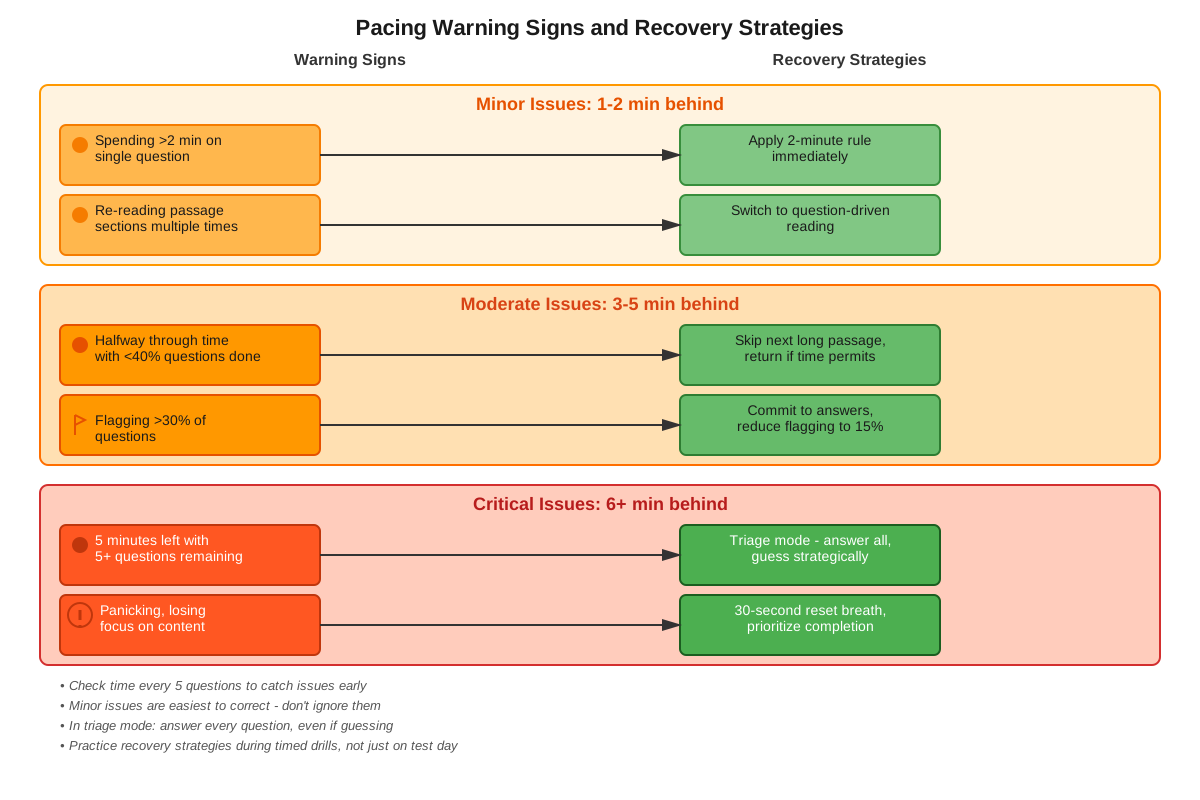
Falling more than 1 question behind at any check-in signals the need for immediate pacing adjustment.
Recovery Strategies
When pacing falls behind target, specific recovery techniques restore momentum:
- Aggressive guessing: On the next difficult question, invest only 30 seconds before selecting the best available answer
- Strategic skipping: Mark the current question and return after completing easier items
- Reduced re-reading: Trust initial comprehension more and return to passage less frequently
- Answer choice elimination: Focus on eliminating wrong answers rather than confirming right ones
These strategies sacrifice marginal accuracy (typically 5-10% on affected questions) to preserve overall completion rates, resulting in net score gains.
Concept Relationships
The concepts within GRE reading pacing form an interconnected system where each element supports the others. The 1.5-minute rule establishes the overarching framework → which informs strategic time allocation by passage type → which determines how to implement active reading techniques → which enable effective execution of the two-pass strategy → while recognizing time traps prevents derailment → and the 5-minute check-in protocol provides feedback → triggering recovery strategies when necessary.
This topic connects to prerequisite knowledge by building upon basic reading comprehension skills, transforming them into time-efficient processes. The relationship to other Verbal Reasoning topics is foundational: vocabulary strategies become actionable only when sufficient time remains to apply them; critical reasoning skills require time to analyze argument structure; passage analysis techniques must be executed within strict time constraints.
The progression flows: Basic comprehension → Strategic pacing → Advanced question-type strategies → Score optimization. Without mastering the middle step (strategic pacing), the connection between foundational skills and advanced techniques breaks down, limiting score potential regardless of content knowledge.
High-Yield Facts
⭐ The average time per question must be 1.5 minutes to complete all 20 questions in 30 minutes
⭐ Reading Comprehension passages should consume 2-4 minutes for initial reading, with 45-60 seconds per associated question
⭐ Students who complete all questions typically score higher than those who achieve perfect accuracy on incomplete sections
⭐ Active reading (focusing on structure and main ideas) reduces reading time by 30-40% compared to passive reading
⭐ The two-pass strategy (initial reading for structure, then question-driven re-reading) optimizes both speed and accuracy
- Long passages (400-450 words) should receive no more than 10 minutes total including all associated questions
- Falling more than 1 question behind at the 15-minute midpoint requires immediate pacing adjustment
- Inference questions and EXCEPT/NOT questions consistently consume 2-3x average time and require special pacing awareness
- Strategic guessing on 2-3 difficult questions typically improves overall scores by enabling completion of easier questions
- The final 5 minutes should be reserved for completing remaining questions and reviewing marked items, not for extended analysis of single questions
Quick check — test yourself on GRE reading pacing so far.
Try Flashcards →Common Misconceptions
Misconception: Reading faster automatically improves pacing → Correction: Effective pacing requires strategic reading (knowing what to read carefully vs. skim), not simply increasing reading speed. Students who read too quickly often miss structural cues and must re-read multiple times, ultimately consuming more time.
Misconception: Every question deserves equal time investment → Correction: Different question types and difficulty levels warrant different time allocations. A straightforward vocabulary-in-context question might require 30 seconds, while a complex inference question might justify 2 minutes. Strategic pacing means recognizing these differences and adjusting accordingly.
Misconception: Skipping questions wastes time because you must return to them later → Correction: Strategic skipping prevents getting trapped on difficult questions and maintains forward momentum. The time cost of returning to 1-2 skipped questions (15-30 seconds) is far less than the time lost to extended struggle on a single item (3-5 minutes).
Misconception: Strong readers don't need pacing strategies → Correction: Even students with exceptional reading comprehension skills face time pressure on the GRE. The exam specifically designs passages and questions to challenge time management, making pacing strategies essential regardless of baseline ability.
Misconception: Checking the clock frequently disrupts concentration → Correction: Regular time awareness (every 5 minutes) actually reduces anxiety by providing control and enabling proactive adjustments. Students who avoid checking time often experience panic when they suddenly realize they're far behind pace.
Misconception: Guessing always lowers scores → Correction: Strategic guessing on 2-3 difficult questions to ensure completion of all items typically increases overall scores. The GRE's scoring algorithm penalizes blank answers more severely than incorrect guesses, and time saved enables higher accuracy on remaining questions.
Worked Examples
Example 1: Pacing Analysis for a Medium-Length Passage
Scenario: A student encounters a 250-word passage about economic theory at the 8-minute mark of the Verbal section, with 3 associated questions. The student has completed 5 questions so far (slightly ahead of the target pace of 5.3 questions at 8 minutes).
Step 1 - Calculate Available Time: Target pace requires completing 10 questions by minute 15. With 7 minutes remaining until the midpoint check-in and 5 questions to complete (3 from this passage + 2 more), the student has approximately 7 minutes ÷ 5 questions = 1.4 minutes per question, slightly below the 1.5-minute average but acceptable given the ahead-of-pace position.
Step 2 - Allocate Passage Time: For a medium passage with 3 questions, optimal allocation is 2.5-3 minutes reading + 45-60 seconds per question = 5-6 minutes total. The student decides on 2.5 minutes for initial reading and 50 seconds per question (2.5 minutes for questions) = 5 minutes total.
Step 3 - Execute Active Reading: The student spends 2.5 minutes identifying: (1) the passage discusses competing economic theories, (2) paragraph 1 introduces Theory A, (3) paragraph 2 presents Theory B as an alternative, (4) paragraph 3 evaluates both theories. The student notes transition words ("however," "in contrast") and the author's slightly favorable tone toward Theory B.
Step 4 - Answer Questions Efficiently: Question 1 asks about the main purpose (structure question) - answered in 35 seconds using the mental map. Question 2 asks about a specific detail regarding Theory A - requires 15 seconds to locate in paragraph 1, then 40 seconds to answer (55 seconds total). Question 3 asks what the author would likely agree with (inference question) - takes 70 seconds, slightly over budget but acceptable.
Step 5 - Evaluate Outcome: Total time spent: 2.5 + 0.6 + 0.9 + 1.2 = 5.2 minutes, within the 5-6 minute target. The student completes the passage at minute 13.2, having answered 8 questions total, ahead of the 10-question midpoint target and well-positioned for the remainder of the section.
Connection to Learning Objectives: This example demonstrates applying GRE reading pacing strategies accurately, calculating optimal time allocation, and recognizing when slight variations from target pace (70 seconds on question 3) remain acceptable within overall time management.
Example 2: Implementing Recovery Strategy
Scenario: A student reaches the 15-minute midpoint having completed only 8 questions instead of the target 10, falling 2 questions behind pace. The current question is a complex EXCEPT question about a long passage, and the student has already invested 90 seconds without reaching an answer.
Step 1 - Recognize the Problem: The student performs a 15-minute check-in and realizes the 2-question deficit. Continuing at the current pace would result in 2-3 unanswered questions at time expiration, likely costing 10-15 percentile points.
Step 2 - Implement Immediate Recovery: Rather than continuing to struggle with the current EXCEPT question (a known time trap), the student makes an educated guess based on partial analysis. Two answer choices have been eliminated, leaving three possibilities. The student selects the choice that seems least consistent with the passage's main argument and moves forward. Time invested: 2 minutes total (acceptable for a difficult question, but no more time can be spent).
Step 3 - Adjust Remaining Strategy: For the next 5 questions (minutes 15-20), the student targets 1.2 minutes per question instead of 1.5, creating a 1.5-minute buffer to recover the deficit. This requires: (1) more aggressive skimming on the next passage, (2) trusting initial answer choice instincts without extensive verification, (3) limiting re-reading to one targeted return per question.
Step 4 - Execute Adjusted Pace: The student encounters a short passage with 2 questions. Instead of the typical 2-minute reading time, the student invests 1.5 minutes, focusing exclusively on main idea and structure. Questions are answered in 40 seconds each. Total time: 2.6 minutes for 2 questions (1.3 minutes per question), recovering 24 seconds toward the deficit.
Step 5 - Monitor Progress: At the 20-minute mark, the student has completed 13 questions (target: 13-14), successfully recovering most of the deficit. The final 10 minutes can proceed at normal pace, with high probability of completing all 20 questions.
Connection to Learning Objectives: This example demonstrates recognizing warning signs of pacing problems, implementing recovery strategies, and adjusting strategies based on real-time performance evaluation.
Exam Strategy
When approaching GRE Verbal Reasoning sections, implement these pacing-specific strategies:
Before Starting: Mentally commit to the 5-minute check-in protocol. Visualize the timing benchmarks (3-4 questions at 5 minutes, 10 questions at 15 minutes, etc.) to enable automatic monitoring without disrupting flow.
Trigger Words for Time Traps: Recognize question stems that signal potentially time-consuming items: "EXCEPT," "NOT," "all of the following," "the author would most likely agree," "which of the following can be inferred." When encountering these triggers, set a mental 90-second timer and commit to guessing if no clear answer emerges.
Process of Elimination for Pacing: When time pressure increases, shift from "finding the right answer" to "eliminating wrong answers." This cognitive reframing often reduces decision time by 30-40% because wrong answers typically contain more obvious flaws than right answers contain confirmatory evidence.
Strategic Question Order: The GRE presents questions in fixed order, but within Reading Comprehension sets, consider answering main idea and structure questions first (typically faster) before detail and inference questions (typically slower). This approach banks quick points early and provides flexibility for time-intensive questions later.
Time Allocation Advice:
- Spend no more than 2 minutes on any single question during the first 20 minutes
- Reserve the final 5 minutes for completing remaining questions and reviewing marked items
- If a passage feels exceptionally difficult, consider investing slightly less reading time and accepting that associated questions may require educated guesses
- Never leave questions blank; even random guessing provides 20% expected value on five-choice questions
Physical Timing Cues: Use the scratch paper to mark the current time at 5-minute intervals, creating a visual reference that prevents time-checking from disrupting concentration. Write "5:00 - Q3-4," "10:00 - Q6-7," etc., as benchmarks.
Memory Techniques
The "1-5-10" Mnemonic: Remember the three critical check-in points:
- 1 = 1.5 minutes per question average
- 5 = 5-minute check-ins throughout the section
- 10 = 10 questions completed at the 15-minute midpoint
The "RACE" Acronym for Active Reading:
- Recognize structure (introduction, body, conclusion)
- Annotate mentally (main ideas, transitions, tone)
- Connect ideas (how paragraphs relate)
- Evaluate purpose (why the author wrote this)
The "2-4-6" Passage Time Rule:
- 2 minutes for short passages
- 4 minutes for medium passages
- 6 minutes for long passages (maximum)
Visualization Strategy: Picture the 30-minute section as a race with three 10-minute segments. Each segment should cover approximately 7 questions. Visualize crossing "mile markers" at 10 and 20 minutes, checking position relative to the target pace.
The "SKIP" Decision Framework:
- Spent more than 90 seconds?
- Know you're guessing between 3+ choices?
- Inference or EXCEPT question?
- Pace falling behind?
If yes to 2+ factors, skip and return later.
Summary
GRE reading pacing represents the operational framework that transforms verbal knowledge into test performance. The core principle centers on the 1.5-minute average per question, with strategic variations by passage length and question type. Effective pacing requires active reading techniques that prioritize structure and main ideas over comprehensive detail absorption, implemented through a two-pass strategy that front-loads passage reading time and enables rapid question answering. Regular time monitoring via 5-minute check-ins provides feedback for proactive adjustments, while recognition of time traps (inference questions, EXCEPT questions, unfamiliar passages) prevents derailment. When pacing falls behind target, recovery strategies including aggressive guessing, strategic skipping, and reduced re-reading restore momentum with minimal accuracy sacrifice. Success requires balancing thoroughness with efficiency, recognizing that completing all questions with slightly lower per-item accuracy consistently outperforms perfect accuracy on incomplete sections. Students must develop personalized pacing strategies based on individual reading speed and question-type strengths, then practice these strategies until they become automatic under test conditions.
Key Takeaways
- The 1.5-minute average per question is non-negotiable for completing all 20 questions in 30 minutes, requiring strategic time allocation by passage length and question type
- Active reading focusing on structure and main ideas reduces reading time by 30-40% compared to passive comprehensive reading, enabling the two-pass strategy
- Regular 5-minute check-ins provide essential feedback for maintaining pace, with the 15-minute midpoint (10 questions completed) serving as the critical benchmark
- Time traps including inference questions, EXCEPT/NOT questions, and unfamiliar passages require recognition and countermeasures to prevent disproportionate time consumption
- Strategic guessing and skipping on 2-3 difficult questions typically improves overall scores by ensuring completion of all items and preventing time-pressure errors on easier questions
- Recovery strategies must be implemented immediately when falling behind pace, as deficits compound rapidly in the final 10 minutes of the section
- Pacing mastery requires personalized strategy development based on individual reading speed and consistent practice under timed conditions until techniques become automatic
Related Topics
Text Completion Pacing Strategies: While this guide focuses on Reading Comprehension pacing, Text Completion questions require different time management approaches due to their self-contained nature and vocabulary emphasis. Mastering reading pacing provides the foundation for developing comprehensive Verbal section time management.
Sentence Equivalence Time Optimization: Similar to Text Completion, Sentence Equivalence questions demand specific pacing strategies that complement reading pacing skills. Understanding how to allocate time across all three Verbal question types enables holistic section performance.
Passage Mapping Techniques: Advanced passage analysis methods that support efficient pacing by creating mental or written organizational frameworks. Strong pacing skills make passage mapping more effective by ensuring sufficient time for implementation.
Question Type Identification and Strategy Selection: Recognizing question types quickly enables appropriate time allocation and strategy application. Pacing mastery allows students to leverage question-type-specific strategies without time pressure.
Adaptive Test-Taking Under Time Pressure: The GRE's computer-adaptive format requires real-time strategy adjustments based on question difficulty. Solid pacing skills provide the foundation for effective adaptive decision-making throughout the exam.
Practice CTA
Now that you understand the principles and strategies of GRE reading pacing, the next critical step is application through deliberate practice. Attempt the practice questions associated with this topic, focusing not just on answer accuracy but on timing for each question. Use the 5-minute check-in protocol during practice sets to build automatic time awareness. Review the flashcards to reinforce key pacing benchmarks and strategies until they become second nature.
Remember: pacing skills develop through consistent practice under realistic time constraints. Each practice session represents an opportunity to refine your personal pacing strategy, identify your specific time traps, and build the confidence necessary for optimal performance on test day. Your investment in mastering these techniques will directly translate to score improvements across the entire Verbal Reasoning section.
Sign up free to keep reading
Create a free AnvayaPrep account to finish this GRE guide on GRE reading pacing — plus flashcards and practice questions.