Overview
Text completion pacing is a critical strategic skill that separates high-scoring GRE test-takers from those who struggle to finish the Verbal Reasoning section. While many students focus exclusively on vocabulary and reading comprehension strategies, the ability to efficiently allocate time across text completion questions directly impacts overall performance. The GRE Verbal Reasoning section presents approximately 6 text completion questions per 20-question section, with each question varying in complexity from single-blank to triple-blank formats. Without a systematic approach to gre text completion pacing, even well-prepared students risk spending excessive time on difficult questions while leaving easier points on the table.
Effective text completion pacing involves more than simply watching the clock. It requires developing an intuitive sense of question difficulty, knowing when to invest additional time versus when to make an educated guess and move forward, and understanding the relative point value of different question types. A single-blank text completion question should typically consume 30-60 seconds, while a three-blank question may warrant up to 2 minutes. However, these guidelines must be balanced against individual question difficulty and the test-taker's confidence level. Students who master pacing strategies report reduced anxiety, improved accuracy on questions they do attempt, and higher overall scores.
The relationship between text completion pacing and other Verbal Reasoning concepts is foundational. Efficient pacing enables students to allocate sufficient time to reading comprehension passages, which often require more sustained attention. Additionally, strong vocabulary knowledge and contextual analysis skills—prerequisites for text completion success—become far more valuable when paired with time management discipline. Pacing strategy also connects to test-taking psychology: maintaining steady momentum through the section builds confidence and reduces the cognitive load associated with time pressure.
Learning Objectives
- [ ] Identify when Text completion pacing is being tested
- [ ] Explain the core rule or strategy behind Text completion pacing
- [ ] Apply Text completion pacing to GRE-style questions accurately
- [ ] Determine optimal time allocation for single-blank, double-blank, and triple-blank text completion questions
- [ ] Recognize warning signs of spending excessive time on a single question
- [ ] Implement a systematic triage system for prioritizing text completion questions
- [ ] Adjust pacing strategy dynamically based on section performance and remaining time
Prerequisites
- Basic understanding of GRE Verbal Reasoning section structure: Essential for knowing how many questions to expect and total time available (30 minutes per section)
- Familiarity with text completion question formats: Necessary to distinguish between single-blank, double-blank, and triple-blank questions that require different time investments
- Foundational vocabulary knowledge: Enables quicker elimination of answer choices and reduces time spent decoding word meanings
- Contextual clue identification skills: Allows for efficient analysis of sentence logic without re-reading multiple times
Why This Topic Matters
Text completion pacing directly influences GRE Verbal Reasoning scores in measurable ways. Research on standardized test performance consistently shows that students who fail to complete sections score significantly lower than those who reach all questions, even when the latter group makes educated guesses on difficult items. On the GRE, approximately 30% of Verbal Reasoning questions are text completions, making them a substantial portion of the scored content. Each question carries equal weight regardless of difficulty, meaning that spending 4 minutes on a challenging three-blank question while leaving an easier single-blank question unattempted represents a strategic failure.
In real-world applications, the time management skills developed through text completion pacing transfer to professional contexts requiring rapid information processing and decision-making under constraints. Graduate programs value these skills because they reflect the ability to prioritize tasks, manage cognitive resources, and maintain performance under pressure—all essential for academic and professional success.
On the GRE specifically, text completion questions appear interspersed with reading comprehension and sentence equivalence questions. Poor pacing on text completions creates a cascade effect: students who spend excessive time early in the section experience increased anxiety, rushed decision-making on later questions, and potential failure to reach all items. Conversely, students who maintain disciplined pacing report feeling more in control, making fewer careless errors, and having time to review flagged questions. The exam frequently places a difficult three-blank question early in the section—a deliberate design choice that tests pacing discipline as much as verbal reasoning ability.
Core Concepts
The Time Budget Framework
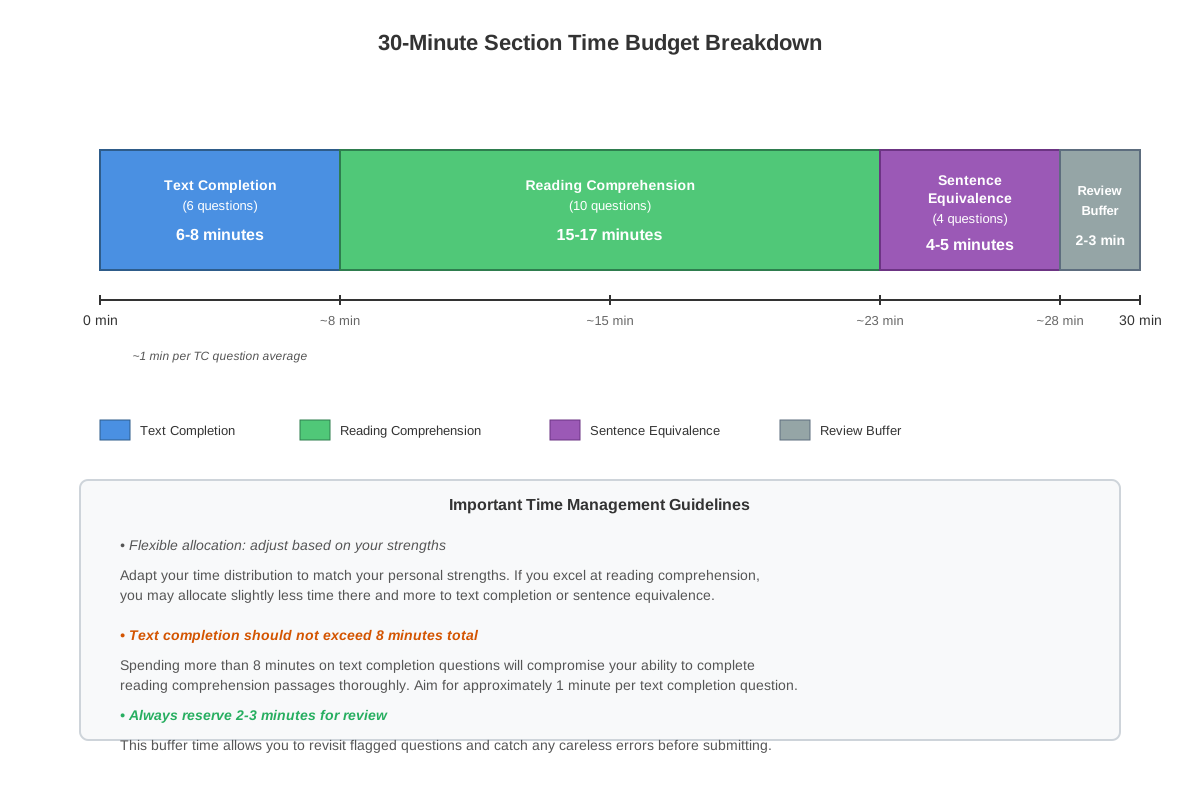
The foundation of effective text completion pacing begins with understanding the time budget for the Verbal Reasoning section. With 30 minutes to complete approximately 20 questions (the exact number varies slightly between test forms), students have an average of 90 seconds per question. However, this average masks important variation: reading comprehension passages with multiple questions require sustained time investment, while individual text completion questions should typically consume less than the average.
A strategic time budget allocates:
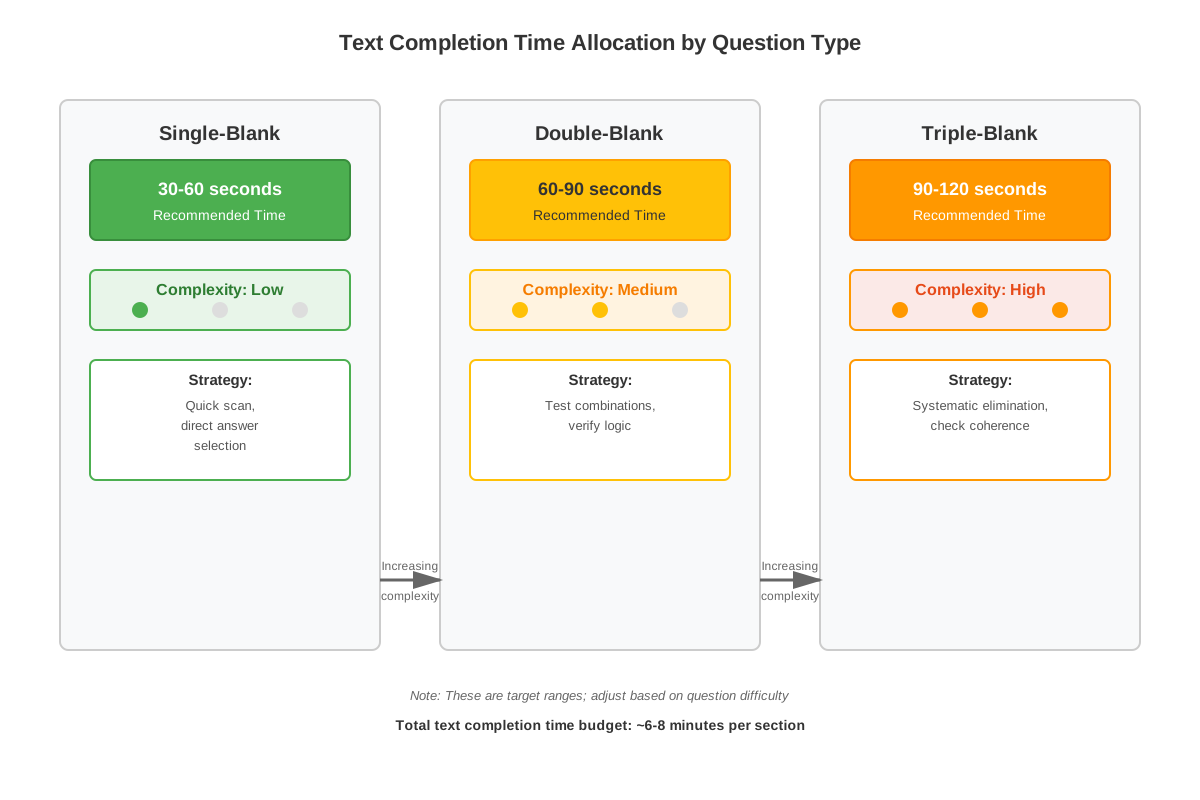
- Single-blank text completions: 30-60 seconds
- Double-blank text completions: 60-90 seconds
- Triple-blank text completions: 90-120 seconds
- Reading comprehension passages: 3-4 minutes per passage plus 60-90 seconds per associated question
This framework provides initial guidelines but must be adjusted based on question difficulty and individual performance patterns. The key principle is that time saved on straightforward questions creates a buffer for more challenging items.
Question Difficulty Recognition
Rapid difficulty assessment is central to gre text completion pacing strategy. Students must develop the ability to gauge question complexity within the first 10-15 seconds of reading. Difficulty indicators include:
High-difficulty markers:
- Three blanks requiring interdependent reasoning
- Unfamiliar vocabulary in both the sentence and answer choices
- Complex sentence structure with multiple subordinate clauses
- Abstract or technical subject matter
- Answer choices with subtle semantic distinctions
Medium-difficulty markers:
- Two blanks with clear contextual clues
- Mix of familiar and challenging vocabulary
- Straightforward sentence structure with one complexity element
- Concrete subject matter with some abstraction
Low-difficulty markers:
- Single blank with strong contextual clues
- Familiar vocabulary in answer choices
- Simple sentence structure
- Concrete, accessible subject matter
- Clear logical relationships (contrast, cause-effect, etc.)
The ability to quickly categorize questions enables strategic decision-making about time investment. A high-difficulty question encountered early in the section might warrant an immediate educated guess and flag for later review, preserving time for questions where accuracy is more achievable.
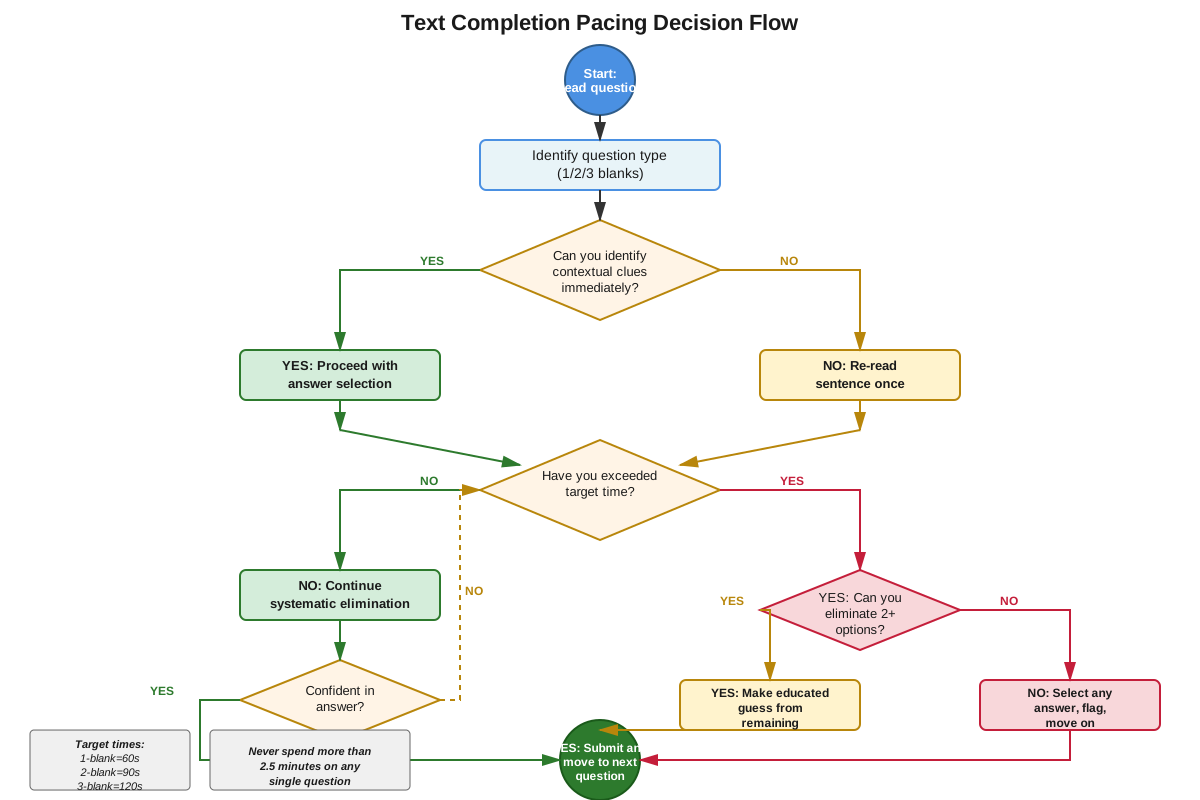
The Triage System
Effective pacing requires implementing a systematic triage approach:
- First pass (0-10 seconds): Read the sentence and assess difficulty level
- Decision point: Determine whether to attempt immediately, attempt with time limit, or skip and flag
- Execution: Apply appropriate strategy based on decision
- Move forward: Regardless of confidence level, proceed to next question once time threshold is reached
| Question Type | Immediate Attempt | Time-Limited Attempt | Skip and Flag |
|---|---|---|---|
| Single-blank, clear context | ✓ | ||
| Double-blank, moderate difficulty | ✓ (90 sec max) | ||
| Triple-blank, unfamiliar vocabulary | ✓ | ||
| Any question after 2 minutes | ✓ |
This triage system prevents the common pitfall of becoming "stuck" on a single question. The psychological commitment to moving forward—even without complete certainty—is essential for maintaining optimal pacing.
The Two-Minute Rule
A cornerstone principle of text completion pacing is the two-minute rule: no single text completion question should consume more than two minutes on the first attempt. This rule applies regardless of question type or perceived difficulty. The reasoning is mathematical: spending three minutes on one question requires "stealing" time from other questions, reducing the likelihood of completing the section.
When the two-minute threshold approaches:
- Eliminate clearly incorrect answer choices
- Make an educated guess from remaining options
- Flag the question for review if time permits at section end
- Move immediately to the next question
Students often resist this rule, believing that additional time will yield the correct answer. However, data from practice tests consistently shows that accuracy gains after two minutes are minimal, while the opportunity cost of neglecting other questions is substantial.
Dynamic Pacing Adjustment
Effective text completion pacing is not static but adapts to real-time performance. Students should check their progress at three key intervals:
10-minute mark: Should have completed approximately 6-7 questions
20-minute mark: Should have completed approximately 13-14 questions
25-minute mark: Should be on final 2-3 questions with time for review
If behind pace at any checkpoint, immediate adjustment is necessary:
- Reduce time per question by 15-20 seconds
- Increase willingness to make educated guesses
- Skip and flag more aggressively
- Prioritize completing all questions over perfecting individual answers
If ahead of pace:
- Maintain current strategy (do not slow down unnecessarily)
- Invest slightly more time in flagged questions
- Double-check answers on completed questions if time permits
The Confidence Threshold Concept
Not all questions require the same level of certainty before moving forward. Developing an appropriate confidence threshold—the level of certainty needed to select an answer and proceed—is crucial for pacing. Aiming for 100% certainty on every question is neither achievable nor strategically sound.
Appropriate confidence thresholds:
- Single-blank questions: 70-80% confidence
- Double-blank questions: 65-75% confidence
- Triple-blank questions: 60-70% confidence
These thresholds acknowledge that the GRE is designed to include questions where complete certainty is difficult to achieve. Students who wait for absolute confidence waste valuable time and often second-guess correct initial instincts.
Concept Relationships
The concepts within text completion pacing form an interconnected system where each element reinforces the others. The Time Budget Framework establishes the foundation, providing quantitative guidelines that inform all subsequent decisions. This framework directly enables Question Difficulty Recognition, as students can only make informed triage decisions when they understand how much time each question type should consume.
Question Difficulty Recognition → feeds into → The Triage System, which operationalizes difficulty assessment into concrete action steps. The triage system cannot function without rapid difficulty evaluation, as students must decide within seconds whether to attempt, time-limit, or skip each question.
The Two-Minute Rule serves as a safety mechanism that prevents the triage system from breaking down. Even when a student decides to attempt a difficult question, the two-minute rule ensures that time investment remains bounded, protecting overall section pacing.
Dynamic Pacing Adjustment operates as the feedback loop that monitors whether the other strategies are working effectively. By checking progress at regular intervals, students can detect when their triage decisions or time budgets need recalibration.
Finally, The Confidence Threshold Concept provides the psychological framework that enables all other strategies. Without accepting that imperfect certainty is acceptable—even necessary—students cannot implement the two-minute rule or triage system effectively.
These concepts connect to prerequisite knowledge in important ways. Vocabulary knowledge accelerates question difficulty recognition by reducing time spent decoding word meanings. Contextual clue identification skills enable faster answer selection, making time budgets more achievable. Understanding GRE section structure provides the context for why these pacing strategies matter: with only 30 minutes and equal point values per question, efficiency directly translates to score improvement.
High-Yield Facts
⭐ The average time per question in Verbal Reasoning is 90 seconds, but text completions should typically consume less time than reading comprehension questions
⭐ No single text completion question should exceed two minutes on the first attempt, regardless of difficulty or number of blanks
⭐ Single-blank text completions should be completed in 30-60 seconds; double-blank in 60-90 seconds; triple-blank in 90-120 seconds
⭐ Students should check pacing at the 10-minute, 20-minute, and 25-minute marks to ensure they're on track to complete all questions
⭐ Each text completion question carries equal weight regardless of difficulty, making completion of all questions more important than perfection on individual items
- The GRE often places a difficult three-blank question early in the section to test pacing discipline
- Time saved on easier questions creates a buffer for more challenging items later in the section
- Accuracy gains after spending two minutes on a single question are minimal compared to the opportunity cost
- Students who fail to complete the Verbal Reasoning section score significantly lower than those who reach all questions, even with educated guesses
- Appropriate confidence thresholds vary by question type: 70-80% for single-blank, 65-75% for double-blank, 60-70% for triple-blank
- The triage system (attempt immediately, time-limited attempt, or skip and flag) should be applied within the first 10-15 seconds of reading each question
- Dynamic pacing adjustment requires reducing time per question by 15-20 seconds when behind pace at any checkpoint
Quick check — test yourself on Text completion pacing so far.
Try Flashcards →Common Misconceptions
Misconception: All text completion questions deserve equal time investment since they carry equal point values.
Correction: While questions carry equal weight, they vary significantly in difficulty and time required. Strategic pacing means investing more time in questions where accuracy is achievable and less in questions where additional time yields minimal accuracy gains. The goal is maximizing total correct answers, not perfecting individual questions.
Misconception: Spending more time on a difficult question will eventually lead to the correct answer.
Correction: Research on standardized test performance shows that accuracy gains plateau quickly after the initial analysis period. If the correct answer isn't apparent within two minutes, additional time rarely helps and often leads to overthinking and second-guessing correct initial instincts.
Misconception: Three-blank text completions are always harder than single-blank questions and should always receive more time.
Correction: While three-blank questions often require more time due to complexity, difficulty depends on vocabulary, context clarity, and subject matter. Some three-blank questions with clear contextual clues are easier than single-blank questions with obscure vocabulary or ambiguous context. Difficulty assessment should be based on the specific question, not just blank count.
Misconception: Checking the clock frequently during the section is distracting and should be avoided.
Correction: Strategic time monitoring at three key checkpoints (10, 20, and 25 minutes) is essential for maintaining appropriate pace. These brief checks enable dynamic adjustment before time pressure becomes critical. The distraction of frequent clock-checking is far less damaging than discovering with 5 minutes remaining that 8 questions remain unattempted.
Misconception: Flagging questions for later review is a waste of time since there's rarely time to return to them.
Correction: Flagging takes only 1-2 seconds and provides valuable optionality. Even if only 2-3 minutes remain at section end, returning to 2-3 flagged questions with fresh perspective often yields additional correct answers. The psychological benefit of knowing difficult questions can be revisited also reduces anxiety and improves decision-making on subsequent questions.
Misconception: Pacing strategies are only necessary for students who struggle with time management.
Correction: Even students with strong verbal skills benefit from systematic pacing strategies. The GRE is designed to challenge all test-takers with time pressure. High-scoring students distinguish themselves not by having unlimited time but by using limited time strategically to maximize correct answers across all questions.
Worked Examples
Example 1: Single-Blank Text Completion with Time Tracking
Question: The scientist's hypothesis was initially met with _____, as colleagues found the proposed mechanism implausible given existing evidence.
(A) acclaim
(B) skepticism
(C) indifference
(D) enthusiasm
(E) reverence
Timing and Strategy (Target: 30-60 seconds)
0-10 seconds: Read sentence and assess difficulty. This is a single-blank question with clear contextual clues ("implausible given existing evidence"). Difficulty: LOW. Decision: Attempt immediately.
10-25 seconds: Identify the logical relationship. The word "as" indicates the blank should align with finding something "implausible." The blank describes colleagues' reaction to an implausible hypothesis.
25-40 seconds: Eliminate answer choices:
- (A) acclaim - positive reaction, contradicts "implausible" → eliminate
- (B) skepticism - doubt/questioning, aligns with "implausible" → keep
- (C) indifference - neutral reaction, doesn't match "implausible" → eliminate
- (D) enthusiasm - positive reaction, contradicts "implausible" → eliminate
- (E) reverence - extreme positive reaction, contradicts "implausible" → eliminate
40-45 seconds: Select (B) skepticism and move to next question.
Total time: 45 seconds (within target range)
Learning objective connection: This example demonstrates applying text completion pacing by recognizing a low-difficulty question, allocating appropriate time (under 60 seconds), and moving forward confidently once the answer is clear.
Example 2: Triple-Blank Text Completion with Triage Decision
Question: The historian's interpretation of the ancient text was (i)_____ by her tendency toward (ii)_____, leading her to draw conclusions that, while intellectually (iii)_____, lacked sufficient evidentiary support.
Blank (i): (A) enhanced (B) compromised (C) validated
Blank (ii): (D) speculation (E) precision (F) caution
Blank (iii): (G) pedestrian (H) provocative (I) conclusive
Timing and Strategy (Target: 90-120 seconds, with two-minute maximum)
0-15 seconds: Read sentence and assess difficulty. This is a three-blank question with abstract subject matter and complex sentence structure. The phrase "while intellectually _____, lacked sufficient evidentiary support" suggests a contrast. Difficulty: MEDIUM-HIGH. Decision: Attempt with strict time limit (2 minutes maximum).
15-45 seconds: Analyze the logical structure. The sentence suggests the historian's interpretation had a problem (blank i) caused by some characteristic (blank ii), resulting in conclusions that were interesting but unsupported (blank iii). The word "while" signals contrast between intellectual quality and evidentiary support.
45-75 seconds: Work through blanks strategically:
- Blank (iii) is easiest: "while intellectually _____, lacked sufficient evidentiary support" suggests something interesting but unproven. (H) provocative fits this contrast. (G) pedestrian and (I) conclusive don't work.
- Blank (ii): What leads to provocative but unsupported conclusions? (D) speculation fits. (E) precision and (F) caution would prevent unsupported conclusions.
- Blank (i): If speculation led to unsupported conclusions, the interpretation was (B) compromised. (A) enhanced and (C) validated don't fit negative outcome.
75-90 seconds: Verify the complete sentence makes sense: "compromised by her tendency toward speculation, leading to conclusions that were intellectually provocative but lacked evidentiary support." This is logically coherent.
90-95 seconds: Select answers and move to next question.
Total time: 95 seconds (within target range)
Learning objective connection: This example demonstrates recognizing a medium-high difficulty question, applying the triage system to attempt with a time limit, working strategically through blanks (starting with the easiest), and adhering to the time budget to maintain overall pacing.
Alternative scenario: If at 90 seconds the answer wasn't clear, the appropriate strategy would be to make educated guesses based on partial analysis, flag the question, and move forward to maintain section pacing—demonstrating the two-minute rule in action.
Exam Strategy
Approaching Text Completion Questions Strategically
When encountering any text completion question, implement this systematic approach:
- Immediate assessment (0-10 seconds): Read the complete sentence and count blanks. Identify subject matter and sentence complexity. Make instant difficulty judgment.
- Triage decision (10-15 seconds): Based on difficulty assessment, decide: attempt now, attempt with time limit, or skip and flag. Commit to this decision.
- Strategic execution: If attempting, work from easiest blank to hardest in multi-blank questions. Use contextual clues and logical relationships. Eliminate clearly wrong answers first.
- Time awareness: Glance at remaining time after every 3-4 questions. If approaching two minutes on any question, make best guess and move forward.
Trigger Words and Phrases
Certain linguistic markers signal specific time management approaches:
Complexity indicators (suggest more time needed):
- "Although," "despite," "while" (contrast relationships requiring careful analysis)
- Abstract nouns: "paradigm," "dichotomy," "juxtaposition"
- Multiple subordinate clauses
- Technical or specialized vocabulary
Clarity indicators (suggest less time needed):
- "Because," "therefore," "thus" (clear causal relationships)
- Concrete nouns and familiar contexts
- Simple sentence structure
- Common vocabulary with clear semantic distinctions
Danger phrases (warning signs of time traps):
- "Not only... but also" (complex parallel structure)
- Multiple negatives ("not without," "hardly lacking")
- Subtle semantic distinctions in answer choices (synonyms with nuanced differences)
Process of Elimination Tips
Efficient elimination accelerates pacing:
- First pass elimination (5-10 seconds): Remove obviously incorrect answers based on basic meaning and logical relationship. Aim to eliminate 2-3 choices immediately.
- Contextual elimination (10-15 seconds): Among remaining choices, eliminate those that don't fit the sentence's tone, register, or logical structure.
- Final selection (5-10 seconds): Choose from remaining options based on precise meaning and contextual fit. If uncertain between two choices, select one and move forward—don't deliberate beyond time budget.
Exam Tip: In double-blank and triple-blank questions, eliminate answer combinations rather than individual words. If blank (i) choice (A) doesn't work with any option for blank (ii), eliminate all combinations containing (A) for blank (i).
Time Allocation Advice
Section-level strategy:
- Reserve 2-3 minutes at section end for review of flagged questions
- Aim to complete first pass through all questions with 3-5 minutes remaining
- If running behind at 20-minute checkpoint, increase guessing threshold and reduce time per question by 20 seconds
Question-level strategy:
- Set mental timer when starting each question
- If uncertain after half the allocated time, begin making educated guesses rather than continuing analysis
- Never spend more than 2 minutes on first attempt at any text completion
Recovery strategy when behind pace:
- Identify remaining question count and available time
- Calculate new time budget per question
- Skip next difficult question encountered to create time buffer
- Maintain faster pace for 3-4 questions to return to target pace
Memory Techniques
The "3-6-9" Pacing Mnemonic
Remember target times with the 3-6-9 pattern:
- 3: 30-60 seconds for single-blank (starts with 3)
- 6: 60-90 seconds for double-blank (6 is double 3)
- 9: 90-120 seconds for triple-blank (9 is triple 3)
The "CHECK" System for Time Monitoring
Clock check at regular intervals
Half-way point assessment (15 minutes)
Evaluate pace at 10 and 20 minutes
Complete all questions before perfecting any
Keep moving forward regardless of confidence level
The "TWO" Rule Visualization
Visualize a large "2" on difficult questions to remember the two-minute maximum:
- Time limit: 2 minutes maximum
- Work efficiently within constraint
- Onward movement after time expires
The "SKIP" Decision Framework
Scan the question (10 seconds)
Know your limits (recognize when vocabulary/context is too challenging)
Immediately flag for later
Proceed to next question without hesitation
This acronym helps overcome the psychological resistance to skipping questions, reminding students that strategic skipping is a sign of good pacing discipline, not weakness.
Summary
Text completion pacing is a strategic skill that directly impacts GRE Verbal Reasoning performance by ensuring efficient time allocation across all questions in the section. The foundation of effective pacing is the time budget framework: single-blank questions should consume 30-60 seconds, double-blank questions 60-90 seconds, and triple-blank questions 90-120 seconds, with a strict two-minute maximum for any text completion on first attempt. Success requires rapid difficulty recognition within the first 10-15 seconds of reading each question, followed by systematic triage decisions about whether to attempt immediately, attempt with time limits, or skip and flag for later review. Dynamic pacing adjustment at the 10-minute, 20-minute, and 25-minute checkpoints enables real-time strategy modification to ensure section completion. The confidence threshold concept—accepting 60-80% certainty depending on question type—prevents the perfectionism that undermines efficient pacing. These interconnected strategies work together to maximize total correct answers by ensuring all questions are attempted while preventing excessive time investment in any single item.
Key Takeaways
- Text completion pacing requires allocating 30-60 seconds for single-blank, 60-90 seconds for double-blank, and 90-120 seconds for triple-blank questions, with a strict two-minute maximum per question
- The triage system (attempt immediately, time-limited attempt, or skip and flag) must be applied within 10-15 seconds of reading each question based on rapid difficulty assessment
- Dynamic pacing adjustment at three checkpoints (10, 20, and 25 minutes) enables strategic course correction before time pressure becomes critical
- Completing all questions with educated guesses is more valuable than perfecting individual questions, as each item carries equal weight regardless of difficulty
- Appropriate confidence thresholds (60-80% depending on question type) prevent perfectionism that undermines efficient pacing
- The two-minute rule serves as a safety mechanism preventing any single question from consuming disproportionate time and compromising overall section performance
- Strategic time monitoring and willingness to move forward despite uncertainty are essential skills that distinguish high-scoring test-takers from those who struggle with the Verbal Reasoning section
Related Topics
Sentence Equivalence Pacing: Similar time management principles apply to sentence equivalence questions, which require selecting two answer choices that produce equivalent meanings. Mastering text completion pacing provides the foundation for efficient sentence equivalence strategies.
Reading Comprehension Time Allocation: Understanding text completion pacing enables better overall Verbal Reasoning time management, as students can calculate how much time remains for reading passages after completing text completion and sentence equivalence questions.
Adaptive Test Strategy: The GRE uses adaptive testing where second-section difficulty depends on first-section performance. Effective pacing in the first Verbal section ensures strong performance that leads to a harder (and higher-scoring) second section.
Vocabulary Building for Speed: While not directly about pacing, expanding vocabulary knowledge accelerates text completion performance by reducing time spent decoding word meanings, making time budgets more achievable.
Test Anxiety Management: Pacing strategies reduce anxiety by providing concrete action steps and preventing the panic that occurs when students realize they're running out of time with questions remaining.
Practice CTA
Now that you understand the strategic principles of text completion pacing, it's time to put these concepts into practice. Attempt the practice questions with deliberate attention to timing—set a timer for each question and track whether you're meeting the target time budgets. Use the flashcards to reinforce key pacing principles until they become automatic. Remember that pacing is a skill that improves with deliberate practice: each practice session is an opportunity to refine your triage decisions, strengthen your two-minute rule discipline, and build the confidence needed to move forward efficiently. Your investment in mastering these strategies will pay dividends not only on text completion questions but across the entire Verbal Reasoning section. Approach practice with the same time discipline you'll use on test day, and you'll develop the pacing instincts that separate good scores from great ones.
Sign up free to keep reading
Create a free AnvayaPrep account to finish this GRE guide on Text completion pacing — plus flashcards and practice questions.