Overview
Evaluate questions represent a distinctive and challenging question type within GRE Reading Comprehension that tests a student's ability to assess the strength, validity, and logical structure of arguments presented in passages. Unlike straightforward comprehension questions that ask what the author said, or inference questions that ask what the author implied, GRE evaluate questions require test-takers to step back and critically analyze what additional information would strengthen, weaken, or help assess the author's reasoning. These questions demand a sophisticated understanding of logical argumentation, evidence evaluation, and the relationship between claims and supporting data.
Mastering evaluate questions is essential for achieving a competitive GRE Verbal Reasoning score because they appear regularly throughout the exam and test higher-order critical thinking skills that distinguish top performers from average test-takers. These questions assess whether students can identify gaps in reasoning, recognize unstated assumptions, and determine what evidence would be most relevant to judging an argument's merit. The ability to evaluate arguments critically is precisely what graduate programs seek in candidates, making this question type particularly aligned with the GRE's mission to predict academic success.
Within the broader landscape of Verbal Reasoning, evaluate questions occupy a unique position that bridges pure reading comprehension and logical reasoning. They require the foundational skills of understanding passage content and structure, but extend beyond these basics to demand active engagement with the author's argumentative strategy. Students who excel at evaluate questions typically demonstrate strong performance across all Reading Comprehension question types because the analytical skills required—identifying assumptions, recognizing evidence gaps, and understanding logical relationships—form the bedrock of sophisticated reading comprehension.
Learning Objectives
- [ ] Identify when Evaluate questions is being tested
- [ ] Explain the core rule or strategy behind Evaluate questions
- [ ] Apply Evaluate questions to GRE-style questions accurately
- [ ] Distinguish evaluate questions from strengthen/weaken questions and other argument-based question types
- [ ] Recognize the common patterns of assumptions and evidence gaps that evaluate questions target
- [ ] Systematically analyze answer choices to determine which information would be most relevant to assessing an argument
- [ ] Predict what types of information would help evaluate an argument before reviewing answer choices
Prerequisites
- Basic argument structure: Understanding premises, conclusions, and how evidence supports claims is fundamental because evaluate questions require identifying what's missing from the argumentative chain
- Reading comprehension fundamentals: The ability to accurately understand passage content and author's purpose is necessary because evaluation requires first comprehending what is being evaluated
- Logical reasoning basics: Familiarity with concepts like assumptions, evidence, and inference enables students to recognize gaps in reasoning that evaluate questions exploit
- Passage analysis skills: The capacity to identify main ideas, supporting details, and argumentative structure provides the foundation for determining what additional information would be relevant
Why This Topic Matters
Evaluate questions test one of the most valuable academic skills: the ability to think critically about arguments and evidence. In graduate-level coursework, students constantly encounter research claims, theoretical arguments, and competing interpretations that require careful evaluation. The skill of determining what information would help assess a claim's validity is central to academic research, literature reviews, and scholarly debate. Beyond academia, professionals in law, business, medicine, and policy analysis regularly evaluate arguments by identifying what additional evidence would strengthen or challenge a position.
On the GRE, evaluate questions appear with moderate frequency—typically 1-3 questions per Verbal Reasoning section—but carry disproportionate weight because they're among the more difficult question types. According to ETS data, these questions have lower average accuracy rates than straightforward comprehension questions, meaning they effectively differentiate between score bands. Students aiming for scores above the 160 threshold (approximately 85th percentile) must demonstrate consistent proficiency with evaluate questions.
These questions most commonly appear in passages discussing scientific research, social science studies, historical arguments, or business analyses—any context where an author presents a claim supported by evidence. The passages are typically 100-200 words and present a single argument with identifiable premises and conclusions. Evaluate questions often follow passages that contain subtle logical gaps, unstated assumptions, or limited evidence bases, creating natural opportunities to test whether students can identify what additional information would be most relevant to judging the argument's strength.
Core Concepts
What Are Evaluate Questions?
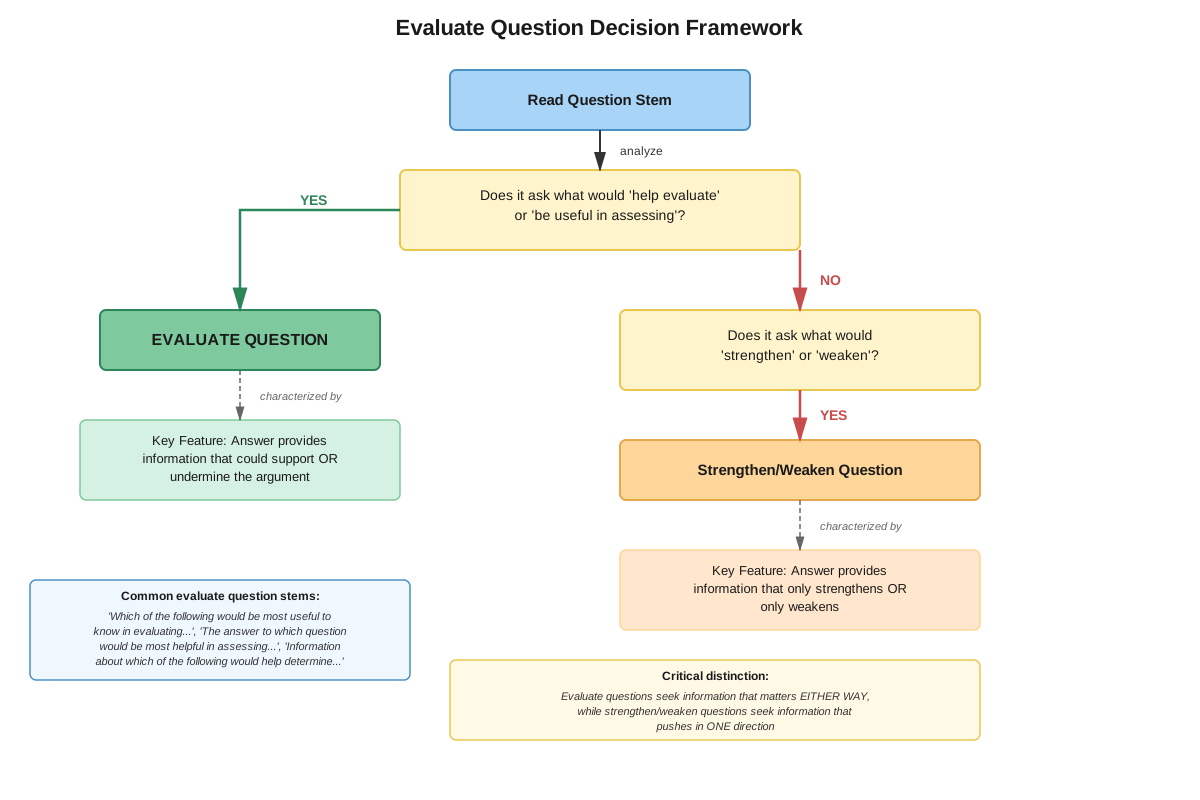
Evaluate questions ask test-takers to identify what additional information would be most useful or necessary for assessing the validity, strength, or soundness of an argument presented in the passage. Unlike strengthen or weaken questions that present new information and ask about its effect, evaluate questions ask students to determine what information is needed. The question stem typically includes phrases like "would be most useful to know," "would help evaluate," "would be most important to determine," or "information about which of the following would be most relevant."
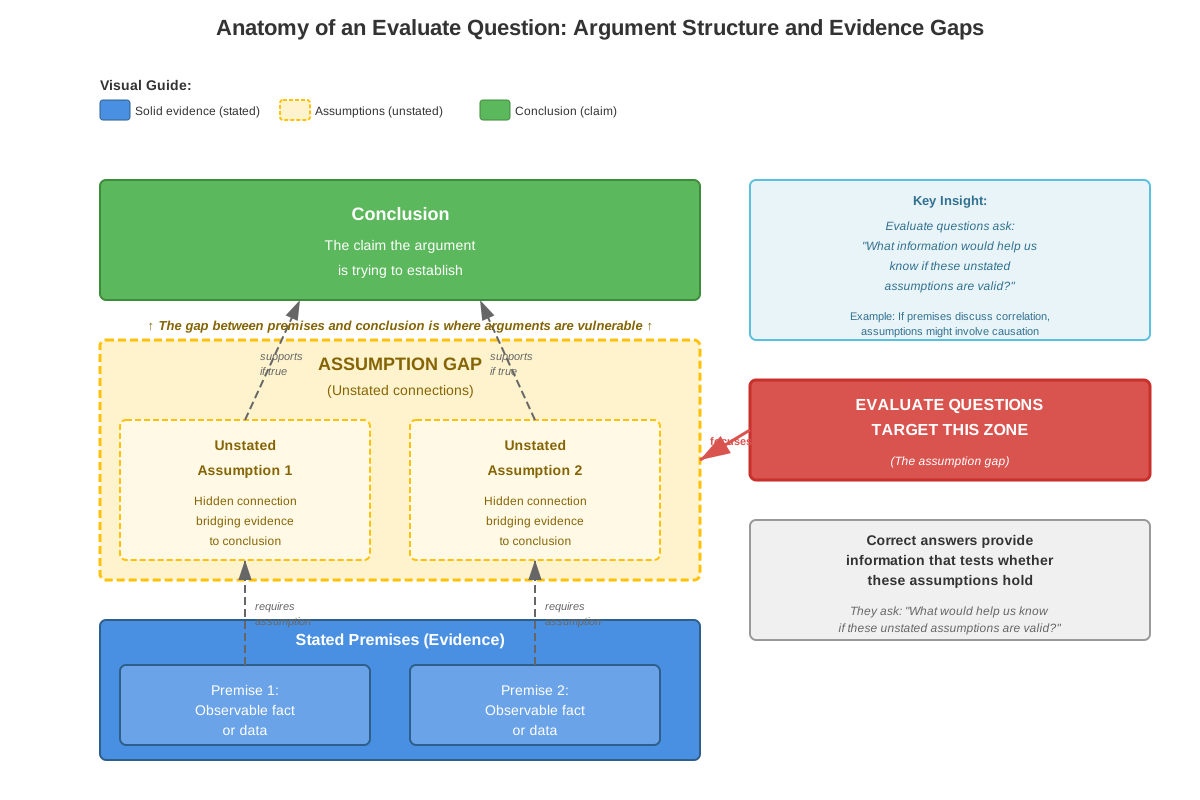
The fundamental principle underlying evaluate questions is that strong arguments rest on verifiable assumptions and adequate evidence. When an argument contains gaps—unstated assumptions, missing data, or logical leaps—certain pieces of information become critical for determining whether the argument succeeds or fails. Evaluate questions test whether students can identify these critical information gaps.
The Anatomy of an Evaluate Question
A typical evaluate question consists of three components:
- The passage argument: A short argument (usually 3-6 sentences) presenting a claim supported by evidence or reasoning
- The question stem: Explicitly asking what information would help evaluate, assess, or determine the validity of the argument or a specific aspect of it
- Five answer choices: Each presenting a different piece of information, only one of which would be genuinely useful for evaluating the argument
The correct answer to an evaluate question identifies information that, depending on the answer to that question, would either strengthen or weaken the argument significantly. This is sometimes called the "variance test"—the correct answer should be information where different possible answers would lead to different assessments of the argument's strength.
Identifying Evaluate Questions
Recognizing evaluate questions quickly is crucial for applying the appropriate strategy. Common question stem patterns include:
- "Which of the following would it be most useful to know in order to evaluate the argument?"
- "Information about which of the following would be most helpful in assessing the author's claim?"
- "The answer to which of the following questions would be most important in determining whether the plan will succeed?"
- "Which of the following would be most relevant to investigate in evaluating the hypothesis?"
- "To assess the validity of the conclusion, it would be most useful to determine which of the following?"
The key identifying features are: (1) the question asks about information that would help judge the argument, and (2) the question doesn't provide new information but asks what information is needed.
The Core Strategy: Finding Assumptions and Evidence Gaps
The most effective approach to evaluate questions involves a systematic three-step process:
Step 1: Identify the argument's conclusion and premises. Clearly articulate what the author is trying to prove (conclusion) and what evidence or reasoning supports that claim (premises). This creates a logical map of the argument.
Step 2: Identify assumptions and gaps. Look for logical leaps between premises and conclusion. What must be true for the conclusion to follow from the premises? What evidence is missing? What alternative explanations haven't been ruled out? Common assumption categories include:
- Causal assumptions (that correlation indicates causation)
- Representativeness assumptions (that a sample represents a population)
- Comparison assumptions (that compared items are truly comparable)
- Implementation assumptions (that a plan can be executed as intended)
- Temporal assumptions (that conditions will remain constant over time)
Step 3: Predict what information would address the most critical gap. Before looking at answer choices, formulate what type of information would help determine whether the assumption holds or the gap is problematic. This prediction prevents being misled by attractive but irrelevant answer choices.
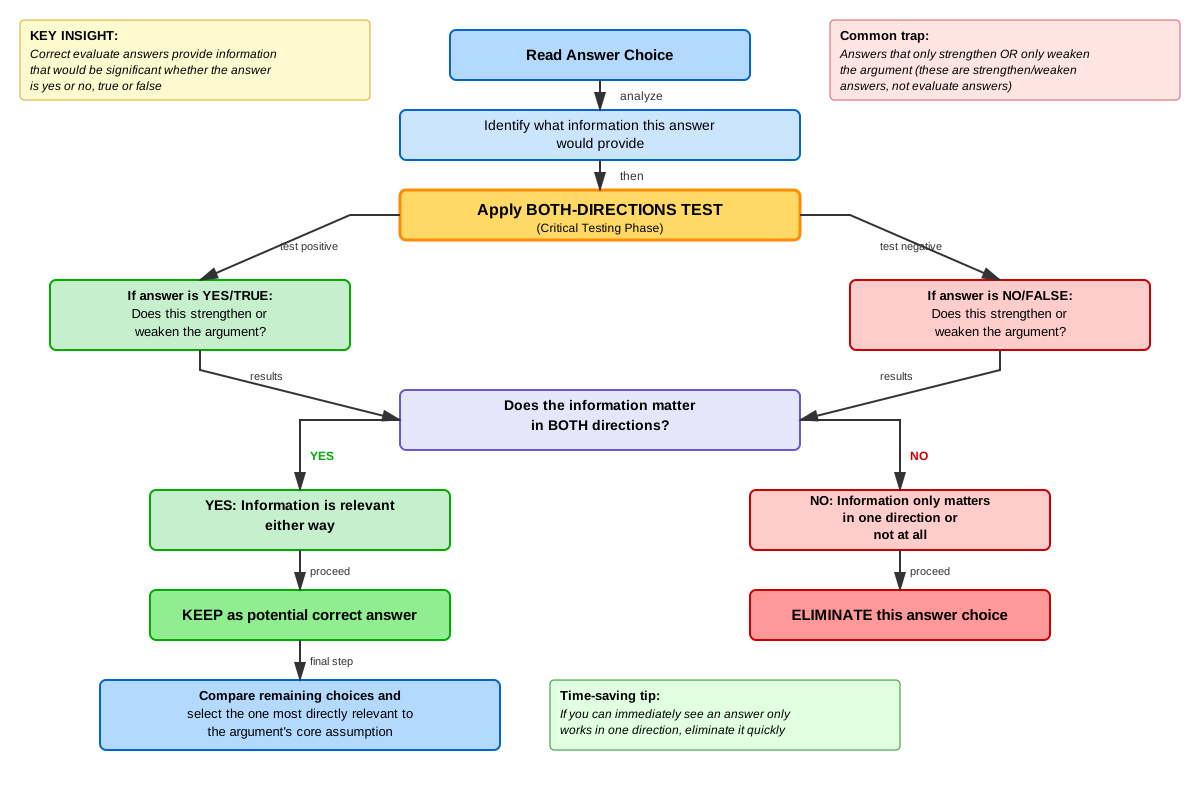
The Variance Test
The most reliable method for confirming the correct answer is applying the variance test: the right answer is information where different possible answers to that question would lead to different evaluations of the argument.
For example, if an answer choice asks "whether the study participants were volunteers," apply the test:
- If YES (they were volunteers): Does this affect the argument's strength?
- If NO (they weren't volunteers): Does this affect the argument's strength differently?
If both answers would significantly impact the argument evaluation in opposite directions, this passes the variance test. If the information wouldn't matter regardless of the answer, or would only matter in one direction, it's not the correct choice.
Common Argument Patterns in Evaluate Questions
| Argument Pattern | Typical Assumption/Gap | What to Evaluate |
|---|---|---|
| Causal claim from correlation | That no alternative causes exist | Whether other factors could explain the correlation |
| Recommendation based on study | That study conditions match real-world application | Whether relevant conditions are comparable |
| Prediction based on past trend | That conditions will remain similar | Whether circumstances have changed |
| Comparison between two groups | That groups are comparable in relevant ways | Whether groups differ in ways that matter |
| Plan to achieve a goal | That implementation is feasible and sufficient | Whether obstacles exist or additional factors are needed |
Distinguishing Evaluate from Similar Question Types
Evaluate questions are often confused with strengthen, weaken, or assumption questions. The key distinctions:
- Strengthen/Weaken questions: Provide new information and ask about its effect on the argument
- Evaluate questions: Ask what information would be useful for judging the argument
- Assumption questions: Ask what must be true for the argument to work
- Evaluate questions: Ask what would be useful to know (not necessarily what must be true)
The critical difference is that evaluate questions are about identifying what's missing, while other question types work with information already provided or assumed.
Concept Relationships
The concepts within evaluate questions form a hierarchical relationship: Argument identification (recognizing premises and conclusions) → Gap analysis (identifying assumptions and missing evidence) → Information prioritization (determining which missing information is most critical) → Variance testing (confirming that the information would actually help evaluate the argument).
Evaluate questions build directly on prerequisite knowledge of argument structure. The ability to identify premises and conclusions enables gap analysis, which in turn allows students to determine what information is missing. This connects to broader Reading Comprehension skills because understanding passage structure and author's purpose helps identify the argumentative claims that evaluate questions target.
The relationship to other question types is complementary: mastering assumption questions improves evaluate question performance because both require identifying what's unstated in an argument. Similarly, understanding strengthen/weaken questions helps with evaluate questions because the variance test essentially asks "would this information strengthen or weaken the argument depending on the answer?"
Within the GRE Verbal Reasoning section, evaluate questions represent the intersection of reading comprehension and analytical reasoning, requiring both accurate passage understanding and logical analysis—skills that together predict success across all question types.
High-Yield Facts
⭐ Evaluate questions ask what information would be useful to know, not what new information does to the argument
⭐ The correct answer must pass the variance test: different answers to the question should lead to different evaluations of the argument
⭐ Evaluate questions most commonly target unstated assumptions in the argument's logical structure
⭐ Common question stems include "most useful to know," "help evaluate," "most important to determine," and "most relevant to assess"
⭐ The most critical step is identifying the gap between premises and conclusion before reviewing answer choices
- Evaluate questions typically appear 1-3 times per Verbal Reasoning section
- Arguments in evaluate questions usually contain causal claims, comparisons, predictions, or recommendations
- Wrong answers often present information that's interesting but wouldn't actually help judge the argument's validity
- The correct answer addresses the argument's most significant logical vulnerability
- Evaluate questions require understanding both what the argument says and what it assumes
- Information that only strengthens OR only weakens (but not both depending on the answer) is usually incorrect
- The argument's conclusion is always the starting point for identifying what needs evaluation
Quick check — test yourself on Evaluate questions so far.
Try Flashcards →Common Misconceptions
Misconception: Evaluate questions are the same as strengthen/weaken questions → Correction: Evaluate questions ask what information would be useful to know for judging an argument, while strengthen/weaken questions provide information and ask about its effect. Evaluate questions require identifying what's missing; strengthen/weaken questions require analyzing what's given.
Misconception: The correct answer must be information that would definitely strengthen or weaken the argument → Correction: The correct answer identifies information that could strengthen or weaken the argument depending on what that information reveals. The key is that the information is relevant to evaluation, not that it points in one direction.
Misconception: Any assumption the argument makes is automatically the correct answer → Correction: While evaluate questions often target assumptions, the correct answer must be information that would be useful to know, not just something assumed. Some assumptions are so fundamental that knowing about them wouldn't help evaluate this specific argument.
Misconception: The most complex or technical answer choice is usually correct → Correction: The correct answer addresses the argument's logical structure, which often involves straightforward gaps. Complex-sounding answers are frequently wrong because they introduce irrelevant considerations that sound sophisticated but don't address the argument's actual vulnerabilities.
Misconception: Information that's generally relevant to the topic is sufficient → Correction: The correct answer must be specifically relevant to evaluating this particular argument's logic. General background information about the topic, even if interesting or important, doesn't help evaluate whether the premises support the conclusion unless it addresses a specific gap in the reasoning.
Misconception: If information would strengthen the argument, it's the right answer → Correction: Information that would only strengthen (or only weaken) the argument regardless of what the information reveals is typically incorrect. The correct answer should be information where different possible answers would lead to different evaluations—it should have the potential to cut both ways.
Worked Examples
Example 1: Scientific Study Evaluation
Passage: "A recent study found that employees who work from home three days per week report 25% higher job satisfaction than those who work in the office full-time. The researchers concluded that companies should implement three-day work-from-home policies to improve employee satisfaction."
Question: Which of the following would be most useful to know in evaluating the researchers' conclusion?
Answer Choices:
A) Whether the study participants were randomly selected from various industries
B) Whether employees who chose to work from home were already more satisfied before the policy change
C) What percentage of companies currently offer work-from-home options
D) Whether job satisfaction correlates with employee productivity
E) How many employees participated in the study
Solution Process:
Step 1 - Identify the argument structure:
- Premise: Study shows work-from-home employees report 25% higher satisfaction
- Conclusion: Companies should implement three-day work-from-home policies to improve satisfaction
Step 2 - Identify assumptions and gaps:
The argument assumes that working from home causes the higher satisfaction (causal assumption). However, there's a potential self-selection problem: maybe people who are already more satisfied choose to work from home, or maybe only already-satisfied employees are offered this option. The argument leaps from correlation to causation and from a study finding to a policy recommendation.
Step 3 - Predict what would help evaluate:
We need to know whether the higher satisfaction existed before the work-from-home arrangement or resulted from it. This addresses whether the relationship is causal.
Step 4 - Apply variance test to answer choices:
(B) Whether employees who chose to work from home were already more satisfied before the policy change
- If YES (they were already more satisfied): The argument fails because work-from-home didn't cause the satisfaction increase
- If NO (they weren't more satisfied before): The argument is strengthened because work-from-home appears to cause satisfaction
- This passes the variance test! ✓
(A) Whether participants were randomly selected:
- This affects generalizability but doesn't address the causal assumption
- Even with random selection, self-selection into work-from-home could still be the issue
(C) What percentage of companies offer work-from-home:
- This is about current practices, not about whether the policy would improve satisfaction
- Doesn't help evaluate the causal claim
(D) Whether satisfaction correlates with productivity:
- This is about a different relationship entirely
- The argument is about whether work-from-home improves satisfaction, not about productivity
(E) How many employees participated:
- Sample size affects statistical reliability but doesn't address the causal assumption
- Even a large study could have the self-selection problem
Answer: B
This example demonstrates how evaluate questions target the gap between correlation and causation, one of the most common logical vulnerabilities in GRE arguments.
Example 2: Business Recommendation Evaluation
Passage: "Rivertown's downtown shopping district has experienced declining foot traffic over the past five years. During this same period, the neighboring town of Lakeville renovated its downtown area with new sidewalks, street lighting, and public art installations, and subsequently saw a 40% increase in downtown visitors. Rivertown should implement similar renovations to reverse its declining foot traffic."
Question: To evaluate the argument, it would be most important to determine which of the following?
Answer Choices:
A) Whether Rivertown has sufficient budget to fund downtown renovations
B) Whether factors other than renovations might explain Lakeville's increased foot traffic
C) How much Lakeville spent on its downtown renovations
D) Whether Rivertown's residents support downtown renovation projects
E) What types of stores are located in Rivertown's downtown district
Solution Process:
Step 1 - Identify the argument structure:
- Premise 1: Rivertown has declining foot traffic
- Premise 2: Lakeville did renovations and saw increased visitors
- Conclusion: Rivertown should do similar renovations to reverse its decline
Step 2 - Identify assumptions and gaps:
The argument assumes that Lakeville's renovations caused the increased foot traffic (causal assumption from correlation). It also assumes that Rivertown and Lakeville are comparable in relevant ways (comparison assumption). Most critically, it assumes no other factors explain Lakeville's success—perhaps Lakeville attracted a major employer, opened a popular restaurant, or benefited from other changes during this period.
Step 3 - Predict what would help evaluate:
We need to know whether the renovations actually caused Lakeville's success or whether other factors were responsible. This addresses whether the comparison is valid and whether the proposed solution would work.
Step 4 - Apply variance test:
(B) Whether factors other than renovations might explain Lakeville's increased foot traffic
- If YES (other factors explain it): The argument fails because renovations may not have caused the increase
- If NO (renovations were the key factor): The argument is strengthened because the proposed solution appears effective
- This passes the variance test! ✓
(A) Whether Rivertown has sufficient budget:
- This addresses feasibility, not whether the plan would work if implemented
- Even if affordable, the renovations might not solve the problem
(C) How much Lakeville spent:
- This is about cost, not about whether renovations caused the success
- Doesn't address the causal assumption
(D) Whether residents support renovations:
- This is about political feasibility, not effectiveness
- Support doesn't determine whether the solution would work
(E) What types of stores are in Rivertown's downtown:
- This might be relevant to the decline but doesn't help evaluate whether renovations would solve it
- Doesn't address the comparison to Lakeville
Answer: B
This example illustrates how evaluate questions test whether students can identify alternative explanations that would undermine an argument based on comparison or analogy.
Exam Strategy
When approaching evaluate questions on the GRE, implement this systematic process:
Before reading answer choices: Spend 30-45 seconds analyzing the argument structure. Identify the conclusion explicitly (underline it mentally or on scratch paper), then identify the premises. Ask yourself: "What's the biggest logical gap here? What is the author assuming?" This pre-work prevents being distracted by attractive but irrelevant answer choices.
Trigger words to watch for in question stems: "most useful to know," "help evaluate," "most important to determine," "most relevant to assess," "in order to evaluate," "would be most helpful in assessing." These phrases signal that you need to identify missing information, not analyze given information.
Process of elimination strategy: Systematically eliminate answers that fail the variance test. For each choice, ask: "If the answer to this question were YES, would it affect my evaluation of the argument? If the answer were NO, would it affect my evaluation differently?" If the answer is "no impact either way" or "only impacts in one direction," eliminate that choice.
Common wrong answer patterns:
- Background information: Interesting context about the topic that doesn't address the argument's logical structure
- Feasibility concerns: Information about whether a plan can be implemented, when the question is whether it would work if implemented
- Tangential issues: Information related to the topic but not to the specific logical gap in this argument
- One-directional information: Information that would only strengthen or only weaken, regardless of what the information reveals
Time allocation: Evaluate questions typically require 60-90 seconds. Allocate 30 seconds to argument analysis, 15 seconds to prediction, and 30-45 seconds to answer choice evaluation. If you find yourself spending more than 90 seconds, make your best educated guess and move on—these questions can become time traps.
When stuck between two answers: Return to the argument's conclusion and ask which answer choice addresses information more directly relevant to whether that specific conclusion follows from the premises. The correct answer almost always addresses the argument's most significant logical vulnerability, not a secondary concern.
Memory Techniques
V.A.G.E. Mnemonic for common assumption types in evaluate questions:
- Validity: Is the evidence valid and reliable?
- Alternatives: Are there alternative explanations not ruled out?
- Generalizability: Can findings be generalized to the proposed application?
- Execution: Can the plan be executed as intended?
The "Two-Way Street" Visualization: Picture the correct answer as a fork in the road where one path strengthens the argument and the other weakens it. If an answer choice is a one-way street (only goes in one direction) or a dead end (doesn't affect the argument), it's wrong.
Question Stem Recognition Acronym - U.H.E.D.:
- Useful to know
- Helpful in assessing
- Evaluate the argument
- Determine whether
If you see these words, you're dealing with an evaluate question.
The "Missing Link" Mental Model: Visualize the argument as a chain with premises on one end and conclusion on the other. The correct answer identifies the missing link in that chain—the piece of information that would help determine whether the chain holds together.
Summary
Evaluate questions test the critical thinking skill of determining what additional information would be most useful for assessing an argument's validity. These questions require a three-step approach: first, identify the argument's premises and conclusion; second, analyze the logical gaps and unstated assumptions connecting them; third, determine what information would address the most significant gap. The correct answer must pass the variance test—different possible answers to the question should lead to different evaluations of the argument's strength. Common argument patterns include causal claims from correlations, recommendations based on studies, predictions from past trends, and comparisons between groups. Success requires distinguishing evaluate questions from strengthen/weaken questions (which provide information rather than asking what information is needed) and avoiding wrong answers that present interesting but irrelevant information, address only feasibility rather than effectiveness, or fail the variance test by only cutting in one direction. Mastering evaluate questions significantly improves overall GRE Verbal Reasoning performance because the analytical skills required—identifying assumptions, recognizing evidence gaps, and understanding logical relationships—enhance performance across all Reading Comprehension question types.
Key Takeaways
- Evaluate questions ask what information would be useful to know for judging an argument, not what effect new information has on an argument
- The correct answer must pass the variance test: different answers should lead to different argument evaluations
- Always identify the argument's conclusion and premises before reviewing answer choices
- The most common targets are unstated assumptions, especially causal assumptions and comparison assumptions
- Wrong answers often present information that's topically relevant but doesn't address the argument's logical structure
- Predict what type of information would address the argument's biggest gap before looking at choices
- Distinguish evaluate questions from strengthen/weaken questions by recognizing key phrases like "useful to know" and "help evaluate"
Related Topics
Strengthen and Weaken Questions: These closely related question types provide new information and ask about its effect on an argument. Mastering evaluate questions builds the foundation for these questions because both require understanding argument structure and logical gaps.
Assumption Questions: These questions ask what must be true for an argument to work. The skills of identifying unstated assumptions developed through evaluate questions directly transfer to assumption questions, making them natural companion topics.
Argument Structure Analysis: A deeper dive into identifying premises, conclusions, intermediate conclusions, and counterarguments provides the foundation for all argument-based questions, including evaluate questions.
Logical Reasoning Patterns: Understanding common logical fallacies, reasoning patterns, and argument structures enhances the ability to quickly identify gaps that evaluate questions target.
Practice CTA
Now that you understand the core concepts and strategies for evaluate questions, it's time to put your knowledge into practice. Attempt the practice questions to reinforce these skills and build the pattern recognition that leads to consistent accuracy. Work through the flashcards to internalize the key concepts and common question patterns. Remember: evaluate questions reward systematic analysis over intuition—trust the process of identifying gaps, predicting information needs, and applying the variance test. With focused practice, you'll develop the critical thinking skills that not only improve your GRE score but also prepare you for the analytical demands of graduate-level work. You've got this!
Sign up free to keep reading
Create a free AnvayaPrep account to finish this GRE guide on Evaluate questions — plus flashcards and practice questions.