Overview
Weaken questions represent one of the most critical question types in GRE Verbal Reasoning, appearing consistently in the Reading Comprehension section. These questions assess a test-taker's ability to evaluate arguments critically by identifying information that undermines or casts doubt on a given conclusion. Unlike questions that ask for supporting evidence or main ideas, weaken questions require students to think adversarially—to find the logical vulnerabilities in an author's reasoning and determine which answer choice exploits those weaknesses most effectively.
Mastering GRE weaken questions is essential because they test higher-order critical thinking skills that the GRE prizes above simple comprehension. These questions evaluate whether students can distinguish between premises and conclusions, identify unstated assumptions, and recognize how new information might challenge an argument's validity. The ability to weaken arguments demonstrates analytical sophistication that graduate programs value highly, as it mirrors the critical evaluation skills necessary for academic research and professional decision-making.
Within the broader landscape of Verbal Reasoning, weaken questions connect intimately with other argument-based question types, including strengthen questions, assumption questions, and evaluate questions. All these question types require understanding argument structure—identifying the evidence presented and the conclusion drawn—but weaken questions specifically demand that students find the "Achilles' heel" of reasoning. This skill builds upon basic reading comprehension while preparing students for more complex analytical tasks throughout the GRE.
Learning Objectives
- [ ] Identify when Weaken questions is being tested
- [ ] Explain the core rule or strategy behind Weaken questions
- [ ] Apply Weaken questions to GRE-style questions accurately
- [ ] Distinguish between answer choices that weaken an argument and those that are merely irrelevant
- [ ] Recognize common argument structures and their typical vulnerabilities
- [ ] Evaluate the relative strength of different weakening answer choices
- [ ] Identify unstated assumptions that make arguments susceptible to weakening
Prerequisites
- Basic argument structure: Understanding the difference between premises (evidence) and conclusions is fundamental to identifying what needs to be weakened
- Logical reasoning fundamentals: Familiarity with cause-and-effect relationships, correlations, and basic inference patterns helps recognize flawed reasoning
- Reading comprehension skills: The ability to extract main ideas and supporting details quickly ensures efficient processing of argument passages
- Vocabulary proficiency: A solid GRE vocabulary base enables accurate interpretation of both passages and answer choices without getting distracted by unfamiliar words
Why This Topic Matters
Weaken questions appear with remarkable consistency on the GRE, typically comprising 15-20% of all Reading Comprehension questions. This frequency makes them one of the highest-yield question types to master. Unlike some question types that appear sporadically, virtually every GRE administration includes multiple weaken questions, making them a reliable opportunity to earn points when properly prepared.
In real-world applications, the critical thinking skills developed through weaken questions extend far beyond standardized testing. Graduate students must regularly evaluate research claims, identify methodological flaws in studies, and challenge existing theories—all skills directly practiced through weaken questions. Professionals in law, business, medicine, and academia constantly assess arguments for weaknesses before making decisions or forming conclusions. The ability to think critically about claims and identify their vulnerabilities represents a cornerstone of advanced intellectual work.
On the GRE specifically, weaken questions typically appear in two formats: as standalone short arguments (usually 3-5 sentences) followed by a question asking which answer choice "most seriously weakens" or "casts the most doubt on" the argument, or embedded within longer reading passages where one question asks students to identify information that would undermine a specific claim made in the passage. Both formats test the same fundamental skill but require slightly different reading strategies. The standalone format demands rapid argument analysis, while passage-embedded questions require tracking multiple claims and identifying which specific assertion is being targeted.
Core Concepts
Understanding Argument Structure
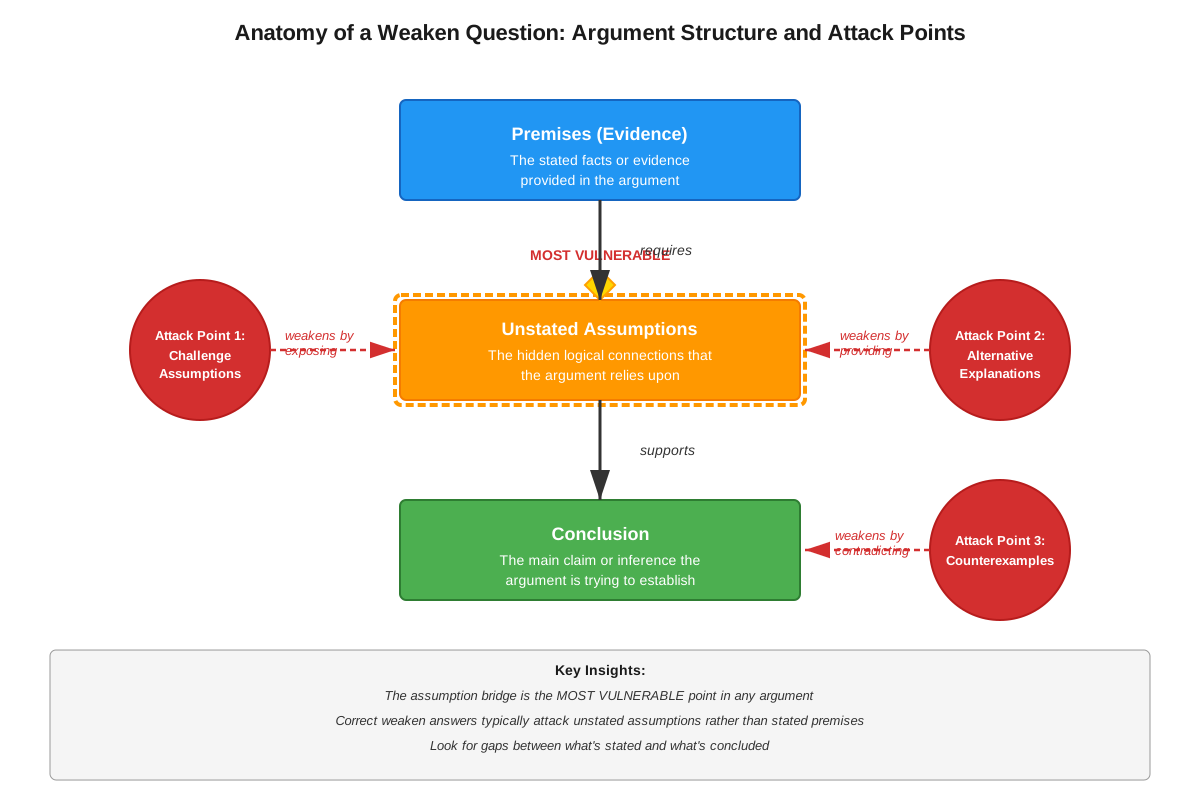
Before weakening any argument, students must first dissect its structure. Every argument contains premises (the evidence or reasons provided) and a conclusion (the claim being supported). The conclusion represents the vulnerable target—the statement that needs to be undermined. Many students mistakenly try to attack the premises, but weaken questions almost always require challenging the logical connection between premises and conclusion or introducing information that makes the conclusion less likely to be true.
Consider this basic structure: "Sales of ice cream increase during summer months. Therefore, hot weather causes people to commit more crimes." The premise (ice cream sales increase) is factually stated, so attacking it won't work. The conclusion (hot weather causes crime) makes a causal claim that goes beyond what the evidence supports. This gap between evidence and conclusion creates the vulnerability.
Identifying Unstated Assumptions
The most effective way to weaken arguments involves targeting their unstated assumptions—the logical bridges that must be true for the conclusion to follow from the premises. Every argument relies on assumptions, and exposing these assumptions as questionable or false severely undermines the argument's strength.
Common types of assumptions include:
- Causal assumptions: The argument assumes that correlation implies causation, or that no alternative causes exist
- Representativeness assumptions: The argument assumes a sample accurately represents a larger population
- Comparison assumptions: The argument assumes two things being compared are actually comparable
- Implementation assumptions: The argument assumes a plan will work as intended without obstacles
- Temporal assumptions: The argument assumes past trends will continue into the future
Types of Weakening Evidence
Different arguments require different types of weakening information. Understanding these categories helps students predict what kind of answer choice will be correct:
| Weakening Type | Description | Example Application |
|---|---|---|
| Alternative Explanation | Provides a different cause for the observed effect | If an argument claims A causes B, showing C could cause B weakens it |
| Counterexample | Presents a case where the conclusion doesn't hold | If an argument claims "all X are Y," one X that isn't Y destroys it |
| Undermining Evidence | Introduces data contradicting the conclusion | If an argument predicts increase, data showing decrease weakens it |
| Questioning Methodology | Reveals flaws in how evidence was gathered | If a survey is cited, showing response bias weakens conclusions drawn |
| Exposing Unrepresentativeness | Shows the sample differs from the population | If a study uses college students, noting they're atypical weakens generalization |
The Scope Principle
A critical concept in weaken questions involves scope matching. The correct answer must be relevant to the specific conclusion being drawn. Many trap answers introduce information that seems related but actually addresses a different issue. For example, if an argument concludes that "Policy X will reduce unemployment in City A," an answer choice discussing Policy X's effects on inflation (rather than unemployment) or its effects in City B (rather than City A) falls outside the scope and cannot be correct, regardless of how interesting or true it might be.
Degree of Weakening
Not all weakening answer choices are created equal. The GRE typically asks for the answer that "most seriously weakens" or "most calls into question" the argument. This language indicates that multiple answers might weaken the argument to some degree, but only one weakens it most effectively. Students must evaluate the relative impact of each answer choice. An answer that completely undermines a central assumption will weaken more effectively than one that raises a minor concern about a peripheral detail.
Common Argument Patterns and Their Vulnerabilities
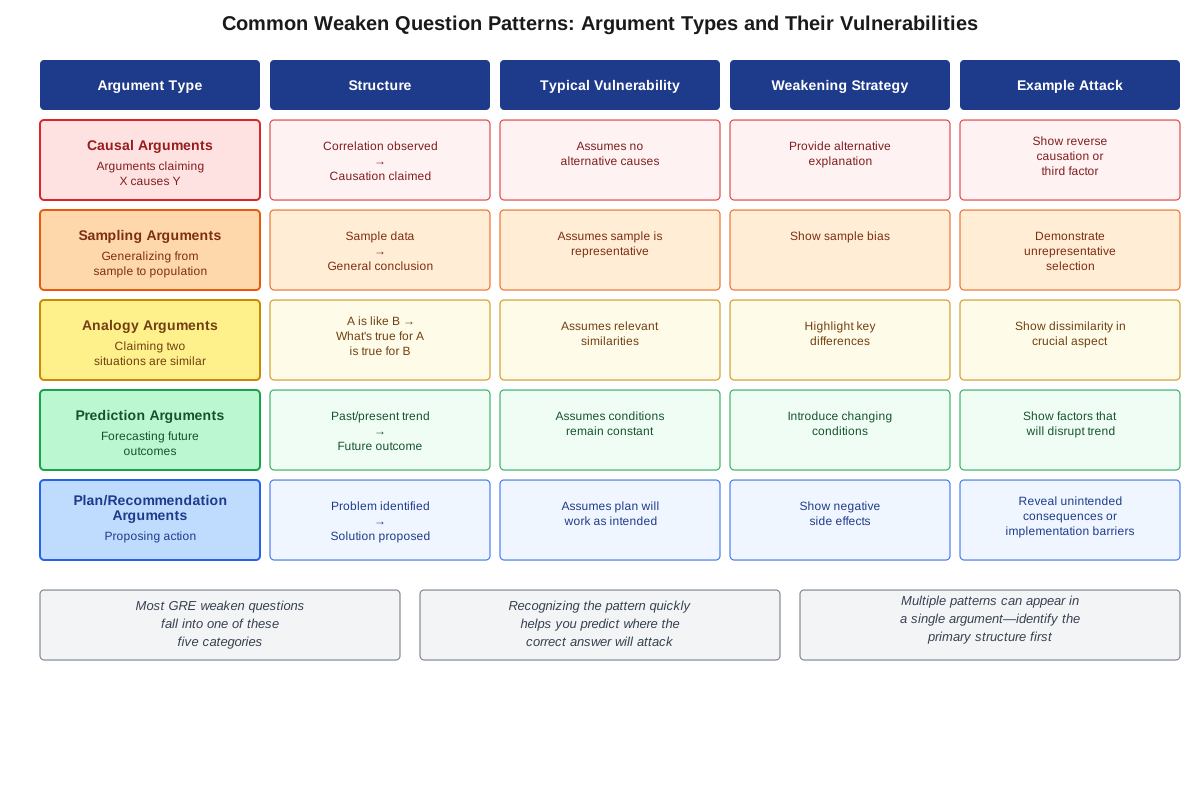
Certain argument structures appear repeatedly on the GRE, each with predictable weaknesses:
Causal Arguments: These claim X causes Y based on correlation or temporal sequence. Weaken by showing: alternative causes exist, the cause-effect relationship is reversed, or a third factor causes both X and Y.
Prediction Arguments: These claim future events will mirror past patterns. Weaken by showing: relevant circumstances have changed, the past data was anomalous, or factors preventing the prediction exist.
Analogy Arguments: These claim two situations are similar enough to draw conclusions. Weaken by showing: crucial differences exist between the compared situations, or the comparison is based on superficial similarities.
Statistical Arguments: These draw conclusions from data or studies. Weaken by showing: the sample is biased or unrepresentative, the sample size is too small, or the methodology is flawed.
Plan Arguments: These claim a proposed action will achieve a desired outcome. Weaken by showing: obstacles will prevent implementation, unintended negative consequences will occur, or the plan addresses symptoms rather than root causes.
Concept Relationships
The concepts within weaken questions form an interconnected analytical framework. Understanding argument structure serves as the foundation—students cannot identify what weakens a conclusion without first identifying what that conclusion is and what evidence supports it. This structural understanding leads directly to recognizing unstated assumptions, which represent the logical gaps between premises and conclusions.
Once assumptions are identified, students can predict what types of weakening evidence would be most effective, creating a mental framework before even reading the answer choices. This prediction step connects to the scope principle, as students must ensure their predicted weakener actually addresses the specific conclusion being drawn. Finally, the degree of weakening concept helps students evaluate multiple potentially correct answers and select the strongest one.
The relationship map flows as follows:
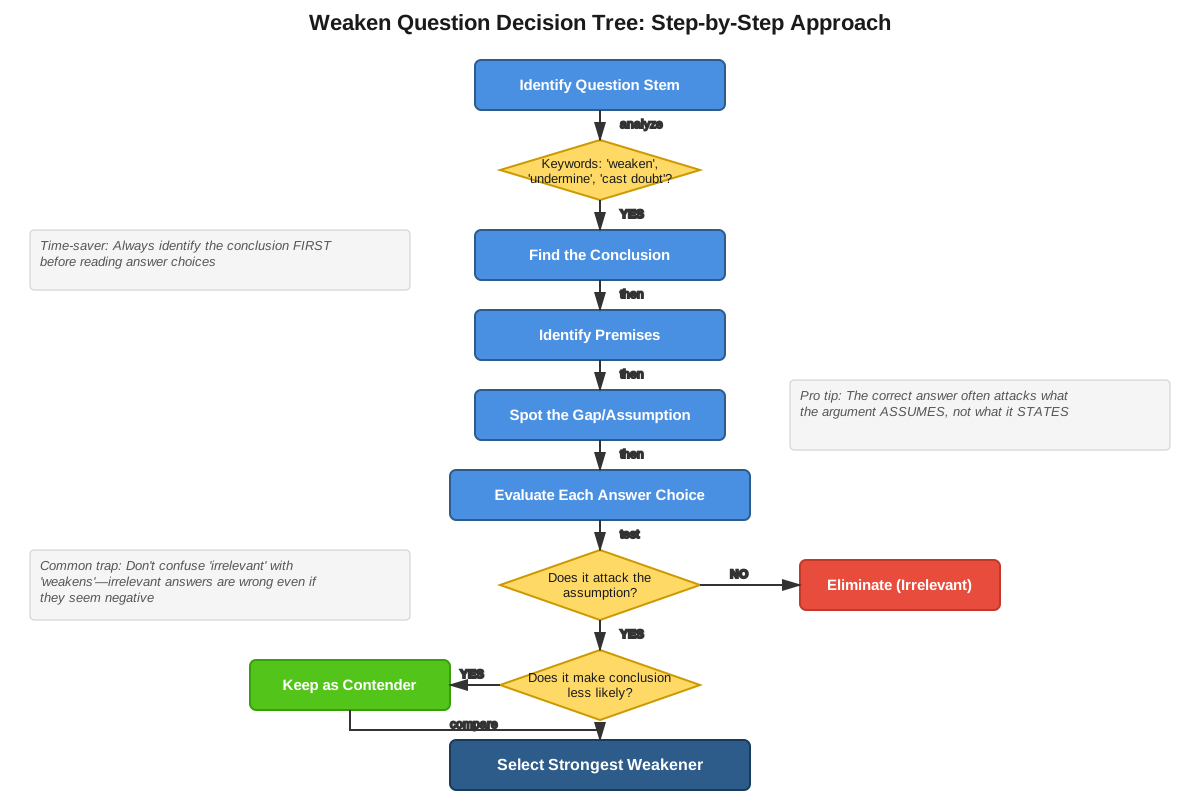
Argument Structure Analysis → Assumption Identification → Prediction of Effective Weakeners → Scope Verification → Degree Evaluation → Answer Selection
This topic connects to prerequisite knowledge by building upon basic reading comprehension (identifying main ideas becomes identifying conclusions) and extending into more advanced critical reasoning. It also relates closely to strengthen questions (which require the opposite skill—finding information that supports rather than undermines) and assumption questions (which explicitly ask for the unstated assumptions that weaken questions implicitly target).
High-Yield Facts
⭐ Weaken questions ask students to find information that makes the conclusion less likely to be true, not necessarily false
⭐ The correct answer must be relevant to the specific conclusion drawn, not just generally related to the topic
⭐ Attacking unstated assumptions is more effective than attacking stated premises
⭐ Alternative explanations for observed phenomena are among the most common correct answers
⭐ The question stem will typically include phrases like "weaken," "cast doubt on," "call into question," or "undermine"
- Causal arguments are particularly vulnerable to evidence showing correlation without causation
- Representative sample assumptions can be weakened by showing the sample is biased or atypical
- Prediction arguments can be weakened by showing relevant circumstances have changed
- Answer choices that strengthen the argument are common trap answers designed to catch students who misread the question
- The correct answer doesn't need to completely destroy the argument—just make it weaker than before
- Scope errors are the most common reason students select incorrect answers on weaken questions
- Evidence that is true but irrelevant cannot weaken an argument
- Weaken questions test critical thinking more than reading speed, so allocating adequate time is essential
- Many arguments contain multiple assumptions, but the correct answer typically targets the most central one
- Understanding common logical fallacies helps predict what will weaken arguments that commit those fallacies
Quick check — test yourself on Weaken questions so far.
Try Flashcards →Common Misconceptions
Misconception: The correct answer must prove the conclusion false → Correction: Weaken questions only require making the conclusion less likely or less well-supported, not demonstrating it's definitively wrong. An answer that introduces reasonable doubt is sufficient.
Misconception: Any answer that relates to the topic will weaken the argument → Correction: Relevance to the general topic is insufficient; the answer must specifically address the logical connection between the stated premises and the specific conclusion drawn. Scope matching is essential.
Misconception: Attacking the premises weakens the argument → Correction: Premises are typically accepted as true for the purpose of the question. The goal is to show that even if the premises are true, the conclusion doesn't necessarily follow or is less likely than claimed.
Misconception: The longest or most complex answer choice is usually correct → Correction: Answer length has no correlation with correctness. The GRE deliberately varies answer choice length to avoid patterns. Students should evaluate logical impact, not word count.
Misconception: If an answer choice introduces new information, it must be out of scope → Correction: Weaken questions almost always require new information not mentioned in the passage. The question is whether that new information is relevant to the conclusion. New information that addresses unstated assumptions is exactly what these questions seek.
Misconception: Extreme language in answer choices makes them wrong → Correction: While extreme language can indicate incorrect answers in some question types, weaken questions may have correct answers with strong language if that strong claim effectively undermines the argument. Evaluate logical impact rather than applying blanket rules about language.
Misconception: The correct answer will be something the author failed to consider → Correction: While this is sometimes true, it's not a reliable test. The correct answer is simply whatever most effectively weakens the conclusion, whether or not the author should have anticipated it.
Worked Examples
Example 1: Causal Argument
Passage: "A recent study found that students who eat breakfast before school perform better on standardized tests than students who skip breakfast. Therefore, eating breakfast causes improved test performance, and schools should provide free breakfast to all students to raise test scores."
Question: Which of the following, if true, most seriously weakens the argument?
Answer Choices:
A) Some students who eat breakfast still perform poorly on standardized tests
B) Students from higher-income families are more likely both to eat breakfast regularly and to have access to test preparation resources
C) Providing free breakfast to all students would be expensive for school districts
D) Standardized tests may not accurately measure all forms of student learning
E) Many successful professionals report having skipped breakfast during their school years
Analysis:
First, identify the argument structure:
- Premise: Students who eat breakfast perform better on tests than those who don't
- Conclusion: Eating breakfast causes improved performance, so providing breakfast will raise scores
The argument makes a causal claim based on correlation. The unstated assumption is that breakfast itself causes the improved performance, with no other factors explaining the correlation.
Evaluating each answer:
Choice A: This doesn't weaken the argument. The argument claims breakfast improves performance on average, not that it guarantees high performance for every individual. This is a common trap that confuses "causes improvement" with "guarantees success."
Choice B: ⭐ CORRECT. This provides an alternative explanation for the correlation—family income might cause both breakfast eating and test performance through access to resources. This undermines the causal assumption by suggesting the relationship might not be causal at all, but rather both factors being caused by a third variable (socioeconomic status). If this is true, providing breakfast alone might not improve scores because breakfast wasn't the actual cause.
Choice C: This addresses implementation costs but doesn't weaken whether breakfast causes improved performance. It's out of scope—the conclusion is about causation, not feasibility.
Choice D: This questions test validity but doesn't address whether breakfast affects performance. Even if tests are imperfect measures, the argument could still be valid about breakfast's effect on whatever tests do measure.
Choice E: Anecdotal evidence about professionals doesn't address the statistical relationship observed in students. This is too limited in scope and doesn't explain the correlation found in the study.
Key Takeaway: This example demonstrates how alternative explanations effectively weaken causal arguments by showing the observed correlation might not indicate causation.
Example 2: Plan Argument
Passage: "City traffic congestion has increased by 40% over the past five years, primarily during morning and evening rush hours. To reduce this congestion, the city council has proposed adding two lanes to the main highway. Traffic engineers predict this expansion will reduce commute times by 25%."
Question: Which of the following, if true, most calls into question the traffic engineers' prediction?
Answer Choices:
A) Highway expansion projects typically take three to five years to complete
B) Studies of similar highway expansions in other cities show that increased road capacity attracts additional drivers, resulting in congestion levels returning to previous levels within two years
C) Public transportation ridership has declined by 15% over the same five-year period
D) The highway expansion will require significant public funding
E) Some commuters have already adjusted their schedules to avoid peak traffic hours
Analysis:
Argument structure:
- Premise: Traffic congestion has increased 40%, mainly during rush hours
- Conclusion: Adding two highway lanes will reduce commute times by 25%
This is a plan argument that assumes the proposed solution will work as intended. The unstated assumption is that adding capacity will reduce congestion without other factors interfering.
Evaluating each answer:
Choice A: Construction timeline doesn't weaken whether the plan will work once completed. This addresses when benefits occur, not whether they'll occur.
Choice B: ⭐ CORRECT. This directly undermines the plan's effectiveness by showing that similar interventions have failed due to "induced demand"—more road capacity attracts more drivers, negating the benefits. This challenges the core assumption that adding lanes will reduce congestion rather than simply accommodating more traffic at the same congestion level. The evidence from comparable situations strongly suggests the predicted 25% reduction won't materialize.
Choice C: Declining public transit ridership might actually support the argument by explaining why road congestion increased, but it doesn't weaken whether adding lanes will help. If anything, it provides context for the problem.
Choice D: Like Example 1's Choice C, this addresses cost rather than effectiveness. Feasibility concerns don't weaken predictions about outcomes if implemented.
Choice E: Some commuters adjusting schedules is consistent with congestion existing and doesn't address whether the highway expansion will reduce it. This is too limited in scope to significantly impact the prediction.
Key Takeaway: This example shows how evidence of similar plans failing under similar circumstances effectively weakens prediction arguments by challenging the assumption that the plan will work as intended.
Exam Strategy
When approaching weaken questions on the GRE, follow this systematic process:
1. Identify the question type immediately by scanning for trigger words: "weaken," "undermine," "cast doubt," "call into question," "challenge," or "counter." This identification determines your entire approach—you're looking for information that hurts the argument, not helps it.
2. Read the argument carefully and identify the conclusion before worrying about premises. Ask yourself: "What is this argument trying to prove?" The conclusion is your target. Everything else is context.
3. Identify the premises and note the logical gap between evidence and conclusion. Ask: "What must be true for this conclusion to follow from this evidence?" This gap reveals the unstated assumptions.
4. Predict what would weaken the argument before reading answer choices. Think: "What would make this conclusion less likely?" Common predictions include alternative explanations, changed circumstances, unrepresentative samples, or implementation obstacles.
5. Evaluate each answer choice for scope and impact. Ask two questions: "Is this relevant to the specific conclusion?" and "If true, does this make the conclusion less likely?" Eliminate answers that fail either test.
6. Compare remaining choices for degree of weakening. If multiple answers weaken the argument, select the one that most seriously undermines it. Look for answers that attack central assumptions rather than peripheral details.
Exam Tip: If you're torn between two answers, identify which assumption each targets. The answer addressing the more fundamental assumption is typically correct.
Time allocation: Spend approximately 1.5-2 minutes per weaken question. These questions reward careful analysis more than speed. Rushing leads to scope errors and misreading the question stem (confusing weaken with strengthen is a costly mistake).
Trigger phrases to watch for in answer choices:
- "Alternative explanation" language suggests the correct answer for causal arguments
- "However" or "but" often introduces weakening information
- Comparative language ("more likely," "less effective") often appears in correct answers
- Absolute language ("always," "never") can indicate incorrect answers, but not always—evaluate logically
Process of elimination tips:
- Eliminate answers that strengthen rather than weaken (common trap)
- Eliminate answers outside the scope of the conclusion
- Eliminate answers that are irrelevant even if true
- Eliminate answers that address premises rather than the conclusion-premise connection
- Keep answers that introduce alternative explanations, counterexamples, or undermining evidence
Memory Techniques
SCOPE Mnemonic for evaluating answer choices:
- Specific to the conclusion (not just the topic)
- Challenges assumptions (not stated premises)
- Opposite effect (weakens, doesn't strengthen)
- Pertinent if true (relevance matters)
- Effective impact (degree of weakening)
The "Alternative Cause" Visualization: For causal arguments, visualize the argument as an arrow from Cause → Effect. The correct answer often draws a second arrow from "Alternative Cause" → Effect, showing the original arrow might not be necessary.
The "Bridge Collapse" Metaphor: Think of the argument as a bridge from premises (one side) to conclusion (other side). Unstated assumptions are the invisible supports holding up the bridge. The correct answer reveals that one of these supports is weak or missing, making the bridge less stable.
CASP Acronym for common argument vulnerabilities:
- Causal claims (alternative explanations weaken)
- Analogies (relevant differences weaken)
- Statistics (sampling problems weaken)
- Predictions (changed circumstances weaken)
The "Opposite Day" Technique: After reading the argument, imagine what would strengthen it. The opposite of that strengthener often weakens it. This helps generate predictions before reading answer choices.
Summary
Weaken questions represent a high-yield, consistently tested component of GRE Verbal Reasoning that assesses critical thinking through argument analysis. Success requires a systematic approach: identify the conclusion, recognize unstated assumptions bridging premises to conclusion, predict what information would undermine those assumptions, and select the answer choice that most effectively makes the conclusion less likely to be true. The key distinction is that correct answers must be relevant to the specific conclusion drawn (scope matching) and must address the logical connection between evidence and conclusion rather than attacking stated premises. Common argument types—causal, prediction, analogy, statistical, and plan arguments—each have characteristic vulnerabilities that can be anticipated. Students must avoid common traps including scope errors, confusing weaken with strengthen, and selecting answers that are interesting but irrelevant. The ability to think adversarially about arguments, identifying their logical weak points, is both a valuable test-taking skill and a crucial academic competency for graduate-level work.
Key Takeaways
- Weaken questions target the logical connection between premises and conclusion, not the premises themselves
- Identifying unstated assumptions is the most reliable path to predicting correct answers
- Scope matching is essential—the answer must address the specific conclusion, not just relate to the general topic
- Alternative explanations are among the most common correct answers for causal arguments
- The correct answer makes the conclusion less likely, not necessarily false
- Systematic analysis (identify conclusion → find assumptions → predict weakener → evaluate scope) prevents careless errors
- These questions reward careful thinking over speed, so allocate adequate time for thorough analysis
Related Topics
Strengthen Questions: The mirror image of weaken questions, these ask students to find information that makes conclusions more likely. Mastering weaken questions provides the analytical framework for strengthen questions—the same assumptions that make arguments vulnerable when attacked make them stronger when supported.
Assumption Questions: These explicitly ask for the unstated assumptions that weaken questions implicitly target. Understanding how to identify assumptions for weaken questions directly prepares students for assumption questions.
Evaluate Questions: These ask what information would be most useful in assessing an argument's strength. Success requires understanding both what would weaken and what would strengthen an argument—skills developed through weaken question practice.
Logical Reasoning Passages: Longer passages that present extended arguments benefit from the same analytical skills developed through weaken questions. The ability to identify conclusions, premises, and assumptions scales up to more complex texts.
Critical Reasoning in Quantitative Sections: The analytical thinking developed through weaken questions enhances performance on quantitative reasoning questions that require evaluating whether data supports conclusions.
Practice CTA
Now that you understand the systematic approach to weaken questions, it's time to apply these strategies to actual GRE-style practice questions. The concepts covered here—identifying conclusions, recognizing assumptions, evaluating scope, and predicting effective weakeners—become automatic only through deliberate practice. Challenge yourself with the practice questions and flashcards to reinforce these high-yield skills. Remember that weaken questions reward careful analysis, so focus on understanding why wrong answers fail and why correct answers succeed. Each practice question is an opportunity to strengthen your critical thinking abilities and build confidence for test day. Your investment in mastering this question type will pay dividends throughout the Verbal Reasoning section and beyond.
Sign up free to keep reading
Create a free AnvayaPrep account to finish this GRE guide on Weaken questions — plus flashcards and practice questions.