Overview
Assumption questions represent one of the most frequently tested question types in the GRE Verbal Reasoning section, appearing within the Critical Reasoning component. These questions assess a test-taker's ability to identify unstated premises that must be true for an argument to hold together logically. Unlike questions that ask about explicit information in the passage, assumption questions require students to recognize the logical gaps between evidence and conclusion—the invisible bridges that make an argument work. Mastering this question type is essential because it directly tests critical thinking skills that graduate programs value: the ability to analyze reasoning, identify logical dependencies, and evaluate the strength of arguments.
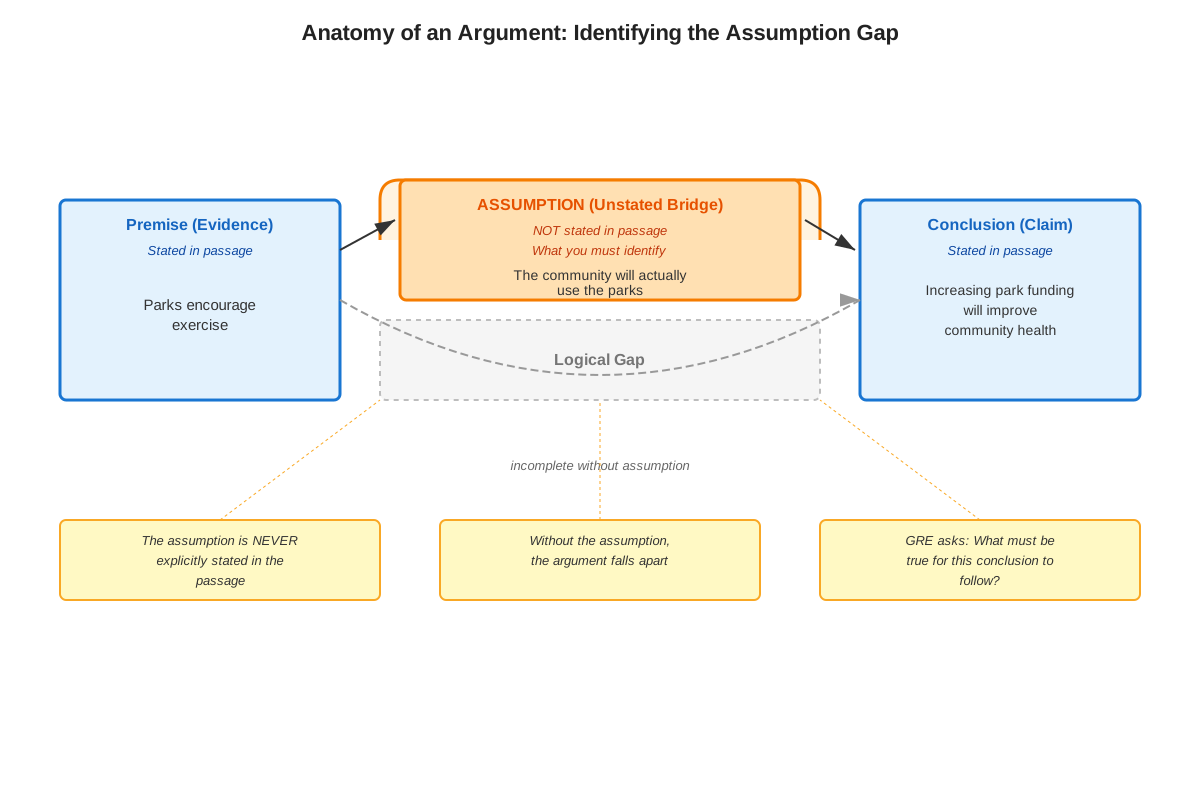
GRE assumption questions challenge students to think beyond what is written and identify what the author takes for granted without stating explicitly. Every argument contains premises (stated evidence) and a conclusion (the claim being made), but the connection between them often relies on unstated beliefs or facts. For example, if an argument concludes that "increasing park funding will improve community health" based on evidence that "parks encourage exercise," the unstated assumption is that the community will actually use these parks. Without this assumption, the argument collapses. The GRE tests whether students can identify these critical logical dependencies.
Within the broader landscape of Verbal Reasoning, assumption questions form the foundation for understanding other Critical Reasoning question types, including strengthen/weaken questions, evaluate questions, and flaw questions. All of these question types require understanding the argument's structure and logical gaps. Students who master assumption identification develop a systematic approach to argument analysis that improves performance across all Critical Reasoning questions, making this topic a high-yield investment of study time.
Learning Objectives
- [ ] Identify when Assumption questions is being tested
- [ ] Explain the core rule or strategy behind Assumption questions
- [ ] Apply Assumption questions to GRE-style questions accurately
- [ ] Distinguish between necessary assumptions and sufficient assumptions
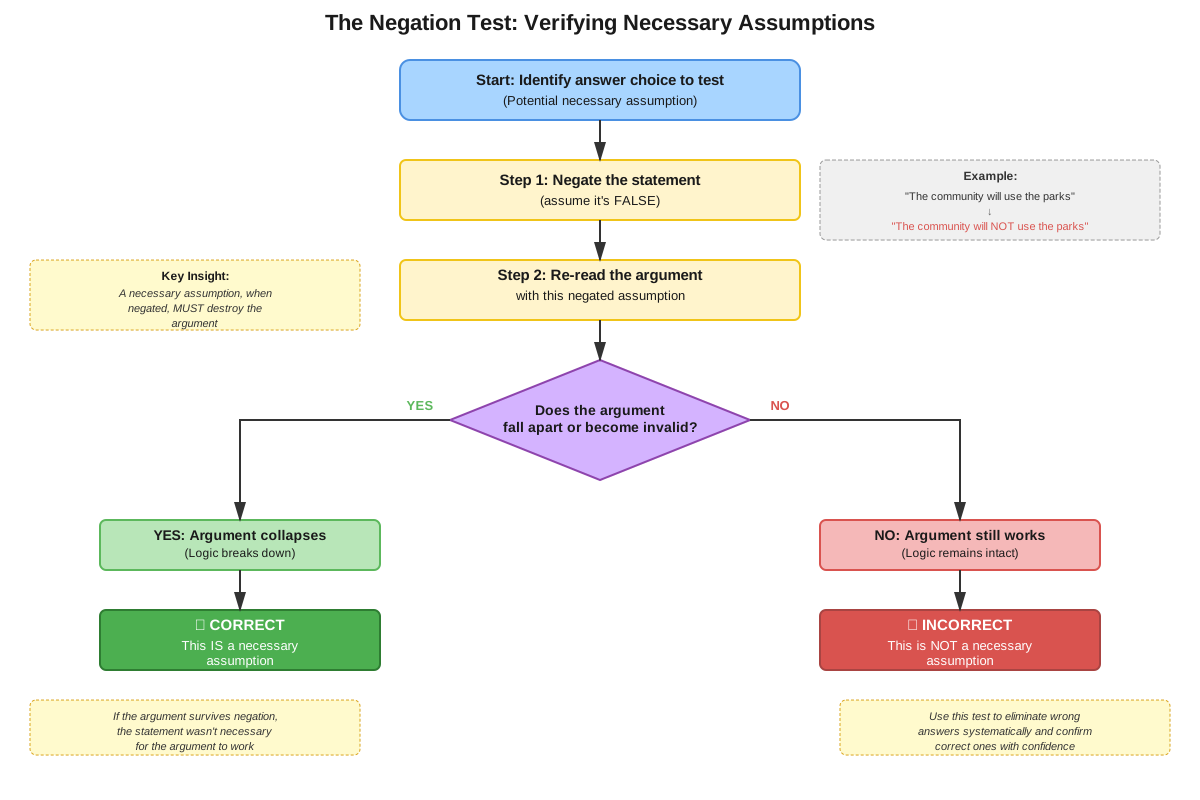
- [ ] Use the negation test to verify whether an identified statement is truly a necessary assumption
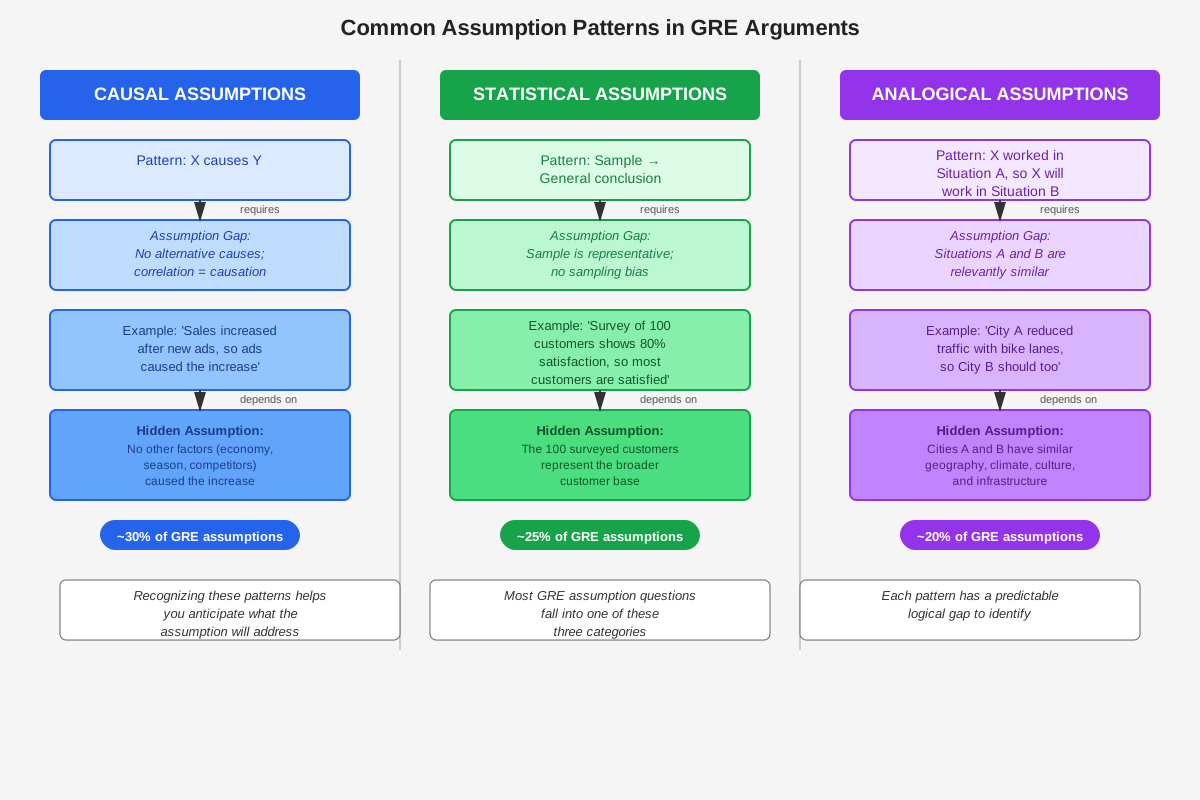
- [ ] Recognize common assumption patterns in causal, statistical, and analogical arguments
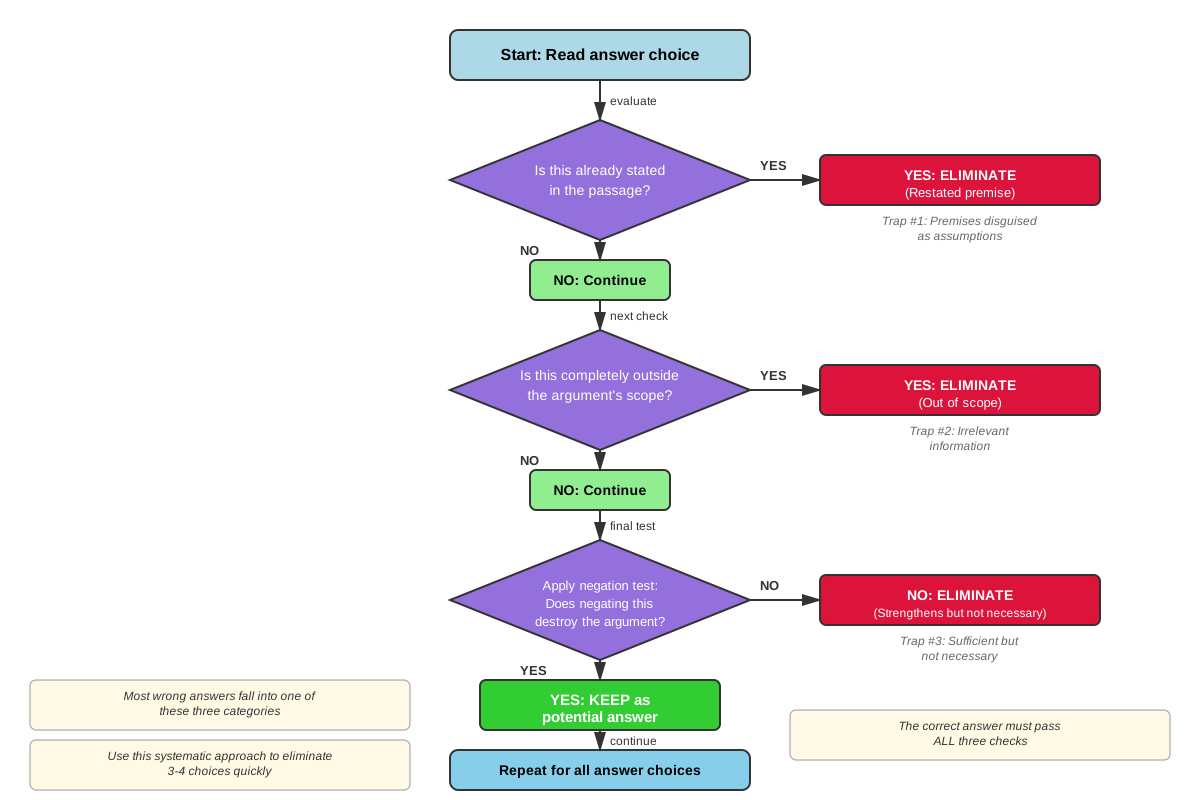
- [ ] Eliminate incorrect answer choices that restate premises, strengthen arguments without being necessary, or fall outside the argument's scope
Prerequisites
- Basic argument structure: Understanding the difference between premises (evidence) and conclusions (claims) is essential because assumption questions require identifying what connects these elements
- Logical reasoning fundamentals: Familiarity with how evidence supports conclusions enables recognition of gaps where unstated premises are needed
- Reading comprehension skills: The ability to extract main ideas and understand author intent provides the foundation for analyzing argument structure
- Causal reasoning basics: Understanding cause-and-effect relationships helps identify assumptions in arguments that claim one thing causes another
Why This Topic Matters
Assumption questions appear in approximately 20-30% of all Critical Reasoning questions on the GRE, making them one of the highest-frequency question types students will encounter. The Educational Testing Service (ETS) considers these questions essential for assessing analytical thinking skills required for graduate-level work. In academic settings, students must constantly evaluate research claims, identify unstated premises in scholarly arguments, and assess the validity of conclusions—skills directly tested by assumption questions.
Beyond the exam, the ability to identify assumptions has profound real-world applications. In professional contexts, recognizing unstated premises helps evaluate business proposals, assess research validity, analyze policy recommendations, and make sound decisions based on incomplete information. Legal reasoning, medical diagnosis, scientific research, and business strategy all require the ability to identify what must be true for a conclusion to follow from evidence.
On the GRE, assumption questions typically appear as short arguments (3-5 sentences) followed by a question stem that explicitly asks for an assumption. Common question stem formats include: "Which of the following is an assumption on which the argument depends?" or "The argument assumes which of the following?" These questions test not just reading comprehension but logical analysis—the ability to see what isn't written but must be true for the argument to work.
Core Concepts
What Is an Assumption?
An assumption is an unstated premise that must be true for an argument's conclusion to follow logically from its stated evidence. Assumptions are the invisible glue holding arguments together—they bridge the gap between what is explicitly stated and what is concluded. Every argument with a logical gap contains at least one assumption, and identifying these gaps is the key to answering assumption questions correctly.
Assumptions differ from stated premises in that they are never explicitly mentioned in the argument. They also differ from inferences or conclusions because they are foundational beliefs the argument requires, not results derived from the evidence. For example, if an argument states "Sales increased after we hired a new marketing director, so the new director caused the sales increase," the assumption is that no other factors (economic conditions, seasonal trends, product improvements) caused the sales increase.
Types of Assumptions
Necessary assumptions are conditions that must be true for the argument to work. If a necessary assumption is false, the argument completely falls apart. These are the assumptions GRE questions typically ask about. For example, in an argument concluding that "electric cars will reduce pollution," a necessary assumption is that "electric cars produce less pollution than current vehicles."
Sufficient assumptions are conditions that, if true, would guarantee the conclusion. These are stronger than necessary and often involve filling all logical gaps completely. While less commonly tested on the GRE, understanding the distinction helps avoid trap answers that provide more support than necessary.
The Argument Structure Framework
Every assumption question involves analyzing argument structure:
- Identify the conclusion: What claim is the author making? Look for conclusion indicators like "therefore," "thus," "consequently," or "so."
- Identify the premises: What evidence supports this conclusion? These are the stated facts or observations.
- Find the gap: What logical leap occurs between evidence and conclusion? What must be true but isn't stated?
- Articulate the assumption: What unstated belief bridges this gap?
For example:
- Premise: Company profits increased 20% after implementing flexible work schedules
- Conclusion: Flexible work schedules caused the profit increase
- Gap: The argument jumps from correlation to causation
- Assumption: No other factors caused the profit increase; the timing wasn't coincidental
Common Assumption Patterns
Causal assumptions appear when arguments claim one thing causes another. These arguments assume no alternative causes exist, no reverse causation occurred, and correlation indicates causation. For example: "Crime decreased after police increased patrols, so increased patrols reduced crime" assumes no other factors (seasonal changes, economic improvements, demographic shifts) caused the decrease.
Comparison assumptions occur when arguments compare two things and assume they are comparable in relevant ways. For example: "This teaching method worked in Finland, so it will work in the United States" assumes the educational systems, student populations, and cultural contexts are sufficiently similar.
Statistical assumptions involve arguments using data or surveys. These assume the sample is representative, the data is accurate, and statistical relationships indicate real-world relationships. For example: "A survey shows 70% of customers prefer our product" assumes the survey sample represents the broader customer base.
Implementation assumptions appear when arguments propose a plan and assume it can be implemented as intended, will have the predicted effects, and won't face significant obstacles. For example: "Building a new highway will reduce traffic congestion" assumes people will use the highway, it won't induce additional traffic, and construction is feasible.
The Negation Test
The negation test is the most powerful tool for verifying necessary assumptions. To apply it:
- Take the answer choice you're testing
- Negate it (make it false or opposite)
- Ask: "Does this negation destroy the argument?"
- If yes, it's a necessary assumption; if no, it's not
For example, if testing whether "The new policy will not face legal challenges" is an assumption for an argument concluding "The new policy will be implemented successfully":
- Negation: "The new policy WILL face legal challenges"
- Effect: This could prevent successful implementation, destroying the argument
- Conclusion: This is likely a necessary assumption
Scope Matching
Assumptions must match the scope of the argument—they should involve the same concepts, timeframes, and populations mentioned in the premises and conclusion. A common trap answer introduces new concepts not discussed in the argument. For example, if an argument discusses "improving employee satisfaction," an assumption about "increasing company profits" likely falls outside the scope unless the argument explicitly connects these concepts.
Concept Relationships
The concepts within assumption questions form a logical progression: understanding argument structure (premises and conclusions) enables identification of logical gaps, which leads to recognizing assumptions that fill those gaps. The negation test serves as a verification tool for assumptions identified through gap analysis, while scope matching acts as a filter to eliminate irrelevant answer choices.
Assumption questions connect directly to prerequisite knowledge of basic argument structure and logical reasoning fundamentals. They build upon these foundations by requiring deeper analysis of what isn't stated. This topic then enables progression to more advanced Critical Reasoning questions: strengthen/weaken questions (which require identifying assumptions to know what would support or undermine them), evaluate questions (which ask what information would help assess assumptions), and flaw questions (which identify problematic assumptions).
Relationship map:
Argument Structure → Gap Identification → Assumption Recognition → Negation Test Verification → Answer Selection
↓
Enables: Strengthen/Weaken Questions, Evaluate Questions, Flaw Questions
High-Yield Facts
⭐ Assumptions are always unstated—if a statement appears in the argument text, it cannot be the correct answer to an assumption question
⭐ The negation test is the most reliable method for verifying necessary assumptions: negate the answer choice and see if it destroys the argument
⭐ Causal arguments always assume no alternative causes exist for the observed effect
⭐ Assumptions must match the scope of both premises and conclusion—new concepts in answer choices are usually incorrect
⭐ Necessary assumptions are required for the argument to work, but they don't need to guarantee the conclusion
- Comparison arguments assume the compared entities are similar in relevant ways
- Statistical arguments assume samples are representative of the populations they're meant to represent
- Implementation plans assume no insurmountable obstacles will prevent execution
- Assumptions often connect new terms in the conclusion to concepts mentioned in the premises
- The correct answer to an assumption question often feels obvious once identified—it should make you think "of course that must be true"
Quick check — test yourself on Assumption questions so far.
Try Flashcards →Common Misconceptions
Misconception: Assumptions strengthen or prove the argument → Correction: Assumptions are necessary for the argument to work at all, but they don't necessarily make the argument strong or prove the conclusion. A necessary assumption is simply something that must be true; the argument can still be weak even with all assumptions met.
Misconception: The correct answer will introduce important new information → Correction: While assumptions are unstated, they must connect concepts already present in the argument. Answer choices that introduce entirely new topics or concepts typically fall outside the argument's scope and are incorrect.
Misconception: Assumptions are the same as inferences → Correction: Inferences are conclusions drawn from evidence, while assumptions are unstated premises required for the argument to work. Inferences follow from the argument; assumptions precede and enable it.
Misconception: If an answer choice would help the argument, it's an assumption → Correction: Many statements could strengthen an argument without being necessary assumptions. The correct answer must be required for the argument to work—its negation must destroy the argument's logic.
Misconception: Longer, more complex answer choices are more likely to be correct → Correction: Correct assumptions are often simple, straightforward statements. Test-makers frequently use complex wording in incorrect answers to make them seem sophisticated and tempting.
Misconception: Assumptions must make the argument airtight → Correction: Necessary assumptions only need to be minimally true for the argument to function. They don't need to eliminate all possible objections or guarantee the conclusion.
Worked Examples
Example 1: Causal Argument
Argument: "The Brookdale School District implemented a new mathematics curriculum last year. Standardized test scores in mathematics increased by 15% compared to the previous year. Therefore, the new curriculum caused the improvement in test scores."
Question: Which of the following is an assumption on which the argument depends?
Answer Choices:
A) The new curriculum is superior to curricula used in other districts
B) No other factors that could improve test scores changed during the same period
C) The 15% increase represents a statistically significant improvement
D) Teachers received adequate training on the new curriculum
E) Students studied more hours under the new curriculum
Step 1 - Identify the conclusion: "The new curriculum caused the improvement in test scores"
Step 2 - Identify the premises: New curriculum was implemented; test scores increased 15%
Step 3 - Find the gap: The argument jumps from correlation (curriculum change coincided with score increase) to causation (curriculum caused the increase). This is a classic causal reasoning gap.
Step 4 - Predict the assumption: The argument must assume no other factors caused the improvement—otherwise, we can't conclude the curriculum was responsible.
Step 5 - Evaluate answer choices:
- A) Compares to other districts—outside the scope; the argument only discusses this district
- B) Directly addresses the causal gap—if other factors changed, they might have caused the improvement
- C) Statistical significance isn't necessary for the causal claim to work logically
- D) Could strengthen the argument but isn't necessary—the curriculum might work even with poor training
- E) Introduces a new factor (study hours) not mentioned in the argument
Step 6 - Apply negation test to B: "Other factors that could improve test scores DID change during the same period." This negation destroys the argument because it provides alternative explanations for the score increase.
Correct Answer: B
Connection to learning objectives: This example demonstrates identifying assumption questions (objective 1), applying the core strategy of gap analysis (objective 2), and accurately selecting the correct answer (objective 3). It also illustrates the common causal assumption pattern (objective 6).
Example 2: Implementation Argument
Argument: "City planners propose converting downtown parking spaces into bicycle lanes to reduce traffic congestion. Studies show that cities with extensive bicycle infrastructure have less traffic congestion than cities without such infrastructure. Therefore, implementing this plan will reduce traffic congestion in our downtown area."
Question: The argument assumes which of the following?
Answer Choices:
A) Bicycle lanes are more cost-effective than other congestion-reduction methods
B) Current downtown traffic congestion is severe enough to warrant intervention
C) A sufficient number of commuters will switch from driving to bicycling
D) Other cities with bicycle infrastructure are comparable to this city
E) The studies cited used rigorous scientific methodology
Step 1 - Identify the conclusion: "Implementing this plan will reduce traffic congestion in our downtown area"
Step 2 - Identify the premises: The plan involves converting parking to bike lanes; other cities with bike infrastructure have less congestion
Step 3 - Find the gaps:
- Gap 1: The argument assumes this city is comparable to the cities in the studies
- Gap 2: The argument assumes the plan will actually change behavior (people will bike instead of drive)
- Gap 3: The argument assumes enough people will change behavior to affect congestion
Step 4 - Evaluate answer choices:
- A) Cost-effectiveness isn't necessary for the plan to reduce congestion
- B) The severity of current congestion doesn't affect whether the plan will reduce it
- C) Directly addresses implementation gap—if no one switches to bicycling, removing parking won't reduce traffic
- D) Addresses comparability but is less directly necessary than C
- E) Study methodology doesn't need to be rigorous for the argument's logic to work
Step 5 - Apply negation test to C: "Commuters will NOT switch from driving to bicycling in sufficient numbers." This negation destroys the argument—if people don't bike instead of drive, removing parking spaces won't reduce traffic congestion.
Step 6 - Apply negation test to D: "Other cities are NOT comparable to this city." This weakens the argument but doesn't completely destroy it—the plan might still work even if the cities differ.
Correct Answer: C
Connection to learning objectives: This example shows how to distinguish between assumptions that weaken versus destroy an argument (objective 4), demonstrates the negation test (objective 5), and illustrates implementation assumption patterns (objective 6).
Exam Strategy
Recognizing assumption questions: Look for question stems containing phrases like "assumes," "depends on the assumption," "presupposes," "takes for granted," or "requires the assumption that." These trigger words definitively identify assumption questions and should prompt immediate activation of gap-analysis strategies.
Systematic approach:
- Read the argument carefully (30 seconds): Identify conclusion and premises
- Find the logical gap (15 seconds): What leap in logic occurs?
- Predict the assumption (15 seconds): Articulate what must be true
- Evaluate answer choices (45 seconds): Match prediction and apply negation test
- Verify with negation (15 seconds): Confirm the answer destroys the argument when negated
Process of elimination strategies:
- Immediately eliminate answer choices that restate premises—these are already stated, so they cannot be assumptions
- Eliminate choices that introduce completely new concepts not connected to the argument's scope
- Eliminate choices that would strengthen the argument but aren't necessary—use the negation test to distinguish
- Eliminate choices that are too extreme—necessary assumptions are often minimal requirements, not absolute guarantees
- Be suspicious of choices with absolute language ("all," "never," "only") unless the conclusion itself is absolute
Time management: Allocate approximately 2 minutes per assumption question. If stuck between two answers after 90 seconds, apply the negation test to both and select the one whose negation more completely destroys the argument. Don't spend more than 2.5 minutes on any single question—guess strategically and move forward.
Common trap patterns:
- The strengthener trap: Answer choices that support the argument but aren't necessary for it
- The premise restatement trap: Answer choices that repeat information already in the argument
- The scope expansion trap: Answer choices that introduce new topics tangentially related to the argument
- The sufficient assumption trap: Answer choices that would guarantee the conclusion rather than being minimally necessary
Exam Tip: When you negate the correct answer, you should feel the argument collapse completely. If the negation only weakens the argument slightly, keep looking.
Memory Techniques
SCAN mnemonic for assumption question approach:
- Structure: Identify premises and conclusion
- Connection: Find the gap between evidence and claim
- Assumption: Predict what bridges the gap
- Negation: Test by negating and checking if argument collapses
The Bridge Visualization: Picture the premises as one side of a canyon and the conclusion as the other side. The assumption is the invisible bridge connecting them. If you remove the bridge (negate the assumption), you can't get from premises to conclusion—you fall into the canyon.
CAUSAL acronym for causal assumption patterns:
- Correlation doesn't equal causation
- Alternative causes must be ruled out
- Unstated factors might be responsible
- Simultaneous changes could explain both
- Assume no reverse causation
- Link between cause and effect must exist
The "Of Course" Test: When you identify the correct assumption, your reaction should be "Of course that must be true—otherwise the argument makes no sense." If you don't have this reaction, reconsider whether you've found a necessary assumption or just a strengthener.
Scope Matching Mantra: "New concepts = wrong answer." Repeat this when evaluating answer choices to avoid scope expansion traps.
Summary
Assumption questions test the ability to identify unstated premises that arguments require to function logically. These questions appear frequently on the GRE Verbal Reasoning section and form the foundation for understanding all Critical Reasoning question types. The core strategy involves identifying the argument's conclusion and premises, finding the logical gap between them, and determining what must be true to bridge that gap. The negation test—negating an answer choice and checking whether it destroys the argument—provides the most reliable verification method. Common assumption patterns include causal assumptions (ruling out alternative causes), comparison assumptions (establishing relevant similarity), statistical assumptions (ensuring representativeness), and implementation assumptions (confirming feasibility). Success requires distinguishing necessary assumptions from statements that merely strengthen arguments, maintaining strict scope matching between answer choices and argument content, and systematically applying gap analysis to every assumption question encountered.
Key Takeaways
- Assumptions are unstated premises required for arguments to work—they never appear explicitly in the argument text
- The negation test is the gold standard for verifying necessary assumptions: negate the answer and check if the argument collapses
- Causal arguments always assume no alternative explanations exist for the observed effect
- Correct assumptions must match the scope of both premises and conclusion—new concepts signal incorrect answers
- Necessary assumptions need only be minimally true; they don't guarantee conclusions or make arguments airtight
- Common traps include premise restatements, strengtheners that aren't necessary, and scope expansions introducing new topics
- Systematic gap analysis (identify conclusion → identify premises → find gap → predict assumption) dramatically improves accuracy
Related Topics
Strengthen and Weaken Questions: After mastering assumption identification, students can progress to questions asking what would support or undermine arguments. Understanding assumptions is essential because strengtheners often confirm assumptions while weakeners often attack them.
Flaw Questions: These questions ask students to identify logical errors in arguments, which frequently involve problematic assumptions. Mastering assumption questions provides the foundation for recognizing when arguments make unjustified assumptions.
Evaluate Questions: These questions ask what additional information would help assess an argument's validity. The information needed typically relates to testing whether key assumptions are true.
Argument Structure Questions: More advanced analysis of how arguments are constructed, including identifying roles of different statements and understanding complex argument patterns. Assumption mastery provides the analytical foundation for this deeper structural analysis.
Practice CTA
Now that you understand the core concepts, strategies, and common patterns in assumption questions, it's time to apply this knowledge. Attempt the practice questions to reinforce your gap-analysis skills and test your ability to apply the negation test under exam-like conditions. Work through the flashcards to internalize high-yield facts and common assumption patterns. Remember: assumption questions reward systematic thinking and careful analysis. Each practice question you complete strengthens your ability to see logical gaps and identify what arguments take for granted. Your investment in mastering this high-frequency question type will pay dividends across all Critical Reasoning questions on test day.
Sign up free to keep reading
Create a free AnvayaPrep account to finish this GRE guide on Assumption questions — plus flashcards and practice questions.