Overview
Colon clues represent one of the most reliable and high-yield punctuation-based strategies for solving GRE Text Completion questions. When a colon appears in a sentence, it functions as a powerful structural signal that the content following the colon will explain, define, restate, or provide specific examples of what came before it. This relationship creates a direct logical bridge that test-takers can exploit to predict the meaning of blank spaces with remarkable accuracy.
Understanding GRE colon clues is essential because the GRE test writers deliberately use punctuation marks as structural indicators to create sophisticated sentence relationships. Unlike casual writing where colons might be used loosely, GRE sentences employ colons with precision and purpose. When students learn to recognize and leverage these punctuation signals, they gain access to explicit textual evidence that points directly toward the correct answer choice. This strategy reduces guessing, increases accuracy, and saves valuable time during the exam.
Within the broader landscape of Verbal Reasoning, colon clues belong to a family of structural and contextual strategies that help decode complex sentences. They work alongside semicolon clues, contrast signals (such as "however" or "although"), and continuation signals (such as "moreover" or "indeed") to form a comprehensive toolkit for Text Completion mastery. While transition words provide logical relationships through vocabulary, punctuation marks like colons offer structural relationships that are often even more explicit and reliable, making them indispensable for achieving high scores on the Verbal Reasoning section.
Learning Objectives
- [ ] Identify when Colon clues is being tested in GRE Text Completion questions
- [ ] Explain the core rule or strategy behind Colon clues and their logical function
- [ ] Apply Colon clues to GRE-style questions accurately and efficiently
- [ ] Distinguish between different types of colon relationships (definition, explanation, example, restatement)
- [ ] Recognize when colons create same-direction versus opposite-direction clues
- [ ] Evaluate answer choices by testing their logical consistency with post-colon content
- [ ] Integrate colon clue strategy with other contextual clues for maximum accuracy
Prerequisites
- Basic sentence structure understanding: Recognition of independent clauses is necessary because colons typically follow complete thoughts and introduce related content.
- Vocabulary fundamentals: A working vocabulary helps students understand the content on both sides of the colon, enabling them to identify the logical relationship.
- Text Completion question format familiarity: Students should understand how blanks function in sentences and how answer choices are presented.
- Logical relationship concepts: Basic understanding of same-direction (support/continuation) versus opposite-direction (contrast) relationships aids in applying colon clues effectively.
Why This Topic Matters
Colon clues appear with remarkable frequency on the GRE Verbal Reasoning section, making them one of the highest-yield strategies for Text Completion questions. Approximately 15-20% of Text Completion questions feature colons as primary structural indicators, and recognizing this pattern can directly improve accuracy on these questions. Beyond their frequency, colon clues offer something rare in standardized testing: explicit, unambiguous evidence for the correct answer embedded directly in the sentence structure.
In real-world applications, understanding how colons function improves reading comprehension across academic and professional contexts. Graduate-level texts, research papers, and scholarly articles frequently employ colons to introduce definitions, explanations, and examples. Students who master colon interpretation develop stronger analytical reading skills that extend far beyond test preparation.
On the GRE specifically, colon clues most commonly appear in single-blank and double-blank Text Completion questions where one blank appears before the colon and the explanatory content follows it, or vice versa. The test writers use colons to create elegant sentences where sophisticated vocabulary is balanced by structural clarity. Questions featuring colon clues typically test whether students can recognize explicit textual support rather than relying solely on vocabulary knowledge or intuition. This makes colon clue questions particularly valuable for strategic test-takers who want to maximize accuracy through systematic analysis rather than guesswork.
Core Concepts
The Fundamental Function of Colons
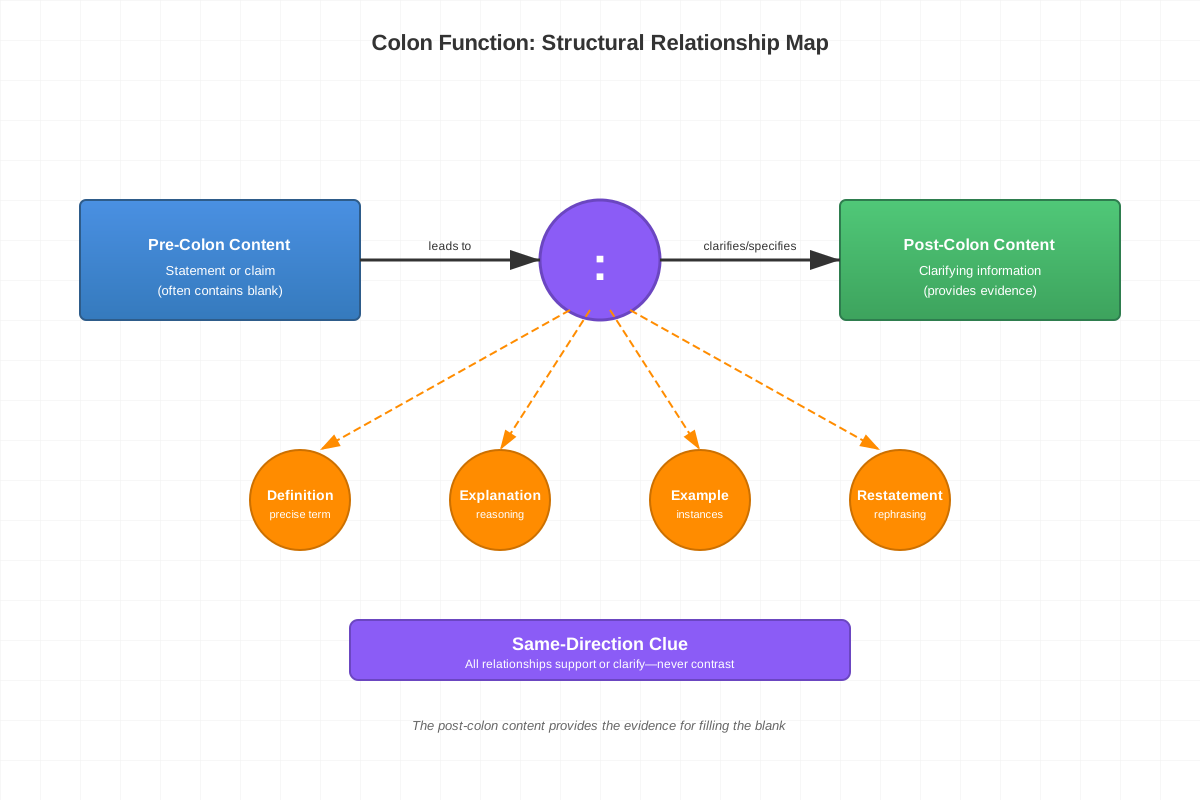
A colon serves as a punctuation mark that signals a specific logical relationship: what follows the colon will elaborate on, explain, define, exemplify, or restate what precedes it. Unlike periods that separate independent ideas or commas that join related elements, colons create a hierarchical relationship where the second part serves the first part by providing clarification or specification.
The critical insight for GRE test-takers is that colons create same-direction relationships. The content after the colon supports, reinforces, or illuminates the content before it. This means that if a blank appears on one side of the colon, the other side will contain semantic clues that point toward words with similar or related meanings. The colon essentially says, "Here's what I mean by that" or "Let me be more specific."
Types of Colon Relationships
Understanding the specific ways colons function helps students predict answer choices more accurately:
| Relationship Type | Function | Example Structure |
|---|---|---|
| Definition | Provides the meaning of a term | "The scientist exhibited \_\_\_\_: a tendency to doubt accepted theories." |
| Explanation | Clarifies why or how something occurs | "Her success was \_\_\_\_: she had prepared thoroughly for months." |
| Example/List | Offers specific instances | "The museum featured \_\_\_\_ artifacts: pottery, tools, and jewelry." |
| Restatement | Expresses the same idea differently | "His approach was \_\_\_\_: he refused to compromise his principles." |
| Cause-Effect | Shows consequences or results | "The drought had \_\_\_\_ effects: crop failures and water shortages." |
Identifying Colon Clues in Sentences
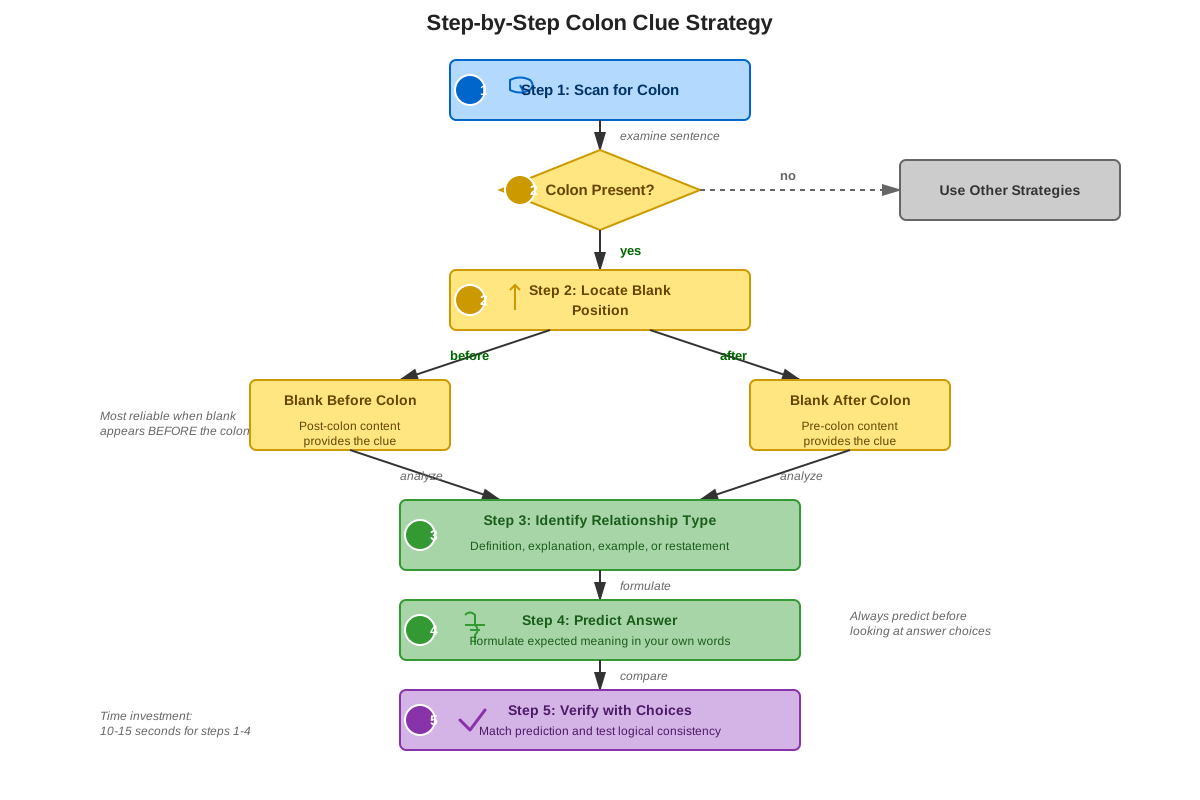
To effectively use colon clues, students must develop a systematic approach:
- Scan for the colon: Immediately identify whether a colon appears in the sentence
- Locate the blank: Determine whether the blank appears before or after the colon
- Read the explanatory content: Carefully analyze the content on the opposite side of the colon from the blank
- Identify the relationship: Determine which type of colon relationship is being used
- Predict the answer: Based on the explanatory content, formulate a prediction for the blank
- Match to choices: Select the answer choice that best fits the prediction
Colon Clues with Blanks Before the Colon
When the blank appears before the colon, the content following the colon provides direct evidence for what should fill the blank. This is often the most straightforward application of colon clues.
Example: "The professor's lectures were notably \_\_\_\_: they incorporated humor, personal anecdotes, and interactive demonstrations."
The content after the colon (humor, anecdotes, interactive demonstrations) describes qualities that are engaging, varied, and entertaining. The blank should reflect these characteristics, pointing toward words like "engaging," "dynamic," or "captivating."
Colon Clues with Blanks After the Colon
When the blank appears after the colon, it should logically explain, define, or exemplify what came before. The pre-colon content sets up an expectation that the post-colon content must fulfill.
Example: "The researcher's methodology was rigorous: she \_\_\_\_ every data point multiple times before drawing conclusions."
The word "rigorous" before the colon indicates thoroughness and precision. The blank after the colon should describe an action that demonstrates rigor, such as "verified," "examined," or "scrutinized."
Multiple Blanks and Colons
Some GRE questions feature multiple blanks with a colon, requiring students to use the colon relationship to solve for both blanks in coordination.
Example: "The artist's work was characterized by \_\_\_\_(i)\_\_\_\_: her paintings featured \_\_\_\_(ii)\_\_\_\_ colors and bold, sweeping brushstrokes."
Here, the second blank and the additional descriptive content ("bold, sweeping brushstrokes") provide clues for the first blank. If the second blank is filled with "vibrant" or "intense," the first blank should reflect a quality like "dynamism" or "energy" that encompasses these specific features.
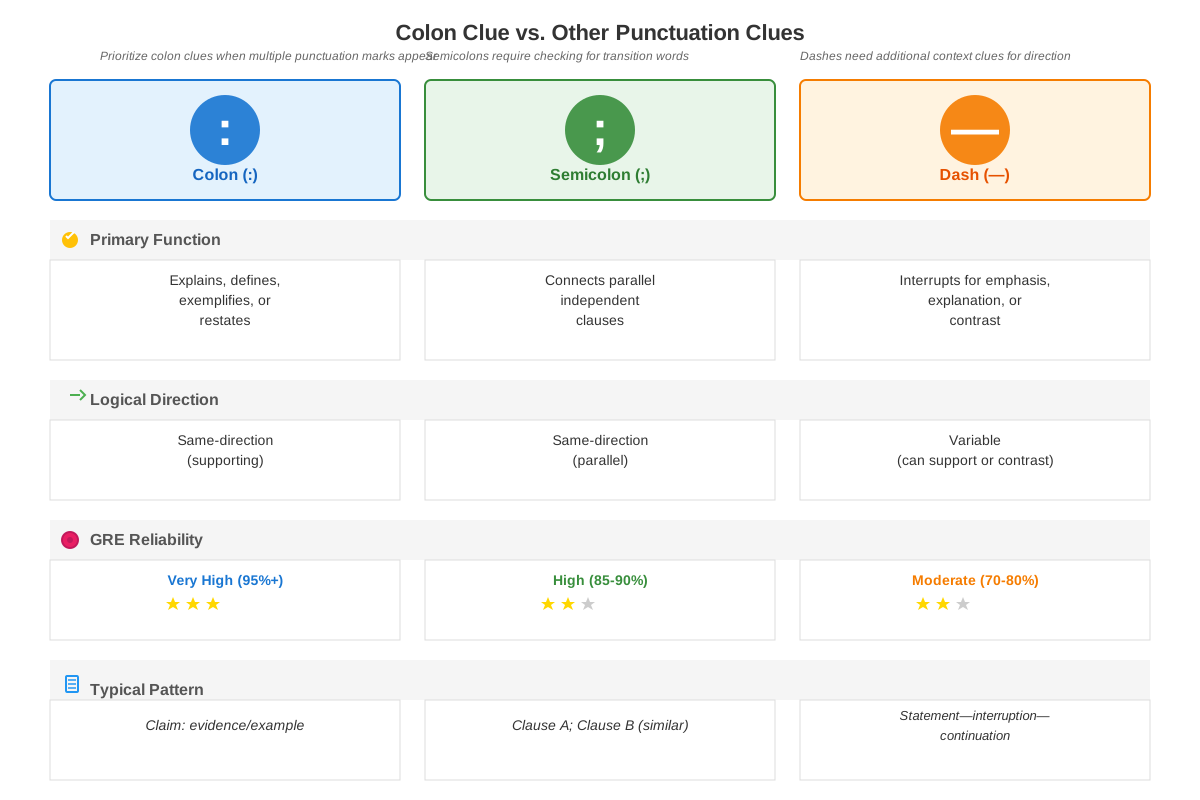
Distinguishing Colons from Semicolons
While both punctuation marks appear in GRE sentences, they function differently:
- Colons introduce explanations, definitions, or examples (same-direction, hierarchical)
- Semicolons connect two independent but related ideas (same-direction, parallel)
Colons create a "general → specific" relationship, while semicolons create an "idea → related idea" relationship. Recognizing this distinction prevents confusion when analyzing sentence structure.
Concept Relationships
The colon clue strategy connects directly to broader Text Completion approaches. Colon clues → serve as one type of → structural signal → which belongs to → contextual clue strategies → that enable → accurate blank prediction.
Within the topic itself, understanding the fundamental function of colons provides the foundation for recognizing specific relationship types (definition, explanation, example). This recognition enables the systematic identification process, which then allows students to apply the strategy to various blank positions (before or after the colon). All these concepts converge in the ability to handle complex sentences with multiple blanks.
Colon clues also relate to prerequisite knowledge of sentence structure because recognizing where independent clauses end and explanatory content begins requires grammatical awareness. They connect forward to more advanced strategies like combining multiple clue types, where students might use both a colon clue and a transition word simultaneously to narrow down answer choices with even greater precision.
The relationship between colon clues and vocabulary knowledge is complementary rather than hierarchical: strong vocabulary helps students understand the content on both sides of the colon, while colon clue strategy helps students deduce word meanings even when vocabulary is challenging. This synergy makes colon clues particularly valuable for questions featuring difficult vocabulary.
High-Yield Facts
⭐ Colons always create same-direction relationships: the content after the colon supports, explains, or exemplifies what comes before.
⭐ Approximately 15-20% of Text Completion questions feature colons as primary structural indicators, making this one of the most frequently tested punctuation patterns.
⭐ When a blank appears before a colon, the post-colon content provides direct evidence for what should fill the blank.
⭐ Colons introduce definitions, explanations, examples, lists, or restatements—never contrasts or opposing ideas.
⭐ The content after a colon is always more specific than what precedes it, creating a general-to-specific relationship.
- Colons can appear in single-blank, double-blank, or triple-blank Text Completion questions.
- Multiple descriptive elements after a colon (lists, multiple examples) provide cumulative evidence for the blank.
- Colon clues work most effectively when combined with careful attention to connotation and tone.
- The GRE uses colons with grammatical precision: what precedes the colon must be an independent clause.
- When both a colon and transition words appear in a sentence, the colon typically provides more explicit structural guidance.
- Incorrect answer choices in colon clue questions often feature words that are semantically opposite or unrelated to the post-colon content.
- Time-efficient test-takers prioritize colon clues because they offer explicit textual evidence requiring minimal inference.
Quick check — test yourself on Colon clues so far.
Try Flashcards →Common Misconceptions
Misconception: Colons can introduce contrasting ideas or opposite meanings.
Correction: Colons exclusively create same-direction relationships. They never introduce contrasts. If a sentence seems to contrast ideas around a colon, the contrast is within a same-direction framework (e.g., explaining why something is surprising, not contradicting it).
Misconception: The content after a colon is always a list or series of examples.
Correction: While colons frequently introduce lists, they also introduce single explanations, definitions, or restatements. A colon can be followed by a complete sentence that elaborates on the preceding clause.
Misconception: Colon clues only work when the blank appears before the colon.
Correction: Colon clues function bidirectionally. When the blank appears after the colon, it should logically explain or exemplify what came before. Both positions offer valuable structural guidance.
Misconception: If you understand the vocabulary on both sides of the colon, you don't need to use the colon clue strategy.
Correction: Even with strong vocabulary, the colon clue strategy provides structural confirmation and helps eliminate trap answers. It serves as a verification tool that increases accuracy beyond vocabulary knowledge alone.
Misconception: Colons and semicolons function interchangeably on the GRE.
Correction: Colons create hierarchical, explanatory relationships (general → specific), while semicolons connect parallel, independent ideas. Confusing these punctuation marks leads to misinterpreting sentence logic and selecting incorrect answers.
Misconception: The colon clue strategy takes too much time to apply during the exam.
Correction: With practice, identifying and applying colon clues becomes nearly instantaneous. Scanning for colons takes seconds, and the explicit evidence they provide often saves time by eliminating the need for extensive deliberation among answer choices.
Worked Examples
Example 1: Single Blank Before Colon
Question: "Despite her reputation for being \_\_\_\_, the executive's decision-making process was actually quite methodical: she carefully analyzed data, consulted multiple experts, and considered long-term consequences before committing to any course of action."
Step 1 - Identify the colon: The colon appears after "methodical" and before the explanation.
Step 2 - Locate the blank: The blank appears before the colon, in the first part of the sentence.
Step 3 - Analyze the post-colon content: The content after the colon describes a careful, thorough, analytical process (analyzing data, consulting experts, considering consequences). These actions demonstrate deliberation and thoughtfulness.
Step 4 - Note the contrast signal: The word "Despite" at the beginning indicates that the blank should contrast with "methodical." The sentence structure suggests her reputation contradicts her actual behavior.
Step 5 - Predict the answer: The blank should describe someone who is NOT methodical—perhaps impulsive, rash, or spontaneous. The colon confirms that "methodical" is the true characteristic, so the blank represents the false reputation.
Step 6 - Evaluate choices:
- (A) meticulous - Same direction as methodical; doesn't create contrast
- (B) impetuous - Opposite of methodical; creates the required contrast ✓
- (C) cautious - Same direction as methodical; doesn't create contrast
- (D) deliberate - Same direction as methodical; doesn't create contrast
- (E) systematic - Same direction as methodical; doesn't create contrast
Answer: (B) impetuous
Key Insight: This example demonstrates how colon clues work in conjunction with contrast signals. The colon confirms what is actually true (methodical behavior), which helps identify what the contrasting reputation must be (impetuous).
Example 2: Double Blank with Colon
Question: "The archaeologist's findings were ___(i)___: the artifacts she unearthed were ___(ii)___ in their preservation, showing almost no deterioration despite being buried for millennia."
Blank (i) choices:
(A) disappointing
(B) remarkable
(C) conventional
Blank (ii) choices:
(D) exceptional
(E) typical
(F) adequate
Step 1 - Identify the colon: The colon appears after blank (i), indicating that what follows will explain or define the nature of the findings.
Step 2 - Analyze the post-colon content: The artifacts showed "almost no deterioration despite being buried for millennia." This is clearly unusual and impressive—most ancient artifacts show significant deterioration.
Step 3 - Solve for blank (ii): The phrase "almost no deterioration" indicates the preservation was outstanding. Blank (ii) should reflect this exceptional quality. "Exceptional" (D) fits perfectly, while "typical" (E) and "adequate" (F) understate the significance.
Step 4 - Solve for blank (i): Now that we know the artifacts were exceptionally preserved, blank (i) should characterize findings that would feature such artifacts. "Remarkable" (B) aligns with exceptional preservation, while "disappointing" (A) contradicts it and "conventional" (C) understates it.
Step 5 - Verify the colon relationship: "The findings were remarkable: the artifacts were exceptional in their preservation" creates a proper colon relationship where the second part explains why the first part is true.
Answers: Blank (i) = (B) remarkable; Blank (ii) = (D) exceptional
Key Insight: With multiple blanks, use the most explicit information (here, "almost no deterioration") to solve one blank first, then use that answer along with the colon relationship to solve the remaining blank(s).
Exam Strategy
Systematic Approach for Colon Clue Questions
When approaching any Text Completion question, invest 2-3 seconds in scanning for punctuation marks, particularly colons. If a colon is present, immediately shift to colon clue strategy as your primary approach:
- Mark the colon visually (mentally or with your pencil on scratch paper)
- Identify which side contains the blank and which contains the evidence
- Read the evidence side carefully, noting specific descriptive words and phrases
- Formulate a prediction before looking at answer choices
- Eliminate choices that contradict or fail to align with the colon relationship
- Select the answer that best matches your prediction and maintains the same-direction relationship
Trigger Phrases and Patterns
Watch for these structural patterns that often accompany colons:
- "The [noun] was [blank]: [explanation/example]" - Classic definition/explanation structure
- "[Statement with blank]: [specific details or list]" - General-to-specific pattern
- "[Blank] [noun]: [descriptive clause]" - Adjective blank followed by defining content
- Lists after colons - Multiple examples that collectively define the blank
Process of Elimination Tips
When using colon clues for elimination:
- Immediately eliminate opposite-direction words: If the post-colon content is positive, eliminate negative answer choices
- Eliminate words that are too weak or too strong: The intensity should match the evidence
- Watch for trap answers that relate to the topic but don't fit the colon relationship: GRE wrong answers often use thematically related words that don't satisfy the structural requirement
- Consider connotation carefully: Words might be similar in denotation but differ in connotation (e.g., "frugal" vs. "miserly")
Time Allocation
Colon clue questions should actually save time rather than consume it. Once you identify a colon:
- Spend 10-15 seconds analyzing the colon relationship and formulating a prediction
- Spend 10-15 seconds evaluating answer choices against your prediction
- Total time: 20-30 seconds for single-blank questions, 35-45 seconds for double-blank questions
This is often faster than questions without clear structural clues, where students might spend 45-60 seconds deliberating among answer choices without explicit textual guidance.
Exam Tip: If you're running short on time, prioritize questions with colons. They offer the most explicit evidence and the highest probability of quick, accurate answers.
Memory Techniques
The "Colon = Clarification" Mnemonic
Remember: Colon = Clarification. Every time you see a colon, think "clarification coming" or "clarification provided." This simple association helps trigger the strategic approach.
The Arrow Visualization
Mentally visualize a colon as an arrow pointing from general to specific:
General statement → : → Specific explanation
This visual reinforces that colons create hierarchical, same-direction relationships where the second part serves the first.
The "Same Team" Metaphor
Think of the content on both sides of a colon as being on the "same team." They work together, support each other, and move in the same direction. This prevents the common error of treating colons like contrast signals.
The Three E's of Colons
Colons introduce:
- Explanations
- Examples
- Elaborations
This alliterative mnemonic helps recall the primary functions of colons on the GRE.
The "Before and After" Technique
Create a mental template: "If the BEFORE is [positive/negative/neutral], the AFTER must be [positive/negative/neutral] too." This reinforces same-direction thinking and prevents opposite-direction errors.
Summary
Colon clues represent one of the most reliable and high-yield strategies for GRE Text Completion questions, appearing in approximately 15-20% of questions. The fundamental principle is straightforward: colons create same-direction relationships where the content following the colon explains, defines, exemplifies, or restates what precedes it. This structural signal provides explicit textual evidence that points directly toward correct answers. Students should systematically scan for colons, identify whether blanks appear before or after them, and use the explanatory content to predict answers before evaluating choices. The strategy works bidirectionally—blanks before colons are explained by post-colon content, while blanks after colons should logically elaborate on pre-colon statements. Mastering colon clues requires understanding the five primary relationship types (definition, explanation, example, restatement, cause-effect) and recognizing that colons always create general-to-specific hierarchies. When combined with careful attention to connotation and integrated with other contextual clues, colon clue strategy dramatically improves accuracy while reducing time spent on deliberation, making it an essential component of high-scoring Verbal Reasoning performance.
Key Takeaways
- Colons always signal same-direction relationships—they never introduce contrasts or opposing ideas
- The content after a colon is more specific than what precedes it, creating a general-to-specific hierarchy
- Scan every Text Completion question for colons within the first few seconds to identify high-yield strategic opportunities
- Use post-colon content to predict answers for pre-colon blanks, and vice versa, before looking at answer choices
- Colon clues appear in 15-20% of Text Completion questions, making them one of the most frequently tested structural patterns
- Combine colon clue strategy with attention to transition words and contrast signals for maximum accuracy on complex sentences
- Practice identifying the five relationship types (definition, explanation, example, restatement, cause-effect) to deepen strategic flexibility
Related Topics
Semicolon Clues: While colons create hierarchical explanatory relationships, semicolons connect parallel independent ideas. Mastering both punctuation strategies provides comprehensive structural analysis skills for Text Completion questions.
Transition Word Strategies: Words like "however," "moreover," "nevertheless," and "furthermore" signal logical relationships similar to punctuation marks. Understanding how transition words and punctuation work together enables sophisticated sentence analysis.
Contrast Signal Recognition: Many GRE sentences combine colons with contrast words (like "despite" or "although"). Learning to navigate these combined structures builds on colon clue mastery.
Multiple Blank Coordination: Advanced Text Completion questions feature two or three blanks that must work together logically. Colon clue strategy provides a foundation for solving these complex questions systematically.
Vocabulary in Context: Strong colon clue skills enhance the ability to deduce word meanings from context, even when facing unfamiliar vocabulary—a critical skill for Reading Comprehension as well as Text Completion.
Practice CTA
Now that you've mastered the fundamentals of colon clues, it's time to cement your understanding through active practice. Attempt the practice questions designed specifically for this topic, paying careful attention to how colons function in each sentence. Use the flashcards to reinforce the five relationship types and common patterns. Remember: recognizing colon clues is a skill that improves rapidly with deliberate practice. Each question you analyze strengthens your pattern recognition and increases your speed and accuracy. You're building a powerful strategic tool that will serve you throughout the Verbal Reasoning section—invest the practice time now to reap significant score improvements on test day!
Sign up free to keep reading
Create a free AnvayaPrep account to finish this GRE guide on Colon clues — plus flashcards and practice questions.