Overview
Double-blank text completion questions represent one of the most challenging and frequently tested formats in the GRE Verbal Reasoning section. Unlike single-blank questions that require students to identify one missing word, double-blank text completion presents sentences or short passages with two missing words that must work together to create a coherent, logical statement. These questions test not only vocabulary knowledge but also the ability to understand complex sentence structures, recognize logical relationships between ideas, and evaluate how multiple words interact within a single context. The GRE typically includes 2-3 double-blank questions per Verbal section, making them a significant component of the overall score.
The complexity of GRE double-blank text completion questions lies in their interdependence: the correct answer for one blank often depends on or constrains the answer for the other blank. This creates a multiplicative effect where students must consider multiple combinations of answer choices, making these questions more time-consuming and cognitively demanding than their single-blank counterparts. Success requires a systematic approach that goes beyond simple vocabulary matching to encompass strategic elimination, contextual analysis, and an understanding of how sentence logic flows from one blank to the next.
Within the broader Verbal Reasoning framework, double-blank text completion serves as a bridge between vocabulary knowledge and reading comprehension. These questions demand the same close reading skills required for passage-based questions while simultaneously testing the precise word choice and semantic understanding emphasized in vocabulary-focused items. Mastering double-blank text completion strengthens overall verbal reasoning abilities and provides transferable skills that enhance performance across all question types in the GRE Verbal section.
Learning Objectives
- [ ] Identify when double-blank text completion is being tested
- [ ] Explain the core rule or strategy behind double-blank text completion
- [ ] Apply double-blank text completion to GRE-style questions accurately
- [ ] Determine the logical relationship between two blanks in a sentence
- [ ] Systematically evaluate answer combinations using efficient elimination strategies
- [ ] Recognize signal words and structural clues that constrain blank choices
- [ ] Distinguish between independent and dependent blank relationships
Prerequisites
- Single-blank text completion proficiency: Understanding how to analyze context clues and evaluate individual word choices provides the foundation for handling multiple blanks simultaneously
- Basic vocabulary knowledge: Familiarity with common GRE vocabulary words (at least 500-1000 words) enables efficient evaluation of answer choices without constant dictionary consultation
- Sentence structure analysis: The ability to identify main clauses, subordinate clauses, and transitional phrases helps determine how blanks relate to each other and to the overall sentence meaning
- Logical reasoning fundamentals: Understanding contrast, support, cause-and-effect, and other logical relationships is essential for predicting what types of words should fill each blank
Why This Topic Matters
Double-blank text completion questions appear with high frequency on the GRE, typically comprising 20-30% of all text completion items. Each Verbal Reasoning section contains approximately 6 text completion questions total, with 2-3 being double-blank format. Since text completion questions account for roughly half of the Verbal section score, mastering double-blank questions directly impacts overall performance. These questions are particularly important because they carry the same weight as single-blank questions despite requiring significantly more analysis time and cognitive effort.
In real-world contexts, the skills developed through double-blank text completion practice translate directly to academic and professional success. Graduate-level reading requires the ability to understand complex sentences where multiple technical terms or concepts interact. Professional writing demands precision in word choice where multiple elements must work together coherently. The analytical thinking required to solve double-blank questions—considering multiple variables simultaneously, testing hypotheses systematically, and recognizing logical constraints—mirrors the problem-solving approaches valued in research, law, business, and other graduate-level fields.
On the GRE, double-blank questions most commonly appear in sentences discussing academic topics such as scientific discoveries, historical events, literary criticism, or philosophical arguments. The passages typically range from one to three sentences in length, with the blanks positioned to test understanding of key relationships within the argument or description. Common patterns include contrasting ideas where the blanks represent opposing concepts, parallel structures where the blanks reinforce similar meanings, or causal relationships where one blank describes a cause and the other describes an effect.
Core Concepts
Understanding Double-Blank Structure
Double-blank text completion questions present a sentence or short passage with exactly two missing words, each represented by a blank line. Each blank has three answer choices (labeled A, B, C for the first blank and D, E, F for the second blank), creating nine possible combinations. The fundamental challenge lies in identifying which combination produces a sentence that is both logically coherent and grammatically correct. Unlike single-blank questions where students can focus on one context, double-blank questions require simultaneous consideration of two contexts that may influence each other.
The blanks in these questions can be positioned anywhere within the sentence structure. Common configurations include:
- Both blanks in the same clause (requiring close semantic coordination)
- Blanks in separate but related clauses (requiring understanding of inter-clause relationships)
- One blank early and one late in the sentence (requiring comprehension of the entire sentence arc)
The Independence vs. Dependence Principle
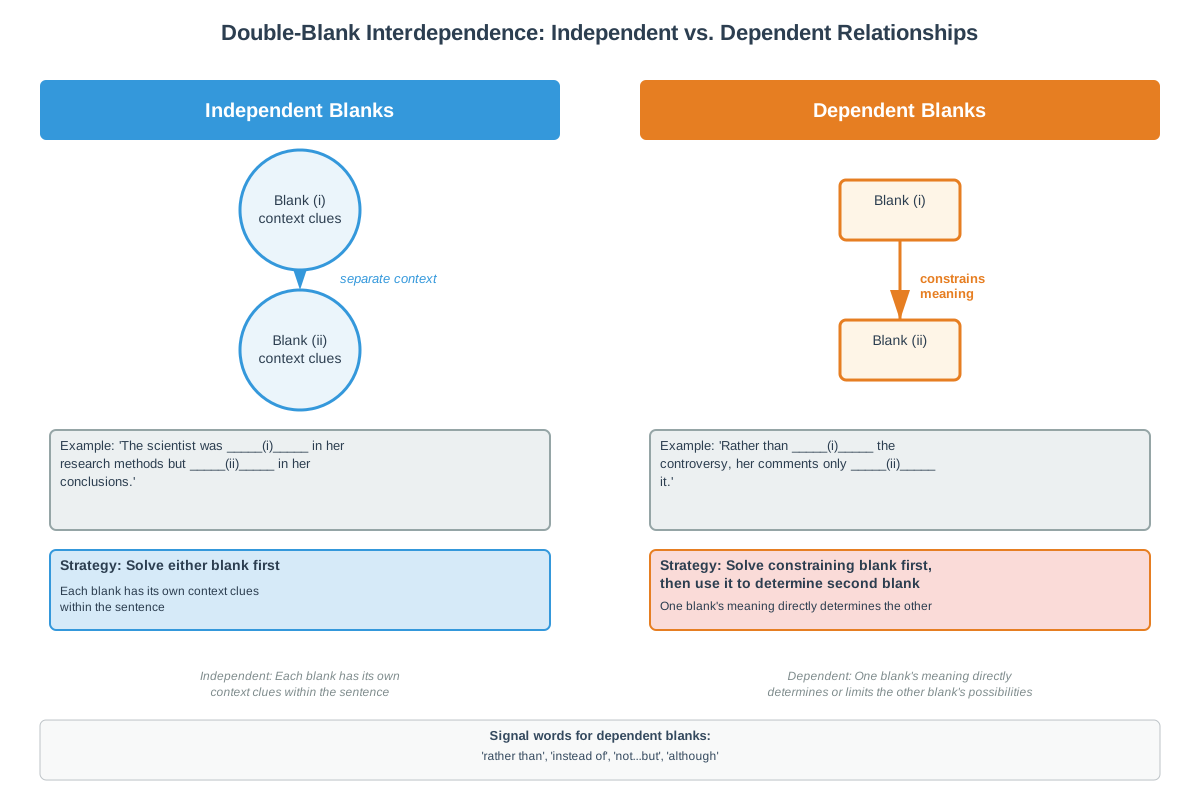
A critical concept in approaching double-blank questions involves determining whether the blanks are independent or dependent. Independent blanks can be solved separately because each has sufficient context clues within its immediate vicinity. The correct answer for one blank does not depend on knowing the answer for the other blank. For example: "The scientist's theory was both _____ (innovative/conventional/derivative) and _____ (rigorous/flawed/incomplete)." Each blank can be evaluated based on separate context clues about the theory.
Dependent blanks, conversely, require understanding how the two missing words relate to each other. The correct choice for one blank constrains or determines the correct choice for the other. For example: "Rather than _____ the controversy, the politician's statement only served to _____ it." The relationship word "rather than" creates a contrast, meaning the blanks must be opposites (like "quell" and "intensify"). Recognizing this dependence is crucial for efficient solving.
| Blank Relationship Type | Characteristics | Strategy |
|---|---|---|
| Independent | Each blank has distinct context clues; blanks can be solved separately | Solve each blank individually, then verify the combination makes sense |
| Dependent - Parallel | Blanks reinforce the same idea or have similar meanings | Look for synonyms or words with similar connotations |
| Dependent - Contrast | Blanks represent opposing ideas | Look for antonyms or words with opposite implications |
| Dependent - Causal | One blank describes cause, the other describes effect | Identify which blank is cause/effect and ensure logical flow |
Signal Words and Structural Clues
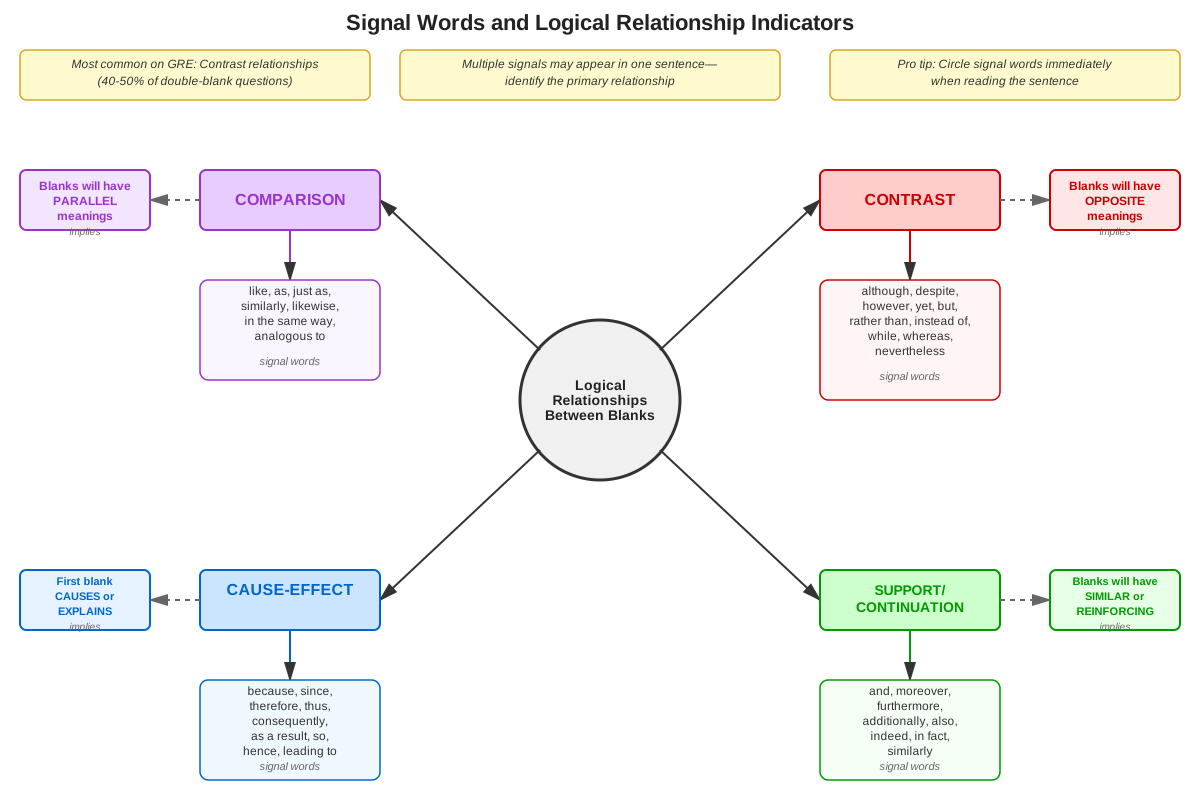
Certain words and phrases within double-blank sentences provide crucial information about how the blanks relate to each other. Contrast signals such as "although," "despite," "however," "rather than," "while," and "yet" indicate that the blanks likely contain opposing or contrasting ideas. Support signals including "and," "moreover," "similarly," "likewise," and "furthermore" suggest the blanks reinforce each other with parallel meanings. Causal signals like "because," "therefore," "consequently," "thus," and "as a result" indicate one blank describes a cause and the other an effect.
Understanding these structural clues allows students to predict the general type of relationship between blanks before even examining the answer choices. This prediction serves as a filter, making the evaluation process more efficient and accurate.
The Systematic Elimination Strategy
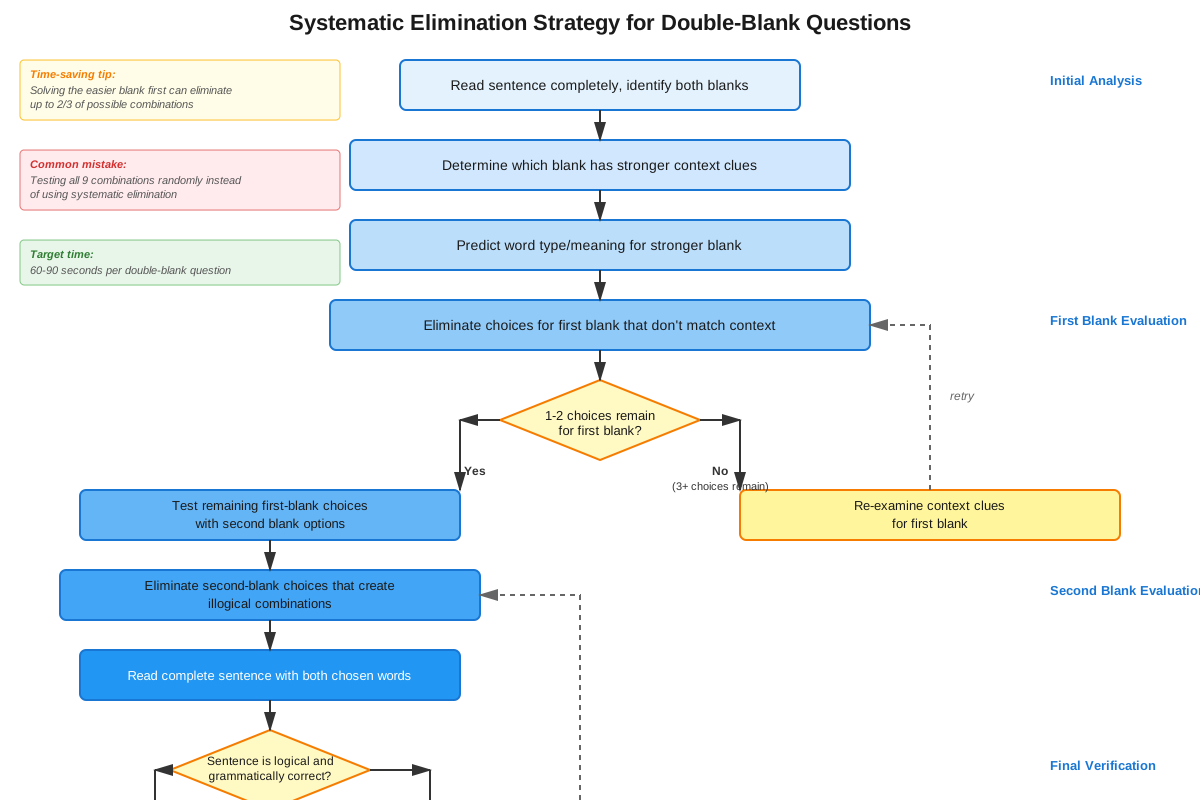
The most effective approach to double-blank questions involves systematic elimination rather than testing all nine combinations. The process follows these steps:
- Read the entire sentence carefully to understand the overall meaning and identify any signal words
- Determine the relationship between the blanks (independent, parallel, contrast, or causal)
- Choose the easier blank to solve first (typically the one with clearer context clues)
- Eliminate impossible choices for that blank based on context, leaving 1-2 viable options
- Move to the second blank and eliminate choices that don't fit its context
- Test the remaining combinations (ideally only 2-4 instead of all 9) by reading the complete sentence
- Verify the final answer by ensuring both words fit grammatically and create logical coherence
This systematic approach reduces cognitive load and time investment while increasing accuracy. By eliminating choices for each blank independently before testing combinations, students avoid the trap of testing all nine possibilities.
Context Clue Analysis for Multiple Blanks
Each blank in a double-blank question has its own set of context clues—words or phrases in the surrounding text that hint at the meaning of the missing word. Restatement clues provide synonyms or similar concepts elsewhere in the sentence. Contrast clues present opposite ideas that help define what the blank is not. Example clues offer specific instances that the blank word must encompass. Logic clues use the overall argument structure to constrain what makes sense.
When analyzing context clues for double-blank questions, students must track clues for both blanks simultaneously while also considering how the blanks might provide clues for each other. Sometimes the best clue for the second blank is the first blank itself, or vice versa. This recursive relationship requires flexible thinking and the ability to hold multiple possibilities in working memory.
Grammatical Constraints
Beyond semantic meaning, grammatical requirements constrain which answer choices can work for each blank. Students must verify that each potential answer matches the required part of speech (noun, verb, adjective, adverb), agrees in number (singular/plural), maintains proper verb tense consistency, and fits the syntactic structure of the sentence. A word might seem semantically appropriate but fail grammatically, immediately eliminating it from consideration.
For example, if a blank appears after "to" and before a noun, it must be an adjective. If it follows a subject and precedes an object, it must be a verb in the appropriate tense. These grammatical filters often eliminate one or two choices per blank before semantic analysis even begins.
Concept Relationships
The core concepts in double-blank text completion build upon each other in a hierarchical structure. Understanding the basic structure of double-blank questions (two blanks, three choices each, nine combinations) provides the foundation. This leads to recognizing the independence vs. dependence principle, which determines the overall solving strategy. The principle of dependence branches into three specific types: parallel relationships, contrast relationships, and causal relationships, each identified through signal words and structural clues.
The systematic elimination strategy integrates all previous concepts, applying the independence/dependence principle and signal word recognition to efficiently narrow choices. This strategy relies on context clue analysis for each individual blank while simultaneously considering grammatical constraints that further limit viable options. The entire process culminates in testing the remaining combinations to find the answer that creates complete logical and grammatical coherence.
This topic connects to prerequisite knowledge of single-blank text completion by extending the same context analysis skills to a more complex scenario. The vocabulary knowledge required for single-blank questions remains essential but must now be applied to two words simultaneously. The logical reasoning skills developed in single-blank questions become more sophisticated as students must track multiple logical relationships within one sentence. Success in double-blank text completion directly enables progression to three-blank text completion questions, which follow the same principles but with added complexity.
Concept Flow: Sentence Structure Recognition → Blank Relationship Identification → Signal Word Detection → Individual Blank Analysis → Systematic Elimination → Combination Testing → Answer Verification
High-Yield Facts
- ⭐ Double-blank text completion questions have three answer choices per blank, creating nine possible combinations, but systematic elimination should reduce testing to 2-4 combinations maximum
- ⭐ Contrast signal words (although, despite, however, rather than) indicate blanks should have opposite or contrasting meanings
- ⭐ Support signal words (and, moreover, similarly, likewise) indicate blanks should have parallel or reinforcing meanings
- ⭐ Always solve the easier blank first—the one with clearer context clues—then use that answer to help constrain the second blank
- ⭐ Reading the complete sentence with both answer choices inserted is essential; words that seem correct individually may create incoherence together
- Approximately 20-30% of text completion questions on the GRE are double-blank format
- Independent blanks can be solved separately; dependent blanks require understanding their relationship
- Grammatical constraints (part of speech, number agreement, tense) often eliminate 1-2 choices per blank immediately
- The correct answer must create both logical coherence and grammatical correctness
- Context clues for one blank sometimes appear near the other blank rather than near the blank itself
- ⭐ Causal relationships (because, therefore, thus) indicate one blank describes a cause and the other describes an effect
- Semicolons often separate two parallel ideas, suggesting the blanks may have similar meanings
- Colons typically introduce explanations or examples, helping predict what type of word should fill subsequent blanks
- Words with extreme meanings (always, never, completely, utterly) are often incorrect in double-blank questions that require nuanced understanding
Quick check — test yourself on Double-blank text completion so far.
Try Flashcards →Common Misconceptions
Misconception: All nine combinations must be tested to find the correct answer → Correction: Systematic elimination of impossible choices for each blank individually should reduce viable combinations to 2-4, making exhaustive testing unnecessary and inefficient. Testing all nine combinations wastes time and increases the likelihood of confusion.
Misconception: The blanks should always be solved in the order they appear in the sentence → Correction: The optimal strategy is to solve the easier blank first, regardless of position. The blank with clearer context clues should be addressed initially, as this often provides information that helps solve the more difficult blank.
Misconception: If two words seem correct individually, they must be correct together → Correction: Words that fit their individual contexts may create logical incoherence or awkward phrasing when combined. Always read the complete sentence with both words inserted to verify the combination works holistically.
Misconception: Double-blank questions primarily test vocabulary knowledge → Correction: While vocabulary is important, these questions primarily test logical reasoning, the ability to recognize relationships between ideas, and skill in analyzing complex sentence structures. Students with moderate vocabulary but strong analytical skills often outperform those with extensive vocabulary but weak reasoning abilities.
Misconception: The correct answers for both blanks will always be the most difficult or sophisticated vocabulary words → Correction: The GRE tests precise word choice, not necessarily advanced vocabulary. Sometimes the correct answer is a relatively common word that fits the context perfectly, while more sophisticated options create subtle meaning errors.
Misconception: Signal words always appear between the two blanks → Correction: Signal words indicating the relationship between blanks can appear anywhere in the sentence—before both blanks, after both blanks, or in a separate clause. Students must analyze the entire sentence structure to identify relevant signals.
Misconception: If one blank seems impossible to solve, the question should be skipped → Correction: Even if one blank seems ambiguous, solving the other blank first often provides crucial information that clarifies the difficult blank. The interdependence of blanks means solving one can unlock the other.
Worked Examples
Example 1: Contrast Relationship
Question: "Although the new policy was designed to _____ bureaucratic inefficiency, critics argued that it would actually _____ the problem by adding more layers of oversight."
Blank 1 choices: (A) reduce (B) expose (C) create
Blank 2 choices: (D) solve (E) exacerbate (F) analyze
Solution Process:
Step 1: Read the entire sentence and identify signal words. The word "Although" at the beginning signals a contrast between the policy's intention and its actual effect. The phrase "actually" reinforces this contrast.
Step 2: Determine the relationship between blanks. This is a dependent contrast relationship—the blanks must represent opposing outcomes. The first blank describes the intended positive effect, while the second blank describes the actual negative effect.
Step 3: Analyze the first blank. The context "designed to _____ bureaucratic inefficiency" suggests the policy aims to improve the situation. Looking at choices:
- (A) reduce: Makes sense—reducing inefficiency is a positive goal
- (B) expose: Possible but less likely—exposing inefficiency is not the same as fixing it
- (C) create: Illogical—a policy wouldn't be designed to create inefficiency
Eliminate (C). Keep (A) as strongest, (B) as possible.
Step 4: Analyze the second blank. The context "would actually _____ the problem" following a contrast signal suggests making things worse. Looking at choices:
- (D) solve: Contradicts "the problem" continuing to exist
- (E) exacerbate: Perfect—means to make worse
- (F) analyze: Doesn't indicate making the problem worse
Eliminate (D) and (F). Keep (E).
Step 5: Test combinations. With (E) locked for the second blank and (A) as the strongest first blank choice:
"Although the new policy was designed to reduce bureaucratic inefficiency, critics argued that it would actually exacerbate the problem..."
This creates perfect logical coherence: the contrast between reducing (improving) and exacerbating (worsening) matches the "Although" signal.
Answer: (A) reduce and (E) exacerbate
Connection to Learning Objectives: This example demonstrates identifying double-blank text completion (objective 1), applying the core strategy of recognizing signal words and blank relationships (objective 2), and accurately solving a GRE-style question (objective 3). It also shows determining logical relationships between blanks (objective 4) and using systematic elimination (objective 5).
Example 2: Parallel Relationship
Question: "The historian's interpretation was both _____ in its attention to previously overlooked sources and _____ in its willingness to challenge established narratives."
Blank 1 choices: (A) meticulous (B) cursory (C) biased
Blank 2 choices: (D) timid (E) audacious (F) conventional
Solution Process:
Step 1: Identify signal words. The structure "both _____ and _____" indicates a parallel relationship where both blanks describe positive qualities of the interpretation (suggested by the approving tone).
Step 2: Determine the relationship. This is a dependent parallel relationship—both blanks should reinforce similar positive characteristics.
Step 3: Analyze the first blank. The phrase "attention to previously overlooked sources" suggests thoroughness and care. Looking at choices:
- (A) meticulous: Excellent fit—means extremely careful and precise
- (B) cursory: Opposite meaning—means hasty and superficial
- (C) biased: Negative connotation, doesn't fit the positive tone
Eliminate (B) and (C). Keep (A).
Step 4: Analyze the second blank. The phrase "willingness to challenge established narratives" suggests boldness and innovation. Looking at choices:
- (D) timid: Opposite—timid people don't challenge established ideas
- (E) audacious: Perfect—means bold and daring
- (F) conventional: Opposite—conventional means following established norms
Eliminate (D) and (F). Keep (E).
Step 5: Test the combination:
"The historian's interpretation was both meticulous in its attention to previously overlooked sources and audacious in its willingness to challenge established narratives."
Both words are positive qualities that complement each other—careful attention to detail (meticulous) and bold innovation (audacious) together describe a thorough yet groundbreaking interpretation.
Answer: (A) meticulous and (E) audacious
Connection to Learning Objectives: This example demonstrates recognizing parallel relationships between blanks (objective 4), applying systematic evaluation (objective 5), and identifying structural clues like "both...and" (objective 6) that signal how blanks relate to each other.
Exam Strategy
Approaching Double-Blank Questions Systematically
When encountering a double-blank text completion question on the GRE, follow this time-efficient process:
- Invest 10-15 seconds in careful reading of the entire sentence before looking at answer choices. This initial investment prevents the need to re-read multiple times and helps identify the overall logical structure.
- Mark signal words mentally or on scratch paper. Circle or note contrast words (although, despite, however), support words (and, moreover, similarly), and causal words (because, therefore, thus).
- Decide which blank to solve first based on context clue clarity, not position. Ask: "Which blank has more obvious clues in the surrounding text?"
- Use the scratch paper strategically. Write "Blank 1: A or B" and "Blank 2: E or F" to track eliminated choices rather than trying to hold all possibilities in working memory.
- Read the complete sentence aloud (silently) with your final answer inserted. This auditory processing often catches errors that visual reading misses.
Trigger Words and Phrases
Certain words and phrases should immediately activate specific analytical approaches:
Contrast triggers: although, despite, even though, however, nevertheless, nonetheless, rather than, while, yet, in contrast, on the other hand, conversely
- Action: Expect blanks to have opposite or contrasting meanings
Support triggers: and, also, moreover, furthermore, similarly, likewise, in addition, additionally, as well as
- Action: Expect blanks to have parallel or reinforcing meanings
Causal triggers: because, since, therefore, thus, consequently, as a result, hence, so, accordingly
- Action: Identify which blank is cause and which is effect
Emphasis triggers: indeed, in fact, particularly, especially, notably
- Action: The blank following these words often intensifies or specifies the preceding idea
Process-of-Elimination Tips
Efficient elimination for double-blank questions requires a specific approach:
- Eliminate on grammar first: Before considering meaning, eliminate any choice that doesn't match the required part of speech or creates grammatical errors. This often removes 1-2 choices per blank immediately.
- Eliminate extreme words cautiously: Words like "always," "never," "completely," "utterly," or "absolutely" are often incorrect because GRE passages typically require nuanced understanding. However, don't eliminate them automatically—verify against context.
- Eliminate based on tone mismatch: If the sentence has a positive tone, eliminate negative words and vice versa. Tone consistency is crucial.
- Use the "one blank at a time" rule: Never eliminate a combination without first eliminating individual choices for each blank. Testing combinations before individual elimination wastes time.
- Trust strong eliminations: If a word creates obvious logical incoherence or grammatical error, eliminate it confidently and don't second-guess.
Time Allocation Advice
Double-blank questions should take approximately 90-120 seconds each, slightly longer than single-blank questions (60-90 seconds) but not proportionally longer despite having more combinations. Allocate time as follows:
- 15-20 seconds: Initial reading and signal word identification
- 25-30 seconds: Analyzing and eliminating choices for the first blank
- 25-30 seconds: Analyzing and eliminating choices for the second blank
- 15-20 seconds: Testing remaining combinations and verification
- 10-15 seconds: Final review and answer selection
If a question exceeds 2 minutes, make your best educated guess and move on. The GRE rewards efficient time management across all questions rather than perfection on individual items.
Exam Tip: If you're stuck between two combinations, choose the one with more common, straightforward vocabulary. The GRE tests precise word choice, and sometimes the simpler word is more precisely correct than the sophisticated alternative.
Memory Techniques
The CREST Mnemonic for Signal Words
Remember the five main categories of signal words using CREST:
- Contrast: although, despite, however, yet
- Reinforcement: and, moreover, similarly
- Emphasis: indeed, especially, particularly
- Sequence: first, then, finally, subsequently
- Therefore (Causal): because, thus, consequently
The "Easy First" Visualization
Visualize double-blank questions as a two-step staircase. Always step on the easier (lower) step first, regardless of whether it's on the left or right. This step provides stable footing to reach the harder (higher) step. This mental image reinforces solving the easier blank first.
The Three-Finger Rule
Hold up three fingers to remember the three types of dependent blank relationships:
- Thumb (pointing up): Parallel/Support (both blanks point in the same direction)
- Index finger (pointing forward): Causal (one blank leads to the other)
- Middle finger (pointing opposite when bent): Contrast (blanks point in opposite directions)
The "Both-And-But" Framework
For quick relationship identification, remember:
- "Both...and" = Parallel relationship
- "But" or "Although" = Contrast relationship
- "Because" or "Therefore" = Causal relationship
This simple framework covers approximately 80% of double-blank relationship types.
Acronym: SOLVE for Systematic Approach
Signal words - Identify them first
Order - Choose easier blank first
Logic - Determine blank relationship
Verify - Test combinations
Eliminate - Remove impossible choices early
Summary
Double-blank text completion questions represent a critical component of GRE Verbal Reasoning, testing the ability to analyze complex sentences with two interdependent missing words. Success requires recognizing whether blanks are independent or dependent, identifying the specific relationship between dependent blanks (parallel, contrast, or causal), and using signal words to guide this analysis. The most efficient approach involves systematic elimination: solving the easier blank first, eliminating impossible choices for each blank individually, and only then testing the remaining 2-4 combinations rather than all nine possibilities. Context clue analysis must be performed for both blanks simultaneously while also considering grammatical constraints that further limit viable options. The correct answer must create both logical coherence and grammatical correctness when both words are inserted into the sentence. Mastery of double-blank text completion requires integrating vocabulary knowledge, logical reasoning, sentence structure analysis, and strategic time management into a cohesive problem-solving approach.
Key Takeaways
- Double-blank questions have nine possible combinations, but systematic elimination should reduce testing to 2-4 combinations maximum
- Always identify signal words (contrast, support, causal) to determine how the blanks relate to each other
- Solve the easier blank first regardless of position, then use that answer to constrain the second blank
- Dependent blanks require understanding their relationship (parallel, contrast, or causal), while independent blanks can be solved separately
- Read the complete sentence with both answers inserted to verify logical coherence—words correct individually may fail together
- Grammatical constraints (part of speech, tense, number agreement) often eliminate choices before semantic analysis begins
- Allocate 90-120 seconds per double-blank question, using the SOLVE framework for systematic approach
Related Topics
Three-blank text completion: Building on double-blank mastery, three-blank questions add another layer of complexity with 27 possible combinations, requiring even more sophisticated elimination strategies and relationship tracking. Mastering double-blank questions provides the essential foundation for handling three-blank items efficiently.
Sentence equivalence questions: These questions require selecting two words that create sentences with equivalent meanings, applying similar skills in recognizing synonyms and understanding context clues, though with a different strategic approach focused on finding pairs rather than combinations.
Reading comprehension inference questions: The logical reasoning skills developed through double-blank text completion—recognizing relationships between ideas, using context clues, and evaluating multiple possibilities—transfer directly to inference questions that require drawing conclusions from passage content.
Advanced vocabulary in context: Deepening vocabulary knowledge specifically for words that commonly appear in double-blank questions (particularly words describing relationships, changes, and contrasts) enhances both speed and accuracy in solving these items.
Practice CTA
Now that you understand the core strategies and concepts behind double-blank text completion, it's time to put your knowledge into action. Attempt the practice questions designed specifically for this topic, focusing on applying the systematic elimination strategy and identifying signal words that reveal blank relationships. Use the flashcards to reinforce your recognition of common signal words and relationship types. Remember that mastery comes through deliberate practice—each question you solve strengthens your pattern recognition and builds the confidence needed for test day success. You've built a solid foundation; now transform that knowledge into consistent performance through focused practice!
Sign up free to keep reading
Create a free AnvayaPrep account to finish this GRE guide on Double-blank text completion — plus flashcards and practice questions.