Overview
Sentence logic is one of the most fundamental and frequently tested skills in GRE Verbal Reasoning, particularly within Text Completion questions. At its core, sentence logic refers to the ability to understand the logical structure and flow of a sentence—how different parts of a sentence relate to one another through transition words, conjunctions, and structural markers that signal contrast, continuation, cause-and-effect, or other logical relationships. Mastering GRE sentence logic means developing the ability to predict what type of word or phrase must fill a blank based solely on the logical architecture of the sentence, independent of vocabulary knowledge or content familiarity.
The GRE tests sentence logic because it measures a critical reading skill: the ability to follow an argument's structure and understand how ideas connect. When facing a Text Completion question, students who understand sentence logic can often predict the correct answer before even looking at the choices. This skill transforms what might seem like a vocabulary test into a logic puzzle where the sentence itself provides explicit clues about what must come next. The test makers deliberately construct sentences with clear logical signals—words like "although," "therefore," "despite," or "similarly"—that indicate whether the blank should continue the same direction of thought or pivot to an opposite idea.
Understanding sentence logic serves as the foundation for all Text Completion and Sentence Equivalence questions on the GRE Verbal section. It connects directly to critical reading skills tested in Reading Comprehension, where following an author's logical progression through multiple sentences and paragraphs becomes essential. Students who master sentence logic develop a systematic approach to verbal questions that reduces guesswork and significantly improves accuracy, even when encountering unfamiliar vocabulary.
Learning Objectives
- [ ] Identify when Sentence logic is being tested
- [ ] Explain the core rule or strategy behind Sentence logic
- [ ] Apply Sentence logic to GRE-style questions accurately
- [ ] Categorize logical relationship indicators into their appropriate types (contrast, continuation, cause-effect)
- [ ] Predict the charge (positive/negative) and general meaning of missing words before reviewing answer choices
- [ ] Analyze complex sentences with multiple logical pivots and determine the cumulative effect on blank(s)
Prerequisites
- Basic understanding of parts of speech: Necessary to recognize whether a blank requires a noun, verb, adjective, or adverb, which constrains possible answers
- Familiarity with common transition words: Essential foundation for recognizing the logical signals that sentence logic depends upon
- Reading comprehension at college level: Required to process sentence meaning quickly enough to identify logical structures within time constraints
- Understanding of positive and negative connotations: Critical for determining whether a blank needs a word with favorable or unfavorable meaning
Why This Topic Matters
Sentence logic represents the single most reliable strategy for approaching GRE Text Completion questions because it provides a systematic, replicable method that works regardless of vocabulary difficulty. While students cannot predict which vocabulary words will appear on test day, they can be certain that every Text Completion question will contain logical structure clues. Research on GRE question construction reveals that approximately 85-90% of Text Completion questions include explicit logical relationship indicators that, when properly identified, point directly toward the correct answer.
On the actual GRE, sentence logic appears in every Text Completion question, which comprises roughly 6 questions per Verbal section (12 total across two sections). Additionally, the logical reasoning skills developed through sentence logic practice transfer directly to Sentence Equivalence questions (another 4 questions per section) and support the inference-making required in Reading Comprehension passages. This means sentence logic skills directly impact performance on approximately 60-70% of all Verbal Reasoning questions.
The GRE specifically tests sentence logic through sentences that contain deliberate logical pivots, parallel structures, and cause-effect relationships. Common patterns include: sentences with contrast words that signal the blank must oppose the surrounding context; sentences with continuation words that indicate the blank should reinforce or extend the existing idea; sentences with cause-effect structures where the blank must logically complete a causal chain; and sentences with definition or restatement structures where the blank essentially means the same as another part of the sentence. Recognizing these patterns allows test-takers to approach each question with confidence and precision.
Core Concepts
Understanding Logical Relationships
The foundation of sentence logic rests on recognizing that sentences communicate not just through individual words but through the relationships between ideas. Every GRE sentence is constructed with a logical skeleton—a framework of relationships that determines how ideas connect. These relationships fall into several major categories, and identifying which category applies to a given sentence immediately narrows the possibilities for what can fill a blank.
The most important logical relationships tested on the GRE include:
- Contrast/Opposition: Ideas that contradict, oppose, or present alternatives to each other
- Continuation/Support: Ideas that extend, reinforce, or provide examples of each other
- Cause and Effect: Ideas where one leads to or results from another
- Definition/Restatement: Ideas where one clarifies or restates another in different words
- Comparison/Analogy: Ideas that are similar or parallel to each other
Contrast Indicators and Their Function
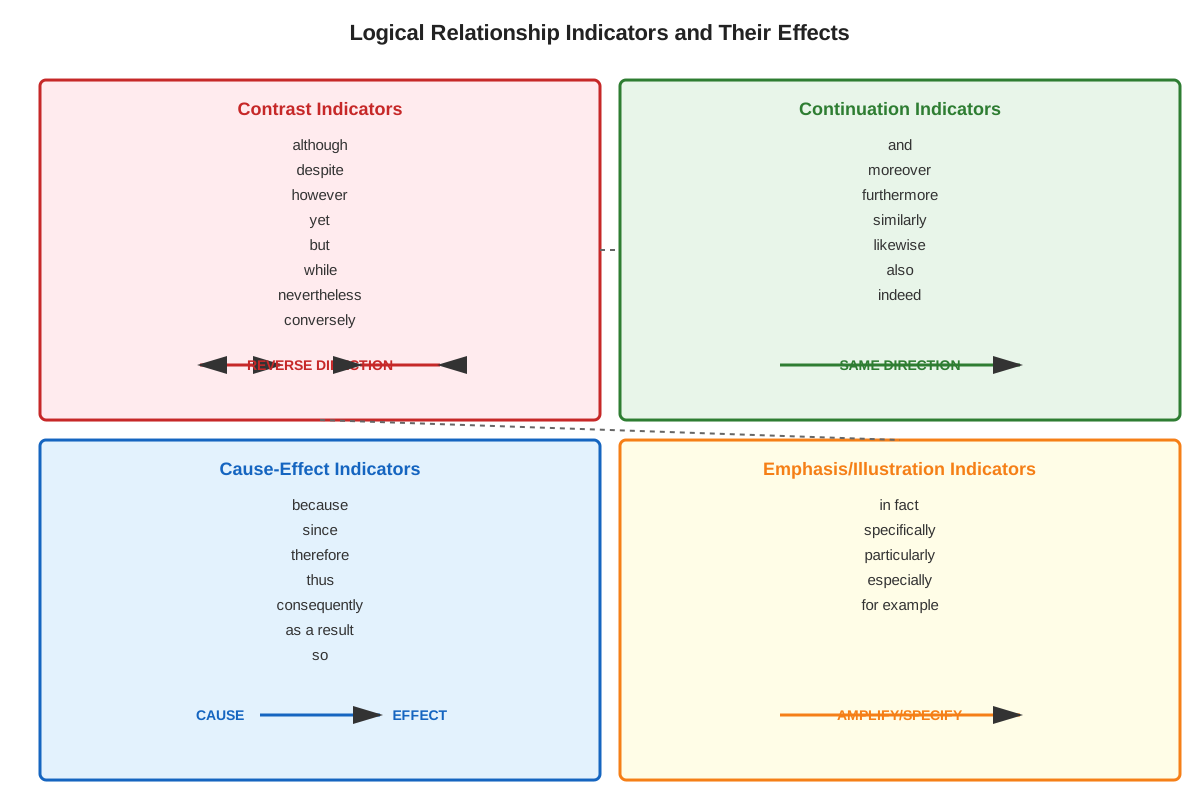
Contrast indicators signal that the sentence will pivot from one direction to the opposite. When a contrast word appears, the blank typically requires a word that means the opposite of what came before (or after) the indicator. The most common contrast indicators include:
Strong contrast words: although, though, even though, despite, in spite of, while, whereas, however, nevertheless, nonetheless, yet, but, rather than, instead of, conversely, on the contrary
Subtle contrast indicators: surprisingly, unexpectedly, ironically, paradoxically, unfortunately, regrettably
When analyzing a sentence with contrast indicators, the key strategy involves identifying what idea exists on one side of the contrast word, then predicting that the blank requires the opposite. For example, in the sentence "Although the critic expected the film to be _____, she found it surprisingly engaging," the contrast word "although" signals that the blank must be the opposite of "engaging"—something like boring, tedious, or dull.
Continuation Indicators and Reinforcement
Continuation indicators signal that the sentence will maintain its current direction, with the blank reinforcing or extending an idea already present. These indicators tell test-takers to look for synonyms or related concepts rather than opposites. Common continuation indicators include:
Addition/Extension: and, moreover, furthermore, additionally, also, likewise, similarly, in addition, as well as
Emphasis: indeed, in fact, certainly, clearly, obviously, undoubtedly, especially, particularly
Example/Illustration: for example, for instance, such as, including, specifically
Result/Consequence: therefore, thus, hence, consequently, accordingly, as a result, so
When a continuation indicator appears, the strategy shifts to identifying the charge (positive or negative) and general meaning of the surrounding context, then selecting a blank that matches. In the sentence "The scientist's methodology was rigorous and her conclusions were similarly _____," the continuation word "similarly" indicates the blank should match "rigorous" in meaning—something like thorough, careful, or precise.
Cause-Effect Structures
Cause-effect relationships represent a specific type of logical connection where one event, condition, or quality leads to another. These structures often use explicit causal indicators:
Causal indicators: because, since, as, due to, owing to, on account of, thanks to, as a result of, consequently, therefore, thus, hence, so, leads to, results in, causes, produces
In cause-effect sentences, the blank typically completes either the cause or the effect portion of the relationship. The key is identifying which part is given and which must be inferred. For example: "Because the drought was _____, crop yields decreased dramatically" requires a cause that would logically lead to decreased yields—something like severe, prolonged, or devastating.
Definition and Restatement Structures
Many GRE sentences include built-in definitions or restatements where one part of the sentence essentially explains or restates another part using different words. These structures often use:
Definition indicators: that is, in other words, namely, specifically, which means, defined as, known as, or (when used to introduce a synonym)
Punctuation clues: colons, semicolons, dashes, and commas setting off appositives
Relative clauses: which, who, that (when introducing explanatory information)
In these sentences, the blank and its definition/restatement should be nearly synonymous. For example: "The politician's speech was bombastic—filled with _____ language designed to impress rather than inform" requires a word that means essentially the same as "bombastic," such as pompous, grandiose, or pretentious.
Charge Analysis
Beyond identifying the type of logical relationship, effective sentence logic requires determining the charge or emotional valence of the blank. Every blank on the GRE requires either a positive, negative, or neutral word. Charge analysis involves:
- Identifying descriptive words in the sentence that carry clear positive or negative connotations
- Determining whether logical indicators signal same-charge or opposite-charge relationships
- Predicting whether the blank needs a positive, negative, or neutral word before looking at choices
| Logical Relationship | Charge Prediction Strategy |
|---|---|
| Contrast | Opposite charge from context |
| Continuation | Same charge as context |
| Cause-Effect | Logically consistent charge |
| Definition | Same charge as defined term |
Multiple Blank Sentences
More complex Text Completion questions contain two or three blanks, requiring analysis of how multiple logical relationships interact. The key strategy involves:
- Identify the easiest blank first: Look for the blank with the clearest logical indicators
- Solve blanks in strategic order: Not necessarily left-to-right, but in order of certainty
- Use solved blanks to constrain remaining blanks: Each solved blank provides additional context
- Check for logical consistency: Ensure all blanks work together to create a coherent sentence
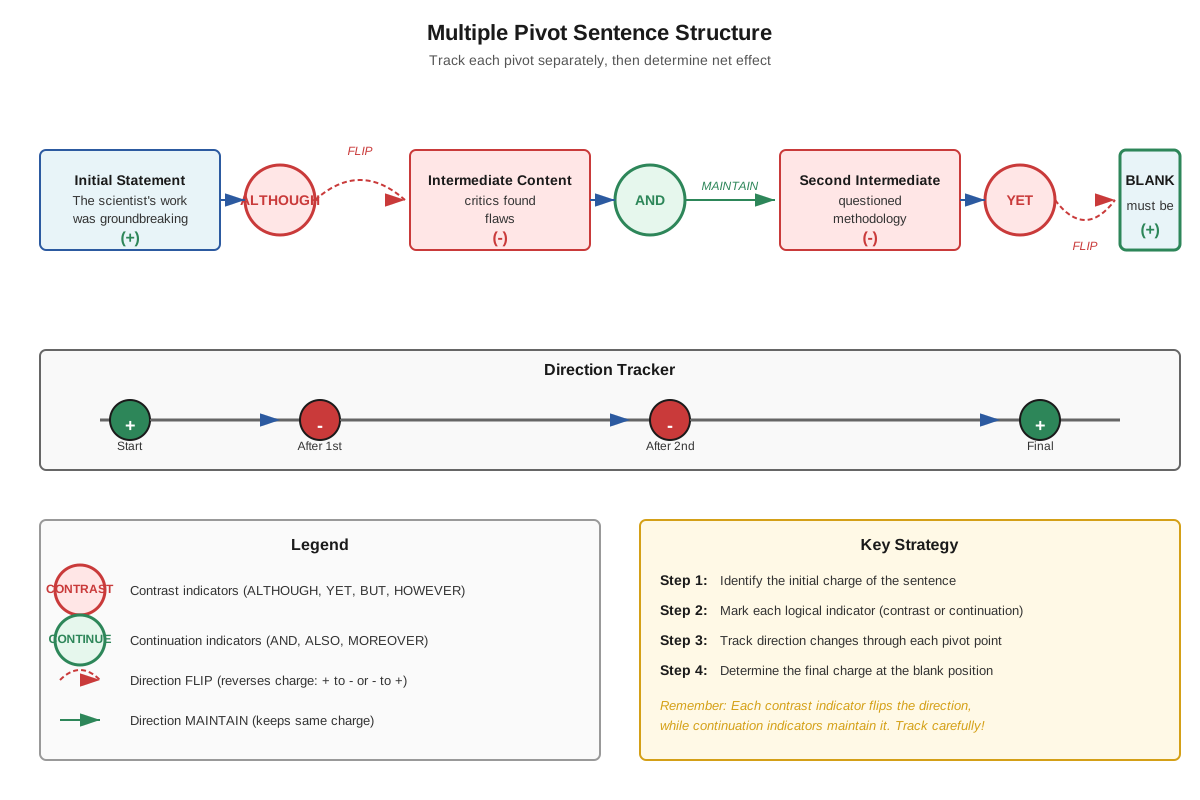
For sentences with multiple logical pivots, track the cumulative effect. For example, two contrast words in sequence create a double negative that returns to the original direction: "Although the theory was initially rejected, it was not, however, _____" requires a word that matches "rejected" because the two contrasts cancel out.
Concept Relationships
Sentence logic concepts form an interconnected system where mastery of one element supports understanding of others. The foundational skill—recognizing logical relationship indicators—enables all other sentence logic strategies. Once students can identify whether a sentence contains contrast, continuation, or cause-effect structures, they can apply the appropriate charge analysis to predict whether the blank requires a positive, negative, or neutral word.
The relationship flows as follows:
Logical Indicator Recognition → Relationship Type Classification → Charge Prediction → Answer Selection
Within this framework, definition/restatement structures represent a special case where the logical relationship directly provides the meaning of the blank, not just its charge. These structures often appear in combination with other logical relationships, creating layered sentences where students must first identify the restatement, then apply contrast or continuation logic to determine the precise word needed.
Multiple blank sentences integrate all previous concepts, requiring students to identify multiple logical relationships within a single sentence and understand how they interact. The skill of solving blanks strategically (not in left-to-right order) depends on the ability to quickly assess which blank has the clearest logical indicators—a meta-skill that develops from mastery of individual relationship types.
These sentence logic skills connect directly to prerequisite knowledge of transition words and parts of speech, while also supporting advanced skills in Reading Comprehension where following logical progressions across multiple sentences becomes essential. The charge analysis skill particularly transfers to Sentence Equivalence questions, where students must identify two words with the same charge and similar meaning.
High-Yield Facts
⭐ Approximately 85-90% of GRE Text Completion questions contain explicit logical relationship indicators that point toward the correct answer.
⭐ Contrast words (although, despite, however, yet) signal that the blank requires the opposite charge or meaning from the surrounding context.
⭐ Continuation words (and, moreover, similarly, therefore) signal that the blank should reinforce or extend the existing direction of the sentence.
⭐ In sentences with multiple blanks, solving the easiest blank first (regardless of position) provides context that constrains remaining blanks.
⭐ Charge analysis—determining whether a blank needs a positive, negative, or neutral word—should occur before reviewing answer choices.
- Cause-effect indicators (because, therefore, consequently) require logical consistency between the cause and effect portions of the sentence.
- Definition structures often use punctuation (colons, dashes, commas) to set off restatements that directly reveal the blank's meaning.
- Two contrast indicators in sequence create a double negative that returns to the original direction (e.g., "not, however" = affirmation).
- Semicolons typically signal continuation or parallel structure, indicating ideas on both sides should have similar charge and meaning.
- Words like "surprisingly," "unexpectedly," and "ironically" function as subtle contrast indicators that signal the blank opposes expectations.
- Time-based transition words (previously, formerly, now, currently) often signal temporal contrast where past differs from present.
- The phrase "far from" functions as a strong contrast indicator meaning "not at all" or "the opposite of."
- Comparative structures (more/less, -er than) create implicit contrast by indicating degree differences.
- Parallel structure (matching grammatical forms) often signals continuation where blanks should have similar meanings.
Quick check — test yourself on Sentence logic so far.
Try Flashcards →Common Misconceptions
Misconception: Sentence logic only applies to sentences with obvious transition words like "however" or "therefore."
Correction: While explicit transition words make logical relationships easier to identify, sentence logic applies to all Text Completion questions. Many sentences use punctuation, parallel structure, or implicit relationships to signal logical connections. Even sentences without obvious transition words have logical structure that determines what can fill the blank.
Misconception: If a sentence contains a contrast word, the blank must be the exact opposite of a specific word in the sentence.
Correction: Contrast indicators signal opposite charge or direction, but not necessarily exact antonyms. The blank needs to oppose the general idea or direction of the contrasting clause, which may involve opposing a concept expressed through multiple words or an entire phrase, not just finding the antonym of a single word.
Misconception: In multiple-blank sentences, blanks must be solved in left-to-right order.
Correction: Strategic test-takers solve blanks in order of certainty, not position. The blank with the clearest logical indicators should be solved first, regardless of whether it's the first, second, or third blank. This approach provides maximum context for solving remaining blanks and reduces the chance of cascading errors.
Misconception: Sentence logic is just about finding transition words and applying simple rules.
Correction: While identifying logical indicators is foundational, effective sentence logic requires understanding how multiple logical relationships interact, recognizing subtle indicators, tracking charge through complex sentences, and integrating logical analysis with vocabulary knowledge. It's a sophisticated skill that develops through practice, not a mechanical formula.
Misconception: If the sentence seems to make sense with an answer choice, that choice must be correct.
Correction: The GRE deliberately includes plausible-sounding wrong answers that create grammatically correct sentences but violate the logical structure. A correct answer must both make grammatical sense and satisfy the logical requirements signaled by the sentence's structure. Always verify that the chosen answer aligns with the logical indicators, not just general plausibility.
Misconception: Charge analysis means simply categorizing words as "good" or "bad."
Correction: Effective charge analysis involves understanding nuance and context. A word like "simple" might be positive (elegant, uncomplicated) or negative (simplistic, naive) depending on context. Similarly, intensity matters—"concerned" and "alarmed" are both negative but differ in degree. Charge analysis must account for both valence and intensity.
Worked Examples
Example 1: Single Blank with Contrast
Question: Although the new policy was designed to promote transparency, critics argued that it actually _____ the decision-making process by adding unnecessary bureaucratic layers.
Step 1 - Identify logical indicators: The word "Although" at the beginning signals a contrast relationship. The word "actually" reinforces this contrast by emphasizing that reality differs from intention.
Step 2 - Analyze the contrast structure: The policy was designed to promote transparency (positive, making things clearer), BUT critics say it actually does something opposite. The blank must describe an effect opposite to "promote transparency."
Step 3 - Determine charge and meaning: The blank needs a negative word that means the opposite of making things transparent/clear. The phrase "by adding unnecessary bureaucratic layers" provides additional context—these layers would make things less clear, more hidden, or more complicated.
Step 4 - Predict before looking at choices: The blank should mean something like "obscured," "complicated," "hindered," or "concealed"—words indicating the opposite of transparency.
Step 5 - Evaluate choices (hypothetical options):
- (A) enhanced - WRONG: positive word, continues rather than contrasts
- (B) obscured - CORRECT: negative word meaning made less transparent, satisfies contrast
- (C) streamlined - WRONG: positive word suggesting efficiency, continues rather than contrasts
- (D) publicized - WRONG: positive word related to transparency, continues rather than contrasts
- (E) obfuscated - CORRECT: negative word meaning made confusing/unclear, satisfies contrast
Answer: (B) or (E) would both work (in actual GRE, only one would appear)
Connection to learning objectives: This example demonstrates identifying when sentence logic is tested (contrast structure), explaining the core strategy (recognizing "although" signals opposition), and applying it accurately (predicting opposite-charge word before reviewing choices).
Example 2: Two Blanks with Multiple Logical Relationships
Question: The scientist's reputation for (i)_____ was well-deserved; her research papers were characterized by meticulous attention to detail and an unwillingness to draw conclusions that were not (ii)_____ supported by data.
Blank (i) options:
(A) innovation
(B) rigor
(C) creativity
Blank (ii) options:
(D) partially
(E) substantially
(F) marginally
Step 1 - Identify which blank to solve first: Blank (ii) appears easier because it has clear logical context. The phrase "unwillingness to draw conclusions that were not _____ supported" creates a logical structure where we need a word that makes sense with "unwillingness to draw conclusions without [sufficient] support."
Step 2 - Solve Blank (ii): The semicolon signals continuation/explanation—the second part explains or exemplifies the first. "Unwillingness to draw conclusions that were not _____ supported" means she only drew conclusions when they WERE _____ supported. Given her careful approach, she would require strong/complete support. The blank needs a word meaning "strongly" or "thoroughly."
- (D) partially - WRONG: would mean she accepts partial support, contradicting carefulness
- (E) substantially - CORRECT: means strongly/thoroughly supported
- (F) marginally - WRONG: means barely supported, contradicting carefulness
Step 3 - Solve Blank (i) using context from Blank (ii): Now we know she requires substantial support and shows "meticulous attention to detail." The semicolon indicates Blank (i) should describe a quality that these characteristics exemplify. What reputation would someone have who is meticulous and requires substantial evidence?
- (A) innovation - WRONG: doesn't connect to carefulness/thoroughness
- (B) rigor - CORRECT: means thoroughness, precision, exactness—perfectly matches the description
- (C) creativity - WRONG: doesn't connect to the emphasis on careful methodology
Answer: Blank (i) = (B) rigor; Blank (ii) = (E) substantially
Step 4 - Verify logical consistency: Reading the complete sentence with both answers confirms logical coherence: "The scientist's reputation for rigor was well-deserved; her research papers were characterized by meticulous attention to detail and an unwillingness to draw conclusions that were not substantially supported by data." The semicolon continuation works, and both blanks reinforce the same theme of thoroughness.
Connection to learning objectives: This example demonstrates solving multiple blanks strategically (not left-to-right), identifying continuation relationships (semicolon), and ensuring logical consistency across the entire sentence.
Exam Strategy
Systematic Approach to Text Completion Questions
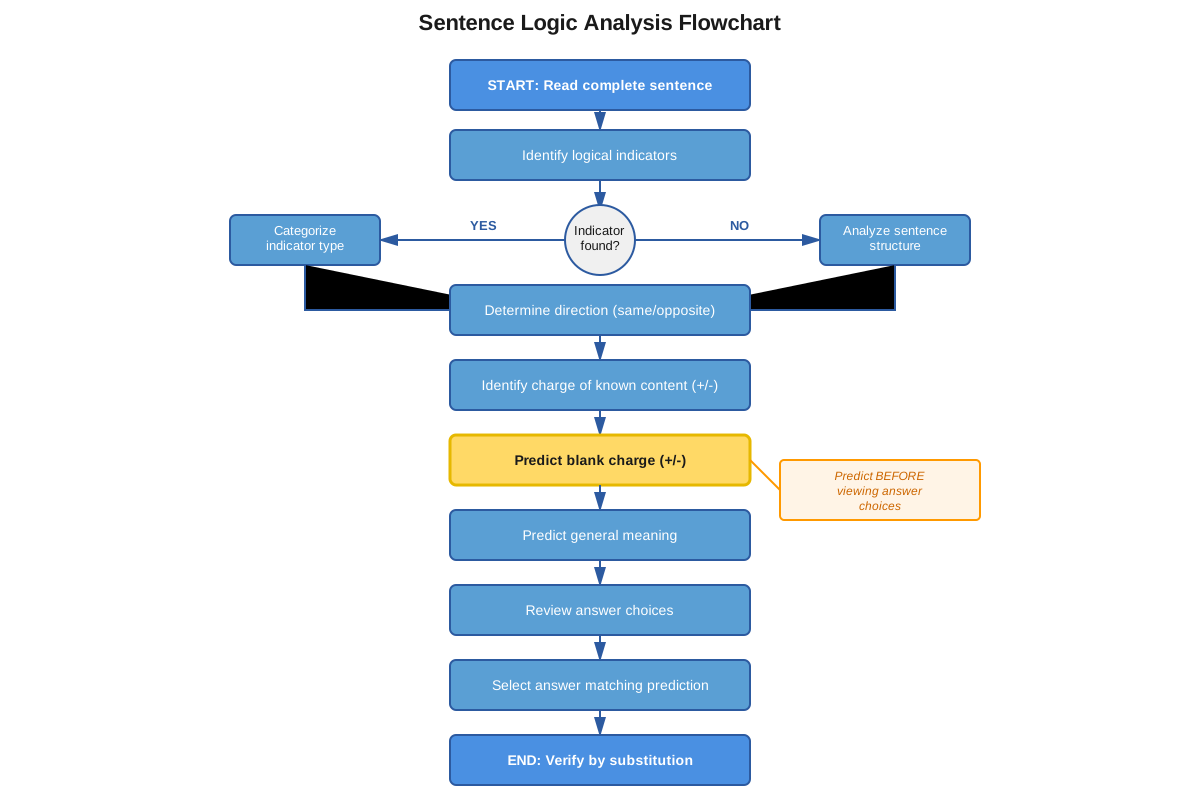
When approaching any Text Completion question on the GRE, follow this systematic process:
- Read the entire sentence first without looking at answer choices (2-3 seconds)
- Identify all logical indicators - circle or mentally note transition words, punctuation, and structural markers (3-5 seconds)
- Classify the logical relationship - determine whether the sentence uses contrast, continuation, cause-effect, or definition structures (2-3 seconds)
- Predict charge and general meaning - before looking at choices, determine whether the blank needs positive/negative/neutral and what general concept fits (5-7 seconds)
- Evaluate choices against prediction - eliminate choices that don't match the predicted charge or logical requirement (10-15 seconds)
- Verify the answer - read the complete sentence with your choice to ensure logical and grammatical coherence (3-5 seconds)
Total time per question: Approximately 30-40 seconds for single-blank, 60-75 seconds for multiple-blank questions.
Trigger Words and Phrases to Watch For
Develop automatic recognition of these high-frequency logical indicators:
Immediate contrast signals: although, though, despite, however, yet, but, rather than, instead of, conversely, on the contrary, far from
Subtle contrast signals: surprisingly, unexpectedly, ironically, paradoxically, unfortunately, while, whereas
Strong continuation signals: and, moreover, furthermore, indeed, in fact, therefore, thus, consequently, similarly, likewise
Cause-effect signals: because, since, as, due to, consequently, therefore, thus, hence, leads to, results in
Definition signals: colons, dashes, commas setting off phrases, "that is," "in other words," "namely"
Exam Tip: When you spot a logical indicator, immediately ask yourself: "Does this signal same direction or opposite direction?" This single question guides your entire approach to the blank.
Process of Elimination Strategies
Use these specific elimination techniques for sentence logic questions:
Charge elimination: If you've determined the blank needs a negative word, immediately eliminate all positive choices, even if you don't know their precise meanings. This often eliminates 2-3 choices immediately.
Degree mismatch elimination: If the sentence context suggests an extreme situation, eliminate moderate words. If the context suggests a mild situation, eliminate extreme words.
Grammatical elimination: Ensure the choice matches the required part of speech and creates grammatical sentences. This is particularly important for blanks that could be multiple parts of speech.
Logical consistency check: For multiple-blank questions, eliminate any choice for one blank that would make it impossible to fill other blanks logically.
Time Allocation Advice
Text Completion questions should average 30-40 seconds for single-blank and 60-75 seconds for two or three-blank questions. If you find yourself spending more than 90 seconds on any Text Completion question:
- You may be overthinking the logical structure
- You may be trying to understand every word in the answer choices rather than using charge and context
- You may need to make your best prediction and move on
Exam Tip: If you can eliminate even one or two choices through sentence logic, guess strategically from the remaining options rather than spending excessive time. The GRE rewards efficient decision-making.
Memory Techniques
The CASE Framework
Remember the four major logical relationship types with CASE:
- Contrast (although, despite, however, yet)
- Addition/Continuation (and, moreover, similarly, therefore)
- Support/Cause-Effect (because, consequently, leads to)
- Explanation/Definition (colons, dashes, "that is")
The Charge Check Mnemonic
Before selecting any answer, perform the PVC Check:
- Predict the charge (positive, negative, or neutral)
- Verify the logical relationship (contrast or continuation)
- Confirm the answer matches both requirements
Visualization Strategy for Contrast
When you see a contrast word, visualize a seesaw or balance scale. If one side goes up (positive), the other must go down (negative). This physical image helps reinforce that contrast indicators require opposite charges.
The Semicolon Rule
Remember: Semicolons = Similarity. When you see a semicolon in a GRE sentence, the ideas on both sides should have similar charge and related meaning. This simple rule eliminates wrong answers quickly.
Double Negative Tracker
For sentences with multiple contrast words, use the Even/Odd Rule:
- Odd number of contrasts = opposite of original direction
- Even number of contrasts = same as original direction
Example: "Although the plan was not unsuccessful" = two contrasts (although + not) = even = same direction = successful
Summary
Sentence logic represents the most systematic and reliable approach to GRE Text Completion questions, providing a framework for predicting correct answers based on the logical structure of sentences rather than vocabulary alone. The core principle involves identifying logical relationship indicators—contrast words, continuation words, cause-effect markers, and definition structures—then using these indicators to determine what type of word must fill each blank. Contrast indicators signal that the blank requires the opposite charge or direction from surrounding context, while continuation indicators signal that the blank should reinforce or extend the existing idea. Effective sentence logic requires charge analysis (determining whether a blank needs positive, negative, or neutral words) before reviewing answer choices, strategic solving of multiple-blank questions (easiest blank first, not left-to-right), and verification that selected answers create logically coherent sentences. Students who master sentence logic transform Text Completion from a vocabulary challenge into a logic puzzle where the sentence itself provides explicit clues to the correct answer, dramatically improving accuracy and efficiency even when encountering unfamiliar words.
Key Takeaways
- Sentence logic is tested in virtually every Text Completion question through logical relationship indicators that signal how ideas connect
- Contrast words (although, despite, however) require opposite-charge answers, while continuation words (and, moreover, similarly) require same-charge answers
- Predict charge and general meaning before looking at answer choices to avoid being misled by plausible-sounding wrong answers
- Solve multiple-blank questions strategically by identifying the blank with clearest logical indicators first, regardless of position
- Semicolons signal continuation and parallel structure, indicating both sides should have similar charge and related meaning
- Charge analysis must account for both valence and intensity, recognizing that words can be positive/negative to different degrees
- Verify every answer by reading the complete sentence to ensure both logical and grammatical coherence
Related Topics
Sentence Equivalence: Builds directly on sentence logic skills by requiring identification of two words that create logically equivalent sentences, demanding precise understanding of both logical structure and charge analysis.
Context Clues in Reading Comprehension: Extends sentence logic principles to longer passages where logical relationships span multiple sentences, requiring tracking of argument structure across paragraphs.
Vocabulary in Context: Combines sentence logic with vocabulary knowledge to determine precise word meanings based on how they function within logical structures, particularly important for words with multiple meanings.
Transition Words and Discourse Markers: Provides deeper exploration of the specific words and phrases that signal logical relationships, expanding the toolkit for identifying sentence logic patterns.
Argument Structure Analysis: Applies sentence logic principles to evaluating the strength and validity of arguments, a skill tested in both Verbal Reasoning and Analytical Writing sections.
Practice CTA
Now that you understand the principles of sentence logic, it's time to apply these strategies to actual GRE-style questions. The practice questions and flashcards that follow will help you develop automatic recognition of logical indicators and build confidence in predicting answers before reviewing choices. Remember: sentence logic is a skill that improves dramatically with deliberate practice. Each question you analyze strengthens your ability to spot logical patterns quickly and accurately. Approach the practice materials systematically, focusing not just on getting correct answers but on understanding why the logical structure demands each answer. Your investment in mastering sentence logic will pay dividends across the entire Verbal Reasoning section!
Sign up free to keep reading
Create a free AnvayaPrep account to finish this GRE guide on Sentence logic — plus flashcards and practice questions.